Showing posts with label Danny Baker. Show all posts

Thursday, 10 August 2023

NME at the gate

From New Coke to Blockbuster’s return as a streaming service, brand reboots don’t always work out, but when a relaunch does, it’s often simply down to luck. 

For example, it’s hard to pinpoint exactly when the vinyl revival began, but once it was established that 12-inch records were cool again, an intersection occurred between middle-aged dads rediscovering album collections stashed in lofts and hipster teens encountering the medium for the first time. Vinyl’s new appeal, especially amongst its youngest consumers, had less to do with the music than ‘collectability’. As heartening as it was to see teens buying Rumours, London Calling or The Dark Side Of The Moon via £30 reissues bought from the few HMV stores that remain, it was their Instagram appeal and opportunities to post iconic sleeves on ubiquitous ‘Now Playing’ plinths.

Consider, then, the associated revival of the NME. I say “revival” but in truth the venerable organ, launched in 1952, never went away. It just ceased, in 2018, to be printed. But as of yesterday the once august weekly newspaper has returned in physical form, relaunched by the brand’s latest owners as a bi-monthly, limited edition magazine, and openly inspired by the resurgence of vinyl and even cassettes.

That’s the marketing pitch, but the NME’s print relaunch isn’t without a modern twist: you won’t be buying it from a newsagent, at least not straight away. NME Networks - part of the Caldecott Music Group (which also publishes Uncut) - will only be producing the new NME in very limited quantities, making them available through the Dawsons chain, which it owns. It’s a deliberate ploy to create exclusivity in much the same way as Nike creates hype (and the occasional riot) with “drops” of limited edition trainers. 

Thus last night at exactly 7.52pm (the original NME was launched in 1952…) those sitting in one of those dreaded online waiting rooms so hated by Taylor Swift fans were given their chance to get their hands on the new NME. Naturally, it sold out straight away.

No details have been given on the size of this NME’s print run, but with a £10 cover price and a promise of a thick, glossy, coffee table-friendly Vogue-like design, presumably they’ve done their homework on how to cover costs. What those of us unsuccessful in getting hold of a copy can’t yet gauge is whether it is any good. Moreover, how this NME stacks up to the NME’s 71-year-legacy.  

Having begun in March 1952 following the purchase, for the princely sum of £1000, of The Accordion Times and Musical Express by music promoter Maurice Kinn, the New Musical Express quickly established itself as the UK’s primary journal of record for contemporary music. Later that year it created the first British singles chart (copying the American magazine Billboard) with Al Martino’s Here In My Heart becoming the first ever British Number 1. 

By the 1960s the NME was selling 300,000 copies a week as the Beat Boom took off, with The Beatles, Rolling Stones and their ilk regularly featured on the cover and at the annual televised NME Poll Winners’ Concert, the Brit Awards of its day. 

In the ’70s the NME took on more of an underground approach to its journalism, with seminal writers like Nick Kent and Charles Shaar Murray joining the staff, with the magazine championing the broadening post-Beatles pop and rock revolution. With punk came further evolution, with cover features on the Sex Pistols and The Clash, and Tony Parsons and Julie Burchill making their names as a new generation of ‘angry young writers’, to use the hackneyed description. Many will consider this the start of a golden age for the NME and music journalism - as carefree and opinionated as punk itself.

The NME wasn’t alone: along with its closest (and, sometimes, bitterest) rival Melody Maker, plus the more heavy rock-orientated Sounds, they vied for the pocket money of spotty youths up and down the country. In 1978 another challenger appeared, Smash Hits, beginning as a poster magazine (and created by ex-NME editor Nick Logan), which would eventually go on to sell a staggering four million copies a fortnight. Around this time a new editor, Neil Spencer was promoted, overseeing a redesign of the NME and shifting the broadsheet further towards post-punk and New Wave, bringing in new blood like Danny Baker (a former NME receptionist and writer for the punk fanzine Sniffin’ Glue), along with the spiky likes of Paul Morley and Ian Penman.

As I began to develop my own interest in music at the start of the 1980s, the NME broadened further, reflecting wider youth interests in the Thatcher era, taking on a notably left-leaning complexion in the process. This chimed with the politics of many of the musicians it covered who, themselves, were capturing the dystopian gloom of young life in Britain in the first half of the decade, a period signified by inner city rioting, CND marches and a decidedly socialist strand to pop. Which, thinking about it now, makes my own debut in the NME more incongruous.

In 1984, my first year of Sixth Form, I decided that my future lay in music journalism. The NMEMelody Maker and, particularly, Smash Hits, had become bibles to me. At the same time, Gary Crowley’s evening show on Capital Radio was essential listening. Deciding that if my ambitions were to be taken seriously I’d need a portfolio of writing samples that weren’t solely made up of reports for the school magazine, I brazenly asked Gary for an interview. Incredibly, he agreed and I went up to the old Capital studios on London’s Euston Road one Tuesday evening. After the interview he asked if I was serious about becoming a music hack, to which I said yes, prompting him to suggest getting in touch with one of his pals at the NME, which I did. 

And so, in early January 1985, aged 17, I went to see the NME’s then live reviews editor: “Er…are you going to see anyone in the coming weeks?” he asked. All I could think of was that I tickets for Phil Collins at the Royal Albert Hall a few weeks later. “OK, do a couple of hundred words on that,” he asked. As the clipping below attests, I managed to get possibly the first Phil Collins live review published in punk’s once-angriest of papers. And possibly the last.

That alone, though, was enough to get me in. The following year, after my A-levels, I got an actual staff job with a new magazine, who liked the cut of my jib. I had the NME to thank for that. Although I only did a handful of things for the NME (I was, supposedly, also trying to get through Sixth Form at the time), it was the start I needed. However, the mid-’80s were a perilous time for the paper. Smash Hits (whom I later did work for) was cannibalising the NME’s pop-minded readership, while the paper itself was struggling to find its editorial identity. Traditionalists on the staff wanted it to continue driving a rock agenda, while more progressive voices championed alternative genres, like hip-hop, all while the magazine continued evolving beyond just music magazine to become a broader cultural barometer.

Music didn’t leave its core, however. In the ’90s, Britpop provided a totemic platform not seen since the ’60s (reaching its zenith with the landmark Blur-vs-Oasis cover in August 1995 marking the simultaneous release of the former’s Country House and the latter’s Roll With It). Music was in rude health again, at least from an editorial perspective, leading to copious coverage in the NME of Madchester and the decade’s mainstreaming of Indie, along with the emergence of American grunge. Into the mix came a further influx to the writing corps, with Steve Lamacq, Stuart Maconie, Mary Anne Hobbs and Andrew Collins joining the roster and giving the paper a new sense of zeitgeist vibrancy.

With the new Millennium came further change, and not all good, either. In 2000 publisher IPC folded Melody Maker into the NME in what many saw as the first death throe of the printed music weekly. Not that there wasn’t plenty for the medium to cover, with new British bands like Kaiser Chiefs, Libertines and, later, Arctic Monkeys. The march of time, though, continued to prove an impossible foe, and by 2014 the NME’s weekly circulation had fallen to 15,000. This prompted the now Time Inc.-owned title to be relaunched as a free magazine in an attempt to boost readership and the advertising the comes with it. The experiment, if it can be called that, lasted just three years before the NME became a digital-only site. While that retained the old paper’s musical news focus, it lacked the journalistic essence that had built its reputation in the heyday of Kent, Shaar Murray, Burchill, Parsons and later, Dannys Baker and Kelly, and the Britpop scribes.

Holly Bishop
Picture: NME Networks
It’s unlikely that their editorial spirit will be revived under the new print venture, so the question is, how will it be relevant? “Although the written word will always play a part in our journalism,” NME Networks chief operating and commercial officer Holly Bishop told the trade magazine UK Press Gazette, “it’s no longer front and centre and it’s naïve to think any different”. 

The 2023 version of the NME will have to appeal to Gen Z, an audience more attuned to consuming content via social media. New music, Bishop maintains, will still be paramount. “An artist can have a meteoric rise on a single track on TikTok, for example. But is there longevity there? It remains to be seen. And actually, what we do know is an artist making music that’s authentic to them, that is good music. It will find a way through, particularly when brands like ours are actively seeking it.”

NME obviously boasts an incredible print legacy,” Bishop told UKPG. “It’s one of the most recognised titles on Earth in print. We’ve had the biggest icons across pop culture appear on our cover.” But, she adds, the exercise is not without its challenges - “not just in terms of audience engagement, but also production; rising costs, particularly in this economic climate.”

“We aren’t looking to [create] hundreds of thousands of readers out of this print product,” Bishop added. “We know that our trajectory remains firmly rooted in being a digitally-led brand and we are successful in that space. NME.com has got more users than ever before and we obviously can monetise those in the traditional ways with advertising and partnerships.” For that, she says, they’re taking “an atypical, unconventional approach to distribution too. We’re not printing masses of copies because we really believe in the inherent value of scarcity.”

If all this sounds like marketingspeak, and a world away from the 1977-spirit-of-punk NME, it’s because the title is as much a brand these days as a single, identifiable newspaper. NME.com continues to attract some 17 million visitors each month, covering the broad scope of genres as well as television, film, games and other branches of pop culture. Its proprietors have even launched editions in Australia and Asia. The new magazine, however, will be global, “curating the very best of NME,” according to Bishop, “championing emerging artists and bands, and serving as the definitive voice in pop culture”.

That will commence with a first edition featuring on its cover 18-year-old self-taught American singer-songwriter d4vd (David Burke), first profiled by the NME online last September as the “multi-genre visionary turning TikTok attention into major chart success”. It’s a bold opening statement from the latest evolution of a magazine now in its eighth decade. In editions to come, we can expect more interviews with similar cutting edge musicians, culture features and reviews.

It remains to be seen whether the new NME will be able to recreate the urgency it once had, but you have to admire its publishers for giving it a go. The incontrovertible truth is that the world of media has become almost exclusively digital. 

Print journalism has been in terminal decline since the advent of the Internet. Last month The Guardian reported that, as a measure of the state of publishing in the UK, six of the country’s biggest selling physical-format magazines - Heat, Economist, Grazia, GQ, Vogue and Private Eye, along with newspaper supplements - are now all printed by just one single print company, Walstead. 

Between 2010 and 2022, the total number of actual magazines sold in Britain declined by 70% from around a billion copies a year to 309 million, with print publishing revenues dropping accordingly over the same period - from £1.4 billion to less than £500 million, according to Enders Analysis. Those magazines that remain in print form struggle to compete with digital distractions: compare the £6.50 you pay for Mojo, one of the few remaining stalwarts of magazine-based music journalism, with the £4.99 that Netflix’s new monthly, advertising-supported package will cost for all the entertainment distraction that offers. It’s an an apples-and-oranges comparison, of course, given that the handful of quality music magazines still in print continue to represent a tactile experience other mediums will never replicate. That, by the way, is the same experience that got me into the music press to begin with, first as a reader and then as a writer.

The NME’s conversion to digital-only five years ago was clearly part of the decline in print. The eyeballs of young consumers - those between 18 and 30 most coveted by advertisers - are simply elsewhere. British magazine websites last year accounted for less than 1% of the time this demographic spent on YouTube, 4.7% on TikTok and 7.4% on Instagram, according to The Guardian. And that is a problem for online magazine advertising. By 2025 the platforms of just Google, Meta and TikTok will earn more than £20 billion in digital advertising revenues. Compare that to, according to GroupM, the £378 million that magazines in the UK will earn by 2027.

All of which makes the decision to bring back the NME in print format even more precarious. But maybe its new owners might just succeed in appealing to the hipster strand that willingly eschews modernity (like vinyl, old-fashioned film cameras have made a return amongst the same youth demographic). This is probably the target audience for the new NME - consumers more likely to buy an expensive print magazine for its collectability, rather than the journalism inside. That, I have to say, is sad.


Wednesday, 10 May 2023

How Nick Heyward almost ruined my marriage, and other stories

My wedding, last year, might not have happened at all, thanks to Nick Heyward. Four days after my first date with the woman who is now, thankfully, my wife, she invited me out for a drink. Unfortunately I had other plans: a ticket to see pop’s perennially boyish, melodically gifted, all-round nice guy at The 229 in London. 

Even though I’d only seen Heyward three weeks before, at the Water Rats launch of his Woodlands Echoes album, I chose another evening with him over, potentially, eternal happiness. Thankfully the correct order of things was restored the following Saturday night when Nic - yes, I recognise the confluence of names here… - and I went out for a splendid dinner.

This might sound obsessive - about both - but Heyward has long been one of pop’s most under-recognised giants. Perhaps he prefers it that way. But I know I’m not alone in my regard for both Heyward’s songwriting gifts (if you’ve never heard his solo song Kite, what’s wrong with you?), not to mention his everlasting charm, honed no doubt by his upbringing in Bowie’s Beckenham. 

“I think so many of us have that thought, ‘Why isn’t he right up there?’,” says DJ Gary Crowley, a fan since before Heyward with Haircut 100 made their debut, 41 years ago, with that extraordinary explosion of effusive pop, Pelican West. That record earned a rave review from Danny Baker in the-then punk bible the NME. David Hepworth in his Smash Hits review wrote that the album possessed “winning vocals”, “a sturdy, flexible rhythm section, creamy saxophone” and “poignant, exhilarating and thoroughly British songs”. It would, however, remain the only album by the Haircuts that Heyward would appear on, but it was enough to propel him - and them - to stratospheric levels of adulation...before the singer himself was dumped, seemingly inexplicably, by the band.

Haircut 100 were the perfect combination of music and image, not least of which their preppy Fair Isle sweaters and upbeat, choppy funk (the jumpers, by the way, were a happy accident: rehearsing for an episode of Top Of The Pops in a freezing studio at BBC Television Centre, the band wore them round their necks as scarves. According to Heyward, “our publisher said: ‘You looked fucking great on the monitors. Keep the jumpers.’” And they did).

But, then, the band’s golden-haired, dimple-cheeked focal point was ousted. Sudden fame had not been kind to Heyward, leading to mental health struggles. To boot, resentment had grown within the band over royalties and other legal matters. So he was fired (“I wasn’t in a strong enough place mentally to fight for my band,” Heyward told The Times’ Dan Cairns earlier this year), just as Haircut 100 were on the cusp of something truly enormous. There was even talk at the time of a Monkees-style TV show. 

A follow-up to Pelican West, Paint And Paint, featuring Fox as lead singer, disappeared without a trace. As, largely, did Haircut 100. Heyward didn’t, however. His debut solo album, North Of A Miracle - released in 1983 and produced by Beatles engineer Geoff Emerick, with singles Whistle Down The Wind, Take That Situation and Blue Hat For A Blue Day - commenced a career that has produced a series of gems, albeit on his own terms. 

“He works at his own pace,” says Gary Crowley. “He’s probably picked it up in the last 10 years or so, but personally I’d love it if he was releasing albums every year! You just have to wait really, but you know the quality is always good”. Back in 1985 Heyward himself told Smash Hits that his ambition is always “...to make the kind of LP you can wrap up and give to someone as a present. No duff tracks at all, just 12 shining wonderful singles”. It’s something he has never, since, strayed from.

Gary Crowley speaks to Nick Heyward at The Exchange in Twickenham, 1 May 2022
© Simon Poulter 

“I think he’s so happy with where he is [today], to be perfectly honest,” says Crowley, who interviewed Heyward just over a year ago in a very entertaining evening in Twickenham. “He gets the respect, he gets the adulation, from the ones who know - if you know what I mean.” He adds that while Heyward would get recognised walking down the street, it wouldn’t be to the same extent as a ’80s pop peer like, say George Michael did when he was alive. Plus, given Heyward’s state of mind when he left Haircut 100, you’d expect him to be just fine with that relative anonymity (and basing himself for part of the year in Key West probably helps, too).

4-CD 40th anniversary edition of Pelican West 
Haircut 100, and Pelican West, have never gone far, however. No Heyward gig can be allowed to conclude without at least Favourite Shirts and Fantastic Day, which he plays with crowd-pleasing relish. Perhaps, then, it was always inevitable that this Friday’s one-off show at the Shepherd’s Bush Empire, celebrating Pelican West’s 40 years-plus anniversary (marked earlier this year by a super-deluxe reissue box set), would happen. 

For a start it’s not their first gathering: the band first reunited in 2004 for a VH1 special, and Heyward, Jones, Nemes and Cunningham performed Pelican West in its entirety in 2011. But if Friday’s show goes well, could they be tempted out on the road for a longer tour? “There was a bit of a bunfight for tickets for [this] show,” Heyward told The Times, “which we weren’t expecting at all, and it sold out in just hours. The promoter is now saying: ‘Let’s see how it goes and then think about a tour.’ ”

While any so-called ‘heritage act’, reliving the glories of four decades ago, relies on those who adored them at the time for a fix of nostalgia, especially in these equally dismal times, Friday’s show and Heyward’s regular solo performances have afforded an opportunity to marvel at, for me, what their appeal was to begin with: songcraft. I would certainly put Heyward in the same category of melodic ease as arch pop tunesmiths like Paul McCartney, Elton John in his ’70s pomp, and Neil Finn, but there is so much more running through his musical veins.

Appearing earlier this year on Gary Kemp and Guy Pratt’s excellent Rockonteurs podcast, Heyward explained that like many of his contemporaries - including Kemp - he’d grown up listening to progressive rock and fellow Beckenham resident David Bowie. Punk, too, factored in their musical awareness (it’s a frequent theme - ’80s pop stars denouncing the notion that punk came along to do away with prog). In a 2017 interview with freelance journalist Malcolm Wyatt, Hayward revealed that Fantastic Day was inspired by a certain mod band from Woking: “I was pogoing to The Jam! I’d go home inspired by them and others around that time, ending up buying a practice amp and guitar. I locked myself in my bedroom and kept playing D major, C major and G. I had to sing something over those chords, which just happened to be, ‘It’s a fantastic day’. I then thought, ‘Actually, that sounds like a song.” He has also cited The Beatles as an obvious point of reference, and even A Trick Of The Tail, Phil Collins’ 1976 debut as Genesis frontman. 

Gary Crowley
“Nick had all these lovely influences going on with Haircut 100,” points out Gary Crowley, citing elements of Earth, Wind & Fire’s funk and The Monkees’ melodies (and, clearly, charm). You could probably throw in Chic, too. 

Heyward himself has also drawn on the emergence of suburban soulboy bands like Animal Nightlife, Blue Rondo A La Turk, Southern Freeze and even Spandau Ballet as part of what shaped Pelican West. Also, New Wave (Jones was a huge fan of The Clash) - an early single, released by Heyward and Nemes under the band name Moving England, could easily have come from a Talking Heads record. Little, though, is ever spoken about Haircut 100’s influences on others. 

“I’m not sure Wham! would have existed without them,” says Crowley, who knew George Michael and Andrew Ridgeley well, having DJ’d on their first UK tour. “Andrew talks about it in his book [2019’s Wham! George & Me]. They were big, big fans. I think Haircut 100 signposted for George and Andrew as to where they could go. Their influence on Wham! was immense.”

41 years on Pelican West, still sounds as fresh and as vibrant as it did when it was released in 1982. The 40th anniversary box set is worth every penny, even if you know the original album well, with that record given a delightful remastering, and additional discs containing B-sides, 12-inch mixes, a collection of previously unreleased tracks, as well as a stonking live recording of a 1982 Hammersmith Odeon gig. 

Remarkably, though, Pelican West didn’t make it to Number 1 on its original release, peaking at 2, but it remained in the upper reaches of the chart for 34 weeks. Listening to it today, it is still a stone-cold ’80s classic. In his 8½/10 Smash Hits review, David Hepworth also commented that “…you can dance to it. The fact is, you simply will dance to it.”. This Friday evening I’m looking forward to doing exactly the same. And you know what? My wife will be dancing right alongside me.


Wednesday, 12 September 2018

Woodstock, SE3

Picture: OnBlackheath 

When it comes to outdoor music festivals, I’m of the fair weather variety. That is, if it ain’t got a roof, I'll remain under my own. Thus, over the years I’ve focused my festival experience exclusively in Montreux, chiefly as some years you can spend an entire week’s holiday on the shores of Lake Geneva, stay in a nice hotel, eat in nice restaurants and, each night, take the free bus down to the Stravinsky Auditorium to see that evening's A-list line-up. Forget glamping at Glastonbury, this one - even with torrential Alpine summer storms - is mud-free and stress free. And you get to mingle with the artists over the road at Harry’s Bar. It’s not cheap, mind (and I don’t just mean Harry’s), but you are at least conscious of the fact you’re paying a premium for it all and not requiring tetanus injections, going down with Trench Foot, eating overpriced rubber vegan food and being stung by all the other hipster indulgences that have proudly kept me away from Worthy Farm. My luxury yurt has, happily, been the living room, BBC Four’s coverage, a short walk to the fridge and to my own bed.

On his doorstep: Danny Baker
© Simon Poulter 2018
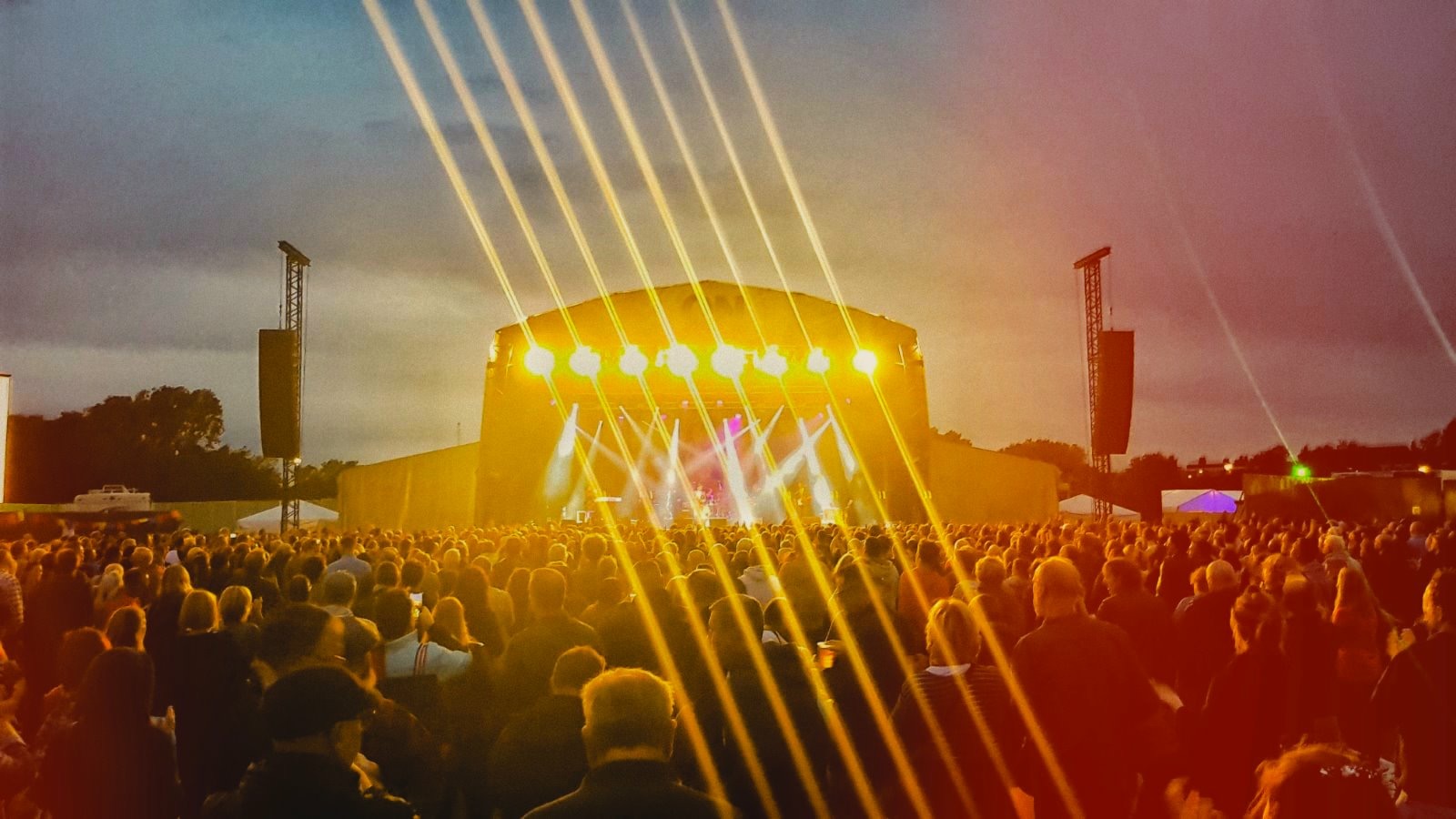
Last weekend, however, I caved in to festival fear to attend OnBlackheath, a two-day, does-what-it-says-on-the tin event in south-east London, and absolutely tremendous event it was, too. I was chiefly drawn by headliners Squeeze, playing literally on their home turf, but also The Divine Comedy, Paloma Faith and the prospect of De La Soul whipping up this profoundly white and middle class enclave into a frenzy of arthritic good times. Sorry to bring up class, by the way, but despite Danny Baker (who lives a matter of yards across the heath from the festival venue) hosting Day 1, and proudly boasting his lifelong connection to this part of London (Deptford-born, raised and schooled, Blackheath dwelling via Bermondsey), the clientele is decidedly white, middle class and middle aged. You know this by the carafes - carafes!!! - of rosé being consumed, and the number of men with floppy grey hair wearing age-defying T-shirts, who clearly work in the creative industries, pushing high-end child transportation around the field. 

But don't be thinking that I'm being sneery about OnBlackheath being, in 80s parlance, a yuppie affair: a safer, family orientated festival you could not find, even with Baker jokingly dubbing it "Woodstock, SE3". Before you've even heard a note of music, your senses are assaulted by the aromas of Caribbean, Vietnamese and Korean food wafting from craft food vans, while children are well taken care of by the obligatory face painting and glitter concessions. This little green enclave of south-east London spans two stages, with a main arena devoted to the two days' major acts, while a tented second hosts groovy acts, such as the venerable and still brilliant James Taylor Quartet, Dirty Vegas (featuring local boy - schooled in Eltham - Steve Smith) and even Steve Davis - yes, that Steve Davis - doing a DJ set. Throughout the show hours, a disco tent pumps out groovy choons for wine-fuelled mums to dance around their handbags. I kid you not.

But it is to the main stage where the big draws are assembled, and the build up to Squeeze on Day 1 is appropriately filled with a theme of British songwriting at its best, albeit with a contrast. First up is dear old Billy Bragg, the 'Big Nosed Bastard from Barking', as the NME used to call him. Still as agit-prop as he was when I last saw him, over 30 years ago on a Red Wedge bill on the South Bank, his punk-meets-folk is probably a little raw for some of the more refined tastes in this audience, but, given the rancid mess that is, currently, the state of British politics, he is brilliantly and fittingly abrasive. Now, grey of beard, Bragg can afford to make light of his resemblance to Jeremy Corbyn (“except that I’m the one with the fucking guitar,” he quips to an already uncomfortable crowd possibly hearing their first swear of the day).

Picture: OnBlackheath
Next up, The Divine Comedy, and a 12-song set including pleasers like Becoming More Like Alfie, Generation Sex, Something For The Weekend, At The Indie Disco, National Express and Tonight We Fly, as well as the brilliant How Can You Leave Me On My Own from their stunning last album, Foreverland. Neil Hannon remains one of Britain's most unsung musical heroes - I suspect he likes it like that - and the hour his sharp-dressed outfit are on stage for provides a reminder - if it was needed - of just how clever a writer he is. It's still impossible to pigeonhole The Divine Comedy: are they rock? Pop? Vaudeville? Anthony Newley incarnate? I'd simply leave it as "genius".

Somewhere much earlier in the day, Danny Baker smashed the proverbial champagne bottle to launch OnBlackheath by announcing that it would be his pleasure to introduce the very first act - someone he's "known since birth" - and the last act of the day, with whom "I went to school with”. The former is none other than 18-year-old Mancie Baker. Yes, the name is no coincidence: it’s the youngest of his three offspring, and a supremely talented singer-songwriter she is, too, boldly getting a thinly-crowded early audience under way with a set of just her and a blue Fender acoustic, singing compositions written in a bedroom just a short walk from the stage. It’s a family affair, too, as the Clan Baker and assorted family friends and neighbours are out in force to support her. Watch this space: I think she’s going to be huge. 

Fast-forward, then, to the evening's finale, Squeeze. Formed, more or less, 40 years previously on the very heath on which we are assembled, they have an unrelenting charm built on the tremendous canon of songs written by Deptford’s Glenn Tillbrook and Greenwich’s Chris Difford. I saw them last year at the O2 Indigo (part of the O2 Arena, built on the site of the Greenwich gasworks, where Difford’s dad worked as the payroll clerk), and it was as joyful a couple of hours of thoughtful pop-rock as it’s possible to have. Moreover, it underlined what Tillbrook and Difford have contributed to post-punk music. So here, a few miles down the road from the O2, Squeeze recreate the same brilliant selection of memorable classics like Pulling Mussels From The ShellHourglassAnnie Get Your GunLabelled With LoveGoodbye GirlAnother Nail In My HeartTake Me I'm YoursTemptedSlap And TickleIs That Love, and of course, Up The Junction and Cool For Cats, ending with Black Coffee In Bed. Just those 13 songs alone would have constituted an incredible gig in their own right, but with the addition of tracks from their last album - the paean to London that was The Knowledge - Squeeze confirmed that they're not just kings of south-east London but a band that, frankly, should be recognised as national treasures. I'm not exaggerating when I say that Difford and Tillbrook is a songwriting partnership in the same breath as Lennon and McCartney, Donald Fagen and Walter Becker.

Squeeze homecoming
© Simon Poulter 2018
Squeeze are, for me, the weekend's undoubted main attraction, but Day 2 brings plenty of good stuff to warrant a full afternoon and evening's attention, with R&B singer-songwriter JJ Rosa kicking things off on the main stage, and another well connected individual, Leon Tlilbrook strumming the second stage into post-prandial life. 

The first major act of the afternoon are The Lightning Seeds, who storm through Sense, Lucky You, Perfect, The Life Of Riley and Pure, with Ian Broudie thankfully ignoring calls for Three Lions (despite one or two members of the band sporting England shirts). I think we've had enough of that song for one summer, thank you. But with a strict evening curfew to observe, the main stage performances come thick and fast. Next up is Corinne Bailey Rae, the Leeds-born soul star who, you'll remember from her self-titled 2006 breakthrough album and hits such as Like A Star and Put Your Records On, a pile of awards, and then a decidedly low profile in the 12 years since (just two more albums - 2010's The Sea and The Heart Speaks In Whispers in 2016. She is, though, an infectious performer, and her set - which includes the 2006 hits - suggests that there's much more to come, albeit at a pace she seems happy to be fully in charge of.
© Simon Poulter 2018

It may now be almost 30 years since De La Soul first emerged with their still lovable album 3 Feet And Rising, with its hippy-dippy mixture of "hip-hop lite" (their words) and psychedelia, so a seemingly lengthy wait for them to reach the main stage is worth it. Within minutes the trio are getting the audience grooving to songs they probably last moved limbs to at university. Noting the family orientation of OnBlackheath, they vow to keep the set profanity-free, a pledge that lasts for only half their allotted time, much to the amusement of children in the crowd. Their parents appear unoffended, willingly joining in the pantomime fun that divides the audience into competing halves, with Posdnuos, Trugoy and Maseo whipping well to do mums and dads into wild frugging with feelgood performances of Me, Myself And I, Eye Know, The Magic Number and Ring, Ring, Ring.


There appears to be a personal pattern to the 2018 OnBlackheath headliners: I only saw Squeeze last October at the O2, and I was back to the Greenwich dome in March to see the second night's star bill, Paloma Faith. Similarly local (well, Hackney), Faith purveys big, brassy retro soul (not dissimilar, in that regard, to Adele) but delivered with a gusto and at times exhausting amount of chatter. She does like to go on, a fact she happily reminds the audience. She has a lot to say, though, and a lot of it is said on her stunning last album, The Architect, tracks from which form the backbone of her Blackheath set. Her songs and their themes revolve around the human condition - often her own, personal experiences - and she's not afraid to tackle the evils of racism, misogyny, homophobia and sexism in society. 

During one lengthy rant I was reminded of the previous evening's Billy Bragg, and the two share an undimmed conviction that their stage is a platform. That might not be everyone's cup of tea, especially if you're expecting a jolly night out waving your arms in the air, but her vow to spread "epic kindness" in her songs is endearing. She may not have - yet - the lengthy career of Squeeze from which to draw on a vast catalogue of witty, poignant, instantly repeatable pop songs, but this second night's headline act is nonetheless a force majeure, belting out blockbusters like Can’t Rely On You and even The Mamas & The Papas’ Make Your Own Kind Of Music. A momentous finale to a couple of delightful days in one of London's more delightful postcodes.

Monday, 18 June 2018

World Cup fever? I'll put off going to the garden centre for now...

Press Association

Normally, in the run-up to a World Cup, I'd be in the throes of schoolboy giddiness. Wall charts obsessively studied, calendars blocked with every fixture, no matter what time the kick-off, and the sun and fresh air dutifully advised that, for the following few weeks, we'd be spending very little time together. But, until last Friday, the FIFA World Cup 2018 had generated little more than a "whatevs" from me. This was largely due to it being the FIFA World Cup, with all connotations of rum doings and brown envelopes, and secondly, because it was the World Cup in Russia, a country with hardly a great recent record of 'world in motion' inclusiveness.

But, then, Friday night came around and with it Portugal versus Spain (or, what has subsequently been revised to Ronaldo versus Spain), and all seemed to be right in the world. Since then we've seen Iceland hold out for a 1-1 draw with the mighty Argentina, replete with a Lionel Messi penalty miss, the Swiss holding Brazil and, even more stunningly, Mexico beating reigning world champions Germany. For those who couldn't care less about football or the World Cup, these results in just the opening weekend will mean little or matter less. But to some of us, they mean something, and this time, have momentarily obscured whatever it was that bred indifference on the run in.

That, though, is just football nerd talk. Tonight the reason 'most' of us in England watch the World Cup - England - means that working days are cut short, pubs are unusually full for a Monday, London taxis will be displaying the Cross of St. George without too much suggestion of distasteful nationalism, and even those who might otherwise show no interest at all in football, will be tuning in. For a brief moment, England's opening Group G match, against Tunisia, will create excitement, even hope. And an awful lot of cliches. There is some belief that Gareth Southgate, the England manager, is bringing a refreshing approach to the so-called "impossible job"; there is some latent belief that the England team's relative youthfulness will make a difference, not just tonight against Tunisia but all the way through into the knock-out stages. The truth is, we just don't know. No one does. As I often quote Danny Baker, "football is chaos".

With England today, as ever, we have to put prospects into context and balance. Yes, the squad is made up of Premier League players, and many drawn from Top Six teams. That surely counts for something. But our hubris at having a national side based around players from the most lucrative and watched domestic league in the world has led to too many false dawns before. England may well have been where association football began, and may, too, be where we've produced some high quality footballers ever since, but the thing we've never been able to grasp is that other countries have either produced better players, or have produced players that instinctively know how to win things - prettily or less so. Yes, England have suffered from poor refereeing decisions and have been unlucky in penalty shootouts, but those are the breaks. And penalties, whether regarded as a test of skill or not, are still just lotteries.

And, then, there's still 1966. To put England's one and only World Cup win into context, it was 52 years ago, just 21 years after the end of World War 2 (21 years ago to today, Labour won a general election landslide, the Princess of Wales died in a Paris car crash, Oasis released Be Here Now and Elton John was knighted. And these events all seem like yesterday). The point is that, apart from moments of joy in Italy in 1990 and the European Championships of 1996, England have been - like most participants in these competitions - a distinctly average team. Realistically, we've lacked true game changers, like France's Zidane in his day or Portugal's Ronaldo, still today. Yes, England have had and still have big-name, big-wage stars, but their profiles, wage packets and expensive choice of exotic car have rarely matched their delivery on the world stage, the international football pitch. That's not because they're bad players, or they've played for bad managers. They just haven't been as good as their opposition, and in some cases - South Africa in 2010 (including the worst game of football I've ever watched, England's 0-0 draw with Algeria) and that 2-1 defeat to Iceland in France two years ago - absolutely moribund.

But let's reflect a little. England are in this World Cup. Luminaries like Italy and The Netherlands are not. Each time England qualify for a tournament, they have done so on merit and at the cost of other equally worthy contenders. Tonight's opponents, Tunisia, may not exactly be a world beating force, but they qualified out of the African group - no easy task - and, despite not winning a World Cup fixture in 40 years, will be out to frustrate England. Southgate's youngsters will disregard them at their peril. Group G - which includes Belgium and Panama - is not going to be easy, but at risk of trotting out the 'there are no easy games' trope, there are...er...no easy games at the World Cup. Why should there be? True, some teams seem to be more likely to proceed than others, but as this weekend's opening games have proven, there are no rules as to who performs and who performs well.

So, strap in, order the pizza, take the phone off the hook and crack open the first beer. We've been there before, we'll be there again. Enjoy the ride, whether successful or a disappointment. This is still the World Cup, even with the slightly bitter taste of how it ended up being staged in Russia, even with England's history of failure and frustration. Someone has to win, someone had to lose. It wouldn't be football if it was pre-ordained.

Friday, 4 May 2018

Record store daze


Two weeks on from this year’s Record Store Day, Danny Baker may have finally calmed down. His Twitter rant, on the eve of RSD, about record company "vampires" exploiting poor saps like me with limited-edition, available-for-one-day-only pressings of records we probably already own, was particularly fruity. Over several tweets Baker (for almost half a century a voracious record collector himself) frothed with some justification about the Record Store Day "racket" and "this stupid treasure hunt" being "so much less about indy [record] stores than creepy eBay limited editions". And those were some of the milder remarks.

While some of Baker’s eruptions were a tad overblown, he made a good point in that local independent record shops - much like a Christmas present puppy - should be for life, not just one single day. This is an argument supported by Garth Cartwright, who has just written the deliciously insightful Going For A Song: A Chronicle of the UK Record Shop.

"Record Store Day certainly increases turnover for shops and gets them some attention," says Garth, "but the whole RSD 'limited edition vinyl' thing is a scam. You need to be nice to record shops like you are nice to your mother - all year round, not only one day a year!".

Nevertheless, record shops this year reported another day of boffo business, with some doing as much turnover on that day's trading than in the usually moribund entire post-Christmas period. This year’s best sellers, such as David Bowie’s triple-live LP Welcome To The Blackout, helped generate a 16% increase in RSD album sales, with 60,000 LPs sold in the UK as part of the exercise. Rachel Lowe of Brighton’s Vinyl Revolution told the industry trade magazine Music Week that April 21 had been "the best day we've had since opening" and that "the revenue will help our young shop immensely but the publicity and goodwill will last much longer".

Picture: Surrey Comet
Jon Tolley of Banquet Records in Kingston-upon-Thames said that RSD was "hands down our busiest day of the year" and a "great shot in the arm" for the business. He told Kingston’s local newspaper, the Surrey Comet, that Banquet had seen more than 1,000 people queuing up, some since 6.30am the previous morning. "Our business year revolves around Record Store Day, which really lasts at least a fortnight," he said. "It’s a great time to not only celebrate physical music but also the weird and wonderful independent shops who sell it."

Such "weird and wonderful" shops provide a strong component of Garth Cartwright’s book, for which the New Zealand-born author travelled the UK, talking to shop owners, record collectors and even musicians to map both the national history of record shops as well as the state of play today. Going For A Song builds a fascinating picture of record buying culture that transcends the traditional tropes of musty shops staffed by cocky cynics like Jack Black's High Fidelity character, as well as some of the characters who made record shops cathedrals of their worlds - famous patrons such as Bowie and Elton John, and former employees like Dead Or Alive's Pete Burns, Dusty Springfield and, of course, the aforementioned Baker. Some shops, such as Dobells in London's Charing Cross Road, played an integral part in the evolution of Britain's post-war musical habits as a mecca for jazz, blues and folk records, while Liverpool's NEMS department store - whose record section was managed by Brian Epstein - became key to The Beatles' own story, and was, by the 1960s, the most successful record shop outside of London.

Garth Cartwright

Incredibly, though Ground Zero for the British Record Shop was neither in London or in the rock and pop era: it was Cardiff. "Cardiff is home to Spiller’s, the world’s oldest record shop," reveals Garth. "It was founded in 1894 to sell wax cylinders (amongst other electrical goods) and developed its focus on only selling records in the 1920s - and continues doing so today. Why is sleepy Cardiff home to such a historic shop? Because in the late 19th Century it was a booming port and much of the coal trade came through here - a boom town - which meant there were people with lots of money around. And people with money tend to buy new technology. Wax cylinders and wax cylinder players weren’t cheap when they came on the market."

It's long been believed that, as word reached these shores in the 1950s of rock'n'roll, Elvis and the blues, cities with strong maritime links became gateways for imported American music. Garth says there's a little bit of myth to this theory: "Liverpool, another booming port city, and Manchester, a massive industrial city, became home to important record shops," he says, "but I actually don’t think the transatlantic liners provided so many records. What I’ve learnt is that the UK has long been obsessed with American music - minstrels were popular here in the 19th Century and there was a banjo craze at the start of the 20th. Then jazz exploded across the UK, post-World War One, and record labels - both majors and indies - were releasing some jazz, blues and country '78s from then on."

Garth notes that the record industry in the 1960s was (and still is) profoundly London-centric. From a record shop point of view, however, London is only a bit-part player in the story. "Brian Epstein could not get The Beatles a record deal as the London-centric labels were absolutely contemptuous of music from outside 'the Smoke'. That he did came through him being such a good client of HMV, with NEMS selling large amounts of [their] records."

Regional shops became intertwined with their local music culture. "There were regional music scenes, like Merseybeat, across the UK and all reliant on their local record shops," Garth says. "There was no Radio 1 until 1967, so the record shop was where you went to hear new music. The Beatles used to colonise NEMS’ listening booths! The Diskery in Birmingham - still trading today! - was a big place for the early Northern Soul DJs. Selectadisc in Nottingham too. Not that these shops were specialist soul shops - they sold everything but ensure they got R&B 45s for the local mod scene."

Specialist music shops, however, continue to be resilient in the UK music scene, albeit in proportionally smaller numbers than mainstream outlets. "There remain a handful of 'ethnic' record shops that continue to sell music related to their communities," says Garth. "Southall - which once was home to great Indian record shops - now has the Afghan Music Centre. At the bottom of Brick Lane there’s Sangeeta Ltd which still stocks CDs and cassettes from Muslim artists in Pakistan, India and Bangladesh. Melodi Muzik in Green Lanes is a Turkish shop that focuses on Turkish music and musical instruments and football paraphernalia. Supertone in Acre Lane, Brixton, is an old school reggae shop that also stocks what the owner calls 'big people music', i.e. old R&B, Elvis and Jim Reeves LPs that older West Indians love. In Brighton there’s The Record Album, a vinyl-only shop established in 1948 and run since 1960 by George Ginn - he specialises in soundtracks and showtune albums. George is a lovely man and has a very eclectic stock in the sense of stocking some really weird albums - John Wayne’s one spoken word album! Fabulous!".

The depth and scale of Garth's research for the book is impressive, as is his clear enthusiasm for the characters and stories he encountered along the way. But the book does also reflect the clearly changing landscape: "I landed [in the UK] in 1991 and record shops then were everywhere - from megastores run by Virgin, HMV and Tower Records, to junk chains on the high street like Our Price and basement dance shops selling techno 12"s and beyond. Today very little of that remains: I miss places like Mole Jazz and Beano’s - Europe’s largest second-hand record shop in Croydon. The Tower Records in Piccadilly had really deep stock."

Greenwich's finest - Casbah Records on Record Store Day

© Simon Poulter 2018

Today, says Garth, there are still plenty of good independents on offer with, even, new players opening up: "After the crash of the CD and the megastores, and the high street Top 40 chains, people have retrenched and decided that they like buying vinyl and going to good independent stores. Eel Pie Records [in Twickenham] is a great example of a new shop that has a musical vision - Phil and Kevin love music and have worked in the industry for years so they’ve gone about opening a record shop that reflects their passion and knowledge. They’re not attempting to compete with the supermarkets. Instead, they’re championing fresh, independent music. This is the way forward."

"There’s lots of good shops," he adds, from the specialists I mentioned before through to longstanding outlets like Reckless Records, Sound Of The Universe, Honest Jon’s, Soul Brother and new places like If Music in Soho and Lorenzo’s Record Shack in Peckham." Garth, who lives in south-east London, regularly visits Camberwell's Rat Records as well as my own local emporium, the very brilliant Casbah Records in Greenwich (dangerously located just 600 yards from my front door...).

While the record shop landscape has changed, as chains like Tower Records, Virgin Megastore and Our Price have vanished from high streets over the last couple of decades, the business is still relatively vibrant. Margins might be thin and rents might be high, and while we shouldn't get too carried away by the so-called vinyl "boom", shops like Casbah remain the knowledgeable, if slightly intimidating experiences they've always been. Garth is somewhat cautious: "I think the club-going, DJ-ing youth are into buying records on vinyl, but most people just want to listen to music on their phones." Times have changed, he says: "Back in the 1950s and '60s most people bought their records in Smiths and Currys, and Mantovani was the most popular album seller in the UK," but adds that there remains a resilient core of consumers - semi-obsessive middle-aged blokes like me as well as Millennials and hipsters - keeping the trade going. "So long as there is a developing community of record shoppers I believe there’s a future for good record shops," he concludes.

---

Garth Cartwright discusses Going For A Song: A Chronicle of the UK Record Shop in the next Word In Your Ear podcast - details of which will be published here. The book is published by The Flood Gallery and can be ordered via their website.

Saturday, 21 April 2018

Gone in 60 seconds - Record Store Day comes...and goes

© Simon Poulter 2018

There is something clearly perverse about standing in a queue at seven in the morning for a shop that doesn’t open until 10am, purely to get your hands on some plastic that, probably exists in some other form or another. Actually, let me correct that statement: there is something clearly perverse about sitting on a pavement still stinking of unidentified Friday night detritus, queuing for a shop that doesn’t open for at another two hours at least.

But then buying and owning records is one of those pastimes that teases out the obsessive. Not quite as bad as standing at the end of a Clapham Junction platform all weekend, I grant you, and compared with buying comic books or football stickers, relatively tame. But the return of vinyl record ownership has, I’ll admit, reawoken a certain “fetishism”, to quote a particularly lively Twitter rant the other evening from Danny Baker - arguably Blackheath's leading record collection owner - on the subject of this year’s Record Store Day.

The main source of Baker’s ire was his belief that artists and their labels use RSD cynically to lure in punters to buy limited edition, available-for-one-day-only, copies of records which then get sold on for profit. “Record Store Day is a racket,” he opened with. “Just press up hundreds of copies for these stores you vampires. What's with this stupid treasure hunt? Its [sic] so much less about indy stores than creepy eBay limited editions. Fuck off Record Store Day.”

So, at least we know where he stands on the topic. But he went on: “Having a record only pressed up for Record Store Day is like owning one of those commemorative dinner plates offered in the back of Sunday supplements. ‘To honour Lady Diana, this once in a lifetime...’” And, inevitably, Baker was not done there: “Hey kids! Does Record Store Day raise your awareness of that little shop around the corner that you'd never seen before?  Or is it for a load of old boys to grab cynically limited, but basically worthless, stock for later profit on eBay?”.

© Simon Poulter 2018
On this last point, he may have something. Most of the individuals ahead and behind me in the queue at Greenwich's excellent Casbah Records this morning were men, well into middle age, and clearly the type who take RSD seriously. Whether they were indeed planning to make a fast buck on eBay, I couldn’t tell and wasn’t that bothered to ask.

Record Store Day may, ultimately, be a marketing gimmick, and even if Baker argues that most of those in the queues are discovering their local music emporium for the very first time, that is largely the point. Independent record shops - the intended beneficiaries of the entire exercise - will make more money on this one day than they do in the traditionally impoverished first three months of the year.

However, while the vinyl revival is going great guns (an £88 million business), with LPs continuing to sell relatively well in the face of other physical and digital formats, the humble record shop is still an endangered species, and for that reason alone, Record Store Day is a great way to show support, although consistent, year-round custom would be even better. So, Danny, call me a fetishist if you want, but I’m more than happy to join in the absurdity of dossing on the pavement for three hours in the hope of landing a Bowie album that inevitably will be on sale later in the year as a CD. Because it is about supporting my local record shop, one I actually visit throughout the year.

Ever since I was a teenager, I’ve spent many a happy Saturday afternoon browsing in record shops and, at the age of 50 - cliche as this might sound - I still do. I still enjoy the discovery of new music, just as I enjoy relistening to familiar music on new formats. Vinyl has given me an excuse to hear anew things I’d previously only heard on cassette, or on early-issue, poorly mastered CD. Record Store Day is part of that curation.

There are those - girlfriends and wives, mostly (emitting disdainful grunts as the front door slams at Stupid O'Clock) - who will think of us as suckers, victims of a gimmick designed to entrap the weak-willed desperate to own some obscure reissue purely because it's a) now on coloured vinyl and b) because it will give them an air of Nick Hornbyesque cultural superiority (may I hear quote John Cusack's Rob Gordon, proprietor of Championship Vinyl in the film adaption of High Fidelity: "I get by because of the people who make a special effort to shop here - mostly young men - who spend all their time looking for deleted Smiths singles and original, not rereleased - underlined - Frank Zappa albums. Fetish properties are not unlike porn. I'd feel guilty taking their money, if I wasn't... well... kinda one of them."). These are experiences you don’t get from Spotify.

Record Store Day is a glorious celebration of the absurdity of record buying. The exclusive releases are hardly rare Picassos at Sotheby’s, but that’s not why they’re bought. In fact I'm not entirely sure why they’re bought but, speaking from trouser-emptying experience, there is a distinct, momentary pleasure about buying something unique, taking it home and - yes, here comes the 'tactile vinyl experience trope' - desleeving that new purchase to stick it on the turntable in order to find out what all the fuss was about.

© Simon Poulter 2018

If you do it right, you’ll walk into your local emporium armed with a carefully compiled list in the hope that at least some of it has been stocked (RSD is a tricky business for record shop proprietors, who have to take a punt on what will sell on the day out from the 500 artists releasing albums and singles as part of the programme). Inevitably that means some disappointment, but if you’re prepared to be in that queue early, and have organised your wishlist, you'll usually come away happy. And broke.

Like Christmas Dinner, it’s over in a matter minutes after a lengthy build up. And worth it. This year I walked out of Casbah Records with pretty much what was on my shopping list - including a reissue of Prince's 1999, Bowie's Welcome To The Blackout (Live London 1978), The Who's Kids Are Alright soundtrack and Steven Wilson's RSD exclusive 12" single How Big The Space. A tidy haul. Was any of it essential? No, but again, that wasn't the point. And if you don't understand that, you probably never will.

© Simon Poulter 2018

Sunday, 28 January 2018

View from the VAR side


"It's hard to know where to start," said West Bromwich Albion manager Alan Pardew last night, as he was asked about the impact the Video Assistant Referee had on his FA Cup Fourth Round win over Liverpool. And he wasn't about to be positive, either. "I don't think that is what we want to see going forward, whether you are a Liverpool or West Brom fan."

VAR is only a matter of weeks old in English football, and - as with anything new and slightly clunky - is taking time to accept. We've moaned long enough about the need for video technology and when it finally comes in we moan some more. In last night's cup tie, referee Craig Pawson referred to VAR and the eyes of virtual referee Andre Marriner (in a box somewhere in London) a total of eight times. Three incidents reviewed via the system proved to be key the game's outcome - including a disallowed West Brom strike, Liverpool winning a penalty, and a contested Baggies goal being allowed to stand.

In its match report, the London Evening Standard talked about VAR being used "...during an action-packed first half". The problem is, VAR slows down that action completely. Craig Dawson's goal took more than a minute to be judged offside via VAR. "Firstly, there is no communication from the referee to us," Pardew complained, adding that the bigger issue was the four minutes it took to judge the Liverpool penalty claim after Mo Salah went down in the Albion box in the 23rd minute. "You are going from high-tempo workrate to nothing," said Pardew. "We had a hastring [injury] just after that." (i.e. "Just sayin'").

It's something I noticed at Stamford Bridge two weeks ago when Chelsea played Arsenal in the Carabao Cup. VAR reviews of, first, César Azpilicueta and Calum Chambers' coming together, then a challenge on Cesc Fàbregas, and again when Victor Moses appeared to foul Alex Iwobi in the penalty area, seemed to take forever for referee Martin Atkinson to resolve. If the managers didn't know what was going on, the players on the pitch certainly didn't and nor did we up in the stand, bored by the tedious 0-0 stalemate unfolding. From a television point of view, it was the sort of pause broadcasters hate - dead air, effectively - as Atkinson repeatedly held his finger to his ear like Chris Morris's spoof newsreader in The Day Today.

For us paying fans, we could easily fill the downtime by posting facetious tweets, but for the players at risk of hamstrings cooling down, it must have felt like eternity. It is, of course, only sensible to assume that VAR simply needs more time to get used to. We've needed video technology for too long now, and now it's here we should embrace it. Jurgen Klopp, the defeated Liverpool manager last night, was certainly more stoic than Pardew: "Normally after a game I have to explain to you a defeat which was not deserved because we din't get a penalty or they scored another goal. Is it cool in January to have delays when it's cold, especially for the players? Maybe not, but it will become smoother and more fluent in the future."

Definitely not impressed was broadcaster Danny Baker, who launched into one of his periodic football rants (and of a veracity not seen since he laid into a combination of England's shameful 2016 European Championship game against Iceland, and Glenn Hoddle's commentary of it). Of the more repeatable tweets, "VAR is sucking all the life out of what was a pulsating cup tie. Literally draining the atmosphere. So, we may have a correct game by computer but dull match in flesh and blood. Absolutely awful. yet this terrible thing will be rolled out" and "What numbs a crowd is the idea that now THEY aren't the people at the event, they are just watching something that is being judged and relayed from some remote office. Supporters are now just extras at their own event. VAR MUST BE ABANDONED."

I have a suspicion that this will run. And run...

Thursday, 5 January 2017

If you get it wrong you'll get it right next time

Picture: Getty Images

I start the year on a negative note. Now, I accept that after all the merde that passed our way in 2016, commencing 2017 with the triviality of a lost football match doesn't seem all that bad, and truly it isn't. But, like most Chelsea fans, I would sincerely hope, last night's defeat to Spurs will stick in the craw for a long time. Why? Because it simply should. This is Tottenham we're talking about, after all.

Why one team should be considered the one to beat over any other with whom you've had history - and Arsenal, Liverpool and Manchester United come immediately to mind - is not immediately clear, and is really just a symptom of the irrationality that is football fandom. Every opponent should be the one to beat, which is surely the logical objective of the game. But like Jerry Seinfeld and his postman neighbour Newman, Chelsea fans have a simmering dislike of Tottenham, going back to who-knows-when, and for no reason whatsoever other than Spurs are simply a rival worthy of our dislike.

But let's not get caught up in all that. Tottenham are, so far this season, looking more resilient, more potent and more disciplined than the side that collapsed in the final stages of last season. That contemptuous draw at Stamford Bridge on May 2 marked not only the end of Spurs' serious challenge to Leicester City for the league title, but also the inexplicable moment that Eden Hazard finally switched on the Eden Hazard we once knew, and had been absent without leave since the beginning of the season. Luckily for Chelsea, that Hazard is still with them. 

Just not last night. First off the bat, Chelsea weren't bad. Spurs' 2-0 win may have ended Chelsea's remarkable 13-match unbeaten run, but that may have been almost inevitable. Yes, perhaps if things had gone differently last night, and César Azpilicueta and Victor Moses had not missed their marked man not once but twice and in identical circumstances, the game might have had a different outcome. But let's not ignore the fact that Tottenham were the better composed side last night. Their MO wasn't that dissimilar to the start they made in May and indeed the way they took the lead at Stamford Bridge in November. In Dele Alli, Tottenham have a true gem, and in Wanyama they had a solid object in midfield to disrupt Chelsea's counter-attacking play. And, perhaps, if Diego Costa had been a little sharper, or if Pedro had run into the space that caused the visible ire between him and Costa, or Hazard himself had been more accurate when he had a shooting chance, then Chelsea may have extended the record to 14 unbeaten.

But it wasn't to be. As Gary Cahill, eloquent in his post-match interviews, said, "we are not robots". An important point. In the previous 13 games Chelsea had been imperious, whether winning emphatically over Manchester United and Everton, or grinding out more modest victories over West Brom, Sunderland and Crystal Palace. It became too easy to think that Antonio Conte had simply found the switch to turn this form on after those early season disasters against Liverpool and Arsenal, the latter of which prompting his change to the 3-4-3 formation that unlocked the success that followed.

This morning Chelsea are still top of the league and five points clear. Last night's defeat may have opened things up a little for the chasing pack, but the Premier League is still in Chelsea's hands if they want it. For us fans, we'll deal with wounded pride (which is, frankly, the biggest casualty). Conte's men will want to reflect, as they watch the video replay at Cobham today, on why they were unable to find the gears to really counter Tottenham and repeat that life-affirming reversal in May. Conte himself - a breath of fresh air at Chelsea following the rank negativity of Mourinho - will want to look at whether he put Cesc Fàbregas on too late to make a difference (his link-up play with Costa was evident from the moment he came on) and whether he should have replaced N'Golo Kanté earlier when it was obvious that his passing and positioning had been uncharacteristically off-kilter.

Football, as I've often quoted Danny Baker, "is chaos". There is no logic to it, no rhyme or reason. Chelsea can start a season poorly, then go on a record-seeking run, and then end it with an off night. That's why we love the game, warts and all. No team is infallible, just as there is no such thing as a perfect 10. Sometimes irresistible forces encounter immovable objects, and they tussle until one is the victor. That wasn't exactly the case last night. Chelsea weren't bad, it's just that Tottenham were better. 

The job now for Antonio Conte is to pick his players up. They won't have lost their mojo in a single, tough encounter (though the mystery is still unsolved as to how this same team lost it in the weeks between winning the league and restarting their campaign a season ago) but they will need to think about what didn't go right for them against one of the toughest opponents they will face this season, and build on it. There's the matter of an FA Cup 3rd Round tie against Peterborough on Sunday to think about - and think hard about (their 2015 4th Round exit to Bradford City should still be fresh in their memories...), followed by the resumption of Premier League hostilities that will see Chelsea play Liverpool (away) and Arsenal (home) in the space of five days at the end of this month. And we are only at the half-way stage of the season, anyway. 

Mental discipline and mindset were the reasons Chelsea fared so poorly last season. Antonio Conte has reversed that. There is confidence oozing through the side. Last night was an aberration. This morning, as the players file into the meeting room at the Cobham training ground, my hope is that someone on the staff is a fan of the late Scottish folk-rocker Gerry Rafferty, and as a musical pick-me-up, plays them his 1979 it Get It Right Next Time. Because if you get it wrong...