Tuesday, 30 August 2022

Travel won’t broaden your bank balance but it will broaden your mind

© Simon Poulter 2022

The man standing opposite me on the 7.55 to Waterloo is demonstrating why we need holidays. In fact, he is demonstrating it every 10 seconds, obsessively checking his phone’s lock screen to see if anything has been added to it. Despite it being August, the train is nose-to-nose packed, so it is impossible for me not to see his phone, but it’s clear that despite his feverish thumbing of the device, nothing new is appearing. If ever there was someone in need of a digital detox, this man is it.

I, on the other hand, am remarkably sanguine. It’s hot already, on a day likely to exceed 30 degrees, but my wife and I have just returned from 12 glorious nights abroad for our honeymoon. Since you asked, we travelled to Vancouver for a city break, before taking the incredible Rocky Mountaineer train to Banff, and then flying to Southern California for the final few days to do absolutely nothing beside a pool. And, not to sound even more smug than I do already, it was glorious.

Like everyone else, not having had a foreign holiday for three years, we’d given thought to our honeymoon probably long before thinking about our wedding. Vancouver appealed to both of us, especially as somewhere neither of us had been to before. When we then discovered that the Rocky Mountaineer departed from Vancouver, and took a leisurely two days to get up and amongst some of the most incredible scenery on Earth, we were sold. Being a little greedy, we also fancied a more traditional ‘beach’ component. The trouble is that getting from Banff to anywhere in the upper parallels of North America with a “proper” beach - for example, New England or the New York Hamptons - would require a day’s worth of travel. That’s when we discovered that Southern California could be reached in three hours by plane from Calgary, meaning that we could be at least poolside by mid-afternoon.
© Simon Poulter 2022

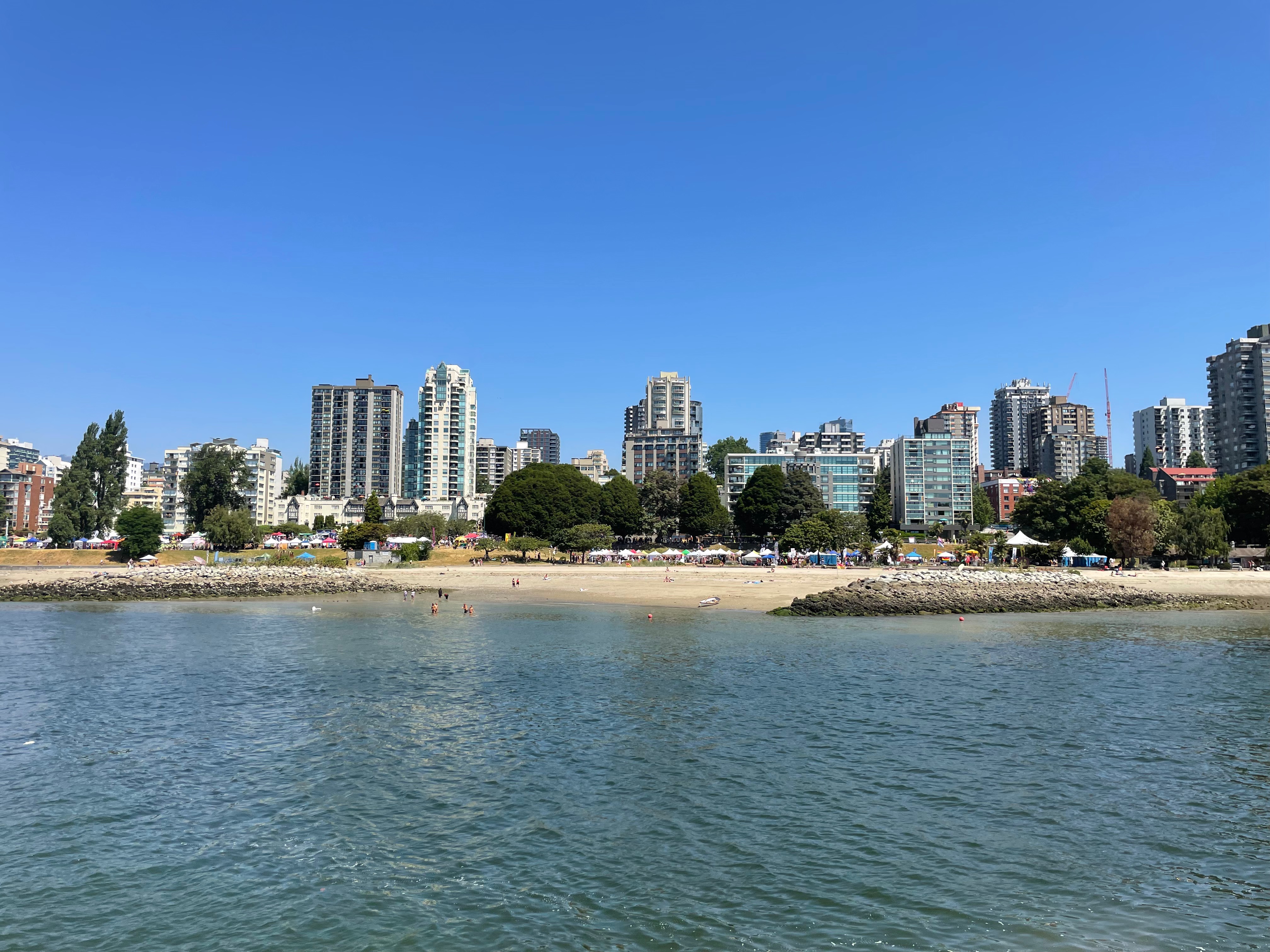
Vancouver’s appeal was that it came across as a very agreeable city, and so it proved. For a town only incorporated in the mid-19th century, flourishing as a key seaport and endpoint of the Canadian Pacific Railroad, it retains a newness, largely the result of urban regeneration that means that the most visible part of the city is dominated by the glass and steel of modern tower blocks lining miles of waterside pathways that curl in and out of apparently upmarket residential districts that appear to house much of the city’s 662,000-strong population. 10 million tourists visit Vancouver every year, and it continues to be the fastest-growing metropolis in Canada.

It’s not hard to see why: Vancouver projects itself as open and notably diverse, culturally, ethnically and socially, presenting a relatively young and progressive city. Its neighbourhoods bustle with the aspirational and the contented, roller-blading, scooting and cycling the city’s seemingly endless bike lane that hugs the waterside edge of this architecturally sharp port city. 

Vancouver was named the world’s second-best city in the Daily Telegraph’s Travel Awards a couple of years ago, only losing out to Cape Town. Colonial, New World conurbations clearly do well. But it’s not just tourists who like Vancouver: it regularly comes out high in lists of the most ‘liveable’ cities, with things like personal safety, healthcare, education, infrastructure and the environment being taken into account. Not that local endorsement is universal. Like so many North American coastal cities, Vancouver also has a homeless problem which, while nowhere near as bad as San Francisco’s, is deep in the consciousness of many residents. Locals also complain bitterly about the Vancouver’s traffic, but we found it to be free flowing (they clearly have never been to London’s car and delivery van-choked streets...).

© Simon Poulter 2022

Perhaps that’s why, with so many of Vancouver’s attractions adjacent to water, a network of water taxis is a convenient and highly relaxing method of getting about. From our hotel - the delightfully funky Opus in hip Yaletown - we were able to paddle up and down False Creek, with its spectacular view of the gleaming apartment buildings that line the waterways, framed by the looming mountains to the north of the city. The False Creek boats service destinations such as the huge BC Place sports and entertainment arena, and Granville Island, with its funky indoor market selling everything from artisan cheese to freshly caught fish. 

Travel further by ‘aquabus’ and you can explore the trendy neighbourhood of Kitsilano, with its upscale homes and a lively downtown shopping area, or to Stanley Park with its collection of First Nation totem poles the vast University of British Columbia campus, with its associate student-friendly neighbourhoods.What amounts to ‘downtown’ Vancouver, on the other hand, is harder to define. West of the city’s waterfront is Gastown, a district stretching alongside one of Vancouver’s transcontinental railway lines, and similar in vibe to New York’s SoHo, with its independent clothing shops, designer chains, restaurants, pubs and a vast vinyl record shop that I wholeheartedly approve of. Despite its apparent age, Gastown isn’t all that meets the historic eye: it’s main attraction, a steam clock that whistles the chimes of Big Ben every quarter hour, was installed as long ago as…er…1977.

Depending on your budget, there are some bigger ticket tourist attractions to eat up the credit card. A huge fleet of seaplanes take off every few minutes from the waterfront, carrying tourists out over the city and even further afield, depending on how long you want to be up in the air and how much you’re prepared to pay for it. 

For us, though, the possibility of seeing whales out in the Georgia Strait, that runs between Vancouver and Vancouver Island, looked like an excellent way to spend half a day. And so it was - five relaxing hours out on the water, catching sight of seals, a pack of sea lions ligging about on a navigation buoy, and even a bald eagle perched atop a tree. Whale sightings were “90% guaranteed”, so we were starting to get a little disappointed when, during Hour 4, we’d not seen so much as a ripple on the water. But, then, sudden excitement. A black dorsal fin, followed by the distinctive spinal arching of a humpback. And then again, and again, sometimes with longer intervals between appearances as she dove deeper after taking in great lungfuls of breath. 

Picture: @princeofwhaleswhalewatching

Finally we were rewarded with a full breach, as her barnacled head emerged from the sea like a submarine surfacing. Her name was Divot (marine biologists have identified them all by their unique tail fin markings) and she’d travelled up from Hawaii to give birth in the Pacific North-West. We learned that she was part of a remarkable re-population of Pacific humpbacks generating a ring binder’s-worth of tail fin pictures of hundreds of the animals, including one called Big Mama, whose annual returns to the area to give birth to the one calf a year they carry had played a huge part in the revival of an entire species that had been hunted almost to extinction.

How do you beat that? You don’t, really, but as experiences go, the Rocky Mountaineer comes pretty close. The luxury train service snakes its way up to breathtaking at-altitude destinations in the Canadian Rockies such as Banff, Jasper and Lake Louise, taking its time (its average speed is just 30mph) to let you take it all in. There’s a choice of packages, with two levels of service and the possibility to travel up to Jasper. Our preference was a two-day journey to Banff, the winter sport resort that, each June, plays host to the international television industry. That fact alone made it seem a good choice - if it’s good enough for expense account-funded TV executives, its going to be good enough for Mrs. P and myself. 

© Simon Poulter 2022

To get there we chose the ‘Gold Leaf’ package, which gave us very comfortable seats in a carriage with giant windows and a semi-transparent moon roof out of which to gawp at God’s work as we progressed at a glacial pace north-east. The idea is that you sit still and just watch the ever-changing countryside, occasionally being interrupted by a drink and a snack served at your seat, a visit to the open viewing platform in each carriage to get a little closer to nature or, a couple of times a day, downstairs to the dining car (it’s the lower half of the double-deck Gold Leaf carriages) for gourmet food. 

Mobile reception for most of the journey is either non-existent or viciously expensive if you’re roaming, so it’s easy to switch off and admire the alpine pastures that become high desert, the vast forest-clad mountains and the seven dramatic rivers that course alongside the majority of the line’s route. If you’re lucky you might catch sight of the wildlife teaming in this part of Canada. Some passengers have seen bears, but the most we saw was another bald eagle in a tree and a confused group of caribou wandering the streets on the outskirts of Banff. Camera buffs will end up with more pictures than they’ll ever need, as the awe-inspiring sights sail past. At some point, the train passes the Continental Divide, marked only by the sudden realisation that the seventh and final river is flowing in the opposite direction to the other six.

It is an overwhelmingly relaxing experience, but also supremely well organised. Your luggage is collected in Vancouver and transported by road to your final destination, briefly reuniting with you in Kamloops, the somewhat nondescript town where you make an overnight stop on the first day. Your hotel room key is handed to you while still sitting in your seat on the train, and your bags are waiting for you in the hotel room. The bus transporting you to the hotel is parked up in front of the steps to your carriage - Bus 13 for Carriage 13. It’s a well-oiled machine. If there was one anxiety, it was being forced to talk to strangers at meal times on the train, though much like an extended speed dating encounter, the conversations are convivial and reveal the same reasons why everyone else is taking the same journey. Over two days, and four meals, we only had to sit with three other couples, fate intervening and giving us a pass on the final lunch in the dining car (there are also plenty of drinks and snacks served at your seat).

© Simon Poulter 2022
The gentle pace of a vast train comprising 41 carriages, pulled by two or even three locomotives, plus the lack of Internet coverage forces you to appreciate the view. At times, the journey grinds to a complete stop, as the Mountaineer waits for mile-long freight trains to pass in the opposite direction (one, my wife counted, contained 140 units). But whereas such a 45-minute delay on that 7.55 to Waterloo would result in a Twitter meltdown, it’s just part and parcel of this experience. as you ride to ever-higher elevations. 

At one point the vast train performs a remarkable change of direction through a right-angled tunnel that seemingly corkscrews up and through a mountain, with the front of the train emerging as the last carriage is still entering. A remarkable piece of human engineering - one of many which built the Canadian Pacific Railway from east to west between 1881 and 1885, with hundreds of European and Chinese immigrant navvies earning just a dollar a day...and often paying with their lives (an estimated 800 Chinese labourers died constructing the line).

Reaching Banff, and travelling across and out of British Columbia and into the province of Alberta, we encountered a lively town teaming with summer tourists. Out of the ski season, its main tourist attraction is the gondola that ascends the near-8,000ft Sulphur Mountain. At the top a four-storey visitor centre offers more views of the breathtaking local peaks and valleys, as well as a couple of restaurants, one of which provides an all-you-can-eat buffet for just C$34 each and all the Rocky Mountain views you can handle. For hardier types, there is even a bar on the open top floor, from which you can grab a beer and shiver under a blanket, looking out over the incredible scenery thousands of feet below.

Vancouver and the Rockies are definitely bucket list-ticking destinations, but that won’t stop us going back. Over the course of a week it felt like a rich and glorious tasting menu for what Canada has to offer. Given that the country itself covers a greater land mass than its southern neighbour, I would certainly look forward to seeing more of it (a Channel 4 travel series presented by Griff Rhys Jones is currently whetting the appetite for a nation and its people that deserves more attention). I’ve never been on a honeymoon before, but as holidays go, this was superbly relaxing, due in part to where we went and the experiences. 

That even extended to our departure for California: though we had to have a brutal, Rude O’Clock 4.30am pickup from our Banff hotel to get to Calgary Airport to check-in for a 9.50am flight to Los Angeles, the airport experience was just as relaxed as the previous few days had been. The check-in area was deserted, security screening a breeze, and then the best part - clearing US immigration while still in Calgary, thus sparing us the often nightmare queues at LAX when large flights from Asia and Europe land at the same time and overwhelm the system.

The three-hour flight to LA, and then the 40-minute drive down the 405 freeway to Huntington Beach in Orange County meant that our brilliant planning worked out perfectly, and we were sitting in the sun, eating lunch with a view of the ocean by early afternoon.

We spent the final four nights of our honeymoon in the lap of luxury. I won’t lie, it came at a price: such is the dismal exchange rate between the pound and the US dollar that every meal and even poolside softdrinks that, a few years before would have cost half the price, required an eye-watering use of the flexible friend, especially once you added 8% sales tax and a 20% tip (even branches of that corporate behemoth Starbucks had a tip jar, not that employees working from 4am for, presumably, minimum wage don’t deserve customer gratuities).

© Simon Poulter 2022

But what cost the memories - the glorious sunsets, the poster paint-blue skies, the palm trees and all the things about SoCal that I’ve been enjoying over almost 30 years of visiting there. There’s so much of the state that I’ve experienced over those three decades that it never fails to draw a grin. 

Cruising up PCH to Malibu for coffee on our final morning is something else I’ve done plenty of times. And it never gets old. For a culture nerd like me, growing up on California-filmed TV shows, driving on roads that have appeared in episodes of Columbo or CHiPs, or popping into the branch of Ralphs where very real Hollywood stars get papped while out doing their weekly shopping never fails to amuse. That the reality cheesiest that is Selling Sunset has now spawned an Orange County spinoff means we can gawp at the actual prices of the incredible beachfront properties we saw up close in places like Laguna Beach. It all adds up to being immersed in your own virtual reality experience - except the sights and sounds of California are all very real.

Spending a few days in this gilded paradise was just the finale to our honeymoon we wanted. Forget the expense and just soak it all up. Those sunsets aren’t just the selling point of ridiculous estate agents. They’re a potent symbol of the dreams and aspirations associated with reaching the ‘left coast’, even if you know that soon you’ll have to get on board that big ol’ jetliner and leave dreamland behind to return to reality.

This, then, wasn’t just our honeymoon. It was the trip we needed. The previous time we’d gone anywhere for fun was a weekend in Palma in the autumn of 2019. So much has happened since then, not least a global pandemic. When we walked into a Guildford travel agency last December we were still in the process of planning our April wedding. A honeymoon at the end of July seemed even further off, but from the moment we dropped cash on the deposit, it was the desirable end of a long road that only included the wedding itself. Canada excelled itself - we will be back! - and no doubt California too. As lifelong memories go, these 12 days and its three distinct components - city break, train ride through breathtaking scenery, poolside decompression - will remain with us forever.


Tuesday, 23 August 2022

Superheroes don't all wear capes

Picture: Kingston Hospital

Some 16 months ago I was in a room a few minutes’ walk away from the one in which I’m writing this, ruminating on the amazing “pit crew”, as I called them, working on my necrotic foot. That was my first in-patient stay in a hospital for almost 30 years (the only previous occasion being for a relatively cosmetic procedure). But framed in the context of the politics of the NHS, and the-then rampant pandemic in April last year, I wrote of my singular, emboldened appreciation of the healthcare profession and all who work within it (Postcard from the cuckoo’s nest).

Today, however, I’m in our local A&E department for a different reason: the treatment of my 92-year-old mother after she had a fall at home. This is the same A&E unit I came to with my diseased foot, thinking at the time that I’d just be given a bandage and some antibiotics and sent on my way. In the end, I remained at this hospital for three and a half weeks. On this occasion, my mother is propped up on a bed in a bay directly opposite the one I was assessed in, prior to being admitted for that lengthy stay. That, too, was a Saturday lunchtime. 

As we sit there, waiting for something to happen, someone to come by and do something else, my admiration for all those working in this environment continues undimmed. This is, though, supposed to be the crucible, the epicentre of crisis. Every day our newspapers scream of meltdowns in the health service, of dysfunction and inefficiency throughout. And while that may be true elsewhere, my mum was ambulanced to hospital within an hour of her carer calling 999.

While A&E processes and procedures take time, as nurses and nursing assistants comprehensively evaluate my mother, taking blood samples and blood pressure readings, and occasionally carting her off for a CT scan, things are reassuringly relaxed. For now. On the basis of the prevailing media depiction of our hospitals, you’d expect to encounter a scene akin to the Do-Lung Bridge in Apocalypse Now!. Instead, the staff are calm and supremely professional. There is some noise - you’d expect the occasional scream in an emergency department - but there is mostly a low-level hubbub as staff go about their duties. In the middle of the large room with 15 treatment bays is a central IT hub, where junior doctors and other staff clack away at computer keyboards, analysing test results, X-rays and medical records, all part of the ultra-digitised health service. It all looks so joined up, but the reality - I speak from experience - is that while some parts are connected, others need a kick (for the post-hospital treatment of my foot, I had to join the dots myself between my GP, the hospital outpatient team and the local podiatry function).

Occasionally, the hubub is raised a tad by a patient call button being pressed in another part of A&E, resulting in a dull beep that, too, gets tuned out along with all the rest of the background noise. This being a Saturday afternoon, the unit doesn’t appear overwhelmed, but there are plenty of customers: - gardening accidents, a couple of people with clear symptoms of dementia, and so on. In an adjacent bay to my mother’s, a police officer stands watch over a young man, not giving anything away as to whether the patient is a victim or a perpetrator of some Friday night criminality. At various points in the day, the one constable will be joined by three colleagues. Their two police cars are parked outside. At a time where the political mood is intensifying on getting police back out on the street to prevent or solve crimes, the sight of four officers and two patrol vehicles tied up for most of a Saturday both suggests the seriousness of the situation, and also reminds you of how resource-stretched the Met is.

Moreover, the longer we sit here - my wife and I watching our phone batteries ebb away (until we discover the ability to rent a Joos charger for £3 - ker- and, indeed, -ching) - the more you start to see our NHS under pressure. The ambulances are coming in thick and fast as Saturday afternoon gives way to Saturday evening. A second set of police officers appear, looking after another admission.

At the time of writing we’ve now been here ten hours. Somewhere between 7pm and 8pm there appeared to be a change of shifts. As one nurse hands over to another, staffing becomes thinner. A new pair of nurses take over the entire ‘Majors’ area (one of three - the others being ‘Resuss’ and a dedicated A&E unit for children), requiring us to tell my mother’s story all over again. By now, two doctors have seen her, and then the senior duty consultant , who thankfully concludes that she won’t need to be kept in overnight, and that her fall was most likely caused by her getting out of bed too quickly. ‘More haste, less speed’, was a mantra my dad drilled into me. I don’t think my mother was listening.

So the good news is that we should be taking Mum home, but there are still more repeat tests to perform to satisfy someone that she’s OK to do so. To be honest, we’re not sure why, and nor do the evening nurses. At some point we note to them that, apart from a couple of biscuits with a cup of tea, and some of the contents of the picnic we’d been planning to take to a seaside airshow when we got the call to come back to south-west London, she hasn’t actually eaten anything substantial all day. This is eventually rectified by a microwaved roast dinner rustled up for her. We make do with coffee from the last service of the day from the on-site branch of Costa.

And so, as hour gives way to hour, the crosswords from the newspaper my mother had with her completed or dispensed with out of boredom, our phones restored with yet another expensive battery rental, we’re all beginning to stare into space. Mum’s discharge seems no closer. No one seems to say why. It takes a firm conversation with one of the nurses to get some clarity, eventually.

Here, then, is a summer Saturday night in a major A&E department. The central hub is now down to a couple of duty junior doctors, with just the two nurses, despite all the visible bays still containing the patients who’ve gradually come in throughout the day. The nursing assistants - those vital components of hospital life, are even fewer. Not that they’re taking it easy: one, who was looking after my mother, was on Day 6 of her roster, and even that was voluntary - she normally worked in another part of the hospital. She’d also only just returned to work after spending two years battling breast cancer.

This is where you simply can’t be critical. Yes,the system creaks, and in some places is actually falling apart. But Saturday’s experience, even if it resembled an episode of Seinfeld (“a show about nothing”), underlined further the addage that not all superheroes wear capes. Some just wear blue scrubs.

I’ve spent a fair amount of time, now, in hospitals and medical facilities as a result of my diabetes. All of that time, you could say, is self-inflicted (I’m Type 2). But my experiences - save for my inpatient stay last year - have been relatively fleeting. A test here, a consultation there - “maintenance”, as my wife calls it. What you never appreciate fully is just what else goes on under the skin. The tempo of this particular metropolitan emergency department on a Saturday has appeared calm, but that’s just the professionalism protecting reality. For the patient - in this case a lady of 92 - it’s bewildering and exhausting. You can’t help but feeling that she is receiving the best care possible, but it takes time to administer. If her son and daughter-in-law hadn’t been around to ask, would she have been able to get a meal, help with her ablutions, or even an update on what was going on?

With every encounter with a health professional, and especially one working within the NHS, you must feel admiration. Admiration for taking on one of society’s lower-paid jobs, one where you literally and figuratively have to put up with strangers’ shit with stoic professionalism. Occasionally, you have to deal with less successful outcomes than ours. Here’s where fiction and reality separate dramatically: if your only idea of life in a medical environment is one of those slick dramas on TV, especially the American ones, like Grey’s Anatomy, life-or-death situations are not resolved in 50 minutes. Modern hospitals are stuffed to the gills with state-of-the-art technology, but in real life - in the UK at least - there’s no team of highly remunerated hotshot surgeons ready to leap in with every emergency case the ambulances bring to the door. There is just “a” team, mostly of young, foreign professionals working twelve-hour shifts, triaging the unfortunate, the drug-addled, the dementia stricken and, in the case of my mother, the elderly. It’s a miracle our hospitals don’t collapse at all. 

The relative calm we experienced for the better part of ten hours masked, I suspect, the real horror going on in the NHS nationwide. And while it was far from perfect, it was a further reminder of the reassurance that, for good or bad, this most jewelled of British institutions, and it’s dedicated people, is there when you need it.

Monday, 22 August 2022

The Monday Moan: the season begins

Picture: Chelsea FC

Oh dear. I shouldn’t be complaining, three games into the new Premier League season, but Chelsea’s 3-0 away defeat yesterday, on the back of the previous Sunday's contentious 2-2 draw with Spurs, suggests that Thomas Tuchel has a lot of work to do in shaping his post-Abramovich team. Tens of millions spent so far this summer on new players doesn’t yet look like a worthwhile investment, either. No wonder there's talk of another £150 million to come before the transfer window shuts.

But hold on there, Bald Eagle. We are only three games in. Chelsea may have started doing their business late this summer, following the sale of the club to the Todd Boehly-Clearlake conglomerate, but with key targets still to be acquired, it would be churlish to write them off after just one defeat, even if the manner of it was abject.

However Tuchel frames yesterday’s miserable performance at Elland Road, and whatever explanations he applies (“Everything that can go wrong, did go wrong,” he told BBC Sport, blaming logistical difficulties getting to Yorkshire, injuries, refereeing - again - whatevs) expectations need to be managed. What about mentality, asked the press, post-match? “Not the big ‘mentality’ as a headline, please,” snapped Tuchel. His counterpart, Jesse ‘Ted Lasso’ Marsch had sent his side out to monster Chelsea, especially in midfield, where Jorginho and Conor Gallagher - so keen to prove a point about the future at his boyhood club - toiled amid a torrid onslaught. “I think you, all of you [in the media], make the mistake - and I feel it - that [Leeds] run 11km more and we lose 3-0.” No, he insisted, it was all down to individual errors.

This is football, and it happens sometimes. No matter who you are or how gilded an existence you indulge, the difference on the day between good and bad, success and failure, can simply be down to the individual. And that, Tuchel must accept, is also a facet of mentality.

Like it or not, Chelsea are still coming to terms with life post-Abramovich. The Boehly-led management has already put a smile back on the faces of those who work at the club, but the creeping uncertainties that pervaded life amongst the players as the club's future fell under threat during the spring and early summer, might linger on. The season, don’t forget, started early to accommodate the sportswashing that will be the Qatar World Cup in December. That means that there is virtually the whole of August in which the transfer window machinations grind away in the background, with some players not knowing whether they’ll be still wearing the club colours they started the month with. 

Chelsea may have gone on a new spending spree, but there are still plenty of players with uncertainty as to their short-, medium- and long-term futures at the club. Even if some, like Marcus Alonso or even Christian Pulisic should have gone by now, Tuchel has his work cut out ensuring that resentment or indifference - call it what you will - from players (some with a long-standing sense of entitlement) don’t leak low-level toxicity into the rest of the team. Hopefully, the 3-0 defeat to Leeds will have knocked some sense into them. It was only their third competitive game of the season and their first defeat, and away to a club with a point to prove, not just to today’s supporters, but to the relics still hankering after the bruising ding-dongs of Leeds-Chelsea fixtures past.

The resources Tuchel still has at his disposal are still expected to net new talent: Leicester’s Wesley Fofana remains the key defensive option still open, while Barcelona’s Pierre Emerick Aubameyang is top choice to fill the gaping hole that is the No.9 slot (that Chelsea perennial issue). But let’s not forget that the existing reinforcements need time: Kalidou Koulibaly was magnificent in defence against Tottenham, and Marc Cucurella showed a deft touch at left wingback, with Koulibaly inside. Strengthening the defence was Chelsea’s number one priority this summer: the loss of Antonio Ruddier and Andrea Christensen required immediate attention. With Trevoh Chalobah still proving his potential, Thiago Silva approaching - incredibly - his 38th birthday, and even captain CĂ©sar Azpilicueta considering a move back to his native Spain after ten years in West London (in the end, he didn’t), building up from the back was going to be Tuchel’s most pressing concern. 

As good as Koulibaly and Cucurella are, more reinforcements are clearly needed, as exposed by Leeds’ intensity at Elland Road. “We could have closed the game down in first 20 minutes,” Tuchel rued. I think he meant to say “We should have closed the game down…”. In the end, Chelsea’s defence was calamitous, with goalkeeper Edouard Mendy also not doing himself any favours by gifting Leeds one of their goals. miscalculating his first touch as he dealt with a backless, only to allow Leeds’ Brenden Aaronson to stroll the ball home.

The blame shouldn’t lie solely with the defence. Gallagher and Jorginho were visibly struggling to cope with Leeds’ intensity, and even their substitution by Hakim Ziyech and Christian Pulisic did little to stir more of a response. Perhaps the missing N’Golo Kante and Mateo Kovacic might have done more, but there are questions over whether Chelsea were simply bullied off the park from front to back. Tuchel was dismissive that his side needs even more midfield options, despite speculation that Barcelona may part company with a reluctant-to-leave Frenkie de Jong (with Alonso going the other way as a makeweight). “Another midfielder? We have Jorginho, N’Golo Kante, Ruben Loftus-Cheek, Conor Gallagher, Mateo Kovacic.”

The hard fact is that, with just two weeks left of the transfer window, Tuchel needs to get settled with his ideal squad, and get them gelling. “We can win with this team in Leeds, everything was going well and we had goalscoring opportunities.,” he said during the post-match presser, before less than graciously adding: “It went the other way and I think it was more our fault than anyone else’s credit.”

Yesterday was only “Game Day 3”, to use the ridiculous NFL lingo creeping into Premier League parlance. There are 35 more to come, plus the new Champions League season and the domestic cups. On yesterday’s evidence, Chelsea are unlikely to make up the 20 points or so that Manchester City and Liverpool beat them by last term, even with more additions to join the squad. A centre forward would be nice, but surely Tuchel has at his disposal a squad that should be able to compete at the very top. Whether that’s Top Two, remains to be seen.

Tuesday, 16 August 2022

Goodman in a storm: an epic television journey

Picture: Greg Lewis/AMC/Sony Pictures Television

So that was Better Call Saul. Six captivating seasons of television charting the back story of shady lawyer Jimmy McGill and his metamorphosis into even shadier lawyer Saul Goodman (and, then, apparently unassuming Omaha, Nebraska, Cinnabon branch manager, Gene Takovic). Goodman (“It’s all good, man!”) was only meant to be a sub-character in Breaking Bad, introduced in its second season for a four-episode run, only to be developed into a more pivotal character in the universe and then, over the last seven years, the focus of Vince Gilligan and Peter Gould’s brilliantly written, intelligently directed, utterly compelling series. 

Much of the show’s strength has been drawn from Bob Odenkirk’s performances as the serial scammer McGill/Goodman/Takovic, an enlarged version of the exaggerated lawyers you see advertising on American local TV (“Been in a car crash? Then I’m the guy for you! Let ME fight your corner!”), making him protagonist of a wider landscape of Mexican drug gangs in and around Albuquerque, the thread running through both Better Call Saul and Breaking Bad

To some extent, Saul has been about plugging gaps in the Breaking Bad universe, filling in the back story of how McGill became Goodman, and thus became mixed up in the cartel that turned high school chemistry teacher Walter White (Bryan Cranston) into the drug kingpin Heisenberg. Saul, however, has never been about tying up loose ends, instead presenting something of a Bonnie & Clyde love story between McGill and fellow lawyer Kim Wexler (Rhea Seehorn), as they engage in an ever-increasing spiral of capers which eventually end in tragedies and tragic separation.

Vince Gilligan (middle) with Bob Odenirk (right) and Michael McKean as Chuck McGill (left)
Picture: Greg Lewis/AMC/Sony Pictures Television

Common to both Breaking Bad and Saul are moments of subtle comedy mixed with arch violence, at perverse odds with the murky nature of plotlines, such as Jonathan Banks’ Mike Ehrmantraut - the cynical ex-cop-turned enforcer for fried chicken supremo/meth magnate Gus Fring - challenging Odenkirk for the wriest lines, and for a good half of Saul’s sixth season Tony Dalton as the Dick Dastardly-esque moustache-twirling smiling psycho Lalo Salamanca, easily one of the finest small screen villains I’ve seen in years. 

“When we first started concocting the idea of doing a spinoff, we literally thought it’d be a half-hour show,” Gilligan recently told Rolling Stone. “It’d be something akin to Dr Katz [animated Comedy Central sitcom from the late ’90s] where it’s basically Saul Goodman in his crazy office with the styrofoam columns and he’s visited every week by a different stand-up comic. It was basically, I guess, legal problems. We talked about that for a day or two. And then Peter Gould and I realised, we don’t know anything about the half-hour idiom. And then we thought, okay, well, so it’s an hour … but it’s going to be a really funny hour. I said, ‘Breaking Bad is about 25-percent humour, 75-percent drama and maybe this will be the reverse of that.’ Well this thing [Saul], especially in Season Four, is every bit as dramatic as Breaking Bad ever was. I just didn’t see any of that coming. I didn’t know how good it would all be. I really didn’t.

Throw in, then, large dollops of irony, the consistently oblique opening sequences to each episode [such as the brilliant Point & Shoot, which begins with the Pacific dreamily washing over a beach, a lone black shoe bobbing in the brine, and followed by a tracking shot that leads to an abandoned car - a future flashback to Ehrmantraut’s deception of how the murdered Hamlin’s body was never found). Add to that exquisite cinematography and smartly unpredictable direction, and Saul will make an immediate entry into the great pantheon of formidable TV series that have enthralled us over the last decade or two. 

Saul’s final season, spread out over 13 episodes (with a mid-season break caused by Odenkirk’s absence from filming due to an on-set heart attack), took arcing narrative to a new level of sophistication and creative licence. Just as Breaking Bad charted White’s transition to Heisenberg, Saul charted McGill’s less linear path from Chicago con artist to his reinvention as Goodman, and then - cleverly shot in black and white - eventual denouement as Takovic (presumably living a new life in Nebraska away from the murderous events in Albuquerque but finding the temptation to scam too much to let go, leading - in last night’s finale - to his past catching up with him). 

It is not altogether, a feelgood end. There is a hint of mild redemption, as McGill settles in for an 86-year stretch at an extreme federal prison in Montrose, Colorado, where fellow hardcore inmates respect him for his ‘Better Call Saul!’ TV ad persona. There is even something of a reconciliation between Jimmy and the now estranged Kim, long after their scamming and its intersection with Lalo Salamanca led to the violent death of smarmy lawyer Howard Hamlin and indeed Salamanca himself.

Picture: Greg Lewis/AMC/Sony Pictures Television

The received wisdom is that we have been - and still are - in a golden age of television. Better Call Saul, and Breaking Bad are both entries in a library of shows that have, with each iteration, challenged the conventions and formulas that, in particular, American-made network television shows took during my childhood. The arrival of, first, the cable channels and then, more recently, the streamers threw off the shackles of network regulation. An hour of television suddenly became an hour of cinematic television. The Sopranos (still for me the greatest television show of all time) in 1999 can lay claim to being the catalyst, leading to shows like The Wire, Mad Men, Homeland, Game Of Thrones and almost every other ‘appointment’ drama you’ve ever been recommended. Even network shows, like House or Grey’s Anatomy benefitted from the narrative-driven approach that the cable and streaming series generated.

I know all of these examples are American, and there have been plenty of similarly intelligently-written series elsewhere (from acclaimed Scandi-dramas to Line Of Duty), but the US has cornered the market for event programming to schedule your life around, rather than simply have on. You could say, I know, that few of these shows were based on new concepts: there was The Godfather before The Sopranos, political dramas before The West Wing and Hill Street Blues before The Wire, but none were allowed the space and creative licence to explore the plots and themes that they pursued, challenging ‘cookie cutter’ depictions of nuclear families, urban living, social behaviour or the criminal underworld.

Arguably, though, the biggest strength of all of them - and Better Call Saul has been the prime example - is pace. Like its ‘sequel’ Breaking Bad, Saul was deliberately slow to get cooking. Gilligan and Gould were in no rush to establish Jimmy McGill as the vengeful rogue, slowly building his ascent to become Saul Goodman by creating a long-form rivalry with slick lawyer Howard Hamlin (whose own arc crossed streams with Lalo’s in tragic circumstances in this final season), leaving victims in his wake, such as his own brother Chuck and eventual wife Kim. Saul doesn’t ask for our view on the morality of it all, much as The Sopranos didn’t ask for our opinion on the casual violence and the almost organised infidelity of the principle characters. And so, McGill cons and fleeces his way through scam after scam, becoming Goodman and latterly Takovic. None of this happened overnight. And it was better for it.

Tony Dalton as Lalo Salamanca
Picture: Greg Lewis/AMC/Sony Pictures Television

The quality is courage: The Sopranos wasn’t afraid to bump off Soprano crew stalwart Salvatore ‘Big Pussy’ Bonpensiero in just the second series and there have been similar ‘Well that just happened…!’ moments in all of the shows it sired, from Idris Elba’s Stringer Bell in The Wire to Bryan Cranston’s Walter White in Breaking Bad itself). Even in Better Call Saul, Lalo met his end midway through this final series, despite appearing to be set up as chief antagonist for its entire length. That is the brilliance of this sort of television. Predictability just won’t cut it.

Seinfeld proved, too, that you could fill a half hour with nothing at all, as long as it was witty. Gilligan and Gould have done something similar with their two series set, more or less, in the fairly uninspiring New Mexico city of Albuquerque. Who else could make five minutes of McGill/Goodman bouncing a tennis ball off his office wall while he contemplates his own divorce, riotously entertaining? In an industry - especially the American television industry - where every second of airtime has to count, less can definitely mean more.

Of course, some of the credit for this must go to the non-linear channels like HBO, Netflix, AppleTV, Disney Plus, AMC and others that now dominate our viewing choices. They’ve enabled the proliferation of television length, cinema-scale creativity, some of which is attracting some of the most talented directors in the industry. Disney’s acquisition of the Star Wars universe, with spinoffs like The Mandalorian and Obi-Wan Kenobi, may not have won over all of the fanboys, but they’ve literally chopped up a cinema product and made it bingeworthy telly. 

Better Call Saul’s ending will probably end the Breaking Bad universe. Gilligan says they’ve had other ideas, but his focus now will be on something completely new. “It’s a lot of pressure. It’s very scary. A lot of sweaty palms. A lot of sleepless nights,”, Gilligans’s creative partner, Peter Gould said of Saul’s ending during a Television Critics Association presentation. “I think, ‘Who are we going to please?’ I think we know. I think those of us on the show are very happy with where it ended. I hope everybody else agrees.”. 

Over the course of 62 episodes of Breaking Bad, 63 episodes of Saul, and the post-Breaking Bad film El Camino, Gilligan (who previously worked on The X Files) and Gould have sealed themselves firmly in the great library of epic television shows. While they haven’t reinvented the medium, they’ve injected something of wit and intelligence to the hour-long format. One day, I’ve promised myself to rewatch The Sopranos in its entirety. I can see these entertaining tales of morally reprehensible behaviour in Albuquerque getting another airing as well. I’d just need to find ten uninterrupted days to binge my way through all of it.

Picture: Greg Lewis/AMC/Sony Pictures Television


Friday, 1 July 2022

Three's company - Porcupine Tree return with Closure/Continuation

News that Peter Gabriel is recording what fans hope will become a new album was a painful reminder that the famously dilettante singer hasn’t actually released any new music for 20 years. Given how long it takes to physically manufacture a new album these days, with our new-found love of vinyl, that interval could stretch to 21. 

It’s a point that resonates with Steven Wilson, founder, lead singer, guitarist and latterly bassist of “alternative” band Porcupine Tree. In November they announced their first new album since 2009, but it has taken until now for Closure/Continuation to appear. But what, though, is eight months when the album has actually had a gestation period of an entire decade? 

In the 13 years since that last release, The Incident, Wilson, drummer Gavin Harrison and keyboard player Richard Barbieri have done their own things: Wilson, a series of acclaimed solo albums that have finally achieved for him some mainstream attention; Barbieri has focused on his own solo releases while Harrison has undertaken numerous gigs with various outfits including King Crimson.

The band’s last hurrah came 12 years in October 2010 with the tour for The Incident culminating in a prestigious, sell-out show at the Royal Albert Hall, a milestone for a band that had been used to playing venues a fraction of the size. The Incident was played in its 55-minute conceptual entirety which, Harrison states during a Q&A session on the day of Closure/Continuation's release, was limiting. Barbieri says that he needed a break, particularly from two decades of the album-tour-album-tour cycle. 

Picture: Facebook/Porcupine Tree

Wilson is more forthright: in his excellent recent autobiography, Limited Edition Of One*, he describes the awkward atmosphere as they prepared for the Albert Hall gig, even admitting his own insecurity as a frontman about to perform at the biggest show of his career. However things ended 12 years ago, the trio (original bassist Colin Edwin’s relationship with the band can be classed as ‘estranged’) is open and honest about it, and make that clear during the Q&A (in Kingston-upon-Thames, by chance, Wilson’s birthplace).                              *Full disclosure - yours truly is mentioned in a chapter about David Bowie

It certainly hasn’t proven to be a barrier to reform and record and release an album with as deliciously ambiguous a title as they have. Not surprisingly, they won’t be drawn on whether Closure/Continuation implies future collaboration under the PT brand. Wilson, in particular, felt pressure to justify the redux: “I wanted to make absolutely sure we had a killer record,” he told Music Week

“There’s so many precedents for fans putting pressure on bands to get back together, and when they do come back, it’s very mediocre and watered down, with all that intensity and momentum they had in their prime no longer there. We were conscious that we wanted to make one of the best records, if not the best, we’d ever made... Almost by stealth, we’d created one of the strongest albums we’d ever made.” 

With Closure/Continuation going straight to No.1 in the British, German, Dutch and Swiss album charts - a first for either the band or its constituent members - the ‘cult’ of Porcupine Tree may finally be catching up with something many have known for a long time: they deserve greater awareness and greater success. “The legend of the band seems to have grown,” Wilson added to Music Week, “to the point that we have more people interested now than at any other time during our previous lifetime.”

 Of course here I must reluctantly address the room-sized elephant that is the ‘P’ word: prog. For much of his career, Wilson has been tagged - lazily - as some latter-day saviour of progressive rock, the last Jedi keeping alive a flame lit all those years ago by Sgt. Pepper, Bowie, King Crimson, Yes, Genesis, et al. While he is no doubt flattered to be included in such exalted company, I know the prog thing rankles. “We are ‘alternative’,” he explains to the Kingston audience, acknowledging that journalists - mainly - have an inherent need to categorise. “[Porcupine Tree] took this element of complex, conceptual rock,” he recently told Super Deluxe Edition’s Paul Sinclair, “and we fused that with Richard’s sound design and approach to keyboard textures, Gavin’s interest in polyrhythms, my singer-songwriter sensibility, even elements of electronic music, industrial music – even metal music – and we put it all together in a way that was completely intuitive and unselfconscious.”

I know from personal conversations I’ve had with Wilson that his musical heroes, like David Bowie or Kate Bush, managed to be creative, inventive, never derivative – progressive – without having to labour under a label. “I would love to believe that after 30 years doing this, and having made lots of many different kinds of music over the years, that this notion that I’m somehow easily categorisable in one genre shouldn’t apply anymore,” he said in the SDE interview

Despite Wilson’s growing reputation as a solo artist (his last album featured a vocal contribution from Sir Elton John, and Nile Rodgers remixed one of its singles), Porcupine Tree is still very much an entity in its own right. In truth, the post-Albert Hall hiatus didn’t really last all that long: in 2012 Wilson popped over to Harrison’s house for a cup of tea which turned into an impromptu jam session between mates. With Harrison drumming and Wilson riffing away on a borrowed five-string bass guitar, they came up with Harridan, the formidable opening track of Closure/Continuation, which marries Wilson’s funk-like thudding to a distorted electric piano. All reminiscent of the jazz-fusion elements of the singer’s first couple of solo albums as well as PT’s own distant past, perhaps providing a subconscious bridge to the future.

The mood becomes more reflective with On The New Day, a solo Wilson composition, with its gently strummed chords and message of hope wrapped into a soothing (and, under five minutes in length, short) interlude before the “miasma of sound” that cues up the single Rats Return, and its acidic – and contemporary - take on tyrants. Wilson has talked of a more stripped back approach to Closure/Continuation, especially with his own guitar playing. Past PT outings tended to feature a lot of proto-metal riffing, but on Dignity Barbieri and Wilson produce a beautiful, melodic epic, underpinned by a ‘less-is-more’ acoustic guitar with only flourishes of jangly electric to punctuate the verses. Wilson will hate me for saying this, but it is reminiscent of the Genesis era I still enjoy the most, post-Gabriel and pre-MTV, when whimsy met a gentle form of rock with the albums Wind And Wuthering and …And Then There Were Three.

Picture: Porcupine Tree

Wilson’s point about wanting Porcupine Tree to be viewed in a category of their own is best exemplified by Walk The Plank, another Barbieri/Wilson song and one that lends itself more to Depeche Mode than any rock music convention, being sonically sparse, with a cold keyboard breeze floating through it. Similarly, the contemplative Chimera’s Wreck finds Harrison and Wilson confronting ageing in a near-nine minute workout that will no doubt be a highlight of the forthcoming tour for the album, which will bring Porcupine Tree to London’s SEC Arena for the first time.

Whether that gig in November (on my birthday, as it happens) proves to be another final hurrah for PT remains to be seen. The three are coy about whether or not they will do more – there is, Wilson says, a deliberate ambiguity to the title, which just lacks a question mark on the end. Wilson’s next solo album is already being prepared, and given his relentless ethic, with the remixes and side projects, it could be a while before Porcupine Tree meet up again for a lunch, and someone brings up the question, “What if we…?”.

Closure/Continuation may have taken ten years to produce, but that has been largely the result of Wilson, Barbieri and Harrison chipping away at it periodically, like an ambitious model railway layout in the attic, painting a station figure here, or a trackside detail there in the evenings or weekends when there’s nothing else on. It certainly is a work of passion, and one where the songcraft, musicianship and inventiveness is cleverly considered and expertly executed. “I don’t think we would have gone ahead and released the record, if we felt it was simply more of the same,” Wilson told Super Deluxe Edition. “It wasn’t a contrived reinvention,” he adds, “but nevertheless, it was a conscious attempt to reinvent, and I think, a successful one. It’s simply, this is what we do when we get together.”


Wednesday, 29 June 2022

“No regrets. Enjoy life” - babe to the very end

Picture: The Times/www.bowelbabe.org

The Instagram post on 10 May was so typical of Dame Deborah James. For a start, it employed the very medium that exemplified her five-year battle with bowel cancer. Even when she was coping with gruelling chemotherapy sessions at London’s Royal Marsden Hospital, and later, a distended stomach, when being treated for a secondary liver condition, her posts were defiantly full of life, occasional black humour, but never self-pity. In fact, her very public battle with incurable canceer was never, once, about self-pity. For what was to be the unavoidable end of a life, James celebrated it to the end.

For the many who’ve followed her plight, James - @bowelbabe to the social media-savvy - was a source of enrichment for anyone dealing with their own health issues. Diagnosed with Stage 4 cancer in 2016 she was given just two years to live, but as she embarked on a new career in 2018 as a broadcaster, co-presenting You, Me And The Big C on BBC Radio 5 Live, the former deputy headteacher became a remarkable beacon of hope for others facing up to cancer themselves. 

Picture: Instagram/BowelBabe

As a campaigner and figurehead of the ‘No Butts’ initiative, she was a positive force of nature, encouraging people not to ignore the symptoms of bowel cancer (“Check your poo!”). Given us Brits' natural reluctance to talk about anything in the toilet department, James’ infectious personality, coupled with logic-defying TikTok videos of her dancing while hooked up to an array of intravenous drips, was nothing short of inspirational.

Her revelation in May that she had halted active treatment for the cancer and was receiving end-of-life hospice care, at her parents’ house in Woking, was, sadly inevitable. James’ near-half a million followers had grown increasingly concerned over recent months as a series of complications kept her off social media for lengthy periods, only appearing occasionally to post something atypically upbeat, but laced with peril.  

“The message I never wanted to write,” the mother of two began that post. “We have tried everything, but my body simply isn’t playing ball. My active care has stopped and I am now moved to hospice at home care, with my incredible family all around me and the focus is on making sure I’m not in pain and spending time with them.” 

“Nobody knows how long I’ve got left but I’m not able to walk, I’m sleeping most of the days, and most things I took for granted are pipe dreams. I know we have left no stone unturned. But even with all the innovative cancer drugs in the world or some magic new breakthrough, my body just can’t continue anymore.”

Stoically, she wrote of how she’d not expected to see Christmases, her 40th birthday or even her children going off to secondary school after her original diagnosis. She also hadn’t expected to still be able to write the word “goodbye” to her followers: “I think it’s been the rebellious hope in me,” she said, adding that she was establishing a fund to raise money and awareness for others like her going through the same experience with cancer. Within a couple of days it had reached almost £3 million - quite significantly more than the £250,000 James had initially intended to raise, fuelled, I suspect, but the sheer force of her infectious charisma as much as pity. Today it stands at over £6.8 million.

Picture: Instagram/BowelBabe

Since that May missive James continued to live her life to the full, or as fully as end-stage cancer would allow, seemingly right up against her death, announced yesterday. She received a damehood for her work, presented in person by Prince Wiliam; on a rainy day she posted an upbeat message about going outside, determined to enjoy the moment for fear of never feeling rain on her face again; she visited the Chelsea Flower Show, in part to see a rose named after her, and even late in her end-stage, went to see the racing at Ascot. In all of these very public activities it wouldn’t have been lost on anyone following her how thin and frail she looked, her body ravaged by disease but her spirit unbroken, still projecting the infectious personality that drew so many to her.   

That, then, has been the crux of these final years of James' life, lived partially in the intentional spotlight of social media, drawing attention with impossible bravery to her plight, but with humour and an absence of mawkishness. “All I ask if you ever read a column, followed my Instagram, listened to the podcast or saw me dressed as a poo for no reason,” she wrote. “Please buy me a drink to see me out [of] this world, by donating the cost to @bowelbabefund which will enable us to raise funds for further life saving research into cancer. To give more Deborahs more time!”. She signed off by saying that her whole family were around her, adding simply: “No regrets. Enjoy life X”.

Announcing her death yesterday evening, James’ family wrote: “We are deeply saddened to announce the death of Dame Deborah James; the most amazing wife, daughter, sister, mummy. Deborah passed away peacefully today, surrounded by her family. Deborah, who many of you will know as Bowelbabe, was an inspiration and we are incredibly proud of her and her work and commitment to charitable campaigning, fundraising and her endless efforts to raise awareness of cancer that touched so many lives.

“Deborah shared her experience with the world to raise awareness, break down barriers, challenge taboos and change the conversation around cancer. Even in her most challenging moments, her determination to raise money and awareness was inspiring. Thank you for playing your part in her journey, you are all incredible.”

James herself managed to have the final say, with a last message shared - as ever on Instagram: “Find a life worth enjoying; take risks; love deeply; have no regrets; and always, always have rebellious hope. And finally, check your poo – it could just save your life.”

Picture: Instagram/BowelBabe
Some might be uncomfortable with a glamorous, vivacious woman like James dying so publicly, not least of which for her children, 14-year-old Hugo and 12-year-old Eloise, who’ve all featured variously in her Instagram posts. Equally, it has required enormous strength for James’ banker husband Sebastien. 

“It’s been hideous telling my children,” the 40-year-old told The Times in May. “We have had a string of emotional conversations that have escalated very quickly from supportive care to end-of-life care. My husband Sebastien has been incredible, he has dropped everything and is with me 24/7. My first thought was [that] I don’t want my children to see me like this. I didn’t think I would be able to speak to them without crying, but I’d love one last cuddle with them.”

Just as following her struggle with cancer has been a strangely upbeat experience, her coping with the inevitability of her death has been equally inspiring. “I have moments when I just sob uncontrollably,” she told The Times, “but I can’t spend my last few days crying, it would be such a waste. So I’m trying to compartmentalise my death, otherwise how would I function?”

It’s a lesson for us all. “I’ve had some really hard conversations during the last week,” she said in an interview with BBC Breakfast. “You think, ‘Gosh, how can anyone have those conversations?’ and then you find yourself in the middle of them. And people are very nice, but you’re talking about your own death and I’ve had five years to prepare for my death. It’s really hard. The thing that I know, because I trust my husband - he’s just the most wonderful man and so is my family and I know that my kids are going to be more than looked after and surrounded by love.

In her interview with The Times James revealed that she had already planned her funeral, largely to avoid it being a burden for her family. She’s thought through every detail: “It sounds morbid, she said, “but I want a sombre funeral in black and white because I think people look good in black and white. There’s a big church in Barnes [where the family home is] and I’ll leave Seb to decide on the reception, as long as there is tequila.” How very Deborah. “I want to die listening to my family, I just want to hear their banter and the normal buzz of life as I go.”

Picture: Instagram/BowelBabe

“I just feel gutted, absolutely gutted, that the things I love — I love life — I won’t get to see, hear, taste or smell [any more],” she concluded. “I have so outlived my prognosis, it’s ridiculous. I want to thank everyone: the NHS, my doctors and nurses. I am now sounding like an Oscar winner except there are no medals for dying.” Maybe not, but Dame Deborah James deserves something more for the force of nature that she has demonstrated herself to be over these last five extraordinary and unexpected years.

Visit bowelbabe.org to donate

Monday, 27 June 2022

Park life: Rolling Stones & Eagles at British Summer Time

© Simon Poulter 2022

If there’s one thing about the Rolling Stones that remains unfathomable, it’s not that they’re still going after 60 years - there are plenty of “legacy” acts doing that - or that the loss of three original members hasn’t prevented them continuing. No, it’s that, simply, they can still put on a rock and roll show like nobody else. Literally, no one else.

That might sound hyperbolic (Mick Jagger told Rolling Stone magazine in 1995 that he found the “greatest rock and roll band in the world” epithet “stupid”). But the unassailable truth is that, simply, they still are. In Hyde Park on Saturday - two weeks shy of the 60th anniversary of their debut gig and almost exactly 53 years since they played the same park for free in front of half a million hippies) - the evidence was compelling, from start to flamboyantly pyrotechnic finish.

Picture: Twitter/Rolling Stones
Opening with Street Fighting Man, it was clear that Jagger, Keith Richards and Ronnie Wood - with a combined age of 231 - were still in the fight (despite the loss last year of drummer Charlie Watts, the band’s sheet anchor). This show, their first of two headline appearances at this year’s British Summer Time events, wasn’t going to be a gentle stroll through wistful recollections of their formative years, but a rollicking, two-hour romp through what the Stones do so well. 

For all their reputation as the ’70s’ louchest band, there was plenty of the intricate beat pop that evolved them from being a purely British blues boom outfit, with sprightly renditions of 19th Nervous Breakdown and She’s A Rainbow, Tumbling Dice and You Can’t Always Get What You Want harking back to their industrious origins, plying the music clubs of London, including that famous first gig at the Marquee on 12 July 1962 (an anniversary Jagger happily reminded Hyde Park of).

With an 80-year-old Paul McCartney headlining on the same evening down at Worthy Farm, Saturday provided a valiant night for the oldies. Twitter, inevitably and depressingly, erupted into a minor culture war, with the knuckleheads calling for a compulsory retirement age for rock stars, and those - like me - simply revelling in the joy of seeing proper legends like Macca and the Stones still able to give electrifying performances, the very thing that founded their existence to begin with.

There was no pretentious, sidelining to focus on obscure album tracks. This was the Rolling Stones everyone assembled wanted: a breathless Can’t You Hear Me Knocking?, Honky Tonk Women, Miss You and Midnight Rambler - one slammer after another. Even the 2020 lockdown single Living In A Ghost Town demonstrated that the Glimmer Twins still have a catchy bit of contemporary rock up their sleeves. But that song, and 1981’s Start Me Up aside, you could easily think that this was the Rolling Stones of 50 years ago, in their NellcĂ´te swagger, the Stones of Exile On Main Street and Let It Bleed, not a group with three elder gentlemen at their core (and the delightfully, bonkers cackling Richards having turned merrily into rock music’s own Rowley Birkin QC). 

And here is the remarkable thing: plenty of the negative comments about McCartney’s Glastonbury set reflected on his voice struggling a little (give the guy a break - he’s 80!), but Jagger, in particular, parades elastically about the stage no differently now at 78 than he did at 28. Nor has the voice suffered. In fact, musically, this Stones show was technically brilliant, the sound booming out crystal clear over Hyde Park. 

As they reached for the finale, with the obligatory Jumping Jack Flash, a mesmeric Sympathy For The Devil, and (I Can’t Get No) Satisfaction to end with, you were reminded - for the fifth time in my life - that you had just witnessed something that, as I stated in the opening of this post, literally no-one else can do.

To the following evening, then, and back to Hyde Park for a continuation of the heritage trail with a billing of Robert Plant (with Alison Krauss) opening for the Eagles. Plant has settled nicely into his groove as custodian of a form of Americana that is neither country or ‘world music’, but which evokes an Appalachian vibe log cabins in smokey remote valleys. Well, that’s at least what wafted across the vast open expanse of Hyde Park as Plant appropriately performed on the Great Oak Stage. 

In fact, the Midlander was the only Brit on stage, with a band exclusively drawn from the four corners of the US provinces, providing the early evening crowd with extracts from the Plant/Krauss albums Raising Sand and Raise The Roof (including the Plant/Jimmy Page composition Please Read The Letter and a couple of Everly Brothers covers), as well as richly devoured reinterpretations of Led Zeppelin’s Rock And Roll, When The Levee Breaks and The Battle Of Evermore.

In Plant was another reminder of an undisputed ’70s behemoth still making epic statements, though clearly without the gargantuan bombast of his once former band. His approach with Krauss these days is somewhat understated, that Valhalla scream of his lowered by an octave or two. But it’s worthy music, and in Hyde Park, providing an unspoken bridge to the main draw.

Picture: Twitter/British Summer Time

When they emerged from the LA canyon scene in the early 1970s, the Eagles were part of that city’s  wider collage as rock central. Down on the Sunset Strip, where Zeppelin’s John Bonham rode motorbikes up and down corridors of the ‘Riot House’ hotel (the Hyatt), you had the Troubadour, where future Eagles Glenn Frey, Don Henley and their friend Jackson Brown hung out with The Byrds and Linda Ronstadt, and worked their way into a scene that was, to quote Donny Osmond, a little bit country, a little bit rock and roll. But it was London where it all came together: Frey had wanted their debut album to be recorded by Glyn Johns, who’d produced albums for the Rolling Stones, The Who and Led Zeppelin, so in the freezing cold of February 1972, the perennial West Coasters set up shop at Olympic Studios in Barnes. It wasn’t, by all accounts, a happy experience, with Johns having one view of the band’s direction, and Frey and Henley having another. And, as Henley will recount to the Hyde Park crowd, Britain was in the midst of a coal strike, so the power to the studio would frequently cut out.

51 years later and the Eagles have been through countless changes of personnel, and have broken up and reformed. Six years ago they lost Frey, leaving the idea of any sort of continuation a little bit moot (rock’s legacy circus is now full of bands missing their original members, to such extent that some resemble Trigger’s Broom). Smartly, though, the Eagles brought in American country legend Vince Gill, who on last night’s evidence, has slotted perfectly into the vocal space vacated by Frey’s tragic death at the age of 67. The core line-up continues to be staffed by Henley, bassist Timothy B. Schmitt and the livewire guitarist Joe Walsh, along with a phalanx of supporting musicians, who last night blew through a 23-song set of their five decades, spanning the countryfied, harmonised vocals of that first album, through to the edgier, bluesy rock hinged on Walsh’s slide guitar.

I saw the Eagles a few years ago at Madison Square Garden in what was a clear attempt to tell the story of their career through each song. There was even a little gentle engagement with the audience. But not here. Instead, it was businesslike, with brief pauses between songs only occasionally broken by one of Henley, Schmitt or Walsh (in his slightly incomprehensible drawl) making proclamations to the crowd. “So, this is British Summer Time,” Henley said at one point. “In case we don’t pass this way again, I want to thank you all for embracing these songs, taking them into your hearts and your homes – we appreciate it,”. Woah - “in case we don’t pass this way again”…?

Picture: Twitter/British Summer Time

If this was, then, to be the last time a British audience experienced this most storied of American megabands, then it certainly got its money’s worth. One Of These Nights, New Kid In Town, Witchy Woman, Take It To The Limit, Lyin’ Eyes, Tequila Sunrise, Best Of My Love, Peaceful Easy Feeling, Take It Easy - they kept on coming. As did the solo hits - Henley’s Boys Of Summer and Walsh’s autobiographical and highly ironic Life’s Been Good. There were more Eagles live highlights - the James Gang cover Funk #49, Heartache Tonight, Life In The Fast Lane, Walsh’s Rocky Mountain Way and Desperado. And, of course, the song probably 90% of the crowd had come for, Hotel California.

Just like the Rolling Stones the night before, it was all technically pristine. Sometimes when you write that about a live performance you make it sound sterile, but while personality-wise the Eagles come across as a little cold, the music was anything but. They can rock out, but it’s with a sense of arch control. Perhaps the one wild card of the night came at the end, with a performance of Already Gone, at which they were joined on stage - bizarrely, now I think of it - by one John McEnroe. Obviously in town for Wimbledon (and to visit his mate Boris Becker in pokey), it was hard to tell what contribution the once Superbrat of tennis made to proceedings, other than to render the audience slightly agog at the somewhat random sight of him mingling with one of rock’s most carefully considered supergroups.

This had been the weekend that sparked the perennial debate over ‘how old is too old’?. As someone nearing his 56th year, I’m of the “age is just a number” fraternity. Yes, it’s sad to see your musical heroes getting old (my review of Phil Collins’ last hurrah with Genesis back in February will serve testament to that), but I can genuinely say that between the Rolling Stones (and Macca at Glasto) on Saturday night, and Robert Plant and the Eagles last night, the law of diminishing returns was proven wrong. My motivation for buying the Stones tickets to begin with was that no one can tell how long they’ll go on for (age and diminishing health didn’t defeat the blues greats like BB King and John Lee Hooker towards their ends). And as Don Henley appeared to confirm, there was every chance that this would be the last time the Eagles would play the very city where their recorded career began. Take It To The Limit (one last time) may have been the most fitting sentiment of the entire weekend.