Showing posts with label California. Show all posts

Tuesday, 30 August 2022

Travel won’t broaden your bank balance but it will broaden your mind

© Simon Poulter 2022

The man standing opposite me on the 7.55 to Waterloo is demonstrating why we need holidays. In fact, he is demonstrating it every 10 seconds, obsessively checking his phone’s lock screen to see if anything has been added to it. Despite it being August, the train is nose-to-nose packed, so it is impossible for me not to see his phone, but it’s clear that despite his feverish thumbing of the device, nothing new is appearing. If ever there was someone in need of a digital detox, this man is it.

I, on the other hand, am remarkably sanguine. It’s hot already, on a day likely to exceed 30 degrees, but my wife and I have just returned from 12 glorious nights abroad for our honeymoon. Since you asked, we travelled to Vancouver for a city break, before taking the incredible Rocky Mountaineer train to Banff, and then flying to Southern California for the final few days to do absolutely nothing beside a pool. And, not to sound even more smug than I do already, it was glorious.

Like everyone else, not having had a foreign holiday for three years, we’d given thought to our honeymoon probably long before thinking about our wedding. Vancouver appealed to both of us, especially as somewhere neither of us had been to before. When we then discovered that the Rocky Mountaineer departed from Vancouver, and took a leisurely two days to get up and amongst some of the most incredible scenery on Earth, we were sold. Being a little greedy, we also fancied a more traditional ‘beach’ component. The trouble is that getting from Banff to anywhere in the upper parallels of North America with a “proper” beach - for example, New England or the New York Hamptons - would require a day’s worth of travel. That’s when we discovered that Southern California could be reached in three hours by plane from Calgary, meaning that we could be at least poolside by mid-afternoon.
© Simon Poulter 2022

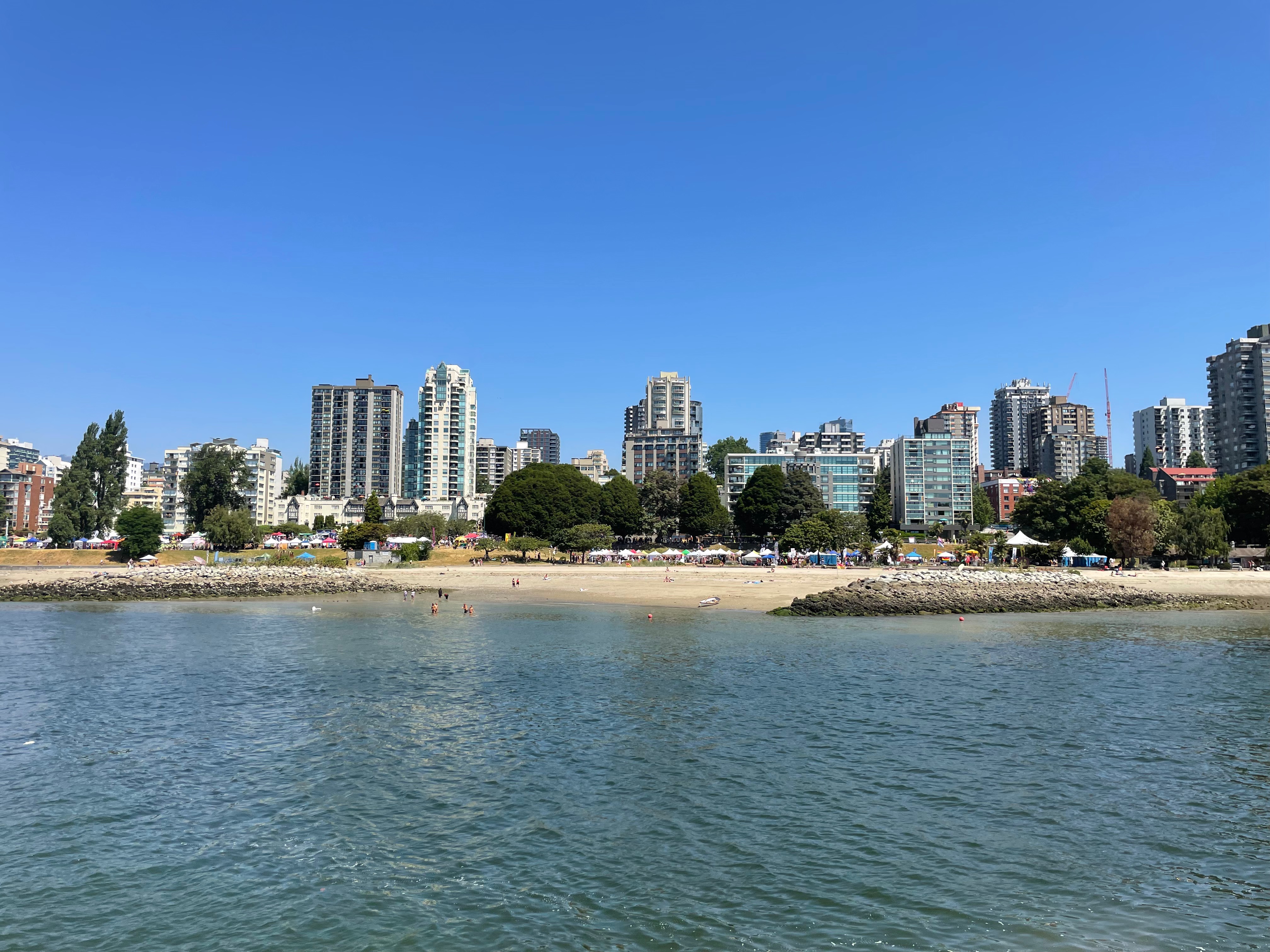
Vancouver’s appeal was that it came across as a very agreeable city, and so it proved. For a town only incorporated in the mid-19th century, flourishing as a key seaport and endpoint of the Canadian Pacific Railroad, it retains a newness, largely the result of urban regeneration that means that the most visible part of the city is dominated by the glass and steel of modern tower blocks lining miles of waterside pathways that curl in and out of apparently upmarket residential districts that appear to house much of the city’s 662,000-strong population. 10 million tourists visit Vancouver every year, and it continues to be the fastest-growing metropolis in Canada.

It’s not hard to see why: Vancouver projects itself as open and notably diverse, culturally, ethnically and socially, presenting a relatively young and progressive city. Its neighbourhoods bustle with the aspirational and the contented, roller-blading, scooting and cycling the city’s seemingly endless bike lane that hugs the waterside edge of this architecturally sharp port city. 

Vancouver was named the world’s second-best city in the Daily Telegraph’s Travel Awards a couple of years ago, only losing out to Cape Town. Colonial, New World conurbations clearly do well. But it’s not just tourists who like Vancouver: it regularly comes out high in lists of the most ‘liveable’ cities, with things like personal safety, healthcare, education, infrastructure and the environment being taken into account. Not that local endorsement is universal. Like so many North American coastal cities, Vancouver also has a homeless problem which, while nowhere near as bad as San Francisco’s, is deep in the consciousness of many residents. Locals also complain bitterly about the Vancouver’s traffic, but we found it to be free flowing (they clearly have never been to London’s car and delivery van-choked streets...).

© Simon Poulter 2022

Perhaps that’s why, with so many of Vancouver’s attractions adjacent to water, a network of water taxis is a convenient and highly relaxing method of getting about. From our hotel - the delightfully funky Opus in hip Yaletown - we were able to paddle up and down False Creek, with its spectacular view of the gleaming apartment buildings that line the waterways, framed by the looming mountains to the north of the city. The False Creek boats service destinations such as the huge BC Place sports and entertainment arena, and Granville Island, with its funky indoor market selling everything from artisan cheese to freshly caught fish. 

Travel further by ‘aquabus’ and you can explore the trendy neighbourhood of Kitsilano, with its upscale homes and a lively downtown shopping area, or to Stanley Park with its collection of First Nation totem poles the vast University of British Columbia campus, with its associate student-friendly neighbourhoods.What amounts to ‘downtown’ Vancouver, on the other hand, is harder to define. West of the city’s waterfront is Gastown, a district stretching alongside one of Vancouver’s transcontinental railway lines, and similar in vibe to New York’s SoHo, with its independent clothing shops, designer chains, restaurants, pubs and a vast vinyl record shop that I wholeheartedly approve of. Despite its apparent age, Gastown isn’t all that meets the historic eye: it’s main attraction, a steam clock that whistles the chimes of Big Ben every quarter hour, was installed as long ago as…er…1977.

Depending on your budget, there are some bigger ticket tourist attractions to eat up the credit card. A huge fleet of seaplanes take off every few minutes from the waterfront, carrying tourists out over the city and even further afield, depending on how long you want to be up in the air and how much you’re prepared to pay for it. 

For us, though, the possibility of seeing whales out in the Georgia Strait, that runs between Vancouver and Vancouver Island, looked like an excellent way to spend half a day. And so it was - five relaxing hours out on the water, catching sight of seals, a pack of sea lions ligging about on a navigation buoy, and even a bald eagle perched atop a tree. Whale sightings were “90% guaranteed”, so we were starting to get a little disappointed when, during Hour 4, we’d not seen so much as a ripple on the water. But, then, sudden excitement. A black dorsal fin, followed by the distinctive spinal arching of a humpback. And then again, and again, sometimes with longer intervals between appearances as she dove deeper after taking in great lungfuls of breath. 

Picture: @princeofwhaleswhalewatching

Finally we were rewarded with a full breach, as her barnacled head emerged from the sea like a submarine surfacing. Her name was Divot (marine biologists have identified them all by their unique tail fin markings) and she’d travelled up from Hawaii to give birth in the Pacific North-West. We learned that she was part of a remarkable re-population of Pacific humpbacks generating a ring binder’s-worth of tail fin pictures of hundreds of the animals, including one called Big Mama, whose annual returns to the area to give birth to the one calf a year they carry had played a huge part in the revival of an entire species that had been hunted almost to extinction.

How do you beat that? You don’t, really, but as experiences go, the Rocky Mountaineer comes pretty close. The luxury train service snakes its way up to breathtaking at-altitude destinations in the Canadian Rockies such as Banff, Jasper and Lake Louise, taking its time (its average speed is just 30mph) to let you take it all in. There’s a choice of packages, with two levels of service and the possibility to travel up to Jasper. Our preference was a two-day journey to Banff, the winter sport resort that, each June, plays host to the international television industry. That fact alone made it seem a good choice - if it’s good enough for expense account-funded TV executives, its going to be good enough for Mrs. P and myself. 

© Simon Poulter 2022

To get there we chose the ‘Gold Leaf’ package, which gave us very comfortable seats in a carriage with giant windows and a semi-transparent moon roof out of which to gawp at God’s work as we progressed at a glacial pace north-east. The idea is that you sit still and just watch the ever-changing countryside, occasionally being interrupted by a drink and a snack served at your seat, a visit to the open viewing platform in each carriage to get a little closer to nature or, a couple of times a day, downstairs to the dining car (it’s the lower half of the double-deck Gold Leaf carriages) for gourmet food. 

Mobile reception for most of the journey is either non-existent or viciously expensive if you’re roaming, so it’s easy to switch off and admire the alpine pastures that become high desert, the vast forest-clad mountains and the seven dramatic rivers that course alongside the majority of the line’s route. If you’re lucky you might catch sight of the wildlife teaming in this part of Canada. Some passengers have seen bears, but the most we saw was another bald eagle in a tree and a confused group of caribou wandering the streets on the outskirts of Banff. Camera buffs will end up with more pictures than they’ll ever need, as the awe-inspiring sights sail past. At some point, the train passes the Continental Divide, marked only by the sudden realisation that the seventh and final river is flowing in the opposite direction to the other six.

It is an overwhelmingly relaxing experience, but also supremely well organised. Your luggage is collected in Vancouver and transported by road to your final destination, briefly reuniting with you in Kamloops, the somewhat nondescript town where you make an overnight stop on the first day. Your hotel room key is handed to you while still sitting in your seat on the train, and your bags are waiting for you in the hotel room. The bus transporting you to the hotel is parked up in front of the steps to your carriage - Bus 13 for Carriage 13. It’s a well-oiled machine. If there was one anxiety, it was being forced to talk to strangers at meal times on the train, though much like an extended speed dating encounter, the conversations are convivial and reveal the same reasons why everyone else is taking the same journey. Over two days, and four meals, we only had to sit with three other couples, fate intervening and giving us a pass on the final lunch in the dining car (there are also plenty of drinks and snacks served at your seat).

© Simon Poulter 2022
The gentle pace of a vast train comprising 41 carriages, pulled by two or even three locomotives, plus the lack of Internet coverage forces you to appreciate the view. At times, the journey grinds to a complete stop, as the Mountaineer waits for mile-long freight trains to pass in the opposite direction (one, my wife counted, contained 140 units). But whereas such a 45-minute delay on that 7.55 to Waterloo would result in a Twitter meltdown, it’s just part and parcel of this experience. as you ride to ever-higher elevations. 

At one point the vast train performs a remarkable change of direction through a right-angled tunnel that seemingly corkscrews up and through a mountain, with the front of the train emerging as the last carriage is still entering. A remarkable piece of human engineering - one of many which built the Canadian Pacific Railway from east to west between 1881 and 1885, with hundreds of European and Chinese immigrant navvies earning just a dollar a day...and often paying with their lives (an estimated 800 Chinese labourers died constructing the line).

Reaching Banff, and travelling across and out of British Columbia and into the province of Alberta, we encountered a lively town teaming with summer tourists. Out of the ski season, its main tourist attraction is the gondola that ascends the near-8,000ft Sulphur Mountain. At the top a four-storey visitor centre offers more views of the breathtaking local peaks and valleys, as well as a couple of restaurants, one of which provides an all-you-can-eat buffet for just C$34 each and all the Rocky Mountain views you can handle. For hardier types, there is even a bar on the open top floor, from which you can grab a beer and shiver under a blanket, looking out over the incredible scenery thousands of feet below.

Vancouver and the Rockies are definitely bucket list-ticking destinations, but that won’t stop us going back. Over the course of a week it felt like a rich and glorious tasting menu for what Canada has to offer. Given that the country itself covers a greater land mass than its southern neighbour, I would certainly look forward to seeing more of it (a Channel 4 travel series presented by Griff Rhys Jones is currently whetting the appetite for a nation and its people that deserves more attention). I’ve never been on a honeymoon before, but as holidays go, this was superbly relaxing, due in part to where we went and the experiences. 

That even extended to our departure for California: though we had to have a brutal, Rude O’Clock 4.30am pickup from our Banff hotel to get to Calgary Airport to check-in for a 9.50am flight to Los Angeles, the airport experience was just as relaxed as the previous few days had been. The check-in area was deserted, security screening a breeze, and then the best part - clearing US immigration while still in Calgary, thus sparing us the often nightmare queues at LAX when large flights from Asia and Europe land at the same time and overwhelm the system.

The three-hour flight to LA, and then the 40-minute drive down the 405 freeway to Huntington Beach in Orange County meant that our brilliant planning worked out perfectly, and we were sitting in the sun, eating lunch with a view of the ocean by early afternoon.

We spent the final four nights of our honeymoon in the lap of luxury. I won’t lie, it came at a price: such is the dismal exchange rate between the pound and the US dollar that every meal and even poolside softdrinks that, a few years before would have cost half the price, required an eye-watering use of the flexible friend, especially once you added 8% sales tax and a 20% tip (even branches of that corporate behemoth Starbucks had a tip jar, not that employees working from 4am for, presumably, minimum wage don’t deserve customer gratuities).

© Simon Poulter 2022

But what cost the memories - the glorious sunsets, the poster paint-blue skies, the palm trees and all the things about SoCal that I’ve been enjoying over almost 30 years of visiting there. There’s so much of the state that I’ve experienced over those three decades that it never fails to draw a grin. 

Cruising up PCH to Malibu for coffee on our final morning is something else I’ve done plenty of times. And it never gets old. For a culture nerd like me, growing up on California-filmed TV shows, driving on roads that have appeared in episodes of Columbo or CHiPs, or popping into the branch of Ralphs where very real Hollywood stars get papped while out doing their weekly shopping never fails to amuse. That the reality cheesiest that is Selling Sunset has now spawned an Orange County spinoff means we can gawp at the actual prices of the incredible beachfront properties we saw up close in places like Laguna Beach. It all adds up to being immersed in your own virtual reality experience - except the sights and sounds of California are all very real.

Spending a few days in this gilded paradise was just the finale to our honeymoon we wanted. Forget the expense and just soak it all up. Those sunsets aren’t just the selling point of ridiculous estate agents. They’re a potent symbol of the dreams and aspirations associated with reaching the ‘left coast’, even if you know that soon you’ll have to get on board that big ol’ jetliner and leave dreamland behind to return to reality.

This, then, wasn’t just our honeymoon. It was the trip we needed. The previous time we’d gone anywhere for fun was a weekend in Palma in the autumn of 2019. So much has happened since then, not least a global pandemic. When we walked into a Guildford travel agency last December we were still in the process of planning our April wedding. A honeymoon at the end of July seemed even further off, but from the moment we dropped cash on the deposit, it was the desirable end of a long road that only included the wedding itself. Canada excelled itself - we will be back! - and no doubt California too. As lifelong memories go, these 12 days and its three distinct components - city break, train ride through breathtaking scenery, poolside decompression - will remain with us forever.


Sunday, 29 May 2022

Taking your breath away, again

Picture: Paramount Pictures

Looked at from a cynical angle, Top Gun: Maverick is something of a corny knock-off of the 1986 original and chock-full of not-so subtle references to the iconic Tony Scott blockbuster. But looked at from an objective, Friday-night-at-the-pictures punter's point of view it is literally breathtaking.

Just like the original, there were plenty of holes that you wouldn't have to be a pedant to spot: for the 1986 film plane spotters like me couldn't help noticing that the ‘aggressor‘ planes used by the Top Gun school combat instructors were exactly the same as the jets used by the unnamed foreign adversary (i.e. American F-5s). In this long-awaited update things are a little more plausible, albeit with generous amounts of licence to let the undoubted star of the show look ridiculously good.

Picture: Paramount
And he is. It's not clear what Tom Cruise does to remain Tom Cruise, but apart from a few lines around the eyes, he is - and I am speaking here with nothing but envy - insanely unaged. Yes, the teeth, yes, that grin, yes, the helmet-free motorbike riding while wearing the white T-shirt/leather jacket/jeans/Aviators combo.

Like I said, you can waste time grumbling about the obvious nods to the original (the music cues, the set-up shots, etc) but that detracts from the sheer enjoyment of it all. Any review you read should - if not will - comment on the flying sequences, which are the best I've ever seen in any film depicting aerial combat. But there is also plenty of genuine, proportional emotional heft, particularly in the quasi-parental relationship between Cruise’s Pete ‘Maverick’ Mitchell and Miles Teller’s Bradley ‘Rooster’ Bradshaw (I’ll let you work out why), and the brief but poignant appearance of Val Kilmer as the-now Admiral Tom ‘Iceman’ Kazinksky, with art tragically imitating life, if you've been following the actor's medical plight.

As you might expect, almost everyone else in Maverick who isn’t Tom Cruise is a supporting player, but you kind of expect that as you walk in through the door. Without giving too much plot away, Maverick is charged with teaching ‘the best of the best’ navy flyers to take on a daring mission in an unnamed “rogue state” with nuclear ambitions (take a guess - somewhere on the eastern coast of the Eurasian landmass...). Here Maverick is given a group of cocky pilots with call signs like ‘Hangman’, ‘Phoenix’ and, er, ‘Bob’, with a sceptical boss (somewhat inexplicably played by Don Draper himself, Jon Hamm), whom he mentors into piloting their F-18 Hornets to the absolute edge of capability for an operation of geo-political significance. And, of course, there is the obligatory love interest - Maverick has managed to remain unmarried, apparently into his late ’50s - provided by Jennifer Connelly, providing a grounding foil as San Diego bar owner Penny.

Which brings me to contemporary events. The protracted timing of Top Gun: Maverick’s release is the result of the  pandemic, but it arrives in a world with a very real war taking place, which makes for some uncomfortable points of reference on the screen. Early in the film Maverick is lectured by a superior (a typically steely-eyed Ed Harris) on the future of combat aviation being unmanned and without the need for thrill jockeys like Maverick. In Ukraine, drones have made the difference for both sides, with Russian air force jets notably less involved than would be expected. Thus, the sight of a fleet of cruise missiles being launched from a warship brings the film disturbingly close to events taking place right now in Eastern Europe.

Picture: Paramount Pictures

Again, though, disbelief requires suspension for the two-and-half-hour duration. Of course, no one (still) on a US Navy captain's salary would own a vintage P-51 Mustang (the plane happens to be Cruise’s own) or a hangar in the Mojave Desert full of classic motorbikes. But that is and always was the Top Gun vibe: the mixture of testosterone, stiff-necked military order, and a touch of the Southern Californian lifestyle. It’s entertainment, after all, and not a documentary. 

Nor is it a cartoon. Top Gun: Maverick exists in a genre all of its own, which is what makes the original an icon of ’80s cinema. It may well be something of a remake, but Maverick moves the genre on enough for fans of the 1986 film to enjoy afresh, and provide something utterly edge-of-the-seat compelling for those not even born back then.

Saturday, 16 October 2021

I don't want to change the world but I am looking for New England

Picture: Massachusetts Office Of Travel & Tourism

The news this week that the United States will finally open itself up to fully vaccinated travellers from the UK and Europe from 8 November means that, were I able to, I could return to the one country I’ve visited more than any other over the last three decades.

In fact, I’ve lost count of how often I’ve crossed the Atlantic since my maiden trip, to the West Coast in 1992. Since then I’ve been back countless times for work and pleasure, and even lived in Silicon Valley for a couple of years. California has been my main destination but I’ve progressively seen New York whenever I’ve been able to, and more recently have had a series of holidays in Florida, a state I’d hitherto avoided in the mistaken belief that it was just a giant theme park. 

In fact I can proudly boast to have visited 22 of the 50 states in the Union (eight alone on my 2,400-mile drive along Route 66). That, though, does leave 28 as-yet untouched. Some offer little appeal: the barren northern states, mainly, including both Dakotas, Nebraska (despite its Springsteen connection), Wyoming and Idaho. Basically, anywhere with nuclear missile silos. But there are still plenty of places with virgin appeal to me (and that’s not a plug for Mr. Branson’s airline to offer me carriage). Hawaii is one, largely out of the curiosity of seeing an American state that’s closer to Asia than its parent nation, and to experience a “tropical Pacific paradise™” with all the trappings and conveniences of the economy it is anchored to (drive-throughs, chain motels and all the other tropes that have made the US such an effortless destination).

Massachusetts State House, Boston
Picture: Tim Grafft/MOTT

But if there’s one place I really should visit, it’s New England, that collection of states so named by the British explorer John Smith in 1616 after he’d scoped out what is now Massachusetts. Four years later the Pilgrims arrived in Plymouth, unimaginatively named after the Devon city from which they’d come, and promptly started settling there. What I have seen of Massachusetts (and I’ll admit, Murder She Wrote is my principle source) does look remarkably like parts of south Devon, so perhaps some forgiveness can be afforded the colonials for their lack of invention when naming their new home, but it would be just the start of a trail of colonies spreading west that will forever be connected to England by name, with place names like Portsmouth, Bristol, Bath, Andover, Manchester and Newbury just in New England alone.

Sadly, the opening up of US travel next month means that arguably the primary reason to visit New England - its “fall” autumnal colours - will be ending, but that doesn’t mean that Massachusetts, Connecticut, Vermont, New Hampshire (yep, another shocker for originality), Maine and the micro-state of Rhode Island are not attractive at any other time of year. Like it’s namesake, New England has become a byword for rustic charm, a cliche I know, especially as it’s a much a region of modern America as anywhere else. There is also more to it than leafy photo opportunities, seafood restaurants and villages that look like they were created just to provide backdrops for ‘country cottage’ furniture catalogues. 

For a country often mocked (usually by us Brits) for lacking history - well, any history created before its indigenous people were so rudely displaced by Europeans… - New England boasts some of the most interesting historic attractions in America. No surprise as, arguably, the nation’s birthplace. Boston is the birthplace of American independence and at one point the country’s biggest city. It is, however, arguably one of America’s most attractive ‘pick’n’mix’ regions to explore by road, that great American tradition.

Critics of American culture might argue that dating back to ‘just’ 1492 doesn’t give it any right to history, but New England provides more than most, whether the tourist is looking to savour the Ivy League college towns, walk in Mark Twain’s footsteps, or explore dramatic, windswept beaches and coves that bear more than an uncanny resemblance to those in the South Hams of Devon. And, yes, there’s a Dartmouth, too.

Picture: Tim Grafft/MOTT

I suppose it’s this perceived lack of modernity that is the attraction, though this is a relative term. It’s far from a picturesque backwater. Boston, for example, is one of America’s most vibrant financial services centres, while the region is home to high tech industries, major defence contractors and healthcare corporations, contributing to a GDP of more than $1 trillion for New England as a whole.

Like everywhere else in the comprehensively curated United States, New England has plenty to offer the tourist, be it Boston’s harbour and the location of that teacup-rattling contretemps that launched the Revolution, but also all the fascinating nods to the Europe that uprising was meant to free itself from.

But perhaps the other appeal is that it seems to offer a gentler version of the United States. I’m sure it’s no different to anywhere else I’ve been in the country, which means I’ve probably succumbed to intoxicating marketing. If, though, that simply means that the appeal is a tree-lined, more liberal part of America, full of cosy guest houses and smalltown country grocery stores selling local produce, that will do me just fine.

Saturday, 26 June 2021

The truth is still out there…probably

In December 1992 I blew half of a redundancy package on fulfilling a long-held dream of visiting the United States for the first time and, specifically, the West Coast. Los Angeles had been an aspirational part of my childhood, having grown up watching TV shows like The Rockford Files, The Six Million Dollar Man, CHiPs and even The Dukes Of Hazzard - all filmed in and around Los Angeles - and I wanted to see the same blue skies that had clearly been absent from Britain during my youth. 

After arriving in LA, I embarked on the customary trip up Pacific Coast Highway to San Francisco, via Big Sur, Monterey and Carmel, before venturing north-east to the magnificent Lake Tahoe. Heading south again, with the Sierra Nevada mountains - California’s snow-capped spine - to my right, I followed the course of the Owens River down “scenic” Hwy 395 until the small town of Lone Pine (frequently used by Hollywood as a filming location for Westerns), where I turned off and headed towards Death Valley, the permanently in-drought, sub-sea level desert basin that regularly records insane temperatures (last week it was 54C). As a stopover for Las Vegas (more direct, less scenic routes are available), I stayed the night in the sparse town of Stovepipe Wells, near the border with Nevada. 

Picture: US DoD
With nothing much else to do for the evening, I switched on the somewhat rickety TV set in my motel room to see the proprietor of a regional station berating his viewers in the independent American local television convention of an “editorial”, lecturing on why, to his annoyance, so many people in the south-western desertlands claimed to have seen UFOs (as opposed to anywhere else in the United States). His blunt argument was that the region is home to a lot of military activity: Lockheed’s so-called ‘Skunk Works’ facility at Palmdale, on the edge of the Mojave Desert, had for decades been turning out secretive experimental aircraft designs, like the F-117 stealth fighter and more recently, the F-35 Lightning II, while another US Air Force facility in Palmdale produced the B-2 Spirit stealth bomber, arguably the nearest shape in the sky to something resembling a UFO. 

A relative stone’s throw, as the crow flies, from Stovepipe Wells and into Nevada in a significantly more inaccessible desert basin is Area 51. This, it should be remembered, is the hub of more or less every conspiracy theory to have ever existed about UFOs, including the widely-held belief that it is home to crashed extra-terrestrial craft being reverse engineered by boffins. Officially, Area 51 doesn’t exist, but it isn’t denied, either. The US military runs daily flights from and to Las Vegas, 80 miles to its south, for workers to commute there. The point of all this, is that Mr. TV Proprietor is probably right: the vast desert region of the American south-west is an ideal environment for the military to play with new technologies, so it’s quite likely that people living in its sparse communities - many, intentionally ‘off-grid’ - are going to see things the authorities would rather were not viewed too widely.

This, then, brings me to the long-awaited US government report, published yesterday, which has taken a serious look at what it calls “Unidentified Aerial Phenomena”. The report, by the Pentagon’s ‘Advanced Aerospace Threat Identification Program’, has investigated sightings dating back to 2004 and made by the US military (as opposed to whacked-out cranks living in the deserts), which have evaded rational identification. These sightings have included flying objects, often captured on camera by military aircraft scrambled to investigate them, which have displayed no obvious means of propulsion or flight surfaces, and have appeared to use technology unknown to US science or any scientific community for that matter. One such sighting occurred aboard the US Navy cruiser USS Princeton in 2004 when several crew witnessed a white oblong-shaped aircraft - which they dubbed “Tic-Tac” for its resemblance to the mint - darting around at high speed. “This was not just another flock of birds or a balloon or swamp gases,” Sean Cahill, a Princeton crew member at the time, told Greg Millam of Sky News this week. “We knew that this was a craft that was outstripping our arsenal, and that was in 2004.” Cahill felt he was witnessing history. “But I think that there's even more out there that we need to see and understand,” he said, adding that the US military’s apparent nonchalance at the time was proof that these things existed as part of secret official projects. But with no explanation then or since, he now believes that the phenomena present very real national security concerns.

What is significant about the US intelligence report is that, while the sightings aren’t claimed to be evidence of little green men joyriding about our planet, it doesn’t categorically rule it out, either. The nine-page report, which is a public extract of more comprehensive, classified information provided to Congress, describes 144 military UFO sightings of which only one could be fully explained. Critics have already been quick to claim that the 144 might be the tip of the iceberg, and that observations by members of the military often go officially unreported for fear of being branded crazy or unfit for duty. This reminds me of the air traffic control scene in Close Encounters Of The Third Kind:

Air Traffic Controller: TWA 517 do you want to report a UFO, over?
TWA517: Negative, we don’t want to report.
ATC: Air East 31, do you wish to report a UFO, over?
Air East 31: Negative, we don’t want to report one of those either.
ATC: Air East 31, do you wish to file a report of any kind to us?
Air East 31: I wouldn’t know what kind of report to file, Center.
ATC: Uh...Air East 31...uh...me neither.

The problem is, the experts still do not know what’s being reported, because the technology they believe they’ve been looking at is beyond current understanding. “It’s clear that we need to improve our capacity to further analyse remaining observations,” one official is reported by the Wall Street Journal as saying. In the report, there were 18 cases of objects with ‘unusual” movement or flight characteristics, with objects apparently defying physics and current parameters of aircraft mobility. Some have offered the more logical explanation that  these objects might be experimental Chinese or Russian vehicles, especially given the two countries’ military interest in hypersonic propulsion, but the UAP report doesn’t appear to conclude that either nation is involved in the unexplained sightings. Instead, it continues to categorise sightings with more rational explanations, such as birds and balloons, or even atmospheric phenomena, although it does also include categorisations for “foreign-adversary systems” and “other” encounters.

© Simon Poulter 2013
That won’t dissuade tin foil-hatted types convinced that the events in Roswell weren’t more real and more sinister than explained at the time, or since. The crash, in July 1947, of an object on a ranch near the New Mexico town, has prompted years of debate. The US military at the time claimed that the object was a weather balloon. Others claim it was a “flying disc”, with even more extreme claims saying that it contained an extra-terrestrial lifeform. Whatever happened, it has certainly proven to be a tourist bonanza for Roswell, as I discovered on another US road trip, while taking a major detour off Route 66 in 2014. The grandly-titled International UFO Museum & Research Center, in a former cinema on Main Street in Roswell, is as much tongue-in-cheek as a serious attempt to document and even explain the 1947 incident. But while the museum’s somewhat comical exhibits don’t exactly give the conspiracy theories all that much credence, there remains plenty of people who are convinced that something sinister lies behind it all. Chris Jones of the Mutual UFO Network, a collective of a civilians who study reported sightings, told Sky News that the US government report only emboldens their belief. “The phenomenon has just been validated by the papers coming out that, yes, there's something out there,” he said. “No, we don't know what it is, but it's worth looking into. And that's what we've been doing for decades.”

The trouble with all this is that we partly want to believe that we’re not alone, and are partly afraid that other forms of intelligent, industrialised life, from somewhere other than Earth, exist, and with nefarious intent, too. Since biblical times, there have been notions of objects in the sky, but the history of UFOs and the possibility of aliens visiting us has always been little more than a mixture of over-active imagination and cultural paranoia. There’s no doubting that people - sane people, rational people - have seen things that can’t be explained, but the conspiratorial X-Files notion that governments know more than they’re letting on has always seemed too fanciful, at least to this cynic’s view. 

Of course, given the infinite enormity of the universe, there’s always a chance that life on Earth wasn’t just an incalculable random event, and that, somewhere else in the cosmos, organic creatures have developed the means and the curiosity to go travelling. But if they did, I’m pretty certain that they’d spend more time doing the Universal Studios tour and Disneyland than hovering over the Mojave Desert, spooking people in trailer parks.

Thursday, 26 March 2020

It's oh so quiet


Serenity is not something you associate with crisis. And, yet, opening the bedroom curtains this morning, that's exactly what I encountered. The sky was poster paint blue, the sunshine bright and inviting, and a pair of postmen traded banter from an appropriate social distance, delivering to opposite sides of the street. The usual hustle and bustle of this London suburb has dropped off a cliff. Our turn-of-the-century street in the "village", as the town is referred to (despite being well within the capital), had almost been returned to its original state, save for the scattering of residents' cars parked up and down it.

Yesterday was the same - the silence only occasionally broken by frantic delivery vans charging over the speed humps, their drivers desperate to make the next dump-and-run as part of their new game of contact-free Knock Down Ginger. Even though we're in the midst of a medical crisis, the urban soundtrack of emergency vehicle sirens around here has also been turned right down. On any given day, living close to a high street and its intersection with another local artery, ambulance, police and fire engine sirens are an almost constant cacophony as they battle their way through choked streets. But not now. It is eerie. People really are staying at home.

The other notable silence is in the air. When Heathrow is running takeoffs from its easterly runways, there is usually a steady stream of planes in their initial climb overhead our part of south-west London. But not any more. Last night the quiet was broken only by a helicopter. It reminds me of Tuesday 11 September, 2001. I was living in Sunnyvale in California, in an area served by three international airports - San Francisco, Oakland and San Jose. On any given day there are hundreds of planes in that airspace, including flights making their 180-degree turns over Sunnyvale itself to line up for landing at SFO. 9/11 unfolded in real time for me. Having been awake, unusually, at 6am and watching CNN as I eat breakfast, a report came in of a plane hitting one of the World Trade Center towers in New York. Initially it was assumed to be a light aircraft or one of the many helicopters that fly up and down the Hudson River, delivering banking executives to Manhattan's heliports, or taking tourists on sight-seeing flights. Very quickly it became something else.

By 6.45am my time, the Federal Aviation Authority had grounded all commercial aircraft within the continental United States. It was a full twelve hours later that I emerged from the apartment for some fresh air, having spent the day in my pyjamas, frantically channel-hopping to see if any one broadcaster had more news than the others. My break for freedom was to drive up the 101 freeway, with no particular destination in mind, just a desire to see something other than my living room. It was as I drove that I noticed how clear the skies were, and how clear the freeway was. One of the San Francisco Peninsular's two main motorways was notably free-flowing at a time of day when traffic would normally be solid. On an impulse, I came off the 101 at Millbrae and drove up to Junipero Serra Park, which has a view over to SFO. It was then that I fully realised how silent it was. Nothing overhead, nothing moving on the ground. Planes that had been given the 'All Stop' order appeared to be scattered all over the airport's taxiways, like toys abandoned by a child ordered to the dinner table.

That night, around 2am, I was woken by the noise of a jet aircraft flying overhead. The nights were warm in California that September, so I'd left a bedroom window open. As the jet - possibly a fighter - approached, I felt myself bracing. No one knew for sure if that morning's attacks had ended, and middle-of-the-night paranoia meant that there was a fair chance that whatever was approaching could be heading for San Francisco, or the heart of Silicon Valley or, frankly, anywhere. The next morning we gathered at the Philips campus in Sunnyvale, everyone numbed by the previous day's events, all trying to get some collective semblance of understanding of what had happened on the other side of the country. Everyone who lived in the South Bay reported the same experience as mine, of being woken by the sound of an aircraft, and wondering where it might go.

That Wednesday morning we all assembled around the campus barbecue pit (about as Silicon Valley as you get) for an impromptu moment of sombre reflection and to sing (or, in my case, attempt to sing) the Star-Spangled Banner, the US national anthem before returning to our desks and try to get on with some work. I remained there for a few minutes longer, still trying to get my head around the lack of noise in the sky. Amid the continuing uncertainty, the calm, the beatific calm, was as unnerving as it was peaceful. Today, outside this house, it is a reassurance that people are paying attention to the instruction to stay at home. Or, at least, they are in this village.

Tuesday, 14 May 2019

Time travel: The Church live in Santa Cruz

© Simon Poulter 2019

Before Amazon, home delivery was a rare event. In fact, I can only remember one occasion in my youth when the doorbell rang and a van driver was standing outside, having wheeled up to the front door a large cardboard box. I was, at the time, living back at home, having returned there from Shropshire after LM, the magazine I joined after leaving school, had gone bust in May 1987. Although I was managing to eek out some freelance work with Smash Hits and Record Mirror, I was officially unemployed. Signing on. So when this large box arrived, I was baffled. Not blessed with a great deal of money, I was hardly going nuts with what was then termed ‘mail order’. Curious, I opened the box and sifting through the polystyrene packing chips I unearthed a whole pile of vinyl records. Carol, the receptionist (whom, I suspect, secretly fancied me) at LM’s publisher had deemed me the lucky recipient of loads of albums that had continued to come into the magazine’s office from record labels, long after the title had folded. For one reason or another, most of this delivery was from Arista Records, and included disco diva Taylor Dayne's unlistenable debut album and an equally iffy release from Aretha Franklin. Also in the pile, however, was a record that, 31 years later, would have me drive for over six hours from Los Angeles to hear it played live in its entirety.

That album was Starfish by The Church, the Australian band once tipped (or is it cursed?) as “the next U2”, and sometimes compared - not unreasonably - with the likes of Echo & The Bunnymen, tropes generated inevitably by a propensity for "ethereal and shimmering"™ guitars drenched in reverb, delays and other effects. Throw in “the 80s” and The Church became part of an Australian invasion (which wasn’t anything like it, but you’ve got to remember this was a time when there were Minogues and various Neighbours on the loose, not to mention Midnight Oil and, if I stretch the antipodean theme a little too far, the Kiwis Crowded House). In customary rock journalism manner, The Church were hard to pin down. Starfish was their fifth album, but not having heard their previous four, it brought me to their sound afresh, and I was particularly drawn to the album's soundscapes, something I'd always liked about progressive rock (I was, then, and still am - suck it up, naysayers - a fan of prog, that genre maligned for the misconception that it's just 20-minute keyboard solos and songs about elves, when in fact Bowie and the latter-stage Beatles were as much prog as anything else). In other words, music that transported you away from the contrite and the conformed, and made you listen a little more, appreciate the instrumentation, wig out even.

Picture: The Church/Facebook
Starfish did just that, and last Friday evening, at the stupendously art deco Rio Theatre in California’s Wigout Central, Santa Cruz, The Church played it in its entirety on the penultimate leg of a US tour to celebrate the album’s 30th anniversary (OK, 31st now). I’ll admit, it was a bit of a punt: the logistics of getting from Anaheim (where I’d been at a work event) to Santa Cruz, a 372-mile drive away, notwithstanding, I'd last seen The Church four years ago at the tiny New Morning, an obscure jazz club in Paris, and had been left somewhat underwhelmed. The evening had been let down by lead singer and bass player Steve Kilbey being decidedly worse for wear. Having succumbed to heroin addiction at the end of the 1990s, it was unclear as to whether he’d relapsed or had simply smoked something before the gig to leave him so unsteady and slurred.

Thankfully there was no such indisposition in Santa Cruz as Kilbey and fellow founder member Peter Koppes (co-architect of that signature guitar jangle), along with longtime drummer Tim Powles, second lead guitarist Ian Haug of Powderfinger, and guitarist/keyboard player Jeffrey Cain of Remy Zero launched into Destination, Starfish’s opening track. The long-held convention in rock is that, when playing live, you must avoid peaking too soon. That would be almost unavoidable in playing Starfish sequentially as the album’s second track is the song that really landed them on the map, especially in the US: Under The Milky Way.

Remembering playing the album for the first time that Tuesday morning (quite why I recall it being a Tuesday, escapes me, but by luck or judgement, Starfish was the first out of the Arista pile), it’s hard not to resort to predictable expression when describing Kilbey’s mellifluous vocal and wonderfully understated vibe. No wonder Under The Milky Way remains their signature and, equally, no wonder it ended up in that other totem of the 1980s, Miami Vice. Michael Mann’s music curation on that show had good form when it came to picking songs with atmosphere, be it In The Air Tonight in the opening episode (Sonny Crocket driving his Dino down Collins - get it? - Avenue), or Peter Gabriel’s Rhythm Of The Heat, so Milky Way and, in a another episode of Series 5, Starfish’s Blood Money, fitted the show's aural aesthetic with polished ease. The thing is, though, that Starfish is such a seminal album, and while Milky Way might be a highlight, the sequence does not diminish, even after the commercial peak of its second track. Produced by legendary Los Angeles session guitarist Waddy Wachtel and Greg Ladanyi (who'd worked with Jackson Browne, Warren Zevon, Fleetwood Mac and Don Henley, amongst others)], the album as a whole invited a sparser sound than The Church's previous outings, drawing on the sort of ambience that indeed made The Joshua Tree so evocative of the desert U2 were trying to eulogise.

Three decades on, Starfish in its entirety is still a complete delight to indulge. The album's original production treatment was so transportive, and yet live at the Rio, no less evocative, albeit with an edgier nature, powered by the band's live complement, especially the guitar interplay between Koppes and Haug, and the use of 12-string guitar to give a Byrds-like chime to Antenna. Lost and North, South, East And West bore a epic soundscape, while the album’s second hit single, Reptile, punched epically as, arguably, the stronger of the two cuts to have graced the Top 40.

Picture: The Church
Touring a classic album in its entirety is a risky proposition, though one that has gained considerable heritage vogue in recent years, as bands leverage work that casts the nostalgic fan back to where and when they first heard it. I have no particular desire to return to who I was in 1988 when that box turned up on my doorstep, and despite my relative disappointment the last time I saw The Church live, the proposition of listening to Starship being performed from start to finish, was too strong to resist when I discovered that they'd be playing relatively close to where I’d be in California. This time I resolutely wasn’t disappointed. Actually, my respect for the band was only reinforced, especially after the intermission when they dipped into their near-40-year canon of 26 albums to play a further 12 songs including the Bowieish Another Century from their most recent studio recording Man Woman Life Death Infinity, the REM-like Constant In Opal and the deliciously rocking Sealine, before ending with The Unguarded Moment, which dates back to their 1981 debut, Of Skins And Heart, and Miami, the epic, hazy track of beautiful, shimmering guitar work that closes Further/Deeper, the 2014 album that led me to that somewhat off-key gig in Paris.

You may have come to the end of this post and found yourself still none the wiser about The Church. Albums, from Of Skins and Heart through to their most recent Man Woman Life Death Infinity, may have passed you by; even mention of Under The Milky Way might only register as something you might have heard once. But consider this: legend has it that it was a 1982 Church gig in Sheffield that inspired Johnny Marr, Mike Joyce and Andy Rourke to form The Smiths. I guess the angle must be in the jangle. In Santa Cruz, a city which proudly retains its hippy vibe (with the surfers and smell of legal weed to go with it), those frugging wildly in front of the stage at the venerable Rio Theatre demonstrated that, with any band of a certain vintage, there’s an audience to be found who will embrace their own histories and the memories that go with them without prejudice. For me, it was a long drive to travel back 31 years but, heck, it was worth it.

Saturday, 12 November 2016

The tea really does taste better, and other observations

© Simon Poulter 2016

So, I’ve been back in London just over a month, after 17 and a half years living abroad, which is a statement that, I know, carries a whiff of the exotic. However, I'm not suggesting for one minute that I've been off-grid, khaki-clad with a pith helmet, observing still-primitive Amazonian tribes, or carrying out a long-term study of penguins in their natural habitat, or in my wilder moments of Walter Mittydom, living the rock star lifestyle in a Malibu hacienda, occasionally doing something with gated reverb.

No, for most of those years away I've been sat in an office. Furthermore, I've hardly been cut off from my homeland. Frequent commando raids to visit family, friends, Stamford Bridge and carry out sundry business commitments, more or less in that order, have kept me in regular contact. That said, there is a substantial difference between weekend trips to the home island and living somewhere day-to-day (or, simply, "living", as I had been doing exclusively in Britain before being coaxed elsewhere).

Of course, moving to the Netherlands - and subsequently California, back to the Netherlands again and then France - as I did, wasn't exactly volunteering for the first manned Mars mission. These countries do, I established quite quickly, have flushing toilets, and if you know where to look, shops selling Marmite. But coming back has thrown a spotlight on things I had missed, or more importantly, didn't know I'd missed.

With worldly-wiseness comes additional awareness of your home country and recognition of things you'd never have been conscious of before moving abroad, or that you suddenly become aware has become a thing while you've been away. Here, I offer my first observation: cars pushing into traffic from side roads. I honestly don't recall this ever being a custom (interestingly enough, in Holland cars coming out of a side road have right-of-way, which I didn't know until it was almost too late…the first time). During my driving lessons I was taught to wait until there was a break in the traffic and then pull out. Now the norm seems to be to simply stick the nose of your car out, forcing others to stop. And often the driver in question is actually trying to blag his or her way onto the other side of the road, forcing traffic on both sides to stop. I don't know when or where this came from, or why. It's possible that it is simply a consequence of Britain's roads becoming ever more congested, as property, demographics and population increases - including net immigration - have put more cars on the streets. Another good reason for me to eschew car ownership and make use of public transport, a trait I warmly embraced in Paris, and am happy to continue as I base myself in south-east London.

This brings me to my second observation: the sense of entitlement. I blame Simon Cowell. For many things, actually. At risk of committing the most middle-aged thing I've ever written, Britain has, in the years I've been at large, developed an assumption of on-demand, instantaneous everything, from Cowell's drive-through fame culture to 18-year-old footballers skipping the traditional cleaning-the-stadium-toilets-with-a-toothbrush apprenticeship and going straight to Range Rover ownership. And don't get me going on compensation.

With this entitlement comes an erosion of civility, something the Brexit referendum seems to have accelerated, with social media becoming the prime medium to tell complete strangers exactly what is thought of them. There is some credence to the argument that if Gary Lineker or Lily Allen tweet about refugees they are putting themselves out there, and that their freedom to express themselves is rightfully matched by those who dare to troll them. But, as I’ve blogged before, spend any time on Twitter and, much like the bubbling stream of bile that is the Daily Mail and its unhinged, tin-foil hat-wearing, demonstrably illiterate readership, you will succumb to both madness and despair at how people, shielded by their keyboard and the semi-anonymity of their handle, feel entitled to say whatever the want without consequence, and without any basis of a relationship to so.

This manifests itself, post-Brexit, with Polish community centres being vandalised, hijab-wearing Muslim women being verbally abused in town centres, and knuckle-dragging thugs staging protests about claiming their country back, not that I ever noticed that it had been taken away from them. And, guess what? After Tuesday's presidential earthquake, it's happening in America, too. Let right-wing populism win, and all of a sudden there are those acting like it's 1933 Germany, when brown was the in-vogue shirt colour.

When I left Britain in 1999 there was no such thing as social media. If you wanted to complain you either wrote to Jimmy Young, Points Of View or The Times. If you wanted to rant at complete strangers there was always Speaker’s Corner. Now, you can meltdown, Basil Fawlty-style, on Twitter. Which I did, without remorse, recently when trying to get broadband installed. Broadband providers go to great lengths to draw you in with slick marketing: TV ads with Hollywood celebrities and websites that connect you to directly via chat to experts helping you pick the right package. And then the horror begins: after handing over a large sum of money, you then wait for the service to begin. Except it doesn’t, so you connect by online chat again…where it takes half an hour for someone to take up your case, only to inform you that another department handles your type of package and you should call their helpdesk. Which you do, and you then spend an hour on hold due to “a high volume of calls”. In my case, I clocked up a full three hours on hold trying to find out why BT had arbitrarily cancelled the visiting installation engineer, and then cancelled my order altogether. Here Twitter comes into its own. It’s amazing how responsive companies become when their reputation is challenged publicly. It shouldn’t be like this, of course. You should just be able to call a number and someone answers, more or less straight away. Britain’s population may have grown in recent years, but not so much that some of a telecommunications provider’s substantial profits can’t be invested in extra customer support personnel.

There are many more line items I could complain about the Britain I’ve returned to, from London’s choked, gridlocked traffic, to those Estuary accents where each sentence ends with a rising pitch like a question?, to jogging bottoms as workwear, young women wearing make-up applied by an industrial sandblaster (and eyebrows which may have been drawn with an extra thick Sharpie), to Nando's. But that could sound ungallant about my return, which would be wrong.

Throughout my time abroad I’ve eulogised about my adopted surroundings. Amsterdam remains an adorable village masquerading as a national capital. California will always be where I go for sunny people and sunny weather in a geography that offers cities as majestic as San Francisco and as relaxed as San Diego, and the eye candy of its beaches, mountains and deserts, of Lake Tahoe and Yosemite. And Paris. What can I say that I haven’t already? An architectural history museum that you can actually live in, with subsidised public transport and the amusement of people watching without being judged for it.

But it's not for nothing that for some time I’ve wanted to come back to London. For a vibrancy matched only by New York; for its culture, its art, music, exhibitions and theatre; for its diversity; for its ability to blend modernity with traditionalism; for the sense of newness I keep finding around every corner, nestled amongst the old; for the joy of taking a Thames Clipper to the football; for tea that really does taste better; for breaking my umbilical cord with the south-western suburbs I grew up in and welcoming me to the south-east of the capital.

As much as there is a degree of architectural vandalism going in London, with the rapid forestation of huge, new towers of glass and steel dominating the skyline, there is also an unshakeable excitement about the place that I notice and experience every day I step outside. Even post-Brexit, with the banks and other corporate institutions supposedly buggering off to Frankfurt and Amsterdam, London feels as resilient today as ever before. It’s new mayor, Sadiq Khan, is a force for good, putting himself about on the world stage in an enthusiastically statesmanlike manner, declaring the British capital open. If he could do something about the traffic, Heathrow and the epidemic of knife crime, he would be somewhere close to the country’s best politician (and certainly more effective than either the leadership of the party he represents or the self-serving scoundrels they are supposed to be in opposition to).

All this aside, I'm not going to make melodrama out of my repatriation. Really, there hasn’t been a lot to it. Essentially, I arrived, and then went straight down the pub. It has all been relatively easy - as really I should have expected, though that’s not to say there have been things to get used to again, not to mention things to do for the very first time. But I’ll be honest, the star of all this has been London.

I'm writing this in New York, the self-styled ‘greatest city in the world’, a description much like The Rolling Stones being the world’s greatest rock and band. If so, then London runs it close on many points, and even beats it on others. Kind of like The Who, The Kinks and Led Zeppelin. It really is good to be back.

Sunday, 2 October 2016

Frexit, stage left

© Simon Poulter 2016
So that's it. Seventeen-and-a-half years after I moved to Amsterdam, and embarked on a journey that took me to California, back to the Netherlands and then, since New Year's Day 2011, Paris, I'm back "home". Yeah, London, baby!

Well, I say home, but it really is where the heart is. And mine has been enchanted by Amsterdam's canal-lined streets, the perma-sunshine of the Golden State, the quaint, rural Dutch village where I 'settled' for six years, and then on to Paris. Of course, I've never been that far from the old country: Amsterdam and Paris are barely an hour by plane, five hours by road, and with family and a Chelsea season ticket to return to, not to mention business commitments, it does sometimes feel like I've never been away. But in reality, there’s a big difference to actually living back here again and the frequent commando raids I’ve made over the last 17 years to stock up on Shreddies and deodorant, or to buy suits from Marks & Spencer that properly fit (France doesn’t do suits for someone of my…er…shape - more so short-arsed men who stay stick thin through chain-smoking and thimbles of weapons-grade coffee that renders them nervous energy-burning furnaces).

Returning to Britain after the better part of two decades as an ex-pat brings many new things to get one's head around. When I left in 1999 there was no broadband, no WiFi, and the Internet - which I accessed on a company-provided laptop - was connected to via a tectonically-slow dial-up connection. On top of that, everyone was running around like Chicken Licken predicting that the sky would fall in because of the Millennium Bug. This also reminds me that I left the UK in the 20th century and have now 'returned’ in the 21st. Of itself, this is not a particularly breathtaking fact - as it's been the 21st century everywhere else I've been - but it does shed daylight in on how Britain has changed.

Immigration may have been the extreme sunburn-sensitive topic that dominated the Brexit debate, but it has made for an enriching character shift to many British communities. There's not a café or coffee outlet in London now not exclusively staffed by eastern Europeans (and more power to them - at least they are happy to serve your cappuccino without giving off the sense of the job being beneath them...). A few Christmases ago I took a bus into Kingston-upon-Thames and was struck by the variety of accents and languages being spoken on the top deck. Here, in the area in which I was born and grew up in, were now conversations in Polish or Czech (working in an international community tunes the ears to foreign tongues), as well as Korean, the result of New Malden (my hometown) hosting Europe's largest Korean community, a legacy of Samsung basing its European HQ there a few years ago. And you know what? The Korean supermarkets and street signs, Polish delis, and Lithuanian-run tea shops have brought a new vibrancy to the area.

The other thing I've noticed is how risk-averse Britain has become and how bossy it is as a result. Such is the health and safety culture here that there is barely a trade not required to wear high-visibility attire (including, even, police horses). Viewed from space, I'm fairly sure that the United Kingdom shows up as a fluorescent yellow triangle in the North Sea. In France there is no such paranoia. In fact, health and safety just doesn’t exist. You can walk under construction cranes shifting heavy loads without so much as a “look up” sign to warn you, let alone a 100-metre safety perimeter and mandatory hard hat wearing. As with many things in France, workers are merely an inconvenience to be shrugged at in that inherently insouciant French manner.

Travelling by public transport in Britain is to be subjected to a never-ending babble of reminders and instructions. Actually, orders. Recently I was in a rush to catch the Heathrow Express into London, and I got barked at over the tannoy by the platform guard: “No need to run! Plenty of time!", in a voice not dissimilar to the schoolteacher on Pink Floyd's The Wall ("YOU! Yes, you laddie! Stand STILL!"). This was the same guard who’d shouted at everyone not to board the train until vital security checks were carried out, and then barked at everyone to board quickly. You can’t win.

Once on board a moving train, Bossy Britain subjects you to a running commentary, telling you which station you’ve just left, what station comes up next, what line you’re on, who runs that line, what terminus you’ll end up in. On the London Underground it’s even worse: “The next station is Bank.” “We are now at Bank.” “Mind the gap as you get off.” “Please allow people to get off before you get on.” “Move down inside the carriage please.” “Move RIGHT down inside the carriage please.” “Stand clear of the doors.” “The doors are closing - stand clear of the doors.” “The doors have now closed”. “The next station is Holborn”. I’m sure some public transport workers in Britain are failed wedding DJs - the type who just won’t shut up.

When I left the UK in 1999 I had a mobile phone that made calls and sent text messages. And that was it. Apple was regarded somewhat dismissively as a niche company with overpriced products designed for creative professionals and no one else. I used to drool over Apple Powerbooks in shop windows like Mike Myers drooling over that white Stratocaster in Wayne’s World. And then the original iMac came out, and all of a sudden the idea of an affordable and cool-looking computer at home seemed viable and attractive. I bought one in Amsterdam in 1999, commencing an addiction to the Apple brand as powerful and as financially destructive as an acute crystal-meth habit. Apple cleverly marketed the digital lifestyle, and I have enthusiastically bought into it.

While I'm trawling through the annals of an already-distancing past, let me also mention my football club. In 1999 Chelsea were still flirting with financial near-death, but since Glenn Hoddle had become manager in 1994, and players like Ruud Gullit, Gianfranco Zola, Gianluca Vialli and Frank Leboeuf had been added, the club’s stock had steadily risen.

© Simon Poulter 2016
By the time I set off for Holland, Vialli had replaced Gullit as player-manager, but they were still perennial sixth place contenders. Their 1995 run in the old Cup Winners’ Cup was their only foray into Europe since 1971. I made the decision to keep my season ticket when I moved abroad. Such was the growing popularity of the club, fuelled by the stars now playing in blue, seats for home games at Stamford Bridge were already becoming scarce. Even when I moved to California I decided not to give up the ticket, knowing that a three-year waiting list would be too painful to endure if I had to start all over again. In 2004 the Abramovich era began, bringing with it José Mourinho, and trophies and titles like I’d never seen in my lifetime. It’s going to be nice going to Stamford Bridge more often again, especially midweek games (I’ve only been able to attend one in 17 years), where the jeans-and-sweatshirt uniform of a Saturday afternoon matches is replaced by those who’ve just rushed from the office, wearing a suit and an overcoat, the Evening Standard stuffed in a pocket.

So what have I gained from these years abroad? It’s a chronic cliché to say that travel broadens the mind, but living abroad - especially on "the continent” - has highlighted just how much of an island nation Britain can be. Europeans are different, but not in a physical way. When I first moved to Amsterdam I seemed to be under the impression I was relocating to a developing country lacking supermarkets, flushing toilets or breakfast cereal. I was instantly wrong. The Netherlands is one of the smartest, modern countries in the world, full of people who learn languages in seconds and enjoy a sense of contentment known locally as “gezelligheid”. It’s an almost-impossible word to define, but imagine very tall, healthy-looking people, sitting outside a café with a glass of rosé on a warm summer’s evening, looking smug, and you’ve come close to understanding what gezelligheid means.

© Simon Poulter 2016

And, then, France (I'll skip my two years in the US - a nation you probably know of too well). The opportunity to live and work in Paris was the fulfilment of a romantic ideal I’d coveted over many years, the result of watching too many Alain Delon films and The Day Of The Jackal, and seeing Paris as somewhere stuck resolutely, defiantly, nobly in the 1960s. I dreamed of living in a traditional Paris apartment, like Inspector Clouseau, with a view of the Eiffel Tower from my window. I achieved that, and then some. And the fact is, Paris is still stuck in the 1960s: I recently watched The Day Of The Jackal again and, now familiar with many of the locations (the hotel at the film’s denouement is right opposite a regular meeting point for a friend of mine and I), I saw how the city really doesn’t look any different 45 years on. And I love it for it. When I moved there I wrote a love letter to it (A Paris Love Affair) on my old blog. That love hasn’t dimmed. Yesterday - my last morning as a Parisian - I went out for breakfast and walked part of the way back in brilliant blue-sky sunshine, soaking up the Haussmann architecture near the Sorbonne. A modern, progressive city but one which hasn’t lost touch with its aesthetic charm. Or its passion.

On this I’m conflicted about London. Yes, there’s plenty of ‘the old’ in London to remind you of its history, even its pre-Roman history, but there’s almost too much of the new. 17 years ago I would take the bus to work across Waterloo Bridge and look east to a skyline dominated by St. Paul’s Cathedral. Now, the skyline is dominated by vast monuments to glass and steel, an architect’s wet dream, in which they compete to out-design each other. Over the next few years, it is reported, there will be as many as 250 new skyscrapers going up in central London. On the one hand, it’s a sign of the city’s vibrancy as a place to do business, and even post-Brexit, an indication that things will be fine, after all. But on the other hand, it reminds me of just how architectural conservatism in Paris has ensured the city remains both liveable and effective, but also eye-wateringly attractive every time you step outside the front door.

When I moved to Paris I was warned by lazy British tabloid tropes that my life was going to be blighted by stereotypes. My day would be brought to a crawling pace by slow and indifferent waiters; strikes would impede any form of travel; and I would drown under an ocean of bureaucracy. Well, the last one proved to be fact. France appears to exist purely to provide employment for office workers processing pieces of paper. But the rest? Not really.

© Simon Poulter 2016
There hasn't, even, been much of the legendary French militancy, the spirit of the Bastille and rioting students at the Sorbonne in '68. Apart from aggressive taxi drivers (and outbreaks of riots this summer), I've seen little of this aspect of French expression. With one exception: being a part of the "unity" march on January 11 last year, in the wake of the Charlie Hebdo shootings, was one of the most profound experiences of my life, a tidal wave of more than a million and half people setting off from Place de la Republique. If only it had had the desired effect in warning off those who believe in the Kalashnikov and the suicide vest as the only means of making a statement. Ten months later, I was dealing with the news that two wonderful friends had been caught up in the attack on Le Bataclan. Thankfully, they got out safely. But this was an attack on the freedom you enjoy in Paris. Ultimately, it was an attack on a lifestyle I enjoyed more than anything else in Paris - the cafés and music venues. I won't dwell further on it - there'll be plenty of that from the media next month when the anniversary comes up - but the era of terrorism (including 9/11 - when I was living in California - and indeed July 7, 2005 in London), has become one of the darker undercurrents of the years I've been abroad.

Paris and London are comparable in size and, to some extent, economic influence over the rest of the nation. But while I am overwhelmingly excited to be back in London, there are many things I’ll miss from the last few years in the French capital. Firstly, the people. I’ve made lifelong friends there, but the fact that the city is only two hours away by Eurostar (well, 13 hours, given the number of breakdowns it experiences…) means they will never be far at all. But secondly, the way of living. Small things that make a big difference, like getting to see gigs by Robert Plant, the Stone Roses, Richard Hawley, Johnny Marr, Paul Weller and many others in small, intimate theatres where you’re only a few feet from the stage, as opposed to the cavernous venues these same acts would play on British tours (tip to self: stay tuned to the Paris gig listings, especially given how easy it is to get from London to Paris).

Then there’s the relative ease of getting about. Yes, Paris is still a choked madhouse of drivers riding their car horns, but that’s for those who still insist on driving. Two years ago I sold my car (which had been stuck in a garage, unused, for the previous two years). Owning a car in Paris is an utter waste of time and money. When public transport is subsidised, and your employer pays for your €70, five-zone monthly Navigo card (compare this to the £212 it costs you to travel the same distance each week in London), and there’s a Métro train every two minutes, there’s every incentive to get rid of the wheels. Getting used to this - and things like shopping every couple of days at the local supermarket rather loading up a car once a week at some giant out-of-town aircraft hangar - has brought an enjoyable simplicity to city living, one which I will replicate readily in London by living close to the centre and not going back to car ownership. That sense of simplicity is one of the many things I’ve acquired living abroad. I grew up in London’s suburbs, where car ownership is a near-necessity, but also a status symbol. In the days when a new number plate letter appeared on August 1, net curtains really would rustle avariciously when a shiny new motor appeared on the driveway across the road. I can do without that. Plus, thanks to being a frequent car hire patron over my years abroad, it’s nice to get an upgrade to something fancy on the few occasions I need to rent one.

17 years, out of almost 49, is a large chunk of my life. For example, I’ve spent more time, since passing my driving test, living in countries where you drive on the right as opposed to driving on the left. For 13 years my salary has been paid in Euros, and I’ve loved being able to visit friends in Germany or go on holiday to Italy without having to go near a bureau de change. These are, though, merely material differences.

Over 17 years I’ve seen two nephews grow from children into successful adults, one with a wife and daughter, the other with a self-made career as a personal trainer. A third came along in 2002 and is now a teenager. I’ve seen my brother and sister-in-law become grandparents, and witnessed, periodically, my own parents go from retirees in their late sixties to proud, but increasingly frail pensioners in their mid-eighties, my dad gradually (though slowly) succumbing to that cruellest thief of dignity, Alzheimer’s.

I’ve never been all that far away from my family over the last 17 years, but now I’m going to be even closer. My visits will not be dictated to by the need to get to an airport, phone calls won’t be scheduled around time zones, spare rooms won’t need to be reserved, and Hertz at Heathrow won’t be seeing so much of me. Everything I love about London will be a Tube ride’s away - the museums, the culture, Covent Garden, gigs, HMV in Oxford Street, the theatre, the diversity, an energy matched (or even eclipsed) only by New York. Over the last three years I’ve spent more time for business reasons in London, during which time I came to feel that there was something I was missing out on. Couldn’t quite put my finger on it, but it was there. One way or another I knew I’d be back, and through the good fortune of a job move, I am. I’m back. London, baby! Yeah.