Showing posts with label progressive rock. Show all posts

Thursday, 13 October 2022

A step back in time

© Simon Poulter 2022

In 1978 Genesis had a hit with the love song Follow You, Follow Me, which marked a sea change in their concert clientelle. At a stroke, the band have noted, there were exponentially more women at their gigs. For the previous ten years, they’d been mostly patronised - again in their words - by men wearing army surplus greatcoats and carrying notebooks in which to record their thoughts about the noodly progressive rock they’d come to consume.

From that moment, Genesis would go on to become one of the biggest pop-rock bands in the world, still rooted in the progressive genre, but with shorter, MTV-friendly songs leading their repertoire. Steve Hackett, who until 1977 had been the band’s highly innovative lead guitarist (he invented the ‘tapping’ technique later made famous by Eddie van Halen and numerous other long-haired headbanging axemen), had left to pursue a solo career, just before this transition in the band’s fortunes. And, yet, for those still attached to the band’s arguably most novel era - with Peter Gabriel as its frontman, replete with his costumes, characters and penchant for lyrical theatricality - Hackett continues to keep the flame alive.

© Simon Poulter 2022

Which is why the crowd queuing outside the Eventim Apollo (the venue better known to old heads like me as Hammersmith Odeon), appeared to be 50 year-aged versions of those earnest young men in their army greatcoats. Paunches were in evidence, while some of those who still had hair had it tied in ponytails, despite expanding bald patches. This meant invariably finding yourself standing next to someone looking exactly like The Simpsons’ Comic Book Man. I do say this from a point of smugness at having a full head of hair.

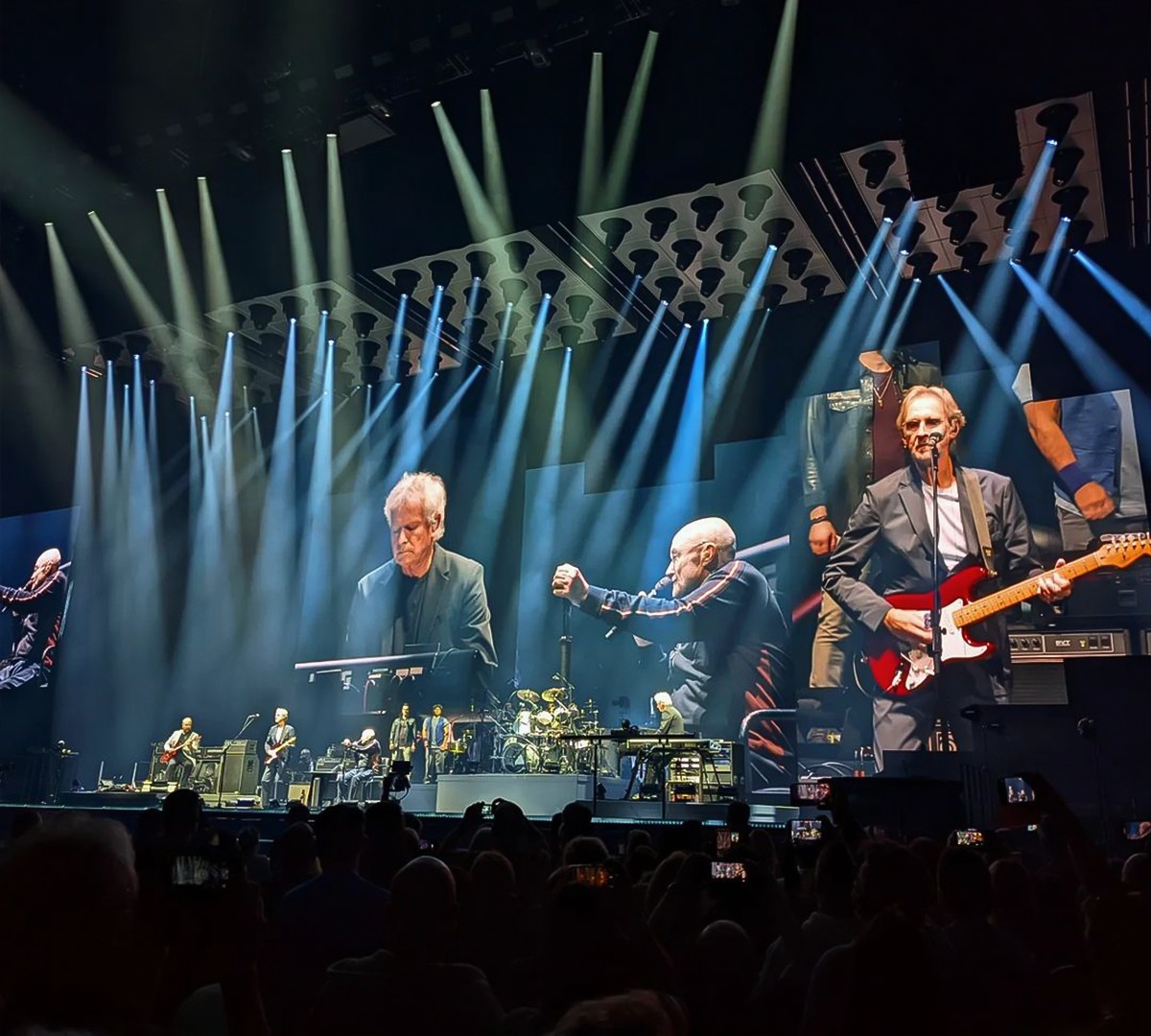
Once inside, however, with the lights down, such cosmetics count for nothing. Hackett and his band - which includes longstanding keyboard stalwart Roger King, second guitarist Amanda Lehmann, bassist Jonas Reingold, flautist/saxophonist Rob Townsend and drummer Craig Blundell - launched into a first half of songs from Hackett’s early solo ventures, such as Ace Of Wands, The Devil’s Cathedral, Spectral Mornings and Every Day. All very good, but it was, I suspect, the second act of the evening that most punters had come to hear - the 1972 Genesis album Foxtrot performed in its entirety.

Being only 5 at the time it came out, I would have missed the original tour for this album, which included Gabriel’s notorious (and, to his bandmates’ surprise) appearance in Dublin wearing a scarlet dress and a fox’s head (a literal representation of the Foxtrot album cover), commencing the costuming that would become the hallmark of his time as Genesis frontman until his departure in 1975. So it would be fair to say that my interest last night at the Apollo/Odeon was to experience something of the magic of an album that, while not changing the band’s financial fortunes, is still held in the hearts of fans as being one of considerable virtuosity, with a still-young band of gifted musicians writing complex songs about complex subjects.

© Simon Poulter 2022
Opening with Watcher Of The Skies, a tribute to an Arthur C. Clarke novel with a bit of Holst’s The Planets thown in, Hackett introduces his vocalist Nad Sylvan, the gloriously eccentric Swedish singer who, vocally sits between Gabriel and his successor, Phil Collins, but despite his long blond Scandi hair and somewhat theatrical mannerisms, blends into the band canvas, rather trying to take centre stage, as Gabriel would have done in 1975. 

Foxtrot’s first side is worked through in sequence, including the prescient social commentary of Get ’Em Out By Friday (a somewhat dystopian Gabriel song about a 70s newtown in which the idea is floated to have residents genetically shortened so that they fit smaller homes in order to build more of them). There is, too, Can-Utility And The Coastliners, a rare early Hackett composition, losely based on the story of King Canute who, you might remember, ordered the sea to be turned back in response to lickspittle sycophancy, something rock bands will know a thing about. 

To replicate the flip from Side 1 to Side 2 of Foxtrot, there is a mini interval, after which Hackett is provided with a classical guitar and a stool. Performing alone, Hackett plays Horizons, a beautiful, baroque instrumental which, in Hammersmith, underlines Hackett’s status as an under-appreciated classical guitarist (he has produced several albums of classical playing, alongside his rock releases). Faithfully following the album’s track listing, it’s a precursor to one of the most adventurous pieces of music any band has ever pulled off: Supper’s Ready

No doubt part-inspired - or at least encouraged - by the 16-minute, eight-song closing medley on The Beatles’ Abbey Road, over the course of seven parts Supper’s Ready romps through a variety of time signatures and themes, starting with the ghostly apparition Gabriel claimed to have seen, through the Lewis Carrroll-esque whimsy of Willow Farm, to the epic conclusion of  As Sure As Eggs Is Eggs (Aching Men's Feet), with its biblical reference to “a new Jerusalem”. Perhaps, on the original record, it appeared more as a collection of songs, but hearing the enture 23-minute suite performed live for the first time in my lifetime, there is an added power to the song that not even the rendition on the imperious live album Seconds Out (during the mixing of which Hackett quit the band) captured.

Many, many years ago, for only my second live review for the NME I saw Sade at the Royal Albert Hall, and was struck by the somewhat clinical, sterile recreation of the Diamond Life album that had propelled her to stardum. Live performances work best when there is some reinvention, either to mitigate the inability to recreate complex arrangements created in the studio, or simply to indulge the artist’s whimsy, and introduce some riffing. Hackett has no need for either. With a piece as intricate as Supper’s Ready - and indeed the entire Foxtrot album - there was no need for embelishment.

© Simon Poulter 2022

This applied, too, to Firth Of Fifth, the grandiose epic on Selling England By The Pound that opens with an extended piano solo - played by Tony Banks on the original, and here faithfully and expertly recreated by King - before the song opens out, heading towards its somewhat legendary guitar solo. I once made a tit of myself when interviewing Hackett, in which I told him that, as a 13-year-old, I’d learned to play the solo, note-for-note, on my Spanish guitar. He was suitably unimpressed. It is still one of the greatest rock guitar solos of all time, though usually criminally overlooked by Jimmy Page’s on Stairway To Heaven, or David Gilmour’s on Comfortably Numb.

Solos are, of course, one of the nadirs of rock concerts. This Is Spinal Tap captured the indulgent absurdity of it, and there is a taste of this with an extended bass solo by Reingold earlier in the show. Blundell introduces the final song of the night with an elongated workout on the drums, but I’ll give him that for two reasons: 1) Craig is a thoroughly decent bloke who recorded a video of encouragement for a friend of mine after she was caught up in the 2015 Bataclan attack and took up drumming as a coping mechanism; and 2) Collins and his co-drummers (Chester Thompson and, briefly, Bill Bruford) would perform a drum duet as a prelude to Los Endos, the closing song of the Trick Of The Tail album whenever it was played live. And thus, Los Endos closes the evening with Hackett and Co in all its grandeur.

I’ve often maintained Trick Of The Tail and Wind & Wuthering, the albums that bore Hackett’s final studio contributions to Genesis, are two of the band’s best, bridging the lyrical and musical flights of fancy of the Gabriel era, and predating the pop orientation that Collins, Banks and Mike Rutherford as a trio went for in the 80s. There have been claims that Hackett’s contribution to the band, over the six albums in as many years, has been diminished. Part of this maybe due to the dominance of writing by Gabriel, Banks and Rutherford, and then the perceived commercial success that Collins’ higher profile led to, long after Hackett had left. But listening back to the albums he played on, his guitar work plays a much bigger role in the soundstage than is ever given credit for. 

In Hammersmith last night, we were given a highly enjoyable reminder. His solo material notwithstanding, I suspect the majority of last night’s punters were there for a trip down Memory Lane. And they would have been richly rewarded. Compared to the disappointing final experience of Genesis, earlier this year at London’s O2 Arena, this felt like the real deal. A wallow, yes, but a thoroughly enjoyable, comfort food-for-the-ears indulgence, provided authentically by the original purveyor. 

Monday, 28 March 2022

Fading lights - Genesis at the O2 Arena

Picture: Instagram/Genesis-band


Clearly, I’m a devotee of unfashionable causes. When news broke that my football club’s owner was being sanctioned for his association with Vladimir Putin, and the club itself was to be put through the ringer as a consequence, there was little sympathy from across football’s tribal communities. Likewise, I knew that I wouldn’t enjoy all that much admiration (or is it empathy?) for going to see Genesis on Friday night, on what would turn out to be their penultimate live performance, 54 years after forming.

I’ve long accepted that Genesis are a Marmite band. A guilty pleasure, even. Amid the devotees from their origins as one of ’70s progressive rock’s pre-eminent acts, and those drawn to their catchy, mid-’80s MTV dominance, are those who just never got them (or saw them as just another outlet for Phil Collins’ ubiquity). Then there’s another group - those, like me, who’ve seen good in all their guises. Over the course of three nights at London’s O2 Arena, 60,000 fans of, mostly, a similar venerability, were of the same view. 

These were the final performances of a tour that had been truncated by the coronavirus (the first scheduled dates were delayed by lockdowns and then the London shows got postponed again by a band member testing positive for Covid), which started to feel like a stay of execution. The tour itself had been named ‘The Last Domino?’ - an intentionally ambiguous in-joke but not without its inevitability, given that an increasingly immobile Collins, robbed of his truly unique ability to drum by a congenital back problem and other health issues, had indicated that this would have to be it. Compared with other still-touring bands of a certain vintage (the Rolling Stones come immediately to mind, and Paul McCartney), the core surviving members of Genesis - Collins, keyboardist Tony Banks and guitarist/bassist Mike Rutherford  - were all 71 as they took to the stage on Friday (the still youthful-looking Banks turned 72 yesterday), so there’s nothing materially requiring them to bring the band to a halt. But from the moment Collins walked on stage, slowly and assisted by a stick, to take the seat he would occupy for the next two hours, it was clear that this Genesis would be different. 

Picture: Instagram/Genesis-band

With his stage school training, Collins was always an impishly lively frontman, ever since he came forward from the drum stool in 1976 to replace the outgoing Peter Gabriel. Live reviews frequently referred to his end-of-pier schtick, a change of tone from Gabriel’s eccentric but hesitantly-delivered fantastical stories which he used to tell between songs as the band retuned their notoriously fussy 12-string guitars. For the live version of their minor 1973 hit I Know What I Like (In Your Wardrobe), Collins developed a remarkable tambourine tarantella, colourfully extending the percussive agility that easily made him a peer of other thunderous drummers of his time, like Bonham, Moon and Rush’s Neil Peart. But no more. Knowing this, some expectation management would be required. 

This was to be a farewell performance, not just a wallow in nostalgia. Not that there was an obvious air of mourning in the air. Opening with Behind The Lines, the song I first saw them open with 41 years ago at Wembley Arena, the hair on the back of my neck raised a little. From that first moment of hearing and ‘seeing’ that song performed live, it has always struck me as the way to open any gig. “Brrrrang!” chimes the opening chord, followed by a fanfare-like keyboard riff. If I ever formed a band myself, I’d want to kick-off a gig like that. 

Long before the video hits, and throughout the years when they weren’t seen as ‘commercial’, Genesis were always a live band. Despite Gabriel, Banks and Rutherford (along with original guitarist Anthony Phillips) regarding themselves more as songwriters than rock stars when they started out, their shows never lacked impact, visually or musically. That has largely been down to the material, songs which - even in the band’s more pop-orientated era - have lent themselves to entertaining engagement live. I may not be a huge fan of the hits that came out of the ’80s, but the albums they were written for didn’t lack the more epic grandeur Genesis established as their stock in trade in the ’70s. 1986’s Invisible Touch album netted five hit singles, more from one album than the band had enjoyed in, then, 20 years of existance. It’s title track is still one of my least favourites, but others - performed on Friday like Throwing It All Away, Tonight, Tonight, Tonight and Land Of Confusion (whose Spitting Image-based video was tweaked to reflect the chaos of Covid), still stand up strongly live.

Picture: Instagram/Genesis-band

In 1977 Genesis released the live album Seconds Out, recorded on the tour for only Collins’ second album as lead singer. As a result, the double release comprised songs from the Gabriel era as well as the new stuff with Collins as singer. Tellingly, it contained only one song that had been released as a single - I Know What I Like, and yet it represents my favourite era of Genesis, with even complex, meandering, multi-part songs like Supper’s Ready found new life by Collins’ stagecraft. Their next release, ...And Then There Were Three, which followed guitarist Steve Hackett’s departure, included the single Follow You, Follow Me, which was the first Genesis track I ever heard on the radio. It’s a simple love song, set to a slowed down samba-like rhythm, and it reached No.4 in the charts. It’s popularity, especially in America, changed the band’s fortunes. The concert demographic started to change: whereas ’70s gigs were mostly attended by earnest young men with long hair, beards and army-surplus greatcoats, making notes on the songs they heard for discussion later over a half of mild, all of sudden there were women at Genesis concerts. 

The Duke album followed, and two more radio hits - Turn It On Again and Misunderstanding, competing with contemporary rock acts like Rainbow or Toto for FM radio airplay in the US. It marked a deliberate shift away from the fantasy stories to more immediacy in their songwriting. Collins inevitably took the blame, but Rutherford and Banks were still the main songwriters. Collins had always been the class clown to puncture the band’s public school loftiness, but he was gradually able to bring more of his own personality into the music. Good Lord, they even recorded a track featuring the Earth Wind & Fire horn section!

Which brings me back to the O2. Sadly, Collins has lost some of his vocal spectrum. It happens with age, but here, there were notable moments where his range was kept low, while - for the first time in Genesis history - two dedicated backing singers filled in some of the gaps in which Collins was struggling. But rather than feeling in any way let down, the band collectively played on. Collins himself, in the concert programme, admitted to his deficiencies. It wasn’t anything the crowd was going to complain about, either. This was an audience who had come to pay their respects to a band that had been a part of their lives for a very long time. They were rapturous when Genesis dipped into their deepest history, with the aforementioned I Know What I Like and the epic instrumental part of Firth Of Fifth from 1973 and even an excerpt from a 1970 track, Stagnation

Picture: Instagram/Genesis-band

Midway through the set, Rutherford, Banks, long-standing touring guitarist Daryl Stuermer and Collins’ uncannily talented 20-year-old son Nic on drums, repositioned around the seated singer to perform somewhat ‘unplugged’ versions of Follow You, Follow MeThat’s All and - to my delight - The Lamb Lies Down On Broadway. This was the title track of an album that, bizarrely, pre-dated punk, being a concept work built around the fantasy disappearance of a Puerto Rican street tough, Rael, into an imagined New York underworld (lyrically, it was Gabriel’s swansong). Here, though, stripped-down, it worked incredibly, suiting Collins Snr’s vocal limitations but sounding like it was always meant to be stripped back.

There were further treats from the past to close the show: after the almost obligatory performance of I Can’t Dance (which epitomised the band’s MTV dominance with its ZZ Top-aping video) - representing the band’s late-stage pre-eminence, there was an excerpt of Dancing With The Moonlit Knight, the opening track of 1973’s satirical Selling England By The Pound album, with its pastorality and references to “Green Shield Stamps”. In 41 years of seeing Genesis live, I’d never heard this track - an obscure entry in their canon at best - performed live. It was delightful. After the stomping pop, an example of the lyrical and musical individuality that, arguably, only this band could have ever produced, steeped in English tradition. 

For those who shunned the knowing commerciality that became Genesis’s hallmark, Moonlit Knight provided a reminder of how this band came into the world, around the time that The Beatles were inventing prog with the narrative concept of Sgt. Pepper’s Lonely Hearts Club Band, onto which David Bowie combined pop, rock and other artistic styles. Those early albums, Trespass, Nursery Cryme and Foxtrot may only have scratched the surface in places like Belgium and Italy, where the Gabriel-led Genesis enjoyed fanatical following, and now are politely “of their time”, but they contain many gems (even an early taste of Collins’ vocal beauty, the love song More Fool Me, along with Hackett’s truly innovative guitar virtuosity). There was, then, one more jewel from that first phase on Friday night: The Carpet Crawlers, one of the few real highlights from the sprawling Lamb Lies Down On Broadway record, its low-key vocal recreated perfectly by Collins, its musical subtleties providing a tender moment to end on.

With that, it was over. Literally (save for one final show the following night). As the full stage band dwindled to just Banks, Collins and Rutherford, who took a poignant final bow, it was time to reflect. All good things come to an end, and with rock bands you tend to want them to stop when they can and while they can. Banks and Rutherford could, probably continue (as they did in 1996 when Collins first decided to put his solo career first, and they brought in Stiltskin’s Ray Wilson in for one album and an ill-advised tour). But it seems unlikely. I would, sadly, even say it was unwise. Collins’ original departure was meant to give the other two an opportunity to prove that they are more than the sum of parts, but that denies the point that much of Genesis’s appeal for the greater part of their existence has been the knowledge that, since 1978, these three men were the band’s beating heart. Gabriel’s six albums defined the band in one way, while the eight with Collins brought with them hit singles. But it would be wrong to divide the band solely by their lead singers. The thread running through all 15 studio records is a style of songwriting that can be compared to no one else, not even the other stalwarts of the prog era, like King Crimson, Supertramp, 10cc, Yes or Pink Floyd. 

Of course, Genesis have never been to everyone’s taste, but for anyone prone to dismissing them for whatever prejudice or perceived prejudice they hold, they have always maintained a tradition of songwriting and song delivery established by A Day In The Life, Is There Life On Mars? or even Good Vibrations. Drama, narrative and, if you can excuse the record label pun, a unique charisma.If you had gone to see them on Friday night having never heard of The Return Of The Giant Hogweed, Squonk or Cinema Show, you would have heard a band of consummate musicians and songwriters, who for the better part of 54 years have made every note, every drumbeat, every chord, every riff and every vocal line count. 

At the start of this post I wrote about Genesis being a guilty pleasure. The trouble with that statement is that it places them in a similar category to, say, a Jason Donovan or a Rick Astley. But, then, to partition based on personal taste is to commit a facet of musical partition that I get very weary of. Taste might divide people, but talent shouldn’t. Genesis may have never been the most fashionable band, but the notion that fashion alone is the only diktat of popularity cuts no ice with me. Guilty pleasure, they may be, Marmite, even, but this band has been an unashamed part of my soundtrack since I was 11 or 12. My first forays with a guitar were to learn the solos and arpeggios of the early work, the infectious riffs of their later efforts. And in unsettling, troubling times like these, comfort is most welcome. On Friday night, in an O2 Arena still missing vast panels from its storm-wrecked roof, I found comfort, for the last time from a band that has been a part of my life for four-fifths of it. 

Marmite, they may be, but you know, I’m quite partial to it.

Picture: Instagram/Genesis-band


Friday, 29 January 2021

The future is here, finally, and it bites

In a week in which the UK passed the grim milestone of 100,000 coronavirus deaths, pretty much all other bets are off. Least of which, any carping about being denied life's simpler pleasures. You could, I suppose, measure the COVID timeline in terms of what has been curtailed and when.Take, for example, No Time To Die, the new Bond film: originally scheduled for November 2019, then shunted by reshoots to February last year, it was then kiboshed altogether by the emerging pandemic. The latest date, we're told, is this October. 

But whereas the Bond producers will easily earn their investment back, the music industry has been faring less well. There’s been no shortage of releases over the last ten months - many recorded stoically in home studio lockdown - but it’s live performance that artists seem to make their money from these days. Which means that if you’ve got an ambitious album and tour concept, these last few months will have been frustrating. 

Take, then, Steven Wilson, whose sixth solo album, The Future Bites, is finally released today. When I first spoke to him about it, it was the autumn of 2019, and the album was, by then, mostly ‘in the can’, bar some final tweaks. The next Christmas, when we met, he was justifiably excited by the concept being developed for the album, which would roughly follow a theme of commenting on the trappings of modernity (including online shopping - ironically before it became such a lifeline), and the ambitious, multimedia approach that would accompany its release. And then the virus struck, pushing back, first, the album's release, and then an extravagant tour that would see him headline London’s O2 Arena. 

That, in itself, was a massive milestone in his solo career. Because, let’s face it, you don’t just get to play the O2 if you don’t have the chops - or the audience - to fill it. Sadly, rescheduling has forced the O2 gig to be cancelled altogether, but a new tour will commence in September that will see Wilson play major cities, including a date at the legendary Hammersmith Apollo. It is, though, heartbreaking, as The Future Bites represents, without doubt, Wilson’s most adventurous breakthrough to date - in a more-than 30-year career that has seen him responsible for more albums than I can actually count, what with his Porcupine Tree, Blackfield, No-Man and numerous, relentless other projects. That’s a big claim, I know, but hear me out.

First, though, the history lesson, because I realise that I’ve been prattling away about someone you may not have even heard of. Which is, Wilson admits with heavy reluctance, par for the course. As a piece in The Times today points out, he may well be the most successful British rock star who can go shopping at his local Waitrose without being asked to pose for a selfie. And, yet, I’ve witnessed punters camped outside Parisian theatres hoping for a glimpse of him, or standing en masse in restaurants to raise their wine glasses in adulation. 

Despite this, however, and despite his last album, To The Bone, reaching number three in the UK (kept off the top by two blokes named Ed Sheeran and Elvis Presley…), and despite even selling out the Royal Albert Hall three nights running on the album’s tour, Steven Wilson is still the rock star you’ve never heard of. Mainstream radio even gives him a giant swerve, which I find baffling. To The Bone represented a change of direction, not only with a new record company (Universal offshoot Caroline International) and better promotion (which even saw him appearing in an extended live interview on BBC Breakfast), but with a record that blatantly embraced Wilson’s love of 80s pop. There was even an ABBA-esque single, Permanating, which delightfully confounded the fans that had followed him from the era of his proto-prog band Porcupine Tree, which had sort of evolved from an at-home bedroom project and into one of the more sizeable touring forces of the 1990s and early 2000s. 

However, that P-word - “prog” - may well be the sprig of garlic that keeps radio programmers at bay. He is unashamed of his association with the form (the oft-told story of his upbringing is that his first two musical influences were the Floyd’s Dark Side Of The Moon and Donna Summer’s Love To Love You Baby, gifts exchanged by his parents, Maureen and Mike, one Christmas). As an adult, his professional sideline remixing albums for King Crimson and Yes has maintained further links to the genre. However, he has also produced multichannel versions of albums by Roxy Music, XTC, Ultravox and Tears For Fears, revealing more than just an ear for more expansive pop.

Which brings us, kind of, to The Future Bites. Before getting into its thematic concept, it is a markedly different album to much of what Wilson has been known for. But not all. While Porcupine Tree may have been born out of a teenage soup of long hair and Home Counties rock guitar, Wilson’s own interests were being spread across an eclectic range of styles, some of which manifested themselves in the No-Man group with long-term friend and collaborator Tim Bowness. On his adolescent bedroom wall in Hemel Hempstead there was a poster of Prince who, along with David Bowie, has been a constant figure in his musical DNA. While his professional music direction would take a somewhat avant-garde rock route, electronic music would always be in his listening palette. Which is why the first thing you notice about The Future Bites is just how unlike a rock album it is. Throughout, it delivers atmosphere over bombast, restrained drum machine beats over epic tom-tom crashes, and while Wilson has always been quite deft at melodic songwriting, melodicism drives the textures of all nine tracks.

What also drives them is the underlying theme: the modern world. Wilson is, like me, 53 (we were actually born a week apart), but don’t mistake that statement for some prematurely aged fellow railing at things. The theme is more a reflection on the Internet age and how online behaviour pervades every aspect of life, from our perception of news to our absorption of information, how we relate to culture and even our addiction to online consumerism. Such a premise could sound dystopian, I agree, but the narrative Wilson puts forward is wry and observational. And it blends seamlessly with a musical approach that surely - surely - must place him more than ever onto the mainstream radar. In this regard, one track stands out for its employment of one Elton Hercules John, arguably pop’s most extravagant consumer, who Wilson arranged - through a friend of a friend - to have intone a series of consumer durables for Personal Shopper, a pulsing EDM track that offers a delightfully cynical take on online impulse buying. “Buy for comfort, buy for kicks/Buy and buy until it makes you sick”, Wilson sings, before Sir Elt kicks in with a shopping list that includes sunglasses, teeth whitener and even - cheekily - deluxe edition box sets…of which I confess to being guilty of…

Purist fans might baulk at the apparent absence of guitars on the album (there are, in fact, plenty, it’s just that they’re not turned all the way up to 11), but you get a sense that in being more atmospheric - and electronic - Wilson has given himself more room to move within. Thus, King Ghost is lush and reflective. On the other hand, 12 Things I Forgot chimes in with a snappy line in acoustic guitar accompaniment to a beautiful, strident pop song about regretful reminiscence. 

Both, however, bring out the best in co-producer David Kosten (aka Faultline), whose own solo work as well as production for Bat For Lashes and Everything Everything has accentuated a gift for texture. There are shades here, too, and in the background, of some of the myriad influences that play on Wilson’s ear, perhaps, labelmate Tame Impala on the scintillating Man Of The People (which, add Neil Tennant, could give the Pet Shop Boys a serious run for their money) or, at a squint, the funk of Wilson’s teenage hero, Prince, on Self IQ.

I may, in this review, have given the impression that The Future Bites is some wild departure from Wilson’s usual fare, and it is indeed another tonal shift. Some of his hardcore fans might rankle at that, but anyone who’s been paying close attention to his career will have noticed that change has been constant. Some changes, he’ll admit, have been more subtle than others, but he has never accepted the view that he is beholden to any one form of music, even if that dreaded ‘P’ word follows him everywhere. 

If there is any sort of compromise, it’s on the closing song, Count Of Unease. It’s what I call a proper closing song. I used to have this theory that, when putting albums together, artists would always programme them so that the final track of the record provides a sunset, a touch of autumnal melancholy. As a teenager, I would hear that final track fading out and feel sad that the whole experience was over. I later found out that, in the pre-digital days, how a vinyl record was sequenced owed more to the physics of certain types of songs requiring more plastic to accommodate bass and rhythm. I still don’t understand the science, so I will gladly settle for the notion that the closing song is indeed a farewell. Count Of Unease is that song, and to bridge to my previous point, is eminent of both the electronica throughout The Future Bites, but also the aural clues that have been there in Wilson’s music, right from the beginning. For all Porcupine Tree’s flights of prog-meets-metal grandeur, there were also lighter-touch moments of atmos and grace. 

Here is just that. But, rather than representing closure, it sets Wilson up for the next record (work of which is, I gather, already in progress), and the first strokes on a blank canvas that remind those just coming to his music that there are no rules to hit. He will always do whatever he damn well likes, and is all the more interesting for it.


Friday, 14 August 2020

I can feel it coming in the air tonight - Phil Collins is cool

Picture: YouTube

"No he's not!". "He never will be!". I can hear the tea being spat out from here. Phil Collins is, was and can never be cool. Everyone knows that. The problem is, no one really knows why, or bothers to find out why he shouldn't be. But let's come to that later, because the big news this week, along with the usual apocalyptic yada-yada about COVID-19, Britain being hotter than Hades and the worst recession in human history, is that Phil Collins has returned to the charts thanks to a viral video of 22-year-old American twins Tim and Fred Williams listening to his debut solo single, In The Air Tonight, for the first time.

ICYMI, the twins host a YouTube show, Twins React, in which they review videos of songs they've never heard before. Their reactions are the show's chief selling point but it has evolved into something more cultish, as the brothers from Gary, Indiana (the city on the shores of Lake Michigan where pop's Jackson family came from) explore a wider world of music. At first they focused on rap, with which they were more familiar, but then they were turned on to Frank Sinatra's I've Got You Under My Skin (Tim had, apparently, never even heard of Sinatra) and things like Radiohead's Creep. A review of Dolly Parton's Jolene received two million views, prompting a Twitter response from La Parton herself: "No point in begging. Jolene already stole these two."

My original copy of In The Air Tonight - bought from MJM Records in New Malden in January 1981

So, back to the twins' encounter with Collins' solo debut: pressing play, they are at first mildly intrigued by the opening hiss of a Roland CR-78 drum machine's hi-hat. It was this noise that arrested my interest at the beginning of January 1981 when, browsing in my local record shop, looking for something to spend my Christmas money on, I, too, heard In The Air Tonight for the first time. I was pulled in by those first couple of bars of synthetic beats followed by the three-chord minor key motif from a Prophet-5 synth. Then comes the haunting, echoey vocal: "I can feel it coming in the air tonight, oh Lord". In their YouTube review, the Williams twins start nodding and trading comments about the song's overall vibe as it begins, unsure as to whether they're listening to rock music or, due to the drum machine, early hip hop. Halfway through, Collins sings: "Well, the hurt doesn't show, but the pain still grows - it's no stranger to you and me" followed by the thunderous break of live tom-toms struck in quick succession - "duh-DUFF-duh-DUFF-dah-DUFF-DUFF-DUFF-DUFF-DUFF-DUFF!". "I have never seen nobody drop a beat three minutes into the song!" Fred exclaims. “That was cold, that was cold how he did that," his brother adds. "I ain’t gonna lie, Phil, you got me on that". As of Tuesday this week, the twins' video had been viewed more than four million times. Their subscriber base has also gone from 40,000 in early July to 400,000 today. Moreover, their review of In The Air Tonight has sent the song back into the charts. At the beginning of this week it sat at No.3 on the iTunes chart and was the fourth biggest selling song in the US in the week ending last Saturday.

The Williams' fĂªting of Collins might sound kitsch, like Glastonbury somewhat patronising a Barry Manilow or Lionel Richie with the 'legend' slot, but the now-69-year-old has form in this area: hip-hop artists have long been fans, even putting together a tribute album in 2001, Urban Renewal, that featured the likes of Ol' Dirty Bastard, Dane Bowers, Lil' Kim, Kelis, Pharrell and Montell Jordan covering some of Collins’ biggest hits. They weren’t, though, being ironic.

Here’s where we get into the complicated DNA of Phil Collins' appeal. Up until In The Air Tonight, and its accompanying album, Face Value, Collins had been the drummer in Genesis who, when Peter Gabriel moved on, took over as lead singer. But in the 11 years between joining Genesis, fifty years ago this month, and the recording of his solo debut in 1980, he’d built a deserved reputation as a truly gifted drummer, something his critics frequently forget or ignore. Although Genesis were often derided, particularly by the music press during the punk era (which they survived) for being proto-prog, Collins' own musical sensibilities were often glossed over, despite coming from a musical background that included The Beatles, Motown, Stax and R’n’B, and branching into jazz fusion with the noodle-mungous Brand X and hanging out with members of Weather Report. Collins may never have been considered hip, but he was a highly respected musician, respected across the musical spectrum for his truly inventive, melodic drumming in particular. A case in point is Turn It On Again, the Genesis chart hit. Drum nerds might note that it is in 13/8 time. Who knew?

In The Air Tonight was either a turning point, or even the turning point. Some argue that Collins never bettered it, but that would be unfair. It does, though, stand out in his solo career, a point not lost by the fact that it was the first song on the first of eight studio albums, several of which generated enormous chart hits on both sides of the Atlantic and turned Collins into a global superstar. In The Air Tonight was a defining statement for an artist who'd been, until Genesis had its first chart hit three years before, relatively unknown. It was also unique as a pop song; like Ultravox's Vienna (released five days later), Collins' single was relatively long at over five minutes. Both songs were also divided by tempo changes more than halfway through. Both, too, had a similarly dystopian feel. It was, though, the album that ITAT appeared on that set in train one of the most dominant musical careers of the 1980s and early 1990s. Because, after the opening track, with its added bombast halfway through, enhanced by the so-called "gated reverb" Collins had accidentally invented with producers Steve Lillywhite and Hugh Padgham while working on Peter Gabriel's third album, the album Face Value took an eclectic and meandering path through Collins' personal style palette. Track 2, It Must Be Love, was the kind of saccharine-sweet love song that Collins haters deflected the most. Track 3, a cover of the Collins-penned Genesis song Behind The Lines featured the Phenix Horns, the Earth, Wind & Fire brass section.


Hardcore Genesis fans, who’d barely adjusted to four-minute love songs replacing 22-minute epics, were horrified (worse came with the next Genesis album, 1981’s Abacab, which featured the Horns again). There was a plaintive dustbowl song, The Roof Is Leaking, and more brass-infused R&B in I Missed Again and Thunder And Lightning, and the album closed with a brave, technically brilliant cover of The Beatles' Tomorrow Never Knows, with a production that pointed much of Collins' later studio work back to what George Martin had pioneered with the Fabs to begin with. The trouble was, the albums that followed could be accused of repeating the pattern. Hello, I Must Be Going opened with a slowed down drum pattern reminiscent of In The Air Tonight's drum fill, while also providing a substantial hit with Collins' cheeky cover of You Can't Hurry Love. No Jacket Required included the clearly Prince-influenced Sussudio, and was, arguably, the album with the most hits and the biggest establishment of Collins as one of the 80s' biggest pop stars. But Seriously brought with it a similar array of hits and big productions, including I Wish It Would Rain Down with new chum Eric Clapton, Something Happened On The Way To Heaven and That's Just The Way It Is, though it was Another Day In Paradise that would endure, negatively, as another stick to beat Collins with, being a song sung by a multi-millionaire rock star about homelessness.

Collins' solo career started to spill over into his Genesis work, as the band moved further away from the prog epics about Giant Hogweed, and into becoming MTV darlings with their ‘wacky’ videos for songs like Illegal Alien and Invisible Touch. Collins took the blame for all this, without anyone bothering to know that it was as much the desired direction of Mike Rutherford and Tony Banks to go into a more pop direction. Collectively, though, Collins became an overwhelming fixture of the era. In some ways, he was the '80s. In The Air Tonight had featured heavily in the pilot of Miami Vice, in a scene featuring Crockett and Tubbs cruising down, fittingly, Collins Avenue in Miami Beach, in their Ferrari Daytona. Collins would later appear in the show, playing a shister game show host called ‘Phil the Shill’ (a somewhat notorious part, as the character used the word “wanker” on prime-time US TV at a time when a) it wouldn’t have been allowed on British television and b) most Americans wouldn’t have recognised the word, anyway).

At Live Aid, Collins appeared twice - first at Wembley and then later, courtesy of Concorde, in Philadelphia. Why? “Because they asked me.” Not even he realised how omnipresent he’d become: “I was always there,” Collins told The Guardian’s Dorian Lynskey in 2016 when publicising his autobiography, Not Dead Yet. “I was always in your face. People were always talking about me, usually not in a nice way. There was definitely too much of me.” Peak zeitgeist was probably reached when Bret Easton Ellis wrote his novel American Psycho - later made into a film with Christian Bale - in which the principle character, murderous ‘80s investment banker Patrick Bateman, expounds on Collins’ music: “His solo efforts seem to be more commercial and therefore more satisfying in a narrower way,” he comments in the film adaptation while telling a couple of prostitutes to act out his sick fantasies. This, probably, was at odds with the ‘Nice Guy Phil’ persona that been built up by first being a decidedly un-rock-and-roll rock star, and then developing a solo career around music that, well, your granny would like. But it didn’t stop him selling millions more records, working on Disney musicals like Tarzan, and being the go-to drummer for every Prince’s Trust celebathon (he was a trustee of the charity).

In some respects, there are two, possibly three Phil Collins. There is the gifted drummer who played more of a role in Genesis’s early phase than many would acknowledge, and still kept them interesting when he took over as singer in 1975; then there is the global pop superstar, whose hundreds of millions of record sales, at one point, sat behind only Paul McCartney and Michael Jackson’s respective totals, whose tempestuous love life just seemed to fuel more albums of ballads and self reflection; and then there is a third Collins, vilified for divorcing his second wife by fax (he didn’t) and voting Tory (he didn’t, in 1992, as was reported - he’d told Piers Morgan, then editor of The Sun’s Bizarre column, that he’d consider going abroad if the incoming Blair government raised taxes, which became seen as a hardline Conservative position). But then he met and married his third wife, the Swiss national Orianne Cevey, and moved to the Swiss Riviera. For the tabloids, the story wrote itself.


More recently, though, Collins has been less uncool as unfortunate. Twenty years ago he temporarily lost his hearing, the start of a chain of health issues that have led to, today, him being unable to drum, walking with a stick, and performing from a chair on stage. We can assume that the Genesis reunion tour - now rescheduled to next year - will not see the once impish Collins leap about the stage and perform the elaborate tambourine ‘tarantella’ during the song I Know What I Like (In Your Wardrobe). Certainly there will be no mesmerising drum duets with second drummer Chester Thompson. Here, then, lay the core of what it was that I liked about Collins in the beginning.

However, this doesn’t address the issue of whether Collins can ever be considered cool, even if his reputation in the music industry - and not just the hip-hop community - is mostly intact. The Tory/tax exile mythology may have skewed views, notably Noel Gallagher’s (and even Bowie once cruelly referred to his ’80s pop spell as “my Phil Collins years”), but for those prepared to wade through the syrup of his ballads - brilliantly lampooned by Spitting Image with a profusely blubbing Collins singing Hello, You Must Be Going - go back to the period of Collins’ history which counts the most for me, as a member of Genesis in their most creative, musically contrarian phase, before the videos and US Top 40 assault.


Even when Collins was ‘just’ the drummer, sat behind the increasingly outrageous Gabriel, guitarists Rutherford and Steve Hackett hunched over 12-string guitars to the right, and keyboard player Banks adopting an equally slumped posture to the left, he applied techniques that made most other rock drummers look decidedly pedestrian (which is why he ended up doing side work for Robert Fripp, Brian Eno, John Cale and other contemporary luminaries). When he stepped up to the lead singer’s microphone, he brought an everyman appeal that contrasted with Gabriel’s previous aloofness. That’s the era I’d point to and say, you know what? Phil Collins was pretty cool. He still is, to be honest, but just don’t let that get in the way of established media lore.

Wednesday, 4 March 2020

And Then There Were Three...again

Picture: Genesis/Patrick Balls
It's the weirdest of coincidences that, on the day that it was announced that Spitting Image is to return, Genesis announce a comeback tour. Phil Collins was, arguably, a deserved target of the show's ribbing back in the mid 1980s when he was, even by his own admission, everywhere. The show's puppeteers even returned the back-handed complement when they provided rubber versions of the band for their Land Of Confusion single's 1986 video. This period was peak Genesis. Peak Collins, too. Even Mike Rutherford was also getting in on the ubiquity with his side project, Mike + The Mechanics, enjoying a string of hits. Former lead singer Peter Gabriel was also in the midst of his own purple patch with the global success of the So album and its hits like Sledgehammer and Don't Give Up, adding to the visibility of the band he co-formed in 1967 and left in 1975.

That, however, Collins, Rutherford and Tony Banks should have, today, announced a tour of the UK and Ireland, 13 years after what appeared to be their farewell tour, is curious. Rumours have been circulating since January of the trio reforming after they were spotted together at a New York Knicks match, a somewhat random event seeing as neither band member had exactly been seen as fans of American basketball. Moreover, a Genesis reunion - even from lifelong fans like me - is hardly something we'd been counting on. Since their 2007 Turn It On Again Tour it had widely been assumed that the band had wound themselves up. Their studio, The Farm, near Dunsfold in Surrey was shut down, Rutherford appeared to be focusing more on his work with the Mechanics, Banks was focusing on his acclaimed classical music work, and Collins...well, he seemed to have been enduring an endless run of ill-health, including his admission of a near-death experience as he succumbed to excessive drinking. Since then, he has appeared increasingly frail, the result of surgery in 2009 on his back, and continued issues with his vertebrae that has rendered him confined to singing from a chair while performing in solo shows as part of his personal own comeback. Sadly, in his most recent TV appearances, he has looked a painful shadow of his impish former self, coming across as increasingly elderly, despite being the younger of the trio (Banks turns 70 later this month, Rutherford catches up in October, Collins next February).


That places questions on the veracity of the tour announced today. For his solo live performances, Collins has drafted in his teenage son, Nicholas, for drumming duties and with eerily authentic effect, too. Collins' haters, while perhaps justifiably knocking his ubiquity in the 80s and 90s, usually forget what an incredible drummer he was, with a unique melodic ability (his signature In The Air Tonight drum fill actually belies his broader talent, first honed in his early days in Genesis, with its influences of jazz and R'n'B drumming). Thankfully, his son has inherited the drum gene, but a Genesis show without Collins Senior and longterm second drummer Chester Thompson doing their mesmerising duets will be somewhat lacking. It's sad, but I guess not everyone goes on forever.

I should, at this point, declare why I'm so defensive of the band, even in the face of whatever music cred I might profess to have. Genesis, to me, are more than some guilty pleasure. They were the first band I saw live (Wembley Arena, 1981); their 1978 album ...And Then There Were Three was the first LP I bought with my own money (MJM Records, New Malden, inevitably no longer there). I even earned my first writing fee reviewing a 1985 Collins gig at the Royal Albert Hall for the NME. They were, along with The Police, Rush, Bowie and Elvis Costello, amongst the first acts I obsessed over, prompting the teenage me to invest in their back catalogue - albums like Nursery Cryme, Selling England By The Pound and Trick Of The Tail, records which would be defined as quintessential prog rock, without anyone - then or still - fully understanding what that term meant. True, some of their songs, like Return Of The Giant Hogweed and Harold The Barrell, were somewhat outrĂ©, but in their first true hit, I Know What I Like (In Your Wardrobe), they presented a soulful groove more reflective of Gabriel's R'n'B leanings than of the art rock movement they were seen to be at the vanguard of, along with King Crimson, Yes and Pink Floyd. With The Lamb Lies Down On Broadway, Gabriel's swansong as lead singer, they even introduced a punk element, with the double concept album charting the journey of Puerto Rican street tough Rael's journey into a bizarre New York underworld. The appeal of music like that of Genesis in the 1970s was the combination of storytelling and engrossing music that drew you in to another world. This wasn't trite pop, a moment's entertainment, but something more involving. No wonder their core audience was, for many years, intense, long-haired young men wearing army-surplus greatcoats and a noted lack of female company. Here, though, is where people lose Genesis. Until Gabriel and guitarist Steve Hackett left the band, they were characterised by wonderful but sometimes meandering fantasy songs. That said, Seconds Out, their 1977 tour album, remains my favourite live album of all, eclipsing even The Who's Live At Leeds and Humble Pie's legendary Performance - Rockin' The Fillmore for energy.

...And Then There Were Three marked the start of a move away from quintessential prog. The single Follow You, Follow Me brought them a new, pop audience. Notably it also marked a greater prominence of women at their concerts. And this was 1978, when punk was supposed to have done away with such bands (a myth - John Lennon was said to be a fan of The Lamb Lies Down On Broadway, while The Clash's Topper Headon once rushed up to Phil Collins at an airport to declare his appreciation). With their next album, Duke, they were still storytelling, but Collins' increasing pop influence was already notable, with hits (especially in the US) like Turn It On Again and Misunderstanding sitting alongside distinctly Collins-penned love songs like Please Don't Ask, material that had come out of the same writing for his divorce-inspired breakthrough, Face Value. What followed was the band's transition into a fully-fledged pop band, much like The Police or Madness, I suppose, enjoying hit after hit supported by witty videos that brought them to a global audience in a way they'd never really managed during the 1970s when they were, arguably, at their most interesting.

Here, though, marks the dividing line between diehard fans and those brought to the band via the heavily-rotated MTV hits. Some maintain that Genesis lost their soul when Gabriel left in 1975. I'll maintain that they became enriched by the departure. A Trick Of The Tail, which introduced a reluctant Collins as lead singer in 1976, is arguably their best. But the Gabriel era still hangs heavily over the band's legacy. Even reports today about the 2020 reunion tour couldn't help themselves from mentioning that Gabriel would not be taking part. "Peter left the band 45 years ago and he's been trying to live it down ever since," joked Tony Banks this morning about his former schoolfriend. "When they put his birthday in The Times, they always say, 'Peter Gabriel - Genesis singer.' And I think, 'What's the guy been doing since then, for God's sake?'". Taking a more serious tone, however, Banks pointed out that even if they could persuade Gabriel to join them (unlikely as he turned down the idea in 2005), most of the songs people know came after his departure. Fair point.

Picture: Facebook/Genesis/Stephanie Pistel

There are, then, two testaments to Genesis. The band formed at Charterhouse in the late 1960s, and won their first record deal with Jonathan King by emulating the Bee Gees' sound at the time (pre-disco - think Massachusetts) as he was a fan. They spent their first few albums eschewing the blues-based rock prevalent at the time by fusing pop, rock, classical and even jazz sentiments into something truly unique. I'm never going to win over the haters, here, but the 70s Genesis albums still hold a magic, even in some of their unashamedly less cool moments. I suppose you had to be there.

So, will I be there in November when they tour the UK? I'll be honest, my thoughts are mixed: I've always regretted only seeing Bowie the once (the horrendous Glass Spider show in 1997), same with Pink Floyd. I've seen the Rolling Stones five times now, and would readily go for a sixth, even as they age gracefully/disgracefully. Indeed, the Stones are still the benchmark for venerated acts remaining out on the road. Having seen footage of Collins' recent solo shows I'd be lying if I thought he will be anything like the last time I saw Genesis, at Twickenham in 2007. But here's the thing: despite their live prowess, they have always been about the songs. Indeed, when it looked like their recording career wouldn't take off, they considered themselves songwriters first, writing for others. Tony Banks still exemplifies this, being the least comfortable in the spotlight. The stage school-educated, former child actor Collins was always the more natural performer as a result of his upbringing, although even he was initially reluctant to step forward from the drum riser after Gabriel left.

Of all of the Genesis line-up, past and present, still certainly worth watching live, it is guitarist Steve Hackett. He has been successfully touring the classic albums he played on in their entirety in recent years, highlighting the guitar solos that - not always recognised - were as much signature of the Genesis sound as anything else. Hackett's shows, which have included complete renditions of Selling England By The Pound and his final studio appearance, Wind And Wuthering, have brilliantly fulfilled the 'older' fans' needs, even supplanting Gabriel's voice with the wonderfully eccentric Swedish singer Nad Sylvan. Wisely, Hackett hasn't pushed into the band's catalogue after he left, which saw them move away from the "prog" tag, mixing longer and shorter songs and generally being more accessible (in other words, 'commercial'). The hits that followed will, I'm sure, comprise the bulk of their sets in November, much as they were on their supposed final tour in 2007 ("There are a few old dogs that won't be running," Collins said today, pointing out that what they will perform wouldn't include songs powered by his drumming). With Collins himself no longer able to drum, and if still confined to a chair on stage, part of the energy that made Genesis a genuinely exhilarating live act will be lost. Though reluctant to be the frontman at first, his charisma was core to the band's overall entertainment value, often taking a less than reverent tone to songs which, from a certain angle, could be described as somewhat rarified.

What is certainly not the case is that this tour is one last boost to the pension fund. Having sold more than 100 million records over their 52-year career, what's brought them back to the road is the recreation of something they've missed personally. You can be cynical about that, but having followed Genesis for 42 years, what they do together - like it or not - is something special to them. "We all felt, 'Why not?'" Collins told BBC News. "It sounds a bit of a lame reason - but we enjoy each other's company, we enjoy playing together." Rutherford added that with Phil touring again in the last couple of years "it seemed the natural moment to have a conversation about it." And, he added, it's not like they had been overstaying their welcome in recent years. "I worked it out and we've only done two shows in the UK in the last 28 years, so we haven't over-worked it." I'm sure the shows will sell out - Genesis have proven over their five decades-plus to be impervious to fashion - it's just a debate as to whether the magic will be there again.