Showing posts with label Led Zeppelin. Show all posts

Friday, 14 July 2023

Squaring The Circle - the story of two of the most important figures in rock history

Aubrey ‘Po’ Powell and Storm Thorgerson
Picture: Hipgnosis

To men of a certain age – and it is, almost exclusively men – album covers are, or at least were, a big thing. They probably still are, but it’s actually hard to think of the last time you heard of an album cover making headlines in the age of streaming.

There was a time, though, when an album cover was almost as significant as the music contained on the vinyl within. Earlier this year I interviewed journalist Mark Blake about his book Us And Them, which tells the story of arguably the greatest purveyors of album design, Storm Thorgerson and Aubrey ‘Po’ Powell – collectively the design house Hipgnosis. Their work between 1968 and 1983 produced, most famously, the artwork for Pink Floyd (including their opus The Dark Side Of The Moon), but also more than 250 sleeves for artists as varied as Led Zeppelin, Paul McCartney, Peter Gabriel, Humble Pie, 10cc, Leo Sayer, Genesis, ELO, Black Sabbath, Olivia Newton-John and XTC. “The Hipgnosis story kind of follows the arc of the LP, and the LP ‘taking over’ from the single as the primary focus of bands,” Mark told me. “[The Beatles’] Sgt. Pepper’s Lonely Hearts Club Band was a game changer in that sense. So, their career follows the art where the LP was king.”

That career is now the subject of a film by Dutch director and photographer Anton Corbijn, himself responsible for iconic album art of his own, having been most closely associated with Depeche Mode and U2, as well as taking iconic images of everyone from Robert Plant and Jimmy Page, Bob Dylan, and Bruce Springsteen to Robert De Niro and Clint Eastwood. 

Squaring The Circle, Corbijn’s debut as a documentary maker (having previously made dramas like Control, about Joy Division’s Ian Curtis and The American with George Clooney), pays homage to trailblazing legacy of Thorgerson and Powell and how they took the concept of cover art - which, for most of the pop era had largely been portraits of the bands - to conceptual pieces of art which complimented or even extended the often progressive, lyrical nature of music they enveloped.

With archive clips of interviews with the late Thorgerson, narration throughout by Powell (who brought the idea for the film to Corbijn) as well as new interviews with the likes of Pink Floyd’s David Gilmour and Roger Waters, Sir Paul McCartney, Led Zeppelin’s Robert Plant and Jimmy Page, Noel Gallagher and Peter Gabriel, the documentary expands on the studio’s work amid the context of rock counter-culture.

Peter Gabriel’s first three, Hipgnosis-designed albums

“There was an enormous amount of goodwill towards Hipgnosis,” Corbijn told The Guardian recently about the involvement of many of Thorgerson and Powell’s muses. “People just wanted to make [the film] work. They were generous. Everyone was proud of their albums and the work they had done with them.”

“Growing up in the late ’60s and ’70s, I was obsessed with music and everything connected to it – especially the album covers,” Corbijn says as a pretext to the film, adding that “record sleeves were a huge part of my education. I clearly recall the moment I first saw the sleeve for Atom Heart Mother by Pink Floyd, and the Peter Gabriel sleeves [whose first three solo albums were untitled save for his name and an iconic image]. They just blew me away and this led me on a journey of discovery towards Hipgnosis, who designed these and some of the most memorable sleeves from that time.”

Without doubt, The Dark Side Of The Moon looms large in that pantheon, with Thorgerson and Powell knowing Pink Floyd since their school days together in Cambridge, before moving to London. “Hipgnosis were unique in these early days and they set the bar very high,” says Corbijn.

Thorgerson was very much the ‘ideas’ half of the duo, while Powell, a photographer, had a more instinctive, snappers approach. When combined with the creative freedom they were afforded by bands and their record companies, the gallery of Hipgnosis’ output deserves a chapter of its own in the history of popular music. “They conjured into existence sights that no one had previously thought possible,” says Corbijn. “They produced visuals which popularised music that had previously been considered fringe, and were at the white-hot centre of the maddest, funniest and most creative era in the history of popular music.”

Hipgnosis at work, 6 Denmark Street, London
Picture: Hipgnosis

Album sleeves, he says, during this period became a force in their own right. “In the ’80s, of course, we got CDs, so the album sleeve sort of deteriorated, and the art with it, Corbijn adds, saying that, as a photographer, he was drawn to Hipgnosis’ work by the images they used. He marvels at how they created works of art: “Before we had all the intricate things we can do now on the computer, they did it with a knife and glue, and pieces of paper,” he recently told Collider. “They made really incredible collages and made the impossible possible.”

As the film reveals, Thorgerson and Powell often went to great lengths - and expense - to produce their album art, notably the images for Pink Floyd’s Wish You Were Here album and, of course, the ‘flying pig’ cover for that record’s follow-up, Animals. It’s this ambition that inspired the documentary’s title. “‘Squaring the circle’ means doing the impossible, but it also represents the circular record going into a sleeve, Corbijn explained to The Guardian.

“One of the craziest things - it’s also in the film - is a sleeve for 10cc [for the Look Hear? album],” Corbijn recalled to Collider. “They saw the idea of having a sheep on a couch in a beautiful ocean. So they went all the way to Hawaii, not realising [there were] no sheep in Hawaii, and there were no [psychiatrists’s] couches either. So they had a couch made, and they had one sheep, they found one sheep at the university, and they managed to give it a lot of Valium and shot it.”

While Noel Gallagher quips in the film that album covers represents “the poor man’s art collection”, there’s no escaping the fact that Hipgnosis have produced some of the most recognisable images of all time, with The Dark Side Of The Moon’s light-entering-a-prism seared in culture (receiving no more prestigious a nod to the zeitgeist than being parodied in an episode of The Simpsons). “I think both of them have a complicated relationship with  Dark Side,” Mark Blake told me earlier this year. “It’s not their favourite work, but it is their most famous work. I don't think it's a very simple design, and it doesn’t have the narrative quality to it as Wish You Were Here did a couple of years later, which I think was certainly one of Storm’s favourite Floyd covers.  So, I think they're both a little bit conflicted about Dark Side, really.”

For his film, however, Anton Corbijn had to negotiate around the frail relationships that exist between the surviving members of the band, most notably the fractious dynamics between founder member Roger Waters and guitarist David Gilmour, who joined in 1967 as co-founder Syd Barrett’s behaviour became ever-more erratic. Barrett himself makes a brief appearance in Squaring The Circle, in a poignant moment when Powell recalls an overweight and almost unrecognisable Barrett visiting Abbey Road studios in 1975 during the recording of Wish You Were Here, by then succumbing increasingly to poor physical and mental health. It is, apparently, a moment that continues to move the band’s remaining members.

Hipgnosis images used for Pink Floyd’s Wish You Were Here album

“I guess everybody knows they have four managers these days – for every member there’s a manager,” Corbijn semi-joked to Collider with typically understated Dutch humour. “But I guess the love for Hipgnosis overrode all that, and they wanted to be part of this. I mean, they were not in the studio at the same, but they all said yes to it in the end.”

Pink Floyd, in particular, gave Thorgerson and Powell a platform. Their abstract, obtuse and often ethereal concepts led them to other exponents of early ’70s progressive music, like Wishbone Ash’s Argus, which in turn led to Led Zeppelin’s Jimmy Page inviting Hipgnosis to design the House Of The Holy sleeve (which depicted Northern Ireland’s Giant’s Causeway). That, then, attracted Paul McCartney’s attention, bringing the studio in to realise his concept for Wings’ celebrity-themed Band On The Run cover.

“I hope people see it as a fun documentary, as well as an educational one, regarding that period of music and graphic design,” Corbijn says of Squaring The Circle. However, it also addresses how the Thorgerson/Powell partnership came apart. Having moved to London during the 1967 ‘Summer Of Love’, the duo shared a South Kensington flat, first using university facilities to build their reputation for art (including their debut for Pink Floyd, A Saucerful Of Secrets in 1968) before opening the Hipgnosis studio at 6 Denmark Street - London’s musical mecca known as ‘Tin Pan Alley’. 

But by 1983 - a year after the launch of the CD - Hipgnosis as, largely Thorgerson and Powell (along with often forgotten Peter Christopherson) - they decided to call it a day. Powell addresses this in the film, breaking down in the process, much to Corbijn’s surprise. “I didn’t see it coming,” Corbijn says of the scene. “It was a beautiful moment in the film. He clearly misses Storm terribly.”

Po and Anton
Picture: Anton Corbijn

As much as Squaring The Circle celebrates an era of album covers that broadly paralleled the rock era itself, it also marks the decline of an art form, first by the introduction of the Compact Disc in 1982 (Hipgnosis gave up album design in 1983 and switched to making music videos) and more recently, by the advent of streaming. It’s a point Noel Gallagher makes in the film, highlighting the lack of appreciation for album covers shown by today’s younger consumers, which may be the result of both record companies trimming their artwork budgets, and the thumbnail formats of streaming platforms making the impact of album cover art negligible. “The importance of the record sleeve has diminished,” Corbijn agrees. “In the ‘70s, for young kids there wasn’t much else to spend money on. Yet you had to save up to buy something, so it was meaningful. Now nothing is meaningful because you can get it at the touch of a button.”

Squaring The Circle opens today in UK cinemas and via streaming services. It also be released as a collector’s edition Blu-ray Disc on 7 August.

Arc Of A Diver, my post on Mark Blake’s biography Us And Them can be read here.


Saturday, 28 January 2023

Art of a diver

Just beyond the eastern extreme of California’s Yosemite National Park, not far from the border with Nevada, sits Mono Lake, a salty body of water formed three-quarters of a million years ago. I came across it considerably more recently than that - 1992 to be exact - but at the time had no appreciation of the cameo it had made in my musical adolescence when I stopped there for what Americans politely term a “comfort break”.

For context, I was midway through a month-long tour of the American West, albeit in December when the tourist hordes are elsewhere. Having driven from Los Angeles up the Pacific Coast Highway to San Francisco, and then north-east to snowed-in Lake Tahoe, I was heading south towards Death Valley along the scenic Highway 395, with California’s spinal Sierra Nevada mountains to my right. Just south-east of Yosemite, I came across Mono Lake and its seemingly abandoned visitor centre. Making use of its facilities, I then took in a view of the lake’s eerie stillness, framed by unique tufa formations. It would be another 25 years - and several visits further to that part of California - before I’d come to realise where I’d seen that tufa before. On a display wall at London’s V&A museum, as part of the Pink Floyd: Their Mortal Remains exhibition, was a blow-up of the inner sleeve of the band’s ninth studio album, Wish You Were Here, depicting a perpendicular diver performing a handstand in, yes, Mono Lake. 

The image was the idea of Aubrey ‘Po’ Powell, the photographer and co-founder with Storm Thorgerson of the Hipgnosis design studio which, from the end of the 60s to the beginning of the 80s produced some of the most distinctive album covers ever committed to 12 inches-square of cardboard. Over 15 years, they produced more than 250 sleeves for artists as varied as Led Zeppelin, Paul McCartney, Humble Pie, 10cc, Leo Sayer, Genesis, ELO, Black Sabbath, Olivia Newton-John and XTC, as well as Pink Floyd, with whom they became most closely associated.

It’s the perfect subject, then, for Us And Them: The Authorised Story Of Hipgnosis, a new book by journalist Mark Blake, whose previous work includes arguably the definitive Floyd account, Pigs Might Fly. “I’d always been quite interested in the idea of doing a book about Hipgnosis,” Mark declares. “I’d interviewed a lot of their associates for Pigs Might Fly - particularly the people who were around at the beginning of their work, their contemporaries, their friends from Cambridge and London in the early days.” A book about the creative duo was a natural next step, especially as Mark had come to know Powell and, in the later years of his life, Thorgerson, in particular, working on the very V&A exhibition I’d been to see. 

Hipgnosis and Pink Floyd’s histories are intertwined: Thorgerson and Powell had been cohorts of the band’s founder members, Syd Barrett and Roger Waters, in Cambridge before they all migrated to London to attend universities. There they met Nick Mason and Rick Wright, eventually becoming fixtures of the capital’s underground music scene as ‘The Pink Floyd Sound’. 

A year after Pink Floyd - as they became - released their debut album, The Piper At The Gates Of Dawn in 1967, Thorgerson and Powell established their working relationship with the band. “Storm was attending the Royal College Of Art, studying film, and Po got a job designing sets for the BBC,” says Mark. “Then Po got sacked and fell into low levels of criminal activity - bank fraud, stealing cars and so on. He got into an awful lot of trouble. It was then that they decided to talk Pink Floyd into letting them design the sleeve for their second album, A Saucerful Of Secrets.” Released in 1968, and made amidst the deteriorating mental health of Barrett (whose departure midway through recording led to David Gilmour joining the group), the album was only the second time that label EMI had allowed an artist to use designers from outside their own in-house art desk. Thorgerson and Powell took it as an opportunity to exploit the changing nature of record covers.

A Saucerful Of Secrets led to the pair designing for Pink Floyd’s labelmates at EMI and, later, its Harvest subsidiary, at first making use of the RCA’s photography faculty (even though Thorgerson wasn’t studying the subject and Po wasn’t even at the college), before being rumbled and thrown out. Instead, they turned the bathroom of Powell’s then-girlfriend into a dark room. This was to change towards the end of 1969 when the pair upgraded: “They moved into a studio in Denmark Street where they began doing stuff for bands like Argent, Quatermass, Toe Fat - all these late-60s, early prog rock,” says Mark. They also took on photographic work came for magazines and book covers. 

“Much of their success can be traced to that of The Beatles’ Sgt. Pepper’s Lonely Hearts Club Band,” says Mark, referring to the grandaddy of progressive rock and its ambitious pop art sleeve designed in 1967 by Peter Blake and Jann Haworth. That landmark inspired a decade of graphic design in rock which saw Hipgnosis, as well as their equally conceptual contemporary Roger Dean, taking cover art into new realms of creativity and expression. Prog bands like Pink Floyd, Yes and Genesis became fertile muses for such designers, turning cover art into an integral component of the narrative their records pursued, invariably conveying dioramic third dimensions through fantastical, somewhat lyrical and always unique imagery. 

For Thorgerson and Powell, getting their concepts across the line with some bands often owed more to the force of personality than creativity alone. “There was one slightly oddball character in Storm, and the slightly more measured character in the shape of Po,” Nick Mason tells Mark in the book. “And it stayed that way for the next fifty years.”

Storm Thorgerson and Aubrey ‘Po’ Powell

As their reputation grew, from 1968 and into the new decade, Hipgnosis became particularly prevalent working for artists sat on various degrees of the progressive spectrum, producing sleeves for myriad acts like Humble Pie, Emerson Lake & Palmer, Rory Gallagher, T-Rex, Wishbone Ash (for their album Argus, with its seminal cover) and even Syd Barrett, for his haphazard but still loved post-Floyd solo albums. At the same time, the relationship with Pink Floyd continued to bear fruit, with covers for the albums More, Ummagumma, Atom Heart Mother, Meddle and Obscured By Clouds.

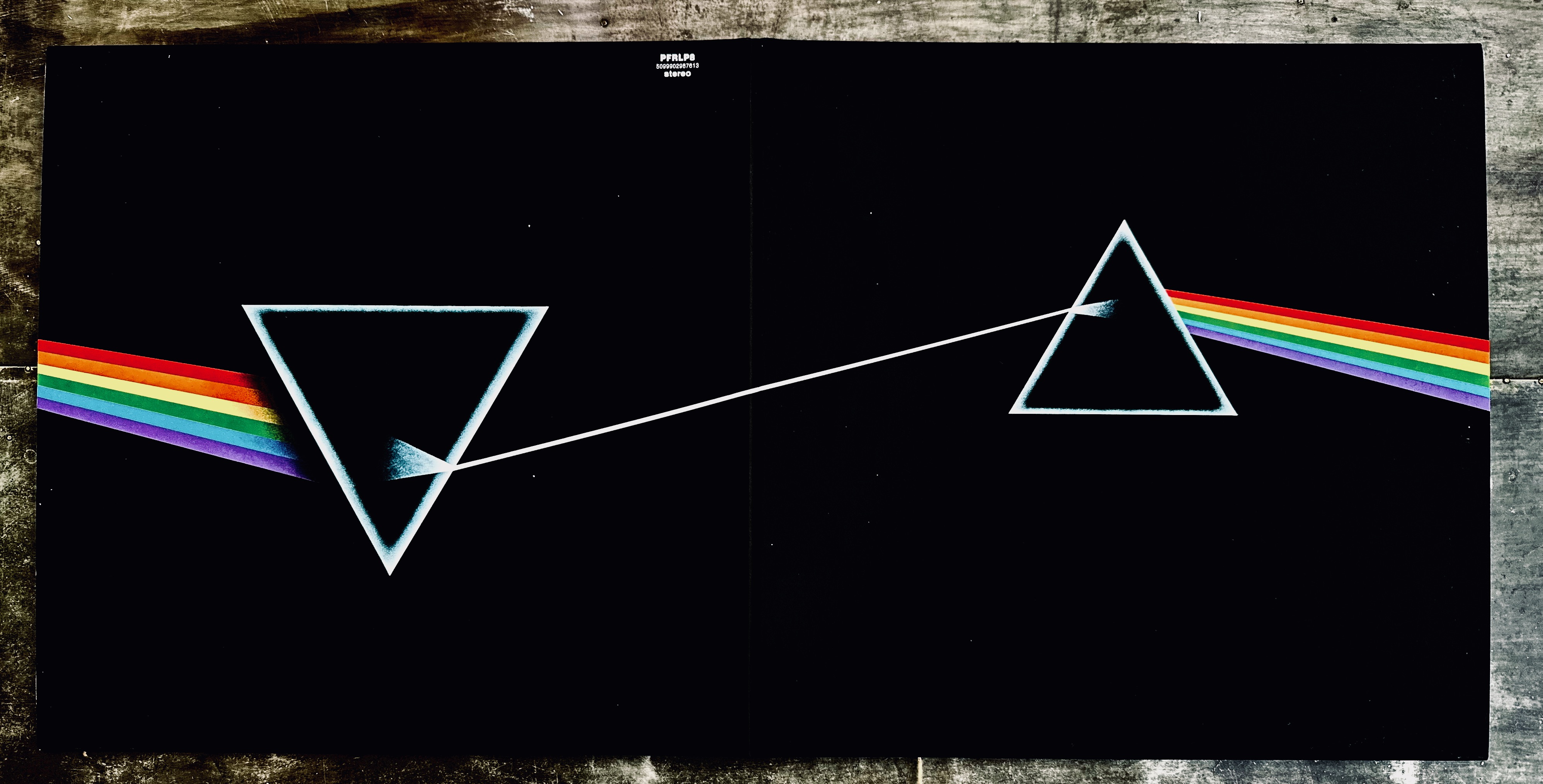
However, the album that still defines the Hipgnosis legacy - and possibly the entire genre of LP art - came in March 1973: The Dark Side Of The Moon. Thorgerson and Powell’s brief from Pink Floyd was to produce something uncomplicated, a contrarian response to opinions amongst the suits at EMI that their previous sleeves for the band had been belligerently obscure and even unmarketable. What they came up with - with a little help from a school book - was the now singular black cover with its beam of light dissipating through a prism into a spectral rainbow.

“I don’t think there was so much foresight and forward thinking in it,” says Mark Blake. “A lot of the time it’s ‘We’ve got to get a cover out - there’s a deadline looming!’. The band wanted something simple so Storm and Po found the prism design in a physics textbook and ripped it off, getting their illustrator George Hardie to create a beautiful design.” To make up for the spartan outer cover, Hipgnosis included some visual extras. “You got the poster of The Great Pyramid and a load of stickers,” says Mark. ”That was Storm trying to shoehorn some bigger ideas in.”

Nowhere on the front or back was there any mention of Pink Floyd or the album’s name. Though not the intention, it reflected an undercurrent of growing distraction within the band (Roger Waters has, with customary misery, described Dark Side as “the beginning of the end”), and the lyrical themes of greed, fame, mortality and even the mental decline of their founder Barrett. Wrapped in a package not dissimilar to a box of Black Magic chocolates, The Dark Side Of The Moon became the standout release of 1973, a year which saw records like Bowie’s Aladdin Sane, Led Zeppelin’s Houses Of The Holy (with a cover also designed by Hipgnosis), Mike Oldfield’s Tubular Bells and Bruce Springsteen’s Greetings From Asbury Park, NJ amongst its pantheon.

Mark acknowledges Dark Side’s enduring success but doesn’t attribute it entirely to the legendary artwork: “I don’t think that it is just down to having the boldness of not having the band’s name anywhere on the cover. I know it wasn’t the first time Storm and Po had done that with Pink Floyd or, in fact, another band.” Music, he says, has clearly been the album’s defining character, but over time the cover has contributed to the record’s legend, albeit contentiously for Hipgnosis: “I think they got paid about 500 quid all-in for that. Years later, Storm tried to get more money out of Pink Floyd because he believed that the cover had contributed more to the sales.”

To date The Dark Side Of The Moon has sold more than 45 million copies worldwide - and continues to do so, even reaching new audiences. My 18-year-old step-daughter asked for a vinyl copy for Christmas two years ago, and even this last December the LP was selling steadily when I visited Fopp! in Covent Garden. While it contains some of the Floyd’s most revered music - Breathe, Money, Time, Us And Them, The Great Gig In The Sky et al - that cover art has found itself peppered throughout the zeitgeist of the last 50 years. “I think both Storm and Po had a complicated relationship with Dark Side,” says Mark. “It’s not their favourite work, but it is their most famous work. It’s a very simple design but doesn’t have the narrative quality that Wish You Were Here had a couple of years later, which I think was certainly one of Storm’s favourite Floyd covers.” 

That record, released in 1975 as a follow up to Dark Side, came with a significantly larger production budget for Hipgnosis, which is how Powell ended up in California for three weeks, an entourage in tow, taking the Mono Lake shot. At the same time, he captured the faceless bowler-hatted man for the back cover (shot in the Mojave Desert), and the front cover image of businessmen shaking hands on a Hollywood backlot, with one of the two stuntmen used for the picture actually on fire - a stunt that almost went very badly wrong.

The story of Hipgnosis isn’t, however, exclusively the Pink Floyd Story. Their work for other artists was equally as distinct, and sometimes just as complicated, though Mark feels they never came up with anything as singularly impactful as The Dark Side Of The Moon. “They became the hip guys to go to after Dark Side and Houses Of The Holy, and also, weirdly, Wishbone Ash’s Argus. That was the album Jimmy Page saw in a record shop: when I interviewed him for the book, he told me ‘I saw this album with a Viking on the cover. I never listened to it but I liked the cover.’ So he rang up Storm and said, ‘Come and do our next album’ [for Led Zeppelin]. After that they got the call from Paul McCartney, who asked them to do Wings’ Band On The Run.” That cover, Mark says, was entirely McCartney’s idea, and famously featured a Clive Arrowsmith picture of Paul and Linda McCartney, Denny Laine, Michael Parkinson, Kenny Lynch, James Coburn, Clement Freud, Christopher Lee and John Conteh posing against a wall, illuminated by a prison searchlight. Still, it had a domino effect, bringing many more bands to Thorgerson and Powell’s door.

Genesis was another band that enjoyed a run of distinctive Hipgnosis-designed covers, commencing with 1974’s The Lamb Lies Down On Broadway - Peter Gabriel’s final work as lead singer and a concept album about a Gulliver-like Puerto Rican street tough descending into the New York underworld. Its literal cover - including a new band logo - was peak Hipgnosis. “Storm was incredibly principled about certain things,” Mark explains. “He would go to the ends of the Earth and spend his own money on getting a cover right. There were certain ideas he wanted to do for bands that they rejected because they wouldn’t have been able to afford it. Storm would do it anyway, just because he wanted to. But by the same token, if Pink Floyd turned an idea down, he’d have no hesitation in trying to fob it off on another band.”

10cc and Genesis were, in particular, beneficiaries of Thorgerson’s ‘generosity’: “The cover of 10cc’s Bloody Tourists is actually a picture of Powell with a map across his face in the West Indies. They pitched that to Genesis for …And Then There Were Three, with the idea that they’d just lost Steve Hackett [who’d quit the band in 1977] and they’re now looking for a new direction.” Genesis, Mark says, weren’t having it, so Hipgnosis took the concept to 10cc who did.

Peter Gabriel recounted a similar experience to Mark for his first three solo albums, which had Hipgnosis covers. Every time he met Thorgerson, he’d be told: “I’ve got a great idea for you, Peter,” to which Gabriel would say: “You’ve fucking tried that on Led Zeppelin, haven't you?”. Mark reveals: “Storm would reply: ‘Yes, but it's perfect for you!’ So, there’s this sort of reject pile that Gabriel would always be confronted by. With Storm it was a weird mix of being incredibly principled and that art is everything, to ‘just have this’.” The covers Gabriel eventually agreed to were markedly different to those Hipgnosis produced for his old band and their contemporaries. While still surreal, they featured distorted images of the singer himself, but to his American record company’s frustration, Gabriel was naming his albums simply ‘Peter Gabriel’, with their covers the only means of distinguishing them. Eventually, the American label would remarket them respectively as ‘Car’, ‘Scratch’ and ‘Melt’, based on the Hipgnosis imagery, just to help the hard of thinking.

If Sgt. Pepper changed the nature of album covers, the early 1980s brought two shifts in the medium itself with industrial developments that, indirectly, altered Thorgerson and Powell’s trajectories. In 1982 Philips and Sony heralded the digital music age by introducing the Compact Disc. The 12-inch canvas that Hipgnosis had made their own became increasingly redundant. Until Gen Z’ers discovered their parents and grandparents’ vinyl collections - and a new romance began with cover art, appearing on bedroom walls and irony-nodding T-shirts - the designs that stood tall in my teenage years became minimised to fit 12cm ‘jewel cases’. Later still, with the advent of streaming, cover art would be minimised further to fit the postage stamp-sized screen real estate of online services. 

Mark Blake
To Mark Blake, the CD’s arrival marked an important pivot away from the ‘long-player’: “That’s another thing that was appealing about doing this book,” he says. “The Hipgnosis story follows the arc of the LP as a medium, which really began with Sgt. Pepper, which was a game-changer in that sense. Suddenly the LP was king. Bands made albums and didn't have to do singles. But, as I’ve been told, the arrival of the CD was one of the reasons that made Hipgnosis decide to wind up the company and go into making music videos.” 

The arrival of MTV in 1983 was the next industrial change, providing Hipgnosis with a new outlet: “All the money that might have once gone into sending them to the Sahara Desert to photograph footballs in the sand for a cover was now being spent on videos,” says Mark. “So that’s why they wound up the company and decided make music videos, which they did for a few years quite successfully…until it wasn’t.” 

While one of their first forays was the clip for Paul Young’s Wherever I Lay My Hat, the video age brought Hipgnosis back into contact with some of their older clients, who were finding new fans through the medium. “They did stuff for Robert Plant and Jimmy Page’s bands,” says Mark. “Owner Of A Lonely Heart [the hit single that revived the fortunes of Yes] was another big one for Hipgnosis. They got in on the ground floor with these older bands trying to relaunch themselves and having to make videos. And obviously, the bands went to the very guys who’d made their album covers, because they figured that they’d feel comfortable with them.”

Although Hipgnosis, as an entity, was wound up in 1983, there is a coda to their greatest legacy in designing covers for LPs. Vinyl sales grew for the 15th consecutive year in the UK in 2022, reaching close to 5.5 million - the highest growth since 1990. What began as baby boomers looking to reconnect with their long-discarded copies of classic Beatles and Bowie records has been boosted by the record-selling phenomenon that is Taylor Swift, as teenagers, moving on from raiding their elders’ records, have adopted their own heroine in the Nashville star. Visit any record shop - from independents to the few remaining chains - and a miasma of album covers will greet you. 

So, is Mark Blake’s celebration of arguably the greatest purveyors of album art perfectly timed? Not necessarily, he says: ”The 50th anniversary Dark Side Of The Moon was the main reason for writing the book. The thing about [the resurgence of] vinyl is interesting, though. I’ve got a 17-year-old son, and when he was first looking through my old records, he said to me, ’Some of these covers would look great if you had them framed on the wall,’ which I think is quite interesting. He listened to Dark Side a couple of years ago, because he’d heard a lot about it - and probably because of the cover.” The vinyl upswing does help, says Mark: “It shows there’s an interest in it as a format, but I don’t think there would have been interest in [a book] ten years ago. We’re moving on to a time where people maybe are reassessing some of this stuff a bit more now, especially after the Pink Floyd exhibition at the V&A. It just feels a bit more timely now.”

Us And Them: The Authorised Story Of Hipgnosis by Mark Blake is published on 2 February by Nine Eight Books

Wednesday, 9 February 2022

When Ziggy played...Tolworth

Picture: Tim Harrison

It is more than likely that you will never have heard of Tolworth. And why would you? It is, mostly, a roundabout on the Kingston Bypass as the A3 heads south-west out of London. It is not the adjacent Surbiton, best known for The Good Life and a million comfortable middle class memes. Nor is it Kingston-upon-Thames, anchor of the royal borough in which it is located. Down the road is Chessington, once best known for a zoo and now for its theme park. Further east is Epsom, north-east is Wimbledon.

Like much of this corner of London, where I was born, grew up and have returned to, Tolworth is part of a seamless conurbation, where towns once made distinct in the Domesday Book blur into each other, separated only by postcodes and school catchment areas. This is the suburbia of Betjeman, the aspirational outer boroughs where 1930s ribbon development brought rows of tree-lined avenues filled with semi-detached houses, bowler-hatted commuters and Austin Maxis getting washed on Sundays.

Tolworth’s primary landmark is a gargantuan concrete tower block built in 1963, with a glamorous-sounding ‘Broadway’ of shops attached to it. If you squint, the tower is visible from the air on the westerly approach as you come in to land at Heathrow. The tower’s exterior was once scaled by Terry Scott in an “amusing” Terry And June jape involving Scott and a window cleaning cradle. That was, pretty much, the extent of Tolworth’s glory, for me at least, coming from two miles up the A3 in New Malden. Until, a few years ago, when a caller to Danny Baker’s then-Saturday morning show on BBC Radio London revealed that he’d seen David Bowie perform in a Tolworth pub one Thursday night in 1972. 

The story, which blew everyone listening away (not least, Baker himself) was that the caller, then a teenager, had actually seen Ziggy Stardust & The Spiders From Mars make their live debut at The Toby Jug, a pub that, until the spring of 2002 , sat next to the A3 at the Tolworth roundabout. Pubs like the Toby Jug were staples of the suburbs, a neighbourhood boozer, with engraved pewter tankards hanging above the bar and regulars like my grandad (who frequented the Toby Jug’s closest rival, the Red Lion), nursing halves of Charrington's Toby Ale. 

But that Saturday morning, when I heard the story of Ziggy’s arrival on Earth in a pub almost walking distance from the house I was born in, my fascination with the area’s musical heritage took on a new and unexpected twist. As I’ve chronicled on these pages before, I’d long known about the Kingston area’s connections with rock’s formative years (see myriad posts-passim on the likes of John Martyn, Eric Clapton and my childhood friend Steven Wilson), but Bowie… 

He was, of course, an adopted son of suburbia himself. Brixton-born, at the age of 6 Bowie and his family migrated out to another leafy borough, Bromley. On 10 February, 1972 he was living in nearby Beckenham, at Haddon Hall, the glorified commune he’d come to occupy with then-wife Angie (a marketing graduate of what used to be Kingston Polytechnic) and their infant son Duncan. Guitarist Mick Ronson, bass player Trevor Bolder and drummer Woody Woodmansey were there too. That afternoon they piled into a Transit van and drove west, through the outskirts of Croydon, Banstead and Sutton, to the pub that, as Surbiton-based writer Tim Harrison describes would play an integral and unlikely part of musical history. 

Not that it was meant to be: having run through most of the songs at a rehearsal gig on 29 January at the legendary Friars of Aylesbury, a planned launch on 3 February at the Lanchester Arts Festival in Coventry had been cancelled by Bowie’s manager, Tony Defries, making Tolworth the first port of call on a string of dates that the band would play throughout the spring and early summer of 1972. The tour would present material from the album that would be released that June - The Rise And Fall Of Ziggy Stardust And The Spiders From Mars. But it wouldn’t just be a showcase for new work - it was the commencement of a new guise for Bowie, one which combined conventional rock music with a somewhat avant garde costumed glam rock theatricality, within the notional concept of a sentient alien arriving on Earth. 

Tim Harrison

Tim Harrison chronicles that evening, 50 years ago, in his remarkable book, Hello Tolworth, I’m Ziggy. In many respects it is the tome I’ve always wanted to write myself, charting the phenomenal galaxy of musical talent that came from and through south-west London in the ’60s and ’70s. In particular, it focuses on the acts who played the function room of one suburban pub in its heyday, on their circuitous, industrial routes to greater glories. It’s the result of five years - yes, Five Years! - of extensive research by Harrison, revealing a rich list of bands who performed at the Toby Jug until its demolition - a catalogue of classic rock, with Led Zeppelin, Fleetwood Mac, Howlin’ Wolf and even Muddy Waters during the ’60s blues boom, King Crimson, Yes, Jethro Tull and Genesis in the prog era, and the likes of Squeeze, The Damned, Ultravox and The Stranglers in the punk and New Wave years. It is, though, the copiously researched chapter at the book’s outset of the night when David Bowie reinvented himself again (and not for the last time), that provides Harrison’s premise. 

Without wishing to recount in full Bowie’s story up until that Thursday night in February 1972, his arrival on stage at the Toby Jug, wearing bright red wrestling boots and supported by three “unreconstructed white English blokes” from Hull dressed in “stretch silver satinette”, to quote one witness, lit the touch paper on the cultural phenomenon that Bowie would become throughout the 1970s. 

Fame - to use a word - had hitherto been fleeting: his pop debut with his self-titled, debut album led to the career reset of his second, self-titled solo album, known mostly as “the one with Space Oddity on it”. That may have been a hit single, but over the course of 1970 and 1971, and the albums The Man Who Sold The World and Hunky Dory, Bowie was still searching for his place. It’s almost a cliche now to refer back to him as a shape-shifting magpie, collecting whatever styles and genres took his fancy, but over the course of these four records he’d embraced Anthony Newley-style vaudeville, pastoral folk and blues rock. Hunky Dory was barely in the can when Bowie and the three Yorkshiremen entered London’s Trident studios to record the Ziggy Stardust album.

Two nights before Tolworth became Ziggy Ground Zero, the band - with no mention of the moniker they would adopt for much of 1972 and 1973 - appeared on The Old Grey Whistle Test, the BBC’s venerable music show which was, then, a late night refuge for the progressive and the eclectic. The set included Five Years, Queen Bitch and Oh! You Pretty Things and was, technically, the debut of Ziggy and the Spiders. But that wouldn’t happen, officially, until 9pm 48 hours later, when the quartet took to the stage at the Toby Jug.

Actually, Ziggy appeared about an hour before the band went on. Harrison tells the story of 19-year-old Alan Stevens, the landlord’s grandson, who brought a brown ale to Bowie in the makeshift dressing room before showtime. Offering it to “Mr. Bowie”, he was quickly corrected: it was for “Ziggy”. An hour later, in front of 60 punters scattered around the pub function room’s wooden flooring, Bowie made his introduction: “These are the Spiders From Mars”, he said, matter-of-factly, and then promptly introduced each Spider by name. Harrison’s extensive research tracked down the predominantly then-teenage punters there that night - 16 and 17-year-olds from surrounding areas like Worcester Park, Thames Ditton and Ewell, from the flats across the road and the housing estate around the corner. Their recollections are fascinating snapshots in time: “No one was really sure if it was brilliant, or if it was madness,” said one, adding: “They [the band] were all up there; tarted up in make-up. It wasn’t androgynous…it was just weird.”

This was the outset of glam, something you wouldn’t find much subscription - yet - to in the suburbs of the early 1970s. “I’m not sure 1972 was ready for it”, the punter told Harrison. Another admitted: “My first thought, when the band came on, was ‘What a bunch of weirdos!’”. He’d gone to the gig somewhat sight unseen of Bowie’s work. “I thought the band were weird and camp,” he said. “I’m not homophobic…but it was men in shiny gear - it was a homoerotic display, and I’d no experience of that, no terms of reference.” 

Like most of Bowie’s guises, Ziggy was part pantomime, part theatre, and even though such comments seem archaic now, it’s just possible, with the squinted eye of half a century’s elapse, to understand what a culture shock the quartet must have caused that night in Tolworth (later that year, in a now infamous appearance on Top Of The Pops, Bowie/Ziggy would drape his arm around Ronson’s shoulder while performing Starman, prompting much conservative frothing, coinciding as it did with Bowie claiming to Melody Maker that he was gay).

Over the course of two hours, and performances of most of the Ziggy Stardust album, along with tracks like Life On Mars?, Changes, Space Oddity, Rock’n’ Roll Suicide and Suffragette City, those 60 gig-goers at the Toby Jug witnessed yet another Bowie rebirth. It was a pattern that would repeat itself with almost every new album, every new persona, every new haircut, right up to and including the release of his final album, Blackstar and his subsequent death in January 2016. Even the death mask he carried at the end, with the visual nods to Major Tom, Ziggy and outer space in the video for the title song’s single release, appeared to be a very considered theatrical exit.

Picture: DavidBowie.com

The 50th anniversary of the live debut of Ziggy Stardust & The Spiders From Mars may, in the grand scheme of things, be a relatively minor moment in pop’s greater panoply. Perhaps not as significant as, say, the young Elvis Presley calling in to a recording studio on Union Avenue in Memphis to cut a disc for his mother’s birthday, or John Lennon bumping into Paul McCartney at the St.Peter’s Church village fete in Woolton. But round these parts, it’s a moment for celebration still today, hence the string of events taking place to commemorate the events of 10 February, 1972 - including a Bowie-themed ‘silent disco’ at Waterloo Station and an open-air music festival 30 minutes down the branch line from the London terminus at Tolworth’s own station, a short walk from the site of the Toby Jug. It’s all the idea of local community figure Robin Hutchinson: “We’re celebrating Tolworth as a place of firsts and discovery,” he says, adding that Bowie's launch of the Ziggy tour was an important moment for the history of pop. “And it happened in Tolworth!”. Hutchinson makes the point that the suburbs have long been the font of musical history: “Yet, fifty years on from the Ziggy gig, you’ll be hard-pressed to find a venue in the town for live music. It’s something the local community has been after for a while. Where would an artist like Bowie play today?”.

That night, fifty years ago, sits prominently on a professional timeline that, itself, spans half a century’s worth of recording, half a century’s worth of music without much comparison for its variety, experimentation and, at times, daring. It’s a career that had been in play for several years when Ziggy and The Spiders rocked up in Tolworth. As a coda to this, the Toby Jug gig provided the opening night of what would be a run of 191 performances before Bowie artfully ‘retired’ Ziggy at the Hammersmith Odeon the following year. You used to be able to get to Hammersmith from Tolworth on the 72 bus - the “phantom 72”, as my late father used to call it when he had to take it to work.

Tim Harrison’s book, Hello Tolworth, I’m Ziggy - including copies signed by the author - can be ordered via this link.


Friday, 19 November 2021

Call the bank manager: it’s new release Friday!

I wouldn’t be the first and probably not the last to say the music industry is totally out of touch, but that this particular Friday falls shortly before most people’s monthly payday, means that many bank accounts are currently running on fumes. Which calls into question the scheduling of a whole slew today of blockbuster albums. I’ve counted at least ten, including the likes of Adele’s unimaginatively-titled 30 (for which vinyl pressing resources have reportedly been consumed, allegedly causing production problems for everyone else). 

I’ll spare you any further consideration of the Adele album - you’ll be hearing enough of it until she releases 35 or 40, or whatever will be her next maudlin confessional - and instead cock a learned ear to the new offerings from Elbow, Robert Plant and Alison Krauss, and Sting, simply because they’re the three of today’s release tsunami that actually interest me.

Elbow - Flying Dream 1

As regulars to this blog will hopefully recall, barely two months ago Elbow dished up an evening of sublime comfort food listening with what was, for many of us at the Hammersmith Apollo, the first gig in almost two years thanks to the pandemic. It was, in any case, the perfect return to gigging, delivered by one of the UK’s finest live acts, anchored by their avuncular lead singer and a set of trademark “soaring” singalong anthems that have brightened many an outdoor summer festival. The set included a cameo from this new album in the delightful What I Am Without You. It gave a glimpse of the somewhat album’s somewhat warmer direction than 2019’s Giants Of All Sizes  (and a song vaguely reminiscent of Clive Dunn’s Grandad…) Dream 1 completes this evolution with what can only be described as an absolutely gorgeous album, a cosy, comforting duvet in a winter’s morning that comprehensively taps into Elbow’s undoubted craft for tenderness, both musically and, inevitably, in Guy Garvey as principle lyricist.

Garvey is a core part of Elbow’s “value proposition”, to use an excruciatingly wanky marketing phrase. His immensely likeable persona pours forth from his words and those mellifluous Bury tones that adorn his delivery on radio and TV outings. But it would be wholly wrong to depict Elbow - and Garvey’s presence - as a schmaltz act. They’ve just come up with a formula that allows for melodicism, romantic escape and, yes, even a prog rock sensibility. Flying Dream 1 has the not original precept of being a lockdown album (as, it would appear, are most examples of the current slew), but comes from a performance premise, having been recorded live at Brighton’s Theatre Royal while it was shut to audiences during the pandemic. Of course, all recordings are “live”, but here is an old-fashioned approach, harking back to the days before endless overdubs and, latterly, the digital recording of entire albums on iPhones. Bruce Springsteen’s recent Letter To You was thusly done, and it gives an immediacy without any excess ambience due to the venue. Perhaps, though, it’s what makes Flying Dream 1 sound tight and efficient, genuine even, painting beautiful landscapes about love (The Only Road), hope (After The Eclipse), childhood (Calm And Happy) and the tenderness of the title track. Inveterate romantics might be, as I write, beating a path to their local record emporium/streaming site to wallow in Adele’s latest collection of mawkishness, but as I become ever more reflective myself and, just a little soppy as I prepare for marriage, I know which album I’d rather be immersing myself in. And Flying Dream 1 is its name.

Robert Plant & Alison Krauss - Raise The Roof

Like Peter Gabriel, it’s still impossible - annoyingly, perhaps - to separate Robert Plant from the band he fronted many years ago, despite both putting considerable distance between the outfits they once fronted more than 40 years ago. It shouldn’t be necessary, in both cases, considering the bodies of work they’ve generated in the decades since. In Gabriel’s case, singer and group parted company, albeit amicably, and in Plant’s, the entire enterprise ground to an abrupt halt in the wake of its drummer’s misadventure-fuelled death in 1980. But with an uptick in Led Zeppelin activity, as their seminal fourth album recently reached its 50th anniversary, with the obligatory box set reminding everyone of rock’s most archetypal viking marauders, it’s hard not to be drawn on Plant’s legacy as the honey-tressed stage god. 

If, though, I could be afforded further licence to compare Gabriel and Plant, their post-band careers have followed similar paths, with both finding their groove in music drawn from a more eclectic palette of cultures than the pop, blues, soul and rock that fuelled their youthful ambition. Plant, in particular, has tapped authentically, post-Zepp, into Americana, reaching a particularly credible, Grammy-hoovering high in 2007 with Raising Sand, his first collaboration with bluegrass singer Alison Krauss. Working with roots authenticity’s go-to producer T Bone Burnett, Raising Sand shifted in impressive quantities, demonstrating an audience acceptance of a music form that Plant has approached passionately and with credibility as a solo artist, digging deep into a version of the blues that his Earth-conquering old vehicle at their core. The formula is reapplied by Plant and Krauss on their follow-up, 14 years later. With Burnett once again overseeing things, Raise The Roof continues where its predecessor left off with a delightful stroll through covers of bluegrass, rockabilly and folk, each balanced by Plant’s gentler singing side (no screaming "Valhalla!" here) and the more arguably more authentic rural voice of his junior partner, raised in small-town Illinois. 

Aided by a cast of faithfull sessioneers, Plant and Kraus work through a terrific hour’s worth of rug-cutters, including a lively reworking of Lucinda Williams’ Can’t Let Go (on which Williams appears herself), and a somewhat darker interpretation of the Everly Brothers’ The Price Of Love. Americana has found its way into British folk in many forms over the years, and here the duo take on the late Scottish folkie Bert Jansch’s Don’t Bother Me, with Krauss rather than Plant taking point (he reciprocates on Go Your Way by Anne Briggs, one of the legion of British folk stars to emerge in the late ’60s and early ’70s (along with John Martyn and Sandy Denny) who became huge influences on early Led Zeppelin and Jimmy Page in particular. Speaking of which, a pleasantly courageous cover of Jimmy Reed’s High And Lonesome by Plant and Krauss has an almost prog rock feel, due to its use of a mellotron to add a string canvass very different from the original’s boogie. There’s always, in my mind at least, a thin line between the various American roots music forms, be it blues or bluegrass, country or western (“We got both kinds!” to quote Bob of Bob’s Country Bunker in The Blues Brothers), but what you get with Raise The Roof is a loving nod to these genres without ever falling into parody of cultural appropriation. As we come closer to this year’s end, it’s already a very strong candidate for inclusion in the end-of-annum lists.

Sting - The Bridge

Lastly, we come to an artist with whom I go back a long way. Not in any personal capacity, you understand, but the second album that I ever bought with my own money was Reggatta de Blanc by The Police. Come to think of it, Sting falls into the same category as Gabriel and Plant, having once been the focal point of a recording unit for only a handful of years, before going solo, in Sting’s case with the release of The Dream Of The Blue Turtles in 1985. I slavishly bought its follow-ups before the law of diminishing returns started to kick in. Like many a mainstream artist in the upper quartile of superstardom, Sting basically became boring, to me at least. I was never fussed by all that tabloid tattle about tantric activities, or the perma-smugness of a wealthy man with his own Tuscan vineyard and one of the most envious lifestyles in pop. It was just that his music stopped doing anything for me, which is not the case with those other two frontmen who went on to do equally interesting things with the longer branches of their careers.

Which is why The Bridge is a bit of a punt. Will it reconnect me with Sting’s songcraft? Will it provide me with something new and engaging? Actually, it does, with a breadth of styles encompassing pop and rock, the jazz his solo career has frequently embraced and even folk and electronica. Songs like the opener, Rushing Water, even hark back to The Police in their pomp, while the genuinely tender lyrics of the lively (if slightly MOR) If It’s Love and For Her Love (vaguely reminiscent of his Shape Of Your Heart from 1993’s Ten Summoner's Tales) draw on a reflective, romantic side that Sting has always been able to call on with heart, when not busy trying to demonstrate the contents of his bookshelf with pretentious references to Jungian philosophy and Shakespearian sonnets. The Book Of Numbers shows that Sting can still rock out, while the electronic beats of Loving You - arguably the album’s highlight - evokes a contemporary feel, with a distinctly dark soulfulness. He has, in the past, looked slightly twattish for his collaborations with hip-hop artists and the appropriation that entails, but here, Loving You gets the balance between modernity and intrigue absolutely right.

Amazingly, The Bridge is Sting’s 14th solo album, and while it lacks some of the edge of his earlier career, it’s entirely enjoyable, even if it falls, musically, into a category of records that will inevitably find their way into the Christmas stockings of grannies, bought for them at the Asda checkout. Yes, that puts The Bridge in a similar cadre as the likes of Coldplay and Ed Sheeran (and obviously Adele) but without wishing to sound ageist, you can’t help but feeling that Sting has earned the right to be so preeminent. As much as Sheehan, in particular, gets regularly feted, Sting has just fired off a warning reminder that he is still an absolute master of this stuff. As David Crosby demonstrated earlier this year with his masterful For Free, not all pop chops fade with age. Sting, who turned 70 in October, has shown, too, that age is not only just a number, but if you apply yourself, continuing to write and record new music long after the teenage posters have been torn down doesn’t have to be an exercise in mediocrity. Sting, consider me back! 


Monday, 8 November 2021

Hey-hey Mama: 50 years of proper Rock and Roll

I don’t know what your memory of 1971 is, but mine’s pretty hazy, mostly because I was 4. But, as David Hepworth’s terrific tome 1971: Never A Dull Moment argued, it was a pivotal year in music - even more so than my own birth year, 1967 (for music, you understand) due to its profound confluence of significant album releases. 

1971 was the year that saw the long playing record, in old money, find its place as one of the major artistic mediums, alongside books and cinema. There had been albums before, of course, and ground-breaking ones, too, like Pet Sounds or Sgt. Pepper, that had made ‘album artist’ a thing in its own right. But 1971 generated an  unprecedented slew of milestone releases, including David Bowie’s Hunky Dory, The Who’s Who’s Next, Marvin Gaye’s What’s Going On, the Rolling Stones’ Sticky Fingers, Carole King’s Tapestry, Elton John’s Madman Across The Water and at least 20 more that played their part in defining not just the year but the decade itself (for a more comprehensive list and examination of Hepworth’s book, here’s my post from when it was published).

50 years on, one of those albums stands out, arguably more than any of the others: Led Zeppelin’s fourth album. Colloquially known as ‘Led Zeppelin IV’, the officially untitled record could - should, even - be described as a touchpoint for classic rock as a genre. A bold claim, I know, but within its eight distinct tracks, over a run time of 42 minutes and 34 seconds, it remains a remarkable piece of work by a band that, with it, truly hit their stride. Yes, it contains Stairway To Heaven, a song worthy of discussion all on its own, but within its octet of tracks lies a breadth of hard rock (Black DogRock And Roll), ballsy stompers (Misty Mountain Hop) and those rooted in traditional blues (When The Levee Breaks), mystic, 12-string folk (The Battle Of Evermore, Going To California) and pastoral country references. It’s legacy extends well into its 50-year history, too, with John Bonham’s distinct drums - captured by virtue of the cold, damp stairwell of the Hampshire country house they recorded it in (latterly sampled and used by seemingly everyone, including the Beastie Boys and Beyoncé. 

“It’s like there was a magical current running through that place [Headley Grange] and that record,” guitarist Jimmy Page recently told Mojo’s Mark Blake. Like it was meant to be. Perhaps this comes somewhat from Page’s singular vision. The former teenage guitar prodigy from Epsom, the third of that remarkable trio of Surrey sons to join The Yardbirds (after Eric Clapton had handed the six string reins to Jeff Beck, who in turn handed them to his friend Page) had largely been the architect of Led Zeppelin, the band renamed from The New Yardbirds in 1968. 

Their first three albums had built their profile and credibility on both sides of the Atlantic, riding the post-Beatles wave for British bands with a harder rock tendency in parallel to the early progressive bands that were coming through at the turn of the decade. Notably, Zeppelin built their reputation through, largely, word of mouth and electrifying live performances at events like the Bath Festival Of Blues And Progressive Music and relentless touing in America, playing legendary venues like Bill Graham’s Fillmore East in New York and its counterpart Fillmore West in San Francisco. 

Notably, too, they had deliberately shied away from releasing singles, the primary promotional vehicle of the pop era. This defiance of convention would remain with Led Zeppelin to the band’s abrupt end in 1980, brought about by Bonham’s untimely death. But in Zeppelin’s fourth album, this belligerence found a particular outlet, led by Page’s own wariness of the way the music industry dictated things, leading to the record being as intentionally enigmatic as the band’s reputational rise had been unconventional. 

For a start, the album would go untitled, a notion obliquely referred to in This Is Spinal Tap by the band’s insistence on releasing Smell The Glove with an all-black sleeve and no lettering. While that was a gimmick, Page had another intention: “I didn’t want anyone, including Rolling Stone, making a judgement before they heard the music,” he told Mojo. “I wanted to prove our music wasn’t just selling because of our name.” 37 million album sales may have proven his instincts to be correct, but that wasn’t how Ahmet Ertegun, the legendary boss of Atlantic Records saw it, telling the band it would be “professional suicide” to not even have the band’s name on the cover. “We weren’t backing down,” Page recalls.

So, for a band that had been feted on both sides of the Atlantic as the Second Coming, Led Zeppelin IV arrived with anonymity, not just lacking cover text, but also photographs of the band anywhere in the album artwork. Instead, the front cover featured a 19th-century agricultural oil painting singer Robert Plant came across in a Reading antiques shop, while the rear featured a drab Birmingham tower block, an attempt to highlight themes of urban and rural living. In place of band pictures, Plant, Page, Bonham or bassist/multi-instrumentalist John Paul Jones. Instead, Page came up with the idea of the quartet being represented by four rune-like symbols. “That whole cover was a Jimmy and Robert production,” Jones has said, somewhat sniffily. “I didn’t quite get it myself.”

Page’s own self-designed symbol, ‘ZoSo’, has itself been a source of much debate, with some pointing to the guitarist’s apparent interest in the work of occultist Aleister Crowley as being its inspiration. Collectively, however, the entire approach of IV’s graphic design is probably just one of those rock band gimmicks which, in 1971, meant that anything went and record company marketeers couldn’t say no. Conventions of album design weren’t broken as few had yet been established. “It’s not something to be questioned or dissected,” Page said of the artwork in his interview with Mojo. “Like the album, it was something that was just meant to be. You listened and made up the pictures in your own mind.”

Which brings me back to Stairway To Heaven, a song commanding a cultural mythology all of its own. As Bohemian Rhapsody is for Queen, Led Zeppelin were so much more than this one song, but Stairway will always be their opus, regarded for it’s sheer expanse and complete defiance of pop tradition. Stairway will also never be regarded as a pop song, but that’s what makes it’s lasting endurance even more extraordinary. It was also, famously, never released anywhere as a single, and yet it has received close to three million plays on American rock radio, according to official figures (it was the most requested song on FM radio stations in the US in the 1970s. By a more contemporary measure, it has been streamed more than 600 million times on Spotify. 

To some extent, too, Stairway is the quintessential early ’70s rock album track, and one that - whisper it - comes closer to prog rock than blues-rooted heavy rock. Broken into three sections over its eight minutes, Stairway commences  with the pastoral, arpeggiated A-minor chord so beloved of guitar shop wannabes everywhere (remember the “No Stairway To Heaven” sign from Wayne’s World?), rolling into a folkier groove before rocking out in the final third, Page committing an excoriating solo to it with his vintage Telecaster (a Yardbirds gift from Beck). While this structure clearly creates the attention, its lyrics - penned by Plant while, apparently in a bad mood - have been the subject of intense debate. “Depending on what day it is,” Plant once said, “I still interpret the song a different way - and I wrote the lyrics.” The general consensus is that the “lady who's sure all that glitters is gold” is about a woman who accumulates money, only to find out - badly - that life is meaningless and she wouldn’t get into heaven. Beyond that, Stairway is no more profound than the product of a band at the peak of their chutzpah indulging in the early ’70s penchant for album tracks that got a tad widdly-widdly. 

Jimmy Page has suggested that when Zeppelin started working on the song in October 1970 it was envisaged as being as long as 15 minutes (still quite brief compared with some examples of the prog genre, such as the 23-minute Supper’s Ready by Genesis), with a construct built on a mystical story that leads to a romping climax. Rumours about hidden satanic messages, contained in reverse-recorded passages, have led to some with too much time on their hands to suggest that Stairway was the Devil’s work. Page’s flirtations with the work of Crowley haven’t helped, either (he did, to be fair, buy Crowley’s house near Loch Ness, which only added to the association). Plant has wisely dismissed the suggestions in pragmatic terms. “There are a lot of people who are making money [out of these suggestions],” he has said. “If that's the way they need to do it, then do it without my lyrics. I cherish them far too much.”

While, though, there is some sense of Stairway being something of a millstone for the surviving members of the band, its place is rock music history hasn’t been lost on them, least of all Page: “I thought Stairway crystallised the essence of the band,” he told Rolling Stone in 1975. “It had everything there and showed the band at its best - as a band, as a unit.” Page called it a milestone for the band, and remains proud that it was never released as a single, a point that only adds to its enigma and its lasting significance. That, though, hasn’t indemnified Stairway from critics (even Plant once said in an interview with Q magazine: “If you absolutely hated Stairway To Heaven, no one can blame you for that because it was so pompous” (he has also branded it a “wedding song”). 

Its appearance on Led Zeppelin IV drew no shortage of accusations of being pretentious and bloated. For a song so eulogised now, it wasn’t always so loved by the music press, but then again, they were never the most receptive audience to anything deemed progressive in the early ’70s (although, in my experience, even the most pro-punk/anti-prog journalists all had plenty of art rock in their record collections…).

With John Bonham’s death in 1980 Led Zeppelin came to an abrupt halt. Plant, Page and Jones were persuaded to play at Live Aid five years later, using both Chic drummer Tony Thompson and Plant’s friend Phil Collins on drums (Collins and Page have since traded barbs, with the latter saying the drummer was unrehearsed, and Collins suggesting the guitarist was somewhat out of it on the day. Stairway To Heaven closed the 30-minute set, which also included Rock And Roll and Whole Lotta Love. The song was performed again in 1988 at the Atlantic Records 40th anniversary concert, with Jason Bonham playing drums. The performance wasn’t great, with Plant even managing to forget some of his own lyrics. A better rendition appeared - for the last time - in 2007 when Plant, Page, Jones and Bonham Jr agreed to play at the Ahmet Ertegun tribute at London’s O2 Arena, the final time Led Zeppelin as a band performed on stage. Stairway was a part of Heart’s tribute set in 2012 at the Kennedy Center Honor show, attended by Barack Obama and intended to take a hat off to artists who’d made an important contribution to American culture (the only other British recipients have ever been Cary Grant, Sean Connery and Paul McCartney).

When it was released on Monday, 8 November, 1971 Led Zeppelin IV went to Number 1 in the UK, only narrowly missing out on the top spot in the US. It is still regarded as one of the greatest albums of the classic rock era, and you can take from it what you want in terms of its legacy. It wasn’t Zeppelin’s first and it wasn’t their last, and certainly wasn’t the only memorable entry in 1971’s lengthy parade of classics. But with so much of the music produced that year, it was the work of a group of young men for whom anything went, creatively (though as numerous biographies have revealed, the same could be said of Zeppelin’s touring antics). Unlike today’s somewhat over-curated, packaged pop, it comes from a time when bands had licence to do what they liked, and weren’t dictated to by popular taste or the need to appeal to radio airplay algorithms. Led Zeppelin IV can also be broken down into the individual DNA of the four proponents - the very people depicted by the inner sleeve’s runes - in so far as it draws, in different degrees, from all the different musical interests Plant, Page, Jones and Bonham had at the time - blues, rock, folk, heavy rock and more. “I think that was the beauty of the players, of all of us, that maybe the style went over here, and then over there, and we could cut it wherever,” Plant told Mojo. “But we were in a really fluid creative place.” 

That manifests itself in the album’s eight tracks: in Black Dog’s riff; Rock And Roll’s nod to the musical revolution of the 1950s that set everything in train; The Battle Of Evermore hippy-dippyness (enhanced by Sandy Denny’s co-vocals); Stairway To Heaven’s sheer audacity; the bonkers groove of Misty Mountain Hop, Four Sticks’ rhythmic veracity; the wistful beauty of Going To California; and those signature, pounding drums of When The Levee Breaks, which consciously made the genetic link between original Delta Blues and hard rock. 50 years on, what it lacks in the innovations of more revered albums like Sgt. Pepper before it, or The Dark Side Of The Moon which followed two years later, over 42 minutes it remains an utterly compelling album. 

These days albums seem designed to be dipped in and out of, with tracks extracted for streaming playlists rather than complete, start-to-finish playback. Led Zeppelin IV, over its eight tracks, defies that. It’s also, by the way, much, much more than that one song that closes Side 1.

Friday, 7 May 2021

Brighton rock: Royal Blood’s Typhoons

If ever there was an example of FOMO, it was the Twitter post earlier this week by friends of mine moseying around ‘The Lanes’ of Brighton. Because not only has my recent unplanned hospital sojourn curtailed most aspects of normal life (coming on top of the curtailment we’ve all been through these last 14 months), it prevented me from doing exactly what my friends did, and walking through the front doors of shops and cafes in Brighton’s gentle Georgian backstreets. Actually, it was the sight of them browsing in one of southern England’s best record shops that set off my FOMO big time. 

This was the second positive thing to come out of the delightful Sussex seaside town this week, the other being the release of Typhoons, the third album from the Brighton-based Royal Blood, and one which takes their formula into somewhat new territory without straying too far from the overdriven-bass funk-rock of their self-titled 2014 debut and its 2017 follow-up How Did We Get So Dark?

It’s a shift that sees Mike Kerr and Ben Thatcher switch on the glitterball and have a crack at applying their trademark sound to the dance floor. This isn’t, evidently, a continuation of last year’s pandemic-reaction mini disco revival by Kylie, Dua Lipa, Charli XCX and others, but in part the result of the duo wishing to give their music a bit more colour, and in part, Kerr getting giving up drink and recreational drugs. “My life had become unmanageable,” he said in a Facebook post, reflecting on two years of sobriety. “Had I not done this, this album would not exist along with lots of other things I dread to think about. I came out of the dark and into the light and this is exactly what this album represents. No matter how bad the storm, all things must pass.” 

Perhaps Typhoons’ exuberance can be put down to the moment of clarity Kerr reached, setting out with Thatcher to tapping their shared love of Goldfrapp and Daft Punk, making a “a very confident and joyous leap forwards” in the process. Nowhere is this more apparent than the single Boilermaker, co-produced by Josh Homme and Paul Epworth which, during pre-lockdown live previews proved to be an instant crowd pleaser. Actually, now I know the Homme connection, the more I recognise the familiarity with Queens Of The Stone Age’s groovier moments. Critics in search of a label with this album will probably have to go round the houses trying to find one. Opener (and the album’s first single) Trouble’s Coming sets the tone with something that could be likened to a heavier version of The Power Station, while Limbo - seemingly a confession by Kerr on wondering how he managed to wake up each morning after caning it the night before - takes some of the rock’n’boogie of Zeppelin’s Dancing Days in its dance floor swagger. 

If there was one valid criticism of Royal Blood’s first two albums it was that they remained fairly fixed in their formula. Like Ben Folds eschewing traditional rock guitar for heavily distorted piano, Kerr had done the same with the bass, cleverly reinventing the instrument (or, perhaps, showing a player like Flea what a bass guitar could really do) to drive the band’s sound, not as its rhythmic foundation but as its melodic heartbeat. Not that Typhoons is a single-track road: there are hints to pysch-rock, Motown string sections, the universal disco reference point of Chic and, yes, the aforementioned Daft Punk. And there is also the closing track, All We Have Is Now, which is more piano ballad than anything else, with the ivory-tinkling underscoring the most personal, reflective lyrics on the album: “If nothing lasts forever/And no one makes it out alive/I wanna spend our lives together/While we have the time”.

Typhoons might be mostly Kerr’s personal look back over his recent journey, but together with Thatcher they’ve produced an album that captures the mood we all should be feeling right now. I, if I wasn’t under medical instructions to remain immobile for a few weeks, would be cutting a rug to it. But, perhaps more importantly, it’s a statement of just how far the Brighton duo have moved on, continuing to reinvent the rock genre in the way that they were wowing festival crowds before The Great Plague came along, but also throwing off whatever baggage - intensely personal or creatively - that might have impeded them in the past.

Saturday, 19 September 2020

Universal exports - David Hepworth's Overpaid, Oversexed And Over There

In early December 1992, 25 years of age and recently furnished with a decent redundancy package, I touched down at Los Angeles International Airport with mouth agape. The America I’d grown up with, vicariously, through the myriad TV shows recorded in Southern California, was finally right in front of me. And it didn’t feel in any way unusual. 

Normally, when you travel abroad, you are immediately assaulted by new sights, sounds and smells. You visit a local supermarket and, by a rite of passage, groceries with amusingly rude brand names bring out the inner sniggering schoolboy in you. But not in LA. There, the sky was as blue as I’d seen it on The Rockford Files and the Six Million Dollar Man, my childhood television staples. The freeways were just as they were on CHiPs, the mountains just as they were used to substitute for Korea in M*A*S*H. And, yes, Santa Monica Beach was just as it appeared on Baywatch. Even the Hollywood sign didn’t seem that startling: “Oh yeah, that,” as I made the first of many ridiculous attempts to find the perfect vantage point in Beachwood Canyon to photograph it.

Of course, I loved it, and that visit to California became the first of many, including two years living there and living the dream for real. Four months after my maiden trip to the US of A, I went to New York (also, the first of many visits since). This proved to be a cultural reawakening of similar stature to my Californian experience, walking the steel and concrete canyons of Manhattan, doing the Statue of Liberty and Ellis Island tours, splurging on cheaper CDs at Tower Records, eating in diners and enjoying the exchange rate benefit by cleaning out Macy’s of clothing at more than two dollars to the pound. You can repeat these patterns in any one of a number of pleasure and work trips in the 28 years since that first visit.

All of this is brought to mind by Overpaid, Oversexed And Over There, the latest instalment of David Hepworth's impressive run of brilliantly researched book-essays on pop music culture. It starts with the premise of the so-called ‘British Invasion’, the wave of British pop bands which commenced with The Beatles travelling to America in 1964, closely followed by the Rolling Stones, The Yardbirds and many others. Collectively, they effectively imported the very rock and roll that had been exported via somewhat nebulous supply lines, be they Elvis Presley’s music heard fertively via offshore radio stations, Bill Hailey’s Rock Around The Clock in cinemas, or the blues records entering Britain via its seaports, which so famously found, in that fateful meeting at Dartford railway station, kindred spirits in Mick Jagger and Keith Richards.

Britain, it shouldn’t be forgotten, wasn’t long out of the economic and social austerity of World War Two when John, Paul, George and Ringo landed at Kennedy Airport to make the first of three appearances in February 1964 on The Ed Sullivan Show, the top-rated Sunday evening institution on the CBS network. They had, actually, appeared before on American television the previous November when a news report covered Beatlemania in Britain. Such was the interest it generated that 4,000 fans turned out to meet the band at JFK when they landed on 7 February. While my first visit to the US wasn’t met with anywhere near the same fervour - in fact no fervour at all - Hepworth examines what it must have been like for The Beatles, four twentysomethings from lower middle class Liverpool backgrounds, to suddenly experience an America they probably had significantly less cultural experience of than I had. At least I’d seen Charlie’s Angels on a weekly basis.

David Hepworth
What must still be admired today about the Fabs’ arrival in America - their first live appearance on the Sullivan show garnered an audience of 73 million - is that it established a new relationship between the United States and the United Kingdom. Just twenty years before, more than a million GIs had been been based on British shores in anticipation of D-Day, grabbing the girls and splashing their not insignificant disposable income around in country pubs to the annoyance of impoverished, ration book-imposed, horny local adolescents. “We saved your ass,” was probably the inbound refrain. But here, in Hepworth’s book, a reverse tide made gods from state-to-state out of young British men, playing mail order-purchased, American-made Fender guitars, as the rock and roll and blues America had inadvertently sent our way, was brought back in spades by these Limey upstarts. 

The Rolling Stones, Hepworth cites, were prime examples of this. Starting out as exclusively a covers band, their evolution into “the greatest rock and roll band in the world” - a description they continue to earn, 56 years later - was founded in America. Hepworth notes that their first signature hit, Satisfaction, came to Keith Richards as a riff while staying at a Florida motel. Lyrically it’s a song about American life, not a lad from a bombsite suburb in Kent who’d never set foot abroad until a couple of years before. Whether Satisfaction was autobiographical or simply a song that worked, it, Hepworth demonstrates, undoubtedly channeled the America that Richards had been infusing via his Chuck Berry and Muddy Waters imports.

While some of these fresh-off-the-boat young men (and they were, exclusively, young men) inevitably found themselves guppy-mouthed at king-sized beds and en-suite hotel bathrooms, as opposed to the provincial B&Bs they’d had to endure in Britain, Hepworth moves on from the initial landings and teen-screamfests to examine how these bands evolved in an America that, itself, was undergoing social movement with the emerging war in Vietnam in the background. 

One of the most interesting sections of the book examines what made Led Zeppelin, ultimately, the most successful British band in the US during their tenure. The contrast, Hepworth notes, is that while the early British invaders - even the Rolling Stones - had a certain cuteness about them, which somewhat appealed to American heartlanders, Zeppelin built their case with sex appeal, musicianship, amplification and sheer momentum (so the legend goes, the band were totally different animals while touring the US, or during their notorious stays at the ‘Riot House’ Hyatt hotel on LA’s Sunset Boulevard, than they were when back home in their bucolic English country piles). While U2’s proclivities aren’t as documented - or even existed at all - Hepworth also examines their ambition to conquer America. Arguably, it took The Joshua Tree and all its Mojave desert imagery to do so - but, like Led Zeppelin, they found the US to be a receptive market, and set to master it, “give it what it considers it wants and needs,” Hepworth quotes a modest Bono saying in 1981.

By the time that U2 started to break America, along with bands like Culture Club (with Boy George causing quite the sensation - remember his appearance in an episode of The A-Team?), British bands had blazed a trail. American charts in the 1970s had been dominated by the likes of Elton John, David Bowie, Pink Floyd and even Fleetwood Mac, if you can consider their ‘classic’ line-up three-fifths British. It is, perhaps, no surprise, that American comedy scion Rob Reiner chose, with co-writers and American actors Christopher Guest, Michael McKean and Harry Shearer, to spoof a British touring rock band in This Is Spinal Tap. Led Zeppelin’s notorious tours, in which manager Peter Grant literally took suitcases of cash away from gigs, provided a model for British acts to be as gargantuan, stadia-fillingly successful in America.


Overpaid, Oversexed And Over There is the latest in a seemingly endless stream of Hepworth tomes that brilliantly and richly get under the skin of popular music. Like it’s most recent predecessor, Nothing Is Real, and the earlier Uncommon People, A Fabulous Creation and 1971 - Never A Dull Moment it is another collection of artfully considered, not to mention highly entertaining thoughts about the music business. Each has been a superbly researched gathering of thoughts around a single theme - be it the rise of rock stars, the LP as a limited concept, or 1971 as the year everything happened (and forget anyone who says otherwise about ’66, ’67 or ’70…). 

The level of detail in Hepworth’s books is always impressive - if you like the history books of an Anthony Beevor or John Julius Norwich you will appreciate the same degree of narrative and insight - but not without the wit that Hepworth has applied in his music journalism career, in particular as editor of Smash Hits and founder editor of The Word, but also his period as co-presenter of Whistle Test with old mucker Mark Ellen. Indeed, I’ve had the pleasure of spending many highly entertaining evenings in both their company for recordings of their Word In Your Ear podcasts, pre-lockdown, in which they gently interrogate authors of similar books about music on their specialist subjects. Hepworth’s own books are also quite substantial, too, which means that, at his current rate of output, another - like the DFS Sale and the Oscars - will be coming around shortly. Which means I’d better get a move on in finishing the new one.