Showing posts with label AC-12. Show all posts

Monday, 3 May 2021

Calm yourself fella - it's just telly!

There was a time when the man on the Clapham omnibus was the gauge of popular arbitration, but today that role is taken by Twitter. Which is why, barely minutes after last night’s Line Of Duty finale, the show was trending like a particularly virulent rash. 

To say the ending of Jed Mercurio’s police procedural met with a mixed response would be something of an understatement, but on reflection, it had been building to a denouement that could have gone in any direction. Even if TV logic is that the crowd must always be pleased, and any whodunnit ends with a big reveal and a belligerent “I would have got away with it if it wasn't for you meddling kids”, Mercurio's masterpiece has consistently defied convention and gone out of its way to baffle and, even, infuriate.

After seven, utterly compelling weeks, he ended our collective misery by somewhat resolving not only the sixth season, but the many spaghetti strands that had threaded unanswered through all six series of, arguably, the most addictive television series in a generation. Crucially, however, several ends were left open. In the process, there was much wailing and gnashing of teeth as the big reveal, the unmasking of the super villain supposedly orchestrating all the bad stuff for nine years turned out to be monumental dimwit Buckells. As Steve Arnott remarks when the so-called fourth “H” is finally identified, he'd been “hiding in plain sight”. “All the time we were sitting here thinking we were chasing a criminal mastermind, but no,” says Ted Hastings. “Your corruption was mistaken for incompetence.”

There is some precedent for such a character: Gus Frings, Giancarlo Esposito’s character in Breaking Bad and Better Call Saul, manages to be a mild-mannered fried chicken chain manager by day and an utterly ruthless methamphetamine kingpin by night. See also Keyser Söze in The Usual Suspects. Buckells, on the other hand, managed to be so incredibly stupid that it was hard to imagine how he’d risen through the ranks to become a superintendent without someone’s guiding hand. After all, you’d question whether his serial misspelling of “definately” would have escaped the notice of his performance reviewers. Even though, during his interrogation scene last night (Mercurio and director Jennie Darnell top-trolling us with with Buckells' long drawn-out arrival at AC-12 in which we only saw someone in a prison sweatshirt and handcuffs, and a lot of knowing glances as he approached the ‘glass box’), he went from nervous “no comment” responses to a more confident assertion: “You lot treat everyone like mugs. Who’s the mug now?”. Still, though, there was no sense that Buckells wasn’t anything more than a muppet being played by some higher authority. Just think of that scene in his prison cell when slimy lawyer Jimmy Lakewell was garrotted in front of him, to his clear distress. That was not the response of a ruthless, cat-stroking, hollowed out volcano-dwelling master villain.

Public Dimwit No.1 - Ian Buckells
Picture: BBC

And here’s where there is justification to the claims that Mercurio failed to resolve Line Of Duty in any meaningful way last night. If Buckells was the OCG's supremo, then we’ve all been wasting our time over multiple series. More aggravation was to come with absolutely no revelation about dodgy Chief Constable Philip Osborne, whose possible guilt had been alluded to from the outset of Season 6 with some of the pre-publicity, or indeed his wouldn’t-trust-them-as-far-as-you-could-throw-them underlings, Deputy Chief Constable Andrea Wise, or the insanely passive-aggressive Patricia Carmichael. But here, though, is where I strongly believe that Mercurio has been quite royally taking the piss. And it’s also why people shouldn’t be losing their sense of humour, either. Because if you take a somewhat perverse view of it, Line Of Duty has, simply, been ridiculous fun. Yes, it has, on final reflection, felt like something of a parable to contemporary events, with the undercurrent of murky goings on at the very top, but at the end of the day, it has always been a police procedural. Not since the 1960s, 1970s and 1980s has real police corruption been as institutionalised as Line Of Duty has portrayed (BBC2’s excellent series, Bent Coppers: Crossing The Line Of Duty, which ran concurrently, skillfully documented just how bad things once got within the Met), but then that wasn’t the point. This was Cluedo, Columbo and The Masked Singer on a different scale. Each week, Mercurio applied more twists and turns than the Nürburgring, throwing in red herrings and intricate plot combinations that related to a master story arc that has spanned all six seasons. He was, in many respects, just messing with us.

And still is. The absence of full resolution last night has enticingly left things open for a seventh series. No one - Mercurio, the cast, the BBC - is yet talking about one (The Sun today claims that Martin Compston is only halfway-through a new two-series contract for the show) - but with so many planted seeds left unflowered, you wouldn’t bet against ultimate resolution being addressed. Not only to see Osborne, Wise or Carmichael brought down, but the role of widow Steph Corbett made more clear, or the possibility of potentially iffy detective Chris Lomax unveiled as another OCG plant, or even more to be made of Jimmy Nesbitt’s bizarre photographic turn-only as corrupt ex-copper Marcus Thurwell. And what about junior detective Chloe Bishop? The AC-12 member who actually seemed to do most of the hard work, and yet so little is known of her, least of which whether she could still be the Chloe who was the eldest daughter of DCI Tony Gates, chief antagonist of Season 1.


There is a chance that Mercurio left things so infuriatingly up in the air deliberately. Why is obviously unknown. One theory (well, my theory) is that he simply wants us to make up our own minds. This is how David Chase ended The Sopranos: Tony, Carmela, Meadow and Anthony Jr. meeting in a diner, the door opens, Tony looks up and the scene fades to black, followed by Journey’s Don’t Stop Believin’. Pound-for-pound, television’s greatest series ended with television’s greatest ever scene. Line Of Duty appeared to conclude with somewhat similar ambiguity. A few minutes before the end, the mood changed. Steve and Kate met for a pint. And then the epilogue revealed Jo Davidson to be in witness protection with a new lover and a dog, living in a generously-proportioned chocolate box house in the wilds of somewhere. The cuckooed Terry Boyle was moved into to a home. The wronged Farida Jatri returned to duty at that notorious nest of vipers, Hillside Lane nick (yep, another “H”...). Darren Hunter was finally brought in for the racist murder of Lawrence Christopher. Closure, but not quite. Hastings took the down elevator to retirement, the guilt of causing John Corbett’s brutal murder unloaded onto Patricia Carmichael, now the empress of anti-corruption and yet with a lot of questions to answer about her own motivation. 

Most heinous of all, Osborne - the nasty piece of work from Season 1, who, as a Chief Inspector, had instructed his officers to lie over a mistaken police shooting - is still swanning about as top cop of Central Police. “I give you my personal assurance that any failings in the original inquiry will be thoroughly investigated,” he gloats to the TV cameras on the steps of police headquarters. “Lessons will be learned. Throughout my career, whenever I’ve encountered wrongdoing, I’ve acted. But let me be clear: these are the misdeeds of a few rotten apples. And to invoke institutionalised police corruption is an outrageous lie and an insult to my officers. The public don’t want police officers to be held to account for every little thing they’re meant to have done. They want us to get on with the job, and that’s what we will do.” As he says this, Hastings looks crestfallen. Even Carmichael looks conflicted. “Currently AC-12’s powers to curb wrongdoings in public office have never been weaker,” is the simple strapline running across the screen as the title music and end credits roll. Ambiguous with a capital A. “Currently”. Think about that.

Picture: BBC

If there is to be a seventh series, there would clearly be much to end it with. My view is that Mercurio has effectively left the BBC with no other option than to commission one more run, such are the number of open ends to be resolved to the public’s satisfaction, and to possibly avoid civil unrest. Trial by Twitter is a terrible thing, but whatever the opinion on last night’s finale, there’s no denying that Line Of Duty has got the nation talking. That’s no idle remark. Newspapers don’t devote acres of space to something if it’s not of public interest, so when you even get the broadsheets devoting copious column inches to writing about the show, you know that it has achieved maximum Zeitgeist. Even the curmudgeons moaning about everyone going on about the final episode can’t ignore the fact that…everyone is going on about the final episode. The BBC has a very unique property on his hands, and with audience numbers weekly reaching more than 50% of the viewership at 9pm on a Sunday night, even an underwhelming final episode has generated insane amounts of publicity that most other drama series can only dream of. It would do well to think carefully about its next move.

Line Of Duty began in 2012 on BBC2 as an obscure midweek drama. In its sixth series, whose production was interrupted by the pandemic, it has provided further escapist claustrophobia at a time when the nation is just starting to emerge from lockdown. It would be a bold claim to say that it has brought the country together, but there’s no denying that it has, over the past seven Sundays, elicited a mass conversation amongst families, friends, WhatsApp groups and strangers alike. Whatever your opinion of the finale, can you remember anything that has brought so many of us together in collective discourse, frothing over what was, at the end of the day, just a bit of Sunday night telly? Absurd when you think about it. But what a lot of fun it’s been.

Wednesday, 14 April 2021

Spoiler alert: I don’t want spoilers, thanks

Picture: BBC/World Productions

We have reached Hump Day, the figurative midpoint of the week. Once this would be the point of reflection that just two more working days remained before the weekend, but Wednesdays are now beset by another anxiety: it’s four days until the next instalment of Line Of Duty.

The series has been slow to get off the ground, a deliberate ploy by Jed Mercurio to hook viewers into a longer, seven-episode run, but in last Sunday’s fourth episode of Series 6, we had a proper LoD corker. In-prison murders, bent coppers everywhere, a set-piece gun battle that matched the bank heist in Heat for loudness, and a boo-the-villain moment between shadier-than-shady Deputy Chief Constable Andrea Wise and Ted Hastings. Here you can’t help weighing up whether Wise will be uncovered as a so-called ‘H’, or even if she’s bent at all. Given the number of corrupt senior officers in this constabulary, it feels like most executive ranks are working for the OCG. But for now we’ll have to make do with the figurative moustache-twirling from Wise as she makes knowing glances at a clearly exasperated Ted.                                                                                                                                                                   


Thankfully, now we know that Hastings isn’t the elusive fourth H. Actor Adrian Dunbar confirmed to Elizabeth Day's How To Fail podcast that it's definitely not him, to his relief. “I spent all this time playing this character and I always thought Ted had a sense of duty and a moral core," he explained, revealing that Jed Mercurio had told him that he wasn’t the show’s arch villain. Dunbar says that he’d have found it hard to accept Ted was a baddie: “Jed is aware of our audience and they know Ted has a sense of moral fortitude,” he told the podcast. “I am glad he came out of it with flying colours."


As Sunday’s viewers will have seen, nasty Wise is pensioning Hastings off and, in a beautiful play on corporate politics, merging AC-12 with two of the force’s other anti-corruption units. Given how much the OCG has got its fingers into City Police, you wonder if all these units are doing any good at all. This, then, coincides with the BBC’s latest tease, news that Episode 5 will feature hard-faced AC-3 boss Patricia Carmichael, who appeared to put herself in the frame to be an H in Series 5 when she was brought in to investigate Ted. She is another wonderful panto villain, and given that she presided over an interrogation infiltrated by a murdering junior, not entirely beyond suspicion, either.


Picture: Instagram/Line Of Duty

Twitter and all the rest is beside itself with speculation since the latest episode, which ended with one of Hastings’ trademark “Mother of God!” exclamations as he read a report DNA-linking Series 6 chief baddie DCI Jo Davidson with someone already known to him. Brilliantly, Mercurio left the identity hanging. A BBC website accidentally posted a picture of a big name to come into the cast this weekend, before quickly taking it down, sending the Internet into meltdown in speculation as to who it was. I don’t want to know. I don’t want spoilers, thank you. I want to play the game at home each Sunday night, knowing that it’ll be another seven days before more is revealed, and not until. This is the kind of suspense-generation you used to get with Doctor Who in the old days. Except here, the production values are in another league entirely. 


Crucially, it’s got the nation talking, when not frantically trying to book haircuts and pub garden tables. Mercurio is just an almighty tease, but the way he plays with the audience is almost psychotic. Conventional set-up would have the villain revealed in Episode 1 and the procedural performed before the big reveal at the end. But not with this show. Villains are suggested, rather than confirmed, OCG sleepers could lurk at every turn. The suspicious looks half the cast spend each episode giving each other are nothing compared with what we viewers are dishing out. Such is Mercurio’s mind that none of the cast are without doubts. For all the clear baddies (such as former teenage delinquent-turned rookie copper - inexplicably, given vetting techniques - Ryan Pilkington) you just know others are hiding in plain sight. The guessing game is half the fun, though not good for blood pressure, as you weigh up all the possibilities. Given how many senior officers in this force are at the very least suspect, Line Of Duty is very adept at recycling supporting characters that turn up like bad pennies in elevated positions. Thus you’ve had the inexplicably over-promoted div Ian Buckells, plus Arnott’s dodgy boss from Series 1 who is now the chief constable, and a number of ad hoc promotions from sergeants to inspectors. Clearly, City Police is where you can see your career advance. Makes you wonder why...


That, then, cruelly, is how it is. Mercurio might reveal more in Episode 5, or he may hold it back until 7. Such is his thinking, he won’t follow convention at all. Columbo was always predictable, in that you knew the dishevelled detective would crack the case in the final minutes with his “Oh, just one more thing...” disarmament of the chief suspect. Line Of Duty won’t do that. While it’s unlikely that Mercurio won’t abandon the moral core of the show that Dunbar talked of, and its more than likely that Steve Arnott and Kate Fleming will solve the whole thing and, possibly come to Ted’s rescue (because even Line Of Duty should uphold some conventions of television), there really is no guarantee that they will. Brilliant television by any stretch.

Monday, 22 March 2021

Trust no one. Line Of Duty is back!

Picture: BBC

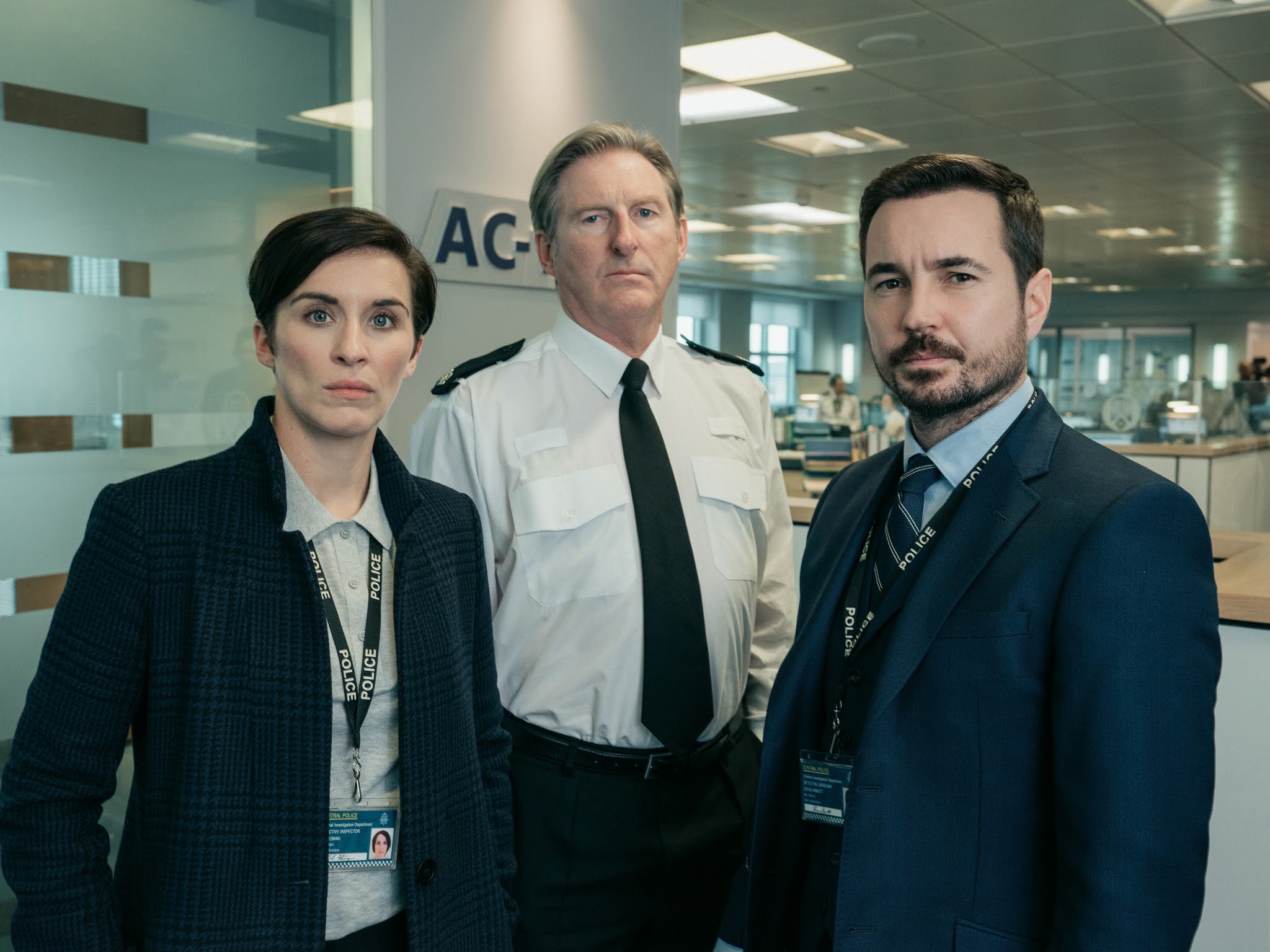
It’s the morning after the night before, when AC-12 - Ted Hastings, Kate Fleming and Steve Arnott, Britain’s favourite trio of coppers-investigating-bent-coppers - returned to our screens with the sixth series of Line Of Duty. For the most part, we weren’t disappointed (we being the 9.69 million viewers who tuned in - a whopping 44.5% of those watching telly between 9 and 10pm).

There was something of a slow-burn feel to the opener, a hallmark of both Breaking Bad and its spinoff Better Call Saul, lulling some critics into thinking it was off-par. It wasn't, but with seven episodes to fill in the series (rather than the usual six), creator Jed Mercurio appeared to be using the extra length to plant an array of seeds, with no idea of which might grow out and when. This is his gift - a panoply of potential plotlines with which to tease and antagonise. 

So, we were introduced to the season’s is-she/isn’t-she baddie, Kelly Macdonald’s DCI Joanne Davidson (billed in pre-publicity as “the most enigmatic adversary AC-12 has ever faced”). Like the previous is-she/isn't-she leads, DIs Lindsay Denton and Roz Huntley, Davidson is a mass of smouldering issues - a failing same sex relationship with a junior officer, paranoia, judging by the numerous heavy-duty locks on her front door, and potentially a link to a murdered journalist. Add to that, Hastings having to play things low-key after his final warning at the end of Series 5, Fleming’s home life in, apparently, tatters, and a bored Steve Arnott popping more Nurofen than is good for him as he continues to deal with being thrown down three flights of stairs in Series 4 by Balaclava Man. Oh, and an absolute blizzard of dizzying new acronyms, such as “We can keep it on the DL only if we have a CHIS on the MIT”, which may have been lifted directly from a Snoop Dogg lyric. “CHIS”, we were relieved to later learn on social media, means 'Covert Human Intelligence Source'. All of which sets us up…for what? Well, exactly. Mercurio has proven - with LoD and Bodyguard - as being a master of expect-the-unexpected, and much of the fun of, if you can call it fun, has been trying sift the red herrings from the ciphers that unlock each series over the course of its run. 

Like a more tortured version of a wet bank holiday afternoon’s game of Cluedo, LoD has become something of a national obsession. Social media yesterday was awash with comments of more or less the same ilk - “Why is it not yet 9pm?” (my own tweet). Family WhatsApp groups went quiet for an hour at 9pm and there was notable concern on Facebook when the preceding Top Gear ran two minutes over time.

Picture: BBC

Make no mistake, Line Of Duty has become event television. We sit there on the sofa arguing with ourselves, booing the baddies like pantomime barons, much as we did each Saturday night during The Masked Singer (look, I guessed Blob was Lenny Henry, almost from the beginning, but would the judges give in to the bleedin’ obvious? No.). Line Of Duty and The Masked Singer share in a television tradition that has been in danger of expiring in the era of box set binges: suspense. While we’ve all filled bored evenings (and afternoons and…er…even mornings…) during lockdown by ploughing through entire seasons of shows on Netflix and all the rest, with Line Of Duty the BBC is sticking to the traditions of cliffhanger Doctor Who endings. No, you will not be able to watch all seven episodes now on the iPlayer, and no, it will not be immediately available on DVD as a complete set. You will have to wait for the next episode, and the next one, and the next one after that. 

I’d like to think of another police procedural occupying the coveted 9pm slot to have caught the national imagination quite as this one has done since it made its debut in 2012, first on BBC2 before being promoted to the proverbial officer one rank higher, BBC1. Over that time we have sucked in by the twisting vortex of Mercurio’s mind, as plots have corkscrewed tantalisingly, each series testing our patience and, on occasion, our tolerance of credibility. That’s not to say there have been shark-jumping moments, just more of a tendency for Mercurio to lob in hand grenades of disruptive thinking that have seen pivotal series characters killed off as early as the opening episodes, while others quite consciously left hanging on to, quite honestly, mess with us. 

Like DI Matthew Cottan - delightfully afforded one of my favourite in-series nicknames of all time, ‘Dot’ - who survived three series as arch-villain ‘The Caddy’, embedded nefariously in AC-12 while remaining the principle conduit of terror and manipulation for the “OCG” (organised crime group - another of the myriad acronyms which add to the bandwidth-sapping plot lines). Or Denton, Keeley Hawes’ wonderfully sociopathic detective inspector whom, even up until her resurrection from prison and eventual death in her second series (at the pistol of Cottan), we never fully knew whether she was just misunderstood, if slightly loony, or truly in league with the dark side of ‘The City’, LoD’s fictional geography. Denton, it should be highlighted, is one of a number of prime examples of women being given equal and authentic screen time in the show. Without pandering to obvious wokeism, unbridled female characters have been a mainstay of Mercurio’s invention (including, it must be said, Hawes’ turn as the Home Secretary in his equally compelling Bodyguard). Thus, he’s also given us demented DI Huntley (Thandie Newton), devious lawyer Gill Biggelowe (another in league with the OCG), and in Series 5, the stone-faced Detective Chief Superintendent Patricia Carmichael (Anna Maxwell-Martin) and the new Deputy Chief Constable, Andrea Wise, all of whom could well reappear in this latest series in either protagonist or antagonist roles. It’s impossible to tell. 

In preparation for last night’s return, I recently gorged through the previous five seasons reminding myself of the threads, Ted Hastings’ zeitgeist-monstering catchphrases (“Mother of God!”, “sucking on diesel”, “bent coppers”, et al) and the somewhat byzantine connections between the police of this one particular city (believed to be in the Midlands) and the OCG. Perhaps because I’d only previously watched Line Of Duty in similar binges on long-haul flights, I’d not previously appreciated the parallels between it and The X-Files which, when it wasn’t doing ‘monster of the week’ episodes, had the recurring thread of a deep-state conspiracy (not entirely dissimilar to the QAnon cobblers) involving shadow governments and aliens. A little more plausibly LoD has featured corruption on a grand scale - and not just the old cliche of masonic handshakes to turn a blind eye to pub lock-ins and local councillors' parking tickets. It has involved largely unseen mobsters’ manipulation of police procedure to enable drug rings, prostitution and child abuse rackets, embedding corrupt officers throughout the Central Police constabulary, and usually in plot-changing positions. 

Picture: Instagram/Vicky McClure
Here we should mention ‘H’, the ruse that has been LoD’s X-Files-style undercurrent: Dot Cottan’s dying revelation of four finger taps cunningly suggested that H may not have been an individual, but four high-ranking coppers. With three now gone, we’re still left to wonder who the fourth is. Ted Hastings is not out of the clear (there have been subtle and not-so subtle suggestions that he might be an H, with actor Adrian Dunbar craftily pictured on social media audaciously wearing a Helly Hansen sweatshirt with its prominent double-H logo…). Towards the end of Series 5 we were fed snippets of doubt about Wise and Carmichael, with the latter’s assistant, Sergeant Tranter attempting to murder Gill Biggelowe in the didn’t-see-that-coming Fatal Attraction denouement in the season's final episode. That also concluded with Ryan Pilkington - recruited into gangster Tommy Hunter’s crime syndicate as a teenager - at his passing out parade at the police training college, teasingly setting up an Alien-style possibility of a spawn-of-the-devil introduction to come.

As amusing as some of this hokum might be, Line Of Duty’s return comes at an awkward time for policing in Britain. Even as the opening episode of Series 6 was going out last night, 12 officers were being injured - two seriously - and police vehicles set on fire in Bristol amid violent protests against the new Police And Crime Bill. The rioting comes soon after the tragic disappearance and murder of Sarah Everard, and the events of Clapham Common in the aftermath. I was in the midst of my Line Of Duty binge when the Everard case was playing out. Fiction began to blur into fact as I switched from the iPlayer to news bulletins revealing the grim outcome and distressing detail of a young woman’s alleged killer being a serving Metropolitan Police officer. All of a sudden, policing and police conduct - and the politics governing them - has come under greater scrutiny than ever before. I’m not being flippant in trying to conflate this with Line Of Duty’s return. It is, without any room for doubt, fiction, and somewhat stylised fiction too. It is no more a documentary about real investigations into police behaviour than The Crown is a factual profile of the royal family. But if it serves any moral purpose, beyond raising the nation’s blood pressure for an hour each Sunday night for the next seven weeks, it is to provide a timely reminder of the importance of trust and accountability in our public institutions.

Line Of Duty treads the finest of lines between escapism and reality. It’s clearly well researched, with Mercurio drawing on well placed sources to enrich his plots and dialogue. The police shooting of Jean Charles de Menezes and the murder of Jill Dando are believed to have been in the mix of inspiration. Where it goes after this latest run, however, is open to debate. The BBC is yet to commit to a seventh series. “I think as long as there’s an appetite from our audience for the show, we’ll keep going,” Dunbar told Graham Norton in January. “Why would we stop? Jed [Mercurio] has managed to keep the standard so high for so long, and people love the show. I hope it does go on.” Martin Compston (Arnott) recently told The Sun that the cast was aware of how big the show had become, but that they probably had one or two more series in them. “So you do start to become aware of the legacy around it - you want to be remembered as ‘one of the great shows’ and not be remembered for ‘a bad last series’. Mercurio himself recently told Jay Rayner’s Out To Lunch podcast that he hoped the show would continue: “I really want to carry on with Line of Duty,” he said. “I think that Season 6 proves that there is much more ground for us still to cover.” There are certainly plenty of lose ends to be tied up, and on the evidence of last night’s opener, new ones being created. Strap in, we’re not done yet.