
We’re barely eight days into 2022 and I’m already blogging about David Bowie. Sue me. But with today being what would have been The Dame’s 75th birthday, and Monday the sixth anniversary of his death, the propensity for Bowie to still surprise and provide compelling cultural fascination shows little signs of abating.
Just this week Variety revealed that the Bowie estate has sold his entire publishing catalogue - more than 400 songs (including 111 singles and 26 studio albums) - to Warner Chappell Music, the Warner entertainment conglomerate’s music publishing division - for figure estimated to be “upwards of $250 million” (it hasn’t been officially disclosed). The deal drives on the current boom in rock’s biggest names monetising their recordings, following Bruce Springsteen selling his catalogue to Sony for an eye-watering $550 million, and Bob Dylan’s similar agreement with Universal for an equally colossal $400 million.

“All of us at Warner Chappell are immensely proud that the David Bowie estate has chosen us to be the caretakers of one of the most groundbreaking, influential, and enduring catalogues in music history,” WCM’s CEO Guy Moot said in a statement. “These are not only extraordinary songs, but milestones that have changed the course of modern music forever. Bowie’s vision and creative genius drove him to push the envelope, lyrically and musically - writing songs that challenged convention, changed the conversation, and have become part of the canon of global culture.”.
For its part, a representative of the Bowie estate hailed Warner as “capable hands” adding: “We are sure they will cherish [the catalogue] and take care of it with the greatest level of dignity.” That, though, comes with some risk. The entertainment industry has a history of precious bodies of work transferring to corporate ownership with mixed critical results. Disney’s assumption of the Star Wars brand, expanding its universe with myriad spinoffs is still to win over the audience beyond the established fanbase of George Lucas’s 1977 creation. Likewise, there are concerns that Amazon’s acquisition of MGM, and with it the James Bond films, will see the imperious cinema property diluted into a similar sprawl as the Star Wars and Marvel franchises.
What might, to some, be surprising about the Bowie deal is that he was, in life, very particular about his work, maintaining tight control over it. Curiously, what isn’t included in the agreement with WCM is the ‘first’ album titled David Bowie, the record released in 1967 which appeared on Decca’s Deram imprint. That album firmly reflected his then-interest in theatrical, Anthony Newley-style whimsy, rather than either the prevailing beat pop of the early ’60s or the emerging progressive sound that manifested itself that year most profoundly with The Beatles’ Sgt. Pepper’s Lonely Hearts Club Band.

Part of what Wilson and I absorbed about Bowie, subliminally at first, was his breathless, relentless, restless search for something new, something different, something else. That’s what Warner Music has bought into. Not one of those 26 album is a replication. Not even the Tin Machine entries lack something adventurous. Amongst the many valid superlatives used to describe Bowie’s career, “visionary” crops up again and again, along with a profound sense of individualism. “He spent his whole life trying to empower people, and I think that’s what he would have continued to do,” the V&A’s Geoff Marsh told Dylan Jones for a posthumous gathering of Bowie’s friends, recounted in September in The Times. “He once said in an interview that ‘I’m doing this for me’, i.e. he was doing what he was doing because that’s precisely what he wanted to do. And he spent his entire life encouraging other people, especially the young, to do the same.”
Bowie was, of course, rightly lauded for “pushing the envelope”, to reuse that horrendous cliche. WCM’s Moot is correct in describing Bowie as inspiring those “not only in music, but across all the arts, fashion, and media”. To that add technology: in 1999 Jeremy Paxman interviewed Bowie for the BBC’s Newsnight, asking him about digital technology. “The potential of what the Internet is going to do to society - both good and bad - is unimaginable,” Bowie told a visibly sceptical Paxo, who responded: “It’s just a tool though isn’t it?” “No,” Bowie replied, with wry disdain, “it’s an alien life form [laughs]. Is there life on Mars? Yes, it’s just landed here.” He then continued, presciently: “I don’t think we’ve even seen the tip of the iceberg. I think we’re actually on the cusp of something exhilarating and terrifying. The actual context and state of content is going to be so different to anything we envisage at the moment. Where the interplay between the user and the provider will be so in simpatico it’s going to crush our ideas of what mediums are all about. It’s happening in every form. That grey space in the middle is what the 21st century is going to be about.”
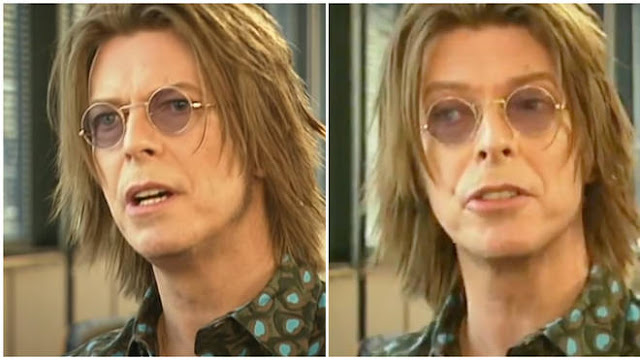 |
| Picture: BBC Newsnight |
The year before, Bowie launched his own Internet service, BowieNet. It was, at the time, ground-breaking: for a monthly fee, members got their own davidbowie.com email address as well as exclusive access to audio and video recordings. They could also participate in chat rooms, which Bowie himself often popped up in. At the time most other stars’ websites were pretty dry affairs, but not Bowie. It was, one user recalled, the first attempt to create an Internet community around an artist. He even used it to crowd-source ideas for new music, with the track What's Really Happening? later appearing on the Hours album. 1995’s Outside drew on a bespoke software application called Verbasizer, into which Bowie typed in different sentence which were then randomly selected and turned into the source of new songs. Four years later Bowie participated in Netaid, a streamed concert that drew an online audience of more than two million, then a record. His enthusiasm for his own online venture waned as the 21st century dawned, and Bowie’s much publicised health issues in 2004 saw him effectively withdraw from public life.
This week’s Warner deal is not, though, the first time that Bowie’s music has been monetised. In the mid-1990s a scheme was devised by his financial manager to sell asset-backed securities, nicknamed ‘Bowie bonds’, which paid out a share in future royalties for 10 years. Another deal, with EMI, saw Bowie sell bonds on the back of royalties from the albums he’d released between 1969 and 1990, but the venture suffered from the music industry downturn in the early 2000s. Even that was something Bowie had predicted in 2002, when he told the New York Times that music would become “like running water or electricity”. He’d foreseen the rise of streaming, with the meagre returns for artists we now know about, and its impact on physical media sales.
All of these exercises serve as a reminder that pop music is rarely as altruistic as either art or ‘just’ an entertainment medium. Business, as The Beatles found to their cost, often gets in the way. But while the Bowie estate’s deal with Warner Music is another chapter in the posthumous commercialisation of his career (which has generated a steady stream of box sets and special editions over the last few years), it shouldn’t do anything to fundamentally change either the Bowie legacy, or this fan’s fascination with it.
There will also be plenty more to come from it, too, in the weeks and months ahead: later this month the 2022 Sundance Festival is expected to premiere a new Bowie film by Brett Morgan (whose credits include The Rolling Stones’ Crossfire Hurricane and Kurt Cobain: Montage of Heck) which pulls together previously unseen live performance recordings, with Bowie’s longtime producer Tony Visconti providing music direction. And then, next month, we will celebrate the 50th anniversary of Ziggy Stardust & The Spiders From Mars making their live debut, at a long-defunct pub which once sat less than three miles from the house I was born in. Kismet, again. 2022 promises to be another busy year in the enduring legacy of the late David Robert Jones from Brixton - and me and my wallet can’t wait.


