Showing posts with label Metropolitan Police. Show all posts

Tuesday, 23 August 2022

Superheroes don't all wear capes

Picture: Kingston Hospital

Some 16 months ago I was in a room a few minutes’ walk away from the one in which I’m writing this, ruminating on the amazing “pit crew”, as I called them, working on my necrotic foot. That was my first in-patient stay in a hospital for almost 30 years (the only previous occasion being for a relatively cosmetic procedure). But framed in the context of the politics of the NHS, and the-then rampant pandemic in April last year, I wrote of my singular, emboldened appreciation of the healthcare profession and all who work within it (Postcard from the cuckoo’s nest).

Today, however, I’m in our local A&E department for a different reason: the treatment of my 92-year-old mother after she had a fall at home. This is the same A&E unit I came to with my diseased foot, thinking at the time that I’d just be given a bandage and some antibiotics and sent on my way. In the end, I remained at this hospital for three and a half weeks. On this occasion, my mother is propped up on a bed in a bay directly opposite the one I was assessed in, prior to being admitted for that lengthy stay. That, too, was a Saturday lunchtime. 

As we sit there, waiting for something to happen, someone to come by and do something else, my admiration for all those working in this environment continues undimmed. This is, though, supposed to be the crucible, the epicentre of crisis. Every day our newspapers scream of meltdowns in the health service, of dysfunction and inefficiency throughout. And while that may be true elsewhere, my mum was ambulanced to hospital within an hour of her carer calling 999.

While A&E processes and procedures take time, as nurses and nursing assistants comprehensively evaluate my mother, taking blood samples and blood pressure readings, and occasionally carting her off for a CT scan, things are reassuringly relaxed. For now. On the basis of the prevailing media depiction of our hospitals, you’d expect to encounter a scene akin to the Do-Lung Bridge in Apocalypse Now!. Instead, the staff are calm and supremely professional. There is some noise - you’d expect the occasional scream in an emergency department - but there is mostly a low-level hubbub as staff go about their duties. In the middle of the large room with 15 treatment bays is a central IT hub, where junior doctors and other staff clack away at computer keyboards, analysing test results, X-rays and medical records, all part of the ultra-digitised health service. It all looks so joined up, but the reality - I speak from experience - is that while some parts are connected, others need a kick (for the post-hospital treatment of my foot, I had to join the dots myself between my GP, the hospital outpatient team and the local podiatry function).

Occasionally, the hubub is raised a tad by a patient call button being pressed in another part of A&E, resulting in a dull beep that, too, gets tuned out along with all the rest of the background noise. This being a Saturday afternoon, the unit doesn’t appear overwhelmed, but there are plenty of customers: - gardening accidents, a couple of people with clear symptoms of dementia, and so on. In an adjacent bay to my mother’s, a police officer stands watch over a young man, not giving anything away as to whether the patient is a victim or a perpetrator of some Friday night criminality. At various points in the day, the one constable will be joined by three colleagues. Their two police cars are parked outside. At a time where the political mood is intensifying on getting police back out on the street to prevent or solve crimes, the sight of four officers and two patrol vehicles tied up for most of a Saturday both suggests the seriousness of the situation, and also reminds you of how resource-stretched the Met is.

Moreover, the longer we sit here - my wife and I watching our phone batteries ebb away (until we discover the ability to rent a Joos charger for £3 - ker- and, indeed, -ching) - the more you start to see our NHS under pressure. The ambulances are coming in thick and fast as Saturday afternoon gives way to Saturday evening. A second set of police officers appear, looking after another admission.

At the time of writing we’ve now been here ten hours. Somewhere between 7pm and 8pm there appeared to be a change of shifts. As one nurse hands over to another, staffing becomes thinner. A new pair of nurses take over the entire ‘Majors’ area (one of three - the others being ‘Resuss’ and a dedicated A&E unit for children), requiring us to tell my mother’s story all over again. By now, two doctors have seen her, and then the senior duty consultant , who thankfully concludes that she won’t need to be kept in overnight, and that her fall was most likely caused by her getting out of bed too quickly. ‘More haste, less speed’, was a mantra my dad drilled into me. I don’t think my mother was listening.

So the good news is that we should be taking Mum home, but there are still more repeat tests to perform to satisfy someone that she’s OK to do so. To be honest, we’re not sure why, and nor do the evening nurses. At some point we note to them that, apart from a couple of biscuits with a cup of tea, and some of the contents of the picnic we’d been planning to take to a seaside airshow when we got the call to come back to south-west London, she hasn’t actually eaten anything substantial all day. This is eventually rectified by a microwaved roast dinner rustled up for her. We make do with coffee from the last service of the day from the on-site branch of Costa.

And so, as hour gives way to hour, the crosswords from the newspaper my mother had with her completed or dispensed with out of boredom, our phones restored with yet another expensive battery rental, we’re all beginning to stare into space. Mum’s discharge seems no closer. No one seems to say why. It takes a firm conversation with one of the nurses to get some clarity, eventually.

Here, then, is a summer Saturday night in a major A&E department. The central hub is now down to a couple of duty junior doctors, with just the two nurses, despite all the visible bays still containing the patients who’ve gradually come in throughout the day. The nursing assistants - those vital components of hospital life, are even fewer. Not that they’re taking it easy: one, who was looking after my mother, was on Day 6 of her roster, and even that was voluntary - she normally worked in another part of the hospital. She’d also only just returned to work after spending two years battling breast cancer.

This is where you simply can’t be critical. Yes,the system creaks, and in some places is actually falling apart. But Saturday’s experience, even if it resembled an episode of Seinfeld (“a show about nothing”), underlined further the addage that not all superheroes wear capes. Some just wear blue scrubs.

I’ve spent a fair amount of time, now, in hospitals and medical facilities as a result of my diabetes. All of that time, you could say, is self-inflicted (I’m Type 2). But my experiences - save for my inpatient stay last year - have been relatively fleeting. A test here, a consultation there - “maintenance”, as my wife calls it. What you never appreciate fully is just what else goes on under the skin. The tempo of this particular metropolitan emergency department on a Saturday has appeared calm, but that’s just the professionalism protecting reality. For the patient - in this case a lady of 92 - it’s bewildering and exhausting. You can’t help but feeling that she is receiving the best care possible, but it takes time to administer. If her son and daughter-in-law hadn’t been around to ask, would she have been able to get a meal, help with her ablutions, or even an update on what was going on?

With every encounter with a health professional, and especially one working within the NHS, you must feel admiration. Admiration for taking on one of society’s lower-paid jobs, one where you literally and figuratively have to put up with strangers’ shit with stoic professionalism. Occasionally, you have to deal with less successful outcomes than ours. Here’s where fiction and reality separate dramatically: if your only idea of life in a medical environment is one of those slick dramas on TV, especially the American ones, like Grey’s Anatomy, life-or-death situations are not resolved in 50 minutes. Modern hospitals are stuffed to the gills with state-of-the-art technology, but in real life - in the UK at least - there’s no team of highly remunerated hotshot surgeons ready to leap in with every emergency case the ambulances bring to the door. There is just “a” team, mostly of young, foreign professionals working twelve-hour shifts, triaging the unfortunate, the drug-addled, the dementia stricken and, in the case of my mother, the elderly. It’s a miracle our hospitals don’t collapse at all. 

The relative calm we experienced for the better part of ten hours masked, I suspect, the real horror going on in the NHS nationwide. And while it was far from perfect, it was a further reminder of the reassurance that, for good or bad, this most jewelled of British institutions, and it’s dedicated people, is there when you need it.

Friday, 20 April 2018

Murder most foul

Picture: BBC

If, like me, you watched the BBC's three-part documentary, Stephen: The Murder That Changed A Nation, we will have a shared frustration. Without trivialising the racist murder, 25 years ago, of teenager Stephen Lawrence, the series at times felt like one of those exalted police procedurals, like Line Of Duty, where you already know who committed the crime, but watch in edge-of-the-sofa agitation over consecutive nights as the perpetrators evade justice. Sometimes, justice prevails, sometimes it doesn't.

In the case of Lawrence, it largely hasn't. There has been some closure, as last night's final episode recounted, with the remarkable story of retired Detective Chief Inspector Clive Driscoll who, in perhaps an example of old-school coppering, took command of Operation Fishpool, the investigation into Stephen's murder. This lead to the engagement of a private forensics company to conduct new examinations of evidence from the fatal stabbing of the 18-year-old architecture student at an Eltham bus stop on 22 April, 1993. Blood traces on clothing fibres led to the conviction, in January 2012, of Gary Dobson and David Norris. To date, they remain the only suspects in the Lawrence case to be jailed.

What Stephen: The Murder That Changed A Nation so compellingly compiled was the multiple layers of the case and its actors. Movingly, we heard from Doreen - now Baroness - Lawrence, Stephen's mother who became the reluctant public face of, not only the campaign to bring her son's murderers to justice, but also to draw attention to perceptions of institutional racism within the Metropolitan Police. We also heard from Neville Lawrence, her estranged husband, who so visibly bore an unfair weight of guilt on his shoulders for "not being there" for his son, and has only found some peace by relocating to Jamaica.

Picture: BBC
And who couldn't be blamed for banging their head against the wall in frustration for Duwayne Brooks, Stephen's best friend, who was with him when the gang of white youths set upon the pair in Well Hall Road that night in 1993. Brooks has taken his own share of shaming, both from police who appeared to treat him more as a suspect than victim, and from an apparent rift between him and the Lawrence family. We saw how Brooks - who has since engaged in local politics in Lewisham and was awarded an OBE - identified two of the five main suspects in a police line-up three months after the murder, only to have his evidence dismissed as "unreliable". We also saw how Brooks was arrested at a protest outside the British National Party HQ in Welling shortly after the murder, part of a police surveillance operation into members of the Justice For Stephen Lawrence campaign.

It would have been very easy to simplify the subject of this series into three acts - the police as bad, the prime suspects as even worse, and the Lawrences as victims. But over the three episodes, Asif Kapadia, James Gay-Rees and James Rogan carefully, respectfully built up a powerful, tragic and, ultimately, disappointing picture of British social justice via the many layers of the case.

Like a good drama, there were intriguing sub plots, which left the bitterest of tastes in the mouth: the Martin Bashir interviews with the chief suspects, who brazenly weaselled their way out of any responsibility, despite the sickening weight of evidence against them, such as the police surveillance video showing them talking about what they'd like to see happen to black people ("I'd go down to Catford and places like that with two submachine guns and I'm telling you I'd take one of them. Skin the black alive, mate. Torture him, set him alight."), with another seen practicing stabbing motions with a large knife.

These suspects - whose names, we learned, had been listed on a piece of paper left for police within hours of Stephen's murder - were and still are known in the Eltham area. Their Facebook timelines still receive complimentary messages from racists. The nation, though, formed its own opinions of the group when they arrived, strutting, goading, wearing sunglasses and looking like they were on a Friday night out, at the McPherson public inquiry in March 1988. The composure of their interviews with Bashir had been dropped. The image of Norris, in particular, snarling and bearing his teeth, will remain ingrained in the memory as a totem of the entire Lawrence murder. As will the Daily Mail's challenge to the gang, with editor Paul Dacre's infamous "MURDERERS" front page splash and its sub-deck challenge: "The Mail accuses these men of killing. If we are wrong, let them sue us." I'd hardly call myself a fan of the newspaper, or indeed Dacre, and even if his personal connection to the Lawrences was simply that he'd employed Neville as a decorator, the line he took, and the subsequent persistence in the story, deserves some credit. Inevitably, the attempt to tease the Eltham gang out didn't succeed, but an important addition was made to the tabloid front page hall of fame and, for once, a newspaper like the Mail campaigning for social justice.

Picture: BBC
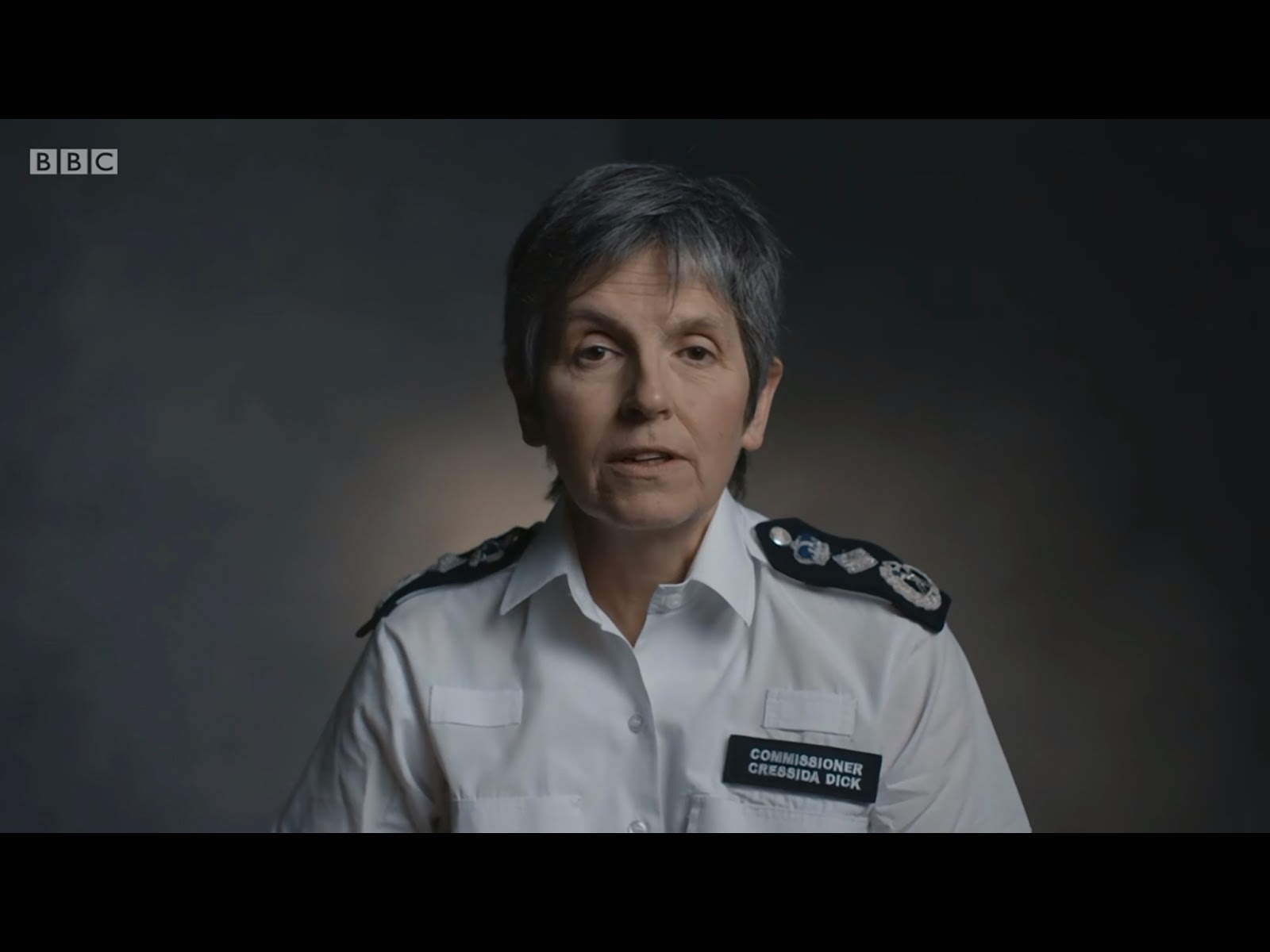
As for the police, it would be hard to say - Clive Driscoll's remarkable dedication and endeavour not withstanding - that the Metropolitan Police came out of this documentary with it's historical reputation in good shape. Current commissioner, Cressida Dick, maintains that the Met has, today, a completely different culture to that which existed in 1993. One would hope so. The documentary's clips of interviews with detectives serving back then left little faith that the system was ever going to deliver justice for the Lawrence family. New interviews didn't add much, either, with retired Detective Superintendent Bill Mellish, who led the second investigation into Stephen's murder, focusing on Brooks, almost gleefully stating: "He knows he forever will be the man that ran away and left his mate. He knows that."

Attitudes might be one thing, but the role of corruption in the Lawrence case became another intriguing aspect of the documentary, adding another bitter ingredient to the overall shambles. Commenting on one specific allegation of a particular detective's alleged connections to David Norris' drug dealing father, Cressida Dick says that today she would shut down any corruption fast. The disturbing thing is, we're talking about police corruption in the mid-1990s, not the 1960s and 1970s, when London's crime gangs had detectives in their pockets, and when dodgy handshakes came in handy to get people out of parking tickets and much more serious offences. This was when the fictional Gene Hunt and Jack Reagan were very real, unreconstructed individuals who could politely be described as "cutting corners" in getting the job done. The idea that such practices actively hampered the Lawrence investigation in, what should still be regarded as recent history, is more than unpleasant.

In the end, Stephen: The Murder That Changed A Nation painted a picture of a police service which had both unconscious and conscious bias towards the black community, in which racism was almost a casual aspect of the Met culture. An archive clip of former Police Federation chief Len Curtis questioning whether "nigger" was an abusive term appeared to underline the suggestion, stated so strongly in the McPherson Inquiry outcome, that the capital's police service was riven by "institutional racism". Racism, it should never be forgotten, remains at the core of the Stephen Lawrence story. He was not only murdered by racists, but the subsequent investigation was either handled indifferently and incompetently, or with intentional reluctance and scepticism towards the victim's story, making that racist, too.

That two of the gang have been convicted for Stephen's murder will be only of limited comfort to the Lawrence family. Doreen Lawrence has said she wants to focus on her other son and grandchildren. She has given what she says is her last interview on the subject. The Met is maintaining an open case on the murder enquiry, something I suspect they will be obliged to do out of embarrassment as much as due process. I'm a big fan of what the police do. Under ever-shrinking resources, and increasing pressures from terrorism and, in London, knife crime in general, the thin blue line has grown thinner. They deserve our admiration and support. But the Stephen Lawrence murder, is a chapter in the Met's history that should not only never be forgotten, but continuously referred to. Racism is ugly to begin with, but when it yields the violent death of a bright, talented, likeable teenager - no matter what his skin colour - there should be no place for it to be investigated as a lesser priority. All lives count. All lives matter. Kudos to the BBC for, over the last three nights, reminding us of that fact.

Picture: BBC

Friday, 21 July 2017

The barista will take down your particulars

Picture: Costa

Until I went to live in America, the meme about US cops "hanging out in donut shops" (to quote The Bangles) seemed something of a cartoon myth. And then I went to live in America, renting a 'condo' in a new housing development with its own branch of Starbucks, and there, every morning, queuing with me for their 'morning joe' would be several representatives of the Sunnyvale Police Department.

Now, in my local Costa in Greenwich, I often see the borough's constabulary queuing for cappuccinos. But the more I think of it, the more such visibility reassures, especially given the latest crime figures, released yesterday by the Office for National Statistics. In the 12 months to the end of March there were almost five million crimes committed across England and Wales, an increase of 458,000 offences on the previous 12 months. And although London saw a more modest increase of just four per cent in the total number committed that figure includes a significant rise in violent crime. Indeed, since I've been back in London, barely a day has passed without the Evening Standard reporting another senseless stabbing, as gangs carry out their bloody turf wars. Knife crime has increased in London by 24 per cent. On top of that, the city has been inundated with moped-born muggings, with police seemingly unable - or not allowed - to prevent them for fear of another teenage miscreant losing his life in a pursuit. And now we have the apparent epidemic of acid attacks, with thugs choosing callously and cynically to render their victims with life-altering disfigurement.

It's easy to conclude, then, that London's streets (and, yes, Glasgow's or Liverpool's too) are becoming too dangerous, and that we should cocoon ourselves away. Not so, of course. But there's no doubt that encroaching high levels of street crime, not to mention recent terror events, are impacting the choices people make on where they go out, or even whether they go out. Just last Friday night, and no more than a five-minute walk from my front door, 31-year-old Danny Pearce, father to a five-year-old daughter, was stabbed to death in Greenwich town centre, apparently by thugs on a moped who took his mobile phone and Rolex watch, as he walked home from a jazz club. When it happens right in the midst of where you live, and and in a street frequented by tourists, you can't help take a different perspective on community policing needs. With the Metropolitan Police facing drastic budget cuts of up to £400 million at a time when crime and the terror threat is on the rise, you actually must feel sympathy for the thin blue line, as expectations increase on what they can do, just as they're finding they're less able to do it.

So, to return to the coffee shop theme, the latest idea for community policing is for officers to set up shop in high street branches of the big coffee chains. This is one proposal from London's mayor, Sadiq Khan, as the Met is forced to close more of its actual police stations to save money. Traditional high street stations have been disappearing at a rate of knots over the last few years: in the London suburb of New Malden, where I grew up, the once familiar police station next to The Fountain roundabout (and across the road from a once notorious pub of the same name) has been turned into a pub itself, The Watchman. Oh, the irony of eating gastropub food in what used to be the station's cells...

Khan has said that 40 police stations will be closed along with other local contact kiosks in libraries and supermarkets, leaving around 32 in operation - roughly one per borough. Instead, the public will be encouraged to report crime via the Internet or phone, rather than walking into a physical location. The argument being made is that these days fewer people, anyway, are actually going into police stations voluntarily, either to ask for directions or to actually report crime. The era of Dixon Of Dock Green is well and truly over. The logic, therefore, is that a borough's ward teams get out and about in London's high streets (where coffee shops have proliferated as other forms of employment have disappeared). As a result, the likes of Costa, Starbucks and Cafe Nero have become prominent parts of local social fabric, making them sensible locations for community engagement. But is such visibility enough? Didn't the local nick, with its traditional blue lamp above the front door, provide a more imposing statement of the police's authority in a town?

The mayor and senior Met officers apparently want to see officers spend more time on the beat. The trouble, though, is not so much where as to who and how many: Khan has warned that London's police numbers could fall below 30,000 as a result of government cuts, putting severe strain on the Met's plan to have at least two dedicated beat officers in every London ward by the end of the year.

As the BBC's brilliant recent fly-on-the-wall series The Met demonstrated, London's police do a remarkable job. Along with the fire and ambulance services I really only have absolute admiration for what they do, and the Grenfell fire and the events of June 3 in Borough Market only underline why the emergency services deserve to be resourced properly. Being able to engage the police in my local Costa is probably more of a PR exercise than one that actually prevents or reduces crime. And a coffee shop is no substitute for a police station, anyway. After all, where would you lock someone up?