Showing posts with label NHS. Show all posts

Tuesday, 23 August 2022

Superheroes don't all wear capes

Picture: Kingston Hospital

Some 16 months ago I was in a room a few minutes’ walk away from the one in which I’m writing this, ruminating on the amazing “pit crew”, as I called them, working on my necrotic foot. That was my first in-patient stay in a hospital for almost 30 years (the only previous occasion being for a relatively cosmetic procedure). But framed in the context of the politics of the NHS, and the-then rampant pandemic in April last year, I wrote of my singular, emboldened appreciation of the healthcare profession and all who work within it (Postcard from the cuckoo’s nest).

Today, however, I’m in our local A&E department for a different reason: the treatment of my 92-year-old mother after she had a fall at home. This is the same A&E unit I came to with my diseased foot, thinking at the time that I’d just be given a bandage and some antibiotics and sent on my way. In the end, I remained at this hospital for three and a half weeks. On this occasion, my mother is propped up on a bed in a bay directly opposite the one I was assessed in, prior to being admitted for that lengthy stay. That, too, was a Saturday lunchtime. 

As we sit there, waiting for something to happen, someone to come by and do something else, my admiration for all those working in this environment continues undimmed. This is, though, supposed to be the crucible, the epicentre of crisis. Every day our newspapers scream of meltdowns in the health service, of dysfunction and inefficiency throughout. And while that may be true elsewhere, my mum was ambulanced to hospital within an hour of her carer calling 999.

While A&E processes and procedures take time, as nurses and nursing assistants comprehensively evaluate my mother, taking blood samples and blood pressure readings, and occasionally carting her off for a CT scan, things are reassuringly relaxed. For now. On the basis of the prevailing media depiction of our hospitals, you’d expect to encounter a scene akin to the Do-Lung Bridge in Apocalypse Now!. Instead, the staff are calm and supremely professional. There is some noise - you’d expect the occasional scream in an emergency department - but there is mostly a low-level hubbub as staff go about their duties. In the middle of the large room with 15 treatment bays is a central IT hub, where junior doctors and other staff clack away at computer keyboards, analysing test results, X-rays and medical records, all part of the ultra-digitised health service. It all looks so joined up, but the reality - I speak from experience - is that while some parts are connected, others need a kick (for the post-hospital treatment of my foot, I had to join the dots myself between my GP, the hospital outpatient team and the local podiatry function).

Occasionally, the hubub is raised a tad by a patient call button being pressed in another part of A&E, resulting in a dull beep that, too, gets tuned out along with all the rest of the background noise. This being a Saturday afternoon, the unit doesn’t appear overwhelmed, but there are plenty of customers: - gardening accidents, a couple of people with clear symptoms of dementia, and so on. In an adjacent bay to my mother’s, a police officer stands watch over a young man, not giving anything away as to whether the patient is a victim or a perpetrator of some Friday night criminality. At various points in the day, the one constable will be joined by three colleagues. Their two police cars are parked outside. At a time where the political mood is intensifying on getting police back out on the street to prevent or solve crimes, the sight of four officers and two patrol vehicles tied up for most of a Saturday both suggests the seriousness of the situation, and also reminds you of how resource-stretched the Met is.

Moreover, the longer we sit here - my wife and I watching our phone batteries ebb away (until we discover the ability to rent a Joos charger for £3 - ker- and, indeed, -ching) - the more you start to see our NHS under pressure. The ambulances are coming in thick and fast as Saturday afternoon gives way to Saturday evening. A second set of police officers appear, looking after another admission.

At the time of writing we’ve now been here ten hours. Somewhere between 7pm and 8pm there appeared to be a change of shifts. As one nurse hands over to another, staffing becomes thinner. A new pair of nurses take over the entire ‘Majors’ area (one of three - the others being ‘Resuss’ and a dedicated A&E unit for children), requiring us to tell my mother’s story all over again. By now, two doctors have seen her, and then the senior duty consultant , who thankfully concludes that she won’t need to be kept in overnight, and that her fall was most likely caused by her getting out of bed too quickly. ‘More haste, less speed’, was a mantra my dad drilled into me. I don’t think my mother was listening.

So the good news is that we should be taking Mum home, but there are still more repeat tests to perform to satisfy someone that she’s OK to do so. To be honest, we’re not sure why, and nor do the evening nurses. At some point we note to them that, apart from a couple of biscuits with a cup of tea, and some of the contents of the picnic we’d been planning to take to a seaside airshow when we got the call to come back to south-west London, she hasn’t actually eaten anything substantial all day. This is eventually rectified by a microwaved roast dinner rustled up for her. We make do with coffee from the last service of the day from the on-site branch of Costa.

And so, as hour gives way to hour, the crosswords from the newspaper my mother had with her completed or dispensed with out of boredom, our phones restored with yet another expensive battery rental, we’re all beginning to stare into space. Mum’s discharge seems no closer. No one seems to say why. It takes a firm conversation with one of the nurses to get some clarity, eventually.

Here, then, is a summer Saturday night in a major A&E department. The central hub is now down to a couple of duty junior doctors, with just the two nurses, despite all the visible bays still containing the patients who’ve gradually come in throughout the day. The nursing assistants - those vital components of hospital life, are even fewer. Not that they’re taking it easy: one, who was looking after my mother, was on Day 6 of her roster, and even that was voluntary - she normally worked in another part of the hospital. She’d also only just returned to work after spending two years battling breast cancer.

This is where you simply can’t be critical. Yes,the system creaks, and in some places is actually falling apart. But Saturday’s experience, even if it resembled an episode of Seinfeld (“a show about nothing”), underlined further the addage that not all superheroes wear capes. Some just wear blue scrubs.

I’ve spent a fair amount of time, now, in hospitals and medical facilities as a result of my diabetes. All of that time, you could say, is self-inflicted (I’m Type 2). But my experiences - save for my inpatient stay last year - have been relatively fleeting. A test here, a consultation there - “maintenance”, as my wife calls it. What you never appreciate fully is just what else goes on under the skin. The tempo of this particular metropolitan emergency department on a Saturday has appeared calm, but that’s just the professionalism protecting reality. For the patient - in this case a lady of 92 - it’s bewildering and exhausting. You can’t help but feeling that she is receiving the best care possible, but it takes time to administer. If her son and daughter-in-law hadn’t been around to ask, would she have been able to get a meal, help with her ablutions, or even an update on what was going on?

With every encounter with a health professional, and especially one working within the NHS, you must feel admiration. Admiration for taking on one of society’s lower-paid jobs, one where you literally and figuratively have to put up with strangers’ shit with stoic professionalism. Occasionally, you have to deal with less successful outcomes than ours. Here’s where fiction and reality separate dramatically: if your only idea of life in a medical environment is one of those slick dramas on TV, especially the American ones, like Grey’s Anatomy, life-or-death situations are not resolved in 50 minutes. Modern hospitals are stuffed to the gills with state-of-the-art technology, but in real life - in the UK at least - there’s no team of highly remunerated hotshot surgeons ready to leap in with every emergency case the ambulances bring to the door. There is just “a” team, mostly of young, foreign professionals working twelve-hour shifts, triaging the unfortunate, the drug-addled, the dementia stricken and, in the case of my mother, the elderly. It’s a miracle our hospitals don’t collapse at all. 

The relative calm we experienced for the better part of ten hours masked, I suspect, the real horror going on in the NHS nationwide. And while it was far from perfect, it was a further reminder of the reassurance that, for good or bad, this most jewelled of British institutions, and it’s dedicated people, is there when you need it.

Monday, 9 August 2021

Masked anxiety

So there we had it: our first flights in over a year: to Edinburgh and back for a four-day break. The only ‘foreign’ holiday this year, as everywhere else was either booked or that plonker Grant Shapps has placed it on the red list, or the amber list, or the amber-plus list, or the oh-what's-the-point list. Or Iceland. And, yes, it wasn't lost on us that the train from London to Scotland would have been more environmentally friendly, but with exorbitant ticket prices for a family of four, plus a five-hour journey each way, we wanted to both maximise our budget and what little holiday we were actually able to get this time.

Edinburgh was, thanks for asking, very pleasant. So pleasant we got engaged there. Yes, I am now a fiancé. The things you do on holiday, eh? What was noticeable in the charming Scottish capital was, firstly, how relaxed it felt for a busy administrative city, and secondly, how well drilled everyone appeared to be under Ms. Sturgeon's jurisdiction. Call the Scots Nats upstarts if you will, but Covid-discipline was impeccably observed wherever you went, even by the vast majority of tourists. There really was precious little obvious civil disobedience when observing the still-enforced coronavirus etiquettes, both social distancing and mask wearing in shops, restaurants, on buses, and inside attractions. No one, from what I could tell, was abstaining on grounds of belligerence or twattery, and that made for a pleasantly anxiety-free time. Only the occasional tourist - who clearly hadn't received the memo - sauntered around indoor venues with their fizzogs fully on display.

You see, I’m a self-confessed zealot when it comes to observing the COVID rules. Despite having had two jabs and indeed a mild dose of the virus itself back in November, I’m diabetic and over 50, and bloody paranoid about catching this thing again (a possibility - even the double-jabbed health secretary Sajid Javid got it). 

I’ll admit that having a  compromised immune system is partly the result of my own misadventure, but I can’t help being 53. Basically it meant that the final leg of our journey back from Edinburgh, from London City Airport to home, was one tightly knotted ball of anxiety, as every carriage we entered on the DLR, the Tube and the SWR train was full of maskless Covidiots, looking back at my petrified eyes, peering over the top of my mask, as if to say “Yeah? What’s your problem?”.

To be somewhat fair, part of the problem is not necessarily ignorance but our dear Prime Minister. Ever since Boris declared 19 July “freedom day”, the wearing of face masks in England has been largely a matter of personal choice. How very doctrinal. This is despite warnings from the scientists - those people who, it would be decent to point out, know a thing or two - that easing rules on masks will reduce public protection. So with “personal choice” the most ambiguous health and safety stipulation you could make (I could jump out of a hot air balloon without a parachute or cut off my legs with a chainsaw - it’s all a matter of personal choice), it’s no surprise that anyone with an aversion to wearing masks, due to comfort, personal freedom or because being told to do something is not for them leads to people cramming onto our trains with their faces bare, breathing in and breathing out in crowded compartments with little concern for their own wellbeing and, more bluntly, mine.

This all stems from one of the few consistencies throughout the pandemic in the UK: inconsistency. And indecision. Boris Johnson appears so eager to please freedom-loving party acolytes that something as simple as mask wearing in environments where the virus can be passed with amusing ease can not be countenanced out of common sense, above anything else. It’s why London’s mayor, Sadiq Khan, has deemed that masks will remain mandatory when traveling on all Transport for London services, including the Underground, buses and trains. Not that he’s been able to enforce the rule, as our journey home the other night amply demonstrated.

“I’ve repeatedly made clear that the simplest and safest option would have been for the Government to retain the national requirement for face coverings on public transport,” Khan has said. “But ministers aren’t willing to do what’s right. I’m not prepared to stand by and put Londoners, and our city’s recovery, at risk.” He has since doubled down on that view, last week calling for mask wearing to be made legally enforceable with criminal prosecutions an ultimate sanction for failure to comply. Khan’s view is partly out of the hope that a bye-law on London’s transport network would partly reduce any further spread of COVID-19, but perhaps as importantly, it would increase the confidence of commuters like me in returning to the capital for work or pleasure, giving a much-needed boost to the economy. Sadiq Khan says that 86% of passengers do observe the mask etiquette, but that means that a sizeable 14% don’t, which is a problem as scientists have said repeatedly that masks only curb the spread of the disease if everyone wears them. I think we’ve lived long enough with the Covid numbers to know what risk that represents to public health. 

However, imposing such rules is still reliant on enforcement. Given the number of trains and buses operating in London, most of which now are driver-only (and in the case of the DLR, driverless), restoring guards as, effectively, enforcers, on the scale required would be problematic. Transport for London has some 400 enforcement officers already, but given the prevalence for some of London’s finer citizens to carry knives, you can understand the reluctance for confrontation. This places extra pressure on depleted police ranks to enforce what is at present little more than a polite request.

Picture: TfL

The challenge for Khan, however, isn’t just safety: TfL faces a budget deficit of as much as £500 million over the current financial year, having been severely impacted by the pandemic. As restrictions ease, Khan desperately needs people back on public transport. That said, there are already signs of private car usage increasing, and second-hand car sales have gone through the roof as people spend saved cash on used vehicles to get around in.

Back in Scotland - where Nicola Sturgeon has appeared to be one step ahead of Johnson throughout the last 18 months - the government intends to continue with the wearing of masks “unless exempt for special circumstances” until at least next year. “The law says you must wear a face covering in most indoor public places including public transport,” official guidance states. “The Scottish government recommends that face coverings should be worn when moving around when it is crowded. This is encouraged for busy outdoor events.”

In England, Boris has customarily faffed on the issue, conceding that “If it’s not mandated it probably won’t do any good” and that he “expected” people to carry on wearing face coverings in enclosed spaces, which is hardly an imposition. Here, in the midst of all this, is us and especially me, the paranoid. The trouble is that the issue is now at risk of getting bogged sown in politics. One scientist worries that this will mask the actual point about wearing a face covering to begin with: “We know wearing masks, particularly in crowded, poorly ventilated environments, has a big impact on the levels of transmission that can take place,” Professor Clifford Stott, who sits on the Scientific Pandemic Insights Group on Behaviours (Spi-B), told LBC last week. “But also I think [that] wearing a mask is also communicating to others about a sense of responsibility, and I think that’s a key issue in mask-wearing now, unfortunately. It’s become almost a little bit politicised whether one wears one or not, which is I think a shame.” Stott is firmly of the belief that masks have had a “big impact” on stopping transmission.

In truth, according to the Office for National Statistics, mask wearing in England hasn’t changed all that much in the last month since the legal requirement to wear them in enclosed spaces was dropped, with figures showing that 95% of people were still covering their face when leaving the house. Our public transport experience, however, suggested otherwise. Perhaps it’s an East London thing, as the majority of abstainers were on the DLR west from London City Airport, and then from Canning Town to Waterloo on the Jubilee Line. That degree of mask-free fellow passengers has done nothing to restore my confidence in getting out and about again. A shame after so many months cooped up at home (including three confined to the sofa following foot surgery). I’ve been desperate for freedom to return, but I won’t hide my anxiety at what I see as other people’s inconsideration and ability to comply with something as relatively simple as wearing a mask.

Perhaps, then, it’s just for me to deal with, but it does rub with me that my liberty can be curtailed by an inconsiderate few. Perhaps I should move to Scotland, where Sturgeon’s position - admittedly, not universally accepted - has at least been unambiguous. “It is my view that if a government believes measures like [face coverings] matter, and this government does, we should say so,” the Scottish First Minister has stressed. I won’t gloss over the fact that the overall numbers are falling, as vaccinations and so-called ‘herd immunity’ take effect. It’s true, too, that the R rate appears to be dipping, but with the school holidays in force, this may well be the ‘circuit break’ needed. 

Come the autumn, and the possible return of colds and flu as more and more companies open up their offices for the first time since March last year, the whole issue of travelling to work on public transport will come under the political and clinical microscope again. This, I’m sure, will put Boris’s chronic prevarication on the line.

Monday, 26 April 2021

Postcard from the cuckoo's nest

Picture: Philips

In the midst of all this brouhaha over leaks and flat refurbishments, it's been easy to forget little Matt Hancock, the eager-to-please Secretary of State for Health & Social Care. In the last week or so he's been pushed out of the limelight by the psychodrama surrounding his boss, but that doesn’t mean the erstwhile minister has lost his boyishly obsequious zeal for saying - at any opportunity and usually when a camera is near - how NHS staff are the most amazing people on the planet.

In truth it’s one of the few areas that Hancock and I agree on. Actually, it’s one of the few things that I’ve had much cause for alignment on with any politician, especially over this last year, not being a great fan of the breed. It is, though, the common bond that had us all on our doorsteps, clapping on a Thursday night for those months of spring and summer last year until the custom fizzled out. We did it partly out of community solidarity, but it was more than an empty gesture. Some of us needed to feel good about the rapidly unravelling situation, as COVID-19 took hold, but it was also the realisation that it was carers and NHS workers in particular who were thrust onto the extremely attritional front line of the coronavirus. And while we may have felt ever so slightly smug, clapping with our neighbours, just as Boris Johnson was doing on the front step of 10 Downing Street, or Sir Keir Starmer was doing outside his Camden abode, it was also good PR for an institution that deserved it. 

Johnson, you could say, had more reason than most, especially as he was visibly in the first throes of COVID when he first took part in the Thursday clap. By the time the prime minister emerged from a very serious encounter with the virus, his appreciation for the NHS should have been enhanced beyond all recognition. That, of course, remains to be seen, given the derisory pay round that has been offered NHS staff. I, on the other hand, have gained my own renewed respect for the NHS frontline. As I write, I’m into my third week in a hospital as a patient. Three Saturdays ago, I had a podiatrist look at what I’d thought was just a stubborn-to-heal foot blister. Thankfully, she knew precisely what she was looking at, and promptly sent me off to A&E at Kingston Hospital, where I’ve been ever since. Evidently the blister had ulcerated and become seriously infected (a perennial risk for people with diabetes like me). The infection was so aggressive and invasive that it had entered the metatarsal, the so-called ‘Beckham Bone’. Three days later I was taken into surgery, where the formidable orthopaedic surgeon (one of the UK’s best, I’m told) worked on the problem at one end with sharp metal, while I relaxed to Coldplay at the other. Post-surgery, I was prepared for what would become a long, steady recovery process, one that has kept me in hospital (albeit in my own room, which is a touch) receiving round-the-clock antibiotics. The wound left by the surgery - a complex procedure to remove a nasty infection that had found its way into the cavities and micro pockets of the foot - is still healing. I’ll spare you the gorier aspects, but the surgery left me with a lot of dead tissue which needed removing to ensure healthy healing overall. At first, this was addressed by wearing a clever ‘vac’ device which, plumbed into the wound, sucked out the dead tissue and gaseous remnants of the infection. It was my ball and chain, requiring 24-hour use and minimal movement, with only a brief disconnection to take a daily shower. However, its progress was slow, which led to an uptick in treatment, and a therapy that is, quite frankly, remarkable: maggots.

There be maggots in there
While you regain your composure at the notion (I know, I had to at first), the premise is incredible: the wound is packed with a ‘tea bag’ containing around 200 larvae - 100 of each gender - who get to work on eating up all the waste. It sounds gruesome, and probably is if I had to watch it, but it’s painless (in fact, it’s completely unnoticeable, save for some discharge - I suppose they’ve got to get rid of ‘stuff’ just as we do). 

According to Swansea University, which cultivates the maggots for this purpose in South Wales, the technique has been used to treat wounds in various indigenous cultures for centuries. During World War One, soldiers’ wounds in the trenches were seen to heal much faster when maggots that had resulted from flies laying their eggs in open injuries got to work. Within the NHS it’s only been in use for the last ten years, but is now sworn by, with clinical trials demonstrating that the maggots are more effective than other treatments to remove wound debris, cleverly cleaning out troublesome hidden microbes that even the best surgeon’s knife can’t reach, and antibiotics can’t kill off.

I won’t dwell too much more on what’s going down there as, tediously but necessarily, it’s continuing for the time being, and I’m still mostly confined to bed, with the extent of travel limited to the toilet and the shower. My view is also somewhat restricted to an imperious sweep of Kingston-upon-Thames out of my 7th floor window (if I sit up and squint I can just about see the very occasional plane taking off from Heathrow). I live a 40-minute walk from here, but I may as well be on Mars with the Ingenuity mission, such is the slow “direction of travel” my stay has required. But I can’t complain, even if the boredom is mind-sapping. 

This has only been my second inpatient experience in 53 years on this planet. Some go their whole lives without seeing the inside of a hospital, save perhaps for the maternity unit where they entered the world. My stay, however, has been truly profound. Who knows what would have happened had I not been admitted to A&E three Saturdays ago, but I’m assuming it would have ended with losing a foot, or worse. That’s not a gloomy self-assessment, but a reflection of the grave tone the surgeon took in the days after she’d performed her magic. But, from the moment my girlfriend dropped me off at the front door, I entered an incredible system, a complex and dynamic clinical care machine that has had me surrounded, from the get-go, by a vast pit crew of doctors, nurses, surgeons, caterers, porters, cleaners and many more that I've never been exposed to. 

Throughout each day I've had fresh drugs plumbed in, my blood pressure, blood sugar and temperature checked at various times of day, my bloods extracted for analysis of infection markers, injections for blood thinners, tablets for this, tablets for that. When you add it all up, I have been the beneficiary of an enormous clinical and service resource. I’d hate to think what it has all cost. I can’t begin to imagine what the bill would have been if I’d been in the American healthcare system. I am living proof of what a burden Type 2 diabetes is on the health service. All of this because of a foot blister, ironically caused by a new pair of trainers bought to further enable the exercise regime that has been key to managing my condition. Of course, this has been a wake-up call: just as I’d thought that I had everything under control, with the three-monthly HbA1C checks showing excellent blood sugar management, the critical arbiter of maintaining my health. And, yet. I’ve had to drain an almighty resource, adding to the estimated £8 billion diabetes costs the NHS every year.

Picture: Philips

It’s not, though, just the cost that’s giving me a form of survivor’s guilt. It’s the people looking after me. And looking after me they are. Over the course of two weeks you become familiar with everyone, even with ever-changing 12-hour shifts of day teams and night teams. One even joked this morning “You still here?!”, which despite its relative inappropriateness, was the kind of levity I appreciate (especially as my now-tired joke with anyone who’ll listen is that if I remain here any longer I’m going to redecorate). Each and every one who has been looking after me has been a hero. God knows what they must think of my folly, after the year they’ve had. 

We all know how these people have been, literally, on the frontline of the pandemic. The roll call of casualties, drawn across the spectrum of NHS functions has been nothing short of appalling. In January, the Mirror newspaper reported that some 52,000 NHS staff were off sick with the coronavirus and that 850 healthcare workers in the UK were thought to have died from COVID-19 between March and December last year. The attrition rate was horrendous. Just as a war cemetery depicts a given battle, with captains and corporals lying alongside each other in the date order in which they were felled, the rollcall of NHS staff of every rank makes the organisation look like unwitting cannon fodder as the virus raged through corridors unabated. While the health service didn’t completely collapse under the strain of admissions at the pandemic’s peak - the feared premise for lockdown to begin with - it was close. What the people who’ve been looking after me have been through, I can't begin to imagine. Wards normally devoted to routine conditions were effectively turned into field hospitals. Staff were redeployed to cope, regardless of their area of specialist expertise. Doctors, surgeons and nurses of every level of experience and capability were retasked with working the wards just to cope. It’s almost hard to fully understand just how a health system that was struggling before COVID-19 has coped under it. 

So why did they allow themselves to succumb? Simple: dedication. The same dedication that has been treating me. There’s nothing altruistic about this. To a worker, the nurses and doctors have clocked on for their shifts because there’s been a job to do that they’ve been highly trained for. While my foot was under the knife, I had an enjoyable chat with the young doctor monitoring my vital signs. He told me how at the peak of battle, he was put on general clinical duties within the hospital, and rather than finding it a chore - even though it was - actually found it quite rewarding. He said that while he might have specialised in orthopaedic surgery, he was still a doctor, he still had invested in an education that could be reapplied. He wasn't alone: no matter what your area of expertise was, if you had a medical degree you were put to good use triaging the COVID-sick as they came in. 

My admiration was undimmed before, but having been in the NHS's midst now for a while my admiration has only been emboldened. The NHS must never be a political football. It must never be treated as a matter of convenient doctrine. It’s birth, on 5th July 1948, almost three years into the austerity of post-war Britain, instigated an institution like no other in the world. Yes, it may be flawed; yes, there will be inefficiencies as there will be in any public body of its size and scale. But what it delivers, the innovations that it relentlessly applies, and the supreme dedication that its chronically underpaid and, invariably, under-appreciated staff deliver is something to truly behold. 

When I’m eventually discharged I will continue for a while as an outpatient. At a time when there is much to gripe about in our country - our economy, our politicians, choose your target - we should never take for granted, nor fail to appreciate what the National Health Service represents: one of the best, if not the best things about Britain. 

Tuesday, 2 February 2021

Tomorrow was a good day, thanks to Captain Tom

Picture: The Captain Tom Foundation

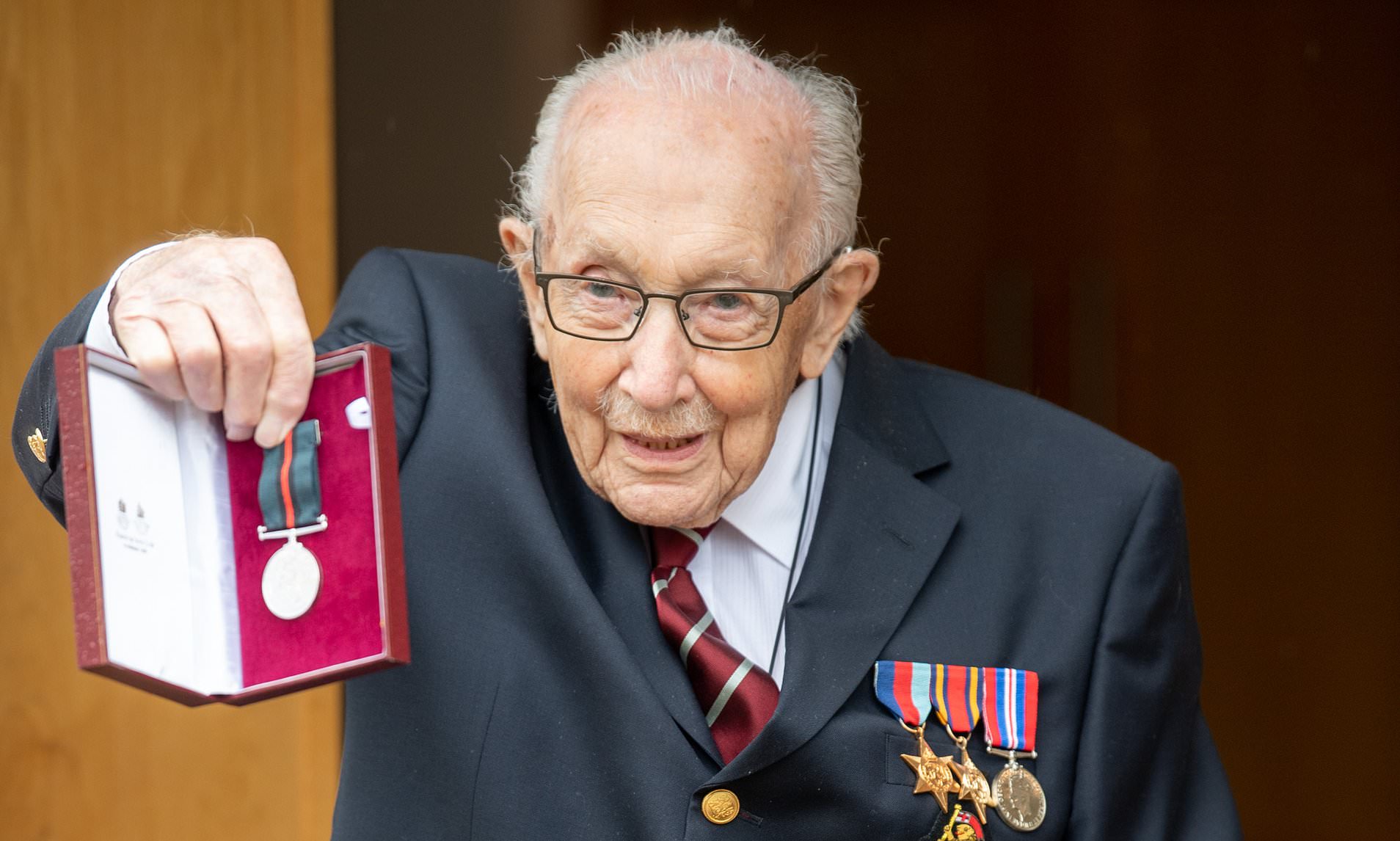
In a year when, for a few months at least, we clapped for the heroes on the front line of the coronavirus, an unlikely hero - an actual war hero, in fact - emerged. Captain Sir Tom Moore was that quintessential British national treasure: in his 100th year, the plucky former Royal Armoured Corps officer, who'd seen Second World War service in Burma and India, and whose previous own brush with fame was a 1983 appearance on Blankety Blank, turned the humble idea of celebrating his centenary by walking 100 laps of his garden for charity into an emblem of the nation's fight against COVID-19. But instead of remaining just a quirky "and finally..." item on News At Ten, his modest plan to raise £1000 by the time of his 100th birthday became more than £32 million (closer to £40 million if you take tax benefits into account). A phenomenon was born.

For those of us who've struggled to get off the sofa during lockdown, seeing this sweet little widower, hunched over his walking frame as he padded up and down outside his Bedfordshire home, was a genuine inspiration. Last April, in early spring warmth, he became a beacon of hope, too, not just for the fundraising but also for his endearing personality and seemingly ever-ready ability to deliver a pearl of wisdom on demand. "Tomorrow will be a good day" became his catchphrase, but also a note of positivity in an otherwise depressing landscape of lockdowns and an absence of hope in the short term. 

Too right that he was rewarded with a knighthood. Too right that the RAF's Battle Of Britain Flight flew a Hurricane and Spitfire over his home to mark his 100th birthday (a moment that, soppily, still brings a lump to my throat in the footage of the centenarian, wrapped in a blanket and sat in a wheelchair, waving at the planes as their Merlin engines roared throatily overhead). "I'm one of the few people here who've seen Hurricanes and Spitfires flying past in anger," he said at the time. "Fortunately today they're all flying peacefully."

News on Sunday that Captain Tom was being treated for COVID-19 following a bout of pneumonia was met universally with the grim expectation that there wouldn't be a good outcome. Today that inevitability came to fruition. Thomas Moore, born on 30 April, 1920, in Keighley, Yorkshire, passed away. His daughters, Hannah Ingram-Moore and Lucy Teixeira, called the final year of his life as "nothing short of remarkable". "He was rejuvenated and experienced things he'd only ever dreamed of," the sisters' statement added. That, presumably, would have included having a Number 1 hit single (with Michael Ball - a charity recording of You'll Never Walk Alone), writing (or co-writing) an autobiography, and even getting into the Guinness Book of Records for the money his walk raised. 

For the birthday that actually started it all, Tom received more than 140,000 cards, so many in fact that a dedicated sorting office was set up at his grandson's school. In December he became the oldest person to appear on the cover of GQ as one of its 2020 Men Of The Year. "Not only was he the oldest person ever to grace our cover, he was one of the most gracious," editor Dylan Jones said tonight. "He was a hero, a genuine old-fashioned hero, and I feel blessed that we were in his orbit, albeit for a very brief time." 

The tributes that have been paid have gone rightfully beyond the normal platitudes of condolence. The ceremony, last July at Windsor Castle, to confer his knighthood by the Queen - a mere six years Moore's junior - put another smile on the nation's face, an occasion Buckingham Palace acknowledged in its statement: "Her Majesty very much enjoyed meeting Captain Sir Tom and his family at Windsor last year. Her thoughts, and those of the royal family, are with them, recognising the inspiration he provided for the whole nation and others across the world." Tonight's comments from Downing Street added to this further: "Captain Sir Tom Moore was a hero in the truest sense of the word," said Prime Minister Boris Johnson. "In the dark days of the Second World War he fought for freedom and in the face of this country's deepest post-war crisis he united us all, he cheered us all up, and he embodied the triumph of the human spirit. He became not just a national inspiration but a beacon of hope for the world."

In tributes to other figures, that might sound hyperbolic but in the short space of time that Captain Tom was in our consciousness, he managed to transcend the mounting misery of the virus. His fundraising for the NHS even attracted well-wishers from all over the world, who flooded his home with cards and donations. He also stood for something old fashioned, traditional, unsurprising in an individual of his generation. But he was more than just a novelty, no flash-in-the-pan media event like Brenda from Bristol. In a matter of weeks he was elevated from humble war veteran, doing his bit, to the status afforded to Sir David Attenborough. His fame may have been fleeting - spanning just the nine months or so to today - but his memory will last long after the virus that ended his remarkable life has been brought under control.

"I am still very proud of our country. There is nowhere like ours," he once said. Tonight, his country is proud of him. Rest in peace, Captain Sir Tom Moore. And thank you. You were the one bright spot in this last year of so much gloom.


Monday, 1 June 2020

Shields down!


It's the first of June. How did that happen? One minute we're in the depths of winter, hearing news of a nasty bug in China, the next, we've barreled through the sunniest, most relentlessly blue-skied spring in living memory. In that time, I have been diagnosed with Type 2 diabetes, started a new job, lost over a stone in weight and watched the world go by, mostly through the living room windows. I have diligently stayed at home, protected the NHS, and saved lives. My own, probably.

There was a time when COVID-19 was seen as a mere irritation affecting somewhere else. "The Chinese," we scoffed, "and their wet markets." And then it came to Europe, and we cast a concerning eye on News At Ten as alarming reports emerged from, first, Italy and then Spain. On 24 March, a few days after HMG's chief scientific adviser, Sir Patrick Vallance, said that keeping the COVID-19 death toll below 20,000 would be "a good outcome", I received a text message from the government itself (whom I didn't remembering ever giving my mobile number), telling me ominously: "New rules in force now: you must stay at home". This was followed by a helpful reminder of Dominic Cummings' latest slogan: "Stay at home. Protect the NHS. Save lives." Well, I was, already, doing just that. A week or so later I received another SMS, this time from my GP surgery, telling me that I'd been "identified as high risk" and to "STAY at HOME & avoid contact with anyone except your carers or healthcare workers for at least 12 weeks". So I have. I've been pretty diligent: my girlfriend, to her infinite credit, braves the supermarket so I don't have to, and on the few times that we have gone out for exercise since rules on how far you can go have relaxed a little, we've done all the right things about avoiding proximity to others. But even then, I've been nervous. Actually, I’ve been scared shitless.

The shielding programme gave the impression that the coronavirus was out there, ligging about in the air, stuck to pavements that would end up on shoes you brought into the house, thriving on door handles and embedded in fabric, just waiting for you to brush past or even walk straight into it. This probably hasn’t been the case, but then again, how do we know? I live in a borough with the least number of coronavirus cases in London. What has made us different from, say, the north-west, where the dreaded ‘R’ rate remains stubbornly high? Even if cases in this locale have been low, I’m not going to assume it’s any safer. Frankly, my diagnosis coming around the same time as COVID-19 announced that it was here in the UK rendered me paranoid, and I’m not easing up on that point of view just because the lockdown is.

Even though diabetes wasn’t specified as an "underlying health condition" when the pandemic arrived it has certainly proven to be one of the highest risks to mortality since. Of the 39,045 deaths recorded up until today, one-in-four have been attributed to diabetes. Britain’s place in the COVID fatality league table is nothing to be proud of at roughly 10% of the worldwide total. True, the rates are coming down, but with the daily average still around 300, we're still seeing the equivalent of a fully loaded Boeing 777 crashing every single day. That's better than the three 777s coming down per day that the coronavirus death rate peaked at here in Britain, but still. 

So, forgive me for being a bit of a Negative Nelly at news that, from today, everything is, apparently, back to normal, but if, like me, you regard the death rate as the key metric of this virus (let's face it, if you know something is capable of killing you, you're going to do your level best to avoid it), I don't share the enthusiasm about lockdown restrictions being lifted. I get it that we need the economy to be restarted, but that shouldn't mean hundreds of people packing themselves onto beaches and into parks (and buying Pringles and gallons of Pepsi from Tesco Express for picnics does not constitute the economy being brought back to life). My other half is a primary teacher, and even if children are less likely to pass on the virus, their clothing could. Exponentially, the risk goes up with every potential encounter my girlfriend has with anyone or anything from outside our house. Now scale that up with all the other activities returning to some semblance of normality.

We can all understand the desire for it but I'm still not convinced that now is the right time. In fact, no amount of colour-coded terrorism alert-style Government charts can convince me that the time is right. I don't think the Government's own scientific advisers are convinced, either. On Saturday, the well-respected Professor Jonathan Van-Tam, England’s deputy chief medical officer, warned of the "potential dangers if we go too fast," adding that if people didn't behave sensibly, there was a high risk of the pandemic worsening. He’s not alone: members of the UK’s SAGE committee of scientific advisers have also expressed the concern that easing is going too quickly. Interesting, then, that on Saturday night at around 10pm news leaked from 10 Downing Street to a conveniently primed Sunday newspaper that the Government was about to ease the lockdown on 2.2 million of the most vulnerable who'd been under virtual house arrest "shielding". In principle, that includes me. Firstly, I was surprised that there were 2.2 million people in this category as, since shielding had begun, we'd been told that 1.5 million came under this regime. Secondly, the leak of a feelgood story on a Saturday night to a Sunday tabloid is a classic piece of spin. By the time Robert Jenrick, the communities minister, fronted yesterday's No.10 press conference (and he was already under a cloud over allegations of cronyism related to a property deal he sanctioned), we were already in the midst of the surprise news that those who were medically shielding, having spent weeks cooped up in bedrooms and unable to even mingle with other members of their households, were suddenly going to be allowed out into the fresh air. Clearly, that nasty little virus, with its trumpet-like horns, was no longer lurking right outside the door. I've worked in the media my entire professional life, and I can spot a confected story when I see one. I can smell one, too.

So here we are, first of another hopefully gloriously sunny month and suddenly everything is looking up. Schools have reopened, street markets have set up shop again, and you can now test drive a car you still won't be able to go anywhere in. We can also gather in others' gardens, guilt-free. Millions of people who have been forced to live hermit-like for almost three months can now get outside for the first time, as long as they follow the rules. Ah, yes, the rules. They're all open to interpretation, right? Just tell that to those evil, microscopic droplets still ligging about, even if they're not ligging about as much as they were... 


Friday, 24 April 2020

Pace yourself - this thing's not over yet

Picture: Twitter/BetterCaulSaul/AMC

There have been two stark reminders this week that we're in it for the long run with this pandemic. Firstly, I finally received a letter from my GP warning me to "stay at home at all times and avoid all face-to-face contact for at least 12 weeks" owing to rather foolishly having an underlying health condition. This, I thought, was somewhat curious as we are now in Week 4 of the lockdown, and I'd received a text message from the NHS three weeks ago today warning me, then, to stay at home for “at least” 12 weeks. So, am I now confined to barracks for 12 or is it 15 weeks? And then, if I heard Chris Whitty, the government's chief medical adviser, correctly this week, I might be here for even longer, like The Count of Monte Cristo or Rapunzel, after he alarmingly stated that no one's getting out until they find a cure, or a vaccine, or the economy collapses and it's the Zombie Apocalypse for real. Something like that.

A staple of the media over the last few weeks has been reporting on how people are (or not) coping with the lockdown. I'm not going to be flippant, and pretend that there aren't families in appalling conditions, children sharing bedrooms in cramped flats, and a serge in domestic violence; I'm also not going to believe that everyone in the UK can simply ride this thing out over the summer by setting up permanent station in their gardens, as it's a myth to believe that we all have one in this green and pleasant land. We do, however, all have access to television, which has become a universal panacea. It's no surprise, then, that box sets and streaming services are being chewed through at a rate of knots. Even I have started watching Masterchef and Bake Off, the kind of thing I'd ordinarily swerve, for want of something feelgood. Travel shows, too, have provided the escapism we've been denied by the lockdown (Sir Tony Robinson taking a train from Seattle to Alaska the other night was strangely liberating, despite being largely about the actor sitting inside a metal tube for hundreds of miles at a time). And there was Tiger King: Murder, Mayhem and Madness, the batshit-mad story of the batshit-mad Joe Exotic, his big cat zoo in Oklahoma and his allegedly murderous obsession with conservationist Carole Baskin. What could have been easily condensed into a single hour (as Louis Theroux had done previously) was brilliantly strung out into seven, somewhat individually themed episodes. These could also have been rationed but, in most people's cases, were binge-viewed in three, two or even single sittings. Given the bizarre story that played out, with equally bizarre players, it was hardly family lockdown material, but there we were - all of us - craving another episode after each dose, even when it was clearly getting late.

Since it’s premiere on 20th March Tiger King has been watched by more than 64 million households (Netflix’s metric) and has become a classic example of word of mouth cultural encroachment. We watched it because “everyone” was talking about it. We weren’t disappointed. Every day there's another recommendation on Facebook, be it Stranger Things, Ozark or Love Is Blind, or from these shores, the BBC’s Killing Eve (an episode of which was filmed not 100 yards from the kitchen table at which I write this). No wonder Netflix has added almost 16 million new accounts in the first three months of the year (almost double the number of new sign-ups for the final months of 2019). Even with new productions on hiatus, Netflix promises that it won't be running out of content any time yet.

One of its jewels, and one it was smart to bet on from the outset, is Better Call Saul, the Breaking Bad prequel which, it is frequently debated, has been even better than the show from which it spawned. This week its ten-episode fifth season drew to a stunning conclusion, brilliantly setting itself up for a sixth and final run, though no one quite knows when that will appear. Showrunners Vince Gilligan and Peter Gould were aiming for a season a year, but the lockdown in California has meant that production is on hiatus, although it has provided time to work on the new scripts. If you’ve not watched the final episode of Season 5, I won’t spoil it here, but like the previous seasons, 5 has been a delicious arc, continuing the metamorphosis of Jimmy McGill into Saul Goodman, the shyster lawyer of Breaking Bad (“It’s all good, man”), laying a few seeds that flower in the original series and even dropping a few plot lines that have left devotees of both shows wondering where and when the link will be made.

Picture: AMC television

But, unlike the much-binged Tiger King, Saul has been drip-fed to us, week-by-week, an old-fashioned approach, perhaps, but equally as effective as cliffhangers from old when the following week’s episode couldn’t come soon enough. This weekly progression has helped build not just a story curve but the season’s character curve, too. There have been standout performances from Bob Odenkirk as McGill/Goodman, as he finds himself deeper and deeper into the murky world of Albuquerque’s criminal underworld. Goodman was only ever meant to be a minor character in Breaking Bad, but with each new season of Saul, Gilligan and Gould have mined an even richer seam of ambition - and paranoia - providing obvious and not so obvious links and bridges to what we know of his future; Rhea Seehorn as his romantic partner and career-minded lawyer who, herself, starts to display a more nefarious side towards the end of the season, just as Walter White’s wife Skyler became more embroiled in the affairs of his alter-ego, ‘Heisenberg’; and the enigmatic Jonathan Banks as Mike Ehrmantraut, the gnarled ex-cop (and, possibly, ex-special forces operative) doing the dirty work for nefarious drug emperor Gus Fring; and the season’s standout character, Lalo Salamanca, played with glorious, moustache-twirling, vintage villainy by Tony Dalton.

“Just IMAGINE when Better Call Saul was announced...the notion of suggesting it’d be half as remarkable as Breaking Bad was. You’d have been immediately ripped on & discredited. It’s all I see now - that it equals it, if not surpasses it. Astronomical odds of that happening.” So wrote the very excellent Canadian radio presenter Greg Brady in a tweet on Tuesday. I mention this as A) I follow Greg (and occasionally you can hear him on BBC 5 Live’s always entertaining Fighting Talk) and he follows me, and B) I couldn’t have summed up Better Call Saul better myself. That’s almost all there is to be said. With each new season, the bar has crept ever higher. Breaking Bad and Better Call Saul have rightfully joined the ranks of the great entries in the so-called 'golden age of television', that period over the last couple of decades when The SopranosThe WireBand Of Brothers, 24 and Homeland managed to transcend formulaic series television and become what became known as “appointment TV”, epic, cinematic television. America hasn’t had the monopoly on this, of course, as the likes of Line Of Duty, Killing Eve and, most recently, The Nest have demonstrated. But many of these examples are of shows which conform to a conventional linearity.

Picture: AMC

Better Call Saul - even more than Breaking Bad - has frequently demonstrated none of it. Moreover, Gilligan, in particular, has presided over two series with an identical love of quirky cinematography. If you thought some of the camera angles in the original Batman TV series in the 1960s were askew, some of the shot framing and scene-teeing in Saul, in particular, has been exquisite. The precedent was set in Breaking Bad, of course, with the opening episode commencing with Walt White, wearing white underpants and a gas mask, speeding off-road in the New Mexico desert in his cookshop 'RV'. All this before we had any clue as to who he was, what he was or why he was out there. Speed forward (or back), to the premiere episode of Better Call Saul, and the opening sequence begins with a individual who looks a lot like Saul living in stark anonymity in Nebraska, running a shopping mall Cinnabon kiosk, and spending his evenings replaying video cassettes of Saul Goodman TV commercials. All in black and white with hardly a word uttered. Here's Gilligan’s trademark: quirksome and often irony-laden, using idiosyncratic tracking shots or even something as simple as the reflection of an SUV in a puddle to build menace, curiosity and fear in equal measure, rather than simply resort to ‘establishing shots’ of landscapes which, while pretty, give little for the narrative to follow.

The Sopranos did similar things, with music frequently applied to underline Tony Soprano’s baby boomer, middle-aged dadness, an important reminder that he wasn’t just a ruthless capo. Both Breaking Bad and Better Call Saul have traded off the fact that New Mexico is not like anywhere else in the American south, and that Albuquerque is not like any other southern desert city. Even if the criminality theme fits into any reflection of modern America, and urban America in particular, the fact that Gilligan’s shows are not set in the usual locations, like Los Angeles or New York, merely adds to the fact that we’re simply watching something else entirely. It’ll be truly interesting to see where Saul - now he has more or less become Vader to Jimmy McGill’s Annakin - takes us in the final season. Whenever that materialises...

Tuesday, 24 July 2018

I'm off to the sun to cool off

I remember the summer of 1976 very well. While most of Britain turned a dusty shade of brown, my family spent two weeks on holiday in a pocket of mid-Wales where it rained every day. Torrentially.

It was also the first family holiday in which my elder brother didn’t join us (17 and too cool for school), but this meant that every evening the four of us (dad, mum, sister and me) would cagoule up and walk to the local phone box, into which we would all squeeze, while my father would call home. "What's the garden like?" would be the opening gambit. "Yellow," would come the reply. And so that went on for a fortnight. Every evening a bemused and bedraggled horse would saunter over to look at us, mockingly, as we appeared progressively more rust red while the rest of the country became increasingly less green and pleasant.

After that summer we returned to traditional British climes with July/August enjoyed in the unpredictable climate that this country had become used to. If you wanted sunshine you'd have to go on a package holiday to Spain. 42 years later, I've lost all perspective on what summer temperatures in Britain should be. The heatwave that has seemingly taken over the weather in the last two months - some parts of the UK have now gone 54 days without rainfall - shows no sign of ending. I can't remember the last time I slept solidly for the full eight hours.

We should be rejoicing. This is the kind of summer weather we all dreamed of as we dodged showers in another Cornish resort, back in the days when Cornwall wasn't the British equivalent of Santa Cruz. Heatwaves, in old money, used to be a week or, at most, two, in which the tabloids ran gratuitous front page pictures of dogs cooling off in duck ponds and young ladies in bikinis eating ice creams on Bournemouth beach, along with 'fancy that' stories of roads cracking. Now we're enduring the longest such dry spell for 49 years, and it's expected to go on for at least another week. Tomorrow could reach 35C, prompting the Met Office to issue an 'amber' heatwave alert and a "Level 3" warning - the weather equivalent of DEFCON2. If it reaches 4, officially there will be a national emergency. And, presumably, nuclear war. The irony of all this is that people are choosing to spend their summer holidays in the UK. The Times today reports that travel agents are discounting foreign holidays by as much as 40% as they try to persuade Britons, as-yet undecided about their holidays, to head for relatively more comfortable destinations around the Med.

Parched: Greenwich Park in May, and today.
Pictures: © Simon Poulter 2018 and Royal Museums Greenwich

Of course, we Brits are never satisfied with the weather, nor do we fare well with any of it. In the autumn the railways can't work due to leaves on the line; in winter, snow brings everything and everyone to a halt; spring - well, we can now skip spring and move straight on to summer, when it is hot and sunny (as prescribed), but so hot and sunny that railway tracks mangle and dustcarts sink into molten tarmac. The problem is that we're just not cut out for extremes of weather. Take the London Underground: built by the Victorians who, if they wanted to experience tropical heat would have to invade an equatorial country in the name of the Empire, its tunnels were built so deep that they cannot be adequately air conditioned. Thus, yesterday, Central Line trains reached temperatures of 36C in overfull carriages during the rush hour. EU legislation specifies that cattle should not be transported at temperatures higher than 30C. Tube trains are so hot that you may as well dress in swimwear. Regular clothing will become drenched in sweat, I guarantee you, within a couple of stops.


Such is the relentlessness of the heatwave that I can't understand why travel companies are having to give away holidays to Spain. With official NHS and Public Health England guidance being "seek shelter" as the heatwave continues and outside temperatures creep closer to the human body's own core temperature, the Mediterranean is starting to look like a very attractive place in which to cool down. There is, however, much worse elsewhere: Japan has declared a 'natural disaster' as its current heatwave sets new records, with the city of Kumagaya recording temperatures of 41.1C yesterday. At least 65 people have so far died of heatstroke with another 22,000-plus hospitalised. Even the Nordic countries are suffering - Finland is likely to get up to 29C later this week, which is, relatively speaking, extreme (though most Finns do at least have endless forests and lakes in which to find respite).

Climate change has made these extremes the new norm. Some experts say it's just a cycle, others fear that we're heading for worse. As much as I love warm weather (when I moved to California people warned me that I'd soon get bored with the sunshine - I didn't), I'm missing the predictability of the English summer. I used to like the fact that if I wanted to enjoy hot sun, a two-hour flight south would sort me out, and that I'd return to England in August, with people talking about "putting on an extra layer". Two months into this heatwave, I'm looking forward to normality. I just don't have an idea of when that will be possible.