Showing posts with label the Queen. Show all posts

Tuesday, 20 September 2022

A front row to history

Picture: Twitter/British Army

The flags have returned to full mast. Television presenters are wearing colour again. Politicians are back on our airwaves spinning their way through the cost of living crisis. Life after 12 extraordinary days is back to normal. 

“Don’t know about you, but I’m looking forward to something else,” crowed the predictable tweets from the more reactionary quarters of social media last night as the Queen’s funeral, and a week and a half of blanket coverage of what has been, without wishing to sound hyperbolic, a properly historic event, came to an end.

On a superficial level, the days since news broke on 8 September of the Queen’s death have shown British pomp and circumstance at its most baffling. Anyone of a republican point of view, or simply indifferent to the role of monarchy in a modern democratic society will have found the enforced lockdown of anything extravagant in the wake of a frail 96-year-old’s death absurd: the abandoning of broadcast schedules, on-air presenters dressed uniformly in black, filling hours of rescheduled rolling programming with nothing but conjecture and babble.

Picture: The Royal Family

But to many, many more, the passing of Queen Elizabeth II and the accession of King Charles has been nothing short of history unfolding before us. From the moment daytime TV was interrupted by grave-looking newsreaders dressed in black, standing in front of Buckingham Palace, the auspicious moments kept coming. They were captured on live television in a manner no monarchic transition in Britain’s long regal history has ever previously witnessed: we were there at Balmoral when The Firm’s senior team arrived in united grief; there when the Queen’s body was transported to Edinburgh and there when it landed at RAF Northolt, emerging from the loading ramp of a giant, slate-grey Globemaster transport aircraft. We were there as it was driven slowly through rain-soaked west London streets to Westminster. There when more than a quarter of a million people queued for hours on end to see the late monarch lying in state, itself a demonstration of endurance, unquestioning loyalty and quirky fanaticism. We were there when the new King signed registers, met the newly-installed prime minister, and shook countless strangers’ hands in the devolved provinces. There as two estranged brothers and their wives went walkabout in Windsor. And there, finally, as members of an estimated five billion-strong worldwide audience tuned in for a six-hour funeral.

An opinion poll published shortly before the Queen’s death suggested that more than 60% of the UK was broadly in favour of the monarchy. In the days since, that manifested itself at the expense of anything else getting a look-in on the news agenda. Liz Truss, in post for just two days before HMTQ popped her clogs, had barely got going with her new agenda before she was reduced, temporarily, to a bit part role in the nation’s fabric. If nothing else, the mourning period gave us respite from the relentless churn of politics that have consumed our media for…well, forever.

The billions watching around the world, not to mention the tens of thousands who lined the funeral cortege route from Westminster to Windsor, on top of the thousands who assembled before giant screens in municipal parks, gave credence to the belief that the Queen’s death meant a lot to many, even those in places where she’d only ever been heard of. 

She was “the world’s Queen”, a remarkable comment, given both the political systems in place int the free and not so free world, but also our own post-imperial, ‘Little Britain’ inferiority complex. Somehow she even transcended her own status - an unelected head of state in several nations, featuring on at least 30 currencies, and with one of the wealthiest portfolios of any individuals on the planet. And, yet, when she said “We will meet again” in that resonant address during the pandemic, she touched further and deeper than any politician did during the crisis. There was a reason why, over these days, we’ve seen and heard endless vox pops conducted in high streets and market squares saying more or less the same thing - that they’d miss - in no particular order - her smile, her duty, her constancy.

If that hadn’t affected you, then the lump-inducing notes from the lone piper in Windsor’s St. George’s Chapel yesterday as they faded away provided the eeriest of musical beds for the lowering of the Queen’s coffin into the chapel’s vault. Anyone who has ever attended the funeral of a loved one will know that awful, irreversible moment of goodbye. It was etched on the face of King Charles as the camera framed him. I challenge anyone not to have been moved by it, or anyone not to have empathy for his family.  

Wherever you stand on monarchy, there’s no escaping the fact that we’ve emerged from an incredible period of our nation’s history. The “ending of the second Elizabethan Era” has a grandeur to it, but it would be fascinating to know how historians will regard it decades or centuries from now. Television has amplified it: when the Queen ascended the throne in 1952, and was crowned in June 1953, hardly anyone had TV sets. At the end of her life, we’ve got them all in our pockets. Yesterday I spent the better part of ten hours in front of our TV, from the build-up to the funeral to its conclusion. Believe me, I’m no rampant monarchist, but I know a once-in-a-lifetime event when I see one. On various levels it was fascinating - the application of long planned-for protocols, arcane traditions, the single greatest collection of world leaders ever assembled, the mass of people turning out for one person. And this on top of moments such as Charles and his siblings resembling human waxworks for their 15-minute vigil at Westminster Hall, as members of the general public filed past, some in disbelief as to who they were seeing before them.

It was all part of a celebration of a life as much as commemoration of a long life lost. The hats, the outfits, the smiles, the corgis, the appearances with James Bond and Paddington Bear, the waving - there is a lot we’ll miss.

Picture: Twitter/The Royal Family


Tuesday, 2 February 2021

Tomorrow was a good day, thanks to Captain Tom

Picture: The Captain Tom Foundation

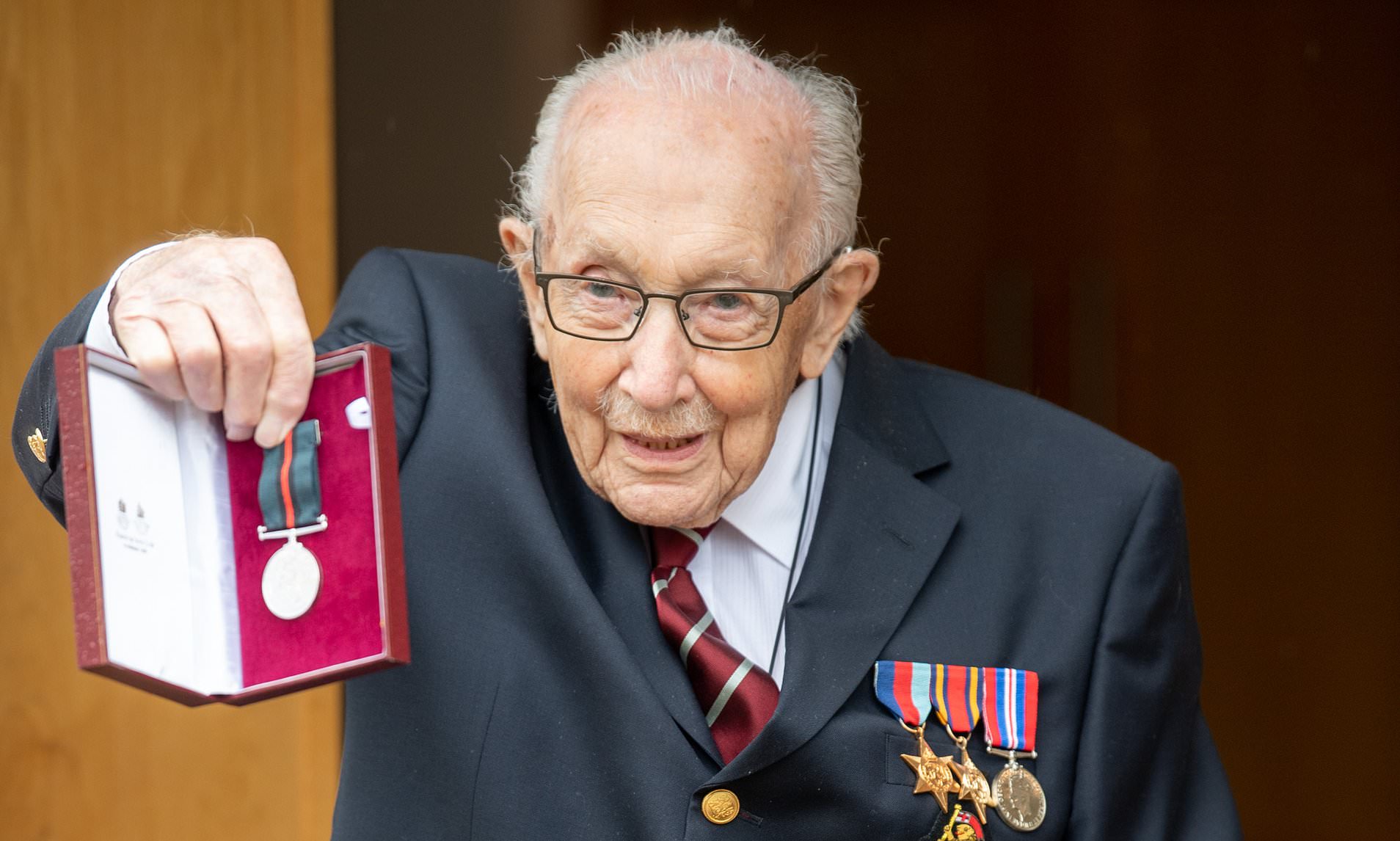
In a year when, for a few months at least, we clapped for the heroes on the front line of the coronavirus, an unlikely hero - an actual war hero, in fact - emerged. Captain Sir Tom Moore was that quintessential British national treasure: in his 100th year, the plucky former Royal Armoured Corps officer, who'd seen Second World War service in Burma and India, and whose previous own brush with fame was a 1983 appearance on Blankety Blank, turned the humble idea of celebrating his centenary by walking 100 laps of his garden for charity into an emblem of the nation's fight against COVID-19. But instead of remaining just a quirky "and finally..." item on News At Ten, his modest plan to raise £1000 by the time of his 100th birthday became more than £32 million (closer to £40 million if you take tax benefits into account). A phenomenon was born.

For those of us who've struggled to get off the sofa during lockdown, seeing this sweet little widower, hunched over his walking frame as he padded up and down outside his Bedfordshire home, was a genuine inspiration. Last April, in early spring warmth, he became a beacon of hope, too, not just for the fundraising but also for his endearing personality and seemingly ever-ready ability to deliver a pearl of wisdom on demand. "Tomorrow will be a good day" became his catchphrase, but also a note of positivity in an otherwise depressing landscape of lockdowns and an absence of hope in the short term. 

Too right that he was rewarded with a knighthood. Too right that the RAF's Battle Of Britain Flight flew a Hurricane and Spitfire over his home to mark his 100th birthday (a moment that, soppily, still brings a lump to my throat in the footage of the centenarian, wrapped in a blanket and sat in a wheelchair, waving at the planes as their Merlin engines roared throatily overhead). "I'm one of the few people here who've seen Hurricanes and Spitfires flying past in anger," he said at the time. "Fortunately today they're all flying peacefully."

News on Sunday that Captain Tom was being treated for COVID-19 following a bout of pneumonia was met universally with the grim expectation that there wouldn't be a good outcome. Today that inevitability came to fruition. Thomas Moore, born on 30 April, 1920, in Keighley, Yorkshire, passed away. His daughters, Hannah Ingram-Moore and Lucy Teixeira, called the final year of his life as "nothing short of remarkable". "He was rejuvenated and experienced things he'd only ever dreamed of," the sisters' statement added. That, presumably, would have included having a Number 1 hit single (with Michael Ball - a charity recording of You'll Never Walk Alone), writing (or co-writing) an autobiography, and even getting into the Guinness Book of Records for the money his walk raised. 

For the birthday that actually started it all, Tom received more than 140,000 cards, so many in fact that a dedicated sorting office was set up at his grandson's school. In December he became the oldest person to appear on the cover of GQ as one of its 2020 Men Of The Year. "Not only was he the oldest person ever to grace our cover, he was one of the most gracious," editor Dylan Jones said tonight. "He was a hero, a genuine old-fashioned hero, and I feel blessed that we were in his orbit, albeit for a very brief time." 

The tributes that have been paid have gone rightfully beyond the normal platitudes of condolence. The ceremony, last July at Windsor Castle, to confer his knighthood by the Queen - a mere six years Moore's junior - put another smile on the nation's face, an occasion Buckingham Palace acknowledged in its statement: "Her Majesty very much enjoyed meeting Captain Sir Tom and his family at Windsor last year. Her thoughts, and those of the royal family, are with them, recognising the inspiration he provided for the whole nation and others across the world." Tonight's comments from Downing Street added to this further: "Captain Sir Tom Moore was a hero in the truest sense of the word," said Prime Minister Boris Johnson. "In the dark days of the Second World War he fought for freedom and in the face of this country's deepest post-war crisis he united us all, he cheered us all up, and he embodied the triumph of the human spirit. He became not just a national inspiration but a beacon of hope for the world."

In tributes to other figures, that might sound hyperbolic but in the short space of time that Captain Tom was in our consciousness, he managed to transcend the mounting misery of the virus. His fundraising for the NHS even attracted well-wishers from all over the world, who flooded his home with cards and donations. He also stood for something old fashioned, traditional, unsurprising in an individual of his generation. But he was more than just a novelty, no flash-in-the-pan media event like Brenda from Bristol. In a matter of weeks he was elevated from humble war veteran, doing his bit, to the status afforded to Sir David Attenborough. His fame may have been fleeting - spanning just the nine months or so to today - but his memory will last long after the virus that ended his remarkable life has been brought under control.

"I am still very proud of our country. There is nowhere like ours," he once said. Tonight, his country is proud of him. Rest in peace, Captain Sir Tom Moore. And thank you. You were the one bright spot in this last year of so much gloom.


Thursday, 9 January 2020

Can't wait for Season 21 of The Crown!

Picture: Instagram/@sussexroyal

Finally, we plunged in. After two complete seasons of the media raving about The Crown, with even me living down the road from the Old Naval College in Greenwich (where exterior scenes of Buckingham Palace for it were filmed), my girlfriend and I started bingeing the Netflix series over Christmas. As a battle-hardened veteran of The Sopranos and Breaking Bad box sets, I’ve always been somewhat averse to soapy shows that might appeal more to Hello! readers rather than gritty drama. Even more, I've always been wary of dramatisations of contemporary stories, especially involving actors playing real people who are still alive (they never seem to get the casting right). On top of this, most previous attempts at portraying the royals in film and television have invariably been awful, Helen Mirren in The Queen being a noted exception.

But in we went - and I’ve been pleasantly surprised by what we’ve watched so far. The casting has been almost exclusively terrific (standout performances by Claire Foy as the younger Queen Elizabeth and John Lithgow mesmerising as Winston Churchill), but more importantly, there has been less of a soap opera about it all and more an insightful depiction of British and global history in the second half of the 20th century. Episodes in the first two seasons have covered the Second World War, Suez, the Kennedy assassination, the complexities of royal heritage and duty, Churchill’s demise and the prescient scramble to succeed him within the Tory party, and even the suggested Nazi associations of the Duke of Windsor, the abdicated king. Like The Sopranos - and with clear parallels to an established family structure being challenged by modernity and its own moral ambiguities - The Crown has thus far been rip-roaring entertainment and thoroughly addictive. So, given last night’s blockbuster news that the Duke and Duchess of Sussex - Harry and Meghan, to you and me - are to "step back as 'senior' members of the Royal Family" and "work to become financially independent", you wonder how, in future seasons of The Crown, the royal soap opera that has periodically spilled into public life over the last 30 years will be portrayed by the show.

I don’t wish to be flippant. Every family has its rifts, and the Royal Family - while essentially being also a ‘firm’ - is not immune to them. As The Crown has depicted (and, so I’m informed, faithfully), the frustrations Prince Philip had as royal consort and Princess Margaret endured as the Queen’s sole sibling are possibly no different to those Harry and Meghan have now brought to a head. I’m no staunch royalist, but then again, I have no strong feelings about the royal family’s existence. For the most part, they’re good for the nation. It's not defensive PR spin to say that the royals contribute positively to the British tourist economy - you only have to listen to the gushing coming from coachloads of Chinese tourists as they press their noses up to the railings of Buckingham Palace and Windsor Castle - even if there is an increasing sense of republican scorn (on Twitter, obviously, but also in the readers' comments of the discreetly anti-royal Mail Online). Here, Harry and Meghan have run themselves into trouble. Flying on private jets while preaching about climate change is downright provocative, making the flak they're now facing over living rent-free in Frogmore Cottage (for now) which was renovated at a cost to the taxpayer of £2.4 million, understandable.

However, their very public and, it would appear, premature, flounce from the Royal Family has been coming. Harry has never been a fan of media scrutiny, both because it cost him his mother but also because it encroached on him personally, and by marrying a successful American actress, whose career thrived on publicity, fault lines were increasingly being exposed as he grew further into his 30s, especially with no clear royal role for himself. That the couple chose to spend six weeks out of the spotlight as what has been termed "a break" from royal life, should have been seen as a precursor to last night's announcement, modishly issued via Instagram. Rumours had been circling for a while that they might be considering relocating to Canada, and the sight of the couple on Tuesday visiting Canada House in London to thank the country for its "hospitality" during their Christmas holidays with Meghan's mother should have been a clue as to their mindset. The big shock, however, is that their announcement came without the knowledge of Buckingham Palace. Royal insiders have expressed genuine dismay, suggesting that the Queen herself was blindsided. Perhaps worse, still, not even Prince Charles was aware, a strange situation since you'd have thought his youngest son would have at least floated the plan in advance. The Palace's official statement, carefully written but full of nuance, said that discussions with Harry and Meghan on their decision to step back were "at an early stage" and that: "We understand their desire to take a different approach, but these are complicated issues that will take time to work through." Not only a signal that the Sussexes had jumped the gun, but that their cry for freedom was not going to be relieved easily.


These are, then troubling times for the Royal Family. Not quite existential-troubling, but not far off. 2019 was, in the history of royal anni horribiles, a peach: Prince Philip's actual car crash last January was eclipsed by his second son's metaphorical car crash on Newsnight in November; an apparent rift appeared between Princes William and Harry as the latter broke away from the Cambridge's foundation in June; and, then, there have been continuing attacks on the tabloid press by Harry and Meghan suing the Mail On Sunday over the publication of a handwritten letter she had sent her estranged father. As someone who has spent most of his working life in corporate PR, I know that nothing ever happens publically without good reason. It's normally just a good idea to be in full control. For the most part, Buckingham Palace is normally in control. The Crown has faithfully depicted many of these episodes. The Queen's 2019 Christmas speech, accompanied by carefully arranged and deliberately selected pictures of members of her family - but notably sans Harry and Meghan - was no accident. The Sussexes are said to be less than happy about that. And then the release on Instagram of a staged portrait of the Queen, Prince Charles, Prince William and Prince George, was a very clear statement of succession, even with Charles standing on a step and appearing taller than his lanky eldest son (Charles is not tall - I know, I've met him). This is being interpreted as part of the inevitable succession of the crown: Charles is said to be thinking of restructuring the family firm, slimming it down and giving it greater social relevance in the 21st century as one of the last functioning monarchies in the world. That process has already begun, effectively, with Prince Philip officially retiring from royal duties last August at the age of 96, and his second son, Andrew, being retired involuntarily following that Newsnight interview. Harry following suit, "while 'continuing to honour our duty to the Queen, the Commonwealth, and our patronages'," reduces the First Team squad even further, though this is a little like Chelsea shedding one ageing player, losing another to a failed drug test, and Eden Hazard moving to Real Madrid.

Few can blame Harry and Meghan for wanting a different life for themselves and their son Archie. Harry, in particular, has had to bear the burden of unwanted attention since birth, inflamed by his mother’s death, and then having to endure living in his brother’s shadow as a young adult. His brief tours of duty in Afghanistan may have given him an outlet for fraternal company, but he was merely following royal tradition (his uncle, Andrew, spent the Falklands War piloting Sea King helicopters as decoys for Argentinian Exocet missiles). What gets under the public skin, however, is money. We pay for the royals whether we like them or not. Choosing to just not be one should be something that is discussed, discreetly. No wonder it has caused the Queen "disappointment and hurt", according to sources. Princess Margaret's portrayal as a younger woman in The Crown as a society player struggling to find purpose as the monarch's sister, holds many parallels for Harry today. The press obsession with his mother (which, incredibly, continues today in the UK's mid-market tabloids) has inevitably and tragically informed his view of how the media has treated his own wife. With, now, a baby son in their midst, it would appear that this particular redhead has conformed to stereotype and gone rogue. Good luck to him, I say. It does make the prospect of future episodes of The Crown even more enticing. Just don't expect Meghan to play herself.