Showing posts with label World War Two. Show all posts

Tuesday, 2 February 2021

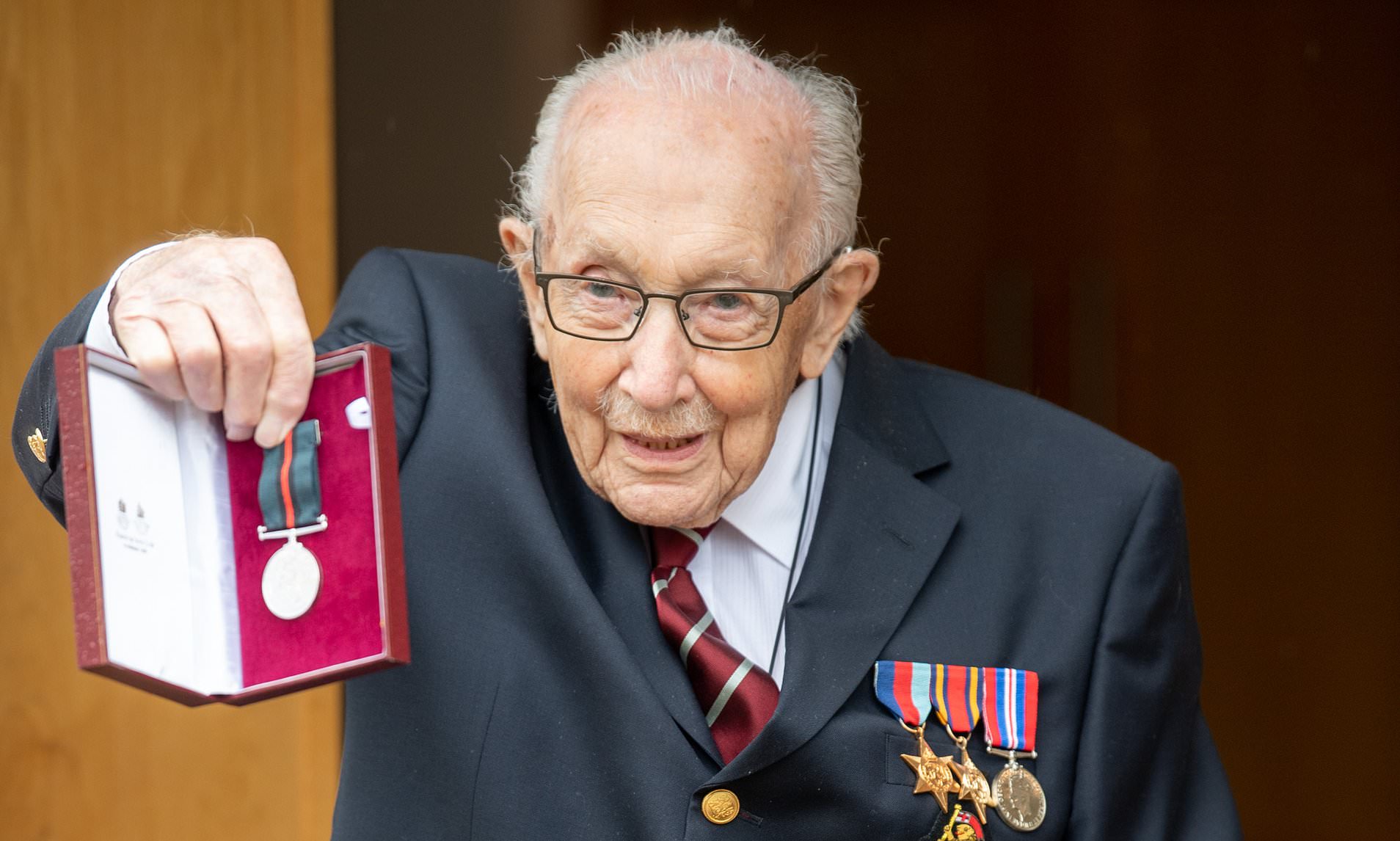
Tomorrow was a good day, thanks to Captain Tom

Picture: The Captain Tom Foundation

In a year when, for a few months at least, we clapped for the heroes on the front line of the coronavirus, an unlikely hero - an actual war hero, in fact - emerged. Captain Sir Tom Moore was that quintessential British national treasure: in his 100th year, the plucky former Royal Armoured Corps officer, who'd seen Second World War service in Burma and India, and whose previous own brush with fame was a 1983 appearance on Blankety Blank, turned the humble idea of celebrating his centenary by walking 100 laps of his garden for charity into an emblem of the nation's fight against COVID-19. But instead of remaining just a quirky "and finally..." item on News At Ten, his modest plan to raise £1000 by the time of his 100th birthday became more than £32 million (closer to £40 million if you take tax benefits into account). A phenomenon was born.

For those of us who've struggled to get off the sofa during lockdown, seeing this sweet little widower, hunched over his walking frame as he padded up and down outside his Bedfordshire home, was a genuine inspiration. Last April, in early spring warmth, he became a beacon of hope, too, not just for the fundraising but also for his endearing personality and seemingly ever-ready ability to deliver a pearl of wisdom on demand. "Tomorrow will be a good day" became his catchphrase, but also a note of positivity in an otherwise depressing landscape of lockdowns and an absence of hope in the short term. 

Too right that he was rewarded with a knighthood. Too right that the RAF's Battle Of Britain Flight flew a Hurricane and Spitfire over his home to mark his 100th birthday (a moment that, soppily, still brings a lump to my throat in the footage of the centenarian, wrapped in a blanket and sat in a wheelchair, waving at the planes as their Merlin engines roared throatily overhead). "I'm one of the few people here who've seen Hurricanes and Spitfires flying past in anger," he said at the time. "Fortunately today they're all flying peacefully."

News on Sunday that Captain Tom was being treated for COVID-19 following a bout of pneumonia was met universally with the grim expectation that there wouldn't be a good outcome. Today that inevitability came to fruition. Thomas Moore, born on 30 April, 1920, in Keighley, Yorkshire, passed away. His daughters, Hannah Ingram-Moore and Lucy Teixeira, called the final year of his life as "nothing short of remarkable". "He was rejuvenated and experienced things he'd only ever dreamed of," the sisters' statement added. That, presumably, would have included having a Number 1 hit single (with Michael Ball - a charity recording of You'll Never Walk Alone), writing (or co-writing) an autobiography, and even getting into the Guinness Book of Records for the money his walk raised. 

For the birthday that actually started it all, Tom received more than 140,000 cards, so many in fact that a dedicated sorting office was set up at his grandson's school. In December he became the oldest person to appear on the cover of GQ as one of its 2020 Men Of The Year. "Not only was he the oldest person ever to grace our cover, he was one of the most gracious," editor Dylan Jones said tonight. "He was a hero, a genuine old-fashioned hero, and I feel blessed that we were in his orbit, albeit for a very brief time." 

The tributes that have been paid have gone rightfully beyond the normal platitudes of condolence. The ceremony, last July at Windsor Castle, to confer his knighthood by the Queen - a mere six years Moore's junior - put another smile on the nation's face, an occasion Buckingham Palace acknowledged in its statement: "Her Majesty very much enjoyed meeting Captain Sir Tom and his family at Windsor last year. Her thoughts, and those of the royal family, are with them, recognising the inspiration he provided for the whole nation and others across the world." Tonight's comments from Downing Street added to this further: "Captain Sir Tom Moore was a hero in the truest sense of the word," said Prime Minister Boris Johnson. "In the dark days of the Second World War he fought for freedom and in the face of this country's deepest post-war crisis he united us all, he cheered us all up, and he embodied the triumph of the human spirit. He became not just a national inspiration but a beacon of hope for the world."

In tributes to other figures, that might sound hyperbolic but in the short space of time that Captain Tom was in our consciousness, he managed to transcend the mounting misery of the virus. His fundraising for the NHS even attracted well-wishers from all over the world, who flooded his home with cards and donations. He also stood for something old fashioned, traditional, unsurprising in an individual of his generation. But he was more than just a novelty, no flash-in-the-pan media event like Brenda from Bristol. In a matter of weeks he was elevated from humble war veteran, doing his bit, to the status afforded to Sir David Attenborough. His fame may have been fleeting - spanning just the nine months or so to today - but his memory will last long after the virus that ended his remarkable life has been brought under control.

"I am still very proud of our country. There is nowhere like ours," he once said. Tonight, his country is proud of him. Rest in peace, Captain Sir Tom Moore. And thank you. You were the one bright spot in this last year of so much gloom.


Friday, 8 May 2020

We’ve got so much to be thankful for

The contrasts couldn’t be greater. 75 years ago, thousands of people thronged into central London and other cities, towns and villages to wave flags and, crammed together, sang, danced and embraced. Today there will be none of that. Not for want of celebrating 75 years since victory in Europe was declared, but because we can’t. Save for a few patriotic neighbourhoods who rarely need an excuse to get out the bunting and have a street party, the lockdown has muted, somewhat, the VE Day commemorations.

But before anyone carps, some perspective. Yes, it’s a drag that we can’t celebrate en masse; yes, it’s frustrating that there is a stilted atmosphere to the day that not even a Red Arrows flypast will lift. For some of us, there is little change on the horizon from being confined to base and in some cases of extreme medical risk, confined to quarters with clinical shielding applied. But whatever inconvenience and even financial hardships COVID-19 is bringing - and an existential threat that this represents - 8 May, 1945 should put it into some perspective.

450,000 Britons lost their lives in World War Two, including those fighting in Europe, Africa and the Pacific theatres, as well as those on the home front, enduring almost six years of the Luftwaffe’s bombs and Hitler’s V rockets. When the war formally ended after the Japanese surrender in August 1945, the financial sacrifice made by Britain in its defence of liberty had been enormous. Even taking into account the material support that came the UK’s way from the United States, Britain was financially crippled. Post-war national debt peaked in the late 1940s to more than 230% of GDP. 

The hardships of wartime rationing on the home front were met by conscripts returning from the war to face unprecedented difficulties that pale into insignificance even when compared to the bleak outlook we face today. Indeed, in 1945, it would be many, many years before the hardships receded, with rationing continuing well into the 1950s. Out of that period, however, emerged the National Health Service, the very institution we now stand on our doorsteps applauding every Thursday evening. The period after the war also produced the longest - and continued - era of global peace and, eventually, prosperity. Organisations like the UN came about. You could even argue that NATO was created to provide a potent buffer to any renewed military ambition from the east. While some of that - particularly the prosperity - may have been arrested by the coronavirus, the optimist must conclude that we will not be in lockdown forever. A recession, predicted to be the worst in 300 years by the Bank of England, may be over faster than any in living memory (though the scars will take longer to heal).

I guess I’m saying that we may still be at the 1941 stage of this pandemic, with no end in sight and an attrition rate ruthlessly keeping us at home (even if the trend is downward, deaths are still equivalent to at least one loaded jumbo jet crashing every single day...). But we have to believe that the summer of 1945 will be here soon. Optimism, even if it was fuelled by a cocktail of patriotic fervour and government propaganda, kept the country going during the Second World War. Today we celebrate and commemorate the incredible suffering of everyone who lived through and fought in that conflict. I think of my own parents (especially my dad who probably only missed a call-up by a couple of years) as teenagers, denied all of the freedoms today’s teens still enjoy, even in the current circumstances. I think of the D-Day soldiers who never made it to the Normandy shore, the Lancaster bomber crews who had a one-in-three chance of coming home alive, and the sailors on Atlantic convoys risking all to bring in vital supplies. And I think of everyone back home who went to work, took on factory jobs and literally put their backs into keeping the country alive. It may sound trite, but we really do have so much to be thankful for.

I have lived in the Netherlands and in France, and have always found fascinating their attitudes to the war. The Dutch, in particular, have two events to commemorate their occupation by the Nazis, and the unfathomable suffering they were subjected to (just look at their war in late 1944 when the Allies were supposedly moving through occupied Europe, and yet the Dutch were being effectively starved to death as the last front of rearguard German defiance). On 4 May, the Netherlands holds its herdenking day (remembrance of the dead), a very sombre commemoration of people who’ve died in all conflicts, including the 70% of the pre-war Dutch Jewish population murdered by the Nazis). On 5 May, the Dutch celebrate Bevrijdingsdag - Liberation Day - a far more colourful and joyous occasion which, as the name suggests celebrates the end of the tyrannous occupation. These two days were always a reminder to me of what the UK escaped, even if that escape came at an incredible price. Life in wartime Britain was one of permanent darkness. Dad’s Army might caricature the stiffened upper lips of bucolic Warmington-on-Sea, but it rarely captured the extent of austerity, of making-do, of living, literally, off meagre rations. Now we’re past the initial madness of toilet paper shortages and tinned tomatoes going missing at least our supermarkets are stocked, Deliveroo will bring a family feast to the doorstep at the touch of an app, and with some obvious exceptions, we are comfortable. We have so much to be thankful for today.

Wednesday, 25 March 2020

Not going out

So, here we all are. Day 3 of a lockdown (well, partial lockdown). The sun is streaming in through the window to make the living room midwinter toasty. The occasional neighbour scurries past outside, on their way to the supermarket as if popping out for a pint of milk before it pours with rain. Except the forecast is for more spring sunshine. So they'll be making lightning raids on Waitrose, distanced at the front door from fellow desperate shoppers by the two-metre rule, still not knowing whether once inside there will be toilet roll, or anything. Viewed from one angle, there's a post-apocalyptic mood taking over. From another, it's business as usual. Weird times.

Face facts, world, we're in a new reality, something unprecedented in most of our lifetimes. Whereas, once, we may have scoffed at dystopian depictions of contagious invasions, like Danny Boyle's scarily prescient 28 Days Later, Outbreak or even the preposterously watchable Independence Day (conceptually not a million miles from HG Wells' The War Of The Worlds), now we are in it for real. In some respects, this doesn't even compare to the world war my 90-year-old mum lived through, though her humour remains undimmed by the virtual house arrest she now finds herself under. "I keep my stick by the door," she joked when I warned her of a couple of conmen prowling the area claiming to offer doorstep coronavirus tests. It's humour like that that got Britain through the Blitz, albeit with rationing, gas masks, Andersen shelters in the back garden and front gates being melted down to build Spitfires. COVID-19 is testing any national cultural stoicism. And so it should. Barrage balloons and Vera Lynn won't work this time around. Not even a Churchillian prime minister.

To the paranoid and even mildly hypochondriac - me, for example - every contact with the outside world is a potential encounter with the coronavirus, that nasty, spherical bug with the protruding antennae we've seen magnified in the media. Mingling with others in the outside world is one thing, but I'm now looking at objects indoors with suspicion. I'm just counting down the days before Hazmat suits can be bought from Amazon (for vastly inflated prices, obviously). Trust me, fashion followers, the American term "leisurewear" is about to get a radical redefinition. Yesterday I started assembling a home exercise bike with the intention of maintaining my existing health, and came to an abrupt, spine-chilling halt when I'd already removed all the components for assembly, handling the packaging without gloves, and then seeing the sign 'Made In China'. It's a paranoid, borderline racist thought, I know, but I started fretting about where the bike had been packaged, its parts manufactured, and how recently? Irrational, I know, but that's where I am, increasingly.

It's why I now baulk at newspaper pictures of gym bunnies still exercising next to each other at public recreation grounds, or cyclists congregating in Richmond Park to swap stories about rogue gear changes and how motorists are the Devil's work, or whatever it is these Lycra lovers do when they get together. What little micro-biological knowledge I possess (i.e. nothing), I do know that COVID-19 is a tricky little bugger, capable of hiding away in places you wouldn't necessarily find other viruses. We know it can last up to 72 hours on hard surfaces, such as handrails and the poles you find on buses and Tube trains, but precious little understanding on how it lives on fabrics and cardboard boxes. The packaging for that exercise bike is so going up in an almighty pyre, once rules on garden bonfires are relaxed. And they will, as local waste disposal facilities run out of capacity.

You see, COVID-19 is already impacting rational behaviour and thinking. But, then, it is also making normality irrelevant. Crises - and existential crises at that - force everything into the background, but now more than ever. Taken to an extreme, nothing - in the words of Metallica - else matters. The other day Chelsea announced a new player for its women's team and I just thought, 'who cares?'. Why do they even think this is worth tugging our chain for? Good news to otherwise cheer us up? In the space of a month since the coronavirus became so globally prevalent I've become totally disengaged with almost everything, football included, that doesn't involve the health and wellbeing of my family and myself. I really couldn't care less about either the lack of football, when it will start again, who might be playing it and for whom. Indeed, whenever I see tra-la-la tweets from companies puffing what they're still up to, as if the chronically sick elephant in the room doesn't even exist and 'normal' commercial life hasn't changed, I wonder whether reality has actually set in.

Evidence does, however, suggest that the new reality has. We live very close to a major commuter railway station. Street parking spaces start filling up from 6am as people from more expensive rail zones leave their cars here for free before returning to collect them later in the day. Last week, there were one or two spaces left vacant. This week could be the middle of August, and a particularly good August for the travel industry at that. And, yet, still we see images of crowded Tube trains. I'm a tad claustrophobic at the best of times, but the sight of human sardines on the Central Line travelling to construction jobs out of sheer economic necessity fills me with dread, especially when you see the infection models various epidemiological institutes have published, depicting both the virulence of COVID-19 and how even the simplest removals of human moments of content can impair its progress. The sight of those poor workers on the Tube reminds me of one of the grimmest stories of 'normal' life in Britain during World War Two: even as Goering's Luftwaffe was bombing Britain's towns and cities people went to work. The buses and trains ran on time and milkmen delivered the daily pint. Amidst the bombsite rubble, life carried on. Indeed, one of the more horrible illustrations of normality occurred barely a four-minute walk from the sofa where I write these words. On 16 August, 1940, a German aircraft that had been bombing the London-Portsmouth railway that runs through this town, returned to strafe commuters as they disgorged from a train from Waterloo. That didn't stop people going back to work the next day, or for the following five years.

Brits are reputed to thrive on an unflappable stoicism, and humour. The "Keep calm and..." meme you see on this page is based on a motivational poster produced in 1939 Britain as the storm clouds of war gathered over Europe. COVID-19 is no less deadly than the war that was brought to these very streets, but is proving even more indiscriminate. Whereas at first we feared for those over 70 or with the ambiguous "underlying health conditions", now it is taking the young, even those with no known existing health issues. Tin hats and even gas masks won't protect us this time (though a bomb shelter in the garden might). The message is clear: stay at home. Just stay at home. When I read in The Times on Monday of three middle-aged men who met up in Richmond Park on Sunday for "a lunchtime sprint" on their bikes, I actually flinched. "In many ways it's the best time to be out," said one who asked to remain anonymous. "I'm very aware that we're all supposed to be social distancing," he added, "but we're on our bikes, wearing Lycra and pollution masks. I think we'd have to be incredibly unlucky to catch it." That's not carrying on as normal. That's carrying on as one of the most lethal contagions in human history is on the loose, and infecting people with alarming rigour and equally alarming spread before anyone's even realised they've got it.


I've spent the last few months on virtual lockdown, myself, having left my last place of employment in September. Staying in and not going out has been pretty much the norm for me, so perhaps I'm better prepared, psychologically, for the conditions we're all now being forced to adopt. Not that I've lived hermit-like, of course. In those months I've managed to move in with my other half and work on a few projects to keep me busy and my noggin active. That will be the challenge facing everyone now. When my girlfriend's 15-year-old daughter was sent home from school last week due to a teacher shortage, she inevitably treated it as what Americans call a 'snow day'. Others must be treating their first week - possibly ever - of 'working from home' as a bit of a holiday. Some will be bunkered in, worrying about how their mortgage will be paid, or even their grocery bills. If that doesn't highlight the existential nature of this crisis, then hopefully the starker warnings from almost every authority figure that public compliance with the lockdown is only about one thing: saving lives.

"Life," Nicola Sturgeon, the Scottish First Minister, said the other day, "should not be going on as normal". Normality was so last month. Normal, now, is staying indoors, venturing out only when there is a supermarket to visit, briefly, or perhaps for a brisk walk on your own. Normal is remaining within our familial caves. Strange as it may seem, as winter finally gives way to spring, there's a nuclear winter going on out there. The stuff of my childhood nightmares, when I was told that Heathrow Airport would be a target for Soviet nuclear missiles in the event of World War Three, and with a westward-facing bedroom window, I'd struggle to get sleep at night for fear of seeing a mushroom cloud. Now, I'm looking out of our living room window, wondering - no, worrying - what lies beyond it. And when it's going to get me. For now, lockdown means wading through that mountain of music biographies and those DVD box sets put into storage almost immediately after getting unwrapped at Christmas. My compulsive record buying disorder will continue to be served as I crack through the crates of still-in-their-packaging LPs while engaging the good people of my local music shop who've now fully converted to a home delivery service (by bike). Even if I use that exercise bike wearing surgical scrubs, I'll need it to work off the demons of social distancing. Who knows how long this will go on for, or how bad it will get. We're only even now at the start. See you on the other side.

Monday, 17 September 2018

The battle that could have ended the war by Christmas

© Simon Poulter 2018

73 years after the end of World War Two, the events of those six gruesome years continue to hold an unbreakable fascination. The conflict began less than two decades after the bloodletting of the First World War, and yet in those intervening years warfare had progressed from biplanes to the Spitfire. But as much as World War One was and still is defined by its industrial levels of human slaughter, World War Two wasn’t without death on a similarly massive scale, not least of which, of course, because of the Holocaust and the Nazi oppression of Europe. In fact, there is a common misbelief that because the Second World War wasn’t fought trench-to-trench in the same way as its predecessor that it was only prosecuted from safe distances. It wasn’t. One such example was a battle that took place relatively late in the war and which, had it gone to plan, was even designed to end the conflict by Christmas 1944. That battle was for the Dutch city of Arnhem.

By the time of D-Day on 6 June, 1944, the war had been turning in the Allies’ favour. D-Day itself had been, in the grand scheme of things, a success - from the Allied deception that led Hitler to be convinced an invasion would take place around Calais, to the relative ease with which the Allies broke out of Normandy once landed. But with this success came hubris. Such was the pace of progress over the summer of 1944 that many in the high command thought that the taking of Berlin was already in sight. How wrong they were. And how much worse was to come.

The over-extended belief in, at least reaching into the Ruhr region by the beginning of winter was fuelled partly by the archly competitive nature of Field Marshall Bernard Montgomery - Monty - and his boss, General Dwight D. Eisenhower, the Supreme Allied Commander. Monty had ridden a long wave of success, from the Western Desert and El Alamein in 1942, through the invasions of Sicily and Italy in 1943, and then to D-Day itself, when he was in overall command of all Allied ground forces. With Normandy secured and progress already being made into France towards Paris, Monty took it upon himself to push for a thrust into Belgium and the Netherlands as the route into Germany. His American rivals, notably General Omar Bradley, favoured a southern ‘punch. Eisenhower indulged his rival generals, something that may not have been the wisest.

In September 1944 Montgomery and his acolyte, the dashing Lieutenant-General Frederick "Boy" Browning (a pioneer of the British airborne infantry, husband of author Daphne du Maurier and even an Olympic bobsleigh team member), concocted Operations Market and Garden, plans for the British 1st Airborne Division to ‘speed’ up through the Low Countries to take three strategic bridges over the Rhine - at Eindhoven, Nijmegen and Arnhem. With these bridges secure, and the occupying German forces pushed back into the Ruhr, the plan would be to encircle them, throttling them further and opening up the route into Berlin. Principle to this plan was the use of paratroopers from the air supported by tanks on the ground that would swiftly move up into the Dutch territory from their holding position on the Belgian border. It all sounded simple.

However, trouble was laying in wait. Arnhem - the furthest north of the three target cities - was only believed to be lightly defended (by “old men and boys on bicycles”). The reality was somewhat different. The Germans had stationed, around Arnhem and between it and Nijmegen, units of the 9th and 10th SS Panzer divisions. Intelligence reports from the Dutch underground and from RAF reconnaissance flights had even suggested that German armour was hidden around Arnhem, but the s was dismissed as ‘probably nothing’. So when, on Sunday, 17 September, 1944 - 74 years ago today - 10,000 paratroopers of the British 1st Airborne landed by parachute and by glider in the woods of Oosterbeek, a three-and-a-half-mile march into Arnhem itself (which sounds short, but was anything but), and met no resistance, it was assumed that the dismissal of intelligence by high command was warranted.

The Germans had, however, other ideas. Field Marshal Walter Model, one of Hitler's most senior officers, had been at Oosterbeek only a matter of hours before the landings began, and had already predicted the invasion based on intelligence chatter. While the 1st Airborne were marching towards Arnhem and, in particular, its bridge, Model’s crack Panzer troops, supported by relatively fresh-off-the-line tanks and heavy armour, were being organised to counter-attack the invaders. When they did, they began six days of the bloodiest fighting seen in World War Two, with the British-led invasion force hampered by poor (if not non-existent) radio communications and by resupply drops which ended up delivering vital ammunition, food and medical supplies behind German lines.

From the force who’d landed at Oosterbeek, a detachment of British Paras led by Lt. Colonel John Frost reached Arnhem and took up position at the northern end of the Rhine bridge. Model mobilised his 2nd SS Panzer Corps under the battle-hardened General Wilhelm Bittrich to attack, unleashing an astonishing barrage in an attempt to demoralise and flush out Frost's troops. Over the next few days, the British Paras fought on bravely - sometimes with just their bayonets - but dwindling in number as casualties mounted up. By the fifth morning those who were left - the injured and those who had volunteered to fight on to protect the injured - were taken prisoner. A final message - transmitted by one of the few working radios in British possession - said, simply: "Out of ammo, God save the King". Arnhem had become a bridge too far.

© Simon Poulter 2018

Although some 2500 Paras managed to get out of Arnhem, 1500 were killed and a further 6000 taken prisoner, including Frost. Today the bridge is named the John Frostbrug in tribute to the plucky British colonel who, with his huntsman's horn, gathered his troops with rifles and machine guns to take on some of the most powerful weapons in the German army, commanded not by old men and boys, but by elite soldiers.

Relief had, however, meant to have come within just two days from 30 Corps - under the command of the charismatic General Brian Horrocks (portrayed with equal charisma by Edward Fox in Richard Attenborough’s star-studded 1977 blockbuster adapted from Cornelius Ryan’s authentic book, A Bridge Too Far). Horrocks’ column of tanks were expected to race up the main road that linked Eindhoven, Nijmegen and Arnhem: today,  the journey takes just over an hour, courtesy of the fast, dual-carriageway A50 motorway. In September 1944, the cities were linked by a single-carriageway road which, like many Dutch provincial highways was flanked by canals. This meant that sholud a tank get hit by enemy fire or, simply, breakdown, removing it was highly time consuming. The Dutch underground had warned the British leadership about this risk, but still, it continued with the plan to send Horrocks’ tanks that way in order to support the airborne troops (in years to come, what would become known as ‘Hell’s Highway’ would become the subject of tactical lessons in military staff colleges the world over).

These fundamental flaws would leave the 1st Airborne stranded in Arnhem and fighting foxhole-to-foxhole, house-to-house and street-to-street, for their survival. Just how bloody their ordeal is described in gruesome detail in Arnhem: The Battle for the Bridges, 1944, the latest compelling war account from master historian Sir Anthony Beevor.

With characteristic attention to minutiae and his usual breathtaking depth of research, Beevor paints an appropriately unsympathetic picture of the flawed planning and debilitating politics that, ultimately, hampered Operations Market and Garden, and which made some aspects unnecessarily clumsy, and others an executional disaster.

If you’ve ever read Ryan’s book or seen the Attenborough film, Beevor’s Arnhem will add several layers deeper of the personalities involved, the operations themselves, the attrition of Colonel John Frost’s brave men defending the Arnhem bridge for days longer than they were expected to, the high rates of casualties on both sides and, critically, the violent reprisals carried out by the Germans on the local Dutch population in the aftermath of, ultimately, this British defeats (it wasn’t until the 1960s that Arnhem had finished rebuilding itself and the houses and properties burned, often with residents still hiding in cellars, in retaliation for helping the Allied forces they had hoped and even assumed would be liberating them).

During my time living in the Netherlands I visited the Commonwealth War Graves cemetery in Oosterbeek every so often for reflection. Each September, at this time, local school children stage a remembrance ceremony in honour of the British, Canadian and American forces who landed nearby on 17 September and fought for over a week to get out to safety. Oosterbeek contains the final resting places of almost 1800 casualties of the battle for Arnhem. An eerie calm pervades the well-tended rows of headstones in the cemetery, set in a deeply wooded area. The graves provide a thought-provoking timeline of the battle - the dates 17, 18, 19, 20, 21, 22, 23, 24 and 25 September: nine consecutive days of attrition - while the ages: 17, 20, 21, 25, 30… - and English, Welsh and Polish names, the occasional Star of David, as well as every conceivable rank and duty from officers to glider pilots, cooks to medical orderlies, tell another story.

Operation Market Garden, in total, cost the lives of several thousand Allied soldiers and a large but undetermined number of German troops. More than 500 Dutch locals were killed in the fighting. The Dutch population paid a terrible price in the winter that followed, as the Nazis tried to starve the Netherlands in the hope that it would capitulate further and give Germany one last stronghold outside of the fatherland. 20,000 Dutch starved to death in the winter of 1944, which was particularly gruelling.

The annual commemoration at Oosterbeek is as much a gesture of gratitude towards those who died in vein trying to liberate Arnhem as it is a reminder of the terrible suffering the Dutch continued to experience long after other parts of Europe had been declare free of the Nazi tyranny. It would be another eight months after the battle before the war in Europe would finally come to an end, and almost an entire year before atomic bombs on Hiroshima and Nagasaki would bring World War Two to a complete stop. Arnhem, in particular, serves to remind us that this war was bitter, right up until the end.