Showing posts with label Montreux Jazz Festival. Show all posts

Friday, 30 July 2021

Raiding the lost Ark

The trouble with posthumous albums is one of suspicion. There’s an inherent fear that material of any merit would have been released by the deceased during their living years, and that anything issued post-mortem is only ever going to be a cynical money grab by the expired’s estate. 

Legacy album deluxe box sets frequently fall into this category, promising all sorts of “previously unreleased” baubles which are invariably outtakes left off the original record for good reason. Too often they’re no more than pointless souvenirs, the gift shop T-shirt you see on the way out of the museum. These are curiosities for completists who feel their collections of a given artist’s work are lacking the alternate versions that you would probably only listen to the once in exchange for that hefty wheelbarrow of cash left behind for the privilege.

Posthumous releases, on the other hand, fall into a category of their own. In some cases they are grave digging exercises or, at least, examples of poor editorial decisions by surviving family members, lawyers or both claiming to represent the dead artist’s interests and enduring legacy. Occasionally, however, a genuine gem will be uncovered, such as Jeff Buckley’s Grace, Joy Division’s Closer or John Martyn’s Heaven And Earth. In other cases the estate finds a way to fulfil the artist’s previously unrequited wishes, such as Tom Petty’s Wildflowers & All The Rest, which was released last year as the full double 1984 album Petty had intended (before record company types chopped it in half), along with a complete live performance and acoustic demos. It is a wonderful document of a much-missed musician at his creative best.

So this brings me to Prince. When he died in April 2016 he left behind two legacies: firstly, the extraordinary body of work committed to record after signing to Warner Bros at the age of 19 - around 40 albums in all - and secondly, the even more extraordinary body of work rumoured to be lying in a supposed vault. Like the Lost Ark, the Paisley Park archive became the subject of myth, but also, it is alleged, wrangling amongst those closest to Prince over how to open it up and access the supposed riches within. But now it has, with the release today of Welcome 2 America, the first ‘proper’ posthumous Princ release (in so far as 2019’s Originals compiled demos written and then given away, and 2018’s Piano And A Microphone, lifted from a single cassette tape, and comprising 35 minutes of - you guessed it - vocals and piano takes of more unreleased demos, with the exception of one of Nothing Compares 2 U). 

Prince was a restless creator. Complete albums were recorded and then abandoned, often on a whim. Thus, it’s believed that the Paisley Park vault contains at least ten completed albums committed to tape between the early 1980s and 2000. Among them are two albums recorded (but not released) from each of 1986, 1987 and 1989, and all titled - though no one really knows whether these are working names or not. Welcome 2 America was recorded - and abandoned - in 2010, four years before Prince’s death, but it remains unclear as to why, beyond the belief that he just didn’t want to release it. Certainly quality wasn’t the issue as it is, frankly, divine. 

If there are any questions about it, it’s to try and figure out what Prince was aiming at, with a record owing more to the Sly Stone, Stevie Wonder or Curtis Mayfield soul of his youth. Actually, it probably owes even more to Gil Scott-Heron, such is the central theme of social conscience that runs through the 12 tracks, making statements on the country’s racial and political divisions a full seven years before Donald Trump moved into the White House, and four years of recriminative madness ensued, much of which can be looked upon as prophesied by Prince on this album. “Land of the free, home of the slave. Get down on Ur knees. Hit me” he says on the partly spoken title track. “Hope and change, everything takes forever. And truth is a new minority”. If it had been written and recorded a day after 6 January this year, it wouldn’t have been a better fit.

Prince's estate has called the album a "powerful creative statement that documents his concerns, hopes and visions for a shifting society”, in fact drawing on reflections of the issues facing black Americans during Barack Obama’s first term as present. Morris Hayes, one of Prince’s longest-serving musical collaborators (and something of a creative consigliere) recently revealed that, musically, the album’s origins came from a challenge. After seeing a speech by activist and thinker Cornel West, in which he professed the view that, as much as he loved his “brother” Prince, “he’s no Curtis Mayfield”. So, Hayes recently told BBC 6 Music, Prince set about proving West wrong.

Picture: Prince Estate
While there is plenty of Mayfield-style R&B on Welcome 2 America (Born 2 Die, with its falsetto vocal and synth grooves being a prime example) it is in stark contrast to his late career dalliances with a variety of genres (and not always satisfyingly so). As a result, it feels more complete, more consistent, and while musically incongruous to contemporary music in 2010, feels like the Prince album you would have wanted to hear in any era. 

Jazz-funk mixes with playful pop fare like Hot Summer, and more contemplative, sombre pieces like Stand Up And B Strong, which features the New Power Generation’s Shelby J as co-vocalist. It’s one of several tracks that Shelby likens to Broadway numbers, with theatrical lyrics and a sense of ensemble performance. Imagine a show like Hamilton, but written and composed by Prince. There are traces of pure soul on 1000 Light Years, and nods to hip-hop with Running Game (Son Of A Slave Master), but the overall vibe is more of an easy-going stroll through urban American styles, peppered with statements that are clearly (but sometimes subtly) designed to make a point.

Prince, as I think we all know, was an enigma. Even now, five years after his death, we probably know as little about him as we have any pop star since Elvis Presley. We think we know him: he cultured an image that partly allowed him to hide behind character - the “Purple Perv”, as Smash Hits once styled him. But right from the get-go, from that 1977 signing to Warners, we were clearly dealing with a talent of outrageous proportions. The much-shared video of him performing the solo on The Beatles’ While My Guitar Gently Weeps in an all-star line-up showed just what a precocious gift he had. It was a preposterous performance that also reminded the world that Prince was more than just a flamboyant eccentric who once changed his name to a symbol out of protest.

Here is what maintains our fascination in Prince, or at least, what maintains mine. Musically he was derivative, as all pop stars were, but also he was pure original. Like all good progressive artists he never stood still, which is why he built this vast collection of unreleased material. 

Picture © Marc Ducrest

I only ever saw Prince live twice: the first, at Wembley Stadium in the 1990s, in which he rattled through the hits, was, frankly, underwhelming. The second was all the more different: an exhausting (for me) three-hour funkiest in 2013 at the Montreux Jazz Festival in which he hardly touched the hits, 1999 and an encore of Purple Rain notwithstanding. And it was fantastic - easily one of the greatest gigs I’ve ever been to. This was brought home by the fact that I’d got my Stravinsky Auditorium strategy right that Saturday night, planting myself for the full 30-track extended set right up against the stage, with Prince himself performing a matter of feet in front of me. It was a schooling in catalogue depth, but also the extent of his musical references, inventively covering relative obscurities by Aretha Franklin, The Impressions, James Brown, Mary J. Blige and even Rufus & Chaka Khan’s Ain.’t Nobody. 

Three years previously Prince had the foresight to see where the country of his birth, the country that produced these same musicians, was going. Some have said he’d always had that vision, and that Welcome 2 America is merely a sequel to Sign O’ The Times, but I would disagree. After a period in which he was every bit as prolific but nowhere near as commercially successful, largely due to a restlessness in finding a defining new identity for his music, on Welcome 2 America he seemed to find it.

Friday, 2 July 2021

Come on feel the noise - Laura Mvula is back

I have, over the years, enjoyed many a happy evening in the Stravinsky Auditorium, the principle venue of the Montreux Jazz Festival. There was the encounter, in 2013, with Prince, a three-hour funkathon during which I was mostly crushed against the front of the stage, drenched in sweat and cramp-contorted like a figure in Picasso’s Guernica. But - man alive! - it was worth it. 

On another occasion, my mate Klaus and I found ourselves in the bar across the road, with Quincy Jones and his entourage floating about behind a roped off area (we weren’t), with George Benson sat at the end of the bar we were sat at. It felt like a stroll down Switzerland’s very own Stella Street, especially when Grace Jones came over, ominously, and merely asked if we were having a good time. Contrary to reputation, she was delightful. Only things like this happen in Montreux.

Another thing that happened was a magical night in a magical week of shows. In 2014 I went the whole hog and made the Jazz Festival my summer holiday, resulting in seeing Massive Attack, Everlast, Pharrel Williams, the Susan Tedeschi/Derek Trucks band, Buddy Guy and Robert Plant on different nights. In the midst of all that was a double-bill featuring Laura Mvula and everyone’s favourite hobbit-sized ivory-tinkler, Jamie Cullum. Mvula was, frankly, enchanting (Cullum was a blast, too). 

The summer of 2014 found Mvula in her ascendancy, having experienced her breakthrough the year before, during which she was copiously feted for her debut album Sing To The Moon. “Classically-trained former receptionist” was the media refrain, along with endless references to Amy Winehouse, Adele, Corinne Bailey Rae, Joss Stone, Mica Parris and the entire cabal of British female singers to take soul, jazz, nu-soul, nu-jazz and the like into the mainstream. Mvula, though, was anything but pedestrian that evening on the Swiss Riviera, performing with a small band comprising a harpist, her sister Dionne on violin, her brother James on cello, and Winehouse-veteran musical director Troy Miller on drums. And it was sublime. Mvula’s sophomore release, The Dreaming Room, garnered acclaim equal to its predecessor but then, at the beginning of 2017, she was abruptly dropped by Sony Music, something communicated to her in a seven-line email. Ever since, she has laid relatively low, but clearly not allowing her prodigious talent to be diminished or even extinguished. 

I say laid low, but that period did include supporting David Byrne on his American Utopia tour, a “pivotal” experience that invigorated her world view. The former Talking Head’s shows were, she says, like black church spiritual gatherings in terms of how audiences responded. It was, Mvula says, liberating and euphoric, and all the result of rhythm and movement. Because her support slot was stripped down - just her and Miller - she found herself generating noise with synths, seeding in the process the album she’s just released - Pink Noise.


Now signed to the legendary home of soul music, Atlantic Records, it’s a full-on dancefest that dares to abandon the dreamy orchestration of her first two releases, instead tapping into the R’n’B vibe of 1980s pop. Thus, you will hear in the mix the ghost of the aforementioned Prince (who, coincidentally, was a noted fan) or the rhythmic signatures of producers Jimmy Jam and Terry Lewis. If ever there was an example of dancing away your blues, then, Pink Noise is a clear catharsis. Her sudden departure from Sony clearly still wrankles, although she admitted to The Times recently that she had to bite her lip: “Plain speaking in this line of work can be tricky,” she told Dan Cairns. “Everyone else was getting angry on my behalf, but it seemed as if it was dodgy if I voiced it. An angry black woman? That’s a no-no. You know, let’s not go there, please, nobody wants that — that’s what it felt like. So to hear myself speak about it in these songs felt amazing.”

Thus, a sense of liberation runs through the entire album, though liberation from what is up for debate. Mvula’s upbringing in a conservative Christian family in Birmingham might be seeping through in the line “How can you dance with the devil on your back?” on the lead single, Church Girl, but it is probably, in reality, more of the dancing queen in her breaking out. Clearly, in her own explanation of the direction Pink Noise takes, she’s looking to let the real Laura Mvula out. While the album overall is a colourful riot of rhythm, with electronic drums and synth bass infectiously parping away, there are shades of light and space, too. But for the most part, it’s an enjoyable return to quintessential ’80s pop, as if you’ve come in from the pub on a Friday night and found a vintage edition of Top Of The Pops on BBC Four, all party streamers and ra-ra skirts, and Janet Jackson or even Prince himself in their prime. In fact, name an ’80s chart reference point, and if you were alive then, Mvula brings it all come flooding back. Even Phil Collins doing Sussudio.

When she was thinking about a return to recording, Mvula sought the advice her people. “The best thing my manager said to me was, ‘What do you want to make?’,” she told The Times. “I said, ‘Something I can move to.’ ” And that is exactly what she did.

Pink Noise is out now on Atlantic Records

Thursday, 28 January 2021

Tales from the other end of the planet: Steve Kilbey's Eleven Women

Music will do strange things to a fellow. In normal times, it’s what turfed me out of bed at Rude O'Clock to queue for a must-have “exclusive” on Record Store Day that would, quite probably, be freely available later in the year. And at a more sensible price, too. It’s the same mild insanity that once sent me on a 12-hour road trip just to buy a Red Hot Chilli Peppers album (for context, I was on holiday in Mammoth Lakes, California, and the nearest Tower Records was in Fresno. To me, a 750-mile round trip seemed a logical use of free time). 

By similar token, I once went to Montreux for the day just to see Prince. The lengthy return train journey, plus two days off work, was totally worth being crammed into the Jazz Festival's Stravinsky Auditorium, wedged against the stage edge with a heaving crowd of 4,000 behind me, just to see Prince deliver three sweaty, cramp-inducing hours of funk, with hardly any hits. It will always be one of the greatest musical experiences of my life.

My last marathon music trip was again in California: in May 2019 I found myself in Los Angeles for work and discovered that legendary Aussie wooze merchants The Church were playing up the road. The fact that "up the road” was Santa Cruz, a six-hour, 380-mile yomp up Interstate 5, was somewhat immaterial. What was important was that The Church were playing, in its entirety, Starfish, the record that introduced me to them. With the luscious Under The Milky Way and Reptile, it was an album of the moment, produced as so many were in that period with an emphasis on mood and jangly guitars. It was the band's deserved breakthrough, placing them in the pantheon of global Antipodean rock exports in the 1980s, like INXS, Crowded House and Midnight Oil. Until 2015 I’d somewhat lost touch with The Church, until I was alerted to them playing the poky New Morning club in Paris, where I was living at the time, and in promotion of a new album, Further Deeper. It was, however, something of a disappointment, largely down to frontman Steve Kilbey appearing somewhat worse for wear. Thankfully, the Santa Cruz experience four years later was a wholesale improvement, making the drive up from LA, the overnight stay and the glorious trip back down California's more scenic Highway 101 all worth it. You can read my recollections of that gig here.

Kilbey has, however, been a fascinating character to follow, from afar. An enigmatic frontman, his dabblings in music, poetry, painting and even acting, are not the symptoms of a dilettante character but, simply, manifestations of one of those people who just have an abundance of creativity about them. Thus, his latest solo album, Eleven Women, is the product of a prolific output over the last 30-odd years, being his 12th solo release (in 2014 it was reported that British-born Kilbey had 750 original songs registered with Australia’s copyright agency, the APRA). In fact, Eleven Woman was the fourth new record Kilbey had been involved in last year, like so many others in his profession, applying himself creatively during the lockdown at home in Sydney. Kilbey, however, hadn’t even planned to make a solo album, having expected to spend 2020 touring and recording with The Church.

Picture © Naomi Dryden-Smith

The result is an album that is at turns heartwarming and enjoyably baffling. Loosely, it’s a series of 11 sketches about women, similar in premise, I suppose, to Eleanor Rigby, but with a lens distinctly similar to that which Kilbey applies in his painting. You could - at risk of a convoluted metaphor - look at Eleven Women as pencil sketches with dabs of paint on some, full colour washes on others, and more intricate brushwork elsewhere. There is psychedelia, such as opener Poppy Byron, with its mesh of guitars - some jangly, some Balearic - and 60s-vibe congas. Or Where Gloria Meets Rachel, which purrs along with a beautiful 12-string and mandolin shimmer. Kilbey’s post-punk sensibilities show through on Woman Number 9, which has echoes of Bowie’s Berlin period, although the vocal owes more to Syd Barrett’s whimsy as much as anything else. 

Over the 11 tracks there is a driving curiosity to Eleven Women, as it takes subtle left and right turns, the music and Kilbey’s at-times obscure lyrics combining to maintain constant interest from start to finish.  Some, like Shiba Chiba and Queen Of Spades veer into pure pop, while the moody Lillian In Cerulean Blue takes Kilbey’s bassy vocal into Ian McCulloch territory, a clear contemporary of The Church's breakthrough early alt-rock era. Kilbey’s vocals are, it has to be said, never the surest, but then there are plenty out there (or were out there) who were never exactly pure, either, from Dylan and Leonard Cohen to Mark E. Smith and even Morrissey. It depends on what you’re looking for, I suppose. On a track like Josephine (no, not a cover of Chris Rea’s AOR staple), a rustic, folky ballad, Kilbey’s singing weaknesses are highlighted, but on the quirky Birdeen, it reaches a similar tone to Midnight Oil’s Peter Garrett (yeah, yeah - lazy Australian trope, I know), which fits the song with perfection.

It was only after listening to Eleven Women that I discovered it was a classic lockdown production, recorded in just three days. That might suggest an artist in a hurry, but my reading was that Kilbey wanted to create immediacy. Albums can, if the people behind them are so inclined, take an inordinate amount of time to produce: just look at the decades between Peter Gabriel’s output, or the 18 months Bruce Springsteen laboured for to create Born To Run. Eleven Women doesn’t suffer from rapidity at all, even if Kilbey only recorded a couple of takes for each song. Rather than produce something slapdash, he’s created something warm, quirky, at times humorous, always genuine and quite unique.

Wednesday, 12 September 2018

Woodstock, SE3

Picture: OnBlackheath 

When it comes to outdoor music festivals, I’m of the fair weather variety. That is, if it ain’t got a roof, I'll remain under my own. Thus, over the years I’ve focused my festival experience exclusively in Montreux, chiefly as some years you can spend an entire week’s holiday on the shores of Lake Geneva, stay in a nice hotel, eat in nice restaurants and, each night, take the free bus down to the Stravinsky Auditorium to see that evening's A-list line-up. Forget glamping at Glastonbury, this one - even with torrential Alpine summer storms - is mud-free and stress free. And you get to mingle with the artists over the road at Harry’s Bar. It’s not cheap, mind (and I don’t just mean Harry’s), but you are at least conscious of the fact you’re paying a premium for it all and not requiring tetanus injections, going down with Trench Foot, eating overpriced rubber vegan food and being stung by all the other hipster indulgences that have proudly kept me away from Worthy Farm. My luxury yurt has, happily, been the living room, BBC Four’s coverage, a short walk to the fridge and to my own bed.

On his doorstep: Danny Baker
© Simon Poulter 2018
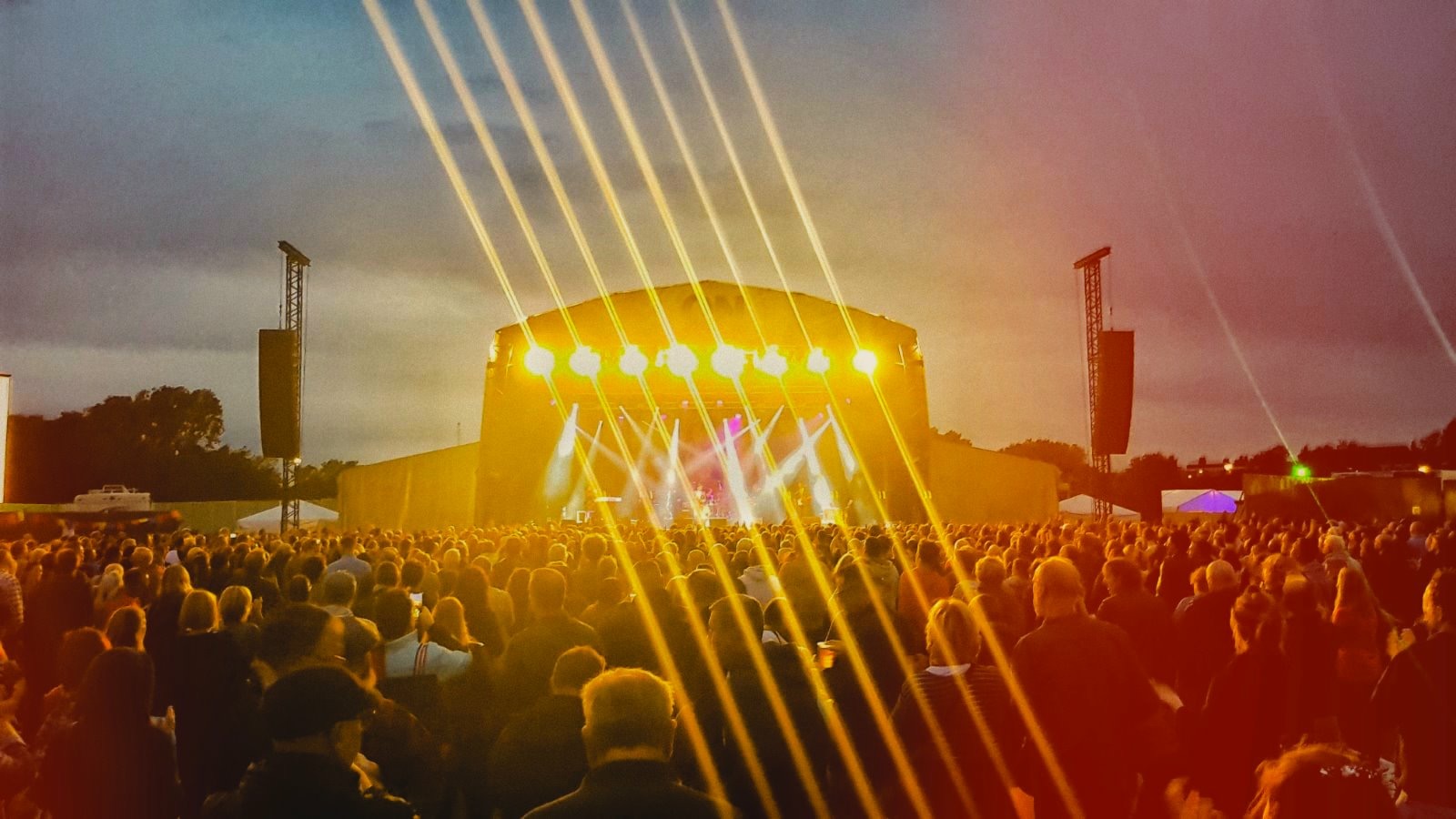
Last weekend, however, I caved in to festival fear to attend OnBlackheath, a two-day, does-what-it-says-on-the tin event in south-east London, and absolutely tremendous event it was, too. I was chiefly drawn by headliners Squeeze, playing literally on their home turf, but also The Divine Comedy, Paloma Faith and the prospect of De La Soul whipping up this profoundly white and middle class enclave into a frenzy of arthritic good times. Sorry to bring up class, by the way, but despite Danny Baker (who lives a matter of yards across the heath from the festival venue) hosting Day 1, and proudly boasting his lifelong connection to this part of London (Deptford-born, raised and schooled, Blackheath dwelling via Bermondsey), the clientele is decidedly white, middle class and middle aged. You know this by the carafes - carafes!!! - of rosé being consumed, and the number of men with floppy grey hair wearing age-defying T-shirts, who clearly work in the creative industries, pushing high-end child transportation around the field. 

But don't be thinking that I'm being sneery about OnBlackheath being, in 80s parlance, a yuppie affair: a safer, family orientated festival you could not find, even with Baker jokingly dubbing it "Woodstock, SE3". Before you've even heard a note of music, your senses are assaulted by the aromas of Caribbean, Vietnamese and Korean food wafting from craft food vans, while children are well taken care of by the obligatory face painting and glitter concessions. This little green enclave of south-east London spans two stages, with a main arena devoted to the two days' major acts, while a tented second hosts groovy acts, such as the venerable and still brilliant James Taylor Quartet, Dirty Vegas (featuring local boy - schooled in Eltham - Steve Smith) and even Steve Davis - yes, that Steve Davis - doing a DJ set. Throughout the show hours, a disco tent pumps out groovy choons for wine-fuelled mums to dance around their handbags. I kid you not.

But it is to the main stage where the big draws are assembled, and the build up to Squeeze on Day 1 is appropriately filled with a theme of British songwriting at its best, albeit with a contrast. First up is dear old Billy Bragg, the 'Big Nosed Bastard from Barking', as the NME used to call him. Still as agit-prop as he was when I last saw him, over 30 years ago on a Red Wedge bill on the South Bank, his punk-meets-folk is probably a little raw for some of the more refined tastes in this audience, but, given the rancid mess that is, currently, the state of British politics, he is brilliantly and fittingly abrasive. Now, grey of beard, Bragg can afford to make light of his resemblance to Jeremy Corbyn (“except that I’m the one with the fucking guitar,” he quips to an already uncomfortable crowd possibly hearing their first swear of the day).

Picture: OnBlackheath
Next up, The Divine Comedy, and a 12-song set including pleasers like Becoming More Like Alfie, Generation Sex, Something For The Weekend, At The Indie Disco, National Express and Tonight We Fly, as well as the brilliant How Can You Leave Me On My Own from their stunning last album, Foreverland. Neil Hannon remains one of Britain's most unsung musical heroes - I suspect he likes it like that - and the hour his sharp-dressed outfit are on stage for provides a reminder - if it was needed - of just how clever a writer he is. It's still impossible to pigeonhole The Divine Comedy: are they rock? Pop? Vaudeville? Anthony Newley incarnate? I'd simply leave it as "genius".

Somewhere much earlier in the day, Danny Baker smashed the proverbial champagne bottle to launch OnBlackheath by announcing that it would be his pleasure to introduce the very first act - someone he's "known since birth" - and the last act of the day, with whom "I went to school with”. The former is none other than 18-year-old Mancie Baker. Yes, the name is no coincidence: it’s the youngest of his three offspring, and a supremely talented singer-songwriter she is, too, boldly getting a thinly-crowded early audience under way with a set of just her and a blue Fender acoustic, singing compositions written in a bedroom just a short walk from the stage. It’s a family affair, too, as the Clan Baker and assorted family friends and neighbours are out in force to support her. Watch this space: I think she’s going to be huge. 

Fast-forward, then, to the evening's finale, Squeeze. Formed, more or less, 40 years previously on the very heath on which we are assembled, they have an unrelenting charm built on the tremendous canon of songs written by Deptford’s Glenn Tillbrook and Greenwich’s Chris Difford. I saw them last year at the O2 Indigo (part of the O2 Arena, built on the site of the Greenwich gasworks, where Difford’s dad worked as the payroll clerk), and it was as joyful a couple of hours of thoughtful pop-rock as it’s possible to have. Moreover, it underlined what Tillbrook and Difford have contributed to post-punk music. So here, a few miles down the road from the O2, Squeeze recreate the same brilliant selection of memorable classics like Pulling Mussels From The Shell, Hourglass, Annie Get Your Gun, Labelled With Love, Goodbye Girl, Another Nail In My Heart, Take Me I'm Yours, Tempted, Slap And Tickle, Is That Love, and of course, Up The Junction and Cool For Cats, ending with Black Coffee In Bed. Just those 13 songs alone would have constituted an incredible gig in their own right, but with the addition of tracks from their last album - the paean to London that was The Knowledge - Squeeze confirmed that they're not just kings of south-east London but a band that, frankly, should be recognised as national treasures. I'm not exaggerating when I say that Difford and Tillbrook is a songwriting partnership in the same breath as Lennon and McCartney, Donald Fagen and Walter Becker.

Squeeze homecoming
© Simon Poulter 2018
Squeeze are, for me, the weekend's undoubted main attraction, but Day 2 brings plenty of good stuff to warrant a full afternoon and evening's attention, with R&B singer-songwriter JJ Rosa kicking things off on the main stage, and another well connected individual, Leon Tlilbrook strumming the second stage into post-prandial life. 

The first major act of the afternoon are The Lightning Seeds, who storm through Sense, Lucky You, Perfect, The Life Of Riley and Pure, with Ian Broudie thankfully ignoring calls for Three Lions (despite one or two members of the band sporting England shirts). I think we've had enough of that song for one summer, thank you. But with a strict evening curfew to observe, the main stage performances come thick and fast. Next up is Corinne Bailey Rae, the Leeds-born soul star who, you'll remember from her self-titled 2006 breakthrough album and hits such as Like A Star and Put Your Records On, a pile of awards, and then a decidedly low profile in the 12 years since (just two more albums - 2010's The Sea and The Heart Speaks In Whispers in 2016. She is, though, an infectious performer, and her set - which includes the 2006 hits - suggests that there's much more to come, albeit at a pace she seems happy to be fully in charge of.
© Simon Poulter 2018

It may now be almost 30 years since De La Soul first emerged with their still lovable album 3 Feet And Rising, with its hippy-dippy mixture of "hip-hop lite" (their words) and psychedelia, so a seemingly lengthy wait for them to reach the main stage is worth it. Within minutes the trio are getting the audience grooving to songs they probably last moved limbs to at university. Noting the family orientation of OnBlackheath, they vow to keep the set profanity-free, a pledge that lasts for only half their allotted time, much to the amusement of children in the crowd. Their parents appear unoffended, willingly joining in the pantomime fun that divides the audience into competing halves, with Posdnuos, Trugoy and Maseo whipping well to do mums and dads into wild frugging with feelgood performances of Me, Myself And I, Eye Know, The Magic Number and Ring, Ring, Ring.


There appears to be a personal pattern to the 2018 OnBlackheath headliners: I only saw Squeeze last October at the O2, and I was back to the Greenwich dome in March to see the second night's star bill, Paloma Faith. Similarly local (well, Hackney), Faith purveys big, brassy retro soul (not dissimilar, in that regard, to Adele) but delivered with a gusto and at times exhausting amount of chatter. She does like to go on, a fact she happily reminds the audience. She has a lot to say, though, and a lot of it is said on her stunning last album, The Architect, tracks from which form the backbone of her Blackheath set. Her songs and their themes revolve around the human condition - often her own, personal experiences - and she's not afraid to tackle the evils of racism, misogyny, homophobia and sexism in society. 

During one lengthy rant I was reminded of the previous evening's Billy Bragg, and the two share an undimmed conviction that their stage is a platform. That might not be everyone's cup of tea, especially if you're expecting a jolly night out waving your arms in the air, but her vow to spread "epic kindness" in her songs is endearing. She may not have - yet - the lengthy career of Squeeze from which to draw on a vast catalogue of witty, poignant, instantly repeatable pop songs, but this second night's headline act is nonetheless a force majeure, belting out blockbusters like Can’t Rely On You and even The Mamas & The Papas’ Make Your Own Kind Of Music. A momentous finale to a couple of delightful days in one of London's more delightful postcodes.