Showing posts with label Squeeze. Show all posts

Wednesday, 18 December 2019

London royalty: the Soho Dukes

© Simon Poulter 2019

Living in Greenwich, as I partially still do, I am constantly reminded of the emergence of the so-called New Wave in the late 1970s. All around this corner of south-east London there are venues that played host to legends of pub rock that were a vital part of the New Wave. Squeeze, in particular, loom large in this story, gigging in and around Greenwich and Deptford (Glenn Tillbrook still lives and works from a studio in Charlton), and there are tales from varying ends of the Old Kent Road of bands like Nine Below Zero, Dr Feelgood, Kilburn And The High Roads (and their successors, Ian Dury & The Blockheads) and even Dire Straits plying their trade in the pubs of the area. Dire Straits' debut single, Sultans Of Swing, was even inspired by a jazz band playing a near-deserted pub in Deptford.

Before the term ‘pub rock’ became coined, there was no shortage of back rooms in pubs hosting bands. The Rolling Stones got their break with a residency at the Crawdaddy Club, a back room at The Station Hotel in Richmond-upon-Thames which was a glorified pub itself. A couple of years later, The Yardbirds - featuring the teenage Eric Clapton - built a similar following in the same part of south-west London. Clapton himself had grown his reputation by busking in the pubs of nearby Kingston. It was perhaps fitting, then, that he signed his professional terms to join The Yardbirds in a pub down the road in New Malden. Today, the term 'pub rock' covers a multitude of exponents and it is, perhaps, a lazy term, but does still validly cover that strata of the music industry that can be found on any given night of the week knocking out a combination of standards and their own tunes to an audience of punters getting ever-so-slightly sozzled, and ever-so-slightly deaf. A case in point is the Cavern Freehouse in Raynes Park, a couple of miles up the road from the pub where Clapton turned pro, and typical of the kind of local haunts where, on any given night of the week, an erstwhile act will be pumping out some chugging boogie. Unashamedly named after its more famous Liverpool namesake, thanks to proprietor Noel being a proud Scouser and Beatles fan, the Raynes Park Cavern is typical of venues where you’ll find good quality, honest-to-goodness pub rock. Such as, on this particular Wednesday night, courtesy of the Soho Dukes.

Formed by rhythm guitarist Colin ‘The Duke’ Foster (a New Malden-raised lad himself), together with seasoned pub rockers Johnny Barracuda (vocals), Si Leach (lead guitar), Mark 'Bomber' Randon (bass) and Adrian Blackwell (drums), the Dukes are a lively brew, drawing quite happily on a number of Route 1 influences. Significantly, they write their own songs, rather than rely on an overworked canon of standards. “It’s all about the song for me,” says Foster, the band’s chief songwriter. “Always has been, always will be.” That is always the essence of any good pub rock band. As Bono once said, “All I want is a red guitar, three chords and the truth”. Well, we’re not far off here. No vibey keyboards, no elaborate backing tapes, just a couple of guitars, a bass, drums and a highly charismatic front man.

© Simon Poulter 2019
“The idea behind the Dukes was to take all the influences we love and create a very British band,” Foster says. “One that you could find trawling the streets of Soho, clutching a can of Party Seven in between falling in and out of pubs, bars and venues! It struck me that the musical history and heritage of Soho and its surrounding areas was that of hosting some of the greats in the 1960s, 70s and 80s. So, why not celebrate the area that gave us so much music - places like the Marquee, the St. Moritz Club, the Borderline, Astoria, and so on. Soho is a place where the Dukes had either individually or collectively spent so much time breathing in the sights and sounds. Hence the Soho Dukes: something regal but with dirt under the fingernails”.

And there certainly is plenty of that. This is pub boogie at its best, with songs like Angel Walk, Pablo’s Place, Murdertown and tracks off their recent Three Sheets To The Wind EP drawing on an even wider range of influences to Foster’s writing style. “My influences are many and varied,” he says, “but right at the top of the list are the Stones - Keith’s guitar playing and Mick’s vocal phrasing. But you can add to that Slade lighting up Top Of The Pops [in the 70s] with rabble-rousing anthems; Rod Stewart’s voice and the good-time vibe that The Faces would bring to the bar room table. From across The Pond you’ve got the likes of John Mellencamp and Tom Petty, while back in Blighty, Tyla from the Dogs D'Amour , who is a huge influence on my song writing. Tyla’s lyrics and melodies set to a backdrop of simple, three or four open chords.”

The influences don’t end there: “I love both electric and acoustic compositions,” says Foster. “Take the Black Crowes: Rich Robinson’s guitar on Shake Your Moneymaker and Chris Robinson’s voice, but also the songs overall on that album. Then you’ve got The Quireboys, with their Mott The Hoople/Faces-influenced rock n roll and Spike’s voice; Phil Mogg from UFO’s vocals and lyrics; Blondie with their delicious pop songs and Clem Burke’s Keith Moon-style drums; early Police, Aerosmith, Hanoi Rocks, Zep, ELO and Jeff Lynne’s eloquent songwriting. Cheap Trick’s zany songs and delightful pop melodies. The list goes on…”

It could indeed go on, such is Foster’s unbridled enthusiasm for collating his influences and shoving them into the music blender. All are readily audible in the Dukes’ music, and fronted by the delightfully eccentric Barracuda, one of those lead singers who can transform themselves into something that can’t be ignored with just the addition of an undertaker’s hat and a pair of sunglasses. Married to Foster’s boogietastic compositions, Barracuda draws on Rod Stewart's phrasing, Ian Dury's comic timing and New Wave figures such as Wreckless Eric and Elvis Costello. He’ll even throw in some literary effect: “The wit of Raymond Chandler. The imagery of Ray Bradbury's prose,” he says. “It's all different flavours of genius. And I'd kill for just 1% of it.”

“Weekend Millionaire was the song that, for me, started to properly define the direction the band has taken,” Barracuda explains. “It's become a bit of an anthem for us and was a natural to record for the EP.” Another is Analogue Man: “It’s about an obstinate old boy standing firm against the march of technology, and and possibly more than a little autobiographical! Usually Col and I will develop a song together; guitars and vocal melodies evolving simultaneously. Songs definitely taste better when they're grown organically. ... And we'll generally start with a chorus and work our way outwards. But Analogue Man was an exception. A vocal melody suggested itself as I was writing the words. Col grabbed it, twisted it into shape and then the band took it to another level entirely. This one won't appear on the first album, in the final stages of completion, but it'll definitely feature on the second. I'm already looking forward to recording it.”

With a name evoking that most central area of central London, the Soho Dukes have a distinct Britishness about them. That doesn’t mean Barracuda adopting Steve Marriott’s Itchycoo Park vocal persona, but more of a lyrical geolocation bound with the American roots of their music. No more is this exemplified than Think Of England, which evokes “supposedly better times”, according to Barracuda. “An England gone forever. An England of fizzy bitter, Marc Bolan and Randall and Hopkirk. It's the Dukes' national anthem. 'Lie back, think of Eng-er-lannnnd!' One for the teenagers…,” he giggles. The song makes references to “back seats at the Odeon”, taking the “last bus home and change out of a shilling”. Resolutely old imagery, but imagery that takes a welcome baseball bat to the latent neanderthal tendency in Britain today that views a return to the 1970s of The Sweeney as being a healthy one. Don’t, however, see this as a Richard Digence-style reminiss about Spangles, Bazookas and Knock-down Ginger. Or see the Dukes as any kind of revivalists. In fact, there’s more going forward for them than going back.

The Soho Dukes will play the 'Camden Rocks' all-day event at Club Kolis (The Lounge 666), 1 Archway Road, London N19, on 29 February - Leap Day. Their three-track EP Three Sheets To The Wind can be downloaded from www.sohodukes.com.  

Wednesday, 12 September 2018

Woodstock, SE3

Picture: OnBlackheath 

When it comes to outdoor music festivals, I’m of the fair weather variety. That is, if it ain’t got a roof, I'll remain under my own. Thus, over the years I’ve focused my festival experience exclusively in Montreux, chiefly as some years you can spend an entire week’s holiday on the shores of Lake Geneva, stay in a nice hotel, eat in nice restaurants and, each night, take the free bus down to the Stravinsky Auditorium to see that evening's A-list line-up. Forget glamping at Glastonbury, this one - even with torrential Alpine summer storms - is mud-free and stress free. And you get to mingle with the artists over the road at Harry’s Bar. It’s not cheap, mind (and I don’t just mean Harry’s), but you are at least conscious of the fact you’re paying a premium for it all and not requiring tetanus injections, going down with Trench Foot, eating overpriced rubber vegan food and being stung by all the other hipster indulgences that have proudly kept me away from Worthy Farm. My luxury yurt has, happily, been the living room, BBC Four’s coverage, a short walk to the fridge and to my own bed.

On his doorstep: Danny Baker
© Simon Poulter 2018
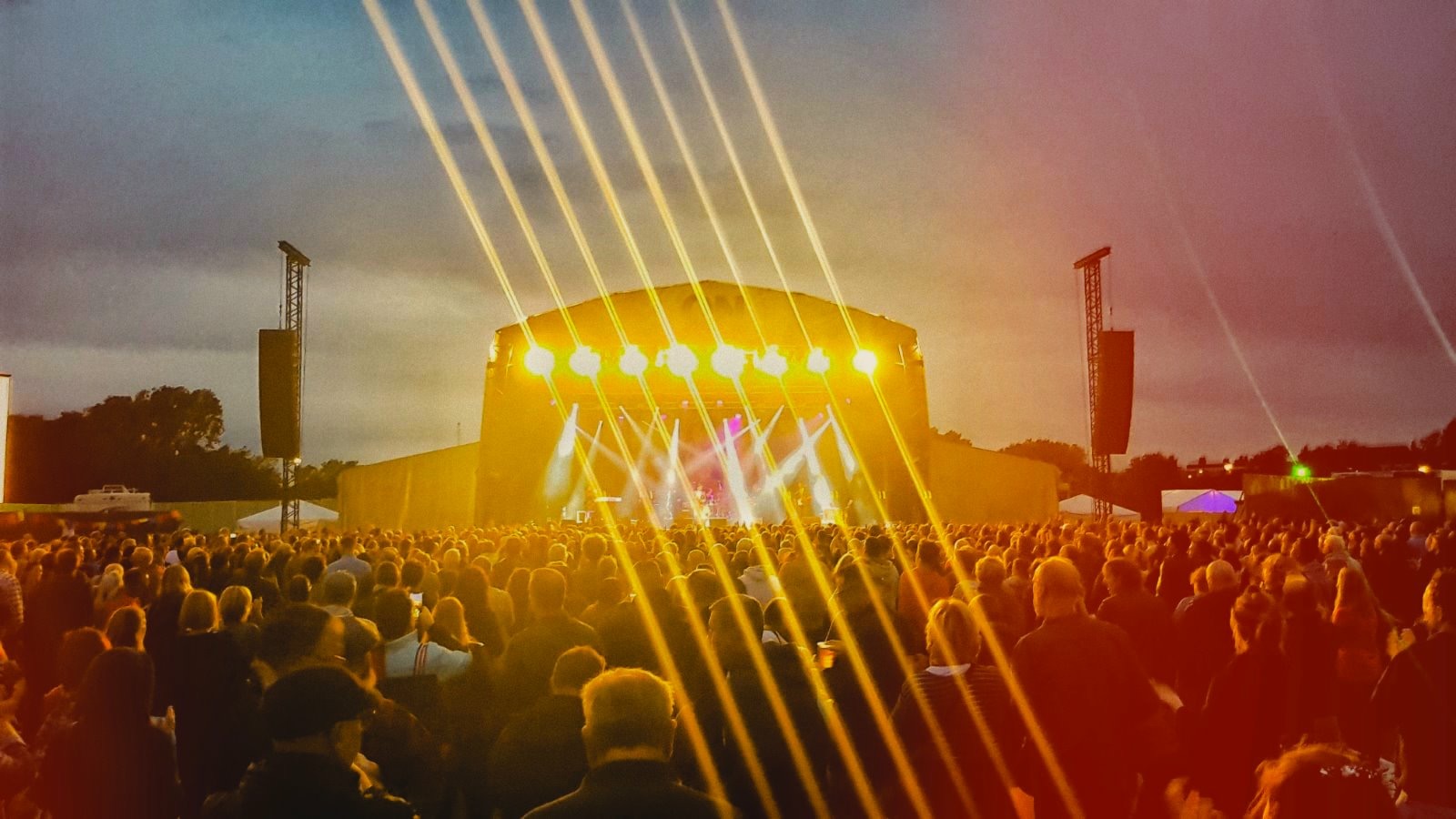
Last weekend, however, I caved in to festival fear to attend OnBlackheath, a two-day, does-what-it-says-on-the tin event in south-east London, and absolutely tremendous event it was, too. I was chiefly drawn by headliners Squeeze, playing literally on their home turf, but also The Divine Comedy, Paloma Faith and the prospect of De La Soul whipping up this profoundly white and middle class enclave into a frenzy of arthritic good times. Sorry to bring up class, by the way, but despite Danny Baker (who lives a matter of yards across the heath from the festival venue) hosting Day 1, and proudly boasting his lifelong connection to this part of London (Deptford-born, raised and schooled, Blackheath dwelling via Bermondsey), the clientele is decidedly white, middle class and middle aged. You know this by the carafes - carafes!!! - of rosé being consumed, and the number of men with floppy grey hair wearing age-defying T-shirts, who clearly work in the creative industries, pushing high-end child transportation around the field. 

But don't be thinking that I'm being sneery about OnBlackheath being, in 80s parlance, a yuppie affair: a safer, family orientated festival you could not find, even with Baker jokingly dubbing it "Woodstock, SE3". Before you've even heard a note of music, your senses are assaulted by the aromas of Caribbean, Vietnamese and Korean food wafting from craft food vans, while children are well taken care of by the obligatory face painting and glitter concessions. This little green enclave of south-east London spans two stages, with a main arena devoted to the two days' major acts, while a tented second hosts groovy acts, such as the venerable and still brilliant James Taylor Quartet, Dirty Vegas (featuring local boy - schooled in Eltham - Steve Smith) and even Steve Davis - yes, that Steve Davis - doing a DJ set. Throughout the show hours, a disco tent pumps out groovy choons for wine-fuelled mums to dance around their handbags. I kid you not.

But it is to the main stage where the big draws are assembled, and the build up to Squeeze on Day 1 is appropriately filled with a theme of British songwriting at its best, albeit with a contrast. First up is dear old Billy Bragg, the 'Big Nosed Bastard from Barking', as the NME used to call him. Still as agit-prop as he was when I last saw him, over 30 years ago on a Red Wedge bill on the South Bank, his punk-meets-folk is probably a little raw for some of the more refined tastes in this audience, but, given the rancid mess that is, currently, the state of British politics, he is brilliantly and fittingly abrasive. Now, grey of beard, Bragg can afford to make light of his resemblance to Jeremy Corbyn (“except that I’m the one with the fucking guitar,” he quips to an already uncomfortable crowd possibly hearing their first swear of the day).

Picture: OnBlackheath
Next up, The Divine Comedy, and a 12-song set including pleasers like Becoming More Like Alfie, Generation Sex, Something For The Weekend, At The Indie Disco, National Express and Tonight We Fly, as well as the brilliant How Can You Leave Me On My Own from their stunning last album, Foreverland. Neil Hannon remains one of Britain's most unsung musical heroes - I suspect he likes it like that - and the hour his sharp-dressed outfit are on stage for provides a reminder - if it was needed - of just how clever a writer he is. It's still impossible to pigeonhole The Divine Comedy: are they rock? Pop? Vaudeville? Anthony Newley incarnate? I'd simply leave it as "genius".

Somewhere much earlier in the day, Danny Baker smashed the proverbial champagne bottle to launch OnBlackheath by announcing that it would be his pleasure to introduce the very first act - someone he's "known since birth" - and the last act of the day, with whom "I went to school with”. The former is none other than 18-year-old Mancie Baker. Yes, the name is no coincidence: it’s the youngest of his three offspring, and a supremely talented singer-songwriter she is, too, boldly getting a thinly-crowded early audience under way with a set of just her and a blue Fender acoustic, singing compositions written in a bedroom just a short walk from the stage. It’s a family affair, too, as the Clan Baker and assorted family friends and neighbours are out in force to support her. Watch this space: I think she’s going to be huge. 

Fast-forward, then, to the evening's finale, Squeeze. Formed, more or less, 40 years previously on the very heath on which we are assembled, they have an unrelenting charm built on the tremendous canon of songs written by Deptford’s Glenn Tillbrook and Greenwich’s Chris Difford. I saw them last year at the O2 Indigo (part of the O2 Arena, built on the site of the Greenwich gasworks, where Difford’s dad worked as the payroll clerk), and it was as joyful a couple of hours of thoughtful pop-rock as it’s possible to have. Moreover, it underlined what Tillbrook and Difford have contributed to post-punk music. So here, a few miles down the road from the O2, Squeeze recreate the same brilliant selection of memorable classics like Pulling Mussels From The Shell, Hourglass, Annie Get Your Gun, Labelled With Love, Goodbye Girl, Another Nail In My Heart, Take Me I'm Yours, Tempted, Slap And Tickle, Is That Love, and of course, Up The Junction and Cool For Cats, ending with Black Coffee In Bed. Just those 13 songs alone would have constituted an incredible gig in their own right, but with the addition of tracks from their last album - the paean to London that was The Knowledge - Squeeze confirmed that they're not just kings of south-east London but a band that, frankly, should be recognised as national treasures. I'm not exaggerating when I say that Difford and Tillbrook is a songwriting partnership in the same breath as Lennon and McCartney, Donald Fagen and Walter Becker.

Squeeze homecoming
© Simon Poulter 2018
Squeeze are, for me, the weekend's undoubted main attraction, but Day 2 brings plenty of good stuff to warrant a full afternoon and evening's attention, with R&B singer-songwriter JJ Rosa kicking things off on the main stage, and another well connected individual, Leon Tlilbrook strumming the second stage into post-prandial life. 

The first major act of the afternoon are The Lightning Seeds, who storm through Sense, Lucky You, Perfect, The Life Of Riley and Pure, with Ian Broudie thankfully ignoring calls for Three Lions (despite one or two members of the band sporting England shirts). I think we've had enough of that song for one summer, thank you. But with a strict evening curfew to observe, the main stage performances come thick and fast. Next up is Corinne Bailey Rae, the Leeds-born soul star who, you'll remember from her self-titled 2006 breakthrough album and hits such as Like A Star and Put Your Records On, a pile of awards, and then a decidedly low profile in the 12 years since (just two more albums - 2010's The Sea and The Heart Speaks In Whispers in 2016. She is, though, an infectious performer, and her set - which includes the 2006 hits - suggests that there's much more to come, albeit at a pace she seems happy to be fully in charge of.
© Simon Poulter 2018

It may now be almost 30 years since De La Soul first emerged with their still lovable album 3 Feet And Rising, with its hippy-dippy mixture of "hip-hop lite" (their words) and psychedelia, so a seemingly lengthy wait for them to reach the main stage is worth it. Within minutes the trio are getting the audience grooving to songs they probably last moved limbs to at university. Noting the family orientation of OnBlackheath, they vow to keep the set profanity-free, a pledge that lasts for only half their allotted time, much to the amusement of children in the crowd. Their parents appear unoffended, willingly joining in the pantomime fun that divides the audience into competing halves, with Posdnuos, Trugoy and Maseo whipping well to do mums and dads into wild frugging with feelgood performances of Me, Myself And I, Eye Know, The Magic Number and Ring, Ring, Ring.


There appears to be a personal pattern to the 2018 OnBlackheath headliners: I only saw Squeeze last October at the O2, and I was back to the Greenwich dome in March to see the second night's star bill, Paloma Faith. Similarly local (well, Hackney), Faith purveys big, brassy retro soul (not dissimilar, in that regard, to Adele) but delivered with a gusto and at times exhausting amount of chatter. She does like to go on, a fact she happily reminds the audience. She has a lot to say, though, and a lot of it is said on her stunning last album, The Architect, tracks from which form the backbone of her Blackheath set. Her songs and their themes revolve around the human condition - often her own, personal experiences - and she's not afraid to tackle the evils of racism, misogyny, homophobia and sexism in society. 

During one lengthy rant I was reminded of the previous evening's Billy Bragg, and the two share an undimmed conviction that their stage is a platform. That might not be everyone's cup of tea, especially if you're expecting a jolly night out waving your arms in the air, but her vow to spread "epic kindness" in her songs is endearing. She may not have - yet - the lengthy career of Squeeze from which to draw on a vast catalogue of witty, poignant, instantly repeatable pop songs, but this second night's headline act is nonetheless a force majeure, belting out blockbusters like Can’t Rely On You and even The Mamas & The Papas’ Make Your Own Kind Of Music. A momentous finale to a couple of delightful days in one of London's more delightful postcodes.

Thursday, 4 January 2018

2017: that was the (music) year that was


So here it is - a shiny new year. We’ve rung out the old and are already getting on with the new. But to allow one last coquettish glance over the shoulder at 2017, there are a couple of reflections to note: because this was a year that commenced with the hangover of the prior annus horribilis and its morbid stream of departures, from Bowie to Prince to George Michael. We switched, then, from 2016's somewhat grim procession to 2017's irritating insanity, chiefly due to an elderly playboy with candy floss hair arriving at the White House in January and then on a daily - if not hourly - basis displaying all the characteristics of a petulant child in whatever first came to his mind while, clearly, carrying out his morning ablutions.

Thankfully, music intervened to provide a certain feelgood factor. In short, 2017 was a superb year for new music and live performances. Just cast your mind back to an unseasonally sunny June and Glastonbury: 12 months on from the Brexit referendum, a month after both the Manchester Arena bomb and a stuttering British government stuttering further with one of the most pointless general elections in history, three weeks after the London Bridge attack and two weeks after the Grenfell fire, music did its bit to perk up the nation, with Nile Rogers/Chic and the-now ‘Sir’ Barry Gibb cranking out guilty pleasures in the heritage slots, headliners Radiohead and Foo Fighters delivering unabashed crowd-pleasing enormity, and relative newcomers like The xx and Royal Blood proving that engaging live performances on a grand stage are far from over.

Further back, in April, there was a bonanza of consumption as Record Store Day generated treasures such as The The's first new music in an age (and an Elbow cover of one of their older songs), as well as sumptuous vinyl releases from the likes of Prince and T-Rex to make the brutally early start to queuing worthwhile. Throughout the year live music was equally as rich and rewarding for me personally, kicking off with Michele Stoddart in early January performing her beautiful Pieces album in its entirety at Camberwell’s Slaughtered Lamb. Later that month I made acquaintance with the brilliant Peter Bruntnell (and discovered that he's from both my home town and school); I saw Robert Howard, Matt Deighton and Chris Difford deliver a masterclass in songwriting and experienced Squeeze on their home patch for a communion of arguably the UK’s most prolific pop-rock band since The Beatles. And in the summer I celebrated the pure pop joy of Nick Heyward, not once but twice. Indeed, this year has been more about pop than rock for me…though thankfully without succumbing to the Faustian horror of Ed Sheeran and his guitar-looped wallpaper-drivel.

Sheeran, inevitably, features heavily in figures released yesterday by the BPI of how music was consumed in the UK during 2017. The numbers reveal that a total of 135.1 million albums were either streamed, purchased in a physical format, or downloaded - a 9.5% year-on-year rise and the third year of consecutive volume growth. Of significance is that streaming now accounts for over half of the UK's music consumption, with 68.1 billion audio streams served last year through Spotify, Apple Music, Deezer and other services, a 51.5% rise on the previous year.

That said, my acquisition of mostly vinyl albums last year maintained a steady pace, to the extent that I actually ended the year with a pile of unlistened-to records more than a pile of those I had played. Clearly I have personally contributed to the growth of vinyl over the last decade: according to the BPI 4.1 million LPs were bought last year - an increase of 26.8% on 2016. That said, it does remain a niche (and, some might say an expensive one, too) with just one in 10 of all physical purchases made in 2017 being vinyl copies. Even the ageing CD represented just under a third of all formats.

Streaming, however, continues to attract converts. In a New Year blog post, my friend Steven Wilson - whose fifth solo album To The Bone was one of the brightest highlights of the year - wrote about his own, somewhat reluctant adoption of streaming formats: "For years I resisted non-physical distribution of music, I just couldn’t relate to music if it didn’t come as a physical piece of art that I could hold in my hands." He acknowledges, however, that streaming services do act as a 'try-before-you-buy' gateway, pointing out that his own album has been streamed eight million times in the four months since it was released. "While those numbers aren’t going to trouble the likes of Kendrick Lamar," he adds, "they are an indication that there are a lot of people out there beginning to discover and hear my music for the first time", pointing out that they might then go on to buy from his back catalogue, or come and see his live shows.

When it was released, To The Bone made it to number three in the album charts. Not bad for an artist many still have never heard of, and even more impressive when you consider that he was pipped to No.2 by someone called Elvis Presley by a relative handful of copies of a greatest hits package. Ed Sheeran - inevitably - remained at No.1 that week by selling a further 15,000 copies of Divide, a relentless achievement helped in part by grannies buying it at supermarket and petrol station checkouts.

I shouldn't be too critical of Sheeran (though his bland, universal appeal does stagger me...meaning that I will). Thank God for more interesting British pop acts, from Rag’n’Bone Man and Stormzy to Paloma Faith, all making for a very good year. It would be impossible to critique everything that passed through my ears in 2017, but particular mention should be given to the following:

Liam Gallagher - As You Were: Liam's reinvention as the macrobiotic, Hampstead Heath-jogging renaissance man (albeit one still hilariously lobbing Twitter grenades at Frère Noel) coincided with him producing the feelgood album of the year. Yes, it was full of Oasis-like stadium stormers, but wasn't that exactly what we wanted? And even if he had help, As You Were also demonstrated that the songwriting genes in the Gallagher family weren't entirely monopolised by his elder sibling. Speaking of whom...

Noel Gallagher's High Flying Birds - Who Built The Moon?: News of a "psychedelic" third solo album from Gallagher proved unfounded. In fact, it took several listens to get any handle on what Who Built The Moon? actually was about. There were traces of Roxy/Sweet/Bolan glam, trademark NG irony, a scissor-playing French vocalist, a flirtation with the sort of Chemical Brothers sound Gallagher had experimented with earlier in his career, and some Britpop whimsy that harked back to prime Oasis. Collectively, and after several listens to be sure, Who Built The Moon? is up there with Liam's product as one of the best of 2017.

LCD Soundsystem - Anerican Dream: James Murphy's declaration that LCD Soundsystem had reached the end in 2011 seemed like a long goodbye when the sumptuous, five-LP live album of that description - The Long Goodbye: LCD Soundsystem Live At Madison Square Garden - made its appearance some years later (and was instantly added to my collection of the greatest live albums ever). So the appearance in 2017 of brand new material from Murphy and his collective, with its conscious and unconscious nods towards Bowie (who'd invited Murphy to work on the Blackstar album but declined citing a lack of worthiness), not to mention Talking Heads, was a surprise. And a welcome one, too. American Dream is a curious cocktail of the obscure and the enlightening, going beyond simply fan pleasing, although fans will be inevitably pleased by the sheer depth of what is dished up. Magnificent.
​
Thundercat - Drunk: I’m a lazy music connoisseur: I should have my finger pressed more tightly on the pulse of what’s going on. Indeed, if it wasn’t for a late night visit to the BBC Radio 6 Music Festival in March I might never have come across the splendidly batshit-mad funk of Stephen Bruner - Thundercat - and his mesmerising six-string bass guitar prowess. Drunk pulled all that together into a 23-track album of the weird mixed with the conventional, of Stanley Clark-style jazz funk blended with traces of hip-hop and even FM radio soft rock, courtesy of guest appearances by Kenny Loggins and Michael McDonald.

Father John Misty - Pure Comedy: Much is made of Josh Tillman’s wry takes on modern life and his somewhat capricious nature towards fans, rivals and indeed anyone who chooses to take him on, but there is no denying that if, like me, you’re a fan of ‘classic era’ Elton John (Tumbleweed Connection, Madman Across The Water, Honky Chateau et al), FJM’s unmistakably Elton-like vocal delivery is as comforting as a box of Quality Street comprised entirely of the green triangles. And that’s before you come to appreciate the smart lyrics that traverse between bittersweet and humour, while remaining smarter than most others out there. A masterpiece.

Portico Quartet - Art In The Age Of Automation: If every record went on its library classification, Portico Quartet’s four studio albums - including this one - would be hard to file. To some, it’s ambient noodling, to others jazz (“…just a series of mistakes without the 'oops’”, to quote Spinal Tap’s Nigel Tufnell), and to those more appreciative, clever, engaging electronica which thankfully stays clear of a suburban wine bar’s looped collection of Café del Mar compilations. Art In The Age Of Automation extensively explores over 11 tracks a variety of landscapes and textures, tinkering with the sparse grooves of trip-hop while applying varying thicknesses of layers with an orchestral approach that knows when to be sparing and when to be full on. This was my go-to record in 2017 for commuting or, simply, needing to come down after a more raucous night out on the tiles.

PP Arnold - The Turning Tide: Initiatives like Record Store Day deliver plenty of re-release treasures, but never something which has lain recorded but unreleased for close to half a century. PP Arnold - a former vocalist in the Ike & Tina Turner band and hit maker in her own right (First Cut Is The Deepest and Angel Of The Morning) - dusted off this hidden treasure, which had originally benefitted greatly from the significant involvement of Barry Gibb and the entertainment mogul Robert Stigwood, as well as Eric Clapton, members of his Delaney And Bonnie outfit, Steve Howe (of Yes) and others. The Turning Tide is a fascinating time capsule opened up, representing some of the best freewheeling pop-soul-rock of the late 1960s, including covers of material by Steve Winwood, Van Morrison, and the Glimmer Twins - Jagger and Richards. Bureaucracy, sadly, kept the recordings under lock and key, until Arnold and her manager, Sally Cradock (wife of Ocean Colour Scene/Paul Weller guitarist Steve) started picking at the strands of publishing complexity with an aim of finally getting the recordings released. With further mixing by Cradock's husband at Weller's Black Barn Studio, the resulting album sounds both fresh and a stunning snapshot of the time it was originally recorded, capped by the voice of one of the finest and under-appreciated soul singers ever.

Squeeze - The Knowledge: While not likely to win any prizes for sonic innovation, Squeeze's best album in more than two decades reinforced why, almost 40 years ago, we liked them to begin with: Chris Difford's lyrics, Glenn Tilbrook's uncannily accessible melodies. Wrapped up in an album loosely about the London they love (with specific reference to the south-east London of their youth - and my current dwelling), Squeeze produced a delightful compendium of observations about modern British life, from the state of the NHS to the ageing population, even including an edgy account of child abuse in youth football. National treasures, with a back catalogue - not just the singles - deserving of serious re-indulgence.

Paul Weller - A Kind Revolution: Arguably competing only with Neil Young for the shere rapidity of his output, Weller's umpteenth solo album since 1990 also set the tone for the summer of 2017. A Kind Revolution is chock-full of solid Weller ear-pleasers, although The Cranes Are Back must rank up there with You Do Something To Me for sheer soulful delightfulness.

Nick Heyward - Woodland Echoes: Weller's album may have set the tone for last summer, but the August release of Nick Heyward's first album in 18 years and only his seventh solo effort, proved to be one of the sunniest moments of the year, being a collection of pure bottled delight. That was, of course, the schtick of Haircut 100, back in the early 80s, but the precedents were good when, in the spring, Gary Crowley started playing the double-A side single Baby Blue Sky/Mountaintop, hinting at some breezy latent Britop to come, such as Perfect Sunday Sun, Beautiful Morning and Love Is The Key By The Sea. I saw Heyward live twice last year and on both occasions was left wondering how long it would be before he would be offered one of the feelgood spots at Glastonbury, such was the utterly infectious good time his canon delivers.

Elbow - Little Fictions: The release, just before Christmas, of Elbow's Best Of compilation, featuring their gorgeous cover of The Beatles' Golden Slumbers, gave timely reminder of the Mancunian quartet's status as arguably Britain’s favourite band. And with good reason: for all the festival singalong/wavealong favourites like One Day Like This and Mirrorball, Elbow have successfully retained enough indie credibility to save them from persecution by those curmudgeons who eschew such popular fare. In that respect, Elbow are like few other acts with such popularity (yes, you Sheeran), in producing vivid, layered (some might even say 'prog') rock, with instrumental curiosity and the genuine warmth of Guy Garvey's persona. Little Fictions is the album (their seventh) where you felt that Elbow were fully comfortable in their skins, kicking off with a sense of wellbeing as Magnificent (She Says) struck a resonant keynote of upbeat goodness, along with the lovely Gentle Storm, with its understated chords and unashamed, plaintive refrain "Fall in love with me - every day". From almost anyone else this might be schmaltz, but it sits amongst a collection embracing themes as varied as relationships, post-Brexit national isolation and Fleet Street's vampiric tendencies. As I wrote on Little Fictions' release, it's easy to declare a band's latest album their best, until you play it back in comparison with the previous work. And even though its six predecessors are mostly excellent, it was hard not to consider this Elbow's best yet.

Saturday, 14 October 2017

A slice of reality: Squeeze's The Knowledge

For reasons I can't explain, and would probably require a pyschology professional to help understand, I've always been fascinated by celebrity associations with the environs I occupy. Discovering that John Martyn was born in a house less than half mile from the dwelling where I entered this world was like hitting a rich seam of gold. That Eric Clapton walked the very streets I did growing up, or that Jimmy Page and Jeff Beck haled from districts no more than a bus ride from my front door provided sparkle to an otherwise not particularly thrilling suburban existence.

So now I'm living in Greenwich, I'm discovering an iconic part of London famed not only for its maritime history, but for being the epicentre of one of the great earthquakes - even if one with somewhat erratic aftershocks - of British pop music. For it was around here that Chris Difford and Glenn Tilbrook found a kindred musical interest that would become Squeeze and endure - more often off than on - for the last 44 years. Difford's superb memoir, Some Fantastic Place: My Life In And Out Of Squeeze charts extensively the ebb and flow of his relationship with Tilbrook, as well as the intrinsic part south-east London (and Greenwich, in particular) has played in their lives, and still does.

These two elements - their relationship and their origins - is an underlying background to The Knowledge, the 16th studio album under the Squeeze name and as musically and lyrically rich as anything they've produced since their recorded debut in 1979. Like all musical partnerships, Difford and Tilbrook's has always been strongly fraternal, a classic case of they only do what they do best when it's been the two of them working together - the former's lyrical wit (recognisably of its geographic origin) whether spoken, written or sung, the latter's melodic ease. Of course, that fraternity has been frequently stretched, often as Difford - as his memoir reveals - has gone off on his own path, encountering demons in the way. But it's a brotherly fabric that even when stretched seemingly beyond shape, it has a welcome habit of retracting back to the state that serves the relationship best.

While their last outing, 2015's Cradle To The Grave (a musical accompaniment to Difford's Deptford schoolfriend Danny Baker's sitcom based on his first memoir) was a first flexing of the Difford/Tilbrook writing muscle in a while, The Knowledge feels like a fully-fledged adventure. And a grand adventure it is, too. Opening track Innocence In Paradise delivers a cinematic Western-theme, while still rooted in London's southern hemisphere, evoking both the social commentary of Up The Junction as well as that perennial pub singalong favourite Cool For Cats. Patchouli sets itself in Difford's Greenwich hometown, referencing Maryon Wilson Park in a nostalgic nod back to some of the tales his book's early chapters covers in entertaining depth. London is a recurring muse in Difford's lyrics, with Rough Ride giving a less than glowing appraisal of the struggles facing Londoners today ("this city we love") while married to a Steely Dan-like funk.

If we were honest, there are few pop acts who can do social conscience without sounding insincere or, simply, corny. Bruce Springsteen can succeed in covering the blue collar human condition whereas Phil Collins singing about homeless people just sounds false. It's all about how you go about it. Thus, A&E, with its gentle jazz-soul, shouldn't deliver anything even remotely cutting about the state of the NHS. But it does. "It wouldn't hurt to give them more," Tilbrook sings about public sector wages. It is, even with a serious message, simply a lovely song.

When Squeeze emerged at the beginning of the post-punk New Wave, they could easily have been categorised as novelty pub rock merchants. But this dismisses Difford and Tilbrook's mastery as songwriters of exquisite, if too often unrecognised class. Final Score is a perfect example - a beautifully crafted, beautifully performed slice of soul - replete with a piano solo former member Jools Holland would be proud of - that lulls you into its arms...until you realise that its about a young boy with aspirations to become a professional footballer being abused by a predatory coach. It's here that you realise that Difford is taking no prisoners with his writing, whether tackling topics as diverse as erectile dysfunction on Please Be Upstanding, record collectors on Albatross, or his relationship with Tilbrook on Two Forks.

One of my frustrations with Squeeze over the years is that they have, too often, only been judged by their hit singles. And while the greatest hits packages that aggregate these songs have, it would appear, kept them solvent during the lean years, the real strength to this band can only be fully experienced in their albums. The Knowledge is a welcome reminder of just why Difford and Tilbrook have been rightfully compared to pop's greatest writing partnerships - yes, a certain pair of Scousers included. Tilbrook has called it their "best-ever record", and he may not be wrong. It's certainly one of the most consistent, soup-to-nuts good albums in their history, one that feels like its been written and recorded with comfort and ease, particularly Difford and Tilbrook being comfortable and at-ease with each other, and rooted in reality - the pain and joy of it.

Wednesday, 28 June 2017

Take that situation: Nick Heyward - live at The Water Rats

© Simon Poulter 2017


I'll get this out of the way from the off: Nick Heyward is infuriatingly ageless. Save for the glasses, he doesn't appear any different from the boyish Haircut 100 frontman of - staggeringly - 36 years ago, adorned in cable-knit sweater with a guitar thrust, circulation-endangeringly under his armpit, plying perfect funk and '60s-infused pop hits like Favourite Shirts (Boy Meets Girl) and Fantastic Day. Almost four decades on, these are now nailed-on classics, as is Love Plus One: even now I can't sit in a business meeting when someone says "So, where do we go from here?" without replying (in my head, Homer Simpson-style) "Is it down to the lake I fear?".

To see Heyward last night looking nothing like his 56 years was itself a welcome journey back in time. Better still was to hear those peerless songs again, performed with a vigour that made them sound as crisp in 2017 as they were when they first appeared between 1981 and 1982.

It's incredible to think, now, that the Heyward-fronted Haircuts only produced the one album, Pelican West, but that perennially sunny trio of successive hits - released between the autumn of 1981 and the following spring - launched the young seven-piece into the kind of success bands starting out today can still only dream of with their debut release, creating Smash Hits cover staples in the process and driving them to the inevitable push to break America.

This, though, ultimately led to Heyward's departure: "We were playing in America and not enjoying it, there was lots of pressure," he explained to the Metro a couple of years ago, as the band was coming back together for a reunion. The highs (an audience with Paul McCartney at his daughters' request) and lows (suicidal feelings...) of new-found fame at such a young age bore heavily on the-then 21-year-old, and he left the band just as it was working on a follow-up to Pelican West. It wasn't long before he produced a solo album, North Of A Miracle, every bit as infectious as the Haircuts' sole release, and rolling out four more perfect pop hits, Whistle Down The Wind, Take That Situation, Blue Hat For A Blue Day and On A Sunday.

But what is less clear is what happened between then - 1983 - and now. True, there have been albums, but nowhere near that early success...or indeed the recognition deserved (even for a record as excellent as From Monday to Sunday, released at the height of Britpop, and containing another British pop gem in Kite, which reached only as high as 44 in the UK Singles Chart in 1993). So, then, news of a crowd-funded new solo album - Woodland Echoes and the steamingly good double-A side, Baby Blue Sky/Mountaintop, all due out next month - has brought about a sudden pique of interest in me, which was richly rewarded last night at the storied Water Rats pub venue in London's Gray's Inn Road.

The show, being recorded for a forthcoming special on the music lovers' channel Vintage TV (tune in at 8pm on 18 July), perfectly framed Heyward's brilliance as a songwriter and a funny, engaging performer, happily delving back into the "heritage" archive of those early Haircut 100 and solo hits, but also showcasing some of the invigorating new material. If the rest of Woodland Echoes is anywhere near as good as the single's two tracks, it's release in mid-August will be a welcome addition to the tail end of summer.

As a primer, on my way out of The Water Rats I bought reissues of North Of A Miracle and last year's Pelican West deluxe edition, which includes extras such as the supreme and often forgotten single Nobody's Fool. A little rockier than the record's bigger hits, it presciently points to Heyward's brand new material, almost 40 years on, which, I hope, will re-cement his credentials as one of the finest pop songwriters Britain has produced post-Beatles.

People talk reverently - quite rightly - about McCartney's unique gift with melody, Squeeze and their 'South London poetry', Ian Dury & The Blockheads' witty funk, Paul Weller's sense of soul and The Smiths' poppy jangle mixed with indie obtuseness. If so, then Nick Heyward deserves re-examination. I've got a feeling, based on last night's taster, that Woodland Echoes will be the catalyst.