Showing posts with label New York. Show all posts

Monday, 1 November 2021

Lost and found: tomb raiding or celebration of a legacy?

© Simon Poulter 2021

My entry to the blogosphere happened by accident: a foul mood one Monday morning resulting from England’s latest humiliating exit from a football tournament led to a 1,000-word rant written on a train and in need of an outlet. Thus, this blog’s predecessor, What Would David Bowie Do? was born. It was never meant to be about The Dame (it’s title came from a throwaway remark by a former girlfriend) but over the course of its lifetime, my love of David Bowie’s music was progressively rekindled as I found myself dipping into the extraordinary body of work he had recorded. His death on 10 January, 2016, brought that blog to an abrupt halt. It just didn’t seem right to continue with that title, which was simply a nod to a throwaway, Jägermeister-fuelled quip in a Yosemite boozer. So I wrote my own obituary and WWDBD? ended there. 

Of course, I wouldn’t stop blogging, and there was only going to be one source for the new one’s name, hence the reference you see at the top of this page. Even now, people think I’m a Bowie blogger, but I haven’t actually written anything specifically about him for a couple of years. Today might change that, as I kick off what I’ve presumptively declared David Bowie Month, for no other reason than the 26th will see the release of the latest box set of Bowie reissues, Brilliant Adventure (1992-2001). The package will feature remasters of output in a period where Bowie may have struggled, remarkably, to fit into the Britpop wave that was going on at the time, but in Black Tie White Noise, The Buddha Of Suburbia soundtrack, Outside, Earthling and Hours, still produced utterly compelling material. 

The period also covers a phase of live performances, where Bowie had a white-hot band and was seemingly comfortable in his skin performing all the old classics. Thus, a BBC Radio live recording from 2000 (originally released as part of the limited-edition three-disc Bowie At The Beeb) - a warm-up for his legendary Glastonbury headline performance - is included in the set, along with a collection of odds and sods called Re:Call 5. The true draw to the package, however, is Toy, the semi-mythical record featuring new versions of Bowie songs from the very beginning of his career, but which wasn’t deemed by the record company to be releasable in 2001. I can assure you there will be more on Brilliant Adventure nearer its release date.

© Simon Poulter 2021
Last week I indulged my fandom with a visit to the new ‘Bowie 75’ pop-up shop in London’s Heddon Street, opened (along with a sister branch in New York) to provide an outlet for devotees to gorge themselves on merchandise, music and other paraphernalia (such as a Stylophone with which to recreate the iconic middle-eight of Space Odyssey). I won’t deny that purchases were made (high-quality vinyl reissues of the ‘second’ David Bowie album and The Man Who Fell To Earth, plus the scintillating Live Nassau Coliseum ’76 recorded on the Station To Station tour - Bowie in his absolute ’70s pomp). 

In the shop’s basement you can listen to vintage songs spruced up with ‘360 Reality Audio’ (Sony’s new ‘spatial’ audio technology), as well as play around with magnetic lyrics stuck to a pillar, composing songs as Bowie once did with cut up newspaper headlines. There’s also a red telephone box in which you can have your picture taken, a hat-tip to the shop being located across the road from the building featured in the cover art for The Rise And Fall Of Ziggy Stardust & The Spiders From Mars, setting the scene for the alien Ziggy’s arrival on Earth.

If people think all this is fan gouging, then that’s up to them. After all, people appear to be paying significantly north of £80 for Adele tickets next summer, so no one has the right to judge what people spend their money on when it comes to pop music. Most of the merchandise on sale in the shops is available on the official Bowie website, but there’s more to it than simply a couple of glorified souvenir kiosks. The London and New York stores (the latter located close to Bowie’s SoHo home of 20 years) have been opened for a strictly limited period, leading up to what would have been the artist’s 75th birthday, on 8 January next year. 

“I’m really emotional,” 35-year-old fan Nikky Smart told The Times the other day while visiting the Heddon Street store. “It’s kind of like they’ve brought him back again.” I can’t say that it was really like that for me, but it was all very tasteful. And seeing most of a back catalogue of 27 studio albums, live sets and compilations on sale, alongside the T-shirts (yep, I bought one), baseball hats, jigsaw puzzles and all the rest, was a poignant reminder of the sheer body of work Bowie left behind when he succumbed to cancer in 2016.

Picture: The Rolling Stones/Bravado

The Bowie 75 shops are just the latest retail ventures opened by heritage acts to interact with fans. The Rolling Stones opened their own ‘Official UK Store’ in London’s Carnaby Street in September last year - a brave move given that it was that brief period of 2020 when normality resumed and people went shopping again, albeit tentatively. The Stones previously had a limited-period concession at Selfridges in Oxford Street to provide the template for the Carnaby Street shop, making it largely a platform to flog somewhat expensive T-shirts bearing the legendary ‘lips’ logo and various pieces of Stones album art. The Bowie shops also arrive a few weeks after Queen opened their own store, also in Carnaby Street, and dedicated to the band’s five-decade career, selling limited edition music releases, fashion collaborations with brands like Champion and Wrangler, Johnny Hoxton jewellery and other ‘lifestyle products’, whatever that means. 

All these band-based retail concepts appear to have two types of punter in mind: tourists that (in theory) throng to London’s West End, and in particular, social media-savvy youngsters looking to post their visits to Instagram and TikTok (that said, the Bowie shop seemed to be mostly customised by middle-aged blokes…er…like me). “We’re really looking at two things,” entertainment consultant Lawrence Peryer explained to The Times last week when talking about how the Bowie shops came about. “We wanted to create a place for the long-term Bowie fan to come in and find out something about Bowie that they didn’t know before, and have an experience they’d not had before, but also to connect with a young audience. David was always ahead of his time, always changing to connect with the younger crowd, and we’re hoping this will carry on the tradition.” 

Bowie certainly was ahead of his time: many will have seen on YouTube his highly prescient interview in 1999 with the BBC’s Newsnight in which he told a sceptical Jeremy Paxman that the Internet - then in relative infancy - would affect society beyond all recognition. “The potential of what the Internet is going to do to society, both good and bad, is unimaginable,” he declared. The year before, Laurence Peryer had helped Bowie create his BowieNet website, widely considered one of the earliest pioneers of online music. It’s just one facet of Bowie that makes him still fascinating today, even before you start delving into the myriad characters and guises he quite consciously invented as avatars for his music. That was something he effectively did up to his dying day, with the morbid, out-of-body experience that was Blackstar, with its conscious references to impending death, which eventually occurred, uncannily, two days after his 69th birthday and the album’s release.

Bowie had a history of prescience. Invariably depicted as an inveterate Mod magpie throughout his life, appropriating music and fashion from wherever and whatever took his fancy, he also kept an unearthly beady eye on technology trends. In 1997 Bowie hatched a plan to monetise the master tapes of his recordings, foreseeing the rise of online streaming services that, as we now know, would only generate paltry revenues for artists compared to what they were used to with sales of physical formats. In the end, Bowie struck a deal with insurer Prudential to issue ‘Bowie bonds’ which used future royalties from his material as collateral, effectively enabling him to borrow against his back catalogue. The deal raised $55 million - shortly before Napster and the file-sharing boom came along, heralding the online music revolution that the industry has been coming to terms with ever since.

Today, as the online platforms Bowie predicted in his Paxman interview have eaten dramatically into sales of physical music formats, many artists have turned to striking deals with companies like the investment vehicle Hipgnosis. In the last year it has bought the rights to the catalogues of artists as diverse as Neil Young, Beyoncé and Blondie. Bob Dylan and Paul Simon have also sold their songwriting for eye-watering sums. Now, the Bowie estate is looking to get in on the act, with the Financial Times reporting last week that it is negotiating a deal for the artist’s albums that could raise anything up to $200 million, to be distributed between the artist’s widow Iman, son Duncan Jones and daughter Lexi, an agreement that would complement another signed recently with Warner Music for the recorded music catalogue.

Posthumously, Bowie continues to merchandise his work with a steady stream of reissues and deluxe packages, including the compilation box sets Five Years (1969-1973)Who Can I Be Now? (1974-1976)A New Career In A New Town (1977-1982) and Loving The Alien (1983-1988), each containing respectfully tarted-up versions of original studio albums along with recordings that encapsulated Bowie’s stage magic. There has also been a series of live albums, released one by one to build up a box set of their own, Brilliant Live Adventures, and drawn from Bowie’s so-called ‘wilderness years’ in the 1990s when he was, incredibly, not in vogue (all these recordings had been officially available online previously, but lucratively making the available physically, with a limited edition slip case drew in the likes of me - and I haven’t been disappointed, either). Indeed, I’ve had no problem buying any of the these Bowie packages, even if they mean owning the same albums over and over again. Each - as will the forthcoming Brilliant Adventure - contain enough trinkets of genuine appeal to the fan and, if bizarrely, such people exist, provide an entry point to the work of one of popular music’s most richly artistic and charismatic figures. Yep, I know: I’m a record company marketing manager’s dream. Sue me.


Saturday, 11 September 2021

The day that time stood still

Picture: BBC/Top Hat Productions

I would never say that flying domestically in the United States before 9/11 was as straightforward as catching a bus, but it did seem like just another form of stagecoach traversing the great American prairies. You would turn up at the airport, collect your boarding pass and, more or less, board your plane with much the same ease as taking a Greyhound bus or an Amtrak train. The logistics of a continental nation were such that domestic aviation was simply a means of getting about for business or pleasure. But that was before 19 terrorists turned four otherwise mundane flights into cruise missiles. It was before a 28-year-old from “leafy” Bromley tried to blow up a plane with explosives in his shoes three months later. It was before the world entered two decades of conflict in Afghanistan, Iraq and Syria, with that conflict subsequently transported back to the Manchester Arena, Le Bataclan, Borough Market, Bali and elsewhere. And we can’t expect that export drive to end just because the “mission” in Afghanistan, at least, has apparently now ended.

Almost a month to the day after 9/11 I flew from California to New York for a trade show. My flight from San Francisco to Newark was the exact reverse route of United Airlines Flight 93, the plane brought down in rural Pennsylvania by passengers heroically trying to wrest control back from hijackers presumably targeting the White House or the Capitol in Washington DC. The plane taking me north-east was a widebody Boeing 767, a pretty redundant appointment given that there could only have been 30 passengers on board. Often on lightly filled flights you’d get a choice of seats but this one had a choice of entire rows. A heavily bearded man wearing combat-style cargo trousers walked down the aisle to a seat somewhere behind me. The few eyes sat around the economy cabin followed him with a hint of suspicion and even a little fear. These were febrile times.

At the show itself some of my colleagues decided they wanted to visit Ground Zero. I couldn’t. Even out of respect, it was too soon to gawp at the hole in Lower Manhattan that had once been the World Trade Center’s North and South towers before being reduced to a pile of rubble, twisted metal and the remains of occupants and the emergency responders sent in to rescue them. An estimated 25,000 workers in the World Trade Center were saved. 2,606 died as a result of the collapse of the Twin Towers and destruction of adjacent buildings. Some victims only came to be identified years later by strands of hair and bone fragments. 

It would be 12 years (and various trips to New York later) before I could finally bring myself to visit Ground Zero. In the end, it was to see the then-newly opened 9/11 Memorial and its two reflecting pools, built on the towers’ footprint. It was impossible to hold back tears reading the names of victims inscribed on bronze parapets enclosing the pools. Many were of firefighters who’d gone into the stricken towers and didn’t come out. Entire ladder companies wiped out doing their jobs. Tragically, even this roll call only represents a proportion of 9/11’s casualties, when you factor in those who’ve died since from health conditions seemingly caused by the toxic dust and ash that enveloped the warren of streets in New York’s financial district that Tuesday morning, 20 years ago today.

© Simon Poulter 2021

When I went to New York in October 2001 for the trade show, the city had already reverted to its usual stoic self. During a break in the event I went uptown to see my ‘New York boss’, who was based in one of the Rockefeller Center towers on 6th Avenue. As the events of 9/11 were unfolding, he and his team at our company’s North American corporate headquarters had been instructed to evacuate their 54-story building. A month on, I emerged from my meeting at the same building onto Avenue Of The Americas to see a brace of fire engines barreling northwards, lights ablaze and sirens wailing. Normally locals ignored such aural intrusion, regarding it as part of the Manhattan cacophony - once the noise abates they continue on with their day. But on this occasion, pedestrians, shoppers and office workers stood on the sidewalk and applauded as the trucks sped past, their cabins populated by grim-looking crew, one or two hanging off standing plates at the back. It was a brief vignette of the scarred firefighting community of a damaged city - the self-styled “greatest city in the world”.

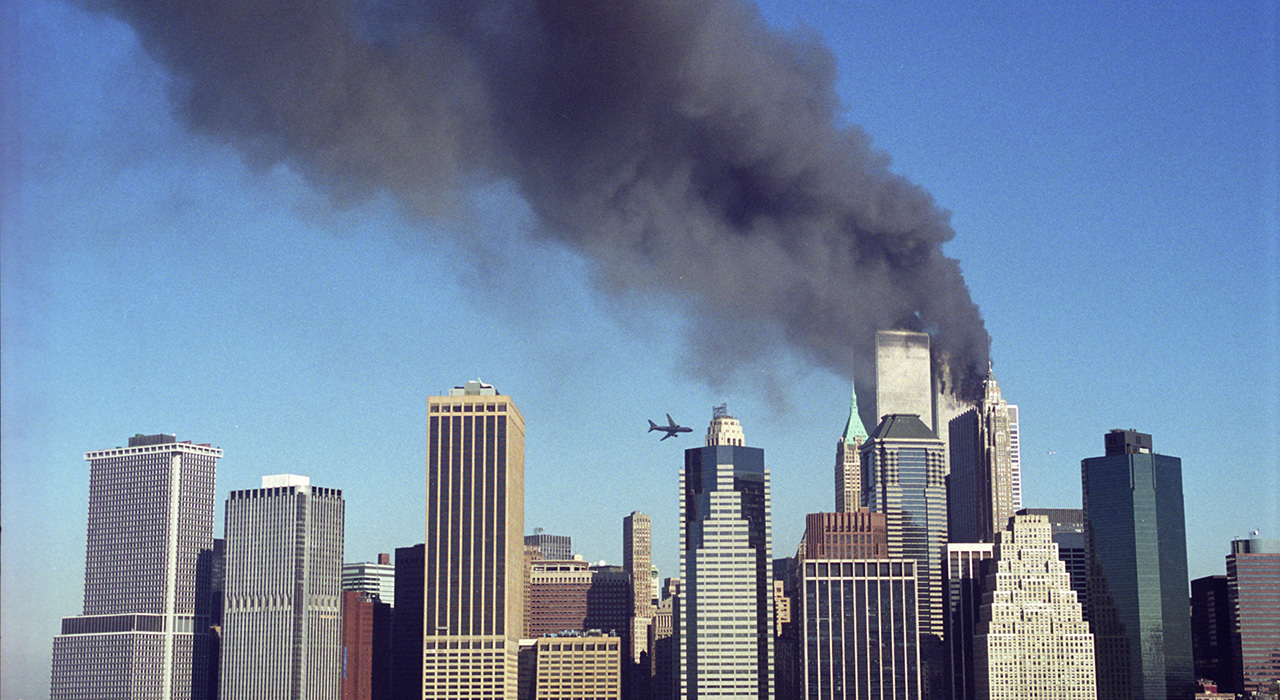
On 9/11 itself I was 3,000 miles away from New York, at home in California. By chance, that morning I was up early to finish packing for a trip to the company mothership in Amsterdam. I made a cup of tea and switched on CNN, my daily breakfast ritual. Living on a coast nine hours behind Europe made it essential to catch up on the day's global news developments before my Dutch colleagues started to head home from their own days in the office. Just after 6am my time, a “BREAKING NEWS” caption briefly flashed on screen, reporting news of an aircraft hitting a New York skyscraper. The assumption was that it was just a terrible accident involving a light plane, a possibility given the number of sight-seeing flights that buzz the city all day long. Soon, though, the picture changed to something far more serious. CNN interrupted an ad break to cut to live images of a horizontal gash between the 93rd and 99th floors of the northern façade of the World Trade Center’s North Tower. Smoke was billowing from the fissure that had been created at 8.46am EDT by an American Airlines Boeing 767 slamming into it on full throttle.

At 9.03am, a second 767 flew into the South Tower, erupting in a vibrant ball of orange flame, the plane’s rapid approach from the south and its subsequent explosion frighteningly caught on live TV by the cameras now trained on the scene. The first crash had still been thought to be an accident until the second one confirmed something far more sickening. 34 minutes later, a Boeing 757 crashed into the ground floor of the Pentagon on the western side of its outer ring, having also been flown at maximum speed into a narrow dive, clipping street lamps in the final moments before impact. And there was more: shortly after 10am, another 757 came down in a field in Shanksville, Pennsylvania, five minutes after the World Trade Center’s 110-storey South Tower collapsed. At 10.28, its sister tower fell too, 102 minutes after first being struck.

Picture: Kelly Guenther

Over the course of that morning the world bore witness to one of the most brutal acts of violence committed in the name of any cause, an event played out in three parts: the hijacking and crashing of the aircraft, the collapse of the Twin Towers and then the response that would ultimately result in the “forever war” that President Joe Biden has just brought to an end. That Tuesday was era-defining for everyone alive at the time, not just in the world’s immediate shock and revulsion, but to everything from world economics and geo-political relationships to national security, privacy concerns and defence procurement. Even popular culture shifted from a Cold War legacy to adversarial Middle Eastern themes as Hollywood echoed real world developments with television dramas like Homeland and 24 all playing on the paranoia and suspicion of a region and the people it had harboured in the planning and execution of the attacks. Not surprisingly, it led to a rise in Islamophobia. 

As the world marks the 20th anniversary of 9/11, it’s worth considering just how long that day’s tail has stretched, and still does. The plethora of documentaries broadcast to mark the anniversary have triggered precise memories and rediscovered the vague. Even now, watching footage of the South Tower’s collapse and seeing the billowing clouds of smoke and dust looks like an audacious Hollywood CGI effect. But it was anything but. Such images remind us of the shared experience of seeing something so horrific unfold in real time on live television. Arguably, there had never before been a broadcast event so raw, of a wholly different - and horrific - nature that no viewer and or producer could have ever envisaged. 

When news broke of the planes hitting the towers, the woman who is now my fiancée was at home in London cradling her then-six-month-old daughter while watching the BBC. That child turns 21 next March. In Amsterdam, the colleagues I was supposed to be flying to see on September 11th were in an office looking out over the Amstel river. Planes taking off from Schiphol Airport on its easterly ‘Buitenveldertbaan’ runway would often soar past the building as they gained height, some invariably heading to ‘New Amsterdam’ on the other side of the Atlantic. That afternoon, they wouldn’t have arrived, once American airspace was closed in response to the hijackings, and any transatlantic flights past the navigable ‘Point Of No Return’, the mid-Atlantic position where there is only enough fuel to continue on to the destination, were redirected to remote airports in north-eastern Canada.

In California, 12 hours after the news first broke from New York, I was still in my pyjamas, frantically surfing the TV networks to see if any one channel had better information than another. By 6pm my time I had to stop. After showering and getting dressed I drove up the 101 freeway towards San Francisco, noting how quiet the normally choked rush-hour roads were. I was also struck by how the Bay Area’s powder blue skies were bereft of the vapour trails usually criss-crossing airspace triangulated by the airports of San Francisco, Oakland and San Jose. I left the freeway at San Bruno and drove up to a park overlooking SFO. Planes appeared scattered like abandoned toys across the airport’s runways and aprons after the FAA had given its ‘all-stop’ instruction to all commercial air traffic, once it became apparent that a mass hijacking was in progress. There was a serenity to the scene in stark contrast to that which the world had witnessed earlier that day. 

Picture: FBI
Only later did the full horror become apparent, along with the scale of the attack. We eventually learned the name of Mohammed Atta, the dead-eyed ringleader of the so-called Hamburg Cell that had executed the plot, and who had been personally selected by Osama bin Laden to lead the operation. At check-in for American 11, Atta had drawn attention to himself at Boston’s Logan Airport by appearing nervous and sweating profusely. Shortly before the 767 pushed back from its gate, airline manager Michael Woodward, who’d been on board finalising paperwork, spotted Atta staring back at him from seat 8D in business class and felt a chill. An hour later, Atta was at the controls of the Boeing as it hit the North Tower. Behind him in north-eastern American airspace were the conspiracy’s three other teams: five terrorists on board United 175, also out of Logan, five on American 77 from Washington-Dulles, and four on United 93 departing from Newark (a suspected 20th hijacker had possibly missed the flight after being denied entry to the United States).

Growing up, terrorism was something that happened in Beirut or Belfast. Occasionally London would be targeted by one of the IRA’s so-called “spectaculars”. There had been hijackings, too, in the 1970s and 1980s, but the bombing of Pan Am 103 over Lockerbie in December 1988 made a stark statement about terrorism’s obsession with aviation as a means of causing mass casualties. However, the “planes operation”, as bin Laden had called the plot, was on a different level altogether. It was effectively a military mission, weaponising passenger aircraft to carry out the ultimate suicide bombing. This wasn’t the work of a reclusive extremist in a basement, soldering together Semtex, wiring and an alarm clock, but of an organisation with the sort of institutional financial backing to arrange flight training for the hijack pilots and boot camps for the ‘muscle’ hired to take over the aircraft using boxcutters and mace to slash and stab cabin crew and pilots. The attack’s concept appeared to deliberately replicate the precision targeting seen for the first time during the 1991 Gulf War in video of American Tomahawks whistling over Baghdad rooftops and disappearing down ventilation shafts.

In the event, 2,977 innocent individuals were killed as a result of the terrorist attacks of September 11, 2001. 147 died on board the two planes in New York, a further 120 at the Pentagon and 40 on United 93. The World Trade Center body count included “ground casualties” - a combination of those still in the buildings when they came down, including 343 firefighters, 72 police officers and other rescue workers, and those who’d been working on the upper floors of the towers and chose to jump to their deaths rather than be burned alive. Chilling footage exists of fire crews assembling in the North Tower’s lobby as the sound of human bodies crashing into the plaza outside became a sickening steady, almost industrial drumbeat.

When the towers collapsed, questions were raised as to why. When they were built in the late 1960s developers assured locals that they weren’t living in the shadow of a giant target by pledging that the buildings were designed to withstand the direct impact of a Boeing 707. 9/11 comprehensively proved that wrong: those who managed to get out of the towers before they collapsed testified to seeing huge amounts of internal steel and concrete displaced by the eruption of the airliners, each laden with thousands of gallons of jet fuel that burned so furiously the buildings’ structure was weakened. It took just 56 minutes for the South Tower to collapse after United 175 slammed into itt.

The 24 hours after the attacks were filled with uncertainty. In the BBC’s illuminating documentary 9/11: Inside The President’s War Room, Dan Bartlett, who was at George W. Bush’s side on 9/11, said: “We didn’t know if it was the beginning, or the middle, or the end.” In another BBC documentary, Arthur Cary’s moving Surviving 9/11, ABC News journalist NJ Burkett - who was filing a piece-to-camera in front of the South Tower as it started to collapse - found himself obsessing about what lay ahead: “At the time I thought 9/11 was just the beginning, that we were going to have suicide bombers at Broadway shows, suicide bombers on the Subway. I thought that was the opening salvo of an ongoing series of terrorism attacks on New York. It started to rule my world: when is the next event going to happen?”.

On that Tuesday night I went to bed with the window of my apartment open as it was warm. At some point I was woken by the noise of an approaching jet aircraft, piercing the silence that had enveloped the Bay Area since the FAA’s instruction. I lived less than five miles in a straight line from Moffett Field Airfield, a base shared by the military and NASA. For all anyone knew it could have been another target. I held my breath as the sound of jet engines grew closer before relief as the plane continued on into the night. Next day in the office - where the company’s entire Silicon Valley campus took part in an impromptu service of remembrance for the 9/11 victims - everyone in the area seemed to have experienced the same dread as me as they, too, had heard that plane cut through the night.

Working for a European company on the West Coast meant that afternoons were quieter, but in the days and weeks immediately after the attacks I was restless. I became obsessed with needing to know the details of what had happened. I spent hours feverishly refreshing the BBC website in the hope of discovering something new, about how 9/11 had happened, who had made it happen, or what could follow. In early October - around the time of my trip to New York - the US started carpet bombing the Tora Bora caves and other Al-Qaeda positions in Afghanistan and the Pakistan borderlands. Later that month, I was assembling an IKEA desk in my spare room when news broke on the Internet radio station I was listening to that ground forces had gone into the Afghan mountains. The fightback had begun, a response that would lead to magnitudes-more deaths in the two decades of wars in the wider region that would follow, as well as further casualties in the acts of terror brought back from the battlefields to western cities.

NJ Burkett

“We are - all of us - survivors of 9/11.” said NJ Burkett in the BBC documentary and in a way he’s right. If it haunts me still, it’ll haunt anyone else who was watching television that Tuesday, 20 years ago. The denouement of the war in Afghanistan hasn’t brought me any sense of closure, either. 9/11 was the trigger for the War On Terror, with the West’s retaliation in Afghanistan and elsewhere in the Islamic world, but this only fuelled an extreme ideology that would haunt us further, in London on 7 July 2005, Paris in November 2015, and in scores of other atrocities on city streets thousands of miles from the desert. It manifested itself in the lawlessness of post-war Iraq and in Syria, and just last month at Abbey Gate outside Kabul Airport. Ultimately, in the conclusions about 9/11, it was a manifestation of a hatred that had begun as far back as the 1950s in the Middle East, festering and metastasising in various forms of terror and armed resistance. 

Perhaps, like the global crisis we’ve all had to cope with over the last 18 months, we will have to live with the constant threat of angry men with hate in their hearts and nefarious backers funding them, vowing to continue what the 9/11 hijackers started. We can’t live in fear, of course, and just as wearing face masks on the Underground is an inconvenient necessity, still having to remove our shoes and belts at airport security is much the same. 

At London City Airport last month, on our way to Edinburgh for a brief family holiday, there were teenagers too young to know why they were being forced to walk through a scanning arch in their socks. For me, it was a small - tiny even - reminder of the legacy of what had happened on this day 20 years ago. Three weeks after our trip to Scotland, Kabul fell. And it felt like we were back at Square One.

Picture: Twitter/US DoD


Friday, 28 May 2021

We were on a break...

Picture: Warner Media

So much for the much-anticipated Friends reunion. It had been talked about for over a year, postponed because of The Thing that’s been screwing everything up, and finally went out yesterday, on Sky in the UK. Note the emphasis on “reunion”: this was certainly not a revival. In fact, at one hour and 40 minutes, I wasn’t entirely sure what the hell it was.

Certainly it was a bit of history - albeit confected history - since, as Jennifer Aniston remarked early on, it was only the second time since the show ended in 2004 that the magic sextet of, in no particular order, Aniston, Courtney Cox, Matthew Perry, Lisa Kudrow, David Schwimmer and Matt LeBlanc, had been together in the same room. Various combinations had met socially, but as the 100-minute special opened, with the cast members walking emotionally on to the original Warner Brothers set, it was clear that something unique was unfolding. Or, at least, should have been.

This was a celebration of an undoubted television phenomenon: a sitcom that ran for 236 episodes over 10 series; shown in 220 countries and dubbed into 18 languages; watched (apparently) more than 100 billion times across all platforms; the No.1 show for six straight seasons in the US, averaging 22 million viewers a week; and whose finale was watched by a US audience of 52 million (no stats for the rest of the world). And, of course, is still running, somewhere, in syndication. Television’s equivalent of Dark Side Of The Moon.

For those of us of a certain age, Friends was a show that, to a limited sense, reflected life in the 1990s and early 2000s. Not that we were all exclusively white New Yorkers with Cox’s cheekbones, Perry’s wit or the sexual prowess of LeBlanc’s character. But we bought into the Friends lifestyle: we descended upon cosy coffee shops like Central Perk and aspired to the SoHo apartment life. Pre-social media, we argued - in person - over who was our favourite Friend. We all had an opinion as to whether Phoebe was, actually, the star of the show, that Chandler and Joey should have had their own sitcom as TV’s greatest odd couple, that Monica was very annoying, that Ross was worse, and that Rachel was lovably ditzy, but Oh My God.

Now I think of it, there was much to celebrate about Friends, and this reunion should have done that. Instead we got a mish-mash. Bits jumped all over the place, themes were never fully fleshed out, and guest appearances either made no sense, or were squandered. From the Warners set reunion of just the six actors, we went to a bizarre outdoor interview set-up, in front of the famous title sequence fountain, in which the aggravating James Corden asked a couple of questions, before it moved on to the cast doing a read-through of a classic scene, or recorded interviews with creators David Crane and Marta Kauffman. Breathlessly we were then on to a meaningless segment in which Tom Selleck walked into the apartment set for all of a minute, or actor James Michael Tyler (Gunther) appeared via Zoom for a brief hello, or Maggie Wheeler (Janice) stopped by to do her nasal “Oh-my-God!” catchphrase.

It was all a bit of an unsatisfying mess, really. And, strangely, for such an anticipated event, we hardly got to hear from the principle cast members. Yes, the likeable Schwimmer told how he’d fancied Aniston for real during their first season (they chose to channel their unrequited interest into the on-off-on-off Ross/Rachel affair). Cox, as might have been expected, seeing as she was, in the very beginning, the only member of the gang to have a profile (courtesy of Bruce Springsteen’s slightly corny Dancing In The Dark video) came across more guarded. LeBlanc - so much better in real life than as a somewhat stiff Top Gear presenter (let’s forget the entirely forgettable Friends spinoff, Joey…) - came across as the Friend you’d actually want to befriend, and perhaps the least actorly of the group. He also reminds me now of an old schoolfriend (albeit somewhat…erm…‘well upholstered’), which might enhance his familiarity. Kudrow, too, as I’d suspected, seemed just nice and down to earth. 


Perhaps the biggest disappointment, the biggest challenge to expectation management, was Perry. As Chandler Bing he had the funniest lines and easily the finest comic timing, famously forcing entire scenes to be rewritten with his own, funnier contributions. Perry had the distinction of uttering the very final line in the finale, with Rachel suggesting to the group that they should get one last coffee, to which Chandler cracks “Sure. Where?”.  In the reunion Perry appeared emotionally stunted, not helped by having undergone dental surgery immediately before the recording, which rendered him with a grin that resembled Jack Nicholson’s Joker, prior to putting on the face paint. 

There were moments of the Chandler wit: in response to Kudrow pledging that they all stayed in touch (“Maybe not every day, but every time you text or call, someone will be there.”) to which Perry deadpans: “I don’t hear from anyone”. It’s easy to see him as the classic tragic clown, and he has been through the wars in real life (self-inflicted, it must be said), but for all his natural funnies, he also felt anxiety the most, gripped with fear at delivering those pin-sharp lines in front of a live studio audience. “To me, I felt like I was going to die if they didn't laugh,” he said. “It's not healthy, for sure, but I would sometimes say a line and they wouldn't laugh and I would sweat and just go into convulsions if I didn't get the laugh I was supposed to get. I would freak out.” Perry’s admission seemed to shock his castmates in what felt like the one true deviation from the slightly forced party atmosphere. 

There’s no doubt that Friends was the product of great writing and astute casting. “We saw a gazillion people,” Kauffman revealed. Bright said that David Schwimmer had even given up television and had returned to doing theatre in Chicago when they came calling. Cox was originally seen as Rachel, until she convinced the producers otherwise. Kudrow’s Phoebe arrived ready-baked, having played the character’s fictional twin sister Ursula first in Mad About You. LeBlanc had been jobbing as a minor teen heartthrob, but when he auditioned he had just $11 to his name. He spent his first pay packet on a hot dinner. He explained how his second audition was almost hampered by a drunken episode the night before, where he’d lamped himself on a friend’s toilet bowl, leaving him a gruesome bruise on his nose. The pratfall may have won him the role. Other characters weren’t so straightforward: once Aniston was identified as Rachel, the producers had the task of freeing her from a contract with another show, Muddling Through. She wanted Friends, but having been in “a graveyard of pilots”, she’d finally found a fixed job and had to plead to be released from it. “That show is not going to make you a star,” she reveals its producer telling her.


Of course, it did. Arguably Aniston became Friends’ biggest breakout star, a point the reunion deftly avoids, although in a compilation of guest stars, there’s an awkward flashback to Brad Pitt’s appearance (they were married for five years). As Kauffman recalls, the Friends actors’ fame was unprecedented, remembering once seeing them on the cover of every single magazine at an airport newsagent as she passed by. “No one was going through what we were going through, except for the other five,” Schwimmer says.

17 years after they went for that final coffee, it’s clear that there is a genuine bond between the six. But ultimately, you can’t help feeling the reunion was squandered. It’s hard to understand why it was entertained in this form to begin with. Yes, some of the clips and anecdotes were fun, but when you’ve probably seen all 236 episodes, multiple times probably, given the amount of global syndication since Friends ended, there was nothing new to say. Ultimately, this was an exercise in HBO Max - the US network - leveraging some of the $425 million it paid to secure exclusive rights to the show. The cast’s appearance fees for the reunion were said to be somewhere between $2.5 and $3 million each. I suppose good for them. Nice work if you can get it.

If there’s one saving grace it was that this reunion wasn’t a precursor to a revival. Sitcoms being reborn, like some bizarre Jurassic Park DNA project, rarely work well. The return of Will & Grace bombed, the various reincarnations of Roseanne haven’t fared any better, and the plan to revive Frasier (see my post Still listening?) has already met with casting headwinds. Perhaps, then HBO Max is actually on to something by buying up every episode of Friends, and hoping that those now in middle age will want to relive their younger, child-free days, or that kids might discover it for the first time. That, though, is unlikely. As comedically perfect as the gang of 1994-2004 were, they probably offer very little to today’s audiences. Six impossibly good looking white twentysomethings? Could they be any less relevant?

Monday, 1 February 2021

You can always get what you want - merchandising the Rolling Stones brand

© Simon Poulter 2021
As someone lucky enough to have seen the Rolling Stones more times than any other band, and on a beautiful, sunlit morning in November 2016, was amongst the first punters through the door of New York's Industria to see their Exhibitionism showcase, you could say I’m a fan. A trawl of my T-shirt drawer reveals a disproportionate number of garments bearing the famous tongue motif, easily the most famous piece of iconography in rock’n’roll history. While it will never compete with a clothing logo like, say, Ralph Lauren's Polo, the Stones preside over a brand that, it would appear, has limitless application. 

This week they've added it to confectionary, with the launch of Rolling Stones-branded chocolate bars, available for £5.95 a pop (plus £3.95 for COVID-friendly home delivery) from the band's substantial online store. Should you be so inclined, you can purchase a bar of Brown Sugar (milk chocolate) or - wait for it - Cherry Red (dark chocolate infused with cherries). There is, now, literally nothing that tongue logo won’t appear on, a trade I have willingly engaged in, given my aforementioned T-shirt collection, the socks, the limited edition Moleskine notebook and, naturally, the super deluxe edition box set reissues, like last year’s Goats Head Soup

Undoubtedly, I am the Stones’ target market, and partly who they had in mind last September when they opened their own “flagship” store at No.9 Carnaby Street in London. Effectively an extension of the merchandising stands you’ll see at their live shows, ‘RS No.9 Carnaby’ is an Aladdin’s Cave of Stones stuff, all bearing that tongue, and fitted out in ‘Stones Red’, now a registered Pantone colour matched to that logo. Given that Carnaby Street would normally be one of London’s biggest tourist attractions (smart marketing in the early 2000s transformed it from the somewhat shabby cove of novelty tat shops it was when I used to visit the Smash Hits offices at 52-55 in the mid-1980s), you could say that even this outlet is further evidence of the Stones’ business smarts.

Along with the limitless racks of Stones-branded clothing, ‘RS No.9 Carnaby’ will sell you tongue-branded Baccarat Crystal wine glasses (£245) and matching decanter (£535), chiffon scarves (£350), a water bottle (£30) and even an umbrella (£25). Actually, the Carnaby Street store was a tad limited when we visited last October, but then this is where retail wonks like to get into the world of “brand experiences”, whereby consumers “engage” with a brand, as opposed to just shop. Think of Apple Stores where everything from the layout to the staff is designed to the Nth degree to exude the company's considerable brand values as much as flog you things.

However, retailing is only one tip of the Rolling Stones business iceberg, which includes the band’s recording, publishing, touring and sponsorship entities. They are, in essence, every bit a corporate brand, and the lips-and-tongue is as powerful an emblem as the logos of Apple, Nike, McDonalds, Mercedes, Coca-Cola or Volkswagen. But, then, the Stones have long been rock’s most successful corporate bands. Such is their endurance on the world stage that, beyond chocolate and branded umbrellas, they remain one of music’s most profitable touring forces. Their No Filter tour, which commenced in 2017 but was postponed last year due to the coronavirus, has so far booked over $415 million at the box office; their 2005 A Bigger Bang Tour remains the fourth highest grossing concert series of all time, trousering $688 million. By the time No Filter resumes, the Stones will have a combined age of 306 (drummer Charlie Watts reaches his 80th birthday in June). Mick Jagger is said to have amassed a net worth of $360 million, with Keith Richards a little way behind on $340 million. Most of this wealth has been generated by business acumen. 

The common thought is that Jagger’s uncompleted course in accounting at the London School of Economics in the early 1960s made him the fiscal brains of the operation, but it probably owes more to Prince Rupert Loewenstein, the Bavarian count who was their business manager for almost 40 years. His legacy (he died in 2014) is that the Stones are one of the most smartly-managed companies in music - even to the extent that they exist as a Dutch “BV” (besloten vennootschap or private limited company - said to be a tax-friendly arrangement), and hold annual company meetings every year in Amsterdam, a ready source of chuckles, given the city's notorious recreational delights.

Central to all of this has been that logo. What has become one of the most lucrative emblems of all time was the result of a £50 commission from Jagger to art student Jon Pasche in 1970 to produce a poster for their European tour that year. After rejecting the first couple of designs, Jagger suggested that Pasche produced something witty that combined the simplicity of the Shell oil logo with the Hindu deity Kali for further inspiration (which actually provided the emphasis on a mouth and tongue - not, as was assumed, a conscious effort to replicate Jagger’s own prominent lippage).

The tongue made its eventual debut on the back cover of the Stones’ Sticky Fingers album in 1971, and has been part of the band’s visual language ever since. According to one intellectual property lawyer it has earned “hundreds of millions of pounds”. Pasche, on the other hand, says he probably only earned a few thousand pounds from his design, eventually selling the copyright in 1982 for just £26,000. Still, though, it has become emblematic of a form of brand marketing that students of such dark arts should and will be examining for years. Merchandising has always been a core part of rock bands' money-making, but few have taken it to the industrial levels of brand exploitation as the Rolling Stones. And they've done it with one of the most controversial and irreverent pieces of corporate imagery ever created.

Band logos have always held a fascination for me. As a schoolboy, it was fashionable to emboss the names of rock bands on the canvas, army-surplus shoulder bags that everyone carted around when I was 13. Bands like Genesis, Steely Dan, Yes and Rush generated a weird form of fan loyalty via their logos, which would be painstakingly scrawled in biro on such bags. No one, though, has ever come close to monetising a graphic identity quite like the Stones. Any band can produce T-shirts, mugs and even sleepwear, but only one band can get away with a £500 decanter or, now, a six quid bar of chocolate. It seems you can always get what you want, for the right price, that is.

Saturday, 19 September 2020

Universal exports - David Hepworth's Overpaid, Oversexed And Over There

In early December 1992, 25 years of age and recently furnished with a decent redundancy package, I touched down at Los Angeles International Airport with mouth agape. The America I’d grown up with, vicariously, through the myriad TV shows recorded in Southern California, was finally right in front of me. And it didn’t feel in any way unusual. 

Normally, when you travel abroad, you are immediately assaulted by new sights, sounds and smells. You visit a local supermarket and, by a rite of passage, groceries with amusingly rude brand names bring out the inner sniggering schoolboy in you. But not in LA. There, the sky was as blue as I’d seen it on The Rockford Files and the Six Million Dollar Man, my childhood television staples. The freeways were just as they were on CHiPs, the mountains just as they were used to substitute for Korea in M*A*S*H. And, yes, Santa Monica Beach was just as it appeared on Baywatch. Even the Hollywood sign didn’t seem that startling: “Oh yeah, that,” as I made the first of many ridiculous attempts to find the perfect vantage point in Beachwood Canyon to photograph it.

Of course, I loved it, and that visit to California became the first of many, including two years living there and living the dream for real. Four months after my maiden trip to the US of A, I went to New York (also, the first of many visits since). This proved to be a cultural reawakening of similar stature to my Californian experience, walking the steel and concrete canyons of Manhattan, doing the Statue of Liberty and Ellis Island tours, splurging on cheaper CDs at Tower Records, eating in diners and enjoying the exchange rate benefit by cleaning out Macy’s of clothing at more than two dollars to the pound. You can repeat these patterns in any one of a number of pleasure and work trips in the 28 years since that first visit.

All of this is brought to mind by Overpaid, Oversexed And Over There, the latest instalment of David Hepworth's impressive run of brilliantly researched book-essays on pop music culture. It starts with the premise of the so-called ‘British Invasion’, the wave of British pop bands which commenced with The Beatles travelling to America in 1964, closely followed by the Rolling Stones, The Yardbirds and many others. Collectively, they effectively imported the very rock and roll that had been exported via somewhat nebulous supply lines, be they Elvis Presley’s music heard fertively via offshore radio stations, Bill Hailey’s Rock Around The Clock in cinemas, or the blues records entering Britain via its seaports, which so famously found, in that fateful meeting at Dartford railway station, kindred spirits in Mick Jagger and Keith Richards.

Britain, it shouldn’t be forgotten, wasn’t long out of the economic and social austerity of World War Two when John, Paul, George and Ringo landed at Kennedy Airport to make the first of three appearances in February 1964 on The Ed Sullivan Show, the top-rated Sunday evening institution on the CBS network. They had, actually, appeared before on American television the previous November when a news report covered Beatlemania in Britain. Such was the interest it generated that 4,000 fans turned out to meet the band at JFK when they landed on 7 February. While my first visit to the US wasn’t met with anywhere near the same fervour - in fact no fervour at all - Hepworth examines what it must have been like for The Beatles, four twentysomethings from lower middle class Liverpool backgrounds, to suddenly experience an America they probably had significantly less cultural experience of than I had. At least I’d seen Charlie’s Angels on a weekly basis.

David Hepworth
What must still be admired today about the Fabs’ arrival in America - their first live appearance on the Sullivan show garnered an audience of 73 million - is that it established a new relationship between the United States and the United Kingdom. Just twenty years before, more than a million GIs had been been based on British shores in anticipation of D-Day, grabbing the girls and splashing their not insignificant disposable income around in country pubs to the annoyance of impoverished, ration book-imposed, horny local adolescents. “We saved your ass,” was probably the inbound refrain. But here, in Hepworth’s book, a reverse tide made gods from state-to-state out of young British men, playing mail order-purchased, American-made Fender guitars, as the rock and roll and blues America had inadvertently sent our way, was brought back in spades by these Limey upstarts. 

The Rolling Stones, Hepworth cites, were prime examples of this. Starting out as exclusively a covers band, their evolution into “the greatest rock and roll band in the world” - a description they continue to earn, 56 years later - was founded in America. Hepworth notes that their first signature hit, Satisfaction, came to Keith Richards as a riff while staying at a Florida motel. Lyrically it’s a song about American life, not a lad from a bombsite suburb in Kent who’d never set foot abroad until a couple of years before. Whether Satisfaction was autobiographical or simply a song that worked, it, Hepworth demonstrates, undoubtedly channeled the America that Richards had been infusing via his Chuck Berry and Muddy Waters imports.

While some of these fresh-off-the-boat young men (and they were, exclusively, young men) inevitably found themselves guppy-mouthed at king-sized beds and en-suite hotel bathrooms, as opposed to the provincial B&Bs they’d had to endure in Britain, Hepworth moves on from the initial landings and teen-screamfests to examine how these bands evolved in an America that, itself, was undergoing social movement with the emerging war in Vietnam in the background. 

One of the most interesting sections of the book examines what made Led Zeppelin, ultimately, the most successful British band in the US during their tenure. The contrast, Hepworth notes, is that while the early British invaders - even the Rolling Stones - had a certain cuteness about them, which somewhat appealed to American heartlanders, Zeppelin built their case with sex appeal, musicianship, amplification and sheer momentum (so the legend goes, the band were totally different animals while touring the US, or during their notorious stays at the ‘Riot House’ Hyatt hotel on LA’s Sunset Boulevard, than they were when back home in their bucolic English country piles). While U2’s proclivities aren’t as documented - or even existed at all - Hepworth also examines their ambition to conquer America. Arguably, it took The Joshua Tree and all its Mojave desert imagery to do so - but, like Led Zeppelin, they found the US to be a receptive market, and set to master it, “give it what it considers it wants and needs,” Hepworth quotes a modest Bono saying in 1981.

By the time that U2 started to break America, along with bands like Culture Club (with Boy George causing quite the sensation - remember his appearance in an episode of The A-Team?), British bands had blazed a trail. American charts in the 1970s had been dominated by the likes of Elton John, David Bowie, Pink Floyd and even Fleetwood Mac, if you can consider their ‘classic’ line-up three-fifths British. It is, perhaps, no surprise, that American comedy scion Rob Reiner chose, with co-writers and American actors Christopher Guest, Michael McKean and Harry Shearer, to spoof a British touring rock band in This Is Spinal Tap. Led Zeppelin’s notorious tours, in which manager Peter Grant literally took suitcases of cash away from gigs, provided a model for British acts to be as gargantuan, stadia-fillingly successful in America.


Overpaid, Oversexed And Over There is the latest in a seemingly endless stream of Hepworth tomes that brilliantly and richly get under the skin of popular music. Like it’s most recent predecessor, Nothing Is Real, and the earlier Uncommon People, A Fabulous Creation and 1971 - Never A Dull Moment it is another collection of artfully considered, not to mention highly entertaining thoughts about the music business. Each has been a superbly researched gathering of thoughts around a single theme - be it the rise of rock stars, the LP as a limited concept, or 1971 as the year everything happened (and forget anyone who says otherwise about ’66, ’67 or ’70…). 

The level of detail in Hepworth’s books is always impressive - if you like the history books of an Anthony Beevor or John Julius Norwich you will appreciate the same degree of narrative and insight - but not without the wit that Hepworth has applied in his music journalism career, in particular as editor of Smash Hits and founder editor of The Word, but also his period as co-presenter of Whistle Test with old mucker Mark Ellen. Indeed, I’ve had the pleasure of spending many highly entertaining evenings in both their company for recordings of their Word In Your Ear podcasts, pre-lockdown, in which they gently interrogate authors of similar books about music on their specialist subjects. Hepworth’s own books are also quite substantial, too, which means that, at his current rate of output, another - like the DFS Sale and the Oscars - will be coming around shortly. Which means I’d better get a move on in finishing the new one.

Saturday, 12 November 2016

The tea really does taste better, and other observations

© Simon Poulter 2016

So, I’ve been back in London just over a month, after 17 and a half years living abroad, which is a statement that, I know, carries a whiff of the exotic. However, I'm not suggesting for one minute that I've been off-grid, khaki-clad with a pith helmet, observing still-primitive Amazonian tribes, or carrying out a long-term study of penguins in their natural habitat, or in my wilder moments of Walter Mittydom, living the rock star lifestyle in a Malibu hacienda, occasionally doing something with gated reverb.

No, for most of those years away I've been sat in an office. Furthermore, I've hardly been cut off from my homeland. Frequent commando raids to visit family, friends, Stamford Bridge and carry out sundry business commitments, more or less in that order, have kept me in regular contact. That said, there is a substantial difference between weekend trips to the home island and living somewhere day-to-day (or, simply, "living", as I had been doing exclusively in Britain before being coaxed elsewhere).

Of course, moving to the Netherlands - and subsequently California, back to the Netherlands again and then France - as I did, wasn't exactly volunteering for the first manned Mars mission. These countries do, I established quite quickly, have flushing toilets, and if you know where to look, shops selling Marmite. But coming back has thrown a spotlight on things I had missed, or more importantly, didn't know I'd missed.

With worldly-wiseness comes additional awareness of your home country and recognition of things you'd never have been conscious of before moving abroad, or that you suddenly become aware has become a thing while you've been away. Here, I offer my first observation: cars pushing into traffic from side roads. I honestly don't recall this ever being a custom (interestingly enough, in Holland cars coming out of a side road have right-of-way, which I didn't know until it was almost too late…the first time). During my driving lessons I was taught to wait until there was a break in the traffic and then pull out. Now the norm seems to be to simply stick the nose of your car out, forcing others to stop. And often the driver in question is actually trying to blag his or her way onto the other side of the road, forcing traffic on both sides to stop. I don't know when or where this came from, or why. It's possible that it is simply a consequence of Britain's roads becoming ever more congested, as property, demographics and population increases - including net immigration - have put more cars on the streets. Another good reason for me to eschew car ownership and make use of public transport, a trait I warmly embraced in Paris, and am happy to continue as I base myself in south-east London.

This brings me to my second observation: the sense of entitlement. I blame Simon Cowell. For many things, actually. At risk of committing the most middle-aged thing I've ever written, Britain has, in the years I've been at large, developed an assumption of on-demand, instantaneous everything, from Cowell's drive-through fame culture to 18-year-old footballers skipping the traditional cleaning-the-stadium-toilets-with-a-toothbrush apprenticeship and going straight to Range Rover ownership. And don't get me going on compensation.

With this entitlement comes an erosion of civility, something the Brexit referendum seems to have accelerated, with social media becoming the prime medium to tell complete strangers exactly what is thought of them. There is some credence to the argument that if Gary Lineker or Lily Allen tweet about refugees they are putting themselves out there, and that their freedom to express themselves is rightfully matched by those who dare to troll them. But, as I’ve blogged before, spend any time on Twitter and, much like the bubbling stream of bile that is the Daily Mail and its unhinged, tin-foil hat-wearing, demonstrably illiterate readership, you will succumb to both madness and despair at how people, shielded by their keyboard and the semi-anonymity of their handle, feel entitled to say whatever the want without consequence, and without any basis of a relationship to so.

This manifests itself, post-Brexit, with Polish community centres being vandalised, hijab-wearing Muslim women being verbally abused in town centres, and knuckle-dragging thugs staging protests about claiming their country back, not that I ever noticed that it had been taken away from them. And, guess what? After Tuesday's presidential earthquake, it's happening in America, too. Let right-wing populism win, and all of a sudden there are those acting like it's 1933 Germany, when brown was the in-vogue shirt colour.

When I left Britain in 1999 there was no such thing as social media. If you wanted to complain you either wrote to Jimmy Young, Points Of View or The Times. If you wanted to rant at complete strangers there was always Speaker’s Corner. Now, you can meltdown, Basil Fawlty-style, on Twitter. Which I did, without remorse, recently when trying to get broadband installed. Broadband providers go to great lengths to draw you in with slick marketing: TV ads with Hollywood celebrities and websites that connect you to directly via chat to experts helping you pick the right package. And then the horror begins: after handing over a large sum of money, you then wait for the service to begin. Except it doesn’t, so you connect by online chat again…where it takes half an hour for someone to take up your case, only to inform you that another department handles your type of package and you should call their helpdesk. Which you do, and you then spend an hour on hold due to “a high volume of calls”. In my case, I clocked up a full three hours on hold trying to find out why BT had arbitrarily cancelled the visiting installation engineer, and then cancelled my order altogether. Here Twitter comes into its own. It’s amazing how responsive companies become when their reputation is challenged publicly. It shouldn’t be like this, of course. You should just be able to call a number and someone answers, more or less straight away. Britain’s population may have grown in recent years, but not so much that some of a telecommunications provider’s substantial profits can’t be invested in extra customer support personnel.

There are many more line items I could complain about the Britain I’ve returned to, from London’s choked, gridlocked traffic, to those Estuary accents where each sentence ends with a rising pitch like a question?, to jogging bottoms as workwear, young women wearing make-up applied by an industrial sandblaster (and eyebrows which may have been drawn with an extra thick Sharpie), to Nando's. But that could sound ungallant about my return, which would be wrong.

Throughout my time abroad I’ve eulogised about my adopted surroundings. Amsterdam remains an adorable village masquerading as a national capital. California will always be where I go for sunny people and sunny weather in a geography that offers cities as majestic as San Francisco and as relaxed as San Diego, and the eye candy of its beaches, mountains and deserts, of Lake Tahoe and Yosemite. And Paris. What can I say that I haven’t already? An architectural history museum that you can actually live in, with subsidised public transport and the amusement of people watching without being judged for it.

But it's not for nothing that for some time I’ve wanted to come back to London. For a vibrancy matched only by New York; for its culture, its art, music, exhibitions and theatre; for its diversity; for its ability to blend modernity with traditionalism; for the sense of newness I keep finding around every corner, nestled amongst the old; for the joy of taking a Thames Clipper to the football; for tea that really does taste better; for breaking my umbilical cord with the south-western suburbs I grew up in and welcoming me to the south-east of the capital.

As much as there is a degree of architectural vandalism going in London, with the rapid forestation of huge, new towers of glass and steel dominating the skyline, there is also an unshakeable excitement about the place that I notice and experience every day I step outside. Even post-Brexit, with the banks and other corporate institutions supposedly buggering off to Frankfurt and Amsterdam, London feels as resilient today as ever before. It’s new mayor, Sadiq Khan, is a force for good, putting himself about on the world stage in an enthusiastically statesmanlike manner, declaring the British capital open. If he could do something about the traffic, Heathrow and the epidemic of knife crime, he would be somewhere close to the country’s best politician (and certainly more effective than either the leadership of the party he represents or the self-serving scoundrels they are supposed to be in opposition to).

All this aside, I'm not going to make melodrama out of my repatriation. Really, there hasn’t been a lot to it. Essentially, I arrived, and then went straight down the pub. It has all been relatively easy - as really I should have expected, though that’s not to say there have been things to get used to again, not to mention things to do for the very first time. But I’ll be honest, the star of all this has been London.

I'm writing this in New York, the self-styled ‘greatest city in the world’, a description much like The Rolling Stones being the world’s greatest rock and band. If so, then London runs it close on many points, and even beats it on others. Kind of like The Who, The Kinks and Led Zeppelin. It really is good to be back.

Tuesday, 27 September 2016

Tales from Thunder Road: Bruce Springsteen's autobiography Born To Run

There was no Damascene moment. I wasn't blinded by the light, to borrow a phrase. No sudden realisation. And it was hardly a conversion, either. But my becoming a Bruce Springsteen fan, as opposed to merely knowing his songs, came relatively late in my life, and relatively late in his career. The summer of 2002, to be precise. The reason why will sound somewhat corny, but bear with me.

The terror attacks on September 11, 2001, affected me more deeply than perhaps I realised on the day. Then, I was living in California, and like so many other people in America - and indeed around the world - it all seemed to happen in vivid, searing real-time. Like everyone else, I'd consumed the news coverage of the Twin Towers being attacked and destroyed. Afterwards it was hard to focus on anything, such was the collective fear that the attacks were only just the beginning of a more sustained onslaught. Over the following weeks and months I was restless. Concentrating at work was a struggle as I fought with a constant need to go to online to see what new developments there were in the aftermath of the single-biggest terrorist mass murder in history.

The hijackings and their attacks on New York and the Pentagon, plus, we presume, the targeting of Washington DC, cast a pall over me. A medical professional might have even called it a form of depression. There had been something so brutal and violent about the taking of those 2,977 lives, most in a city I loved to visit for its relentless energy and verve. I was struggling to properly process what had happened. But then, right smack in the middle of the following July, I heard the song The Rising for the first time, and was moved. An anthemic song, majestic, and yet conversely concerned with a theme so dark and somewhat surreal, that of a doomed New York firefighter entering the World Trade Center just after the hijacked planes had come slamming in. And, yet, I felt uplifted by the song, released, even, from the gloom that had descended upon me ever since that grim Tuesday morning the September before.

I bought the album The Rising on the day it came out at the end of July. I soon discovered the 9/11 narrative within it. It became the catharsis I’d been lacking. Its title song, along with Lonesome Day, You’re Missing and My City In Ruins provided tangible expression of what the world had so brutally witnessed collectively. And in doing so, these songs opened the curtains wide on what it was that had propelled Bruce Springsteen to his exalted status as America’s greatest rock star.

The starting point was Springsteen's authenticity. His home in Colt’s Neck, New Jersey, close to the Jersey Shore where he grew up, is not much more than 30 miles, as the crow flies, from where the old World Trade Center stood. Like so many residents of the Greater New York area, Springsteen watched from his kitchen window as the towers burned before crumbling into a toxic pile of rubble and dust. He spoke for the victims, many of whom came from the New York hinterland that sprawls out into New Jersey. He was New Jersey - working class Jersey. Of all the celebrities who came out to support of the 9/11 victims, Springsteen was unequivocally one of them. His words resonated.

So, suddenly, my eyes - more pertinently, my ears - were open. I was no newcomer to Springsteen - the radio hits like Born In The USA, Dancing In The Dark, Born To Run, Cover Me and Brilliant Disguise, had just been that, radio hits. Like everyone else, I’d gone with Born In The USA as simplistic, fist-pumping patriotism without giving too much thought to its real meaning about a Vietnam veteran struggling for acceptance. And Born To Run - unexpectedly popularised by Frankie Goes To Hollywood, of all bands - was simply a rollicking good rock song. It was only later that I started to place that song into a wider context about Springsteen’s songwriting. That came when I belatedly got around to seeing Cop Land, the superb crime thriller starring Sylvester Stallone as a partially deaf local sheriff living amongst a nest of corrupt New York cops (De Niro, Keitel, Liotta et al) in the small New Jersey community he also polices. The local connection with Springsteen was made by the inclusion of Drive All Night and Stolen Car from Springsteen’s album The River. This prompted me to buy The River itself, along with Born To Run, Darkness On The Edge Of Town, Nebraska and Springsteen’s debut Greetings From Asbury Park, N.J. The river, so to speak, had burst its banks.

Vicariously, I had began to immerse myself in an America I’d hitherto not been exposed to. My first visits to the country had been to California and the golden West, not the industrial, grey-skied badlands of the north-east. I have since driven up Highway 9 in New Jersey, heading north from Springsteen's hometown of Freehold to the outer suburbs of Newark. Hardly a last-chance power drive, but it seemed to fall into place with the oil-stained, denim-clad ordinality of Springsteen’s music.

Like many of America’s greatest songwriters, Springsteen can conjure romance out of the most mundane. Freeways, diners and dance halls possess a thrill and zeal that British motorways, greasy-spoon cafés and provincial discos do not. Cadillacs and Chevys, Lincolns and Fords, already immortalised in the classics of rock and roll, were part of the furniture of the ‘real’ America Springsteen wrote about. His cast of characters were the downtrodden and the poor, the dreamers and the ill-fated lovers.

Springsteen’s music is nothing new and never has been. A song like Brilliant Disguise is pure Roy Orbison, and of course his signature sound was cast with the Born To Run album and its unashamed purloining of Phil Spector. But then rock’n’roll has ever been thus. More or less any artist you like can point to Elvis Presley as the source, Chuck Berry and Little Richard as the catalyst, and The Beatles as the perfect application of the art. Even The Clash and the Sex Pistols can hold their hands up and agree that Presley influenced their look and Berry influenced their guitar solos. The Beatles' Helter Skelter even provided the blueprint for most punk songs.

Picture: Vanity Fair/Annie Leibowitz

Springsteen isn’t, however, merely someone who has aggregated these influences, thrown in Dylan, Woody Guthrie and Pete Seeger for rustic authenticity and arrived at being the heart and soul of salt-of-the-earth America. But he has taken Americana as his canvass and then musically and lyrically fused the 1950s of his childhood with his adulthood and beyond. The screen doors slamming and motorbikes tearing up highways haven’t just been dutiful nods to the age of chrome fenders and billowing gathered skirts, but characters in mini operettas created around small town romances and economic reality. These were themes that I’d never paid much attention to previously, even listening to blues music, which is mostly only about such topics. There was another aspect, too, to the all-enveloping nature of Springsteen’s music: that they offered an incredible soundscape, the so-called “heartland rock” of the E-Street Band - Clarence’s sax, Roy Bittan’s chiming piano and the jangling guitars of The Boss himself. Having always been drawn to more introspective or, perhaps, more complicated, layered music, I had to change up a gear to appreciate Springsteen's music at its fullest.

In doing so, however, I came to see beyond the radio-friendly MTV star, bopping away with a young Courteney Cox in that still-excruciating Dancing In The Dark video. All of a sudden I realised that musically, Springsteen was every bit as compelling as those ‘classic’ British bands I’d considered without-question to be the greatest. There were parallels, I found, between Springsteen and, say, The Who. The British group’s music might have been tighter, even more intense, but to both there was a reflection on what it is to live in the real world. Punk, they say, was the embodiment of this spirit too.

I have a habit of coming to bands late. It’s partly the result of a stubborn blindspot I have which shuts out hype. Once the cognoscenti endorses something, I succumb to immediate suspicion and cast it to one side. The Springsteen myth - all that talk of legendary, four-hour concerts and blue-collar authenticity - had previously had a reverse effect on me and my cynicism. But with The Rising, its predecessors and its successors, I took to consuming Springsteen old and new at any opportunity. Live albums, albums with and without the E-Street Band, offshoots, box sets - you name it, I’ve come to absorb everything the man produces, musically and, perhaps more importantly, lyrically.

Inevitably, Born To Run, Bruce Springsteen’s long-awaited autobiography, out today, has taken me in too, but then I’m a sucker for a music memoir. And there’s always plenty to choose from - Keith Richards’ Life and Neil Young’s Waging Heavy Peace stand out as particular highlights of the genre, and there have been more recent entries by Chrissie Hynde, Linda Rondstadt, Donald Fagen and Graham Nash. Even Phil Collins and Johnny Marr are getting in on the act with their respective Not Dead Yet and Set The Boy Free tomes coming up in time for Christmas. And, of course, no shortage of weighty books about The Beatles, the Stones, Led Zeppelin, Bowie and many more, many of which are still piled high on my dining table awaiting their turn.

Unsurprisingly, perhaps, Born To Run - which has taken Springsteen the better part of seven years to write - is exhaustive. And it unlocks something about this self-effacing and seemingly open rock star, who almost lives like we do (albeit on a 340-acre New Jersey farm and homes in gated communities in Florida and California...). In an era when celebrity can be created out of nothing (i.e. "starring" in reality television), someone of Springsteen's stature probably doesn't need to commit himself to an unexpurgated memoir. But the seed was planted in 2009, after Springsteen and the E-Street Band had played at that year's Super Bowl, and he wrote a blog post for his website about his experience of playing during the half-time show. Over the following months, he found himself keeping a diary of sorts, enjoyed writing it, and enjoyed the voice that it gave him. The writing process snowballed further, resulting in the book. Written entirely by Springsteen himself. No ghost writers.


A first glimpse of Springsteen's expanded writing "voice" came in March 2012 at South By Southwest in Austin, when he gave a mesmerising keynote speech - perhaps the ultimate essay on rock and roll. "In the beginning, every musician has their genesis moment," he outlined. "For you, it might have been the Sex Pistols, or Madonna, or Public Enemy. It's whatever initially inspires you to action. Mine was 1956, Elvis on the Ed Sullivan Show. It was the evening I realized a white man could make magic, that you did not have to be constrained by your upbringing, by the way you looked, or by the social context that oppressed you. You could call upon your own powers of imagination, and you could create a transformative self."

These are themes Springsteen comes back on in the book in large dollops. In particular, about not being constrained by upbringing and his background. "I come from a boardwalk town where almost everything is tinged with a bit of fraud. So am I," he writes in the foreword. "By 20, no race car-driving rebel, I was a guitar player on the streets of Asbury Park and already a member in good standing amongst those who 'lie' in service of the truth...artists with a small 'a'. But I held four clean aces. I had youth, almost a decade of hard-core bar band experience, a good group of homegrown musicians who were attuned to my performance style and a story to tell."

At this point, in many a rock memoir, the author would talk about chord shapes and grand visions for changing the world. But in trying to pick the lock of how he ended up "face-to-face with eighty thousand (or eighty) screaming rock'n'roll fans who are waiting for you to do your magic trick", Springsteen starts at the very beginning - the working class New Jersey family into which he was born, and the strained relationship he endured with his often violent and often unemployed father. Douglas Springsteen was of Dutch-Irish ancestry, while Bruce’s mother, Adele, was of Italian-American background. You probably couldn’t find a more atypical north-eastern American cocktail. Douglas worked different jobs, including driving buses and more often than not, no job at all. Adele worked as a legal secretary, and was invariably the family breadwinner. No surprise, then, that through this childhood in the town of Freehold, New Jersey, that the young Bruce - captivated by the music of Elvis and The Beatles - was drawn to “poetry, danger and darkness” to drive his imagination. Throughout his songbook, Springsteen comes back to paternal relationships, and in the book, he expounds on his own at some length. "I had to find the roots of my own troubles and issues," he recently told Vanity Fair while publicising the book, "and the joyful things that have allowed me to put on the kind of shows that we put on."

The catalyst of how Bruce Frederick Joseph Springsteen, born September 23, 1949, became Bruce Springsteen: The Boss is well explored in Born To Run. He describes his first guitar (bought for him by his mother) and, after his parents virtually abandoned him as they moved to California, the late-teenage Bruce taught himself piano and the harmonica, and joined his first bands playing the seaside towns along the Jersey Shore. Those who see pop stardom as only a few X-Factor appearances away might do well to read this book, to see how it should be done, and the rags-to-riches graft - I offer no apology for the cliche - that took him from eeking out a living in doo-wop bar bands to being, arguably, the greatest live performer in business today.

Even just four years before Time magazine put him on the cover declaring him in three simple words “Rock’s New Sensation”, Springsteen was still in the throes of poverty. Even once signed to Columbia Records, he didn’t have the single dollar needed to drive through the Holland tunnel to collect his record company advance. He had just 99 cents in loose change. Depression is another theme that Springsteen covers in depth in the book. It’s an affliction plenty of artists succumb to and have succumbed to - some almost as a badge of honour for their art - but in Springsteen’s case he talks about his occasional struggles with depression as a consequence of his family origins, and a need for control (for that, see my blog post from August last year on the 40th anniversary of the album Born To Run being released). The collapse of his first marriage, to actress Julianne Phillips, led to him “…sliding back toward the chasm where rage, fear, distrust, insecurity and family-patented misogyny made war with my better angels.” Armchair Freudians will no doubt want to study this section in detail.

One of the joys of Keith Richards’ Life was that it wasn’t just about - in fact it hardly was at all - ribald tales of life on the road as one of rock music’s greatest hell-raisers. In fact, there was more about life as a Stone in Ronnie Wood’s autobiography, Ronnie. Richards cast deep into his family origins, his upbringing in post-war, lower-middle class Dartford, of how an extended family was both a blessing and a curse. Born To Run covers very similar ground, in fact, in very similar geography. Like so many of that generation, rock music - especially Elvis - led them out of the darkness of austerity and 1950s strictness. Music became a beacon, a torch, and it’s no wonder that so much of that experience has been worked into Springsteen’s music. Most of it, he now admits, has been autobiographical (Rosalita, for example, is the account of losing his virginity), but there’s clearly been more to come forth, and that’s where the book Born To Run plays its part.

Funny in places, dark in others - especially when facing up to the bouts of depression that have come at him over the years, it transposes the man I saw on July 13 this year, bouncing about for almost four hours on stage in Paris, into someone you may never get to know personally, and yet will feel like you have done by the end of reading it. It will shed light on your own families, your own relationships with your own family. But most of all, in era when the people we most admire are tweeting what they have for breakfast, Born To Run goes some way to break down barriers between us and someone who can rightfully be described as one of the greatest rock stars in the history of rock stardom.