 |
| Picture: BBC/Top Hat Productions |
I would never say that flying domestically in the United States before 9/11 was as straightforward as catching a bus, but it did seem like just another form of stagecoach traversing the great American prairies. You would turn up at the airport, collect your boarding pass and, more or less, board your plane with much the same ease as taking a Greyhound bus or an Amtrak train. The logistics of a continental nation were such that domestic aviation was simply a means of getting about for business or pleasure. But that was before 19 terrorists turned four otherwise mundane flights into cruise missiles. It was before a 28-year-old from “leafy” Bromley tried to blow up a plane with explosives in his shoes three months later. It was before the world entered two decades of conflict in Afghanistan, Iraq and Syria, with that conflict subsequently transported back to the Manchester Arena, Le Bataclan, Borough Market, Bali and elsewhere. And we can’t expect that export drive to end just because the “mission” in Afghanistan, at least, has apparently now ended.
Almost a month to the day after 9/11 I flew from California to New York for a trade show. My flight from San Francisco to Newark was the exact reverse route of United Airlines Flight 93, the plane brought down in rural Pennsylvania by passengers heroically trying to wrest control back from hijackers presumably targeting the White House or the Capitol in Washington DC. The plane taking me north-east was a widebody Boeing 767, a pretty redundant appointment given that there could only have been 30 passengers on board. Often on lightly filled flights you’d get a choice of seats but this one had a choice of entire rows. A heavily bearded man wearing combat-style cargo trousers walked down the aisle to a seat somewhere behind me. The few eyes sat around the economy cabin followed him with a hint of suspicion and even a little fear. These were febrile times.
At the show itself some of my colleagues decided they wanted to visit Ground Zero. I couldn’t. Even out of respect, it was too soon to gawp at the hole in Lower Manhattan that had once been the World Trade Center’s North and South towers before being reduced to a pile of rubble, twisted metal and the remains of occupants and the emergency responders sent in to rescue them. An estimated 25,000 workers in the World Trade Center were saved. 2,606 died as a result of the collapse of the Twin Towers and destruction of adjacent buildings. Some victims only came to be identified years later by strands of hair and bone fragments.
It would be 12 years (and various trips to New York later) before I could finally bring myself to visit Ground Zero. In the end, it was to see the then-newly opened 9/11 Memorial and its two reflecting pools, built on the towers’ footprint. It was impossible to hold back tears reading the names of victims inscribed on bronze parapets enclosing the pools. Many were of firefighters who’d gone into the stricken towers and didn’t come out. Entire ladder companies wiped out doing their jobs. Tragically, even this roll call only represents a proportion of 9/11’s casualties, when you factor in those who’ve died since from health conditions seemingly caused by the toxic dust and ash that enveloped the warren of streets in New York’s financial district that Tuesday morning, 20 years ago today.
 |
| © Simon Poulter 2021 |
When I went to New York in October 2001 for the trade show, the city had already reverted to its usual stoic self. During a break in the event I went uptown to see my ‘New York boss’, who was based in one of the Rockefeller Center towers on 6th Avenue. As the events of 9/11 were unfolding, he and his team at our company’s North American corporate headquarters had been instructed to evacuate their 54-story building. A month on, I emerged from my meeting at the same building onto Avenue Of The Americas to see a brace of fire engines barreling northwards, lights ablaze and sirens wailing. Normally locals ignored such aural intrusion, regarding it as part of the Manhattan cacophony - once the noise abates they continue on with their day. But on this occasion, pedestrians, shoppers and office workers stood on the sidewalk and applauded as the trucks sped past, their cabins populated by grim-looking crew, one or two hanging off standing plates at the back. It was a brief vignette of the scarred firefighting community of a damaged city - the self-styled “greatest city in the world”.
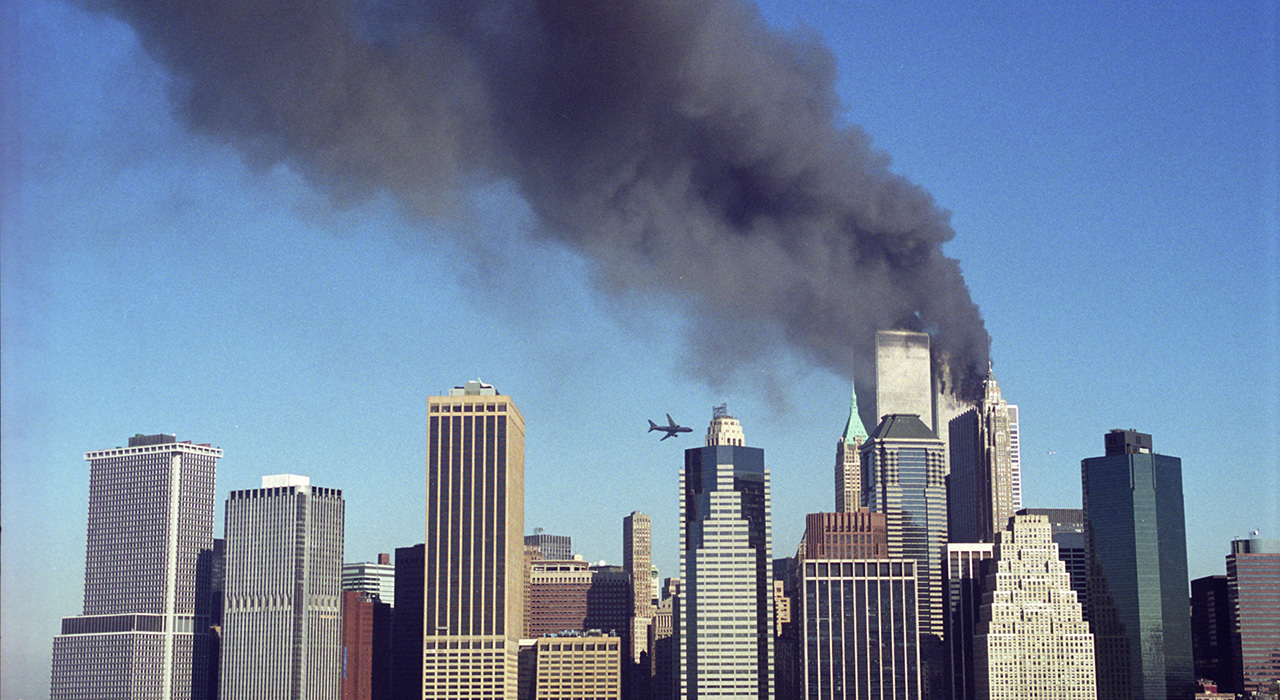
On 9/11 itself I was 3,000 miles away from New York, at home in California. By chance, that morning I was up early to finish packing for a trip to the company mothership in Amsterdam. I made a cup of tea and switched on CNN, my daily breakfast ritual. Living on a coast nine hours behind Europe made it essential to catch up on the day's global news developments before my Dutch colleagues started to head home from their own days in the office. Just after 6am my time, a “BREAKING NEWS” caption briefly flashed on screen, reporting news of an aircraft hitting a New York skyscraper. The assumption was that it was just a terrible accident involving a light plane, a possibility given the number of sight-seeing flights that buzz the city all day long. Soon, though, the picture changed to something far more serious. CNN interrupted an ad break to cut to live images of a horizontal gash between the 93rd and 99th floors of the northern façade of the World Trade Center’s North Tower. Smoke was billowing from the fissure that had been created at 8.46am EDT by an American Airlines Boeing 767 slamming into it on full throttle.
At 9.03am, a second 767 flew into the South Tower, erupting in a vibrant ball of orange flame, the plane’s rapid approach from the south and its subsequent explosion frighteningly caught on live TV by the cameras now trained on the scene. The first crash had still been thought to be an accident until the second one confirmed something far more sickening. 34 minutes later, a Boeing 757 crashed into the ground floor of the Pentagon on the western side of its outer ring, having also been flown at maximum speed into a narrow dive, clipping street lamps in the final moments before impact. And there was more: shortly after 10am, another 757 came down in a field in Shanksville, Pennsylvania, five minutes after the World Trade Center’s 110-storey South Tower collapsed. At 10.28, its sister tower fell too, 102 minutes after first being struck.
 |
| Picture: Kelly Guenther |
Over the course of that morning the world bore witness to one of the most brutal acts of violence committed in the name of any cause, an event played out in three parts: the hijacking and crashing of the aircraft, the collapse of the Twin Towers and then the response that would ultimately result in the “forever war” that President Joe Biden has just brought to an end. That Tuesday was era-defining for everyone alive at the time, not just in the world’s immediate shock and revulsion, but to everything from world economics and geo-political relationships to national security, privacy concerns and defence procurement. Even popular culture shifted from a Cold War legacy to adversarial Middle Eastern themes as Hollywood echoed real world developments with television dramas like Homeland and 24 all playing on the paranoia and suspicion of a region and the people it had harboured in the planning and execution of the attacks. Not surprisingly, it led to a rise in Islamophobia.
As the world marks the 20th anniversary of 9/11, it’s worth considering just how long that day’s tail has stretched, and still does. The plethora of documentaries broadcast to mark the anniversary have triggered precise memories and rediscovered the vague. Even now, watching footage of the South Tower’s collapse and seeing the billowing clouds of smoke and dust looks like an audacious Hollywood CGI effect. But it was anything but. Such images remind us of the shared experience of seeing something so horrific unfold in real time on live television. Arguably, there had never before been a broadcast event so raw, of a wholly different - and horrific - nature that no viewer and or producer could have ever envisaged.
When news broke of the planes hitting the towers, the woman who is now my fiancée was at home in London cradling her then-six-month-old daughter while watching the BBC. That child turns 21 next March. In Amsterdam, the colleagues I was supposed to be flying to see on September 11th were in an office looking out over the Amstel river. Planes taking off from Schiphol Airport on its easterly ‘Buitenveldertbaan’ runway would often soar past the building as they gained height, some invariably heading to ‘New Amsterdam’ on the other side of the Atlantic. That afternoon, they wouldn’t have arrived, once American airspace was closed in response to the hijackings, and any transatlantic flights past the navigable ‘Point Of No Return’, the mid-Atlantic position where there is only enough fuel to continue on to the destination, were redirected to remote airports in north-eastern Canada.
In California, 12 hours after the news first broke from New York, I was still in my pyjamas, frantically surfing the TV networks to see if any one channel had better information than another. By 6pm my time I had to stop. After showering and getting dressed I drove up the 101 freeway towards San Francisco, noting how quiet the normally choked rush-hour roads were. I was also struck by how the Bay Area’s powder blue skies were bereft of the vapour trails usually criss-crossing airspace triangulated by the airports of San Francisco, Oakland and San Jose. I left the freeway at San Bruno and drove up to a park overlooking SFO. Planes appeared scattered like abandoned toys across the airport’s runways and aprons after the FAA had given its ‘all-stop’ instruction to all commercial air traffic, once it became apparent that a mass hijacking was in progress. There was a serenity to the scene in stark contrast to that which the world had witnessed earlier that day.
 |
| Picture: FBI |
Growing up, terrorism was something that happened in Beirut or Belfast. Occasionally London would be targeted by one of the IRA’s so-called “spectaculars”. There had been hijackings, too, in the 1970s and 1980s, but the bombing of Pan Am 103 over Lockerbie in December 1988 made a stark statement about terrorism’s obsession with aviation as a means of causing mass casualties. However, the “planes operation”, as bin Laden had called the plot, was on a different level altogether. It was effectively a military mission, weaponising passenger aircraft to carry out the ultimate suicide bombing. This wasn’t the work of a reclusive extremist in a basement, soldering together Semtex, wiring and an alarm clock, but of an organisation with the sort of institutional financial backing to arrange flight training for the hijack pilots and boot camps for the ‘muscle’ hired to take over the aircraft using boxcutters and mace to slash and stab cabin crew and pilots. The attack’s concept appeared to deliberately replicate the precision targeting seen for the first time during the 1991 Gulf War in video of American Tomahawks whistling over Baghdad rooftops and disappearing down ventilation shafts.
In the event, 2,977 innocent individuals were killed as a result of the terrorist attacks of September 11, 2001. 147 died on board the two planes in New York, a further 120 at the Pentagon and 40 on United 93. The World Trade Center body count included “ground casualties” - a combination of those still in the buildings when they came down, including 343 firefighters, 72 police officers and other rescue workers, and those who’d been working on the upper floors of the towers and chose to jump to their deaths rather than be burned alive. Chilling footage exists of fire crews assembling in the North Tower’s lobby as the sound of human bodies crashing into the plaza outside became a sickening steady, almost industrial drumbeat.
 |
When the towers collapsed, questions were raised as to why. When they were built in the late 1960s developers assured locals that they weren’t living in the shadow of a giant target by pledging that the buildings were designed to withstand the direct impact of a Boeing 707. 9/11 comprehensively proved that wrong: those who managed to get out of the towers before they collapsed testified to seeing huge amounts of internal steel and concrete displaced by the eruption of the airliners, each laden with thousands of gallons of jet fuel that burned so furiously the buildings’ structure was weakened. It took just 56 minutes for the South Tower to collapse after United 175 slammed into itt.
The 24 hours after the attacks were filled with uncertainty. In the BBC’s illuminating documentary 9/11: Inside The President’s War Room, Dan Bartlett, who was at George W. Bush’s side on 9/11, said: “We didn’t know if it was the beginning, or the middle, or the end.” In another BBC documentary, Arthur Cary’s moving Surviving 9/11, ABC News journalist NJ Burkett - who was filing a piece-to-camera in front of the South Tower as it started to collapse - found himself obsessing about what lay ahead: “At the time I thought 9/11 was just the beginning, that we were going to have suicide bombers at Broadway shows, suicide bombers on the Subway. I thought that was the opening salvo of an ongoing series of terrorism attacks on New York. It started to rule my world: when is the next event going to happen?”.
On that Tuesday night I went to bed with the window of my apartment open as it was warm. At some point I was woken by the noise of an approaching jet aircraft, piercing the silence that had enveloped the Bay Area since the FAA’s instruction. I lived less than five miles in a straight line from Moffett Field Airfield, a base shared by the military and NASA. For all anyone knew it could have been another target. I held my breath as the sound of jet engines grew closer before relief as the plane continued on into the night. Next day in the office - where the company’s entire Silicon Valley campus took part in an impromptu service of remembrance for the 9/11 victims - everyone in the area seemed to have experienced the same dread as me as they, too, had heard that plane cut through the night.
Working for a European company on the West Coast meant that afternoons were quieter, but in the days and weeks immediately after the attacks I was restless. I became obsessed with needing to know the details of what had happened. I spent hours feverishly refreshing the BBC website in the hope of discovering something new, about how 9/11 had happened, who had made it happen, or what could follow. In early October - around the time of my trip to New York - the US started carpet bombing the Tora Bora caves and other Al-Qaeda positions in Afghanistan and the Pakistan borderlands. Later that month, I was assembling an IKEA desk in my spare room when news broke on the Internet radio station I was listening to that ground forces had gone into the Afghan mountains. The fightback had begun, a response that would lead to magnitudes-more deaths in the two decades of wars in the wider region that would follow, as well as further casualties in the acts of terror brought back from the battlefields to western cities.
 |
| NJ Burkett |
“We are - all of us - survivors of 9/11.” said NJ Burkett in the BBC documentary and in a way he’s right. If it haunts me still, it’ll haunt anyone else who was watching television that Tuesday, 20 years ago. The denouement of the war in Afghanistan hasn’t brought me any sense of closure, either. 9/11 was the trigger for the War On Terror, with the West’s retaliation in Afghanistan and elsewhere in the Islamic world, but this only fuelled an extreme ideology that would haunt us further, in London on 7 July 2005, Paris in November 2015, and in scores of other atrocities on city streets thousands of miles from the desert. It manifested itself in the lawlessness of post-war Iraq and in Syria, and just last month at Abbey Gate outside Kabul Airport. Ultimately, in the conclusions about 9/11, it was a manifestation of a hatred that had begun as far back as the 1950s in the Middle East, festering and metastasising in various forms of terror and armed resistance.
Perhaps, like the global crisis we’ve all had to cope with over the last 18 months, we will have to live with the constant threat of angry men with hate in their hearts and nefarious backers funding them, vowing to continue what the 9/11 hijackers started. We can’t live in fear, of course, and just as wearing face masks on the Underground is an inconvenient necessity, still having to remove our shoes and belts at airport security is much the same.
At London City Airport last month, on our way to Edinburgh for a brief family holiday, there were teenagers too young to know why they were being forced to walk through a scanning arch in their socks. For me, it was a small - tiny even - reminder of the legacy of what had happened on this day 20 years ago. Three weeks after our trip to Scotland, Kabul fell. And it felt like we were back at Square One.
 |
| Picture: Twitter/US DoD |


