And, so, we’re back to that again: who will be next to play James Bond on screen. Ever since Daniel Craig bowed out in No Time To Die, barely a month has gone by without the press running with one rumour or another. Aaron Taylor-Johnson, James Norton, Henry Cavill, Idris Elba, Regé-Jean Page and Jack Lowden, and many, many others have been, apparently, in the frame. One or two are even believed to have been actively auditioning. The cold hard truth, however, is that, to the best of anyone’s knowledge, probably, outside of producers Barbara Broccoli and her half-brother Michael G. Wilson no one knows exactly where things stand.
Actually, there is one other person: Debbie McWilliams, who has been the Bond franchise’s casting director since 1981. “There’s no conversation being had at the moment,” she revealed to the Radio Times this week, pointing out that Broccoli has been busy with other projects (including the decidedly un-Bondlike films Ear For Eye and Till). That No Time To Die was released in 2021 (and then delayed by more than a year due to the pandemic), and no new Bond film has been put into production is, says McWilliams, nothing to be concerned about.
“You know, it’s not unusual for there to be quite a big gap between different Bonds, it has been known to have a five-year gap. So, no, nothing.” That notwithstanding, the longer the gap, the greater the hunger for the press to fill it. “When there’s a gap in a newspaper, they fill it with a James Bond story, because they haven't got anything else to write about,” McWilliams said. “Why people can’t just wait and see, I don’t know.”
She is, of course, being cute. I may be biased, but she will surely know that the role of 007 is the most talked about in cinema. And while the press might - as they will do - simplify the process into who they think ‘looks’ like a Bond (or, simply, who they like), the actual process is far from straightforward.
Some fans have suggested that the next Bond could be a younger version, as other franchises like Sherlock Holmes, Inspector Montalbano, Indiana Jones and Star Wars’ Han Solo have done - even younger than Craig’s Bond in Casino Royale. “We’ve tried looking at younger [actors] in the past,” Wilson has said, “but trying to visualise it doesn’t work. Remember, Bond’s already a veteran. He’s had some experience. He’s a person who has been through the wars, so to speak. He’s probably been in the SAS or something. He isn’t some kid out of high school that you can bring in and start off. That’s why it works for a 30-something”.
Getting it right is fraught with challenge. “When Daniel was cast, I met hundreds of people and travelled here, there and everywhere,” McWilliams told the Radio Times. “Barbara Broccoli was the main advocate. She knew she wanted him pretty much from the beginning, but it was proving to everybody else which was the difficulty.”
That, perhaps, draws reference to the fact that Craig didn’t look like any previous cinematic James Bond, the ideal that had been established by Sean Connery, more or less directly replicated by George Lazenby, and then followed - to varying degrees - by Roger Moore, Timothy Dalton and Pierce Brosnan. Craig was both blond and blue eyed, and not all that tall, either (a point made jokingly in the actor’s cameo as a Stormtrooper in Star Wars: The Force Awakens).
“When we started, it was a slightly different feel,” McWilliams said of the casting search that eventually led to Craig becoming 007. “We did look at a lot of younger actors, and I just don’t think they had the gravitas. They didn’t have the experience, they didn’t have the mental capacity to take it on, because it’s not just the part they’re taking on, it’s a massive responsibility.” Even when Craig was eventually cast, the decision encountered a hostile media: “It was unbelievably negative, I have to say,” McWilliams told Entertainment Weekly in another interview. “The press response was awful and I felt so sorry for him, but in a funny kind of a way I think it almost spurred him on to do his damndest to prove everybody wrong.”
This time around, McWilliams says there are no preconceived ideals as to who they cast. “There’s lots to be taken into consideration,” she says. “There isn't an absolute ideal mould. There never would be and never should be, because otherwise, it just becomes boring. It’s the best person for the job and one year it might be one person, one year somebody else – you can’t really predict.” It’s not, she says, “algebraic”. “It just doesn't work like that.”
Picture: Unwind Media
That being said, an artificial intelligence app, DeepDream AI, recently created an image for gaming company Unwind Media of the perfect Bond, based on a brief Broccoli talked about last year of the actor being British, male, under 40 and over 5’10” tall.
McWilliams suggests that Bond should look like “a regular guy”, adding that such a brief would rule out a Hollywood action star like Dwayne ‘The Rock’ Johnson. “He has to have a great physique - it demands a high level of fitness - but he shouldn’t stand out in any situation.” That, then, might rule out Henry Cavill, long considered a leading contender, whose casting as Superman drew on his physique and chiselled appearance. Then again, Cavill wouldn’t look all that different to Timothy Dalton, whose portrayal of Bond - sadly curtailed by contractual wrangles to just the two outings - is considered by many to be the most definitive interpretation of the Fleming creation.
“The gift of casting a James Bond film is you don’t need to cast a well-known name,” McWilliams concluded in the Radio Times. While Moore and Brosnan were well known from television when they became Bond, Connery, Lazenby, Dalton and Craig were much less known. Many fans - including this one - would have loved to have seen Idris Elba in the role (not, by the way, for any culture-war baiting reason, but simply because of his screen presence and that he has displayed shades of Bond in many of his past roles, like The Wire’s Stringer Bell and detective John Luther). The idea of a complete unknown to reboot the post-Craig 007 is not a bad idea, either.
According to McWilliams, they wanted to “give Bond a bit more of a menace” with Casino Royale, which is why they went with Craig as more of the “blunt instrument” Ian Fleming intended for the character with his novels. Craig had, says McWilliams, a bit more menace: “Let's face it, as good as Pierce was, he’s not a menace, whereas Daniel is. You feel a very strong presence in the room with him, and I think that that is incredibly important.”
Whoever Broccoli, Wilson and McWilliams go with for ‘Bond 26’, there will be one key hurdle for the actor to negotiate: the screen test. “It’s really just to see how that person looks on screen, and how they respond, and how they feel sitting in that chair,” McWilliams told the Radio Times.
At a BFI event last year to celebrated the 60th anniversary of Dr. No’s release, Wilson revealed that they test all potential Bond actors by having them recreate one particular scene from From Russia With Love - arguably my favourite entry in the series - in which unwitting SPECTRE agent Tatiana Romanova (Daniela Bianchi) attempts to seduce Sean Connery’s 007.
The scene follows Bond’s killing of a KGB assassin and finds him returning to his hotel room to unwind, discovering Tatiana in bed waiting for him. “Anyone who can bring that scene off is right for Bond. It’s tough to do,” Wilson said, explaining that in that one sequence, Bond has to exude both sex appeal as well as invoke the Cold War without trivialising the latter or making the former too cheesy, something that lesser spy films and the various spoofs have usually done.
The world has, of course, moved on from the Cold War, but given the ratcheting up of geopolitical tensions since No Time To Die was released, Bond 26 will not only present a challenge in the casting, but also in the storyline it produces. Assuming they’ll be involved in the project, longstanding scriptwriters Neal Purvis and Robert Wade will have their work cut out. The suggestion from Broccoli and Wilson is that the script will be developed before casting decisions are made, including choosing their next James Bond. Casino Royale rebooted the series (following the questionable Die Another Day, Brosnan’s final outing) by starting at the beginning, with Bond earning his licence to kill, commencing a five-film arc that ended - avoiding any spoilers if you still haven’t seen No Time To Die - with a pretty conclusive outcome. To say the whiteboard is completely empty for the next Bond film, and therefore its lead actor, is an understatement. The expectations aren’t too modest, either.
Picture: Francois Duhamel/Danjaq, LLC, United Artists, Columbia Pictures, all rights reserved
If there had been any any doubt before, the opening of the envelope first thing on the morning of my birthday this year proved how well my wife knows me. Inside were tickets to a screening of Skyfall at the Royal Albert Hall, accompanied by the Royal Philharmonic Orchestra performing Thomas Newman’s score in sync with the film. One of my favourite Bond films, with live music, in the majestic setting of one of the world’s greatest performance venues. I couldn’t have asked for a better present.
Shown as part of a series of such screenings celebrating the 60th anniversary of the 007 franchise, the evening was introduced by Sir Sam Mendes, Skyfall’s director, who elaborated on how a director, highly regarded beforehand for his theatre work, came to helm cinema’s longest-running action franchise. Evidently, running into Daniel Craig at a party in New York, the actor suggested that Mendes should direct his third outing as Bond. Mendes agreed, although he later realised it wasn’t in Craig’s gift to offer the job. The next day, sober, Mendes contacted executive producers Barbara Broccoli and Michael G. Wilson to see if they’d be interested. Wisely, they said yes, and one of the best films in the-then 50-year history of the series was set in train.
Every Bond fan will have their own favourites, and every Bond fan will have their reasons. Every film will have its memorable moments, every film its great lines, every film its naff bits. It’s why we love Bond, let’s face it. Rugged action with the occasional Carry On element thrown in for larks. Under Mendes, Skyfall added another dimension, developing out some of the darkness in Bond’s backstory (namely how he became an orphan), but played out through a cinemascope the series had rarely delivered with its lively cartoonism of characters, stunts, gadgets and glamour.
Bond films have always reconfigured Ian Fleming’s original ideas with a more contemporary twist (though the rush to make Moonraker a Bond for the Star Wars era was patently flawed), but with Skyfall, Neal Purvis, Robert Wade and John Logan’s story addressed spycraft’s very real transition from Cold War adversariality to cyber threats (“I can do more damage on my laptop sitting in my pyjamas before my first cup of Earl Grey than you can do in a year in the field,” Ben Whishaw’s newly-appointed Q informs Bond on their first encounter, to which the agent retorts: “So why do you need me?”. “Every now and then a trigger has to be pulled,” comes the reply).
Few at the time would have realised that Skyfall was the apex of an arc that would conclude with No Time To Die, but there was an enrichingly downbeat nature to the film, built around Javier Bardem’s delightfully camp villain Silva seeking revenge on M (Dame Judi Dench) by attacking MI6 itself. Yes, it didn’t veer too far from the established mad superbaddie formula, but - and here’s where the difference was made for me - there was a noticeably different cinematic quality about Skyfall.
Picture: Francois Duhamel/Danjaq, LLC, United Artists, Columbia Pictures, all rights reserved
Part of that is indebted to Mendes’s use of Sir Roger Deakins as cinematographer. The scenes in Shanghai, especially the tower block fight between Bond and assassin Rapice - are some of the most stunningly-photographed moments I’ve seen this side of a Michael Mann production, capturing the Chinese city’s LED sophistication and BladeRunner-esque futurism. But, equally, are the scenes shot in Scotland, as Bond and M attempt to get ahead of Silva by driving the famous Aston Martin DB5 up to the titular Skyfall ancestral home, amid breathtaking - and cold - moorland scenery.
Growing up watching Bond films on television as Christmas and Easter holiday treats, I absorbed their escapism. Never did I process the body count, or the many moral ambiguities the films presented, not least of which the inherent sexism. To me, Bond was glamour: dressing up in one of my dad’s suit jackets made me Bond, purely for the myopic belief that it looked more like a tuxedo than a school blazer. Skyfall, for me, reset the franchise as a storytelling venture, albeit one with elements of Bond tradition and familiarity. And knowingly so: back to that first encounter between Bond and Q, in which the quartermaster hands over a ticket to Shanghai, a Walther PPK (with a palm-print encoder in the grip) and a tiny little radio device. “A gun and a radio. It’s not exactly Christmas, is it?“, the somewhat entitled secret agent remarks icily. “What, were you expecting an exploding pen?” says Q. “We don't really go in for that anymore.”
While Mendes would next helm the somewhat flawed Spectre, the fourth Daniel Craig outing before his finale in No Time To Die, the knight-director can take pride in making a Bond film that will forever be a high benchmark in the 25-film canon to date. Naturally, a few weren’t too fond of Skyfall, because it was too wrought, or because it suggested an ageing Bond, though this last gripe completely ignores the preposterous sight of Roger Moore at 58 in A View To A Kill (though having read that, having just turned 55, I’m increasingly sympathetic…).
In Skyfall, Bond bleeds, he gets shot - twice (including once by Miss Moneypenny) - he drinks to excess, fails his physical and psychological tests, and ultimately loses the maternal figure that Dench’s M is portrayed as. For once, or at least the first time since George Lazenby shed a tear at the death of his new bride in On Her Majesty’s Secret Service, Bond is made vulnerable amid the existential threat Silva poses to MI6. While he ultimately comes through, as has always been the outcome, Skyfall’s emotional heft - brought to bear by Mendes - combined with its stunning visual complexion. Last night it was a joy to see it again on a big screen.
I shouldn’t ignore, either, the experience of watching it with a live orchestra. Such are the perfect acoustics of the Royal Albert Hall that if there hadn’t been almost a hundred musicians and conductor Anthony Gabriele waving his baton at them below us, you would have thought you were listening to the original recorded score.
Deservedly, though, the ensemble generated impromptu applause after playing the film’s title song, Adele’s vocal presumably isolated for playback over the live orchestra. But the greatest ripple was reserved for The James Bond Theme, Monty Norman’s twanging guitar riff, which lasered through the 5,000-odd seated punters as a reminder of the most iconic piece of theme music in film history. We weren’t introduced to any of the individual performers, but whoever the job fell to play that riff should know that the reverence in the audience was akin to that reserved for David Gilmour performing the Comfortably Numb solo, or Jimmy Page wigging out on Stairway To Heaven. Hard to remember this was a film we were still watching. But what an experience.
With a very real sociopathic lunatic threatening civilisation with very real nuclear annihilation, it's probably the wrong time to think about who 007 might be up against in the as-yet unnamed 26th ‘official’ James Bond film that Eon Productions is expected to start pre-production work on sometime soon. But that’s not stopping producers Barbara Broccoli and Michael G Wilson thinking about who the baddie will be in ‘Bond 26’, as it is currently known.
Speaking to the Hollywood Reporter last week during a presentation dinner, at which Broccoli and her half-brother received the 2022 Pioneer Award from the Will Rogers Motion Picture Pioneers Foundation, Broccoli said that they always consider what challenge Bond should face before anything else. “We always sit down with our writers, and we start by thinking about ‘What is the world afraid of?’,” she revealed. “We start by thinking about, ‘Who’s the Bond villain?’. We try to focus on that as the sort of uber story, and then we want to also look at Bond’s emotional life, and what he’ll be facing personally that he hasn’t had to deal with before. So he has two big issues in the films — one is the geopolitical one and the other is the personal one.
Wilson hinted that even the most up-to-date global dramas could be reflected in Bond 26. “Everyone thought that when the Berlin Wall came down it was all hunky dory [in the world] and there would be no stories to tell anymore. Well, that proved wrong. The world is so unpredictable and it’s a rich environment for storytelling.”
That won’t be the only response to change: with the death of the Queen, Bond will next be working for His Majesty’s Secret Service. “Bond worked for queen and country, and will now be working for king and country,” Broccoli told the Hollywood Reporter. “He was a very loyal servant of the British government. He’s a classical hero that cares about the world and cares about humanity more than his own personal desires. It’s a very sad time in Britain, obviously, it’s a big time of transition, but she certainly has left a very extraordinary legacy.”
Daniel Craig, Barbara Broccoli, Michael G Wilson and Michelle Yeoh at the 2022 Will Rogers Pioneer of the Year Dinner
Speaking of transition, there is still the small matter of who will play Bond next. “When we get to a point, like we are now, we have to think about the trajectory of the Bond films and the storylines and where we want to take them,” Broccoli explained. “So, that’s really the main focus at the beginning. Once we have a sense of where we want to go, then we’ll start thinking about casting.”
Broccoli and Wilson recently spoke to Variety and revealed the scale of arguably cinema’s most auspicious casting decision. “It’s not just about casting an actor for a film,” Broccoli said. “It’s about a reinvention, and ‘Where are we taking it? What do we want to do with the character? And then, once we figure that out, who’s the right person for that particular reinvention?”
Broccoli explained that when they first spoke to Daniel Craig about the role, the actor had to come to terms with the length of service he’d be expected to commit to, not to mention how much it would turn his life upside down for, then, a relatively unknown actor. “It’s not just showing up for a couple of months of filming,” she told the Hollywood Reporter. “When we cast Bond, it’s a 10 to 12-year commitment. So any actor is probably thinking, ‘Do I really want that thing?’.”
The vexed question, however, for many Bond fans is what Eon will do with Bond next time out, given that No Time To Die brought Craig’s reign to an end with [sort of spoiler alert] 007 facing certain oblivion as Royal Navy cruise missiles rained down on Lyutsifer Safin’s bio weapon-infected island. Fan forums have called for the producers to make Bond much younger, even younger than the character was in Craig’s debut, Casino Royale, which suggested that it was the start of his ‘double-O’ status.
As the conclusion of Craig’s five-film arc, No Time To Die represented the evolution of the character, from the “sexist, mysogynist dinosaur” Judi Dench’s M branded Bond in Pierce Brosnan’s Goldeneye, to a significantly more emotional Bond. “The films over his tenure were the first time we really connected the emotional arc,” Broccoli says. The character will inevitably evolve even further with the choice of the next actor to play 007 - to which the producers remain quite open-minded. Broccoli and Wilson have hinted, though, that the notion of a women playing Bond has been quietly nixed.
With the likes of Idris Elba, Henry Cavill and Toms Hardy, Hiddleston and Holland appearing to rule themselves out, press speculation has turned to actors like Bridgerton’s Regé-Jean Page, Henry Golding, Micheal Ward and Thomas Doherty, the latter three relatively unknown, as Craig was. By the time casting actually takes place, there will no doubt be plenty more permutations. I just know it won’t be me.
With the 60th anniversary next week of Bond’s cinematic debut in Dr. No, on 5 October 1962, and Mad Vlad in the Kremlin threatening armageddon, consciousness of fiction’s most famous superhero remains high. Who knows what sort of world Bond 26 will arrive in, as Broccoli and Wilson have said that could be another two years before the film hits screens, and there’s a long way to go before then. The first job will be identifying its villain and the fiendish plot he or she will require 007 to foil. Given the state of the world right now, it would be fair to say that there’s a rich field of possibilities to take inspiration from.
I may be speaking from an extremely partisan position, but for my entire lifetime - and certainly my culturally-aware lifetime - there has never been anything in cinema quite like James Bond. Even giving a pass to the weaker entries in the now-25-strong ‘official’ series (and you’ll have to read my post from earlier this week to see how the first 24 stack up), the films have, for 59 years, provided a scale and scope of escapism that many rivals have attempted to surpass, but none ever have. No wonder the cinema industry has been hanging on to the opening of No Time To Die with grim determination - and relief that, finally, the film is being released.
This is, after all, Hollywood’s longest-running franchise (anything featuring Godzilla or Sherlock Holmes not withstanding), in an era when bankable repeat business driven by definitive movie brands is what keeps the multiplexes going. To date, the series launched by Albert “Cubby” Broccoli and Harry Saltzman in 1962 with Dr. No has earned a collective $16.3 billion in global ticket sales, according to a calculation by Forbes in 2018. That stat alone underlines just what the almost two-year delay to No Time To Die means to the film industry. As it is, MGM and Eon Productions, the company Broccoli and Saltzman founded in 1961, have spent $250 million making the film (the highest budget ever for a Bond production) and $66 million on promoting it, though no doubt the myriad product placement deals - from the usual watch and car brands to, bizarrely, a limited edition pair of Adidas trainers - will have offset some of that cost.
Nevertheless, while 007 has endured plenty of save-the-world scrapes in his time, the stakes couldn’t be higher for an industry deadened by the global pandemic. Yes, there have been other priorities and, yes, there’s been television and a tsunami of everyone-has-a-favourite streaming recommendations, but there is nothing - repeat, nothing - like the big screen experience. And there is nothing like a new Bond film to experience it through. What the series might lack in Oscar-worthy artistic integrity it more than makes up for in areas that popcorn-munching paying punters actually enjoy, namely a stupidly good time, with the right cocktail of action, confected glamour, a little bit of knowing humour, and a window opened on the world though spectacular locations. Which is why the arrival, at last, of No Time To Die fills me with both unbridled excitement and just a little worry.
The worry comes from the obvious: is it any good? Ever since the ‘Bond 25’ project was announced in 2016, a year after Spectre appeared, expectation has mounted. Of course it did. It always does. The first issue was whether Daniel Craig, who had rebooted Bond when receiving his double-o status with 2006’s Casino Royale, would return. He’d been quoted saying, rashly, that he’d “rather slash his wrists” than play 007 again, but in fairness, he was asked the question not long after Spectre had wrapped. As he has subsequently said in interviews, it was like asking a marathon runner if they’d run another just after passing the finishing line on the first.
However, getting Craig to sign on for a fifth outing turned out to be the easiest challenge for Bond 25 to surmount: first, Danny Boyle, who was brought in to replace the equally auteurist Sam Mendes (who’d directed Craig's third and fourth, Skyfall and Spectre), walked away amid “creative differences” (allegedly trying to change Bond too much). In came Cary Fukunaga, a relatively unknown director in the genre, but whose work on TV series like True Detective had marked him out as an innovator. In, too, came Phoebe Waller-Bridge at Daniel Craig’s behest, to add a little of her own magic to a script already written by longtime Bond writers Neal Purvis and Robert Wade. All of this further pushed back a release date of what was, for certain, Craig’s final Bond film. But then a global calamity as deadly as 007 had ever faced down forced the opening of No Time To Die to be rescheduled not once, not twice, but three times.
Now, almost two years after it was supposed to be on our cinema screens, it’s here. Expectation levels are off the charts. Enticingly, the producers have been feeding us delicious scraps of No Time To Die through trailers. From these we’ve pieced together that Craig is joined for a second time by Léa Seydoux as love interest Madeleine Swann, that Christoph Waltz returns, cryptically, as perennial nemesis Ernst Stavro Blofeld, and there is the usual supporting gang of M (Ralph Fiennes), Miss. Moneypenny (Naomie Harris) and Q (Ben Whishaw). And we know that principal villain this time is Remi Malik as Lyutsifer Safin, while Lashana Lynch has kept people guessing as to whether she’s being teed up to play a female Bond (she’s not) as the fellow 00, Nomi. There are gadgets, car chases and shootouts, obviously.
For subscribers to the Bond mythology, No Time To Die also, we’re promised, resolves an arc commenced by Casino Royale. That film wasn’t just a reset of the character’s “sexist, misogynist, dinosaur” ways, as Judi Dench’s M accused Brosnan’s Bond of in GoldenEye, but the introduction of themes that made the character decidedly more vulnerable, emotional even. It wasn’t, however, the dramatic reboot some seem to think it was. But in everything from the cinematography to the characterisations, the Daniel Craig Bond films have marked a tonal shift from the cartoon-like self parody they were, at one stage, in danger of becoming. The Bond producers have acknowledged that 007 had to reflect a post-9/11 reality, in which spies didn’t drink vodka-martinis and drive exotic (and highly conspicuous) sports cars, but actually operated in the shadows, cyphers for governments with a genuine need for secret agents to be just that, secret. This was key to the critical and commercial success of the Jason Bourne films, which redefined the spy-action genre as more dystopian than Bond’s encounters with deranged super-villains. It was a realism that 007 had to shift towards to remain audience-credible.
We don’t, however, want Bond to be another Bourne. We want “Bond, James Bond” with all the Bond traditions, tropes and cliches. And, it would appear, we get plenty of that with No Time To Die. Now that it's opened I’ll spare you any plot spoilers if you’re planning to go and see it in the coming days, but we do already know that it centres around Bond being forced out of retirement after his CIA friend Felix tells him about the kidnap of scientist by the sinister Safin who has seriously dangerous intentions for the world. As they usually do. You’re welcome, of course, to read any of the first reviews that have appeared since Tuesday night’s premiere.
The one hope, going into No Time To Die’s general opening today in the UK, is that it will break the supposed curse of Last Bond Appearance Syndrome. This is the slightly flimsy supposition that the five Bond actors until Craig have all made final appearances in underwhelming 007 outings. I’d dispute that assessment for Sean Connery (Diamonds Are Forever - No.5 on my ranking, posted earlier this week), and George Lazenby only made the one film, On Her Majesty’s Secret Service, which was pretty good (No.7), but it is true that with Roger Moore’s A View To A Kill, Timothy Dalton’s Licence To Kill, and Pierce Brosnan’s Die Another Day, their tenures ended disappointingly. The Den Of Geek website correctly pointed out that No Time To Die brings an end to Craig’s time as Bond after a largely acclaimed run of films, with directors Martin Campbell, Marc Foster and Sam Mendes (twice) taking the franchise into new territory, character and narrative-wise. And now it is Fukunaga who has been given the keys to cinema's most famous and enduring screen property.
Daniel Craig has undoubtedly moved the needle as far as Bond goes, in his 15 years in the role - itself a landmark, albeit one determined by the circumstance of the extended gap between Spectre and now. He caused shock and even denial when first cast for being blond and of a somewhat stockier physical stature than the image first cast by Sean Connery in Dr. No (to the extent that the CraigNotBond movement emerged online amongst those with clearly too much time on their hands). Now it would be hard to imagine anyone else. “I’m in total denial,” co-producer Barbara Broccoli - Cubby's daughter - recently told Variety of the end of the Craig era. “I’ve accepted what Daniel has said, but I’m still in denial. It’s too traumatic for me.”
It is certainly going to be strange: I grew up in the era of Roger Moore, and accepted the transition to Timothy Dalton and then Pierce Brosnan, but the Daniel Craig films have reinvigorated my love of the entire franchise. This, then, raises the stakes of how Broccoli and her step-brother Michael G. Wilson go about a potential Bond 26. Casting the lead will be the first challenge, given that the media has, since Craig first suggested his time was over, been tripping over themselves with names, from Idris Elba, Tom Hardy and Henry Cavill to Richard Madden, James Norton and, most recently, Bridgerton’s Rege-Jean Page all tipped to replace him. Even Lynch has been suggested as the first female Bond, purely for playing the double-0 Nomi in No Time To Die. However, Broccoli insists that the process to find the next James Bond has not started yet. “Oh, God no. We’re not thinking about it at all,” she told BBC Radio 4’s Today programme on Monday. “We want Daniel to have his time of celebration. Next year we’ll start thinking about the future.” “He’s been such a great Bond,” Wilson added. “Those are big shoes to fill.”
What is certain is that Bond, in Broccoli and Wilson’s eyes, wouldn’t necessarily have to be white and dark-haired in the Connery image. “You think of him as being from Britain or the Commonwealth, but Britain is a very diverse place,” Wilson said to Variety, with his step-sister underlining the seriousness with which they regard the key process of finding their next Bond first, before a 26th film commences development. “For better or worse, we are the custodians of this character. We take that responsibility seriously,” Broccoli said. “He can be of any color,” she added, but stressed the following point: “but he is male. I believe we should be creating new characters for women - strong female characters. I’m not particularly interested in taking a male character and having a woman play it. I think women are far more interesting than that.”
That, in itself, is a key statement, given that political attitudes have shifted with the #MeToo movement. “Bond’s been evolving along with all the other men in the world,” Broccoli told Variety, and to some extent that’s true. In Vesper Lynd and Madeline Swann, Craig’s Bond has been virtually monogamous. That doesn’t mean to say that glamorous women don’t still play a part in 007's lifestyle, but there has been a shift - arguably begun during the Brosnan era - towards less simpering female characters serving more than just lazy eye candy and perpetuating that horrendously anachronistic tabloid term ‘Bond girls’.
The other assurance the Bond team have given is that 007 will remain a cinema proposition. Despite fears (and, surely, the studio’s temptation) that COVID-19 would lead to No Time To Die being released on streaming platforms first, even the acquisition of Eon’s production partner MGM by Amazon has brought pledges by all parties that Bond will remain a big screen attraction first and foremost. Or at least for now. “We make these films for the audiences,” Broccoli has said. “We like to think that they’re going to be seen primarily on the big screen. But having said that, we have to look to the future. Our fans are the ones who dictate how they want to consume their entertainment. I don’t think we can rule anything out, because it’s the audience that will make those decisions. Not us.”
The Amazon buyout has accelerated the discussion. In July, Wilson and Broccoli issued a statement to The New York Times for a piece about MGM bosses Michael De Luca and Pamela Abdy in which they referred to “the continuing success” of the Bond films as being at a “critical juncture”, with its future “dependent on us getting the next iteration right”. They looked to De Luca and Abdy to be allowed to run the studio “unencumbered”, a possibly veiled remark about Amazon as a streaming giant. In the immediate term, fears about parental meddling would be unfounded, especially given that the acquisition is yet to pass regulatory approval, but also, Amazon didn’t acquire the Bond franchise outright, as it is a partnership between MGM and Eon. But still, the spectre, so to speak, of Bond being developed as some sort of television spinoff rarely disappears from view. “I think we’re in denial!” Wilson quipped to Total Film during a conversation about the franchise’s future, and the possibility of 007 appearing in a TV series. “We make films. We make films for the cinema. That’s what we do,” They had resisted the temptation of television “for 60 years”.
Clearly, though, the expectation and excitement generated by the prolonged release of No Time To Die, coupled with the critical and public success it is now generating, will only accelerate the need for Wilson and Broccoli to sit down, soon, and decide where they take their Bond custody next’. “It’s tough to think about the future until this film [No Time To Die] has its moment,” Broccoli told Total Film. “I think we just really want to celebrate this and celebrate Daniel, and then when the dust settles, look at the landscape and figure out what the future is. Although I think one thing we’ve certainly learned in the last 18 months is you never know what the future is.” One thing’s for certain: “James Bond will return”.
So it’s finally here: the 25th Bond film, No Time To Die, receives its premiere tonight, at long last, having been delayed three times since its original November 2019 release date, the result of original director Danny Boyle walking away from the project, Cary Fukunaga taking over, and then COVID-19 proving to be a greater adversary than any villain 007 has faced to date. Added to the weight of expectation is that it is decidedly Daniel Craig’s fifth and final appearance as James Bond, having somewhat reinvented the character (in my opinion at least) from the outset of his tenure, as the franchise took on the grittier Jason Bourne films and Tom Cruise’s ever-more audacious Mission: Impossible series at the box office.
Conventional wisdom has it that the best screen Bond was Sean Connery, but Craig’s run has arguably come closest, running ahead of Roger Moore’s playboy Bond, Timothy Dalton’s rugged Bond, Pierce Brosnan’s stockbroker Bond, and George Lazenby’s one-off (but highly creditable) Bond. However, beyond the individual portrayals of the vodka martini-guzzling secret agent - well, as secret as you can get in a three-grand Tom Ford suit - how do the 24 ‘official’ films so far in which he appears stack up?
Here, then, in reverse order is my ranking of each entry in the canon made by Eon Productions, the company set up in 1961 by producers Albert “Cubby” Broccoli and Harry Saltzman to turn Ian Fleming’s literary creation into a six-decade cinematic institution:
24. Die Another Day (2002)
It didn’t take long for the James Bond film series to border on self parody, but then that was half the fun of it. They have always been formulaic, but also have balanced the occasional touch of campery with sterner drama. Die Another Day, however, had neither the drama or the subtlety of the vast majority of the series, veering dangerously - and unintentionally - close to Austin Powers’ silliness, what with giant lasers and invisible cars. A shame, really, as Pierce Brosnan had been a credible 007. But once the scriptwriters jumped shark with Pierce Brosnan’s final outing, all the good work he’d built up since GoldenEye evaporated. Not even Halle Berry’s swimsuit-clad emergence from azure Cuban waters did much for it. What came next - Daniel Craig’s debut in Casino Royale - was the reset the Bodly badly needed...
23. Moonraker (1979)
The second Bond film I actually went to a cinema to see at an age when I was probably as enamoured with it as any other entry in the series I’d hitherto mostly seen on television. 40-odd years on, however, its flaws are too obvious: while the title Moonraker was, in fact, one of the earliest Ian Fleming novels to be envisaged being turned into a film (by the author himself), by the time the Bond producers put it into use as the 11th episode in the franchise, it was turned into a frankly ludicrous story that ended in a Star Wars-style space shootout. This was the result of the misshapen belief that Bond suddenly had to compete with George Lucas’s then-box office-imperious space operas. Even the ageing Moore looked bemused by it all. For various economic and union reasons, production was moved from Bond’s traditional Pinewood home to Boulogne-Billancourt in south-west Paris. When I worked there, my office overlooked the main sound stage’s distinctive shape, into which you could see how the interior of villain Hugo Drax’s Earth-threatening space station was built into it. Still the most memorable part of the film,
22. Tomorrow Never Dies (1997)
Speaking of zeitgeist-bating villains, Jonathan Pryce’s hammy turn as a thinly-disguised Murdoch-clone media baron was a prime example of the Bond scriptwriters attempting some topicality. But instead of making an interesting - for Bond at least - statement about media power, we ended up with something that you didn’t have to work in the media to see right through as implausible and corny, though the brief scenes of a Hamburg hotel I’ve stayed in myself were something of a saving grace. Pierce Brosnan, too, plays Bond to steely effect, and while the Bondisms are well within the traditions of the canon, Tomorrow Never Dies trades too much on a somewhat dry plot with a quasi-political message that doesn’t properly land…or needed to be said in the first place.
21. A View To A Kill (1985)
Look, I’m not bashing Roger Moore. Like ranking your favourite Doctor Who according to the one you grew up with, as a child of the 1970s (I was born in 1967) you should say that Moore was ‘my’ Bond. The problem is that by 1985, Moore was 58 and the notion of Bond being a virile thirtysomething was getting stretched to the detriment of the film. Not that it doesn’t have its moments (well, they all do), and in the always entertaining Christopher Walken and Grace Jones, AVTAK had some engaging villainy to challenge 007, not to mention the prescient application of Silicon Valley as the film’s ultimate location, before the tech industry was anywhere near the omnipresence it has now. But, still.
20. The World Is Not Enough (1999)
With the exception of a genre-honouring theme song by Sheryl Crow, Pierce Brosnan, again, was poorly served by both plot and script on his third 007 outing. Like all of them, in the grand scheme of things, it’s not bad, but the weaknesses stand out over better entries in the series, not least of which a second and fairly pointless appearance by Robbie Coltrane, and Denise Richards’ turn as Dr Christmas Jones, which took Bond girl vacuousness to a new low. Robert Carlyle does a reasonably effective job as the KGB agent-turned-terrorist Renard, while Sophie Marceau adds a classy touch as the oil heiress who proves more than a match for Bond. But, again, like its predecessor, The World Is Not Enough tries too hard to make a point, rather than deliver on expectations of a Bond film.
19. Octopussy (1983)
A 19th place for Roger Moore’s sixth Bond film might seem harsh as it’s not bad. There’s just something about it that doesn’t quite put it in the series’ upper echelons. It is a John Glen-directed film, which is usually a decent benchmark for the Bond canon, but the film is probably undermined by its weak script and Moore playing 007 a little too casually, even for his breezy application of the role. There is plenty of decent action, of course, which from a cinema point of view would have made it a good night out in 1983, but Octopussy, as the unlucky 13th entry in the series, started to make the whole franchise look tired.
18. Licence To Kill (1989)
Like George Lazenby’s single appearance as 007, Timothy Dalton’s brace of Bond films never really gave the classically-trained Welshman the chance to prove his metal in the role. Clearly he had something of a tough act to follow in replacing Roger Moore after his seven turns, but for reasons best known to the producers, Dalton’s sophomore appearance - even with that man John Glen again - took too much influence from television action series than the adverntures of Britain’s pre-eminent superspy. Aerial scenes over the Florida Keys were admittedly impressive, but the storyline of Her Majesty’s leading secret agent taking on Robert Davi’s Central Casting drug kingpin Sanchez came across more Miami Vice than vintage Bond. Even cop show character stalwarts like Anthony Zerbe in the mix gave it more of a television scale rather than big screen Bond. A 15 certificate for its earthier scenes didn’t help with box office returns, either. Dalton would leave the role there, as the series came to a jarring halt due to legal disputes.
17. The Man With The Golden Gun (1974)
On many levels, this should be much higher in the rankings. After Moore’s stylish debut in Live And LetDie, the Bond producers gathered together a solid cast, led by Christopher Lee (a cousin of Ian Fleming) as the plummy-voiced, three-nippled titular assassin Francisco Scaramanga, Fantasy Island’s Hervé Villechaise as his impish manservant Nick Nack, and Britt Ekland at the height of her Britt Eklandness as the appallingly lightweight Miss Goodnight, but with the exception of a few genuinely impressive set-pieces (including Scaramanga’s flying AMC Hornet car, there was a tendency towards too much 1970s hipness, and even a little of the era’s psychedelia (in the showdown between Bond and Scaramanga) rather than the all-out action gags that the Bond films had established for themselves during the Sean Connery era.
16. For Your Eyes Only (1981)
Frankly, this should have been the Bond film made instead of Moonraker, so it was no surprise that 007 was restored to a more traditional outing for this first film of the 1980s, and the last made by United Artists before it was taken over by MGM. More importantly, after the sci-fi nonsense of Moonraker, Moore was given a better platform with which to portray his version of Suave Bond that, arguably, he did better than any of the other six actors in the franchise. Again with John Glen at the helm, Moore stands out amid a less starry cast, and a less trivial storyline, to the film’s benefit. It’s not at the top of the Bond game, but what it lacks in wit it makes up for in action which was finely tuned. Still, though, as with its follow-up, Octopussy, questions were already being asked about the series’ longevity, as the formula was starting to creak a little.
15. Quantum Of Solace (2008)
Frankly, I’ve wrestled with this ranking of Daniel Craig’s second Bond film. Because, as I think you’ll gather by the end of this post, I’ve been a huge fan of Craig as 007 and, equally, have loved what the three directors (in terms of films released to date) have done with him. Quantum was very much a postscript to the rebooting Casino Royale, rather than its sequel, which was a little bit of a shame. Even Craig has admitted that it "wasn’t quite what it should have been", but in mitigation, producer Barbara Broccoli has cited a Hollywood writers’ strike, and also the prospect of an actor’s walkout as a debilitation on Quantum’s development. Nevertheless, the opening sequence car chase through Italy, with Bond at the wheel of a modern Aston Martin being shot at by Quantum hitmen, was truly breathtaking, as were the rooftop scenes in Siena after Mr. White’s double-agent had shot their way out of MI6’s clutches - all skilfully arranged by director Marc Foster. Mathieu Amalric’s Dominic Greene took a new twist on the traditionally cat-stroking Bond baddie, but there was an unsatisfying dryness to the outcome of the film, not to mention a shorter length than most others in the series. Still, it’s not bad and, if I was in a more generous mood, would have placed it higher than 15th.
14. The Spy Who Loved Me (1977)
On artistic merit alone, Quantum Of Solace should indeed be higher than this, a film released almost 30 years beforehand. The Spy Who Loved Me, however, became the reference point for Bond films past, present and future, as well as being the one where it all fell into place for Roger Moore in his third appearance. While being somewhat reminiscent of You Only Live Twice (instead of satellites being gobbled up in space we had nuclear submarines captured at sea), veteran director Lewis Gilbert orchestrated arguably the coolest opening sequence ever committed to a Bond film - or, indeed, any film ever - with 007 chased down a ski slope by KGB agents until he flies off a cliff to be saved by a Union Flag-themed parachute opening with audacious flourish. We also dipped back into the Cold War, albeit with signs of Anglo-Soviet detente in the form of Barbara Bach, and Q Branch coming up with its best gadget since the Aston Martin DB5 - a Lotus Esprit that becomes a rocket-firing submarine. In Curt Jürgens, as the web-handed eco-villain Stromberg, you had another memorable baddie, accompanied by Richard Kiel’s van roof-chomping Jaws. Throw in some stunning Sardinian scenery and you have a Bond film - my first at the cinema - that remains memorable to this day. Better entries have been made - this is still 14th - but already we’re into the part of this ranking where it’s like choosing a favourite child in a very large brood of offspring.
13. The Living Daylights (1987)
With Timothy Dalton, 007, lost the arch camp that had increasingly accompanied Roger Moore as he grew older (and the Bond films become more like Carry On Spying), and instead introduced an intensity that returned the character to Sean Connery’s darker moments. The Living Daylights, too, applied an intelligent approach to Cold War politics without becoming too seriousness (the obligatory ski chase involving Dalton and Maryam d'Abo sliding down a mountain in a cello case is a classic), although it moved through familiar east European settings with vintage spy film style, before ending - very presciently - in Soviet invasion-era Afghanistan - and an absolutely brilliant climax involving Bond battling a baddie and a ticking bomb at the back of a Hercules over the Khyber Pass. A Bond masterclass from the Bond veteran director John Glen.
12. GoldenEye (1995)
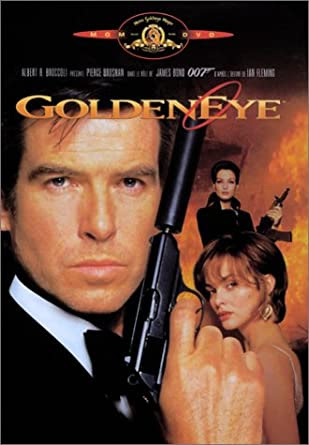
After the lengthy legal wrangling that also saw Timothy Dalton resign his licence to kill, the Broccoli family finally got their man. Pierce Brosnan had been earmarked for Bond by Cubby Broccoli ever since they’d met on the set of For Your Eyes Only, but contractual obligations to the TV series Remington Steele had kept the smooth Irishman at arms length until the middle of cinema Bond’s fourth decade. Broccoli’s patience was richly rewarded, with Brosnan combining the eye-twinkling charm of Roger Moore with a degree of the sophistication that Sean Connery had beneath that sturdy Glaswegian exterior, two factors that, to be honest had been missing from Dalton’s colder interpretation of the character. There was much to like about GoldenEye, which is easily Brosnan’s best in the series. It felt modern, and moved the character on satisfactorily, introducing Judi Dench as the first female M, whose introduction to her star agent is to call him “a sexist, mysognist dinosaur”, giving the Bond franchise a healthy kick in the pants in the process (while also acknowledging the contemporary dismantling of the Soviet Union). Martin Campbell’s direction was crisp, with little wasted in terms of the plot or the set pieces. Welcome back, Mr. Bond.
11. Dr No (1962)
The one that started it all. The one that gave us “Bond, James Bond.” Shortly before Dr. No appeared in cinemas, Darryl F. Zanuck’s D-Day epic The Longest Day appeared, setting the trend for the next couple of decades of grandiose film-making involving as many star names as you could cram on to a billboard (John Wayne, Kenneth More, Robert Mitchum, Richard Burton, Henry Fonda, Peter Lawford, Rod Steiger, Kurt Jürgens, George Segal, Robert Wagner and Paul Anka amongst them. Indeed, such was the number of superstars in the three-hour black-and-white marathon that some made only virtual cameos. Amongst the line-up was a former milkman and amateur bodybuilder from Edinburgh, playing a lowly conscript in the Normany landings. The Longest Day would become the highest-grossing film of 1962. Two weeks after its release, Dr. No was released, heralding the start of the most enduring - and lucrative - franchise in film history. For this, alone, it deserves prominence in the 007 rankings. While it didn’t contain any of the gadgets and visual gags that would become the stock-in-trade of both Bond and its numerous parodies in the six decades to come, it established Sean Connery as, for many, the definitive 007, and in a film that, in retrospect, appears closest of all to Fleming’s literary characterisation. Of course, compared with the later Connery films, Dr. No was made on a very tentative budget, in total contrast to most of the mainstream films of 1962, but there was something decidedly expansive about the first of Terence Young’s three Bond directions, making exquisite use of Fleming’s beloved Jamaica, and turning Ursula Andress’s bikini-clad emergence from the Caribbean to the tune of Under The Mango Tree into one of cinema’s most iconic scenes. Even if the Bond films wouldn’t extend to a further 24 pictures, Dr. No stands out as an enjoyable and engaging ‘60s spy film, with colour and wit, as opposed to the tendency towards bleak Cold War themes in other examples of the genre. What it also introduced is, arguably, the most famous signature music in film history - played over the equally distinct gun barrel opening - and featuring a dark, distorted electric guitar riff (apparently written in just two minutes) at a moment in music history when rock and roll was still in its infancy, and mainstream cinema audiences were only likely to respond to orchestral scores and easy-listening music.
10. Spectre
What we now know as Daniel Craig’s penultimate Bond film had a tough act to follow in Skyfall. By now, too, there was a story arc to continue, after the Vesper Lynd/Quantum thread, and the introduction - in concept - of Ernst Stavro Blofeld in Skyfall. Here, Blofeld is finally revealed, this time in the guise of Christoph Waltz. The trouble with Spectre is that it does have an impossible task after Skyfall - a task made harder by the fact that Sam Mendes directed both. Spectre has divided opinion amongst Bond fans, with some (including critics) branding it a disappointment. I think that’s harsh: all of the Craig films have been subtly dark and notably grittier than any in 007 history. Perhaps the ending is a little weak, with Bond encountering his arch-nemesis after yet another attempt to blow up the MI6 headquarters (one of our greatest national jokes - the Secret Intelligence Service located in one of the most prominent buildings on the London riverside, right next to Vauxhall Station…), but getting there meant plenty of terrific Bond romps, from the Day Of The Dead opening set-piece in Mexico City to the car chase in Rome, and then 007 chasing down the kidnapped Léa Seydoux in a plane eventually shorn of its wings.
9. Thunderball (1965)
We reach single figures in this ranking with Sean Connery’s fourth instalment, and another example of a hard act to follow, coming straight after the genre-defining Goldfinger. Thunderball was actually meant to be the first Fleming novel to be adapted for the big screen, but it became the centre of complex legal wrangling between Fleming and producers over claims that the book was actually based on an original screenplay. That legal dispute wasn’t resolved until as recently as 2006. That not withstanding, Thunderball booked a solid entry in the series, a ‘proper’ Bond film, with spectacular locations, sharks and underwater sequences, a clever use of an RAF Vulcan bomber as centrepiece of peak 1960s nuclear jeopardy, and Bond almost dying at a health farm. Of nothing more than a sidenote, Connery effectively remade Thunderball with the semi-serious Never Say Never Again, in which Porridge writers Dick Clement and Ian Le Frenais reused one of my favourite gags from the prison sitcom - [Nurse - holding a sample jar]: “Mr. Fletcher - could you fill this for me please?” [Fletcher - sat on a hospital bed]: “What, from here?”].
8. Casino Royale (2006)
Cinema’s James Bond needed resetting. After the CGI horrors of Die Another Day, 007 faced new competition, most significantly, Matt Damon’s Jason Bourne, which tapped into the post-9/11 new world order of electronic warfare, cultural paranoia and a very different kind of paramilitary spycraft that made dinner jackets and vodka-martinis irrelevant. Perhaps sensing the acute ridicule Pierce Brosnan’s ultimate appearance had met (but with the actor still expected to play Bond again), established Bond screenwriters Neal Purvis and Robert Wade sought to return the franchise to its classic origins with Ian Fleming’s first Bond novel (indeed, his debut as a novellist) and based on his own experiences during the Second World War as a British naval intelligence officer. The Bond Fleming had invented for Casino Royale was meant to be an “extremely dull, uninteresting man to whom things happened” adding that he saw Bond as “a blunt instrument”, attached to ”the dullest name I ever heard [James Bond]”. With Brosnan eventually ruling himself out of another Bond film for, apparently, fear of going into his 50s like Roger Moore had done, Broccoli heirs Michael G. Wilson and Barbara Broccoli found their “blunt instrument”, a relatively diminutive, blond-haired actor who’d been building his reputation as a solid character actor in film and television, leading to a standout performance as a drug dealer in Matthew Vaughan’s Layer Cake. Opinion was split when he was announced as the new Bond as he patently didn’t look like any of the Bonds before, not even Moore. Looking back, it was a masterstroke: Casino Royale took Bond back to the start of his ’00’ licence, recalling his first kill as well as the love affair for Vesper Lynd that would be part of the story arc ultimately No Time To Die will resolve, along with Craig’s tenure. New Zealander Martin Campbell, who’d helmed the BBC nuclear thriller Edge Of Darkness, as well as Brosnan’s Bond debut, GoldenEye, was tasked with turning Craig into James Bond, and refreshing the Bond machine for the 21st century. Out went the nonsense of Die Another Day and in came a Bond closer to the civil servant that Michael Caine played in the Harry Palmer films, albeit with a better wardrobe, better locations, and an Aston Martin DB9. The four-year break between Casino and its predecessor built up a dam wall of expectation, which meant that crowds swarmed to see the new incarnation of 007 with a mixture of curiosity and expectation. They weren’t disappointed, and nor were the film’s producers, coining in $606 million worldwide, the highest-grossing James Bond film to date.
7. On Her Majesty’s Secret Service (1969)
Logic might dictate, or at least suggest, that the Bond film which marked its star’s only appearance in the role might have been a turkey. OHMSS was anything but, but it confounds to this day why George Lazenby made just one appearance as 007. Taken as a whole, OHMSS is a perfect Bond film (many will rank it even higher than I have done), and while Lazenby - who at 29 was the youngest actor ever to play the lead - didn’t have, perhaps, the same impact or charisma as Sean Connery, who he replaced, director Peter R. Hunt orchestrates a fantastic adventure. Telly Savalas nails it as Blofeld, while his Swiss lair’s collection of ‘Angels Of Death’ being brainwashed for the purpose of spreading a deadly virus includes a young Joanna Lumley and a pre-Magpie Jenny Hanley. Arguably, though, the standout of OHMSS is Diana Rigg as Bond’s ultimate, and ill-fated love interest, Contessa Tracy di Vicenzo, the actress at her most beautiful, playing the part as the model for Eva Green’s much later classy portrayal of Vesper Lynd. As for Lazenby, his single outing as Bond can simply be explained as his choice. He confounded everyone - including the Bond production team - by walking away from the role, at some point explaining his decision thus: “Fantasy doesn’t interest me. Reality does. Anyone who’s in touch with the kids knows what’s happening, knows the mood. Watch pop music and learn what’s going to happen. Most film-makers don’t watch and aren’t in touch.”
6. Live And Let Die (1973)
The arrival of the the third actor to play Bond - Roger Moore - heralded something of a tonal shift for the franchise. 1971’s Diamonds Are Forever cemented Sean Connery’s status as the definitive 007, returning after Lazenby’s brief stint for one more turn with all the bells and whistles of a classic Bond film, with the 1970s budget and sideburns to boot. For Moore’s debut, writer Tom Mankiewicz and director Guy Hamilton dipped faithfully into the plot of Ian Fleming’s 1954 novel, with a storyline involving Bond in tackling a North American smuggling operation tinged with Caribbean voodoo, and dipped perilously into the blaxploitation cinematic movement, just two years after Richard Rowntree’s Shaft had made black urban themes hip. While this might sound like a convoluted association for a Bond film, Moore’s arrival - relatively fresh on the back of his 1960s exploits as TV’s The Saint (as well as, bizarrely, the US Western series Maverick) did reset the series. Moore, for a start, was not the dark-haired Bond that Connery and Lazenby had conformed to - in many people’s eyes epitomising the character Fleming had imagined. But with Live And Let Die, Moore’s slightly camp, safari suit-wearing Bond had not yet developed, the eye-winking was held back for future outings. What we got was a genuinely entertaining romp that holds its magic still, 48 years on, not least of which the speedboat race through the Louisana bayous that was a mainstay clip of TV’s children’s film quiz Screen Test with Michael Rodd. Live And Let Die was, too, possibly the first consciously hip Bond film, driven by Paul McCartney’s memorable theme tune, the voodoo and, in Yaphet Kotto as “Mr. Big”/Kananga, a welcome break from the Nehru-jacketed, cat-stroking Blofeld role.
5. Diamonds Are Forever (1971)
Some fans and critics still struggle to acknowledge Diamonds as one of the great Bond films, but I’m always ready to challenge that point of view. Because when you take it as a hole, it’s a lot of fun, with at-times batshit-mad set-pieces that probably provided most of the blueprint for the Austin Powers piss-takes, but not so much that it descends into self-parody. Even accepting that Connery returned to 007 for one last time for the pay packet, he doesn’t appear as disinterested as well he might, and fits into the semi-serious plot with ease and authority. Opinion is still mixed, of course, on the presence of camp baddies Mr. Wint and Mr. Kidd, or indeed of Charles Grey’s equally waspish Blofeld, but the early scenes in Amsterdam will always resonate with me as a former resident of that city, and with Las Vegas - another of my haunts - providing a sun-kissed backdrop to the whole yarn’s conclusion, we have one of the more memorable films in the series, even if it as far removed from the darkness of earlier and later entries. And if nothing else, it has that Shirley Bassey theme song.
4. You Only Live Twice (1967)
As the Bond film that came out in the year of my birth, I have a particular affinity for You Only Live Twice. That fondness gets stronger at the thought of yet another classic John Barry theme tune - sung by Nancy Sinatra - (shamelessly purloined by Robbie Williams for his hit Millennium…). But as the fifth episode in the series, you got the feeling that Cubby Broccoli was hitting his stride in terms of the What Can We Do This Time? challenge. Thus, the sets were more ambitious, the locations more exotic, the stunts that much more outrageous, and designer Ken Adam’s hollowed-out volcano cleverly provided the Bond films with one of the all-time brilliant finales in cinema history. Perhaps not enough credit goes to Roald Dahl, who reapplied the kooky whimsy of his children’s writing to a contemporary spy thriller (a reversal of Ian Fleming also writing Chitty-Chitty-Bang-Bang), or director Lewis Gilbert’s expansive vision, injecting the same sense of big-sky drama he put into Reach For The Sky, the Douglas Bader biopic. Gilbert would seemingly reuse some of the gags in You Only Live Twice for the aforementioned Moonraker, but that shouldn’t be held against him, as this 1967 entry justifiably sits well in the Top 5 Bond Films for being, frankly, the full package.
3. Skyfall (2012)
2012 was quite the year for Brand Britain, what with the London Olympics opening with Bond himself - Daniel Craig - appearing on Her Majesty’s service with HRH herself. But with the arrival of Skyfall, directed by no less a figure as Sam Mendes, Bond took on an altogether more adventurous cinematic heft. A lot of that is down to Roger Deakins’ exquisite cinematography - the brief scene of 007 swimming in the rooftop pool of a Shanghai hotel is arguably my favourite scene in any Bond film ever, purely for its artistic quality. But in Neal Purvis, Robert Wade and John Logan’s script, Skyfall delves deeper than ever into Bond’s past, with Javier Bardem’s Double-O agent-gone bad Silva (and even a moment of homo-erotic tension between them), forcing an emotional, maternal connection between Judi Dench’s M and Craig’s 007. From start to finish, Mendes created a truly compelling Bond film, without compromising on all the gags we love the series for just to underline his theatre credentials. Skyfall also became the first Bond film in history to feature Britain, prominently, with its final third drawing a geographic line between London and Scotland, as Bond and M take the iconic Aston Martin up to the titular Skyfall, the Bond ancestral family home, for a spectacular (and surprisingly moving) final showdown with Silva.
2. Goldfinger (1964)
Watching all the early ’60s Bond films now shows up their contemporary technical deficiencies. Goldfinger’s iconic car chase, for example, with 007 driving the Aston Martin DB5 around the portly villain’s Swiss factory (actually, it was an industrial park in Wales) was as much as the age’s cinema could provide, with Sean Connery clearly sat inside a motionless Aston while a backscreen jerked around him. But that’s looking at Goldfinger through a 2021 viewer’s sophistication, where we can no longer tell the difference between real and CGI. I raise all this in my thoughts about Goldfinger merely to get them out of the way. Because in the third Bond film, Cubby Broccoli stepped up a significant gear. Director Guy Hamilton pulled off the first properly ‘classic’ Bond film, arguably setting the blueprint for every one that followed. It’s a view shared by Daniel Craig himself, who named Goldfinger his favourite of the entire series: “Just everything about it,” he told the Sunday Times. “The suits and the car and the look and the feel of it. This is Bond firing on all cylinders.” After the Caribbean setting of Dr. No, and the European landscape of From Russia With Love, Guy Hamilton took Bond into a more expansive spread of locations (a hallmark of the series ever since) - the Fontainbleu Hotel in Miami where Bond takes on Auric Goldfinger at cards, the Swiss alps where he encounters Tilly Masterson, the Kentucky stud farm where Goldfinger literally wipes out the Mafia, and then the actual Fort Knox, where Pussy Galore’s Flying Circus kicks off the audacious plot to detonate a nuclear bomb inside the US gold reserve. After the rudimentary briefcase of From Russia With Love, Q Branch also stepped up their game with Goldfinger, delivering arguably Bond’s most famous gadget, the DB5 with “modifications” that included an ejector seat for unwanted passengers, machine guns in the lighting recesses, revolving number plates, an early form of satnav, bullet-proof screen, tyre-slashing wheel hubs and an oil slick delivery system. In Gert Frobe, the German actor (well, his voice stand-in, British actor Michael Collins) we had one of the all-time great Bond/Bond villain interactions: [Bond] “Do you expect me to talk?” [Goldfinger]: “No Mr. Bond! I expect you to die!” as a laser beam edges closer to the Bond family jewels.
1. From Russia With Love (1963)
It might be counter-intuitive to position the second-oldest Bond film as its best, given that it lacks the technical brilliance of the most recent, with 21st century production values, but From Russia With Love for me combines all the things I love about Bond films with all the things I love about spy thrillers. Made just 12 months after Dr. No, director Terence Young swapped the debut’s sun-kissed Caribbean setting for the considerably greyer tones of Eastern Europe, as Bond comes up against SMERSH seeking revenge for the death of Dr. No in the first film. What it lacks in the outrageous gadgetry that would follow (Q’s greatest contribution is a nifty “standard issue attaché case” containing an Armalite rifle, a throwing knife, tear gas canisters disguised as talcum powder tins, and a string of gold sovereigns), it more than makes up for in sophistication. In Robert Shaw’s body builder Red Grant, Bond meets one of the first great adversaries, especially in their thrilling, claustrophobic encounter on a train, along with second, Lotte Lenya as SPECTRE’s knife-in-shoe-wielding ‘No.3’ Rosa Klebb. We also get a full first glimpse of Bond’s refined pedantry, when he requests a coffee from Ali Kerim Bey, head of MI6 ‘Station T-Turkey’ in Istanbul, and orders it “medium sweet”. I have never known what that actually means - one lump or three? - but its a scripting touch that adds to the overall cool of From Russia With Love that, arguably, the Bond franchise would not return to until Timothy Dalton’s first appearance, The Living Daylights, fully coming back with the Daniel Craig era that is about to come to an end.