Showing posts with label Dark Side Of The Moon. Show all posts

Friday, 6 October 2023

Roger Waters presents the dark side of Dark Side Of The Moon

I’ll admit to wrestling with my conscience about giving Roger Waters any airtime at all over the release, today, of his, on first consideration, bizarre remake of The Dark Side Of The Moon

To say that he is a polarising figure is an understatement: quite where he fits into the post-truth culture spectrum is anyone’s guess. The conventional take is that Waters has always been a troubled individual: the death of his father, a former conscientious objector and Communist Party activist, during the Battle of Anzio in 1944 when young Roger was just five months old has loomed large in his work, one way of another.

But of the various world issues Waters has been vocal about, his views on Israel have generated the most controversy, to the extent that his performances of songs from The Wall, in which he dresses in quasi-Nazi uniforms have lead to his solo shows been banned, with accusations of an anti-semitic agenda continuing. All of which, of course, Waters has denied.

Even this week, on the eve of his reinterpretation of The Dark Side Of The Moon being released, the topic was thrust back into the spotlight when David Gilmour seemingly reignited his feud with Waters by retweeting a post about a documentary produced by the Campaign Against Antisemitism, in which musicians and producers who’ve worked with Waters recall their experience of him making anti-Semitic remarks. Gilmour’s wife, the writer Polly Samson, has played her own part in the froideur, earlier this year branding Waters “antisemitic to [his] rotten core”, “a Putin apologist” and “a lying, thieving, hypocritical, tax-avoiding, lip-synching, misogynistic, sick-with-envy, megalomaniac”. Which told him.

Waters has inevitably dismissed the film as a “flimsy, unapologetic piece of propaganda”, but the flare-up of antisemitic accusation provides a profoundly uneasy context for Dark Side Of The Moon Redux to be released. Because it is, in fact, genuinely intriguing. 

Remakes of anything are rarely any good. Name a film reboot or “updated” TV show that doesn’t suffer the foreshadow of the original work. Albums are no different, whether the stream of ‘unplugged’ reinventions in the 1990s or the occasional novelty reggae reworking of a Beatles record. Covers albums by the original artist are inevitably regarded as “lazy”, no matter how inventive the treatment, or feted the artist (Bowie’s Pin Ups, anyone?). 

The original Dark Side was and remains seminal, even if Waters himself once dismissed its lyrics as adolescent “lower sixth” drivel. Released 50 years ago, and providing a platform for Waters, largely, to expand upon on life, death, wealth, fame and his own complex psychology, it became totemic of 1970s progressive rock and should, today, still be regarded as one of the most important albums of the entire rock era. 

So why remake it, 50 years later? Why jeopardise the original’s justifiable legacy in what might seem a petulant attempt to reclaim it as Waters’ own? 


Waters will (and does) argue that Dark Side was his to begin with, and he can do whatever the hell he likes with it. “I wrote The Dark Side Of The Moon. Let’s get rid of all this ‘we’ crap,” he told The Telegraph recently. “Of course we were a band, there were four of us, we all contributed – but it’s my project, and I wrote it.” In the same interview he also accused his former bandmates of being unable to write songs: “They’ve nothing to say. They are not artists! They have no ideas, not a single one between them. They never have had, and that drives them crazy.” Ouch.

The origins of the Redux project date back to the pandemic, when Waters and his touring band got together virtually from wherever they were locked down to record stripped down versions of songs like The Wall’s Mother, Comfortably Numb and Vera. “When we recorded [the Lockdown Sessions], the 50th anniversary of the release of The Dark Side Of The Moon was looming on the horizon,” Waters explains on his website. “It occurred to me that The Dark Side Of The Moon could well be a suitable candidate for a similar re-working, partly as a tribute to the original work, but also to re-address the political and emotional message of the whole album.” 

He stresses that the new version is not “a replacement for the original which, obviously, is irreplaceable”, but serves as an opportunity for the now 80-year-old to look back 50 years into the eyes of himself on the cusp of 30. “And also it is a way for me to honour a recording that Nick [Mason] and Rick [Wright] and Dave [Gilmour] and I have every right to be very proud of,” a statement in marked contrast to his comments to The Telegraph. A penny, then for Gilmour’s thoughts, given that the remake is sparse and notably devoid of either his signature guitar solos, or his sweet, higher register vocals which provided a contrast to the darker, deeper sourness of Waters somewhat manic singing. 

Much of that sparsity comes from a significantly downscaled group of musicians around Waters than those who participated in the Lockdown Sessions. For the most part, Waters has worked with producer Gus Seyffert and multi-instrumentalist Jonathan Wilson as the album’s musical core, with Syrian singer Azniv Korkejian providing a very different approach to Clare Torry’s soaring vocals on the original Dark Side’s The Great Gig In The Sky.

In his reimagining, Waters turns narrator, speaking in a near-whisper instead of singing entirely new passages of words that provide the most telling reflections of his octogenarian perspective. As such, the songs acquire a poignancy, especially on the themes like mortality.

Elsewhere there is a more genteel pace to songs, most notably the original’s hit single Money, which turns into a blues shuffle, Waters’ cynical intonation possessing a Leonard Cohen-like timbre. Some still rankle at multi-millionaires like Waters and Gilmour (who has performed the song on his solo tours) singing about wealth, but it is still a unique piece of music that actually works well with Waters’ new treatment. 

Equally so with Us & Them, always my highlight of Dark Side, which takes on an even more reflective tone than the original, which ruminated in 1973 on the futility of war. Conflict, or at least highlighting its human waste, has always been one Waters’ passions, but in taking on the lead vocals (from Gilmour) on the reimagined version, Waters contemporizes its themes. Just don’t ask him about what he’s trying to say about the war in Ukraine.

That, though, does raise the question as to why Waters has remade Dark Side, beyond simply saying ‘up yours’ to his former bandmates. The 1973 release’s 50th anniversary earlier this year was marked by the inescapable celebratory box set (coming in a long line of reissues), so at least Waters has given Dark Side’s ten songs fresh thinking. In some sense, this new vision is overlaid on the original’s themes about the passing of time and human weakness with a current world view (even if Waters’ world view is somewhat jaundiced).

The Redux version, then, works as a curiosity. There is even a moment of levity on the new version of Brain Damage, in which Waters himself is heard asking “Why don’t we re-record Dark Side Of The Moon?” before responding with “He’s gone mad” (the original song, of course, was part inspired by Syd Barrett’s pychosis, opening with the spoken words of Floyd roadie Chris Adamson saying: “I’ve been mad for fucking years. Absolutely years. I’ve been over the edge for yonks, been working with bands so long.”).

Picture: Kate Izor
Musically, Waters has always been a conundrum. Technically limited (“it’s just the same bloody four chords”, a musical friend once observed, correctly, of Waters’ songwriting), he has nevertheless managed to create compelling theatre with his solo work. His first solo album-proper, 1984’s The Pros And Cons Of Hitchhiking remains a firm favourite of mine, and his last release of entirely new material, Is This The Life We Really Want? was essentially the de facto sequel to Dark Side with its rumination on authoritarianism, commercialism and greed. 

Inexorably, Redux picks these batons up again, perhaps demonstrating the political maxim that anything worth saying is worth repeating. You just wish that sometimes Waters would choose his words more carefully. At 80, that’s unlikely.


Friday, 28 July 2023

The other Quiet One

In the greater regard for Pink Floyd, a couple of things overshadow everything: firstly, The Dark Side Of The Moon and its enduring legacy, but secondly, Roger Waters’ relationships with guitarist David Gilmour, drummer Nick Mason and keyboard player Richard Wright.

The dynamic between Waters and Gilmour, in particular, has become something of a pyschodrama, with the pair (and Gilmour’s wife, the writer Polly Samson) trading barbs via social media over, mostly, Waters’ politics. But while Waters has been courting the wrong kind of publicity for his provocative world view, Gilmour has edged into what feels like semi-retirement, and Mason has sought to protect the band’s heritage through his Saucerful Of Secrets outfit (playing the music of the early, pre-Dark Side Floyd albums), Wright has largely been forgotten. 

Today, his debut solo album, Wet Dream - recorded and released between the Floyd’s Animals in 1977 and The Wall in 1979 (and in the context of a band dynamic that was starting to collapse) - is being re-released, remixed by Steven Wilson and repackaged with a load of extras, providing an opportunity to reassess The Quiet One of Pink Floyd, whose influence on the band from its very beginning can often be forgotten under the weight of the egos and internecine battles that raged increasingly as commercial success in the 1970s gave way to Waters’ dramatic exit in 1985. 

When he succumbed to lung cancer in 2008 at the age of 65, Rick Wright was eulogised by Waters, Gilmour and Mason for having had a bigger part in their musical canon than he was ever given credit for when alive. “In the welter of arguments about who or what was Pink Floyd, Rick's enormous input was frequently forgotten,” David Gilmour wrote in an online tribute. “He was gentle, unassuming and private but his soulful voice and playing were vital, magical components of our most recognised Pink Floyd sound.” Wright was irreplaceable, Gilmour wrote of his “musical partner and my friend.”

While these words might read like a carefully constructed ‘corporate’ statement, Gilmour had certainly remained close to Wright, having him play on his solo tour for the On An Island album. The Floyd-heavy set lists reminded audiences that Floyd hadn’t been just about Waters’ lyrical vision (or, in the early days, Syd Barrett’s flights of psychedelic fancy) or indeed Gilmour’s distinctly soaring guitar solos, but also of the melodic foundation that Wright brought to many of their songs from the off.

Richard Wright
Keyboard players tend to be cerebral introspectives, but also the most pivotal figures in a band, especially in the 1970s when guitar-based beat pop gave way to intricate, complex progressive rock. Tony Banks of Genesis, springs to mind here: hunched over his Mellotron, playing elaborate, classically-inspired solos, he was never the focal point (especially with Peter Gabriel charging about in his various costumes). Banks and Wright considered themselves songwriters first, and pop stars a very distant second. “Shy and unassuming” are also the mutually exclusive adjectives that sit before the words “keyboard player”, but if you were to analyse the contribution Wright and Banks’ multi-layered keyboard compositions made to the overall canons of their respective bands, I’d wager  they would outstrip the limelight chasers who sang or played the guitar solos. 

Wright’s “spacious, sombre, enveloping keyboards, backing vocals and eerie effects” were, in the words of the New York Times’ obituary, “an essential part of [Pink Floyd’s] musical identity. ” He was certainly responsible for some of the band’s signature moments: the epic Echoes, on the Meddle album, for example, but also the ambient, G-minor keyboard chord that heralds Shine On You Crazy Diamond at the beginning of Wish You Were Here. More significantly are two songs on The Dark Side Of The Moon: amid the album’s wiggy space rock and Waters’s jaded rumination about the human condition, the sonorous Us And Them and the mesmerising Great Gig In The Sky highlight Wright’s exquisite composition and piano work. 

“The blend of his and my voices and our musical telepathy reached their first major flowering in 1971 on Echoes,” Gilmour wrote in his tribute. “In my view all the greatest PF moments are the ones where he is in full flow. After all, without Us And Them and The Great Gig In The Sky, both of which he wrote, what would The Dark Side Of The Moon have been? Without his quiet touch the album Wish You Were Here would not quite have worked.” 

Despite his indelible stamp on the canon, Wright was fired by Waters during the making of The Wall album in 1979. Despite having been college friends, tension had built over the preceding decade. “There has always been friction between me and Roger,” Wright once reflected. In 2000 he revealed to Classic Rock magazine how unhappy he’d been during The Wall sessions: “Both myself and Dave [Gilmour] had little to offer, through laziness or whatever. Looking back, although I didn’t realise it, I was depressed.” At the time, he was in the throes of divorce from his first wife, Juliette. 

With some sort of divine retribution, however, Wright was rehired – on wages – to play keyboards on The Wall’s outlandish, theatrical tour. Ironically, as a jobbing musician, he was the only original member of the Floyd to profit from The Wall Tour, such was its extravagant staging. 

Wright’s exile from the band was, though, relatively short-lived. After Waters himself formerly quit in 1982, Gilmour and Mason reconvened to record 1987’s A Momentary Lapse Of Reason, with Wright effectively working as a session player. By 1994 he was fully back on board for Pink Floyd’s de facto final album, The Division Bell, on which Wright co-wrote several songs as well as contributed his own composition, the contemplative Wearing The Inside Out, a reflection of his experience of the band’s tensions prior to his original departure: “From morning to night, I stayed out of sight. Didn’t recognise what I’d become. No more than alive I’d barely survived. In a word – overrun”.

Rick Wright in David Gilmour's Remember That Night

In Mark Blake’s Pink Floyd biography Pigs Might Fly, Division Bell producer Bob Erin said of Wright’s composition: “There’s a lot of emotional honesty there. Fans pick up on the sad, vulnerable side to Rick.” In reality, the words came from former Slapp Happy keyboard player Anthony Moore, working with Wright, but there’s no doubt they came from a very personal place. Moore “had to climb inside Rick’s head to get the words out”, a band insider told Blake.

Pink Floyd’s first album, The Piper At The Gates Of Dawn, was released in August 1967. While Syd Barrett was seen as the band’s prime creative force, he and Wright, in particular, had formed a particularly fruitful partnership - Wright’s melodicism acting as a counterweight to Barrett’s eccentric whimsy (they co-wrote Astronomy Domine and both provided vocals for the track Mathilda Mother). But as Barrett’s use of LSD intensified towards the end of 1967, leading to increasing psychosis and his firing, the band’s centre of gravity started to shift. Gilmour - an old cohort of the band from their teenage years in Cambridge - was brought in to, initially, augment Barrett, before his eventual exit. Gilmour’s appointment as the band’s lead guitarist set in train the band’s imperious phase, evolving from London underground darlings to the stadium behemoths that The Wall somewhat self-satirised a full decade later. 

This period also became the creative arena for Waters’ concepts, with Gilmour and Wright, in particular, providing the instrumental flourishes. However, Wright’s clearly more diffident personality would never get a look in as the band became an increasing power struggle between Waters and Gilmour. As so often is the case (Steve Hackett, again of Genesis, comes to mind), solo projects become an outlet when breaking open an established hierarchy proves impossible, Hence 1978’s Wet Dream and Broken China in 1986. Both were well received, but commercially underwhelming. Wright was said to be working on a new project at the time of his death, though there is no known plan for them ever to be released posthumously. 


Today, however, on what would have been Wright’s 80th birthday, Wet Dream is being reissued as an expanded edition, with Wilson - now the go-to-master of classic album reinventions - producing new stereo and multi-channel remixes. “Most people know that Pink Floyd have always been my favourite band,” he tweeted, “so it was a real honour to be commissioned by Richard’s children Gala and Jamie Wright to remix this relatively underrated and beautiful entry in the Floyd canon. For anyone hearing the album for the first time it will become apparent just how much of Richard’s DNA runs through Pink Floyd. His distinctive rhythm patterns, signature keyboard sounds, vocals, jazz influences, and style of play exude throughout.” A vinyl version of the reissue along with a Blu-ray Disc package will be released later in the summer.

At the time of its original release Wet Dream - self-produced by Wright and featuring all of his own songs - largely flew under the radar, a symbolic reflection of his under-appreciation within Pink Floyd. Roger Waters has somewhat vacillated over his former friend’s legacy: “It is hard to overstate the importance of his musical voice in the Pink Floyd of the ’60s and ’70s,” he said in a similar statement to Gilmour’s after Wright’s death in 2008. But in an interview with the Telegraph earlier this year, Waters in more vituperative form said: “David Gilmour and Rick Wright? They can’t write songs, they’ve nothing to say,” maintaining that his self-ascribed role as Pink Floyd’s creative centre after Barrett “went loopy” was that none of the others had any ideas. “Nick [Mason] never pretended,” he said adding that Gilmour and Wright weren’t artists. ”They have no ideas, not a single one between them. They never have had, and that drives them crazy.”No wonder Wright once said: “I think, ‘Why do you have to say these things?’”.  

When Pink Floyd reformed for the one-off Live 8 charity concert in 2005 there was a visible unease on stage between Waters and Gilmour, in particular. That, though, didn’t stop the clamour for the band to fully get back together. “Everyone who loves Pink Floyd wants it to happen,” said Wright at the time. “But I don’t feel I need it, not musically and not personally,” adding, cuttingly, “Maybe if Roger comes back as a different person – charming and nice, with really good ideas.”  

While Live 8 marked the final time all four members of Pink Floyd’s ‘classic’ line-up would share a stage. Wright’s role would be further extended by the release of their final record, The Endless River, which featured unused music from the Division Bell sessions. Released in November 2014, it was positioned as a tribute to Wright, featuring Gilmour, Wright and Mason seemingly improvising on what could be described as archetypal Pink Floyd songs – in particular built-out blues jams – that all featured Rick’s hallmark keyboard infusion. “I think this record is a good way of recognising a lot of what [Rick] does and how his playing was at the heart of the Pink Floyd sound,” Mason said at the time of the album’s release. “Listening back to the sessions, it really brought home to me what a special player he was.” 

In September 2007, a year before he died, Wright performed for the last time, joining Gilmour for an unexpected jam at a cinema in London’s Leicester Square at the premiere of Gilmour’s Remember That Night film, recorded at the Royal Albert Hall during the tour for his On An Island album. The tour had, in Wright’s own words, been the “happiest” he’d “ever been on”. 

A couple of months before he died, on 15 September 2008, there was talk of Pink Floyd reforming to play Glastonbury. It had transpired that Gilmour had enquired about the possibility of playing as an opportunity for one last show with Wright, knowing that he was ill. The idea never came off. Glastonbury founder was edging towards acts with a younger profile and appeal. Pink Floyd - easily, in the context of contemporary Glastos, would have been perfect for the ‘heritage slot’.

You could argue that without Rick Wright I might never have found Pink Floyd. Like many of my contemporaries, Another Brick In The Wall (Part 3) was probably my first conscious exposure, appearing at the end of my first term of secondary school, with that grammar police-baiting “we don’t need no education” refrain offering a note of pre-pubescent revolution. It would be later in my school career when my curiosity would be fully triggered. During an English Literature lesson, we were forced to listen to a Richard Burton-narrated BBC radio production of Samuel Taylor Coleridge’s Rime Of The Ancient Mariner. It began with that opening to Shine On You Crazy Diamond before the Welshman intones: “It is an ancient mariner, and he stoppeth one of three…”. 

I was captured. I asked my English teacher if he knew what the music was. “It’s Pink Floyd,” he told me. “Opening track of the Wish You Were Here album.” By chance, my brother had a copy, which I feverishly taped as soon as I got home from school. Inevitably, my interest would be piqued by Gilmour’s signature four-note motif two minutes into Shine On. But as I replayed that tape over and over again, before exploring Wish You Were Here’s more venerated predecessor, The Dark Side Of The Moon, it became apparent there was a lot more to Pink Floyd than their lyrical narratives, soundscapes and iconic guitar solos, but also the textures and colour palettes their classically-trained keyboard player was responsible for. Quiet, he may have been, but sometimes loudness isn’t just a matter of volume.

Saturday, 28 January 2023

Art of a diver

Just beyond the eastern extreme of California’s Yosemite National Park, not far from the border with Nevada, sits Mono Lake, a salty body of water formed three-quarters of a million years ago. I came across it considerably more recently than that - 1992 to be exact - but at the time had no appreciation of the cameo it had made in my musical adolescence when I stopped there for what Americans politely term a “comfort break”.

For context, I was midway through a month-long tour of the American West, albeit in December when the tourist hordes are elsewhere. Having driven from Los Angeles up the Pacific Coast Highway to San Francisco, and then north-east to snowed-in Lake Tahoe, I was heading south towards Death Valley along the scenic Highway 395, with California’s spinal Sierra Nevada mountains to my right. Just south-east of Yosemite, I came across Mono Lake and its seemingly abandoned visitor centre. Making use of its facilities, I then took in a view of the lake’s eerie stillness, framed by unique tufa formations. It would be another 25 years - and several visits further to that part of California - before I’d come to realise where I’d seen that tufa before. On a display wall at London’s V&A museum, as part of the Pink Floyd: Their Mortal Remains exhibition, was a blow-up of the inner sleeve of the band’s ninth studio album, Wish You Were Here, depicting a perpendicular diver performing a handstand in, yes, Mono Lake. 

The image was the idea of Aubrey ‘Po’ Powell, the photographer and co-founder with Storm Thorgerson of the Hipgnosis design studio which, from the end of the 60s to the beginning of the 80s produced some of the most distinctive album covers ever committed to 12 inches-square of cardboard. Over 15 years, they produced more than 250 sleeves for artists as varied as Led Zeppelin, Paul McCartney, Humble Pie, 10cc, Leo Sayer, Genesis, ELO, Black Sabbath, Olivia Newton-John and XTC, as well as Pink Floyd, with whom they became most closely associated.

It’s the perfect subject, then, for Us And Them: The Authorised Story Of Hipgnosis, a new book by journalist Mark Blake, whose previous work includes arguably the definitive Floyd account, Pigs Might Fly. “I’d always been quite interested in the idea of doing a book about Hipgnosis,” Mark declares. “I’d interviewed a lot of their associates for Pigs Might Fly - particularly the people who were around at the beginning of their work, their contemporaries, their friends from Cambridge and London in the early days.” A book about the creative duo was a natural next step, especially as Mark had come to know Powell and, in the later years of his life, Thorgerson, in particular, working on the very V&A exhibition I’d been to see. 

Hipgnosis and Pink Floyd’s histories are intertwined: Thorgerson and Powell had been cohorts of the band’s founder members, Syd Barrett and Roger Waters, in Cambridge before they all migrated to London to attend universities. There they met Nick Mason and Rick Wright, eventually becoming fixtures of the capital’s underground music scene as ‘The Pink Floyd Sound’. 

A year after Pink Floyd - as they became - released their debut album, The Piper At The Gates Of Dawn in 1967, Thorgerson and Powell established their working relationship with the band. “Storm was attending the Royal College Of Art, studying film, and Po got a job designing sets for the BBC,” says Mark. “Then Po got sacked and fell into low levels of criminal activity - bank fraud, stealing cars and so on. He got into an awful lot of trouble. It was then that they decided to talk Pink Floyd into letting them design the sleeve for their second album, A Saucerful Of Secrets.” Released in 1968, and made amidst the deteriorating mental health of Barrett (whose departure midway through recording led to David Gilmour joining the group), the album was only the second time that label EMI had allowed an artist to use designers from outside their own in-house art desk. Thorgerson and Powell took it as an opportunity to exploit the changing nature of record covers.

A Saucerful Of Secrets led to the pair designing for Pink Floyd’s labelmates at EMI and, later, its Harvest subsidiary, at first making use of the RCA’s photography faculty (even though Thorgerson wasn’t studying the subject and Po wasn’t even at the college), before being rumbled and thrown out. Instead, they turned the bathroom of Powell’s then-girlfriend into a dark room. This was to change towards the end of 1969 when the pair upgraded: “They moved into a studio in Denmark Street where they began doing stuff for bands like Argent, Quatermass, Toe Fat - all these late-60s, early prog rock,” says Mark. They also took on photographic work came for magazines and book covers. 

“Much of their success can be traced to that of The Beatles’ Sgt. Pepper’s Lonely Hearts Club Band,” says Mark, referring to the grandaddy of progressive rock and its ambitious pop art sleeve designed in 1967 by Peter Blake and Jann Haworth. That landmark inspired a decade of graphic design in rock which saw Hipgnosis, as well as their equally conceptual contemporary Roger Dean, taking cover art into new realms of creativity and expression. Prog bands like Pink Floyd, Yes and Genesis became fertile muses for such designers, turning cover art into an integral component of the narrative their records pursued, invariably conveying dioramic third dimensions through fantastical, somewhat lyrical and always unique imagery. 

For Thorgerson and Powell, getting their concepts across the line with some bands often owed more to the force of personality than creativity alone. “There was one slightly oddball character in Storm, and the slightly more measured character in the shape of Po,” Nick Mason tells Mark in the book. “And it stayed that way for the next fifty years.”

Storm Thorgerson and Aubrey ‘Po’ Powell

As their reputation grew, from 1968 and into the new decade, Hipgnosis became particularly prevalent working for artists sat on various degrees of the progressive spectrum, producing sleeves for myriad acts like Humble Pie, Emerson Lake & Palmer, Rory Gallagher, T-Rex, Wishbone Ash (for their album Argus, with its seminal cover) and even Syd Barrett, for his haphazard but still loved post-Floyd solo albums. At the same time, the relationship with Pink Floyd continued to bear fruit, with covers for the albums More, Ummagumma, Atom Heart Mother, Meddle and Obscured By Clouds.

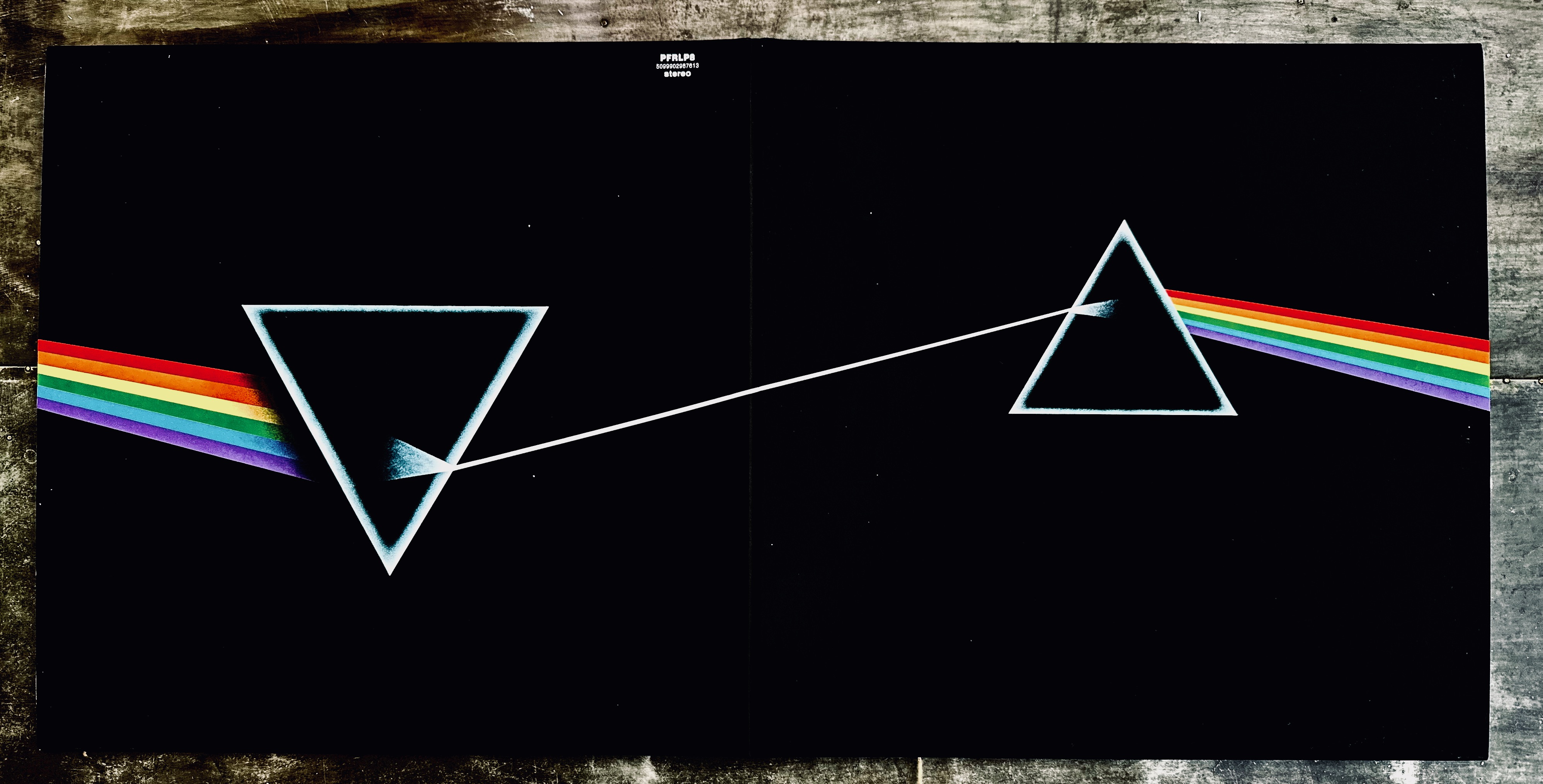
However, the album that still defines the Hipgnosis legacy - and possibly the entire genre of LP art - came in March 1973: The Dark Side Of The Moon. Thorgerson and Powell’s brief from Pink Floyd was to produce something uncomplicated, a contrarian response to opinions amongst the suits at EMI that their previous sleeves for the band had been belligerently obscure and even unmarketable. What they came up with - with a little help from a school book - was the now singular black cover with its beam of light dissipating through a prism into a spectral rainbow.

“I don’t think there was so much foresight and forward thinking in it,” says Mark Blake. “A lot of the time it’s ‘We’ve got to get a cover out - there’s a deadline looming!’. The band wanted something simple so Storm and Po found the prism design in a physics textbook and ripped it off, getting their illustrator George Hardie to create a beautiful design.” To make up for the spartan outer cover, Hipgnosis included some visual extras. “You got the poster of The Great Pyramid and a load of stickers,” says Mark. ”That was Storm trying to shoehorn some bigger ideas in.”

Nowhere on the front or back was there any mention of Pink Floyd or the album’s name. Though not the intention, it reflected an undercurrent of growing distraction within the band (Roger Waters has, with customary misery, described Dark Side as “the beginning of the end”), and the lyrical themes of greed, fame, mortality and even the mental decline of their founder Barrett. Wrapped in a package not dissimilar to a box of Black Magic chocolates, The Dark Side Of The Moon became the standout release of 1973, a year which saw records like Bowie’s Aladdin Sane, Led Zeppelin’s Houses Of The Holy (with a cover also designed by Hipgnosis), Mike Oldfield’s Tubular Bells and Bruce Springsteen’s Greetings From Asbury Park, NJ amongst its pantheon.

Mark acknowledges Dark Side’s enduring success but doesn’t attribute it entirely to the legendary artwork: “I don’t think that it is just down to having the boldness of not having the band’s name anywhere on the cover. I know it wasn’t the first time Storm and Po had done that with Pink Floyd or, in fact, another band.” Music, he says, has clearly been the album’s defining character, but over time the cover has contributed to the record’s legend, albeit contentiously for Hipgnosis: “I think they got paid about 500 quid all-in for that. Years later, Storm tried to get more money out of Pink Floyd because he believed that the cover had contributed more to the sales.”

To date The Dark Side Of The Moon has sold more than 45 million copies worldwide - and continues to do so, even reaching new audiences. My 18-year-old step-daughter asked for a vinyl copy for Christmas two years ago, and even this last December the LP was selling steadily when I visited Fopp! in Covent Garden. While it contains some of the Floyd’s most revered music - Breathe, Money, Time, Us And Them, The Great Gig In The Sky et al - that cover art has found itself peppered throughout the zeitgeist of the last 50 years. “I think both Storm and Po had a complicated relationship with Dark Side,” says Mark. “It’s not their favourite work, but it is their most famous work. It’s a very simple design but doesn’t have the narrative quality that Wish You Were Here had a couple of years later, which I think was certainly one of Storm’s favourite Floyd covers.” 

That record, released in 1975 as a follow up to Dark Side, came with a significantly larger production budget for Hipgnosis, which is how Powell ended up in California for three weeks, an entourage in tow, taking the Mono Lake shot. At the same time, he captured the faceless bowler-hatted man for the back cover (shot in the Mojave Desert), and the front cover image of businessmen shaking hands on a Hollywood backlot, with one of the two stuntmen used for the picture actually on fire - a stunt that almost went very badly wrong.

The story of Hipgnosis isn’t, however, exclusively the Pink Floyd Story. Their work for other artists was equally as distinct, and sometimes just as complicated, though Mark feels they never came up with anything as singularly impactful as The Dark Side Of The Moon. “They became the hip guys to go to after Dark Side and Houses Of The Holy, and also, weirdly, Wishbone Ash’s Argus. That was the album Jimmy Page saw in a record shop: when I interviewed him for the book, he told me ‘I saw this album with a Viking on the cover. I never listened to it but I liked the cover.’ So he rang up Storm and said, ‘Come and do our next album’ [for Led Zeppelin]. After that they got the call from Paul McCartney, who asked them to do Wings’ Band On The Run.” That cover, Mark says, was entirely McCartney’s idea, and famously featured a Clive Arrowsmith picture of Paul and Linda McCartney, Denny Laine, Michael Parkinson, Kenny Lynch, James Coburn, Clement Freud, Christopher Lee and John Conteh posing against a wall, illuminated by a prison searchlight. Still, it had a domino effect, bringing many more bands to Thorgerson and Powell’s door.

Genesis was another band that enjoyed a run of distinctive Hipgnosis-designed covers, commencing with 1974’s The Lamb Lies Down On Broadway - Peter Gabriel’s final work as lead singer and a concept album about a Gulliver-like Puerto Rican street tough descending into the New York underworld. Its literal cover - including a new band logo - was peak Hipgnosis. “Storm was incredibly principled about certain things,” Mark explains. “He would go to the ends of the Earth and spend his own money on getting a cover right. There were certain ideas he wanted to do for bands that they rejected because they wouldn’t have been able to afford it. Storm would do it anyway, just because he wanted to. But by the same token, if Pink Floyd turned an idea down, he’d have no hesitation in trying to fob it off on another band.”

10cc and Genesis were, in particular, beneficiaries of Thorgerson’s ‘generosity’: “The cover of 10cc’s Bloody Tourists is actually a picture of Powell with a map across his face in the West Indies. They pitched that to Genesis for …And Then There Were Three, with the idea that they’d just lost Steve Hackett [who’d quit the band in 1977] and they’re now looking for a new direction.” Genesis, Mark says, weren’t having it, so Hipgnosis took the concept to 10cc who did.

Peter Gabriel recounted a similar experience to Mark for his first three solo albums, which had Hipgnosis covers. Every time he met Thorgerson, he’d be told: “I’ve got a great idea for you, Peter,” to which Gabriel would say: “You’ve fucking tried that on Led Zeppelin, haven't you?”. Mark reveals: “Storm would reply: ‘Yes, but it's perfect for you!’ So, there’s this sort of reject pile that Gabriel would always be confronted by. With Storm it was a weird mix of being incredibly principled and that art is everything, to ‘just have this’.” The covers Gabriel eventually agreed to were markedly different to those Hipgnosis produced for his old band and their contemporaries. While still surreal, they featured distorted images of the singer himself, but to his American record company’s frustration, Gabriel was naming his albums simply ‘Peter Gabriel’, with their covers the only means of distinguishing them. Eventually, the American label would remarket them respectively as ‘Car’, ‘Scratch’ and ‘Melt’, based on the Hipgnosis imagery, just to help the hard of thinking.

If Sgt. Pepper changed the nature of album covers, the early 1980s brought two shifts in the medium itself with industrial developments that, indirectly, altered Thorgerson and Powell’s trajectories. In 1982 Philips and Sony heralded the digital music age by introducing the Compact Disc. The 12-inch canvas that Hipgnosis had made their own became increasingly redundant. Until Gen Z’ers discovered their parents and grandparents’ vinyl collections - and a new romance began with cover art, appearing on bedroom walls and irony-nodding T-shirts - the designs that stood tall in my teenage years became minimised to fit 12cm ‘jewel cases’. Later still, with the advent of streaming, cover art would be minimised further to fit the postage stamp-sized screen real estate of online services. 

Mark Blake
To Mark Blake, the CD’s arrival marked an important pivot away from the ‘long-player’: “That’s another thing that was appealing about doing this book,” he says. “The Hipgnosis story follows the arc of the LP as a medium, which really began with Sgt. Pepper, which was a game-changer in that sense. Suddenly the LP was king. Bands made albums and didn't have to do singles. But, as I’ve been told, the arrival of the CD was one of the reasons that made Hipgnosis decide to wind up the company and go into making music videos.” 

The arrival of MTV in 1983 was the next industrial change, providing Hipgnosis with a new outlet: “All the money that might have once gone into sending them to the Sahara Desert to photograph footballs in the sand for a cover was now being spent on videos,” says Mark. “So that’s why they wound up the company and decided make music videos, which they did for a few years quite successfully…until it wasn’t.” 

While one of their first forays was the clip for Paul Young’s Wherever I Lay My Hat, the video age brought Hipgnosis back into contact with some of their older clients, who were finding new fans through the medium. “They did stuff for Robert Plant and Jimmy Page’s bands,” says Mark. “Owner Of A Lonely Heart [the hit single that revived the fortunes of Yes] was another big one for Hipgnosis. They got in on the ground floor with these older bands trying to relaunch themselves and having to make videos. And obviously, the bands went to the very guys who’d made their album covers, because they figured that they’d feel comfortable with them.”

Although Hipgnosis, as an entity, was wound up in 1983, there is a coda to their greatest legacy in designing covers for LPs. Vinyl sales grew for the 15th consecutive year in the UK in 2022, reaching close to 5.5 million - the highest growth since 1990. What began as baby boomers looking to reconnect with their long-discarded copies of classic Beatles and Bowie records has been boosted by the record-selling phenomenon that is Taylor Swift, as teenagers, moving on from raiding their elders’ records, have adopted their own heroine in the Nashville star. Visit any record shop - from independents to the few remaining chains - and a miasma of album covers will greet you. 

So, is Mark Blake’s celebration of arguably the greatest purveyors of album art perfectly timed? Not necessarily, he says: ”The 50th anniversary Dark Side Of The Moon was the main reason for writing the book. The thing about [the resurgence of] vinyl is interesting, though. I’ve got a 17-year-old son, and when he was first looking through my old records, he said to me, ’Some of these covers would look great if you had them framed on the wall,’ which I think is quite interesting. He listened to Dark Side a couple of years ago, because he’d heard a lot about it - and probably because of the cover.” The vinyl upswing does help, says Mark: “It shows there’s an interest in it as a format, but I don’t think there would have been interest in [a book] ten years ago. We’re moving on to a time where people maybe are reassessing some of this stuff a bit more now, especially after the Pink Floyd exhibition at the V&A. It just feels a bit more timely now.”

Us And Them: The Authorised Story Of Hipgnosis by Mark Blake is published on 2 February by Nine Eight Books

Friday, 14 October 2022

Pigs might fly

Roger Waters is a miserable bugger. That much has been perennially true. The founder member of Pink Floyd has recently been resolutely ignoring the generally wise advice that when one finds oneself in a hole, stop digging. Having railed, in recent years, against everything and everyone from Israel to Donald Trump, the 79-year-old has recently dismissed claims of war crimes in Ukraine by Russia as “lies”, and wrote an open letter to Ukrainian first lady, Olena Zelenska, calling on her husband Volodymyr Zelensky to reach a peace deal with Vladimir Putin. No wonder the good people of Poland have called off Waters’ tour dates there next year.

As much as I hold my hat high to the work of the Floyd, Waters’ relentless misanthropy is exhausting. In 1977 he was just as splenetic. In fact, he has long maintained that by the time Pink Floyd’s album Animals came out that year, the band was already in decline, having peaked with the juggernaut that The Dark Side Of The Moon became, and capitalised on with its reflective follow-up, Wish You Were Here.

Animals, however, was certainly not a happy record. Loosely based on George Orwell’s Animal Farm - itself a statement about Stalinism - Waters used the album to lay in to the perils of being a fabulously wealthy rock star, something he has continued to do into his eighth decade while continuing to be...er...a fabulously wealthy rock star. It was in Montreal, on the Animals tour in 1977, that during a performance of the album’s Pigs, Waters spat at an over-exuberant fan, leading to his feelings of alienation in the spotlight, which part-inspired the cheerful narrative of The Wall in 1980. Animals is not a bad album, by the way. Part of my musical upbringing, in fact. It has also just been re-released with the usual super-deluxe package of remixes and surround sound goodies. 

But that isn’t, you might be surprised to learn, the point of this post. Animals’ cover art remains distinctive, in the great gallery of 1970s albums, for its depiction of Battersea Power Station with a pig flying above it (geddit?). It was Waters’ idea to use the distinctive Grade II listed building, dating back to the 1930s, as he used to drive past it on the way to his-then Clapham home. Hipgnosis - Floyd cohort Storm Thorgerson and partner Aubrey Powell’s legendary design studio - developed the concept further. With the inflatable pig, Algie, still aloft for a second day’s photography it slipped its moorings and floated off, first interfering with incoming flights to Heathrow Airport before veering south-east to land in Kent. There is a story that Floyd’s management had hired a marksman to take out the pig had it had been necessary, but that he didn’t turn up for that fateful second day of pictures, allowing Algie to escape.

Picture: Battersea Power Station Lrd

Today it is the power station itself, not Algie, that is returning to prominence, with the formal reopening of the complex as a retail, hospitality, residential and office working venue, following a £9 billion, ten-year project to transform the art deco building and its surrounding site. At its peak of operations it supplied a fifth of London’s electricity before being shut down permanently in 1983, laying idle beside the Thames for commuters to glance at out of their train windows as they make their way into Waterloo Station. Various ideas were floated as to what to do with it including, at one point, a plan for Chelsea to build a new stadium on the site, clearly on the opposite bank of the Thames to the club’s Stamford Bridge ground today. 

Picture: Battersea Power Station Ltd
Ten years ago a Malaysian property developer plunged in, launching an ambitious plan to repurpose the distinctive structure - one of Europe’s largest brick buildings - hollowing out the main turbine hall and, over six floors, installing offices (including Apple’s new UK headquarters over six floors), flats, restaurants and shops belonging to brands like Hugo Boss, Ralph Lauren, Nike, Mulberry, Uniqlo, Mango, Superdry and Levi’s. It’s not the first time a sizeable Thameside industrial property has been reborn like this: the former Bankside Power Station in Southwark became the Tate Modern. But thanks to Battersea’s prominence on the London skyline it has, for its 80-odd years, been one of the most recognisable fixtures of the capital’s topography. Helped in no small measure by Pink Floyd, it even worked its way into the celebrations of London’s hosting of the 2012 Olympics.

While it may not be a landmark in the same realm of architectural marvel as the Houses of Parliament, St. Paul’s Cathedral or Buckingham Palace, the Malaysian investors clearly saw Battersea’s potential, prompting a daily outlay of £2 million at the height of construction work. When architects WilkinsonEyre got to work in 2012, the main building was lacking a roof and grass was growing on its floor. It was a mouth-watering creative challenge. “We were stunned by the scale of the building,” project director Sebastien Ricard told The Guardian. “We wanted to retain it. We didn’t want to over-restore it.

The mammoth nature of the project also involved extending the London Underground’s Northern Line to a new, dedicated station serving the site. This was key to the project’s evolution, says Simon Murphy, chief executive of the Battersea Power Station Development Company. “Without [the Tube station] we wouldn’t have brought our office occupiers, we wouldn’t have brought the retailers. Neither project could survive without the other.” The station also serves the vast new American embassy less than a mile further along Nine Elms Lane, along with the forest of new residential towers that have sprung up in the area.

So, what can the visitor expect from today? Journalists have compared the reborn power station to a cross between a Westfield shopping mall and the aforementioned Tate Modern, but along with the shops and restaurants there’s a much more on offer, including a cinema and a theatre, a gym and a health club. On 11 November (my birthday folks!) a 1200 square metre ice rink will open in time for the Christmas season. There is even a glass lift that’s been built into one of the power station’s four iconic chimneys, which takes visitors up 109 metres to a 360-degree viewing platform.

Some of the original power station’s original spaces have been cleverly repurposed, such as the art deco Control Room A, which is available to hire for events (and has already been used for the film The King’s Speech), while other features and even machinery of the once-working facility have been kept intact to enhance the industrial appeal of the building. Control Room B has been turned into a very cool bar, making good use of the stainless steel control panels and instrument panels. Elsewhere there are art deco designs and traces of 1950s functional industrial chic.

© Simon Poulter 2022

When my wife and I visited the site in April - with the power station’s main building not yet reopened - it was clear that it was a ‘destination’ in the making. The few riverside cafes already open on the site were still getting used to business. There is, though, already, a sizeable number of people living in the development. “In the past 18 months we’ve sold over £600 million of residential [properties], largely to Brits,” Simon Murphy told journalists, explaining that the first of the entire power station site’s 4,000 homes was occupied in May last year. Filling all of them, with prices starting at just over £800,000, is going to be a challenge given the cost of living crisis, inflation and an expected pressure on the housing market. 

Indeed, as so often is the case with modern developments, there is little at Battersea to address the lack of affordable housing in London, although the developers have promised 386 such homes, representign less than a tenth of the project’s total residential stock. “The number of affordable homes in the plan had to be revised down because of the massive cost of restoration and because the developer was expected to provide the infrastructure,” Patricia Brown of the British Property Federation told the Evening Standard. But, she added: “This project has had so many false dawns. It is a brilliant addition to London and in a few years’ time people will be flocking there.”

A large part of that attraction will be the retailing operation, with the dizzying array of brands moving in. That, though, provides a further challenge to the site’s operator, given the rate of shop closures on our high streets and the looming recession. That said, the developers are hoping to attract up to 30 million visitors a year. It’s a gamble, for sure, but while you can surely question the wisdom of such an ambitious and expensive project - especially through the current economic despair - you do wonder whether a white elephant, and not a giant inflatable pig, has been installed on the Wandsworth stretch of the River Thames.

Picture: PinkFloyd.com

Perhaps prophetically, Pink Floyd returned to Battersea Power Station for the reissue of their album Animals. Designer Aubrey Powell took new shots of the complex, including the cranes of urban development that weren’t there in December 1976 when the original cover art was captured. “With the original album cover being such an iconic piece of stand-alone art, I had the chance to update it, which was a rather daunting task,” Powell said recently, adding that the new photography allowed him to reflect a changing world.“By using modern digital colouring techniques I kept Pink Floyd’s rather bleak message of moral decay using the Orwellian themes of animals, the pig ‘Algie’, faithful to the message of the album.” A somewhat miserable thought, given the regeneration of Battersea Power Station that has been achieved. Roger Waters would surely approve of that sentiment.

Friday, 2 June 2017

Anger management: Roger Waters' Is This The Life We Really Want?

We've seen it coming for more than forty years. Roger Waters has never been the happiest of souls, even when he was in Pink Floyd. He has often said that the success of The Dark Side Of The Moon marked the beginning of the end of the band, though it was a slow demise. But with their subsequent albums, Wish You Were Here, Animals and The Wall, and the virtual Waters solo album The Final Cut, his lyrics became increasingly dour, ranging from the mere cynical tone of Have A Cigar? and its satire on the music industry, to the unshackled anger about war on the Final Cut and its references to the Falklands and the Second World War that painfully robbed the infant Waters of his father.

In the solo albums since, his thematic palette has swung from melancholic reflection to outright anger, while musically rarely disappearing from the chords, tempos and song structures that manifested themselves most strongly on The Wall. But while that might be considered laziness, the familiarity actually binds Waters' de facto solo work. His first album, the much under-rated Pros And Cons Of Hitchiking contained some of his best writing, as well as drawing out some of Eric Clapton's most lucid guitar work in a period of his life when lucidity wasn't particularly forthcoming. But as Waters worked through his next releases, Radio K.A.O.S. and Amused To Death, the melancholy seemed to be taken over by a bleaker, more dystopian world view. And, in the 25-year period since that last rock album and today's release of Is This The Life We Really Want?, Waters has appeared to grown even angrier.

His epic tour of a new production of The Wall added additional targets to those the original album aimed at, including Waters' increasingly vociferous position on Israel and Palestine, on top of more familiar themes of corporate greed and state brutality. Some might say that Waters has simply become a gnarly individual in his 70s, but to be honest, he has always been so (and it shouldn't be lost that the father he so often has lamented, Eric Fletcher Waters, was a diehard Communist and conscientious objector before a change of heart saw him commissioned into the Royal Fusiliers, eventually losing his life in the Battle for Anzio).

That, then, should always be remembered as the source of Waters' pain, and his inspiration. But on Is This The Life his targets have been reset, with one Donald J. Trump drawing the most fire. This won't come as any great surprise - on tour last October and before the US election, Waters performed Floyd's Pigs (Three Different Ones) in Mexico City with projections of Trump combined with the word "pendejo" ("stupid"). Here, Waters goes further, Much further. And that is both the strength and the flaw of the album.

Musically there is nothing on Is This The Life to surprise if you've listened to Waters' past output. I don't mean that in an ill-tempered way, but there is tremendous familiarity: the guitars and string arrangements of Déjà Vu bear striking similarity to cues that ran through The Pros And Cons Of Hitchiking, and its intro also harks strongly back to AnimalsPigs On The Wing Part 1, though these might be mere background to the song's vituperative narrative about the state of the world. The Last Refugee doesn't cheer things any further, casting grey-skied reflection on, presumably, the tragic death of Kurdish toddler Alan Kurdi, washed up on a Turkish beach last year. In its restraint, The Last Refugee is, in fact, quite powerful, and this reminds one that Waters - for all his inner anger is also earnest in the way he approaches such subjects. Whatever your view is of wealthy rock stars railing for causes, Waters is always totally heartfelt and, as his Facebook spats over Israel have shown, unapologetic.

© Simon Poulter 2017

The ghost of Pink Floyd re-emerges on Picture That, and not just in the staccato bassline borrowed from One Of These Days or the slide guitar so effectively used by David Gilmour on numerous Floyd songs, but in the very pointed use of the phrase "Wish You Were Here" in an arcing piece about drone strikes and the distances between those they affect and those who pull the trigger.

By Broken Bones the mood hasn't lifted much, and Waters continues to drive home his frustrations at a world and its apparent need to persist with war. But it's on the album's title song that Waters gets to the nub of what ails him. Drawing on producer Nigel Godrich's subtle touches with Radiohead, Waters lays directly into Trump ("...every time a nincompoop becomes the president...") and the unsettled world climate his election has coincided with. Bird In A Gale also bears more of Godrich's textural influence, matching it to Waters' love of putting delays on key words for emphasis, as well as drawing on samples of radio broadcasts (remember the channel-tuning intro at the beginning of Wish You Were Here?).

However, this song is where Waters' lyric writing comes under scrutiny: as someone who once described his own lines to Floyd's Breathe as "a bit Lower Sixth", it would be fair to say that Waters has written better lines than appear on Is This The Life. Some come across as too simplistic for their own good, while others appear half-arsed. With that in mind, Smell The Roses is the album's most disappointing track, with words that could easily have been scribbled out on the back of a physics exercise book, and a soundscape that even includes samples of dogs barking (yes, again, heard before on Animals), as well as the very Floydian 'boogie' that had the band themselves heavily criticised for its somewhat pointless album of improvised outtakes, The Endless River.

That, though, can be considered the weak point of the album, but there are, thankfully, many high points to compensate. The Most Beautiful Girl, with is casual downbeat, reminiscent of Mick Woodmansey's Five Years intro and tapped out by seasoned session drummer Joey Waronker, is a high point, while Wait For Me and Oceans Apart - even if bearing strong resemblance to the more contemplative moments of The Wall (such as Mother) and Pros And Cons - both present the essence of Waters' ability to create mood without screaming.

There will be those who will feel that, after 25 years since Waters' last rock record, Is This The Life could have offered greater variety. But that, I suspect, is not what Waters' fans would want. There will always be those who want, effectively, another Pink Floyd album, and musically that desire is fulfilled to some degree with this album. That said, Waters - arguably from the moment he became the Floyd's creative core - has largely used the music as a canvas on which to paint the things he believes in and wants off his chest. And at 73, he is doing that once with an album which, warts-and-all, does so honestly, passionately and sincerely. And is all the better for it.