Showing posts with label Mark Blake. Show all posts

Friday, 28 July 2023

The other Quiet One

In the greater regard for Pink Floyd, a couple of things overshadow everything: firstly, The Dark Side Of The Moon and its enduring legacy, but secondly, Roger Waters’ relationships with guitarist David Gilmour, drummer Nick Mason and keyboard player Richard Wright.

The dynamic between Waters and Gilmour, in particular, has become something of a pyschodrama, with the pair (and Gilmour’s wife, the writer Polly Samson) trading barbs via social media over, mostly, Waters’ politics. But while Waters has been courting the wrong kind of publicity for his provocative world view, Gilmour has edged into what feels like semi-retirement, and Mason has sought to protect the band’s heritage through his Saucerful Of Secrets outfit (playing the music of the early, pre-Dark Side Floyd albums), Wright has largely been forgotten. 

Today, his debut solo album, Wet Dream - recorded and released between the Floyd’s Animals in 1977 and The Wall in 1979 (and in the context of a band dynamic that was starting to collapse) - is being re-released, remixed by Steven Wilson and repackaged with a load of extras, providing an opportunity to reassess The Quiet One of Pink Floyd, whose influence on the band from its very beginning can often be forgotten under the weight of the egos and internecine battles that raged increasingly as commercial success in the 1970s gave way to Waters’ dramatic exit in 1985. 

When he succumbed to lung cancer in 2008 at the age of 65, Rick Wright was eulogised by Waters, Gilmour and Mason for having had a bigger part in their musical canon than he was ever given credit for when alive. “In the welter of arguments about who or what was Pink Floyd, Rick's enormous input was frequently forgotten,” David Gilmour wrote in an online tribute. “He was gentle, unassuming and private but his soulful voice and playing were vital, magical components of our most recognised Pink Floyd sound.” Wright was irreplaceable, Gilmour wrote of his “musical partner and my friend.”

While these words might read like a carefully constructed ‘corporate’ statement, Gilmour had certainly remained close to Wright, having him play on his solo tour for the On An Island album. The Floyd-heavy set lists reminded audiences that Floyd hadn’t been just about Waters’ lyrical vision (or, in the early days, Syd Barrett’s flights of psychedelic fancy) or indeed Gilmour’s distinctly soaring guitar solos, but also of the melodic foundation that Wright brought to many of their songs from the off.

Richard Wright
Keyboard players tend to be cerebral introspectives, but also the most pivotal figures in a band, especially in the 1970s when guitar-based beat pop gave way to intricate, complex progressive rock. Tony Banks of Genesis, springs to mind here: hunched over his Mellotron, playing elaborate, classically-inspired solos, he was never the focal point (especially with Peter Gabriel charging about in his various costumes). Banks and Wright considered themselves songwriters first, and pop stars a very distant second. “Shy and unassuming” are also the mutually exclusive adjectives that sit before the words “keyboard player”, but if you were to analyse the contribution Wright and Banks’ multi-layered keyboard compositions made to the overall canons of their respective bands, I’d wager  they would outstrip the limelight chasers who sang or played the guitar solos. 

Wright’s “spacious, sombre, enveloping keyboards, backing vocals and eerie effects” were, in the words of the New York Times’ obituary, “an essential part of [Pink Floyd’s] musical identity. ” He was certainly responsible for some of the band’s signature moments: the epic Echoes, on the Meddle album, for example, but also the ambient, G-minor keyboard chord that heralds Shine On You Crazy Diamond at the beginning of Wish You Were Here. More significantly are two songs on The Dark Side Of The Moon: amid the album’s wiggy space rock and Waters’s jaded rumination about the human condition, the sonorous Us And Them and the mesmerising Great Gig In The Sky highlight Wright’s exquisite composition and piano work. 

“The blend of his and my voices and our musical telepathy reached their first major flowering in 1971 on Echoes,” Gilmour wrote in his tribute. “In my view all the greatest PF moments are the ones where he is in full flow. After all, without Us And Them and The Great Gig In The Sky, both of which he wrote, what would The Dark Side Of The Moon have been? Without his quiet touch the album Wish You Were Here would not quite have worked.” 

Despite his indelible stamp on the canon, Wright was fired by Waters during the making of The Wall album in 1979. Despite having been college friends, tension had built over the preceding decade. “There has always been friction between me and Roger,” Wright once reflected. In 2000 he revealed to Classic Rock magazine how unhappy he’d been during The Wall sessions: “Both myself and Dave [Gilmour] had little to offer, through laziness or whatever. Looking back, although I didn’t realise it, I was depressed.” At the time, he was in the throes of divorce from his first wife, Juliette. 

With some sort of divine retribution, however, Wright was rehired – on wages – to play keyboards on The Wall’s outlandish, theatrical tour. Ironically, as a jobbing musician, he was the only original member of the Floyd to profit from The Wall Tour, such was its extravagant staging. 

Wright’s exile from the band was, though, relatively short-lived. After Waters himself formerly quit in 1982, Gilmour and Mason reconvened to record 1987’s A Momentary Lapse Of Reason, with Wright effectively working as a session player. By 1994 he was fully back on board for Pink Floyd’s de facto final album, The Division Bell, on which Wright co-wrote several songs as well as contributed his own composition, the contemplative Wearing The Inside Out, a reflection of his experience of the band’s tensions prior to his original departure: “From morning to night, I stayed out of sight. Didn’t recognise what I’d become. No more than alive I’d barely survived. In a word – overrun”.

Rick Wright in David Gilmour's Remember That Night

In Mark Blake’s Pink Floyd biography Pigs Might Fly, Division Bell producer Bob Erin said of Wright’s composition: “There’s a lot of emotional honesty there. Fans pick up on the sad, vulnerable side to Rick.” In reality, the words came from former Slapp Happy keyboard player Anthony Moore, working with Wright, but there’s no doubt they came from a very personal place. Moore “had to climb inside Rick’s head to get the words out”, a band insider told Blake.

Pink Floyd’s first album, The Piper At The Gates Of Dawn, was released in August 1967. While Syd Barrett was seen as the band’s prime creative force, he and Wright, in particular, had formed a particularly fruitful partnership - Wright’s melodicism acting as a counterweight to Barrett’s eccentric whimsy (they co-wrote Astronomy Domine and both provided vocals for the track Mathilda Mother). But as Barrett’s use of LSD intensified towards the end of 1967, leading to increasing psychosis and his firing, the band’s centre of gravity started to shift. Gilmour - an old cohort of the band from their teenage years in Cambridge - was brought in to, initially, augment Barrett, before his eventual exit. Gilmour’s appointment as the band’s lead guitarist set in train the band’s imperious phase, evolving from London underground darlings to the stadium behemoths that The Wall somewhat self-satirised a full decade later. 

This period also became the creative arena for Waters’ concepts, with Gilmour and Wright, in particular, providing the instrumental flourishes. However, Wright’s clearly more diffident personality would never get a look in as the band became an increasing power struggle between Waters and Gilmour. As so often is the case (Steve Hackett, again of Genesis, comes to mind), solo projects become an outlet when breaking open an established hierarchy proves impossible, Hence 1978’s Wet Dream and Broken China in 1986. Both were well received, but commercially underwhelming. Wright was said to be working on a new project at the time of his death, though there is no known plan for them ever to be released posthumously. 


Today, however, on what would have been Wright’s 80th birthday, Wet Dream is being reissued as an expanded edition, with Wilson - now the go-to-master of classic album reinventions - producing new stereo and multi-channel remixes. “Most people know that Pink Floyd have always been my favourite band,” he tweeted, “so it was a real honour to be commissioned by Richard’s children Gala and Jamie Wright to remix this relatively underrated and beautiful entry in the Floyd canon. For anyone hearing the album for the first time it will become apparent just how much of Richard’s DNA runs through Pink Floyd. His distinctive rhythm patterns, signature keyboard sounds, vocals, jazz influences, and style of play exude throughout.” A vinyl version of the reissue along with a Blu-ray Disc package will be released later in the summer.

At the time of its original release Wet Dream - self-produced by Wright and featuring all of his own songs - largely flew under the radar, a symbolic reflection of his under-appreciation within Pink Floyd. Roger Waters has somewhat vacillated over his former friend’s legacy: “It is hard to overstate the importance of his musical voice in the Pink Floyd of the ’60s and ’70s,” he said in a similar statement to Gilmour’s after Wright’s death in 2008. But in an interview with the Telegraph earlier this year, Waters in more vituperative form said: “David Gilmour and Rick Wright? They can’t write songs, they’ve nothing to say,” maintaining that his self-ascribed role as Pink Floyd’s creative centre after Barrett “went loopy” was that none of the others had any ideas. “Nick [Mason] never pretended,” he said adding that Gilmour and Wright weren’t artists. ”They have no ideas, not a single one between them. They never have had, and that drives them crazy.”No wonder Wright once said: “I think, ‘Why do you have to say these things?’”.  

When Pink Floyd reformed for the one-off Live 8 charity concert in 2005 there was a visible unease on stage between Waters and Gilmour, in particular. That, though, didn’t stop the clamour for the band to fully get back together. “Everyone who loves Pink Floyd wants it to happen,” said Wright at the time. “But I don’t feel I need it, not musically and not personally,” adding, cuttingly, “Maybe if Roger comes back as a different person – charming and nice, with really good ideas.”  

While Live 8 marked the final time all four members of Pink Floyd’s ‘classic’ line-up would share a stage. Wright’s role would be further extended by the release of their final record, The Endless River, which featured unused music from the Division Bell sessions. Released in November 2014, it was positioned as a tribute to Wright, featuring Gilmour, Wright and Mason seemingly improvising on what could be described as archetypal Pink Floyd songs – in particular built-out blues jams – that all featured Rick’s hallmark keyboard infusion. “I think this record is a good way of recognising a lot of what [Rick] does and how his playing was at the heart of the Pink Floyd sound,” Mason said at the time of the album’s release. “Listening back to the sessions, it really brought home to me what a special player he was.” 

In September 2007, a year before he died, Wright performed for the last time, joining Gilmour for an unexpected jam at a cinema in London’s Leicester Square at the premiere of Gilmour’s Remember That Night film, recorded at the Royal Albert Hall during the tour for his On An Island album. The tour had, in Wright’s own words, been the “happiest” he’d “ever been on”. 

A couple of months before he died, on 15 September 2008, there was talk of Pink Floyd reforming to play Glastonbury. It had transpired that Gilmour had enquired about the possibility of playing as an opportunity for one last show with Wright, knowing that he was ill. The idea never came off. Glastonbury founder was edging towards acts with a younger profile and appeal. Pink Floyd - easily, in the context of contemporary Glastos, would have been perfect for the ‘heritage slot’.

You could argue that without Rick Wright I might never have found Pink Floyd. Like many of my contemporaries, Another Brick In The Wall (Part 3) was probably my first conscious exposure, appearing at the end of my first term of secondary school, with that grammar police-baiting “we don’t need no education” refrain offering a note of pre-pubescent revolution. It would be later in my school career when my curiosity would be fully triggered. During an English Literature lesson, we were forced to listen to a Richard Burton-narrated BBC radio production of Samuel Taylor Coleridge’s Rime Of The Ancient Mariner. It began with that opening to Shine On You Crazy Diamond before the Welshman intones: “It is an ancient mariner, and he stoppeth one of three…”. 

I was captured. I asked my English teacher if he knew what the music was. “It’s Pink Floyd,” he told me. “Opening track of the Wish You Were Here album.” By chance, my brother had a copy, which I feverishly taped as soon as I got home from school. Inevitably, my interest would be piqued by Gilmour’s signature four-note motif two minutes into Shine On. But as I replayed that tape over and over again, before exploring Wish You Were Here’s more venerated predecessor, The Dark Side Of The Moon, it became apparent there was a lot more to Pink Floyd than their lyrical narratives, soundscapes and iconic guitar solos, but also the textures and colour palettes their classically-trained keyboard player was responsible for. Quiet, he may have been, but sometimes loudness isn’t just a matter of volume.

Thursday, 20 July 2023

Caught in a trap: the male obsession with music

In my last post I mused about the (almost exclusively) male obsession with music, and how those of us of a certain age and disposition spent their formative years preoccupied with the artwork that enveloped album covers back in the day when vinyl was the actual predominant format, as opposed to its more recent revivalist hipster accessory.

Earlier this year, when I interviewed Mark Blake about his excellent Us & Them book about the Hipgnosis design studio, we concluded that another sub-branch of this obsession was the habit of Biro doodling on school bags (and the undersides of many a school desk lid…) the artistically designed logos of bands like Genesis or AC/DC. To the adolescent us, it was A Thing. 

It’s why our middle aged contemporaries still queue outside record shops at five in the morning on Record Store Day to buy the “limited edition” coloured reissue of an album we already own, probably on several formats. Simply because we have to have it.

One of the greatest portrayals of this umbilical relationship with buying, owning and curating music is High Fidelity, Nick Hornby’s readily identifiable 1995 novel about the emotionally stunted 35-year-old owner of an Islington record shop, who processes the trauma of yet another break-up through the weed-depth compilation of a mix tape. 

Hornby’s chief protagonist, Rob Fleming, engages in a seemingly never-ending series of pedantic arguments with his employees, Dick and Barry, on topics such as whether to store albums alphabetically, generically or chronologically.. “The thing that interested me about people like the characters in the book,” Hornby has explained, “is that what they listen to all the time is incredibly emotive and yet they’re very anal about stuff.”

In Stephen Frears’ masterful screen adaptation of the book, Rob is transported to Chicago (and renamed Rob Gordon) with John Cusack in the lead role. In one of many fourth wall-breaking narratives, he establishes the premise of why he owns the record shop, and who it sells to: “I own this store called Championship Vinyl. It’s located in a neighbourhood that attracts the bare minimum of window shoppers. I get by because of the people who make a special effort to shop here - mostly young men - who spend all their time looking for deleted Smiths singles and original, not re-released - underlined - Frank Zappa albums. Fetish properties are not unlike porn. I’d feel guilty taking their money, if I wasn’t...well…kinda one of them.” 

Conversations between Gordon and the awkwardly shy Dick and the acerbic counterweight Barry (memorably played by Jack Black in his first major screen role), faithfully appropriate the level of fanaticism chaps will sink into (sample argument: after Rob has included Nirvana’s Smells Like Teen Spirit in one of his top five lists, Barry sarcastically counters: “Oh, that's not obvious enough Rob. How about The Beatles? Or fucking Beethoven? Side One, Track One of the Fifth Symphony! How can someone with no interest in music own a record store?”.

The undisputed companion to High Fidelity’s exploration of masculine musical neuroses is Giles Smith’s 1987 memoir Lost In Music, which is being republished today. It’s an autobiographical account of Smith’s own journey through music, from growing up in Colchester (the same London satellite town that begat Blur), to having somewhat unrequited musical ambitions of his own. It is riotously funny in recalling that journey, and the mania Smith - and I suspect plenty of others - become consumed by.

“This book is the story of that voyage - one man’s journey into the world of rock and then back to his mum’s,” Smith explained in the book. “And at the same time it’s a book about what gets into people when pop gets hold of them. And boy, can pop get a hold. It’s pushy like that. You’ve really got to watch it. You invite pop into your house on a fairly casual basis and the next thing you know it’s telling you what to wear and picking your friends.”

A case in point: I was 17 on 13 July 1985, the date of one of the greatest events in musical history: Live Aid. It was an impressionable time. I had no ambition (well, relatively little…) of becoming a pop star myself, but I was easily influenced. I obsessively bought a pair of white dance shoes from the Pineapple Dance Studios in Covent Garden because Bryan Ferry wore the exact same pair at Live Aid. Ditto, the 12-pleat blue-grey trousers Bowie wore during his set. Likewise the bright yellow shirt George Michael wore during the Wembley finale.

But for ridiculous fanboy obsession, it was Sting who left the most lasting memory on me of that day - wearing a baggy white grandad-collar shirt, untucked, with one arm of a pair of sunglasses casually adorning the outside of the breast pocket. Sting also played an all-black Stratocaster (with a 1970s headstock) that day. I wanted to be him, and hunted high and low for, at least, the shirt and accompanying loose-fit linen trousers. I even bought a bottle of Sun-in to get my hair like Sting’s. Of course, it turned orange.

I wasn’t alone. “I really fancied Sting’s job. Great pay: the best pay,” Smith wrote. “Superb hours too (because what does Sting actually do in the long months between albums and tours? He mucks about, I reckon). Homes in Hampstead and New York and Miami and Los Angeles (Barbra Streisand’s old place, in fact). Not that I wanted to make records that sounded like his, but I was certainly on for the lifestyle. Concerts, fans. Pop music. Pop stardom.“

Smith did eventually break out of his suburban Essex confines in the pursuit of pop stardom, as a keyboard player, the result of concluding that he couldn’t play guitar and would therefore be denied the preening glory that all axemen indulge. “Keyboard players seemed to be people like Tony Banks of Genesis, perhaps the least expressive man in rock, whose idea of a crowd pleasing freak-out is to nod gently to himself,” Smith concludes. He also acknowledges that playing one of those keyboards that you wear like a guitar - Herbie Hancock comes to mind - is no substitute, either. “…it made you look like a keyboard player with a bad case of career envy.”

Eventually he experienced some fame with Cleaners From Venus. “For every Simple Minds there are dozens, even hundreds, of Cleaners From Venuses,” wrote the late John Peel in his review for The Guardian of Lost In Music, “bands which, according to the accountants and promo hit squads, have failed. I know about these failures and I respect them. Some of the best music I have heard has been made by failures. This book could equally well have been, say, the Skip Bifferty Story, the Stackwaddy Story or the Bogshed Story, but these bands had no Giles Smith to record the handful of games with the reserves they played before their free transfer to oblivion.”

John Cusack and Jack Black in High Fidelity
© Touchstone Pictures

Lost In Music describes in glorious detail the foundations of his relationship with music, from the High Fidelity-esque arguments over which ranked higher out of T.Rex or Slade, to standing in vain on a Colchester street corner hoping that Marc Bolan might happen to drive past en route to a music festival in Clacton. We’ve all probably done it. But it is precisely this lack of logical thinking that underpins the male obsession with music, and is the frankly hilarious - if worryingly resonant - thread coursing throughout Lost In Music. It is balanced perfectly between anecdotes of being that fan, to being that fan who wants to really be on stage. “You really want to be a rock star, but then you discover that you’re really just a fan,” Smith recently told David Hepworth and Mark Ellen on their Word In Your Ear podcast. 

In the years since Lost In Music first came out, much has changed. Smith, who has written for Q and Mojo, went on to become a brilliant sports columnist in The Times. The vinyl record has been, gone, and come back again. The album sleeve has lost its great significance as it has been reduced to a thumbnail on a streaming app. That said, Smith told Hepworth and Ellen:  “It’s a golden age to be a fan and a listener. When the book came out [in 1987] it was possible to get excited by the fact you could listen to music on a Walkman. And then not long after the book came out you had the iPod which could contain 40,000 songs. Suddenly you have streaming, which brings you everything all the time. In terms of the hardware you use to consume this stuff, that’s changed but we haven’t. People of our generation still cling to the physical format, but I look at my kids and they own nothing - it’s all on their phones. the fetishism has gone. I envy them, as they travel light!”

Yours truly, in front of his alphabetically ordered record collection
Me too. I still want records on the day they are first released. I will still buy albums I’ve owned several times before. I’ve transitioned from owning vinyl and cassettes to CDs, before buying them all again on vinyl, probably for the tactile excitement that still comes from unsheathing a record for the first time and placing a needle on the intro groove.

Years ago I went through a purge of my CD collection, mainly to accommodate a girlfriend’s request to make my then-home a little less of a man cave. Of the roughly 1200 discs I had at that moment in time (fuelled largely by visits to Tower Records branches in the US in the good times when a pound bought you two dollars or so), I had half professionally ripped onto a hard drive before selling them to a second hand dealer in Amsterdam. 

In his book Smith describes this as a form of purification, but also part and parcel of the awkward selectivity and margin calls that come with owning and listening to records. “When I went to the shelf and took down, say, [Stevie Wonder’s] Innervisions, I was just as importantly electing not to play Jailbreak by Thin Lizzy or Venus And Mars by Wings, or any of those albums that had seemed like a good idea at the time, but whose appeal had dwindled with age or the dawning of good sense. I was able to prize the wheat, because of its contrast with the enormous, patiently accrued pile of old chaff.”

All music fans, to varying degrees, apply this arch subjectivity. At its extreme, exhaustingly so. “Liking both Marvin Gaye and Art Garfunkel is like supporting both the Israelis and the Palestinians,” Rob Gordon informs his estranged girlfriend Laura in High Fidelity. “No, it’s really not,“ she replies. “You know why? Because Marvin Gaye and Art Garfunkel make pop records.” “Made,” he retorts. “Made. Marvin Gaye is dead. His father shot him.” Mansplaining, as much as that comes across (Cusack has acknowledged the masculine toxicity that his character exudes), it does also faithfully capture the inanity that Smith also delves into in Lost In Music, the “emotional librarian” that lies in most men, to quote a Guardian review of the book.

“The book did want to be quite proudly wrong about things, which isn’t often really a strength about rock writing,” Smith said on Word In Your Ear. “I think people like to feel they’re championing a right cause and getting behind the stuff that matters.” Actually, he did. 

Lost In Music is an extraordinary, personal and resonant exploration of the transformative power of music, but also what drives the obsession. For some, that obsession shapes their lives. For others it provides context. Some simply can’t function without music, while others will go to extreme lengths to consume it. That’ll be me, then, someone who once drove for 12 hours on a 900-mile round trip just to buy a Red Hot Chilli Peppers album. You had to be there. You had to be me.

Friday, 14 July 2023

Squaring The Circle - the story of two of the most important figures in rock history

Aubrey ‘Po’ Powell and Storm Thorgerson
Picture: Hipgnosis

To men of a certain age – and it is, almost exclusively men – album covers are, or at least were, a big thing. They probably still are, but it’s actually hard to think of the last time you heard of an album cover making headlines in the age of streaming.

There was a time, though, when an album cover was almost as significant as the music contained on the vinyl within. Earlier this year I interviewed journalist Mark Blake about his book Us And Them, which tells the story of arguably the greatest purveyors of album design, Storm Thorgerson and Aubrey ‘Po’ Powell – collectively the design house Hipgnosis. Their work between 1968 and 1983 produced, most famously, the artwork for Pink Floyd (including their opus The Dark Side Of The Moon), but also more than 250 sleeves for artists as varied as Led Zeppelin, Paul McCartney, Peter Gabriel, Humble Pie, 10cc, Leo Sayer, Genesis, ELO, Black Sabbath, Olivia Newton-John and XTC. “The Hipgnosis story kind of follows the arc of the LP, and the LP ‘taking over’ from the single as the primary focus of bands,” Mark told me. “[The Beatles’] Sgt. Pepper’s Lonely Hearts Club Band was a game changer in that sense. So, their career follows the art where the LP was king.”

That career is now the subject of a film by Dutch director and photographer Anton Corbijn, himself responsible for iconic album art of his own, having been most closely associated with Depeche Mode and U2, as well as taking iconic images of everyone from Robert Plant and Jimmy Page, Bob Dylan, and Bruce Springsteen to Robert De Niro and Clint Eastwood. 

Squaring The Circle, Corbijn’s debut as a documentary maker (having previously made dramas like Control, about Joy Division’s Ian Curtis and The American with George Clooney), pays homage to trailblazing legacy of Thorgerson and Powell and how they took the concept of cover art - which, for most of the pop era had largely been portraits of the bands - to conceptual pieces of art which complimented or even extended the often progressive, lyrical nature of music they enveloped.

With archive clips of interviews with the late Thorgerson, narration throughout by Powell (who brought the idea for the film to Corbijn) as well as new interviews with the likes of Pink Floyd’s David Gilmour and Roger Waters, Sir Paul McCartney, Led Zeppelin’s Robert Plant and Jimmy Page, Noel Gallagher and Peter Gabriel, the documentary expands on the studio’s work amid the context of rock counter-culture.

Peter Gabriel’s first three, Hipgnosis-designed albums

“There was an enormous amount of goodwill towards Hipgnosis,” Corbijn told The Guardian recently about the involvement of many of Thorgerson and Powell’s muses. “People just wanted to make [the film] work. They were generous. Everyone was proud of their albums and the work they had done with them.”

“Growing up in the late ’60s and ’70s, I was obsessed with music and everything connected to it – especially the album covers,” Corbijn says as a pretext to the film, adding that “record sleeves were a huge part of my education. I clearly recall the moment I first saw the sleeve for Atom Heart Mother by Pink Floyd, and the Peter Gabriel sleeves [whose first three solo albums were untitled save for his name and an iconic image]. They just blew me away and this led me on a journey of discovery towards Hipgnosis, who designed these and some of the most memorable sleeves from that time.”

Without doubt, The Dark Side Of The Moon looms large in that pantheon, with Thorgerson and Powell knowing Pink Floyd since their school days together in Cambridge, before moving to London. “Hipgnosis were unique in these early days and they set the bar very high,” says Corbijn.

Thorgerson was very much the ‘ideas’ half of the duo, while Powell, a photographer, had a more instinctive, snappers approach. When combined with the creative freedom they were afforded by bands and their record companies, the gallery of Hipgnosis’ output deserves a chapter of its own in the history of popular music. “They conjured into existence sights that no one had previously thought possible,” says Corbijn. “They produced visuals which popularised music that had previously been considered fringe, and were at the white-hot centre of the maddest, funniest and most creative era in the history of popular music.”

Hipgnosis at work, 6 Denmark Street, London
Picture: Hipgnosis

Album sleeves, he says, during this period became a force in their own right. “In the ’80s, of course, we got CDs, so the album sleeve sort of deteriorated, and the art with it, Corbijn adds, saying that, as a photographer, he was drawn to Hipgnosis’ work by the images they used. He marvels at how they created works of art: “Before we had all the intricate things we can do now on the computer, they did it with a knife and glue, and pieces of paper,” he recently told Collider. “They made really incredible collages and made the impossible possible.”

As the film reveals, Thorgerson and Powell often went to great lengths - and expense - to produce their album art, notably the images for Pink Floyd’s Wish You Were Here album and, of course, the ‘flying pig’ cover for that record’s follow-up, Animals. It’s this ambition that inspired the documentary’s title. “‘Squaring the circle’ means doing the impossible, but it also represents the circular record going into a sleeve, Corbijn explained to The Guardian.

“One of the craziest things - it’s also in the film - is a sleeve for 10cc [for the Look Hear? album],” Corbijn recalled to Collider. “They saw the idea of having a sheep on a couch in a beautiful ocean. So they went all the way to Hawaii, not realising [there were] no sheep in Hawaii, and there were no [psychiatrists’s] couches either. So they had a couch made, and they had one sheep, they found one sheep at the university, and they managed to give it a lot of Valium and shot it.”

While Noel Gallagher quips in the film that album covers represents “the poor man’s art collection”, there’s no escaping the fact that Hipgnosis have produced some of the most recognisable images of all time, with The Dark Side Of The Moon’s light-entering-a-prism seared in culture (receiving no more prestigious a nod to the zeitgeist than being parodied in an episode of The Simpsons). “I think both of them have a complicated relationship with  Dark Side,” Mark Blake told me earlier this year. “It’s not their favourite work, but it is their most famous work. I don't think it's a very simple design, and it doesn’t have the narrative quality to it as Wish You Were Here did a couple of years later, which I think was certainly one of Storm’s favourite Floyd covers.  So, I think they're both a little bit conflicted about Dark Side, really.”

For his film, however, Anton Corbijn had to negotiate around the frail relationships that exist between the surviving members of the band, most notably the fractious dynamics between founder member Roger Waters and guitarist David Gilmour, who joined in 1967 as co-founder Syd Barrett’s behaviour became ever-more erratic. Barrett himself makes a brief appearance in Squaring The Circle, in a poignant moment when Powell recalls an overweight and almost unrecognisable Barrett visiting Abbey Road studios in 1975 during the recording of Wish You Were Here, by then succumbing increasingly to poor physical and mental health. It is, apparently, a moment that continues to move the band’s remaining members.

Hipgnosis images used for Pink Floyd’s Wish You Were Here album

“I guess everybody knows they have four managers these days – for every member there’s a manager,” Corbijn semi-joked to Collider with typically understated Dutch humour. “But I guess the love for Hipgnosis overrode all that, and they wanted to be part of this. I mean, they were not in the studio at the same, but they all said yes to it in the end.”

Pink Floyd, in particular, gave Thorgerson and Powell a platform. Their abstract, obtuse and often ethereal concepts led them to other exponents of early ’70s progressive music, like Wishbone Ash’s Argus, which in turn led to Led Zeppelin’s Jimmy Page inviting Hipgnosis to design the House Of The Holy sleeve (which depicted Northern Ireland’s Giant’s Causeway). That, then, attracted Paul McCartney’s attention, bringing the studio in to realise his concept for Wings’ celebrity-themed Band On The Run cover.

“I hope people see it as a fun documentary, as well as an educational one, regarding that period of music and graphic design,” Corbijn says of Squaring The Circle. However, it also addresses how the Thorgerson/Powell partnership came apart. Having moved to London during the 1967 ‘Summer Of Love’, the duo shared a South Kensington flat, first using university facilities to build their reputation for art (including their debut for Pink Floyd, A Saucerful Of Secrets in 1968) before opening the Hipgnosis studio at 6 Denmark Street - London’s musical mecca known as ‘Tin Pan Alley’. 

But by 1983 - a year after the launch of the CD - Hipgnosis as, largely Thorgerson and Powell (along with often forgotten Peter Christopherson) - they decided to call it a day. Powell addresses this in the film, breaking down in the process, much to Corbijn’s surprise. “I didn’t see it coming,” Corbijn says of the scene. “It was a beautiful moment in the film. He clearly misses Storm terribly.”

Po and Anton
Picture: Anton Corbijn

As much as Squaring The Circle celebrates an era of album covers that broadly paralleled the rock era itself, it also marks the decline of an art form, first by the introduction of the Compact Disc in 1982 (Hipgnosis gave up album design in 1983 and switched to making music videos) and more recently, by the advent of streaming. It’s a point Noel Gallagher makes in the film, highlighting the lack of appreciation for album covers shown by today’s younger consumers, which may be the result of both record companies trimming their artwork budgets, and the thumbnail formats of streaming platforms making the impact of album cover art negligible. “The importance of the record sleeve has diminished,” Corbijn agrees. “In the ‘70s, for young kids there wasn’t much else to spend money on. Yet you had to save up to buy something, so it was meaningful. Now nothing is meaningful because you can get it at the touch of a button.”

Squaring The Circle opens today in UK cinemas and via streaming services. It also be released as a collector’s edition Blu-ray Disc on 7 August.

Arc Of A Diver, my post on Mark Blake’s biography Us And Them can be read here.


Saturday, 28 January 2023

Art of a diver

Just beyond the eastern extreme of California’s Yosemite National Park, not far from the border with Nevada, sits Mono Lake, a salty body of water formed three-quarters of a million years ago. I came across it considerably more recently than that - 1992 to be exact - but at the time had no appreciation of the cameo it had made in my musical adolescence when I stopped there for what Americans politely term a “comfort break”.

For context, I was midway through a month-long tour of the American West, albeit in December when the tourist hordes are elsewhere. Having driven from Los Angeles up the Pacific Coast Highway to San Francisco, and then north-east to snowed-in Lake Tahoe, I was heading south towards Death Valley along the scenic Highway 395, with California’s spinal Sierra Nevada mountains to my right. Just south-east of Yosemite, I came across Mono Lake and its seemingly abandoned visitor centre. Making use of its facilities, I then took in a view of the lake’s eerie stillness, framed by unique tufa formations. It would be another 25 years - and several visits further to that part of California - before I’d come to realise where I’d seen that tufa before. On a display wall at London’s V&A museum, as part of the Pink Floyd: Their Mortal Remains exhibition, was a blow-up of the inner sleeve of the band’s ninth studio album, Wish You Were Here, depicting a perpendicular diver performing a handstand in, yes, Mono Lake. 

The image was the idea of Aubrey ‘Po’ Powell, the photographer and co-founder with Storm Thorgerson of the Hipgnosis design studio which, from the end of the 60s to the beginning of the 80s produced some of the most distinctive album covers ever committed to 12 inches-square of cardboard. Over 15 years, they produced more than 250 sleeves for artists as varied as Led Zeppelin, Paul McCartney, Humble Pie, 10cc, Leo Sayer, Genesis, ELO, Black Sabbath, Olivia Newton-John and XTC, as well as Pink Floyd, with whom they became most closely associated.

It’s the perfect subject, then, for Us And Them: The Authorised Story Of Hipgnosis, a new book by journalist Mark Blake, whose previous work includes arguably the definitive Floyd account, Pigs Might Fly. “I’d always been quite interested in the idea of doing a book about Hipgnosis,” Mark declares. “I’d interviewed a lot of their associates for Pigs Might Fly - particularly the people who were around at the beginning of their work, their contemporaries, their friends from Cambridge and London in the early days.” A book about the creative duo was a natural next step, especially as Mark had come to know Powell and, in the later years of his life, Thorgerson, in particular, working on the very V&A exhibition I’d been to see. 

Hipgnosis and Pink Floyd’s histories are intertwined: Thorgerson and Powell had been cohorts of the band’s founder members, Syd Barrett and Roger Waters, in Cambridge before they all migrated to London to attend universities. There they met Nick Mason and Rick Wright, eventually becoming fixtures of the capital’s underground music scene as ‘The Pink Floyd Sound’. 

A year after Pink Floyd - as they became - released their debut album, The Piper At The Gates Of Dawn in 1967, Thorgerson and Powell established their working relationship with the band. “Storm was attending the Royal College Of Art, studying film, and Po got a job designing sets for the BBC,” says Mark. “Then Po got sacked and fell into low levels of criminal activity - bank fraud, stealing cars and so on. He got into an awful lot of trouble. It was then that they decided to talk Pink Floyd into letting them design the sleeve for their second album, A Saucerful Of Secrets.” Released in 1968, and made amidst the deteriorating mental health of Barrett (whose departure midway through recording led to David Gilmour joining the group), the album was only the second time that label EMI had allowed an artist to use designers from outside their own in-house art desk. Thorgerson and Powell took it as an opportunity to exploit the changing nature of record covers.

A Saucerful Of Secrets led to the pair designing for Pink Floyd’s labelmates at EMI and, later, its Harvest subsidiary, at first making use of the RCA’s photography faculty (even though Thorgerson wasn’t studying the subject and Po wasn’t even at the college), before being rumbled and thrown out. Instead, they turned the bathroom of Powell’s then-girlfriend into a dark room. This was to change towards the end of 1969 when the pair upgraded: “They moved into a studio in Denmark Street where they began doing stuff for bands like Argent, Quatermass, Toe Fat - all these late-60s, early prog rock,” says Mark. They also took on photographic work came for magazines and book covers. 

“Much of their success can be traced to that of The Beatles’ Sgt. Pepper’s Lonely Hearts Club Band,” says Mark, referring to the grandaddy of progressive rock and its ambitious pop art sleeve designed in 1967 by Peter Blake and Jann Haworth. That landmark inspired a decade of graphic design in rock which saw Hipgnosis, as well as their equally conceptual contemporary Roger Dean, taking cover art into new realms of creativity and expression. Prog bands like Pink Floyd, Yes and Genesis became fertile muses for such designers, turning cover art into an integral component of the narrative their records pursued, invariably conveying dioramic third dimensions through fantastical, somewhat lyrical and always unique imagery. 

For Thorgerson and Powell, getting their concepts across the line with some bands often owed more to the force of personality than creativity alone. “There was one slightly oddball character in Storm, and the slightly more measured character in the shape of Po,” Nick Mason tells Mark in the book. “And it stayed that way for the next fifty years.”

Storm Thorgerson and Aubrey ‘Po’ Powell

As their reputation grew, from 1968 and into the new decade, Hipgnosis became particularly prevalent working for artists sat on various degrees of the progressive spectrum, producing sleeves for myriad acts like Humble Pie, Emerson Lake & Palmer, Rory Gallagher, T-Rex, Wishbone Ash (for their album Argus, with its seminal cover) and even Syd Barrett, for his haphazard but still loved post-Floyd solo albums. At the same time, the relationship with Pink Floyd continued to bear fruit, with covers for the albums More, Ummagumma, Atom Heart Mother, Meddle and Obscured By Clouds.

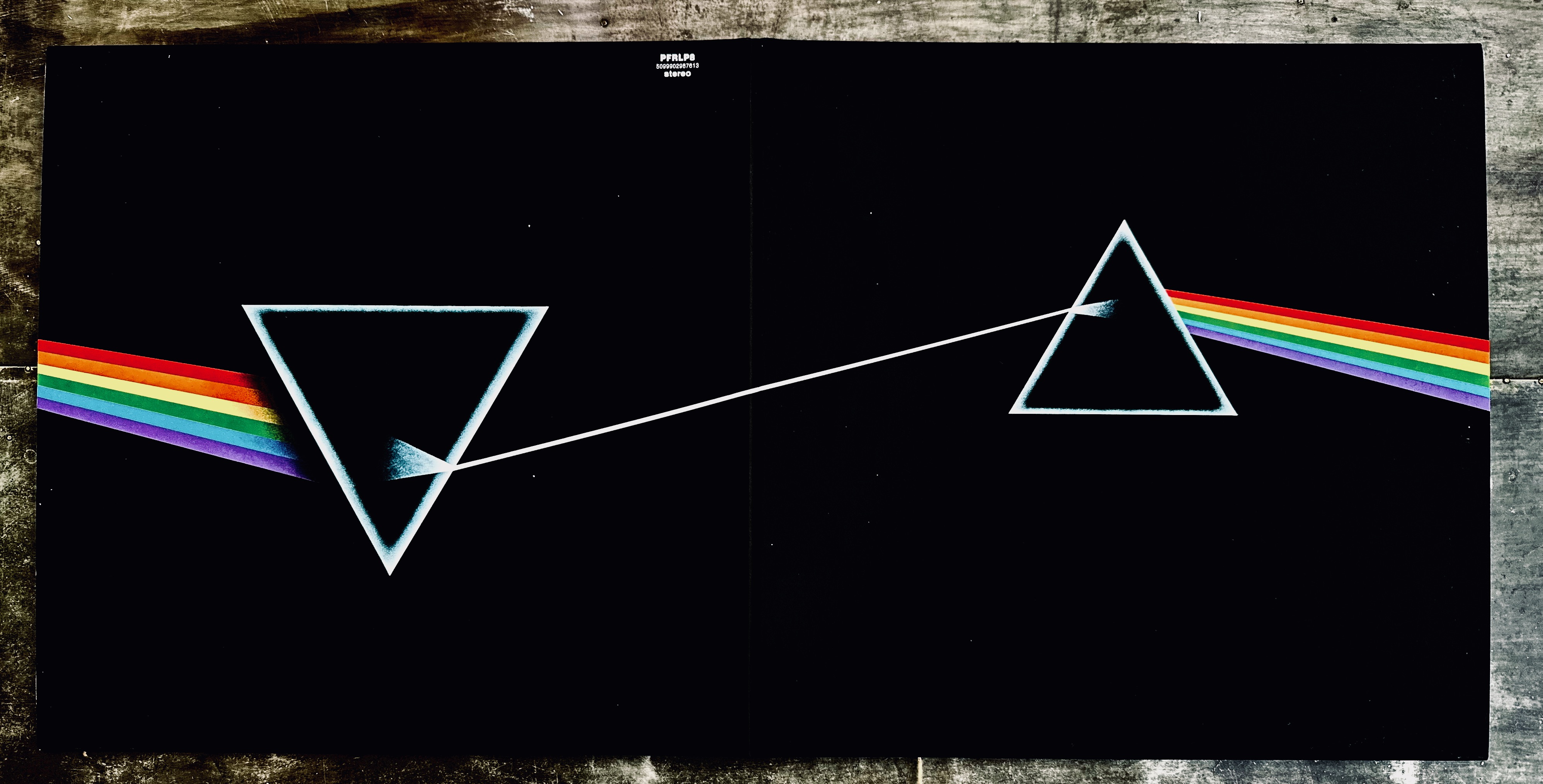
However, the album that still defines the Hipgnosis legacy - and possibly the entire genre of LP art - came in March 1973: The Dark Side Of The Moon. Thorgerson and Powell’s brief from Pink Floyd was to produce something uncomplicated, a contrarian response to opinions amongst the suits at EMI that their previous sleeves for the band had been belligerently obscure and even unmarketable. What they came up with - with a little help from a school book - was the now singular black cover with its beam of light dissipating through a prism into a spectral rainbow.

“I don’t think there was so much foresight and forward thinking in it,” says Mark Blake. “A lot of the time it’s ‘We’ve got to get a cover out - there’s a deadline looming!’. The band wanted something simple so Storm and Po found the prism design in a physics textbook and ripped it off, getting their illustrator George Hardie to create a beautiful design.” To make up for the spartan outer cover, Hipgnosis included some visual extras. “You got the poster of The Great Pyramid and a load of stickers,” says Mark. ”That was Storm trying to shoehorn some bigger ideas in.”

Nowhere on the front or back was there any mention of Pink Floyd or the album’s name. Though not the intention, it reflected an undercurrent of growing distraction within the band (Roger Waters has, with customary misery, described Dark Side as “the beginning of the end”), and the lyrical themes of greed, fame, mortality and even the mental decline of their founder Barrett. Wrapped in a package not dissimilar to a box of Black Magic chocolates, The Dark Side Of The Moon became the standout release of 1973, a year which saw records like Bowie’s Aladdin Sane, Led Zeppelin’s Houses Of The Holy (with a cover also designed by Hipgnosis), Mike Oldfield’s Tubular Bells and Bruce Springsteen’s Greetings From Asbury Park, NJ amongst its pantheon.

Mark acknowledges Dark Side’s enduring success but doesn’t attribute it entirely to the legendary artwork: “I don’t think that it is just down to having the boldness of not having the band’s name anywhere on the cover. I know it wasn’t the first time Storm and Po had done that with Pink Floyd or, in fact, another band.” Music, he says, has clearly been the album’s defining character, but over time the cover has contributed to the record’s legend, albeit contentiously for Hipgnosis: “I think they got paid about 500 quid all-in for that. Years later, Storm tried to get more money out of Pink Floyd because he believed that the cover had contributed more to the sales.”

To date The Dark Side Of The Moon has sold more than 45 million copies worldwide - and continues to do so, even reaching new audiences. My 18-year-old step-daughter asked for a vinyl copy for Christmas two years ago, and even this last December the LP was selling steadily when I visited Fopp! in Covent Garden. While it contains some of the Floyd’s most revered music - Breathe, Money, Time, Us And Them, The Great Gig In The Sky et al - that cover art has found itself peppered throughout the zeitgeist of the last 50 years. “I think both Storm and Po had a complicated relationship with Dark Side,” says Mark. “It’s not their favourite work, but it is their most famous work. It’s a very simple design but doesn’t have the narrative quality that Wish You Were Here had a couple of years later, which I think was certainly one of Storm’s favourite Floyd covers.” 

That record, released in 1975 as a follow up to Dark Side, came with a significantly larger production budget for Hipgnosis, which is how Powell ended up in California for three weeks, an entourage in tow, taking the Mono Lake shot. At the same time, he captured the faceless bowler-hatted man for the back cover (shot in the Mojave Desert), and the front cover image of businessmen shaking hands on a Hollywood backlot, with one of the two stuntmen used for the picture actually on fire - a stunt that almost went very badly wrong.

The story of Hipgnosis isn’t, however, exclusively the Pink Floyd Story. Their work for other artists was equally as distinct, and sometimes just as complicated, though Mark feels they never came up with anything as singularly impactful as The Dark Side Of The Moon. “They became the hip guys to go to after Dark Side and Houses Of The Holy, and also, weirdly, Wishbone Ash’s Argus. That was the album Jimmy Page saw in a record shop: when I interviewed him for the book, he told me ‘I saw this album with a Viking on the cover. I never listened to it but I liked the cover.’ So he rang up Storm and said, ‘Come and do our next album’ [for Led Zeppelin]. After that they got the call from Paul McCartney, who asked them to do Wings’ Band On The Run.” That cover, Mark says, was entirely McCartney’s idea, and famously featured a Clive Arrowsmith picture of Paul and Linda McCartney, Denny Laine, Michael Parkinson, Kenny Lynch, James Coburn, Clement Freud, Christopher Lee and John Conteh posing against a wall, illuminated by a prison searchlight. Still, it had a domino effect, bringing many more bands to Thorgerson and Powell’s door.

Genesis was another band that enjoyed a run of distinctive Hipgnosis-designed covers, commencing with 1974’s The Lamb Lies Down On Broadway - Peter Gabriel’s final work as lead singer and a concept album about a Gulliver-like Puerto Rican street tough descending into the New York underworld. Its literal cover - including a new band logo - was peak Hipgnosis. “Storm was incredibly principled about certain things,” Mark explains. “He would go to the ends of the Earth and spend his own money on getting a cover right. There were certain ideas he wanted to do for bands that they rejected because they wouldn’t have been able to afford it. Storm would do it anyway, just because he wanted to. But by the same token, if Pink Floyd turned an idea down, he’d have no hesitation in trying to fob it off on another band.”

10cc and Genesis were, in particular, beneficiaries of Thorgerson’s ‘generosity’: “The cover of 10cc’s Bloody Tourists is actually a picture of Powell with a map across his face in the West Indies. They pitched that to Genesis for …And Then There Were Three, with the idea that they’d just lost Steve Hackett [who’d quit the band in 1977] and they’re now looking for a new direction.” Genesis, Mark says, weren’t having it, so Hipgnosis took the concept to 10cc who did.

Peter Gabriel recounted a similar experience to Mark for his first three solo albums, which had Hipgnosis covers. Every time he met Thorgerson, he’d be told: “I’ve got a great idea for you, Peter,” to which Gabriel would say: “You’ve fucking tried that on Led Zeppelin, haven't you?”. Mark reveals: “Storm would reply: ‘Yes, but it's perfect for you!’ So, there’s this sort of reject pile that Gabriel would always be confronted by. With Storm it was a weird mix of being incredibly principled and that art is everything, to ‘just have this’.” The covers Gabriel eventually agreed to were markedly different to those Hipgnosis produced for his old band and their contemporaries. While still surreal, they featured distorted images of the singer himself, but to his American record company’s frustration, Gabriel was naming his albums simply ‘Peter Gabriel’, with their covers the only means of distinguishing them. Eventually, the American label would remarket them respectively as ‘Car’, ‘Scratch’ and ‘Melt’, based on the Hipgnosis imagery, just to help the hard of thinking.

If Sgt. Pepper changed the nature of album covers, the early 1980s brought two shifts in the medium itself with industrial developments that, indirectly, altered Thorgerson and Powell’s trajectories. In 1982 Philips and Sony heralded the digital music age by introducing the Compact Disc. The 12-inch canvas that Hipgnosis had made their own became increasingly redundant. Until Gen Z’ers discovered their parents and grandparents’ vinyl collections - and a new romance began with cover art, appearing on bedroom walls and irony-nodding T-shirts - the designs that stood tall in my teenage years became minimised to fit 12cm ‘jewel cases’. Later still, with the advent of streaming, cover art would be minimised further to fit the postage stamp-sized screen real estate of online services. 

Mark Blake
To Mark Blake, the CD’s arrival marked an important pivot away from the ‘long-player’: “That’s another thing that was appealing about doing this book,” he says. “The Hipgnosis story follows the arc of the LP as a medium, which really began with Sgt. Pepper, which was a game-changer in that sense. Suddenly the LP was king. Bands made albums and didn't have to do singles. But, as I’ve been told, the arrival of the CD was one of the reasons that made Hipgnosis decide to wind up the company and go into making music videos.” 

The arrival of MTV in 1983 was the next industrial change, providing Hipgnosis with a new outlet: “All the money that might have once gone into sending them to the Sahara Desert to photograph footballs in the sand for a cover was now being spent on videos,” says Mark. “So that’s why they wound up the company and decided make music videos, which they did for a few years quite successfully…until it wasn’t.” 

While one of their first forays was the clip for Paul Young’s Wherever I Lay My Hat, the video age brought Hipgnosis back into contact with some of their older clients, who were finding new fans through the medium. “They did stuff for Robert Plant and Jimmy Page’s bands,” says Mark. “Owner Of A Lonely Heart [the hit single that revived the fortunes of Yes] was another big one for Hipgnosis. They got in on the ground floor with these older bands trying to relaunch themselves and having to make videos. And obviously, the bands went to the very guys who’d made their album covers, because they figured that they’d feel comfortable with them.”

Although Hipgnosis, as an entity, was wound up in 1983, there is a coda to their greatest legacy in designing covers for LPs. Vinyl sales grew for the 15th consecutive year in the UK in 2022, reaching close to 5.5 million - the highest growth since 1990. What began as baby boomers looking to reconnect with their long-discarded copies of classic Beatles and Bowie records has been boosted by the record-selling phenomenon that is Taylor Swift, as teenagers, moving on from raiding their elders’ records, have adopted their own heroine in the Nashville star. Visit any record shop - from independents to the few remaining chains - and a miasma of album covers will greet you. 

So, is Mark Blake’s celebration of arguably the greatest purveyors of album art perfectly timed? Not necessarily, he says: ”The 50th anniversary Dark Side Of The Moon was the main reason for writing the book. The thing about [the resurgence of] vinyl is interesting, though. I’ve got a 17-year-old son, and when he was first looking through my old records, he said to me, ’Some of these covers would look great if you had them framed on the wall,’ which I think is quite interesting. He listened to Dark Side a couple of years ago, because he’d heard a lot about it - and probably because of the cover.” The vinyl upswing does help, says Mark: “It shows there’s an interest in it as a format, but I don’t think there would have been interest in [a book] ten years ago. We’re moving on to a time where people maybe are reassessing some of this stuff a bit more now, especially after the Pink Floyd exhibition at the V&A. It just feels a bit more timely now.”

Us And Them: The Authorised Story Of Hipgnosis by Mark Blake is published on 2 February by Nine Eight Books