Showing posts with label Peter Gabriel. Show all posts

Friday, 1 December 2023

Peter Gabriel’s i/o - slow train coming

Peter Gabriel has rarely, if ever, done things by convention. He left Genesis in 1975 just as they were filling larger venues and selling records in places other than just Belgium and Italy. When he launched his solo career in 1977 he abandoned the dull custom of titling albums by naming his first four ‘Peter Gabriel’, much to the consternation of his American record company. On the third of those albums he instructed Phil Collins to not use cymbals, purely to disrupt the drummer’s natural inclination to punctuate rhythms with them. 

For the 56 years Gabriel has been making music for a living he has seemingly trodden his own path - and at his own pace. Which, invariably, has been glacial. Those first solo albums came along at a clip – all four released in the space of five years - and even the gap between the fourth and the commercial triumph that was So was just four years. 

But then things started to slow, as a heightened celebrity took Gabriel off in different directions, and not always actually involving making music. The ‘divorce album’ Us appeared in 1992, and its successor Up in 2002, but since then Gabriel has been tinkering at this and that, side projects such as co-founding The Elders with Richard Branson and the late Nelson Mandela, and involving himself in the human rights foundation Witness. There were wildly esoteric ventures, such as Gabriel at his most Brian Pern-like, making music with bonobo apes at an ape language laboratory (apparently, they’re a thing). 

Occasionally scraps of music have been thrown out there - offcuts, apparently, gifted to soundtracks (and compiled into the wittily-titled compilation Rated PG in 2019). There have been more substantive ventures, such as Scratch My Back…, an album of cover versions twinned with responses from their originators, …And I’ll Scratch Yours, featuring creditable versions of Gabriel songs by Paul Simon, Lou Reed, David Byrne, Elbow, Arcade Fire and others. The New Blood album presented orchestral retreads of old Gabriel songs, while there has been the occasional tour, such as the surprise ‘Rock, Paper, Scissors co-headline trundle around North America with Sting. But for the most part, those who have stuck with Gabriel throughout his extended silences and dalliances with whatever-takes-his-fancy causes, there’s been nothing net-new to get stuck into. Until today. Well, until January this year, and every month since.

Picture: Instagram/@itspetergabriel

Let me explain: in October 2021 an Instagram post revealed that Gabriel has been recording at his Real World Studios complex with “a few familiar faces” - long-serving bassist Tony Levin, guitarist David Rhodes and drummer Manu Katché. And then nothing. Until last December when Gabriel’s revived ‘Full Moon Club’ digital newsletter turned up with a link to a brief video in which he declared: “I’m now surrounded by a whole tonne of new material. I’ve pretty much got an album ready, and it’s been a lot of fun playing with the band again.” 

Expectations raised, on 6 January this year Gabriel released Panopticom, the lead-in single from a new album that would be called i/o. In February came The Court, and then Playing For Time in March, but still no complete album. However, it what can be considered peak Gabriel, the releases were being timed to coincide with the lunar cycle, accompanied by an individual piece of bespoke art to add an extra dimension to the release. 

Before long it dawned on most that Gabriel was indulging in mischief. The lunar video updates, announcing the latest release were all part of a plan to put i/o out track by track, full moon by full moon (which meant that, bizarrely, there were two releases in August) - and for free.

Gabriel announces i/o on YouTube, December 2022

To add to the giveaway, each track was released in two versions - a ‘Dark Side’ mix by Tchad Blake and then later a ‘Bright Side’ mix by Mark ‘Spike’ Stent. In his last instalment Gabriel revealed that this drip-feed had been an “experiment”. Like his friend Brian Eno (who appears on the album), the studio is his laboratory, much as a real laboratory was the creative workshop for his late inventor father, Ralph. It’s where the album - named after the ‘input’ and ‘output’ connections on electrical equipment - explores the interconnectivity of everything, and the perils, pitfalls and benefits of the bigger questions being asked about technology’s future. 

Thus, i/o’s release today is something of a literal anti-climax, but there is logic to its approach. “There’s not a huge income from the streaming services,” he said of technology’s present in an interview with Mojo’s Mark Blake. “Some of the themes [on i/o] are about connecting with nature, so it felt appropriate to do something on every new moon, as our ancestors used to.” But while monthly releases via streaming platforms might be uber meta, some musical traditions haven’t been completely jettisoned: “We’re storytellers and we love stories. And there’s more of a story on an album than there is on a single track. But the world is moving in the direction of shorter, faster, and when the tide goes one way it’s attractive to go in the opposite direction. The slower, longer thing has its place, and I’m notoriously slow.” 

Listened to as a whole, Gabriel’s distinction between new and tradition makes sense. In both single and complete forms, the new music bears testament to his penchant for fastidious production, intricate layering and disparate instrumentation but, 21 years on since Up, there is a notable maturity to i/o, both in terms of the 73-year-old’s growing sense of mortality, but also his enduring fascination with a world continuing to evolve.

The ‘Dark Side’ and ‘Bright Side’ mixes of i/o

Panopticom directs that from the outset, in Gabriel’s own words positing an “infinitely expandable accessible data globe”, ‘The Panopticom’, which connects like-minded people to “see what’s going on” in order to make the world understand itself better, a notion inspired by the work of groups like Forensic Architecture, Bellingcat and the aforementioned Witness. With a similar bass riff to Digging In The Dirt, Gabriel’s confessional about marital breakdown, it combines grandeur with a singalonga chorus (though the line “Panopticom - let’s find out what’s going on” only just sits on the right side of dodgy…). As the first single off the first new album in 21 years, it sent up a bright red flare that Gabriel had not lost his mojo in terms of writing with meaning, purpose and intrigue. In fact, it’s a hallmark of the entire album, which paints alternating strokes of mood, energy and substance. 

The Court tackles the online age with a Cuban rhythm interspersed with the staccato refrain of “And the court will rise”, an acerbic reflection perhaps on the tendency for Internet platforms to be judge, jury and executioner on public discourse, and leads well into the i/o’s title track, which drives one of the album’s core themes, the philosophical consideration of human progress. The track i/o has a genuinely uplifting quality that on repeated hearings suggests an overwhelmingly optimistic view of “the interconnectedness of everything”.

Four Kinds Of Horses is one of the album’s highlights, and a dramatic, ambitious consideration of the contemporaneous themes of spiritualism and religion as they intersect with geo-politics. Developed out of a tentative collaboration with XL Records founder Richard Russell, it emotively combines an orchestral arrangement from John Metcalfe with Gabriel’s core band as well as keyboard layers from Eno. Gabriel’s singer daughter Melanie, who has toured with her father, also makes an appearance (“another lovely moment for a dad”). 

Anyone who has seen Gabriel live will attest to his dad dancing, (In Your Eyes, in particular), to which we can now add Road To Joy. It’s another big, brassy pop tune in the manner of Sledgehammer, which funks along foot-tappingly, and is blessed by backing vocals from the Soweto Gospel Choir (who previously appeared on Down To Earth, Gabriel’s theme song for Wall-E). But despite being seemingly infused with happiness, it’s not the clappy celebration of life it might appear to be on first listen. In fact, it based in another side project Gabriel is involved in, dealing with near-death experiences and ‘locked-in’ syndrome. It is nevertheless delightfully engaging. As is This Is Home, late on in the album, which started life as a suggested idea from DJ Skrillex about partying late into the night, before Gabriel turned it on its head by making it about family life, underpinned by a warming,  soulful groove.

The similarly up-tempo Olive Tree is about another ‘brain’ project, examining how interacting with nature can broaden the potential for enhancing the human experience. “Part of the theme of this song and of [i/o] really is that we are part of everything,” Gabriel explains, “but these natural worlds of non-human intelligence are out there and we haven’t yet been smart enough to understand what they’re communicating and how they communicate.” 

So Much, which features more of Metcalfe’s orchestration and Melanie Gabriel’s vocals, tackles ageing, but not in a maudlin sense. “When you get to my sort of age you either run away from mortality or you jump into it and try and live life to the full,” Gabriel explains. “The countries that seem most alive are those that have death as part of their culture.” Mortality, another theme of the album, appears in the contemplative, Randy Newman-esque ballad Playing For Time, which reflects on the passing of time. Having recorded Father, Son about his dad for the Up album, Playing For Time is a “an elegy of sorts” to Gabriel’s late mother Edith, who was his musical influence. “When my mum died, I wanted to do something for her,” he explained in the Full Moon Club release, “but it’s taken a while before I felt comfortable and distant enough to be able to write something. She loved classical music, so we have a beautiful cello playing there.” The song is full of childhood memories - ”some of which are good, enjoyable and positive and some of which are obviously sad, dealing with loss.” 

There is even more emotional heft at work in the beautiful, ethereal Love Can Heal, for me the standout song on the record. Written several years ago (and debuted on the tour with Sting, when it was dedicated to Jo Cox, the murdered Labour MP, whom Gabriel had met at a conference), it draws musically from what he calls a “sensual pallete”. It is a daringly soporific exploration of the role emotions play in human connectivity. “I know I bang on about this ‘emotional toolbox’ and how one of the roles of songs is the potential to change how you feel and change your mood according to what you’re listening to,” Gabriel says. “Hopefully, Love Can Heal has its place in this emotional toolbox.”

The core PG band - Tony Levin, David Rhodes and Manu Katché
Picture: Instagram/@itspetergabriel 

By the time i/o reaches its 12th and final track, the listener will have been through a range of emotions and music evoking a plethora of life experiences. The temptation is to think Gabriel is just another rock star in his eighth decade processing the years passed, but there is a settled acceptance to his songs, that age is just a number, and that despite the maths, there is plenty to live for. That is certainly the cause behind Live And Let Live, November’s final Full Moon release and a closing song to savour. The very last song to be completed, it’s about “forgiveness, tolerance and optimism”, but also about the positive impact music can have on the human mood.

In his Mojo interview with Mark Blake, Gabriel addressed his reputation for being somewhat dilettante: “If it’s fun and it’s interesting, I’ll do it”. i/o may have taken 21 years to release (in fact some of the songs on it go back even further in their origin), but it won’t necessarily be the another two decades before it gets followed up. “Who knows, I may just keep going,” Gabriel told Mojo, teasingly. There is even more new music in the works, though in what state of readiness - by Gabriel’s standards of perfection - remains to be seen. “I think you can over-saturate people and they get bored with you,” he said with knowing modesty. “One of the reasons I am still able to make a living doing this is that there are long periods of absence.” 

All of this might sound like Gabriel is a very serious man indeed. He is, but there has always been a twinkle in his eye. “I’m 73 now, at an age when I might as well just play around and have fun,” he told Blake. i/o may cover some complex even baffling themes, but you could never cause Gabriel of tossing off something generic or formulaic. If anything, he’s still not afraid to metaphorically walk on stage in a red dress and a fox’s head (as he did for real at a Genesis concert in 1972, much to the surprise of his bandmates). 

i/o gives firm demonstration that he refuses to become a heritage act in his dotage. “Sometimes you have to take the road that requires fear and courage,” he told Mojo. Doing things differently “makes it way more interesting for me”. He is happy to face rejection, if that’s what comes. Listening to i/o, that is not going to happen any time soon: it’s an album of rare consideration and deep thought about the world reflective of the length of time it has taken to reach these ears. While that world will have changed many times in the 21 years of i/o’s gestation, the final yards of recording and producing it have created an album of beauty, grace, intelligence and wit, qualities that you rarely come across in this day and age.  

Peter Gabriel’s i/o is released today on Real World Records

Wednesday, 11 October 2023

Cinema for the ears: Steven Wilson’s The Harmony Codex

Let me toot my own horn a little: in his memoir Limited Edition Of One, polymath musician, songwriter and producer Steven Wilson mentions me in a section about David Bowie (he traces his love of The Dame to the purchase, by my parents, of a copy each of The Laughing Gnome for our respective birthdays in 1973, which are only eight days apart, having known each other since infancy thanks to our mums meeting at post-natal clinic).

The only reason I mention this, apart from showing off, is that the same book contains a short story written by Wilson called The Harmony Codex. “Dystopian sci-fi,” he described it recently to the NME. “Like a lot of my music, it had a very dreamlike quality”. 

As the story was coming together Wilson was also working – in his customary restless manner – on his seventh full solo album under his own name. “As I was writing the story I was beginning to develop the initial ideas for this record [which has just been released and takes its name from the short story]. It felt logical to have a narrative feel to the songs, to match the cinematic quality of the music,” he continued in his NME interview. “It made sense to write an imaginary soundtrack for that short story, writing music based on its characters and ideas.”

The result is a multidimensional experience that is Wilson’s best solo record to date. But before I get into that, a little context: he has been at this game a very long time, producing his first music while still at school in Hemel Hempstead, and very quickly started building a music career via various projects and outfits like No-Man (with Tim Bowness) and Bass Communion. In the process he has explored myriad genres from trip-hop to jazz, ambient to prog rock (most notably with Porcupine Tree). His last solo album The Future Bites featured a spoken vocal appearance from no less than Sir Elton John, and its predecessor To The Bone included the ABBA-esque Permanating. None of this is pastiche, but a reverence and love for the panoply of popular music including, yes, pure pop (don’t get him going about The Rubettes…).

Despite all this, the standard line is to describe Wilson as one of those artists who people who know, know (implying that those who don’t, won’t). His reputation has been augmented further by becoming the go-to producer of multi-channel remixes of classic albums from everyone from King Crimson and Jethro Tull to Chic and ABC. And yet, if you sat opposite him on the Tube many probably wouldn’t recognise him as someone who has and does sell out arenas.

Die-hard fans, who packed out Wembley Arena last November (notably on my birthday) for a temporarily reformed Porcupine Tree concert indicated the level of fanaticism that follows Wilson around the world. “I’m in the enviable position of having a fanbase who almost expect me to do the unexpected,” he told the NME. “If they feel like I’m making concessions to the music industry, they spot it a mile off and rightly pick me up on it.”

A cute sentiment, but Wilson is also in the enviable position of being able to do exactly whatever he wants. With each solo album since 2008’s Insurgentes he has continually changed the complexion of his music, confounding those still of the stubborn view that he is a prog rocker in the tradition of bands like King Crimson and Genesis. In truth, Bowie has probably been his touchstone, just simply for never conforming to any one genre, and never standing still, either. And that’s quite a feat in itself.

“I always talk about people like Bowie and Zappa and Neil Young and Kate Bush as being role models, in the sense of how they conducted their careers - that constant sense of reinvention and confronting audience expectations,” he told that august organ The Spectator a couple of years ago (the interview’s standfirst contained the line “The most successful musician you’ve never heard of”). 

“At the same time, I’m also conscious that it was easier for them, because I live in the age of social media. The problem with social media is that you get a response within five minutes of doing anything. You release a new song into the world, which might be different to anything you’ve done before, and literally within minutes you have an incredible wave of feedback, much of which will be negative. And I’ve come to like that. Maybe I’m a masochist. I prefer that to the indifference that most bands who just recycle everything over and over again get. Like the fans will go, ‘We love this. More of the same’. I feel that’s too easy and too lazy.”

Lazy he has never been. Peter Gabriel has been working on i/o, his first album of brand new songs for 21 years and it still hasn’t seen the light of day as a complete work. I actually can’t count how much material Wilson has released in that time.

A limited edition of one - Steven Wilson
Picture: Hajo Mueller
You certainly wouldn’t call The Harmony Codex “more of the same”. Whereas The Future Bites took a knowing lurch into pop, it’s successor is still accessible but with more musical tangents, and arguably more interesting for it. Inclination opens the record with a pulsing drum beat reminiscent of the aforementioned Gabriel’s stunning work on The Last Temptation Of Christ soundtrack, and builds over four minutes into something similarly rooted in the desert heat of The Holy Land. It is more electronica than anything, with Slovak guitarist David Kollar performing a guitar solo that defies the laws of ‘soaring’ axe work in traditional rock music.

It is notable that for a musician who, in Porcupine Tree and the first part of his solo career drove an at-times heavy, metal-like thrash, electric guitars are used sparingly and texturally throughout The Harmony Codex. In their application, guitars are just some of the brushes in the artist’s jar, not driving songs but contributing to their palette.

Into this, Wilson has put together an extraordinary collection of guest musicians, contributing something distinctive to the different directions each song takes. Pink Floyd/David Gilmour alum Guy Pratt adds bass to the single What Life Brings (which also features longtime Wilson cohort Craig Blundell on drums). Another regular collaborator, keyboard player Adam Holzman (son of legendary Elektra Records boss Jac Holzman) pops up throughout the album, most prominently on Impossible Tightrope, a frenetic jazz-rock workout which harks back to Wilson’s third solo release, The Raven That Refused to Sing (And Other Stories). Another member of that album’s cohort, Theo Travis, provides a bonkers sax solo.

A calmer moment is provided by Rock Bottom, a duet with another of Wilson’s closest musical friends, the Israeli singer Ninet Tayeb (who also co-wrote it), and it is a beautiful, if slightly dark, love song which is also emblematic of the entire album’s exquisite production. It is in this regard that you recognise Wilson’s professed desire to create “cinema for the ears”. It’s no wonder, either, that he has invested a great deal of effort in the use of spatial audio technologies, and publicised the album’s release with a series of listening sessions around the world in which lucky punters were exposed to its full multidimensional effect.

I can’t begin to imagine what The Harmony Codex’s title song – for me an absolute highlight – must have sounded like in those listening environments. At almost ten minutes in length, it is a dreamlike experience, invoking the short story that inspired it. It reminds me greatly of Vangelis’s music for – yes, another film  - Blade Runner, and includes ethereal electric piano from Holzman as well as the first of two spoken word contributions on the album from Wilson’s delightful wife Rotem. It is as enigmatic as it is transporting. It is also unconventional, an ambient moment in the middle of an album, rather than the ‘slow one’ that traditionally ends it. “Part of this record is confidence from having done this for a long time now,” Wilson explained to the NME, “which means I can think ‘No, fuck it! I can put a 10-minute ambient piece on the same record as an acoustic song and an electronic pop song.’ It’s good to embrace that.”

The song that does end the ten-track album is Staircase, an epic, reflective track that warrants the involvement of Holzman and Blundell again, as well as Nick Beggs, another member of Wilson’s touring bands (and currently on the road with Howard Jones), who combine to create a song that both typifies past approaches (i.e. prog-ish) as well as Wilson’s drive to expand. 

It, too, is cinematic in its expanse, drawing reference to the Dutch conceptual artist MC Escher’s never-ending staircase (suggested in the album artwork). Written from a perspective that, I suspect, all of us in our mid-50s ponder on – the journey that has taken us to now – it also provides commentary on modernity: “Plagued by poor health/But you stockpile more wealth/Congratulate yourself/A sense of proportion/An act of extortion/There's too much distortion/You sink in stages/As you're approaching middle ages (You're up to here in debt)” trills its third verse. It ends with another appearance from Rotem Wilson, again speaking as the album oozes into another dreamscape facilitated by vintage synths (including the ARP 2600 that was a staple of the 70s).

For those who want more of The Harmony Codex there is more: an expanded edition includes remixes by, among others, Manic Street Preachers and Tears For Fears’ Roland Orzabal, underlining the point that for all of Wilson’s apparent anonymity, he can command the attention and involvement of some very heavy hitters indeed. 

It’s only what is deserved. He’s hardly flown under the radar these last thirty-odd years, and while some of that has probably suited him, to be at this stage of a career and still producing albums of this ingenuity, ambition and immersion, and not resorting to a lazy covers project, deserves commercial success as much as the acclaim that continues to come Wilson’s way.

The Harmony Codex is out now on Virgin Records

Friday, 14 July 2023

Squaring The Circle - the story of two of the most important figures in rock history

Aubrey ‘Po’ Powell and Storm Thorgerson
Picture: Hipgnosis

To men of a certain age – and it is, almost exclusively men – album covers are, or at least were, a big thing. They probably still are, but it’s actually hard to think of the last time you heard of an album cover making headlines in the age of streaming.

There was a time, though, when an album cover was almost as significant as the music contained on the vinyl within. Earlier this year I interviewed journalist Mark Blake about his book Us And Them, which tells the story of arguably the greatest purveyors of album design, Storm Thorgerson and Aubrey ‘Po’ Powell – collectively the design house Hipgnosis. Their work between 1968 and 1983 produced, most famously, the artwork for Pink Floyd (including their opus The Dark Side Of The Moon), but also more than 250 sleeves for artists as varied as Led Zeppelin, Paul McCartney, Peter Gabriel, Humble Pie, 10cc, Leo Sayer, Genesis, ELO, Black Sabbath, Olivia Newton-John and XTC. “The Hipgnosis story kind of follows the arc of the LP, and the LP ‘taking over’ from the single as the primary focus of bands,” Mark told me. “[The Beatles’] Sgt. Pepper’s Lonely Hearts Club Band was a game changer in that sense. So, their career follows the art where the LP was king.”

That career is now the subject of a film by Dutch director and photographer Anton Corbijn, himself responsible for iconic album art of his own, having been most closely associated with Depeche Mode and U2, as well as taking iconic images of everyone from Robert Plant and Jimmy Page, Bob Dylan, and Bruce Springsteen to Robert De Niro and Clint Eastwood. 

Squaring The Circle, Corbijn’s debut as a documentary maker (having previously made dramas like Control, about Joy Division’s Ian Curtis and The American with George Clooney), pays homage to trailblazing legacy of Thorgerson and Powell and how they took the concept of cover art - which, for most of the pop era had largely been portraits of the bands - to conceptual pieces of art which complimented or even extended the often progressive, lyrical nature of music they enveloped.

With archive clips of interviews with the late Thorgerson, narration throughout by Powell (who brought the idea for the film to Corbijn) as well as new interviews with the likes of Pink Floyd’s David Gilmour and Roger Waters, Sir Paul McCartney, Led Zeppelin’s Robert Plant and Jimmy Page, Noel Gallagher and Peter Gabriel, the documentary expands on the studio’s work amid the context of rock counter-culture.

Peter Gabriel’s first three, Hipgnosis-designed albums

“There was an enormous amount of goodwill towards Hipgnosis,” Corbijn told The Guardian recently about the involvement of many of Thorgerson and Powell’s muses. “People just wanted to make [the film] work. They were generous. Everyone was proud of their albums and the work they had done with them.”

“Growing up in the late ’60s and ’70s, I was obsessed with music and everything connected to it – especially the album covers,” Corbijn says as a pretext to the film, adding that “record sleeves were a huge part of my education. I clearly recall the moment I first saw the sleeve for Atom Heart Mother by Pink Floyd, and the Peter Gabriel sleeves [whose first three solo albums were untitled save for his name and an iconic image]. They just blew me away and this led me on a journey of discovery towards Hipgnosis, who designed these and some of the most memorable sleeves from that time.”

Without doubt, The Dark Side Of The Moon looms large in that pantheon, with Thorgerson and Powell knowing Pink Floyd since their school days together in Cambridge, before moving to London. “Hipgnosis were unique in these early days and they set the bar very high,” says Corbijn.

Thorgerson was very much the ‘ideas’ half of the duo, while Powell, a photographer, had a more instinctive, snappers approach. When combined with the creative freedom they were afforded by bands and their record companies, the gallery of Hipgnosis’ output deserves a chapter of its own in the history of popular music. “They conjured into existence sights that no one had previously thought possible,” says Corbijn. “They produced visuals which popularised music that had previously been considered fringe, and were at the white-hot centre of the maddest, funniest and most creative era in the history of popular music.”

Hipgnosis at work, 6 Denmark Street, London
Picture: Hipgnosis

Album sleeves, he says, during this period became a force in their own right. “In the ’80s, of course, we got CDs, so the album sleeve sort of deteriorated, and the art with it, Corbijn adds, saying that, as a photographer, he was drawn to Hipgnosis’ work by the images they used. He marvels at how they created works of art: “Before we had all the intricate things we can do now on the computer, they did it with a knife and glue, and pieces of paper,” he recently told Collider. “They made really incredible collages and made the impossible possible.”

As the film reveals, Thorgerson and Powell often went to great lengths - and expense - to produce their album art, notably the images for Pink Floyd’s Wish You Were Here album and, of course, the ‘flying pig’ cover for that record’s follow-up, Animals. It’s this ambition that inspired the documentary’s title. “‘Squaring the circle’ means doing the impossible, but it also represents the circular record going into a sleeve, Corbijn explained to The Guardian.

“One of the craziest things - it’s also in the film - is a sleeve for 10cc [for the Look Hear? album],” Corbijn recalled to Collider. “They saw the idea of having a sheep on a couch in a beautiful ocean. So they went all the way to Hawaii, not realising [there were] no sheep in Hawaii, and there were no [psychiatrists’s] couches either. So they had a couch made, and they had one sheep, they found one sheep at the university, and they managed to give it a lot of Valium and shot it.”

While Noel Gallagher quips in the film that album covers represents “the poor man’s art collection”, there’s no escaping the fact that Hipgnosis have produced some of the most recognisable images of all time, with The Dark Side Of The Moon’s light-entering-a-prism seared in culture (receiving no more prestigious a nod to the zeitgeist than being parodied in an episode of The Simpsons). “I think both of them have a complicated relationship with  Dark Side,” Mark Blake told me earlier this year. “It’s not their favourite work, but it is their most famous work. I don't think it's a very simple design, and it doesn’t have the narrative quality to it as Wish You Were Here did a couple of years later, which I think was certainly one of Storm’s favourite Floyd covers.  So, I think they're both a little bit conflicted about Dark Side, really.”

For his film, however, Anton Corbijn had to negotiate around the frail relationships that exist between the surviving members of the band, most notably the fractious dynamics between founder member Roger Waters and guitarist David Gilmour, who joined in 1967 as co-founder Syd Barrett’s behaviour became ever-more erratic. Barrett himself makes a brief appearance in Squaring The Circle, in a poignant moment when Powell recalls an overweight and almost unrecognisable Barrett visiting Abbey Road studios in 1975 during the recording of Wish You Were Here, by then succumbing increasingly to poor physical and mental health. It is, apparently, a moment that continues to move the band’s remaining members.

Hipgnosis images used for Pink Floyd’s Wish You Were Here album

“I guess everybody knows they have four managers these days – for every member there’s a manager,” Corbijn semi-joked to Collider with typically understated Dutch humour. “But I guess the love for Hipgnosis overrode all that, and they wanted to be part of this. I mean, they were not in the studio at the same, but they all said yes to it in the end.”

Pink Floyd, in particular, gave Thorgerson and Powell a platform. Their abstract, obtuse and often ethereal concepts led them to other exponents of early ’70s progressive music, like Wishbone Ash’s Argus, which in turn led to Led Zeppelin’s Jimmy Page inviting Hipgnosis to design the House Of The Holy sleeve (which depicted Northern Ireland’s Giant’s Causeway). That, then, attracted Paul McCartney’s attention, bringing the studio in to realise his concept for Wings’ celebrity-themed Band On The Run cover.

“I hope people see it as a fun documentary, as well as an educational one, regarding that period of music and graphic design,” Corbijn says of Squaring The Circle. However, it also addresses how the Thorgerson/Powell partnership came apart. Having moved to London during the 1967 ‘Summer Of Love’, the duo shared a South Kensington flat, first using university facilities to build their reputation for art (including their debut for Pink Floyd, A Saucerful Of Secrets in 1968) before opening the Hipgnosis studio at 6 Denmark Street - London’s musical mecca known as ‘Tin Pan Alley’. 

But by 1983 - a year after the launch of the CD - Hipgnosis as, largely Thorgerson and Powell (along with often forgotten Peter Christopherson) - they decided to call it a day. Powell addresses this in the film, breaking down in the process, much to Corbijn’s surprise. “I didn’t see it coming,” Corbijn says of the scene. “It was a beautiful moment in the film. He clearly misses Storm terribly.”

Po and Anton
Picture: Anton Corbijn

As much as Squaring The Circle celebrates an era of album covers that broadly paralleled the rock era itself, it also marks the decline of an art form, first by the introduction of the Compact Disc in 1982 (Hipgnosis gave up album design in 1983 and switched to making music videos) and more recently, by the advent of streaming. It’s a point Noel Gallagher makes in the film, highlighting the lack of appreciation for album covers shown by today’s younger consumers, which may be the result of both record companies trimming their artwork budgets, and the thumbnail formats of streaming platforms making the impact of album cover art negligible. “The importance of the record sleeve has diminished,” Corbijn agrees. “In the ‘70s, for young kids there wasn’t much else to spend money on. Yet you had to save up to buy something, so it was meaningful. Now nothing is meaningful because you can get it at the touch of a button.”

Squaring The Circle opens today in UK cinemas and via streaming services. It also be released as a collector’s edition Blu-ray Disc on 7 August.

Arc Of A Diver, my post on Mark Blake’s biography Us And Them can be read here.


Tuesday, 20 June 2023

A midsummer night’s dream - Peter Gabriel at the O2 Arena

Picture: York Tillyer

It’s been 21 years since Peter Gabriel last delivered a full album of net-new material. Children have been born and graduated in that time. I’m now three years older than Gabriel was when he last put out an entire collection of properly original songs. Not that he’s been a recluse: there have been contributions to soundtracks here, collaborations with other artists there, and a couple of cover version projects. But that aside, nothing box-fresh. We have, though, had six tours, of which I’ve seen five, only missing out on his ‘Rock, Paper, Scissors’ double-header with Sting.

However, there is a glimmer of hope on the horizon. In principle, the 73-year-old has been working on a new album for most of those 21 years, but it was only photographs this time last year of Gabriel and long-term cohorts Tony Levin, David Rhodes and Manu Katché at work at his Real World Studios near Bath that confirmed a tenth solo studio album was “on”. But, being Gabriel, and with the middle of 2023 now reached, the semi-mythical new record is still months away. 

This might be, simply, Gabriel’s customary glacial rate of progress: interests and causes constantly throw him off schedule. Or equally, he’s simply teasing. Maybe it’s the latter. There have, in fact, been new releases since the beginning of the year. Six songs, to be precise, each introduced in typically Gabrielesque manner to coincide with the lunar cycle. “I’m an awkward sod,” he told Uncut’s Michael Bonner in March. “I like doing things differently, if I can. I’m 73. At this point, it doesn’t matter what other people say. I listen, still, to people who I think are wise and smart and have good taste. Generally, though, I’ll end up doing what I think will be either fun or interesting.”

He has earned that right, and not always with the recognition his notoriously sporadic output has deserved. While never regarded with the same chameleonic awe as David Bowie, across nine solo studio albums so far, four soundtrack projects and myriad one-offs, produced a body of work as intriguing, compelling and as invariably confounding as anyone I can think of. I’m somewhat biased, of course. Having been first introduced to Gabriel via his seven-year tenure as lead singer and figurehead of proto-prog era Genesis, his solo albums (the first four simply titled Peter Gabriel to encourage the cover art to make each record stand out...although I suspect some wry record label trolling was also at play) have been nothing short of eclectic. Classic rock, soul, funk, gospel, Afro-beat, Indian themes, Aboriginal influences, electronica, barbershop jazz - you name it, they’ve all featured.

Surprisingly, there’s been more commercialism in that array than some might recognise, what with hits like Solsbury Hill, Games Without Frontiers, Shock The Monkey, and then the pop phenomenon that was the So album, with Sledgehammer, Don’t Give Up and In Your Eyes. But as the period between albums has stretched out - the first four made over five years, then gaps of four, six and ten respectively, before the two-decade elapse since 2002’s Up - Gabriel has also found plenty to with which to dilly and dally.

Peter Gabriel plays live - by yours truly in Smash Hits, 14 July 1987

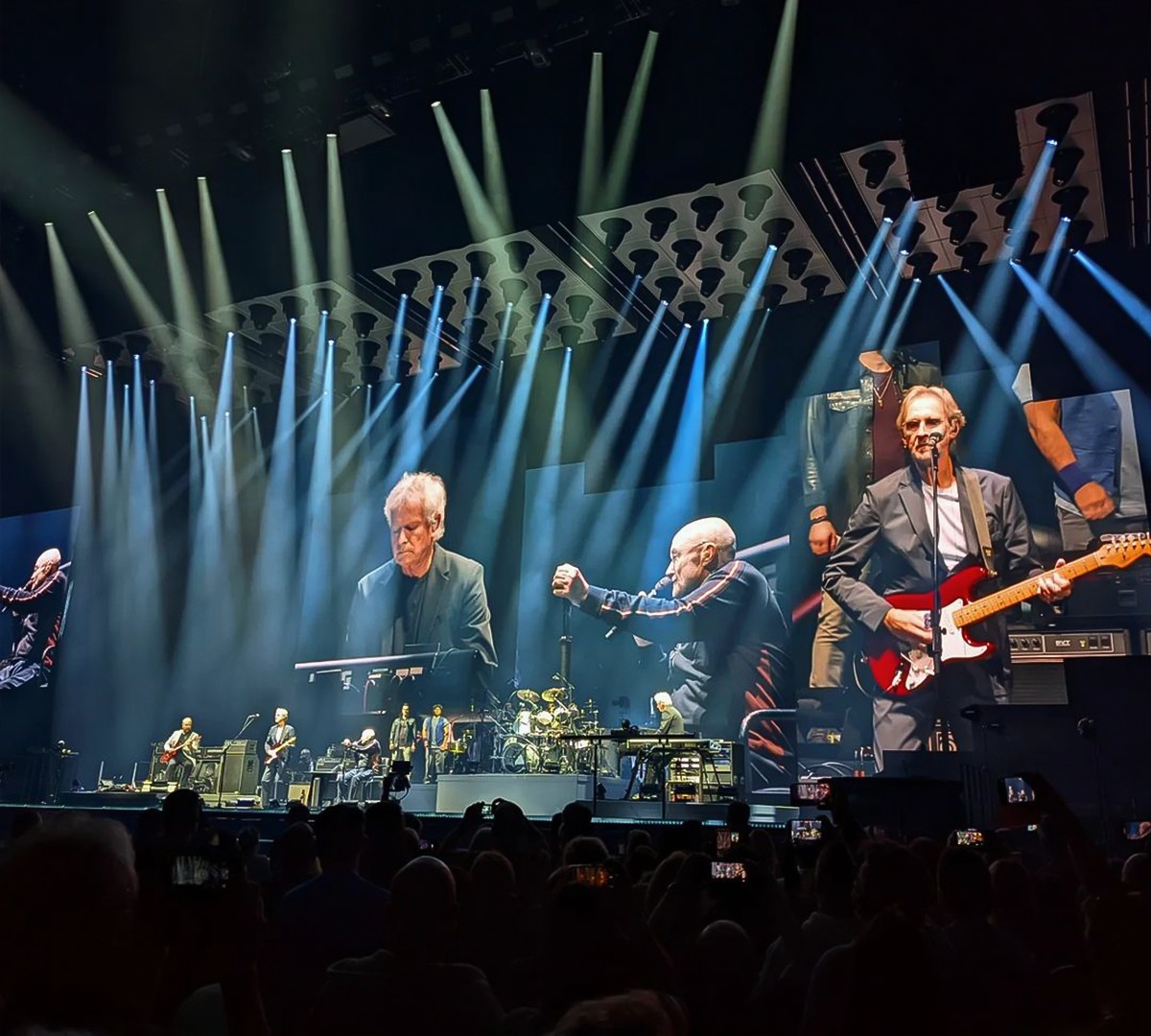
At the O2 Arena last night - the seventh time I’ve seen Gabriel play live since 1987 - the 46-year expanse of Gabriel’s solo career was condensed into almost three hours, separated by an interval, and given fresh impetus. As with any well-established act, there are the expected staples: the now-customary finale of In Your Eyes followed by Biko (in 1980, one of the first mainstream rock songs to address apartheid), the feelgood Stax energy of So’s Sledgehammer (oddly sequenced at the end of the first set before the interval) and Big Time, the intimate optimism of Don’t Give Up (backing vocalist Ayanna Witter-Johnson stamping her own signature to mesmerising effect on Kate Bush’s duet role in the original). These are what many, if not most, of the punters have come to hear. 

This, though, raises questions about the back-to-front commercial wisdom of the 22-song set including a whopping 11 new pieces drawn from the forthcoming album i/o. It’s easy to assume that this is peak contrarian Gabriel - especially as the i/o Tour is not actually in support of the near-mythical new release, the date for which is still not confirmed. In the end, it was a masterstroke. This was, essentially, a preview of the new album on a grand, arena-sized scale. Gabriel has used tours in the past to preview works in progress, but here in North Greenwich, the new material was brought spectacularly to life. 

Even the six new songs released so far, were given bigger and bolder expression in the O2’s expanse. Lead-off single Panopticom, Four Kinds Of Horses and the i/o title track (named after the computing acronym for “input/output”) bounce expressively, their instantly singalongable choruses underpinned by stalwarts Levin, Rhodes and Katché’s combined rhythms. Along with The Court, Playing For Time and Road To Joy, the new songs bloomed into dimensions that seemed familiar and new in equal measure. Those we hadn’t heard before also seemed to fit effortlessly into the programme: Olive Tree, for example, seemed like it had come from a 1980s soundtrack album without sounding out of place in a trio of new songs that included the aforementioned Playing For Time (featuring the studio recording’s Tom Cawley on piano) and the warm reflection on domesticity, This Is Home. 

The one misfire of the entire evening was another new piece, And Still, inspired by the loss of  Gabriel’s mother. Not that it won’t have its place on the new album, but coming after the searing brilliance of Red Rain, it seemed downbeat and out of kilter with the general upbeat mood of the evening (much the result of the ensemble Gabriel has placed around him on this tour - which also includes guitarist Richard Evans, Witter-Johnson on vocals and cello, Marina Moore on vocals and violin, Josh Shpak on brass, along with the very funky keyboardist Don E).

“There’s always a trade-off,” Gabriel explained in one of his monthly Full Moon Club newsletters. “People generally want to hear what they know and the artist generally wants to play the new stuff. So, I think there’s a sort of barter thing where you have to suffer enough new numbers to get to hear the old ones. It’s always been a bit like that with me, but I think this is a strong batch of songs. They’re not all up-tempo, but I feel they’re certainly being played with a lot of heart.” 

Levin, Gabriel and Rhodes - not a comb between them
Picture: York Tillyer

In the early days of Genesis, Gabriel wore masks and costumes to ‘act out’ the invariably complex narratives of their lengthy fantastical songs. He would also tell ponderous, meandering stories between songs, largely to allow Mike Rutherford and Steve Hackett time to retune their twelve-string guitars. Some of this was a front, mere armour to shield his shyness, but also - in his own words - to “command an audience”. Five decades on, he’s still giving ponderous introductions, largely to explain what his songs are about. While mostly worthy, they are also sincere, and delivered with a wry sense of self-depreciation. And while the costumes and greasepaint have long been abandoned for stage clothing redolent of his world music interests, the singer who once bunked out of Charterhouse to see Otis Redding play the RamJam Club in Brixton is still prone to dad-dancing routines to accompany his livelier songs, like Solsbury Hill and In Your Eyes. Rather than being embarrassing, it’s endearing. By the evening’s end, and a somnolent, cavernous drum beat heralds the traditional ending of Biko, the crowd knows the score, clenched fists punching the air in solidarity to the “Heh! Heh! Heh! The man is dead, the man is dead” township refrain.

When the new album i/o eventually arrives, and lyric sheets and press releases can be pored over, the disparate, encyclopedic themes that Gabriel has always pursued will be explored in more depth than via, for most people, their first listen live. It’s part of my fascination with the multiple dimensions he brings to bear with his work, especially with a penchant for eccentric wordplay. When he officially left Genesis in 1975, he released a statement to Sounds newspaper which concluded:

“The following guesswork has little in common with truth: Gabriel left Genesis.
1) To work in theatre.
2) To make more money as solo artist.
3) To do a ‘Bowie’.
4) To do a ‘Ferry’.
5) To do a ‘Furry Boa round my neck and hang myself with it’.
6) To go see an institution.
7) To go senile in the sticks.
I do not express myself adequately in interviews and I felt I owed it to the people who have put a lot of love and energy supporting the band to give an accurate picture of my reasons.”

Such witticism (which found its way into songs like Games Without Frontiers and Sledgehammer) is there on the new songs, but used to cover pet topics such as utopianism (Panopticom), dystopia (The Court) and environmentalism. But, if their unfamiliarity to new ears might be unsettling, audience engagement is undimmed. “Now we’re going to do something new” is usually the cue for a bar stampede, which suggests that devoting half the set list to songs from i/o  would seem instinctively risky at best. But it’s here that you realise that Gabriel - even if never the first name on people’s lips when you invite them to name a rock legend - has earned that respect over 56 years as both a frontman and originator of, in his words “awkward”, yet utterly inventive pop music.

Absence does make the heart grow fonder, but there have been times when it has felt like Gabriel’s almost fan-trolling ponderousness in the studio might have tested that allegiance. “It’s been a while since I’ve been touring, but I am thoroughly enjoying it. We’ve had lovely audiences and I think it is a really extraordinary band, so I am delighted with that,” he wrote in his latest Full Moon Club update. 

For all the human rights causes, obscure artistic rabbit holes and other tangents that will have understandably drawn irate cries of “Just get on and make a new record, will you?!” from his fanbase, his emergence, on this tour and with the prospect to come of i/o, reawakened my belief that Gabriel is one of the most compelling artists in the business.

Friday, 6 January 2023

Light side of the moon - Peter Gabriel is back!

Picture by Nadav Kander
To those that believe in such things, the moon is, apparently, a symbol of femininity, a notion loosely related to the fact that the average length of a menstrual cycle matches that of the lunar phases. Thus, many cultures associate the moon with fertility. It’s fascinated Peter Gabriel for many years, even creating ‘The Full Moon Club’ on his website more than 20 years ago as a platform for monthly updates about the singer’s activities. Not that, in the 20 years since, there’s been much to update. 

That’s because Gabriel is a notorious dilettante. By his own admission, he is easily distracted by causes, projects and diversions that take his fancy. That has meant new music over the last two decades has been thin on the ground. Since his last studio album, 2002’s Up, there have been sporadic contributions to soundtracks, compilations, tours on his own and with Sting, but nothing as substantial as a brand new Peter Gabriel album.

To say that the gestation of a Gabriel record takes a while is an understatement. Hope was raised of new material in October 2021 when pictures appeared on Gabriel’s Instagram channel of work going on at the singer’s Real World Studios complex near Bath together with long-term cohorts Tony Levin on bass, David Rhodes on guitar, Manu Katché on drums. It would be another 13 months before Gabriel would announce plans to release a whole new album - i/o - this year, along with a tour.

Fittingly, then, on the day of a full moon, Gabriel has today dropped a new single, Panopticom. Reassuringly, this isn’t another random one-off release (his last, 2016’s I’m Amazing, which was partly dedicated to Muhammed Ali, appeared as merely a promotional tool for a tour, and had been been plucked from storage, having been written several years before). Instead, it is the first release, proper, from the new album, and significantly features Levin, Rhodes and Katché, as well as electronic noodlings from Brian Eno, reconnecting with Gabriel almost 50 years after Roxy Music ‘lent’ him to Genesis to provide “Enossification” to The Lamb Lies Down On Broadway album.

On first listen, Panopticom combines Gabriel’s customary layered approach with a sonic abstraction, building slowly on an electronic bed with an understated vocal that opens out into a rousing second half. Equally customary is that the single is based on some deep conceptual thinking, “an idea I have been working on to initiate the creation of an infinitely expandable accessible data globe: The Panopticom,” Gabriel says in a press release. “We are beginning to connect a like-minded group of people who might be able to bring this to life, to allow the world to see itself better and understand more of what’s really going on.”

Gabriel says the single’s lyrics are part inspired by the work of organisations like Bellingcat and Forensic Architecture, as well as the human rights group WITNESS that Gabriel himself co-founded. 

“Some of what I’m writing about this time is the idea that we seem incredibly capable of destroying the planet that gave us birth and that unless we find ways to reconnect ourselves to nature and to the natural world we are going to lose a lot,” he explains further in the press release. “A simple way of thinking about where we fit in to all of this is looking up at the sky...and the moon has always drawn me to it.”

Each new release from i/o be accompanied by a piece of art. For Panopticom it’s ‘Red Gravity’ by David Spriggs, an artist Gabriel noted for his recurring themes of surveillance. “David does this amazing stuff using many layers of transparencies so you get these strange creations with a real intensity to them,” says Gabriel. “Part of what he does is imagine what art might look like a few years in the future and then try and create accordingly and I think he’s done that very successfully in this particular piece.”

Concepts like these have been a constant for much of Gabriel’s 55-year career, even with his poppier songs, like Shock The Monkey or In Your Eyes. It is what has made him one of the most fascinating - if infuriatingly slow - creative forces in music. Nothing - even the hat-tip to Stax that Sledgehammer was - have sounded like anything else out there, and to that extent his solo work is timeless. However, the paucity of new material over the years has been largely the fault of Gabriel himself and his constant distractions. 

The one-offs and the Scratch My Back/New Blood projects, which saw Gabriel re-record his own songs as well as those of his favourite musicians with an orchestra, have provided moments of interest, but haven’t compensated for the lack of truly original new music, of the depth and richness of his de facto solo albums. Those, too, have been few and far between: his commercial breakthrough, So in 1986, was a fifth studio album in ten years (and the first not to be simply called ‘Peter Gabriel’). But since then there were only two additional non-soundtrack or live albums - Us in 1992 and then Up ten years later.

Pictures: Instagram/itspetergabriel/York Tillyer

Panopticom gives hope that i/o will fill the ever-widening gap since that last album, and my initial take is that it certainly gives reassurance that the work Gabriel has put in at Real World with Levin, Rhodes, Katché and others will deliver another gem which can genuinely be regarded as unlike anything else out there.

Listen to Panopticom via your preferred audio platform here

Thursday, 13 October 2022

A step back in time

© Simon Poulter 2022

In 1978 Genesis had a hit with the love song Follow You, Follow Me, which marked a sea change in their concert clientelle. At a stroke, the band have noted, there were exponentially more women at their gigs. For the previous ten years, they’d been mostly patronised - again in their words - by men wearing army surplus greatcoats and carrying notebooks in which to record their thoughts about the noodly progressive rock they’d come to consume.

From that moment, Genesis would go on to become one of the biggest pop-rock bands in the world, still rooted in the progressive genre, but with shorter, MTV-friendly songs leading their repertoire. Steve Hackett, who until 1977 had been the band’s highly innovative lead guitarist (he invented the ‘tapping’ technique later made famous by Eddie van Halen and numerous other long-haired headbanging axemen), had left to pursue a solo career, just before this transition in the band’s fortunes. And, yet, for those still attached to the band’s arguably most novel era - with Peter Gabriel as its frontman, replete with his costumes, characters and penchant for lyrical theatricality - Hackett continues to keep the flame alive.

© Simon Poulter 2022

Which is why the crowd queuing outside the Eventim Apollo (the venue better known to old heads like me as Hammersmith Odeon), appeared to be 50 year-aged versions of those earnest young men in their army greatcoats. Paunches were in evidence, while some of those who still had hair had it tied in ponytails, despite expanding bald patches. This meant invariably finding yourself standing next to someone looking exactly like The Simpsons’ Comic Book Man. I do say this from a point of smugness at having a full head of hair.

Once inside, however, with the lights down, such cosmetics count for nothing. Hackett and his band - which includes longstanding keyboard stalwart Roger King, second guitarist Amanda Lehmann, bassist Jonas Reingold, flautist/saxophonist Rob Townsend and drummer Craig Blundell - launched into a first half of songs from Hackett’s early solo ventures, such as Ace Of Wands, The Devil’s Cathedral, Spectral Mornings and Every Day. All very good, but it was, I suspect, the second act of the evening that most punters had come to hear - the 1972 Genesis album Foxtrot performed in its entirety.

Being only 5 at the time it came out, I would have missed the original tour for this album, which included Gabriel’s notorious (and, to his bandmates’ surprise) appearance in Dublin wearing a scarlet dress and a fox’s head (a literal representation of the Foxtrot album cover), commencing the costuming that would become the hallmark of his time as Genesis frontman until his departure in 1975. So it would be fair to say that my interest last night at the Apollo/Odeon was to experience something of the magic of an album that, while not changing the band’s financial fortunes, is still held in the hearts of fans as being one of considerable virtuosity, with a still-young band of gifted musicians writing complex songs about complex subjects.

© Simon Poulter 2022
Opening with Watcher Of The Skies, a tribute to an Arthur C. Clarke novel with a bit of Holst’s The Planets thown in, Hackett introduces his vocalist Nad Sylvan, the gloriously eccentric Swedish singer who, vocally sits between Gabriel and his successor, Phil Collins, but despite his long blond Scandi hair and somewhat theatrical mannerisms, blends into the band canvas, rather trying to take centre stage, as Gabriel would have done in 1975. 

Foxtrot’s first side is worked through in sequence, including the prescient social commentary of Get ’Em Out By Friday (a somewhat dystopian Gabriel song about a 70s newtown in which the idea is floated to have residents genetically shortened so that they fit smaller homes in order to build more of them). There is, too, Can-Utility And The Coastliners, a rare early Hackett composition, losely based on the story of King Canute who, you might remember, ordered the sea to be turned back in response to lickspittle sycophancy, something rock bands will know a thing about. 

To replicate the flip from Side 1 to Side 2 of Foxtrot, there is a mini interval, after which Hackett is provided with a classical guitar and a stool. Performing alone, Hackett plays Horizons, a beautiful, baroque instrumental which, in Hammersmith, underlines Hackett’s status as an under-appreciated classical guitarist (he has produced several albums of classical playing, alongside his rock releases). Faithfully following the album’s track listing, it’s a precursor to one of the most adventurous pieces of music any band has ever pulled off: Supper’s Ready. 

No doubt part-inspired - or at least encouraged - by the 16-minute, eight-song closing medley on The Beatles’ Abbey Road, over the course of seven parts Supper’s Ready romps through a variety of time signatures and themes, starting with the ghostly apparition Gabriel claimed to have seen, through the Lewis Carrroll-esque whimsy of Willow Farm, to the epic conclusion of  As Sure As Eggs Is Eggs (Aching Men's Feet), with its biblical reference to “a new Jerusalem”. Perhaps, on the original record, it appeared more as a collection of songs, but hearing the enture 23-minute suite performed live for the first time in my lifetime, there is an added power to the song that not even the rendition on the imperious live album Seconds Out (during the mixing of which Hackett quit the band) captured.

Many, many years ago, for only my second live review for the NME I saw Sade at the Royal Albert Hall, and was struck by the somewhat clinical, sterile recreation of the Diamond Life album that had propelled her to stardum. Live performances work best when there is some reinvention, either to mitigate the inability to recreate complex arrangements created in the studio, or simply to indulge the artist’s whimsy, and introduce some riffing. Hackett has no need for either. With a piece as intricate as Supper’s Ready - and indeed the entire Foxtrot album - there was no need for embelishment.

© Simon Poulter 2022

This applied, too, to Firth Of Fifth, the grandiose epic on Selling England By The Pound that opens with an extended piano solo - played by Tony Banks on the original, and here faithfully and expertly recreated by King - before the song opens out, heading towards its somewhat legendary guitar solo. I once made a tit of myself when interviewing Hackett, in which I told him that, as a 13-year-old, I’d learned to play the solo, note-for-note, on my Spanish guitar. He was suitably unimpressed. It is still one of the greatest rock guitar solos of all time, though usually criminally overlooked by Jimmy Page’s on Stairway To Heaven, or David Gilmour’s on Comfortably Numb.

Solos are, of course, one of the nadirs of rock concerts. This Is Spinal Tap captured the indulgent absurdity of it, and there is a taste of this with an extended bass solo by Reingold earlier in the show. Blundell introduces the final song of the night with an elongated workout on the drums, but I’ll give him that for two reasons: 1) Craig is a thoroughly decent bloke who recorded a video of encouragement for a friend of mine after she was caught up in the 2015 Bataclan attack and took up drumming as a coping mechanism; and 2) Collins and his co-drummers (Chester Thompson and, briefly, Bill Bruford) would perform a drum duet as a prelude to Los Endos, the closing song of the Trick Of The Tail album whenever it was played live. And thus, Los Endos closes the evening with Hackett and Co in all its grandeur.

I’ve often maintained Trick Of The Tail and Wind & Wuthering, the albums that bore Hackett’s final studio contributions to Genesis, are two of the band’s best, bridging the lyrical and musical flights of fancy of the Gabriel era, and predating the pop orientation that Collins, Banks and Mike Rutherford as a trio went for in the 80s. There have been claims that Hackett’s contribution to the band, over the six albums in as many years, has been diminished. Part of this maybe due to the dominance of writing by Gabriel, Banks and Rutherford, and then the perceived commercial success that Collins’ higher profile led to, long after Hackett had left. But listening back to the albums he played on, his guitar work plays a much bigger role in the soundstage than is ever given credit for. 

In Hammersmith last night, we were given a highly enjoyable reminder. His solo material notwithstanding, I suspect the majority of last night’s punters were there for a trip down Memory Lane. And they would have been richly rewarded. Compared to the disappointing final experience of Genesis, earlier this year at London’s O2 Arena, this felt like the real deal. A wallow, yes, but a thoroughly enjoyable, comfort food-for-the-ears indulgence, provided authentically by the original purveyor. 

Friday, 1 July 2022

Three's company - Porcupine Tree return with Closure/Continuation

News that Peter Gabriel is recording what fans hope will become a new album was a painful reminder that the famously dilettante singer hasn’t actually released any new music for 20 years. Given how long it takes to physically manufacture a new album these days, with our new-found love of vinyl, that interval could stretch to 21. 

It’s a point that resonates with Steven Wilson, founder, lead singer, guitarist and latterly bassist of “alternative” band Porcupine Tree. In November they announced their first new album since 2009, but it has taken until now for Closure/Continuation to appear. But what, though, is eight months when the album has actually had a gestation period of an entire decade? 

In the 13 years since that last release, The Incident, Wilson, drummer Gavin Harrison and keyboard player Richard Barbieri have done their own things: Wilson, a series of acclaimed solo albums that have finally achieved for him some mainstream attention; Barbieri has focused on his own solo releases while Harrison has undertaken numerous gigs with various outfits including King Crimson.

The band’s last hurrah came 12 years in October 2010 with the tour for The Incident culminating in a prestigious, sell-out show at the Royal Albert Hall, a milestone for a band that had been used to playing venues a fraction of the size. The Incident was played in its 55-minute conceptual entirety which, Harrison states during a Q&A session on the day of Closure/Continuation's release, was limiting. Barbieri says that he needed a break, particularly from two decades of the album-tour-album-tour cycle. 

Picture: Facebook/Porcupine Tree

Wilson is more forthright: in his excellent recent autobiography, Limited Edition Of One*, he describes the awkward atmosphere as they prepared for the Albert Hall gig, even admitting his own insecurity as a frontman about to perform at the biggest show of his career. However things ended 12 years ago, the trio (original bassist Colin Edwin’s relationship with the band can be classed as ‘estranged’) is open and honest about it, and make that clear during the Q&A (in Kingston-upon-Thames, by chance, Wilson’s birthplace).                              *Full disclosure - yours truly is mentioned in a chapter about David Bowie

It certainly hasn’t proven to be a barrier to reform and record and release an album with as deliciously ambiguous a title as they have. Not surprisingly, they won’t be drawn on whether Closure/Continuation implies future collaboration under the PT brand. Wilson, in particular, felt pressure to justify the redux: “I wanted to make absolutely sure we had a killer record,” he told Music Week. 

“There’s so many precedents for fans putting pressure on bands to get back together, and when they do come back, it’s very mediocre and watered down, with all that intensity and momentum they had in their prime no longer there. We were conscious that we wanted to make one of the best records, if not the best, we’d ever made... Almost by stealth, we’d created one of the strongest albums we’d ever made.” 

With Closure/Continuation going straight to No.1 in the British, German, Dutch and Swiss album charts - a first for either the band or its constituent members - the ‘cult’ of Porcupine Tree may finally be catching up with something many have known for a long time: they deserve greater awareness and greater success. “The legend of the band seems to have grown,” Wilson added to Music Week, “to the point that we have more people interested now than at any other time during our previous lifetime.”

 Of course here I must reluctantly address the room-sized elephant that is the ‘P’ word: prog. For much of his career, Wilson has been tagged - lazily - as some latter-day saviour of progressive rock, the last Jedi keeping alive a flame lit all those years ago by Sgt. Pepper, Bowie, King Crimson, Yes, Genesis, et al. While he is no doubt flattered to be included in such exalted company, I know the prog thing rankles. “We are ‘alternative’,” he explains to the Kingston audience, acknowledging that journalists - mainly - have an inherent need to categorise. “[Porcupine Tree] took this element of complex, conceptual rock,” he recently told Super Deluxe Edition’s Paul Sinclair, “and we fused that with Richard’s sound design and approach to keyboard textures, Gavin’s interest in polyrhythms, my singer-songwriter sensibility, even elements of electronic music, industrial music – even metal music – and we put it all together in a way that was completely intuitive and unselfconscious.”

I know from personal conversations I’ve had with Wilson that his musical heroes, like David Bowie or Kate Bush, managed to be creative, inventive, never derivative – progressive – without having to labour under a label. “I would love to believe that after 30 years doing this, and having made lots of many different kinds of music over the years, that this notion that I’m somehow easily categorisable in one genre shouldn’t apply anymore,” he said in the SDE interview

Despite Wilson’s growing reputation as a solo artist (his last album featured a vocal contribution from Sir Elton John, and Nile Rodgers remixed one of its singles), Porcupine Tree is still very much an entity in its own right. In truth, the post-Albert Hall hiatus didn’t really last all that long: in 2012 Wilson popped over to Harrison’s house for a cup of tea which turned into an impromptu jam session between mates. With Harrison drumming and Wilson riffing away on a borrowed five-string bass guitar, they came up with Harridan, the formidable opening track of Closure/Continuation, which marries Wilson’s funk-like thudding to a distorted electric piano. All reminiscent of the jazz-fusion elements of the singer’s first couple of solo albums as well as PT’s own distant past, perhaps providing a subconscious bridge to the future.

The mood becomes more reflective with On The New Day, a solo Wilson composition, with its gently strummed chords and message of hope wrapped into a soothing (and, under five minutes in length, short) interlude before the “miasma of sound” that cues up the single Rats Return, and its acidic – and contemporary - take on tyrants. Wilson has talked of a more stripped back approach to Closure/Continuation, especially with his own guitar playing. Past PT outings tended to feature a lot of proto-metal riffing, but on Dignity Barbieri and Wilson produce a beautiful, melodic epic, underpinned by a ‘less-is-more’ acoustic guitar with only flourishes of jangly electric to punctuate the verses. Wilson will hate me for saying this, but it is reminiscent of the Genesis era I still enjoy the most, post-Gabriel and pre-MTV, when whimsy met a gentle form of rock with the albums Wind And Wuthering and …And Then There Were Three.

Picture: Porcupine Tree

Wilson’s point about wanting Porcupine Tree to be viewed in a category of their own is best exemplified by Walk The Plank, another Barbieri/Wilson song and one that lends itself more to Depeche Mode than any rock music convention, being sonically sparse, with a cold keyboard breeze floating through it. Similarly, the contemplative Chimera’s Wreck finds Harrison and Wilson confronting ageing in a near-nine minute workout that will no doubt be a highlight of the forthcoming tour for the album, which will bring Porcupine Tree to London’s SEC Arena for the first time.

Whether that gig in November (on my birthday, as it happens) proves to be another final hurrah for PT remains to be seen. The three are coy about whether or not they will do more – there is, Wilson says, a deliberate ambiguity to the title, which just lacks a question mark on the end. Wilson’s next solo album is already being prepared, and given his relentless ethic, with the remixes and side projects, it could be a while before Porcupine Tree meet up again for a lunch, and someone brings up the question, “What if we…?”.

Closure/Continuation may have taken ten years to produce, but that has been largely the result of Wilson, Barbieri and Harrison chipping away at it periodically, like an ambitious model railway layout in the attic, painting a station figure here, or a trackside detail there in the evenings or weekends when there’s nothing else on. It certainly is a work of passion, and one where the songcraft, musicianship and inventiveness is cleverly considered and expertly executed. “I don’t think we would have gone ahead and released the record, if we felt it was simply more of the same,” Wilson told Super Deluxe Edition. “It wasn’t a contrived reinvention,” he adds, “but nevertheless, it was a conscious attempt to reinvent, and I think, a successful one. It’s simply, this is what we do when we get together.”


Monday, 28 March 2022

Fading lights - Genesis at the O2 Arena

Picture: Instagram/Genesis-band


Clearly, I’m a devotee of unfashionable causes. When news broke that my football club’s owner was being sanctioned for his association with Vladimir Putin, and the club itself was to be put through the ringer as a consequence, there was little sympathy from across football’s tribal communities. Likewise, I knew that I wouldn’t enjoy all that much admiration (or is it empathy?) for going to see Genesis on Friday night, on what would turn out to be their penultimate live performance, 54 years after forming.

I’ve long accepted that Genesis are a Marmite band. A guilty pleasure, even. Amid the devotees from their origins as one of ’70s progressive rock’s pre-eminent acts, and those drawn to their catchy, mid-’80s MTV dominance, are those who just never got them (or saw them as just another outlet for Phil Collins’ ubiquity). Then there’s another group - those, like me, who’ve seen good in all their guises. Over the course of three nights at London’s O2 Arena, 60,000 fans of, mostly, a similar venerability, were of the same view. 

These were the final performances of a tour that had been truncated by the coronavirus (the first scheduled dates were delayed by lockdowns and then the London shows got postponed again by a band member testing positive for Covid), which started to feel like a stay of execution. The tour itself had been named ‘The Last Domino?’ - an intentionally ambiguous in-joke but not without its inevitability, given that an increasingly immobile Collins, robbed of his truly unique ability to drum by a congenital back problem and other health issues, had indicated that this would have to be it. Compared with other still-touring bands of a certain vintage (the Rolling Stones come immediately to mind, and Paul McCartney), the core surviving members of Genesis - Collins, keyboardist Tony Banks and guitarist/bassist Mike Rutherford  - were all 71 as they took to the stage on Friday (the still youthful-looking Banks turned 72 yesterday), so there’s nothing materially requiring them to bring the band to a halt. But from the moment Collins walked on stage, slowly and assisted by a stick, to take the seat he would occupy for the next two hours, it was clear that this Genesis would be different. 

Picture: Instagram/Genesis-band

With his stage school training, Collins was always an impishly lively frontman, ever since he came forward from the drum stool in 1976 to replace the outgoing Peter Gabriel. Live reviews frequently referred to his end-of-pier schtick, a change of tone from Gabriel’s eccentric but hesitantly-delivered fantastical stories which he used to tell between songs as the band retuned their notoriously fussy 12-string guitars. For the live version of their minor 1973 hit I Know What I Like (In Your Wardrobe), Collins developed a remarkable tambourine tarantella, colourfully extending the percussive agility that easily made him a peer of other thunderous drummers of his time, like Bonham, Moon and Rush’s Neil Peart. But no more. Knowing this, some expectation management would be required. 

This was to be a farewell performance, not just a wallow in nostalgia. Not that there was an obvious air of mourning in the air. Opening with Behind The Lines, the song I first saw them open with 41 years ago at Wembley Arena, the hair on the back of my neck raised a little. From that first moment of hearing and ‘seeing’ that song performed live, it has always struck me as the way to open any gig. “Brrrrang!” chimes the opening chord, followed by a fanfare-like keyboard riff. If I ever formed a band myself, I’d want to kick-off a gig like that. 

Long before the video hits, and throughout the years when they weren’t seen as ‘commercial’, Genesis were always a live band. Despite Gabriel, Banks and Rutherford (along with original guitarist Anthony Phillips) regarding themselves more as songwriters than rock stars when they started out, their shows never lacked impact, visually or musically. That has largely been down to the material, songs which - even in the band’s more pop-orientated era - have lent themselves to entertaining engagement live. I may not be a huge fan of the hits that came out of the ’80s, but the albums they were written for didn’t lack the more epic grandeur Genesis established as their stock in trade in the ’70s. 1986’s Invisible Touch album netted five hit singles, more from one album than the band had enjoyed in, then, 20 years of existance. It’s title track is still one of my least favourites, but others - performed on Friday like Throwing It All Away, Tonight, Tonight, Tonight and Land Of Confusion (whose Spitting Image-based video was tweaked to reflect the chaos of Covid), still stand up strongly live.

Picture: Instagram/Genesis-band

In 1977 Genesis released the live album Seconds Out, recorded on the tour for only Collins’ second album as lead singer. As a result, the double release comprised songs from the Gabriel era as well as the new stuff with Collins as singer. Tellingly, it contained only one song that had been released as a single - I Know What I Like, and yet it represents my favourite era of Genesis, with even complex, meandering, multi-part songs like Supper’s Ready found new life by Collins’ stagecraft. Their next release, ...And Then There Were Three, which followed guitarist Steve Hackett’s departure, included the single Follow You, Follow Me, which was the first Genesis track I ever heard on the radio. It’s a simple love song, set to a slowed down samba-like rhythm, and it reached No.4 in the charts. It’s popularity, especially in America, changed the band’s fortunes. The concert demographic started to change: whereas ’70s gigs were mostly attended by earnest young men with long hair, beards and army-surplus greatcoats, making notes on the songs they heard for discussion later over a half of mild, all of sudden there were women at Genesis concerts. 

The Duke album followed, and two more radio hits - Turn It On Again and Misunderstanding, competing with contemporary rock acts like Rainbow or Toto for FM radio airplay in the US. It marked a deliberate shift away from the fantasy stories to more immediacy in their songwriting. Collins inevitably took the blame, but Rutherford and Banks were still the main songwriters. Collins had always been the class clown to puncture the band’s public school loftiness, but he was gradually able to bring more of his own personality into the music. Good Lord, they even recorded a track featuring the Earth Wind & Fire horn section!

Which brings me back to the O2. Sadly, Collins has lost some of his vocal spectrum. It happens with age, but here, there were notable moments where his range was kept low, while - for the first time in Genesis history - two dedicated backing singers filled in some of the gaps in which Collins was struggling. But rather than feeling in any way let down, the band collectively played on. Collins himself, in the concert programme, admitted to his deficiencies. It wasn’t anything the crowd was going to complain about, either. This was an audience who had come to pay their respects to a band that had been a part of their lives for a very long time. They were rapturous when Genesis dipped into their deepest history, with the aforementioned I Know What I Like and the epic instrumental part of Firth Of Fifth from 1973 and even an excerpt from a 1970 track, Stagnation. 

Picture: Instagram/Genesis-band

Midway through the set, Rutherford, Banks, long-standing touring guitarist Daryl Stuermer and Collins’ uncannily talented 20-year-old son Nic on drums, repositioned around the seated singer to perform somewhat ‘unplugged’ versions of Follow You, Follow Me, That’s All and - to my delight - The Lamb Lies Down On Broadway. This was the title track of an album that, bizarrely, pre-dated punk, being a concept work built around the fantasy disappearance of a Puerto Rican street tough, Rael, into an imagined New York underworld (lyrically, it was Gabriel’s swansong). Here, though, stripped-down, it worked incredibly, suiting Collins Snr’s vocal limitations but sounding like it was always meant to be stripped back.

There were further treats from the past to close the show: after the almost obligatory performance of I Can’t Dance (which epitomised the band’s MTV dominance with its ZZ Top-aping video) - representing the band’s late-stage pre-eminence, there was an excerpt of Dancing With The Moonlit Knight, the opening track of 1973’s satirical Selling England By The Pound album, with its pastorality and references to “Green Shield Stamps”. In 41 years of seeing Genesis live, I’d never heard this track - an obscure entry in their canon at best - performed live. It was delightful. After the stomping pop, an example of the lyrical and musical individuality that, arguably, only this band could have ever produced, steeped in English tradition. 

For those who shunned the knowing commerciality that became Genesis’s hallmark, Moonlit Knight provided a reminder of how this band came into the world, around the time that The Beatles were inventing prog with the narrative concept of Sgt. Pepper’s Lonely Hearts Club Band, onto which David Bowie combined pop, rock and other artistic styles. Those early albums, Trespass, Nursery Cryme and Foxtrot may only have scratched the surface in places like Belgium and Italy, where the Gabriel-led Genesis enjoyed fanatical following, and now are politely “of their time”, but they contain many gems (even an early taste of Collins’ vocal beauty, the love song More Fool Me, along with Hackett’s truly innovative guitar virtuosity). There was, then, one more jewel from that first phase on Friday night: The Carpet Crawlers, one of the few real highlights from the sprawling Lamb Lies Down On Broadway record, its low-key vocal recreated perfectly by Collins, its musical subtleties providing a tender moment to end on.

With that, it was over. Literally (save for one final show the following night). As the full stage band dwindled to just Banks, Collins and Rutherford, who took a poignant final bow, it was time to reflect. All good things come to an end, and with rock bands you tend to want them to stop when they can and while they can. Banks and Rutherford could, probably continue (as they did in 1996 when Collins first decided to put his solo career first, and they brought in Stiltskin’s Ray Wilson in for one album and an ill-advised tour). But it seems unlikely. I would, sadly, even say it was unwise. Collins’ original departure was meant to give the other two an opportunity to prove that they are more than the sum of parts, but that denies the point that much of Genesis’s appeal for the greater part of their existence has been the knowledge that, since 1978, these three men were the band’s beating heart. Gabriel’s six albums defined the band in one way, while the eight with Collins brought with them hit singles. But it would be wrong to divide the band solely by their lead singers. The thread running through all 15 studio records is a style of songwriting that can be compared to no one else, not even the other stalwarts of the prog era, like King Crimson, Supertramp, 10cc, Yes or Pink Floyd. 

Of course, Genesis have never been to everyone’s taste, but for anyone prone to dismissing them for whatever prejudice or perceived prejudice they hold, they have always maintained a tradition of songwriting and song delivery established by A Day In The Life, Is There Life On Mars? or even Good Vibrations. Drama, narrative and, if you can excuse the record label pun, a unique charisma.If you had gone to see them on Friday night having never heard of The Return Of The Giant Hogweed, Squonk or Cinema Show, you would have heard a band of consummate musicians and songwriters, who for the better part of 54 years have made every note, every drumbeat, every chord, every riff and every vocal line count. 

At the start of this post I wrote about Genesis being a guilty pleasure. The trouble with that statement is that it places them in a similar category to, say, a Jason Donovan or a Rick Astley. But, then, to partition based on personal taste is to commit a facet of musical partition that I get very weary of. Taste might divide people, but talent shouldn’t. Genesis may have never been the most fashionable band, but the notion that fashion alone is the only diktat of popularity cuts no ice with me. Guilty pleasure, they may be, Marmite, even, but this band has been an unashamed part of my soundtrack since I was 11 or 12. My first forays with a guitar were to learn the solos and arpeggios of the early work, the infectious riffs of their later efforts. And in unsettling, troubling times like these, comfort is most welcome. On Friday night, in an O2 Arena still missing vast panels from its storm-wrecked roof, I found comfort, for the last time from a band that has been a part of my life for four-fifths of it. 

Marmite, they may be, but you know, I’m quite partial to it.

Picture: Instagram/Genesis-band