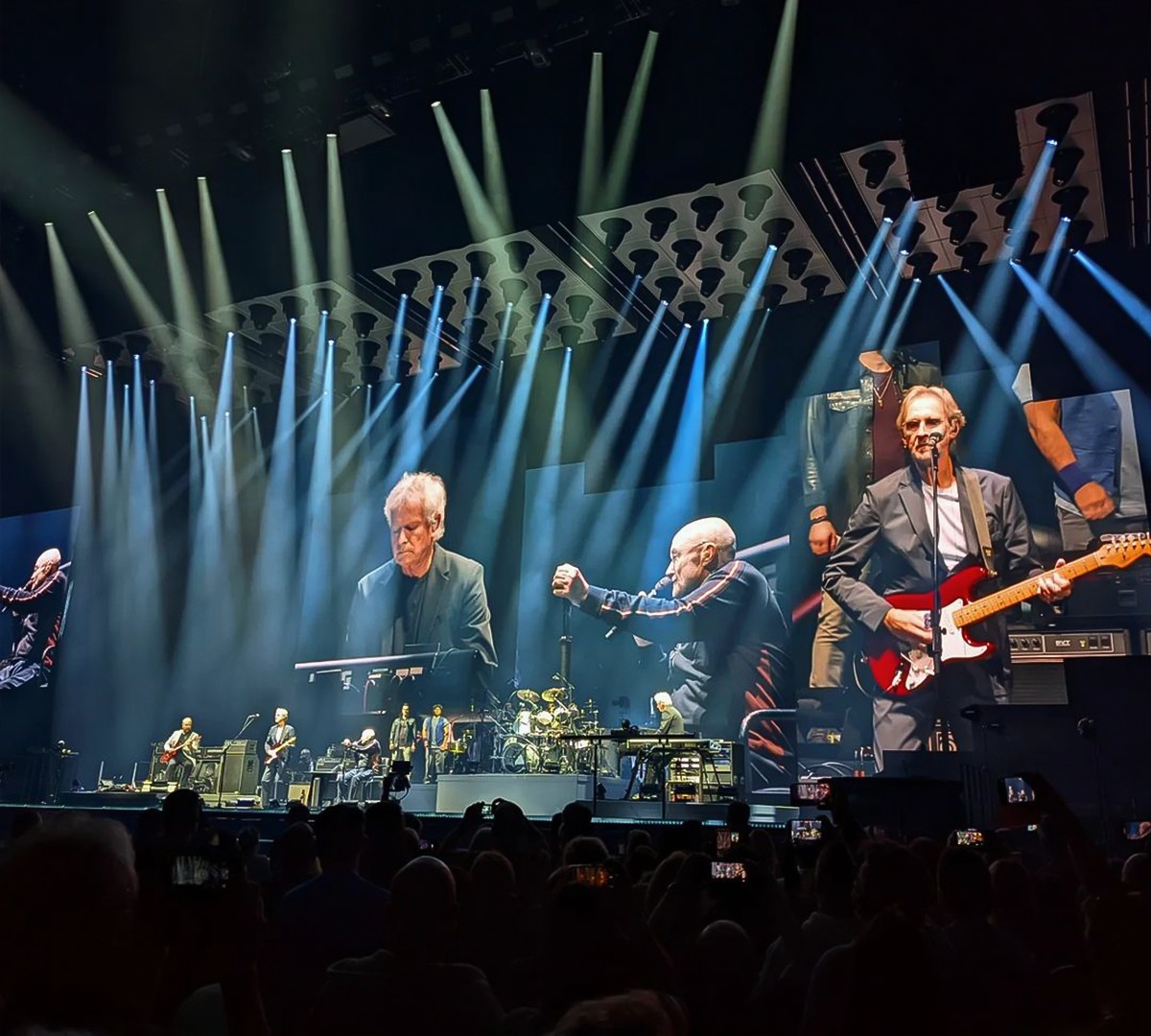
Showing posts with label Mike Rutherford. Show all posts

Thursday, 13 October 2022

A step back in time

© Simon Poulter 2022

In 1978 Genesis had a hit with the love song Follow You, Follow Me, which marked a sea change in their concert clientelle. At a stroke, the band have noted, there were exponentially more women at their gigs. For the previous ten years, they’d been mostly patronised - again in their words - by men wearing army surplus greatcoats and carrying notebooks in which to record their thoughts about the noodly progressive rock they’d come to consume.

From that moment, Genesis would go on to become one of the biggest pop-rock bands in the world, still rooted in the progressive genre, but with shorter, MTV-friendly songs leading their repertoire. Steve Hackett, who until 1977 had been the band’s highly innovative lead guitarist (he invented the ‘tapping’ technique later made famous by Eddie van Halen and numerous other long-haired headbanging axemen), had left to pursue a solo career, just before this transition in the band’s fortunes. And, yet, for those still attached to the band’s arguably most novel era - with Peter Gabriel as its frontman, replete with his costumes, characters and penchant for lyrical theatricality - Hackett continues to keep the flame alive.

© Simon Poulter 2022

Which is why the crowd queuing outside the Eventim Apollo (the venue better known to old heads like me as Hammersmith Odeon), appeared to be 50 year-aged versions of those earnest young men in their army greatcoats. Paunches were in evidence, while some of those who still had hair had it tied in ponytails, despite expanding bald patches. This meant invariably finding yourself standing next to someone looking exactly like The Simpsons’ Comic Book Man. I do say this from a point of smugness at having a full head of hair.

Once inside, however, with the lights down, such cosmetics count for nothing. Hackett and his band - which includes longstanding keyboard stalwart Roger King, second guitarist Amanda Lehmann, bassist Jonas Reingold, flautist/saxophonist Rob Townsend and drummer Craig Blundell - launched into a first half of songs from Hackett’s early solo ventures, such as Ace Of Wands, The Devil’s Cathedral, Spectral Mornings and Every Day. All very good, but it was, I suspect, the second act of the evening that most punters had come to hear - the 1972 Genesis album Foxtrot performed in its entirety.

Being only 5 at the time it came out, I would have missed the original tour for this album, which included Gabriel’s notorious (and, to his bandmates’ surprise) appearance in Dublin wearing a scarlet dress and a fox’s head (a literal representation of the Foxtrot album cover), commencing the costuming that would become the hallmark of his time as Genesis frontman until his departure in 1975. So it would be fair to say that my interest last night at the Apollo/Odeon was to experience something of the magic of an album that, while not changing the band’s financial fortunes, is still held in the hearts of fans as being one of considerable virtuosity, with a still-young band of gifted musicians writing complex songs about complex subjects.

© Simon Poulter 2022
Opening with Watcher Of The Skies, a tribute to an Arthur C. Clarke novel with a bit of Holst’s The Planets thown in, Hackett introduces his vocalist Nad Sylvan, the gloriously eccentric Swedish singer who, vocally sits between Gabriel and his successor, Phil Collins, but despite his long blond Scandi hair and somewhat theatrical mannerisms, blends into the band canvas, rather trying to take centre stage, as Gabriel would have done in 1975. 

Foxtrot’s first side is worked through in sequence, including the prescient social commentary of Get ’Em Out By Friday (a somewhat dystopian Gabriel song about a 70s newtown in which the idea is floated to have residents genetically shortened so that they fit smaller homes in order to build more of them). There is, too, Can-Utility And The Coastliners, a rare early Hackett composition, losely based on the story of King Canute who, you might remember, ordered the sea to be turned back in response to lickspittle sycophancy, something rock bands will know a thing about. 

To replicate the flip from Side 1 to Side 2 of Foxtrot, there is a mini interval, after which Hackett is provided with a classical guitar and a stool. Performing alone, Hackett plays Horizons, a beautiful, baroque instrumental which, in Hammersmith, underlines Hackett’s status as an under-appreciated classical guitarist (he has produced several albums of classical playing, alongside his rock releases). Faithfully following the album’s track listing, it’s a precursor to one of the most adventurous pieces of music any band has ever pulled off: Supper’s Ready

No doubt part-inspired - or at least encouraged - by the 16-minute, eight-song closing medley on The Beatles’ Abbey Road, over the course of seven parts Supper’s Ready romps through a variety of time signatures and themes, starting with the ghostly apparition Gabriel claimed to have seen, through the Lewis Carrroll-esque whimsy of Willow Farm, to the epic conclusion of  As Sure As Eggs Is Eggs (Aching Men's Feet), with its biblical reference to “a new Jerusalem”. Perhaps, on the original record, it appeared more as a collection of songs, but hearing the enture 23-minute suite performed live for the first time in my lifetime, there is an added power to the song that not even the rendition on the imperious live album Seconds Out (during the mixing of which Hackett quit the band) captured.

Many, many years ago, for only my second live review for the NME I saw Sade at the Royal Albert Hall, and was struck by the somewhat clinical, sterile recreation of the Diamond Life album that had propelled her to stardum. Live performances work best when there is some reinvention, either to mitigate the inability to recreate complex arrangements created in the studio, or simply to indulge the artist’s whimsy, and introduce some riffing. Hackett has no need for either. With a piece as intricate as Supper’s Ready - and indeed the entire Foxtrot album - there was no need for embelishment.

© Simon Poulter 2022

This applied, too, to Firth Of Fifth, the grandiose epic on Selling England By The Pound that opens with an extended piano solo - played by Tony Banks on the original, and here faithfully and expertly recreated by King - before the song opens out, heading towards its somewhat legendary guitar solo. I once made a tit of myself when interviewing Hackett, in which I told him that, as a 13-year-old, I’d learned to play the solo, note-for-note, on my Spanish guitar. He was suitably unimpressed. It is still one of the greatest rock guitar solos of all time, though usually criminally overlooked by Jimmy Page’s on Stairway To Heaven, or David Gilmour’s on Comfortably Numb.

Solos are, of course, one of the nadirs of rock concerts. This Is Spinal Tap captured the indulgent absurdity of it, and there is a taste of this with an extended bass solo by Reingold earlier in the show. Blundell introduces the final song of the night with an elongated workout on the drums, but I’ll give him that for two reasons: 1) Craig is a thoroughly decent bloke who recorded a video of encouragement for a friend of mine after she was caught up in the 2015 Bataclan attack and took up drumming as a coping mechanism; and 2) Collins and his co-drummers (Chester Thompson and, briefly, Bill Bruford) would perform a drum duet as a prelude to Los Endos, the closing song of the Trick Of The Tail album whenever it was played live. And thus, Los Endos closes the evening with Hackett and Co in all its grandeur.

I’ve often maintained Trick Of The Tail and Wind & Wuthering, the albums that bore Hackett’s final studio contributions to Genesis, are two of the band’s best, bridging the lyrical and musical flights of fancy of the Gabriel era, and predating the pop orientation that Collins, Banks and Mike Rutherford as a trio went for in the 80s. There have been claims that Hackett’s contribution to the band, over the six albums in as many years, has been diminished. Part of this maybe due to the dominance of writing by Gabriel, Banks and Rutherford, and then the perceived commercial success that Collins’ higher profile led to, long after Hackett had left. But listening back to the albums he played on, his guitar work plays a much bigger role in the soundstage than is ever given credit for. 

In Hammersmith last night, we were given a highly enjoyable reminder. His solo material notwithstanding, I suspect the majority of last night’s punters were there for a trip down Memory Lane. And they would have been richly rewarded. Compared to the disappointing final experience of Genesis, earlier this year at London’s O2 Arena, this felt like the real deal. A wallow, yes, but a thoroughly enjoyable, comfort food-for-the-ears indulgence, provided authentically by the original purveyor. 

Monday, 28 March 2022

Fading lights - Genesis at the O2 Arena

Picture: Instagram/Genesis-band


Clearly, I’m a devotee of unfashionable causes. When news broke that my football club’s owner was being sanctioned for his association with Vladimir Putin, and the club itself was to be put through the ringer as a consequence, there was little sympathy from across football’s tribal communities. Likewise, I knew that I wouldn’t enjoy all that much admiration (or is it empathy?) for going to see Genesis on Friday night, on what would turn out to be their penultimate live performance, 54 years after forming.

I’ve long accepted that Genesis are a Marmite band. A guilty pleasure, even. Amid the devotees from their origins as one of ’70s progressive rock’s pre-eminent acts, and those drawn to their catchy, mid-’80s MTV dominance, are those who just never got them (or saw them as just another outlet for Phil Collins’ ubiquity). Then there’s another group - those, like me, who’ve seen good in all their guises. Over the course of three nights at London’s O2 Arena, 60,000 fans of, mostly, a similar venerability, were of the same view. 

These were the final performances of a tour that had been truncated by the coronavirus (the first scheduled dates were delayed by lockdowns and then the London shows got postponed again by a band member testing positive for Covid), which started to feel like a stay of execution. The tour itself had been named ‘The Last Domino?’ - an intentionally ambiguous in-joke but not without its inevitability, given that an increasingly immobile Collins, robbed of his truly unique ability to drum by a congenital back problem and other health issues, had indicated that this would have to be it. Compared with other still-touring bands of a certain vintage (the Rolling Stones come immediately to mind, and Paul McCartney), the core surviving members of Genesis - Collins, keyboardist Tony Banks and guitarist/bassist Mike Rutherford  - were all 71 as they took to the stage on Friday (the still youthful-looking Banks turned 72 yesterday), so there’s nothing materially requiring them to bring the band to a halt. But from the moment Collins walked on stage, slowly and assisted by a stick, to take the seat he would occupy for the next two hours, it was clear that this Genesis would be different. 

Picture: Instagram/Genesis-band

With his stage school training, Collins was always an impishly lively frontman, ever since he came forward from the drum stool in 1976 to replace the outgoing Peter Gabriel. Live reviews frequently referred to his end-of-pier schtick, a change of tone from Gabriel’s eccentric but hesitantly-delivered fantastical stories which he used to tell between songs as the band retuned their notoriously fussy 12-string guitars. For the live version of their minor 1973 hit I Know What I Like (In Your Wardrobe), Collins developed a remarkable tambourine tarantella, colourfully extending the percussive agility that easily made him a peer of other thunderous drummers of his time, like Bonham, Moon and Rush’s Neil Peart. But no more. Knowing this, some expectation management would be required. 

This was to be a farewell performance, not just a wallow in nostalgia. Not that there was an obvious air of mourning in the air. Opening with Behind The Lines, the song I first saw them open with 41 years ago at Wembley Arena, the hair on the back of my neck raised a little. From that first moment of hearing and ‘seeing’ that song performed live, it has always struck me as the way to open any gig. “Brrrrang!” chimes the opening chord, followed by a fanfare-like keyboard riff. If I ever formed a band myself, I’d want to kick-off a gig like that. 

Long before the video hits, and throughout the years when they weren’t seen as ‘commercial’, Genesis were always a live band. Despite Gabriel, Banks and Rutherford (along with original guitarist Anthony Phillips) regarding themselves more as songwriters than rock stars when they started out, their shows never lacked impact, visually or musically. That has largely been down to the material, songs which - even in the band’s more pop-orientated era - have lent themselves to entertaining engagement live. I may not be a huge fan of the hits that came out of the ’80s, but the albums they were written for didn’t lack the more epic grandeur Genesis established as their stock in trade in the ’70s. 1986’s Invisible Touch album netted five hit singles, more from one album than the band had enjoyed in, then, 20 years of existance. It’s title track is still one of my least favourites, but others - performed on Friday like Throwing It All Away, Tonight, Tonight, Tonight and Land Of Confusion (whose Spitting Image-based video was tweaked to reflect the chaos of Covid), still stand up strongly live.

Picture: Instagram/Genesis-band

In 1977 Genesis released the live album Seconds Out, recorded on the tour for only Collins’ second album as lead singer. As a result, the double release comprised songs from the Gabriel era as well as the new stuff with Collins as singer. Tellingly, it contained only one song that had been released as a single - I Know What I Like, and yet it represents my favourite era of Genesis, with even complex, meandering, multi-part songs like Supper’s Ready found new life by Collins’ stagecraft. Their next release, ...And Then There Were Three, which followed guitarist Steve Hackett’s departure, included the single Follow You, Follow Me, which was the first Genesis track I ever heard on the radio. It’s a simple love song, set to a slowed down samba-like rhythm, and it reached No.4 in the charts. It’s popularity, especially in America, changed the band’s fortunes. The concert demographic started to change: whereas ’70s gigs were mostly attended by earnest young men with long hair, beards and army-surplus greatcoats, making notes on the songs they heard for discussion later over a half of mild, all of sudden there were women at Genesis concerts. 

The Duke album followed, and two more radio hits - Turn It On Again and Misunderstanding, competing with contemporary rock acts like Rainbow or Toto for FM radio airplay in the US. It marked a deliberate shift away from the fantasy stories to more immediacy in their songwriting. Collins inevitably took the blame, but Rutherford and Banks were still the main songwriters. Collins had always been the class clown to puncture the band’s public school loftiness, but he was gradually able to bring more of his own personality into the music. Good Lord, they even recorded a track featuring the Earth Wind & Fire horn section!

Which brings me back to the O2. Sadly, Collins has lost some of his vocal spectrum. It happens with age, but here, there were notable moments where his range was kept low, while - for the first time in Genesis history - two dedicated backing singers filled in some of the gaps in which Collins was struggling. But rather than feeling in any way let down, the band collectively played on. Collins himself, in the concert programme, admitted to his deficiencies. It wasn’t anything the crowd was going to complain about, either. This was an audience who had come to pay their respects to a band that had been a part of their lives for a very long time. They were rapturous when Genesis dipped into their deepest history, with the aforementioned I Know What I Like and the epic instrumental part of Firth Of Fifth from 1973 and even an excerpt from a 1970 track, Stagnation

Picture: Instagram/Genesis-band

Midway through the set, Rutherford, Banks, long-standing touring guitarist Daryl Stuermer and Collins’ uncannily talented 20-year-old son Nic on drums, repositioned around the seated singer to perform somewhat ‘unplugged’ versions of Follow You, Follow MeThat’s All and - to my delight - The Lamb Lies Down On Broadway. This was the title track of an album that, bizarrely, pre-dated punk, being a concept work built around the fantasy disappearance of a Puerto Rican street tough, Rael, into an imagined New York underworld (lyrically, it was Gabriel’s swansong). Here, though, stripped-down, it worked incredibly, suiting Collins Snr’s vocal limitations but sounding like it was always meant to be stripped back.

There were further treats from the past to close the show: after the almost obligatory performance of I Can’t Dance (which epitomised the band’s MTV dominance with its ZZ Top-aping video) - representing the band’s late-stage pre-eminence, there was an excerpt of Dancing With The Moonlit Knight, the opening track of 1973’s satirical Selling England By The Pound album, with its pastorality and references to “Green Shield Stamps”. In 41 years of seeing Genesis live, I’d never heard this track - an obscure entry in their canon at best - performed live. It was delightful. After the stomping pop, an example of the lyrical and musical individuality that, arguably, only this band could have ever produced, steeped in English tradition. 

For those who shunned the knowing commerciality that became Genesis’s hallmark, Moonlit Knight provided a reminder of how this band came into the world, around the time that The Beatles were inventing prog with the narrative concept of Sgt. Pepper’s Lonely Hearts Club Band, onto which David Bowie combined pop, rock and other artistic styles. Those early albums, Trespass, Nursery Cryme and Foxtrot may only have scratched the surface in places like Belgium and Italy, where the Gabriel-led Genesis enjoyed fanatical following, and now are politely “of their time”, but they contain many gems (even an early taste of Collins’ vocal beauty, the love song More Fool Me, along with Hackett’s truly innovative guitar virtuosity). There was, then, one more jewel from that first phase on Friday night: The Carpet Crawlers, one of the few real highlights from the sprawling Lamb Lies Down On Broadway record, its low-key vocal recreated perfectly by Collins, its musical subtleties providing a tender moment to end on.

With that, it was over. Literally (save for one final show the following night). As the full stage band dwindled to just Banks, Collins and Rutherford, who took a poignant final bow, it was time to reflect. All good things come to an end, and with rock bands you tend to want them to stop when they can and while they can. Banks and Rutherford could, probably continue (as they did in 1996 when Collins first decided to put his solo career first, and they brought in Stiltskin’s Ray Wilson in for one album and an ill-advised tour). But it seems unlikely. I would, sadly, even say it was unwise. Collins’ original departure was meant to give the other two an opportunity to prove that they are more than the sum of parts, but that denies the point that much of Genesis’s appeal for the greater part of their existence has been the knowledge that, since 1978, these three men were the band’s beating heart. Gabriel’s six albums defined the band in one way, while the eight with Collins brought with them hit singles. But it would be wrong to divide the band solely by their lead singers. The thread running through all 15 studio records is a style of songwriting that can be compared to no one else, not even the other stalwarts of the prog era, like King Crimson, Supertramp, 10cc, Yes or Pink Floyd. 

Of course, Genesis have never been to everyone’s taste, but for anyone prone to dismissing them for whatever prejudice or perceived prejudice they hold, they have always maintained a tradition of songwriting and song delivery established by A Day In The Life, Is There Life On Mars? or even Good Vibrations. Drama, narrative and, if you can excuse the record label pun, a unique charisma.If you had gone to see them on Friday night having never heard of The Return Of The Giant Hogweed, Squonk or Cinema Show, you would have heard a band of consummate musicians and songwriters, who for the better part of 54 years have made every note, every drumbeat, every chord, every riff and every vocal line count. 

At the start of this post I wrote about Genesis being a guilty pleasure. The trouble with that statement is that it places them in a similar category to, say, a Jason Donovan or a Rick Astley. But, then, to partition based on personal taste is to commit a facet of musical partition that I get very weary of. Taste might divide people, but talent shouldn’t. Genesis may have never been the most fashionable band, but the notion that fashion alone is the only diktat of popularity cuts no ice with me. Guilty pleasure, they may be, Marmite, even, but this band has been an unashamed part of my soundtrack since I was 11 or 12. My first forays with a guitar were to learn the solos and arpeggios of the early work, the infectious riffs of their later efforts. And in unsettling, troubling times like these, comfort is most welcome. On Friday night, in an O2 Arena still missing vast panels from its storm-wrecked roof, I found comfort, for the last time from a band that has been a part of my life for four-fifths of it. 

Marmite, they may be, but you know, I’m quite partial to it.

Picture: Instagram/Genesis-band


Wednesday, 19 May 2021

I hear that voice again


There was hubbub recently, mostly amongst those who care about such things, when a 38-minute film of Genesis playing Le Bataclan in Paris in 1973 surfaced online. Now, it should be stated for the defence that this clip wasn’t of any great cultural significance: this wasn’t a ten-year-old Hendrix writing All Along The Watchtower on a toy guitar (Dylan wrote it, in any case), or hitherto unseen footage of The Beatles in some Hamburg bierkeller. No, this was Genesis, long before their MTV tenure, with then-lead singer Peter Gabriel giving it the full Brian Pern. For those less familiar with this era of the band, and indeed Gabriel (before he left in 1975, promising to “Do a Ferry, or a Bowie, or a Furry Boa and hang myself with it”) the restored, 4K-quality footage featured the band in proto-prog mode, performing grandiose stage epics such as The Musical Box,​ Supper's Ready and pre-punk stomper The Knife, with Gabriel dressed in a variety of outfits (such as a fox’s head and his wife’s red dress) to act out the songs, as was his want in those days, while Messrs. Banks, Collins, Hackett and Rutherford earnestly played around him. 

It’s easy to see, now, how lampoonable it all was (kudos to Simon Day for Pern, and to Gabriel himself for accepting the pisstake in very good humour), but like most of these time capsules that get unearthed from time to time, it served as a reminder of how, in the early 70s, rock music was still relatively new, and anything went. Gabriel’s final turn with Genesis was to take the concept album The Lamb Lies Down On Broadway out on tour in 1975, with the singer’s costumes and stage presence taking even more prominence, often to the mild resentment of the other band members. Two years later (and after the near tragedy of his first wife, Jill, almost dying in childbirth), Gabriel launched a solo career with the first of four albums, simply titled Peter Gabriel (a typically obtuse Gabrielism, which frustrated his American record company, Geffen). With the fantasy stories and extended keyboard noodling of the Genesis albums now behind him, Peter Gabriel (rebranded ‘Car’ by his US peeps) was a melange of themes and styles, from the Springsteen-esque rocker Modern Love to the cod-barbershop plaintive Excuse Me, the now perennial favourite Solsbury Hill (an autobiographic reflection on his ‘release’ from the rock band hamster wheel) and the melodramatic Here Comes The Flood, a song Gabriel also recorded as a haunting, stripped down affair, along with a version in German.

With each successive solo album - 1978’s Peter Gabriel (‘Scratch’), 1980’s Peter Gabriel (‘Melt’) and 1982’s Peter Gabriel (‘Security’) - the somewhat dilettante Gabriel took notable twists and turns of artistic style, delivering a more conventional rock album with his second release, experimenting with cymbal-free drums on the third (in the process “inventing” Phil Collins, who played on the album, with producers Steve Lillywhite and Hugh Padgham developing that famous ‘gated reverb’ drum sound), as well as collaborated with Kate Bush and Paul Weller, before throwing away the rock rule book with his fourth, with its extensive use of the Fairlight sampling keyboard, obscure rhythms and a decidedly un-Western musical fabric.

By the time So, Gabriel’s fifth solo album appeared, he’d established a reputation for artistically interesting, if not particularly commercially impactful, records. Between ‘PG4’ and So he’d also recorded the soundtrack to Alan Parker’s Birdy, which effectively and hauntingly remade existing songs to considerable effect (the jungle drums of Rhythm Of The Heat was a common presence underneath early-80s documentaries). While collaborating on Birdy with producer Daniel Lanois, he commenced work on his next solo album-proper. The final track recorded become the first song to be heard from the album, and it blew everyone away, in every dimension. Sledgehammer was an unashamed tribute to the soul music that Gabriel was obsessed with as a 60s schoolboy (he still considers Otis Redding at Brixton’s RamJam club the best gig he’s ever seen), and with its Stax-style brass, ever-so slightly saucy lyrics, and Nick Park’s pre-Wallace & Gromit plasticine video, it turned Gabriel into a bona fide pop star. Ironically, his former band’s Invisible Touch was released at the same time, with Gabriel and Genesis vying for chart positions throughout the world.

Released on 19 May, 1986, So was, still, quintessential Gabriel. Sledgehammer plus the gospel-inspired Don’t Give Up duet with Kate Bush, the US hit In Your Eyes and the satirical Big Time, all may have introduced Gabriel to singles buyers too young to have remembered Solsbury Hill, let alone The Return Of The Giant Hogweed, but the album was no sell-out. The brooding opener Red Rain launched the audience into Gabriel’s environmental concerns, while Don’t Give Up - for all of its goo-goo romanticism (especially that swoonsome video featuring Gabriel and Bush) and its 1930s dustbowl symbolism - was actually a direct swipe at Thatcherism. We Do What We’re Told (Milgrim’s 37) was a dark essay on the obedience experiments carried out by psychologist Stanley Milgram; the offbeat Mercy Street was inspired by the poetry of Anne Sexton; while the hypnotic This Is The Picture matched Gabriel in another duet, this time with avant-garde multimediaist Laurie Anderson. 

Picture: 20th Century Fox

Fuelled by the success of its singles, especially Sledgehammer and, in the US, In Your Eyes (used brilliantly in Cameron Crowe’s directorial debut, Say Anything…, in a scene in which John Cusack appears, Romeo-like, before his love interest, blasting out the song from his boombox), So went to No.1 in a number of countries and remained on the US chart for almost two years solidly. Sledgehammer itself became a No.1 single on the Billboard Hot 100, ironically, knocking Genesis and Invisible Touch off the top. “There is always wisdom from hindsight,” Gabriel recently reflected. “And because So was my most successful record, I think that a lot of people, particularly in America, think that it was designed to be that. From the other end of it, you never really know which records are going to do well. You know that some things are going to be so obscure and difficult for a mainstream audience that they’re no-hopers but generally, with what I do, it’s hard to predict which albums are going to do well.”

Gabriel says that, while he sort of knew instinctively which of So’s tracks might do well on radio, he was more excited by how the musicians produced what remains, 35 years later, a truly unique-sounding hit record, for that time or any other. Much of that credit goes to Lanois, then one of the hottest producers on the block, having worked with Brian Eno and on U2’s The Unforgettable Fire. “One of the things I learned with [Lanois] is a total respect for the magic of the moment. When you have some spine-tingling event musically, you’ve got to capture it,” says Gabriel, recalling his musical soulmate, Eno’s work with Talking Heads in which raw energy took effort to extract. “I wanted his emotions to come to the forefront [with So],” Lanois himself has said. “To wear no mask and no veil. To have no mirrored contact lenses, no trickery. Just take everything off and let the songs be heard. A nice sequel into the next chapter for Peter Gabriel. I think these songs are more revealing, they are more naked, they are taking risks, and listeners feel that when a man takes a risk.”

It has become something of a cliche to pick up on Gabriel’s long-standing embrace of world music, even the fact that he somewhat invented the term. His Real World label continues to be one of the strongest outlets for the form, and - after a near-bankrupting experience that required a Genesis reunion to bail it out - Gabriel’s WOMAD festival has become an annual fixture for promoting musical diversity. With a roster of musicians from every continent and ethnicity, Gabriel’s Real World label continues to be a positive outlet for music that challenges the notion that it should be both Western and sung in English, a concept Gabriel has championed since Biko on his third album and, more significantly, In Your Eyes, which features Senegalese singer Youssou N’Dour. 

In Your Eyes was the first thing that I’d recorded, I think, with Youssou and it was very important for that reason,” says Gabriel. “It was around the time I was going to Africa and really getting inspired by a lot of the music I was hearing there, particularly rhythmically and vocally. I’ve described Youssou’s voice as ‘liquid gold’ and I think when he comes in singing on that track it’s just a fantastic moment. We’ve since gone on to do a lot of other things, but that was one of the most exciting.” As an aside, In Your Eyes played a tiny part in music technology’s evolution: on So’s original vinyl release, the sonic limitations of the format meant that, due to Tony Levin’s bass, the track had to be listed earlier on the album (something to do with the width of grooves, so I’m told). For So’s CD release, the uplifting song closes it out.

35 years on, So retains a freshness that most of its mid-80s contemporaries would struggle to provide. Many compilations from that time and re-runs of Top Of The Pops expose how production techniques were still transitioning from analogue to digital, with associated aural limitations. With So, Gabriel produced something that spanned so many influences while still sounding unlike anything else. It’s worth mentioning here the record Gabriel released ‘immediately’ afterwards (in 1989, which is quite “immediate” for Gabriel): Passion, his stunning soundtrack for Martin Scorcese’s The Last Temptation of Christ, was another career high point, but for very different reasons, drawing inspirations, musicians and instrumentation from a multitude of cultures, including the Middle East. On balance it remains, perhaps, my favourite Gabriel album - not for its hit songs (there aren’t any) but for the incredible landscapes it paints, inspired by the Holy Land. I played it endlessly a few years ago while driving in that very part of the world, and it was incredibly evocative, even in the very place it was inspired by. 

Steven Wilson
No surprise, then, that Steven Wilson - a musician very much in the Gabriel tradition of never standing still, musically or thematically - is a committed fan of So, comparing it to Kate Bush’s Hounds Of Love, which had come out the previous September: “With this album Gabriel managed to make his sound more accessible, giving him a much broader mainstream appeal.” That is normally quite a tricky feat, especially for an artist hitherto known for his broad experimentation with conventional rock as well as non-Western traditions. But, says Steven, it was without compromise. “This was achieved without sacrificing any of his personality and ambition, or his will to experiment and push the envelope. So has pop immediacy but also artistic depth that bears repeated listening. It’s an extremely difficult trick to pull off.”

So's shift in form for Gabriel was even captured in the record’s graphic design, overseen by Peter Saville, who’d been responsible for artwork at Factory Records, New Order and Joy Division to his credits. To begin with, he wasn’t a fan: “I didn’t actively dislike him,” Saville revealed to the Real World Notes blog of Gabriel’s record label. “He was just not somebody I knew that much about.” Saville, who was brought on board when the album had the working title ‘Good’, was won over to working with the singer after a first meeting at his house near Bath. As Saville and his creative partner Brett Wickens drove back up to London, they listened to a cassette copy of the album for the first time. 

“The first track was Red Rain,” reveals Saville. “If you’re in a sensitive mood and you’ve just seen a car crash [as they had witnessed while approaching the M4] and you hear Red Rain for the first time… it’s quite like, ‘Woooaaah!’. There was a real passion in Peter’s voice and it was very listenable. I didn’t mind it. As we approached the motorway Sledgehammer came on. We stopped the fucking car on the slip road! You know when you’re hearing something important. It was like hearing Blue Monday for the first time. Brett and I just looked at each other and then looked at the cassette player and almost simultaneously we said, ‘That’s a number one single!’ It was fucking brilliant. By the time Don’t Give Up came on I cried a little bit. I hadn’t got far away enough from Bath and that just completely did me in, actually.”

Gabriel’s first four solo albums had all featured covers that had partly obscured his face, rendering the singer somewhat oblique. Even having released singles like Shock The Monkey and Games Without Frontiers in the video age, it would have been hard, in 1986, for mainstream pop fans to identify him. So changed all that, and its black and white cover image played a massive role in that. “Gail Coulson [Gabriel’s manager] had briefed me privately that Peter had to come out of himself for this record,” Saville recalled. “She knew that he had made an emotional album and that he’d written songs and made music which crossed over to other people who were not Peter Gabriel fans. We had to give a face to that. Of course Peter’s natural inclination was towards shyness and not showing himself. But that wasn’t going to do the job because this was 1986, you know.” With two weeks to deliver So’s cover, Saville brought in photographer Trevor Key, who’d produced the art for New Order’s Low Life, another band “disinterested in presenting their own identity” he says. The other graphic standout was the album’s name, presented simply over the singer’s name. It remains to this day one of the most basic but impactful album covers of all time. More importantly, it propelled Gabriel into another strata of fame.

A question remains, however, as to So’s place in the Gabriel canon: without doubt, it transformed him from legacy prog rock star into a genuine pop act, perhaps in a more artistically acceptable manner than his former bandmates in Genesis had done as they consciously moved into the pop-rock realm as a three-piece. But, the original albums that followed So took their time: Us came out in 1992, Up a full ten years after that. The former leant heavily on the break-up of Gabriel’s first marriage, and while it didn’t take the heart-on-sleeve approach his mucker Phil Collins had famously taken with his ‘divorce album’, Face Value, beneath the deep and introspective lines of Digging In The Dirt lay an album forced into the open through the cauterising of emotional wounds rather than So’s at times carefree approach. Up, Gabriel’s last album of original songs, had an even longer gestation, having been conceived originally in 1985. It remains a good addition to the library, with all the sonic layers and ambitious conceptual excursions Gabriel has always been known for, but it, and its predecessor, lacked the immediacy that So had through its hit singles.

It’s been a long time, then, since we heard anything really new from Peter Gabriel. His last new album-proper was ten years ago - the orchestral retreads of New Blood in 2011, preceded by the covers album Scratch My Back in 2010. There has long been talk of an album in the works, but as with everything Gabriel does, he picks and chooses what he devotes his energies to, with music taking a back seat (he owns the record company, so no pressure there). He’s not invisible, he’s not a recluse, and he’s certainly not a one-hit wonder. But with 35 years separating today’s anniversary and So first being released, it’s tempting to look at it through the prism of pop stardom. 

Gabriel has never sat easily with fame. His somewhat diffident personality fits well with his status as an arch auteur, owning a fine body of work but happy to tinker at the edges while being distracted by his myriad worthy causes, such as his long-standing commitment to human rights and The Elders group he co-founded with Nelson Mandela and Richard Branson. At 71, it’s unlikely that Gabriel will grace the charts with another Sledgehammer, but it would be nice if he produced another album with the accessibility of So that Steven Wilson talks of - but without selling out on the musical principles he’s held dear since those very early days with Genesis. 

Wednesday, 4 March 2020

And Then There Were Three...again

Picture: Genesis/Patrick Balls
It's the weirdest of coincidences that, on the day that it was announced that Spitting Image is to return, Genesis announce a comeback tour. Phil Collins was, arguably, a deserved target of the show's ribbing back in the mid 1980s when he was, even by his own admission, everywhere. The show's puppeteers even returned the back-handed complement when they provided rubber versions of the band for their Land Of Confusion single's 1986 video. This period was peak Genesis. Peak Collins, too. Even Mike Rutherford was also getting in on the ubiquity with his side project, Mike + The Mechanics, enjoying a string of hits. Former lead singer Peter Gabriel was also in the midst of his own purple patch with the global success of the So album and its hits like Sledgehammer and Don't Give Up, adding to the visibility of the band he co-formed in 1967 and left in 1975.

That, however, Collins, Rutherford and Tony Banks should have, today, announced a tour of the UK and Ireland, 13 years after what appeared to be their farewell tour, is curious. Rumours have been circulating since January of the trio reforming after they were spotted together at a New York Knicks match, a somewhat random event seeing as neither band member had exactly been seen as fans of American basketball. Moreover, a Genesis reunion - even from lifelong fans like me - is hardly something we'd been counting on. Since their 2007 Turn It On Again Tour it had widely been assumed that the band had wound themselves up. Their studio, The Farm, near Dunsfold in Surrey was shut down, Rutherford appeared to be focusing more on his work with the Mechanics, Banks was focusing on his acclaimed classical music work, and Collins...well, he seemed to have been enduring an endless run of ill-health, including his admission of a near-death experience as he succumbed to excessive drinking. Since then, he has appeared increasingly frail, the result of surgery in 2009 on his back, and continued issues with his vertebrae that has rendered him confined to singing from a chair while performing in solo shows as part of his personal own comeback. Sadly, in his most recent TV appearances, he has looked a painful shadow of his impish former self, coming across as increasingly elderly, despite being the younger of the trio (Banks turns 70 later this month, Rutherford catches up in October, Collins next February).


That places questions on the veracity of the tour announced today. For his solo live performances, Collins has drafted in his teenage son, Nicholas, for drumming duties and with eerily authentic effect, too. Collins' haters, while perhaps justifiably knocking his ubiquity in the 80s and 90s, usually forget what an incredible drummer he was, with a unique melodic ability (his signature In The Air Tonight drum fill actually belies his broader talent, first honed in his early days in Genesis, with its influences of jazz and R'n'B drumming). Thankfully, his son has inherited the drum gene, but a Genesis show without Collins Senior and longterm second drummer Chester Thompson doing their mesmerising duets will be somewhat lacking. It's sad, but I guess not everyone goes on forever.

I should, at this point, declare why I'm so defensive of the band, even in the face of whatever music cred I might profess to have. Genesis, to me, are more than some guilty pleasure. They were the first band I saw live (Wembley Arena, 1981); their 1978 album ...And Then There Were Three was the first LP I bought with my own money (MJM Records, New Malden, inevitably no longer there). I even earned my first writing fee reviewing a 1985 Collins gig at the Royal Albert Hall for the NME. They were, along with The Police, Rush, Bowie and Elvis Costello, amongst the first acts I obsessed over, prompting the teenage me to invest in their back catalogue - albums like Nursery Cryme, Selling England By The Pound and Trick Of The Tail, records which would be defined as quintessential prog rock, without anyone - then or still - fully understanding what that term meant. True, some of their songs, like Return Of The Giant Hogweed and Harold The Barrell, were somewhat outré, but in their first true hit, I Know What I Like (In Your Wardrobe), they presented a soulful groove more reflective of Gabriel's R'n'B leanings than of the art rock movement they were seen to be at the vanguard of, along with King Crimson, Yes and Pink Floyd. With The Lamb Lies Down On Broadway, Gabriel's swansong as lead singer, they even introduced a punk element, with the double concept album charting the journey of Puerto Rican street tough Rael's journey into a bizarre New York underworld. The appeal of music like that of Genesis in the 1970s was the combination of storytelling and engrossing music that drew you in to another world. This wasn't trite pop, a moment's entertainment, but something more involving. No wonder their core audience was, for many years, intense, long-haired young men wearing army-surplus greatcoats and a noted lack of female company. Here, though, is where people lose Genesis. Until Gabriel and guitarist Steve Hackett left the band, they were characterised by wonderful but sometimes meandering fantasy songs. That said, Seconds Out, their 1977 tour album, remains my favourite live album of all, eclipsing even The Who's Live At Leeds and Humble Pie's legendary Performance - Rockin' The Fillmore for energy.

...And Then There Were Three marked the start of a move away from quintessential prog. The single Follow You, Follow Me brought them a new, pop audience. Notably it also marked a greater prominence of women at their concerts. And this was 1978, when punk was supposed to have done away with such bands (a myth - John Lennon was said to be a fan of The Lamb Lies Down On Broadway, while The Clash's Topper Headon once rushed up to Phil Collins at an airport to declare his appreciation). With their next album, Duke, they were still storytelling, but Collins' increasing pop influence was already notable, with hits (especially in the US) like Turn It On Again and Misunderstanding sitting alongside distinctly Collins-penned love songs like Please Don't Ask, material that had come out of the same writing for his divorce-inspired breakthrough, Face Value. What followed was the band's transition into a fully-fledged pop band, much like The Police or Madness, I suppose, enjoying hit after hit supported by witty videos that brought them to a global audience in a way they'd never really managed during the 1970s when they were, arguably, at their most interesting.

Here, though, marks the dividing line between diehard fans and those brought to the band via the heavily-rotated MTV hits. Some maintain that Genesis lost their soul when Gabriel left in 1975. I'll maintain that they became enriched by the departure. A Trick Of The Tail, which introduced a reluctant Collins as lead singer in 1976, is arguably their best. But the Gabriel era still hangs heavily over the band's legacy. Even reports today about the 2020 reunion tour couldn't help themselves from mentioning that Gabriel would not be taking part. "Peter left the band 45 years ago and he's been trying to live it down ever since," joked Tony Banks this morning about his former schoolfriend. "When they put his birthday in The Times, they always say, 'Peter Gabriel - Genesis singer.' And I think, 'What's the guy been doing since then, for God's sake?'". Taking a more serious tone, however, Banks pointed out that even if they could persuade Gabriel to join them (unlikely as he turned down the idea in 2005), most of the songs people know came after his departure. Fair point.

Picture: Facebook/Genesis/Stephanie Pistel

There are, then, two testaments to Genesis. The band formed at Charterhouse in the late 1960s, and won their first record deal with Jonathan King by emulating the Bee Gees' sound at the time (pre-disco - think Massachusetts) as he was a fan. They spent their first few albums eschewing the blues-based rock prevalent at the time by fusing pop, rock, classical and even jazz sentiments into something truly unique. I'm never going to win over the haters, here, but the 70s Genesis albums still hold a magic, even in some of their unashamedly less cool moments. I suppose you had to be there.

So, will I be there in November when they tour the UK? I'll be honest, my thoughts are mixed: I've always regretted only seeing Bowie the once (the horrendous Glass Spider show in 1997), same with Pink Floyd. I've seen the Rolling Stones five times now, and would readily go for a sixth, even as they age gracefully/disgracefully. Indeed, the Stones are still the benchmark for venerated acts remaining out on the road. Having seen footage of Collins' recent solo shows I'd be lying if I thought he will be anything like the last time I saw Genesis, at Twickenham in 2007. But here's the thing: despite their live prowess, they have always been about the songs. Indeed, when it looked like their recording career wouldn't take off, they considered themselves songwriters first, writing for others. Tony Banks still exemplifies this, being the least comfortable in the spotlight. The stage school-educated, former child actor Collins was always the more natural performer as a result of his upbringing, although even he was initially reluctant to step forward from the drum riser after Gabriel left.

Of all of the Genesis line-up, past and present, still certainly worth watching live, it is guitarist Steve Hackett. He has been successfully touring the classic albums he played on in their entirety in recent years, highlighting the guitar solos that - not always recognised - were as much signature of the Genesis sound as anything else. Hackett's shows, which have included complete renditions of Selling England By The Pound and his final studio appearance, Wind And Wuthering, have brilliantly fulfilled the 'older' fans' needs, even supplanting Gabriel's voice with the wonderfully eccentric Swedish singer Nad Sylvan. Wisely, Hackett hasn't pushed into the band's catalogue after he left, which saw them move away from the "prog" tag, mixing longer and shorter songs and generally being more accessible (in other words, 'commercial'). The hits that followed will, I'm sure, comprise the bulk of their sets in November, much as they were on their supposed final tour in 2007 ("There are a few old dogs that won't be running," Collins said today, pointing out that what they will perform wouldn't include songs powered by his drumming). With Collins himself no longer able to drum, and if still confined to a chair on stage, part of the energy that made Genesis a genuinely exhilarating live act will be lost. Though reluctant to be the frontman at first, his charisma was core to the band's overall entertainment value, often taking a less than reverent tone to songs which, from a certain angle, could be described as somewhat rarified.

What is certainly not the case is that this tour is one last boost to the pension fund. Having sold more than 100 million records over their 52-year career, what's brought them back to the road is the recreation of something they've missed personally. You can be cynical about that, but having followed Genesis for 42 years, what they do together - like it or not - is something special to them. "We all felt, 'Why not?'" Collins told BBC News. "It sounds a bit of a lame reason - but we enjoy each other's company, we enjoy playing together." Rutherford added that with Phil touring again in the last couple of years "it seemed the natural moment to have a conversation about it." And, he added, it's not like they had been overstaying their welcome in recent years. "I worked it out and we've only done two shows in the UK in the last 28 years, so we haven't over-worked it." I'm sure the shows will sell out - Genesis have proven over their five decades-plus to be impervious to fashion - it's just a debate as to whether the magic will be there again.

Monday, 14 October 2019

Size doesn't matter: Elbow's Giants Of All Sizes

With time on my hands, I've taken to perusing Elbow's press coverage on the occasion of their eighth and latest album, Giants Of All Sizes, finding its way into the world. And so, a casual Google galavant reveals a predilection for journalists to make reference to Guy Garvey's avuncular nature. "Cuddly", is an oft-repeated description, along with "bear-like", which all border on sizeist judgement of the bearded 45-year-old from Bury. Quite what Craig Potter, his brother Mark, and Pete Turner, the band's other members, feel about this is not known, but it's common for a band with a charismatic lead singer and chief lyricist, to attract most, if not all, of the attention. Peter Gabriel (one of Garvey's musical idols) built up similar internal resentment when lead singer of Genesis, to such extent that Phil Collins has been quoted as saying that they were in danger of being known as "Peter Gabriel and Genesis".

Why this is relevant is that despite Garvey's apparent ursine appeal, Elbow's eighth and latest album, Giants Of All Sizes is, according to the band, anything but cuddly. "It's certainly not an uplifting album," Garvey recently told a journalist, explaining that the band wanted to make an album reflective of both their mood, as well as the mood of the times. That doesn't mean a lot of ambient Thom Yorke-style droning in a minor key, however: at essence, Giants is still an Elbow album, with the warmth of Garvey's voice binding a band comfortable in its own musical skin, experimenting with sounds and instrumentation without going too far, mood without being too Enoesque. But within that experimentation and instrumentation there is certainly a darker tonality, even from the off, with opener Dexter & Sinister and its disjointed time signatures and non sequitur breaks addressing a number of things on Garvey's mind, from Brexit to bereavement (including the death of his father) and, in his own words, "the general sense of disaffection you see all-around at the moment". The track rings the keynote for the rest of the album, one which draws on a certain Lancastrian bleakness that has run through all their work, as it does with their great mates Doves and I Am Kloot. That's not a lazy southern trope, but think about it. I've never been entirely sure whether it is to do with geography, like the rain-soaked cobbles of Coronation Street, or something else, but it's there in almost everything coming out of the north-west, The Beatles' childlike acts of whimsy notwithstanding.

Musically, some might find Giants musically narrow, nine songs with a very similar range and notably lacking in the sort of anthemic bluster that made the nation fall in love with them via the album Seldom Seen Kid and their closing ceremony performance at the London Olympics in 2012, where One Day Like This seemed to supplant Land Of Hope And Glory in the nation's communal singing preferences. Frankly, though, this lack of width makes for a better album, one which accentuates the combination of Garvey's voice with Turner's at times McCartneyesque bass, Potter (C)'s keyboard washes and Potter (M)'s understated guitar work. Despite being more compressed and lyrically reflective than either Build A Rocket Boys! or The Take Off And Landing Of Everything, Elbow's last de facto albums, Giants is nonetheless immediately accessible, even when tackling some of its weightier subjects, such as the undertone of Brexit in Empires, with its fairground Wurlitzer stabs part of a layered fabric interwoven with such existential questions as "How can a bland unremarkable typical Tuesday be Day of the Dead?".  Others, like The Delayed 3.15, with its string section find melodic companionship with some of the less bonkers elements of prog rock, a musical genre often misunderstood and invariably mocked, but which had more in common with jazz as anything else. Doldrums even points back to prog's true origins, with a decidedly Beatles-like groove and Garvey's vocal treble-tracked to the extent it sounds like they were recorded in a broom cupboard. As a result, it's a track that, strangely enough, benefits from being listened to on headphones. The band's assertion that this is a bleak album is a bit of a misnomer, but paying close attention to the lyrics throughout reveals the true state of Garvey's mind. White Noise White Heat, for example, provides a stark reflection on the nightmare of Grenfell Tower and the injustices handed down to its victims, wrenching the song's emotional heft further with strings and brass. It is, perhaps, the closest Giants gets to a "soaring"™anthem like One Day Like This, should that be what you'd buy an Elbow album for.

If I might return to Garvey's avunicularity, it stems from his voice. With his Bury accent heavily inflected in the delivery, each song rings with autumnal comfort, no more so than the beautiful My Trouble, with the vocal perfectly mixed over a combination of bass, strings and the subtlest of drum machine rhythm tracks, building to a hymn-like chorus of "Come get me/Guide and check me/Sail and wreck me/Soak me to my skin." I defy anyone not to sing along at the top of their voice while driving along to it.

At the arrival of On Deronda Road, the penultimate song, I reached the point where I realised why I find Giants Of All Sizes so accessible. It's not because this particular song is notably catchy, there are no obvious hit-making hooks, and in some respects it's a somewhat brief interlude. No, it's the realisation that I'm listening to something from Trick Of The Tail-era Genesis. Now, don't baulk at that suggestion (trust me, naysayers, it's a quality album), but the vocal harmonies and textures hark back to that 1976 album's most beautiful moments, in particular, Steve Hackett and Mike Rutherford's 12-string guitars producing something ethereal on songs like Entangled and Ripples. In fact, this vibe continues with the closing track of Giants, Weightless, which takes inspiration from both the death of Garvey's father and the continuation of life with the birth of his son. It is a truly beautiful song and easily one of the best Elbow have committed over the course of their eight albums. Whether by design of sequencing or simply the way it fell out of the writing process, Weightless concludes an album written around gloomier themes with a sense of uplift, of hope and admission that, maybe, the world isn't all bad. Or, perhaps, Garvey is driving at a bleak future for his offspring. Either way, it's a song of balanced grace.

When not making Guy Garvey out to be some sort of Lancastrian Yogi Bear, media reaction to Giants Of All Sizes has been a little mixed. Some reviewers have (quite rightly) claimed it to be Elbow's best yet, while others are still just not sure. My view is that it is brilliantly intriguing, musically, and obliquely reflective, lyrically. If this is a key test to go by, I listened to it on repeat for most of Saturday afternoon, hearing something new each time, pulling it closer like a warm blanket on a cold, wet October afternoon, a comfort no Pumpkin Spice Latte from Starbucks will ever fulfil.