Showing posts with label LIverpool. Show all posts

Saturday, 12 August 2023

Once more into the breach…


How has your summer been? Time to relax and switch off? Read a book or two on the beach? I hope so. For me, it’s been about trying to mute anything and everything about Chelsea Football Club. Until now, at least. 

Last season, as some may have noticed, was a bin fire from kick-off to final whistle. Three managers (four if you include a one-match caretaker), a £600 million trolley dash to bring in new players in the the aftermath of a protracted and complicated takeover, all resulting in a 12th place Premier League finish, the club’s lowest season end in 29 years.

As politicians say when forced to resign for foul and unpleasant affairs of the bedroom kind, this summer has been a time for quiet reflection for all concerned with the football club. For me, it’s meant avoiding the self-appointed ‘experts’ on social media claiming to have the inside track on everything going on at Chelsea. Because for the most part, much of what I have seen has been speculative at best, utter bollocks at most. Only occasionally has some kernel of reality come through. 

Take the example of Moisés Caicedo, the Equadorian midfielder Chelsea have been pursuing all summer from Brighton & Hove Albion. At the time of writing this, it’s not entirely sure where he will be playing his football this season. Yesterday Chelsea appeared to have been gazumped at the 11th hour by Liverpool (conveniently, Chelsea’s opening day opponents tomorrow) with a bid Brighton accepted of £111 million. However, the player himself has expressed a preference of playing in London. Chelsea’s pursuit of Caicedo has, apparently, taken much of the last two months, with co-sporting directors Paul Winstanley and Laurence Stewart managing a process that saw three or four bids of up to £80 million knocked back by Brighton insisting that the player is worth £100 million. As it now stands, Chelsea chairman Todd Boehly and co-controlling owner Behdad Eghbali have taken personal charge of the discussions - not a good look for either Winstanley or Stewart - in the hope of rescuing a deal for the one player Chelsea really want this summer. A new bid of £115 million might be on the table by the time you read this.  

It is, though, quite possible that Chelsea were never going to land Caicedo, given the south coast club’s insistence of his valuation. Plus the two clubs have enjoyed a weird relationship of late, with Chelsea having taken Graham Potter and his entire coaching staff off their hands last season, after the Londoners had been rinsed for the signature of Marc Cucurella for an inexplicable initial fee of £55 million. This season, in parallel to the Caicedo deal, Brighton appeared to make it very clear that they wanted to retain Chelsea loanee defender Levi Colwill, possibly as a makeweight in a deal for the midfielder. Colwill has now signed a lucrative six-year contract with Chelsea, with whom he’s been on the books since childhood. Oh, and by the way, Chelsea have taken second-choice goalkeeper Robert Sánchez off Brighton in recent weeks. What was that about all’s fair in love and war?

While other names will no doubt continue to be bandied about by the aforementioned experts in the remaining days of the summer transfer window, given the importance of tomorrow’s season opener, it’s probably time to focus energies on other matters. As one fan commented on Twitter (or X or whatever the hell Space Karen calls it now), “it seems people are more bothered about who we sign than how we play”.

Picture: Chelsea FC

So what are Chelsea’s prospects for Season 23-24? Fresh beginnings, for a start, including a new head coach, Mauricio Pochettino. The former Spurs manager officially arrived on 1 July, having been under consideration by Chelsea since at least Thomas Tuchel’s departure, and with Frank Lampard appointed only temporarily as Graham Potter’s replacement (who, in turn, replaced Tuchel, who’d also replaced Lampard – hope you’re keeping up), the Argentinian has had plenty of time to run the rule over what the job would entail.

Before even a whiteboard had been scribbled on with team tactics, Pochettino’s first job has been to oversee the transformation of a bloated squad that, last season, grew so large there weren’t enough places in the training ground changing room for everyone. Since the end of May, 13 senior players have left in the current transfer window, including Mason Mount (to Manchester United), Kai Havertz (to Arsenal) and Mateo Kovacic (to Manchester City) – three key individuals to direct league rivals – along with captain César Azpilicueta, Christian Pulisic, N'Golo Kante and Kalidou Koulibay. Exit solutions are still to be found for at least Romelu Lukaku and Hakim Zyech, if not others. 

Most fans had grown comfortable with these departures, even that of Mount, who’d been at the club since he was eight and was largely thought of as a future captain. However, over the course of last season he’d looked increasingly disinterested, while it was well known that his contract was running down. Most fans were resigned to losing him on the basis that no player is bigger than the club. Kai Havertz was a slightly different case: though capable of scoring important goals (his Champions League winner against City in Porto being the most prominent), he seemed to struggle in his own shadow.

Picture: Chelsea FC
While dramatic, this summer’s player exits have all been justified, even if seeing players move to rivals has been tough to comprehend. By contrast, the appointment of Pochettino took some time to bed in with a section of the fan base. 

There was predictable knuckle dragging over his history as Spurs’ manager when he was first announced, but thankfully most right-minded individuals saw the opportunity Poch represents – a coach with a history of bringing on young players. Admittedly, a lack of silverware at Spurs might have dimmed some people’s view of him, but that may have simply had more to do with the limitations of that club. With, possibly, disingenuity, Pochettino described Chelsea as “a different club, different period, different process, different project”, when he arrived, adding: “For me, football is about to win”. Make of that what you will.

Not unlike Spurs, or indeed anywhere else, expectations are high and timescales are short. “It’s a parallel line,” he told The Athletic’s Liam Twomey, saying that he has to simultaneously think short-, medium- and long-term. “Our plan first of all is one year and then we go and cut into six months, three months, one month, one week and then day by day. But that doesn’t mean we aren’t thinking to win. My idea and message to the players, the fans and everyone is that we are Chelsea and we need to win. Today, yesterday, not tomorrow. At the same time we need to be working hard and being clever in how we are going to prepare next month, next six months and the year.”

Whatever the timeline, Pochettino has been somewhat forced to start his tenure at Chelsea by getting established with the smaller squad he prefers. For those players who haven’t left, he will have had to pick up an inevitably demoralised group following last season’s travails. In his first week in charge, Pochettino hosted a barbecue for players and staff as a welcome gesture. Reports from the pre-season tour of the United States have suggested a well-motivated and happy group, despite being put through Pochettino’s notoriously gruelling fitness regime (particularly needed given how sluggish Chelsea looked last season, although that may also have been due to disinterest).

Any manager will tell you that pre-season is never long enough to prepare for the exhaustive rigours of elite club football – especially in England with two domestic cups to play for on top of the league and, if qualified, Europe. Endurance not withstanding, Pochettino’s new charges will also need to adapt to his tactical thinking, favouring an asymmetrical 4-2-3-1 formation. How that works out may well depend on how balanced a squad the club finally provide him with - one of the key drawbacks for last season’s managers when the new owners’ spending spree delivered players for various parts of the pitch (and not always where they were needed, either).

The Chelsea squad jets off for pre-season in the USA
Picture: Chelsea FC

In terms of ambition, Chelsea start this season from a low base. After last season’s moribundity, even Champions League qualification seems like a hill to climb, especially with a strong Manchester City, a rejuvenated Arsenal and a revamped Manchester United in the way, not to mention Liverpool getting its mojo back, and even Aston Villa and Newcastle competing for top places. A cup is always possible, too, but perhaps Chelsea fans will have to accept a fallow season as Pochettino establishes his leaner, younger squad and builds back up for the future. He’s only been given a two-year contract, with a one-year extension, so he knows that time is not unlimited. As last season’s revolving managerial door demonstrated, the schismatic approach to managerial job security, established over decades but made more ruthless under, first, Ken Bates, then Roman Abramovich and latterly the Boehly-Clearlake consortium, means that Pochettino will still have to chalk up victories quite quickly.

Goals would be a start. The early part of Graham Potter’s spell in charge gave Chelsea some headroom when their league position started tumbling towards Christmas and continued afterwards. Without those results it’s conceivable that a club that had spent close to £600 million on new players could have been relegated. 

For the average fan – and I count myself as one – it was the lack of goals last season that proved the most disappointing. Blame what you want – lack of a striker, disinterested forwards, VAR, Anthony Taylor, changing managers, global warming – we go to football matches to watch our teams score more times than the opponent does. It’s that simple. And, yet, despite the eye-watering amount of money represented by those on the pitch (yes, you Raheem Sterling), even that seemed beyond their grasp.

Christopher Nkunku 
Picture: Chelsea FC
In Christopher Nkunku, signed in-principle from RB Leipzig in January but not released until the end of last season, we thought we’d acquired a recognisable centre forward. In pre-season, that looked very much the case, until an Ed Sheeran concert messed up Chicago’s Soldier Field ahead of Chelsea playing Borussia Dortmund in a friendly, and the Frenchman was relieved of a functioning knee until December. Back, then, to the drawing board. 

The £31 million acquisition of Senegal national Nicolas Jackson could offset Nkunku’s loss, looking very useful indeed during pre-season, scoring two goals in two games and contributing four assists. As any Chelsea fan will tell you, however, we’ve all been let down before by the prospect of an out-and-out striker who has failed to live up to expectations. The Number 9 shirt is widely considered to be a curse. 

Chelsea’s transfer business this summer has been one of both practical need and fiscal provenance. After last season’s ridiculous outlay, acquisitions have been more considered, with a view to getting the wage bill down and complying with Financial Fair Play (even with, now, a Premier League investigation hanging over the club as a result of allegedly murky deals during the Abramovich era).

“What we cannot have is a massive squad - players not be involved and then it’s going to create a mess in the squad,” Pochettino told journalists in Atlanta during the US tour. “Maybe less is more and more is less. It is not mathematic. That is why I need to make clear we don’t need a big squad. We need 22, 23, 24 players, with some younger and that’s it. I am so sorry because maybe the decision will be tough but we need to build a good and a balanced team who want to compete for things.”

As it stands, that balance is still not there. Missing out on Caicedo still leaves a hole in midfield. Buying Enzo Fernandez last season for a then-record £107 million for a midfielder (and therefore setting a precedent for the likes of Caicedo and Declan Rice) was an investment in the future, but he can’t be expected to cover every midfield need. With longtime target Rice going to Arsenal, Fernandez needs a dynamic midfield partner. Caicedo or Southampton’s Roméo Lavia could fulfil that role. Conor Gallagher, who by default has now become one of the squad’s senior players, should also look the part – and ticks another box for fans as a homegrown player - but still needs some convincing to do. Much expectation will fall on the shoulders of Mykhailo Mudryk, the Ukrainian wunderkind bought from under Arsenal’s noses for £62 million but yet to demonstrate fully what all the excitement about. There will also be increased pressure on Sterling – himself acquired in last year’s summer madness and currently the club’s top wage earner, without so far showing anything to justify that largesse.

Supporters will, for this season at least, have to be consigned to hope over reality. Pre-season has been fascinating, if only to see what Pochettino can achieve with youngsters – his stock-in-trade. Young Brazilian signing Andrey Santos has been one, as has 21-year-old Ian Maatsen, another product of Chelsea’s legendary academy. Both were noted for having outperformed more senior, more seasoned, and more expensive members of the squad during the US tour. Securing Colwill, too, will give the player an opportunity to demonstrate why Brighton was so keen to keep him, especially given Wesley Fofana’s latest injury setback, and the fact that Thiago Silva – bless him – can’t, at 39, be expected to anchor the defence with his mastery week in week out. With Fofana out for an unspecified period for the start of a second season running, Chelsea have brought in Axel Disasi from Monaco for £38 million. We can only hope that he doesn’t turn out to be another disaster like Kalidou Koulibaly last time out.
Captain Reece James
Picture: Chelsea FC
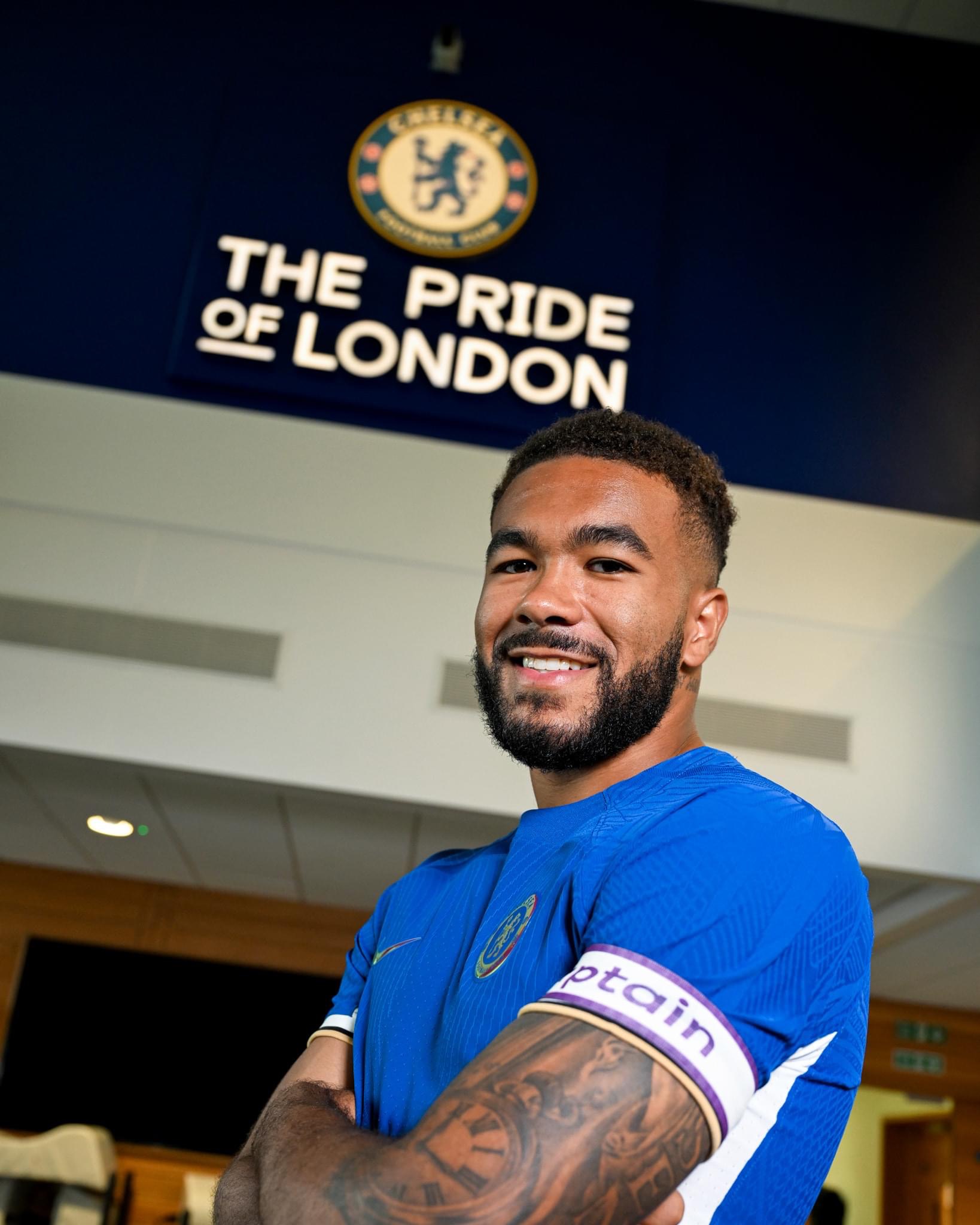
Responsibility will fall inevitably on Chelsea’s newly appointed captain, Reece James. Like Mount, Gallagher and indeed Colwill, James is a club product, having joined the club as a six-year-old. But whereas Mount’s head was turned – quite noticeably, it has to be said - by the possibility of football elsewhere, James has shown relatively unwavering commitment to the club that also has his sister Lauren on the books. The right wingback has long looked like captaincy material but with a caveat: when fit. Most fans will be pleased to see the likeable 23-year-old take on the mantle, but his injury will raise questions about consistency. 

Ben Chilwell, James’ left-sided counterpart has been appointed vice-captain, another sensible move for one of the most under-rated grown-ups in the Chelsea squad. He, too, has had a troubled history with injuries, so Pochettino must hope that his captain and his deputy won’t need another backup option. 

Leadership wasn’t always in evidence last season, with some games descending into farce as players started making things up for themselves on the pitch. “He’s a player that is a leader,” Pochettino said of his new skipper during Friday’s press conference. “He’s the present and he’s going to be the future of the club. He’s a perfect player for me and the club to be a captain.”

Viewed from one angle, Chelsea still look somewhat dysfunctional, both on the pitch and behind the scenes (for their opening game tomorrow against Liverpool they still don’t have a primary shirtfront sponsor). That said, the seismic upheavals that characterised 2022 for the club are still reverberating. 19 years of mostly relentless success under the Abramovich regime left fans with an inflated sense of expectation that the Boehly-Clearlake takeover would ensure continuity. It didn’t, although if the new owners would admit it, they didn’t get everything right themselves.

For his part, Pochettino’s job will be to not only rebuild the squad, tactically and spiritually, but rebuild some of the damaged goodwill towards the fans, who turned up at Stamford Bridge, or travelled to away fixtures, irrespective of how poor the games turned out to be. “We are building something special, I think,” he told journalists in America during the pre-season tour.

He qualified that statement by saying: “It’s a process and we need time. But in football, you cannot ask for time and you need to deliver from now. We know that we are in Chelsea and even if we have young players that will be involved against Liverpool [in the opening fixture], the mentality is to win. We are preparing ourselves to know the first game will be tough and then the next game also but we need to arrive with a good mentality.”

Chelsea, as a club, has liked to talk about “projects” for a while. The Boehly-Clearlake takeover has been one. When Tuchel, Potter and then Lampard used the phrase last season it sounded somewhat hollow, a PR phrase drummed up to excuse a work-in-progress. The fact is, every football season is a work in progress. Every team selection an experiment. A 4-3-3 formation at the start of a match can very easily change shape several times in the course of proceedings. It is, as Danny Baker once shrewdly observed, “chaos”. Thus, too much store is placed on the speculative summer weeks, which is why I tuned out in the first place. Tomorrow is the start of the period in which matters really count.

Saturday, 14 May 2022

Expectation management: the Subbuteo Final awaits

Subbuteo.com

The last time I blogged about Chelsea it was in the immediate aftermath of sanctions being imposed on Roman Abramovich following Russia’s abhorrent invasion of Ukraine, and the existential threat the UK government’s action posed to the club. Now that a consortium led by LA Dodgers owner Todd Boehly has agreed to takeover the club - still subject to government approval - scrutiny will turn to what happens next in terms of Chelsea’s evolution.

It is believed that the Boehly takeover will pay £2.5 billion for the actual club, with a further £1.75 billion committed to the club’s development, with that investment going on [hopefully] the rebuild of Stamford Bridge, as well as support for the much-vaunted Academy, and to the EWL champions Women’s team and their Kingsmeadow stadium, a mile or so up the road from where I live. What’s not clear, however, is what will be spent on new players for the men’s first team, the side going into the 150th FA Cup Final today for their only chance of silverware this season. That, in itself, is quite a statement for a club that has won five Premier League titles, the Champions League twice, five FA Cups and three League Cups, two Community Shields, the Europa League twice and the Super Cup once, and most recently the FIFA Club World Cup - all in the Abramovich era. Compare that with what came before: until the FA Cup win over Middlesbrough in 1997 there hadn’t been anything for over 25 years.

The conventional wisdom (i.e. what pub experts and the back pages perpetuate), then, is that Abramovich started the arms race that football's elite has either actively joined or aspires to. Thus, since the sanctions were imposed on the Russian, and tightly restricted the club’s expenditure to clear the path for a takeover by someone without ties to the Kremlin, visiting fans to Stamford Bridge have sung themselves giddy with choruses of “Where’s your money gone?” and “Just like the old days - there's nobody here”. This has been a gleeful baiting of the West London club‘s supporters with all the compassion you’d expect from football’s arch tribalism. Don’t worry, we reason with ourselves in the home stands, we’d be doing exactly the same if it was the other club under sanction. Harsh, but those are the rules of the football jungle.

For the last 19 years the pervading narrative is that Abramovich’s largesse has funded a conveyor belt of silverware, sanctioning the purchase of marquee signings to win them and charging successive managers with making those players work. Which hasn’t always gone to plan: Fernando Torres, Andriy Shevchenko, Adrian Mutu, Alexei Smertin, Juan Sebastián Verón, Mateja Kežman, Tiemoue Bakayoko, Danny Drinkwater, Ross Barkley are just some of the names on the list of expensive flops, which could easily populate a complete XI plus a subs’ bench. The jury is still out, too, on the £97.5 million spent last summer on Romelu Lukaku. And, of course, for each of these disappointments there has been a head coach fired for not getting the best out of them. Even club legend Frank Lampard, who ended up swimming against the tide amid rumoured player agitation behind his back. Another is Carlo Ancelotti, arguably one of the greatest club managers in the history of the sport, who was the model Abramovich coveted for the club he’d just acquired in 2003, but ended up firing for the crime of only achieving runners-up place in the Premier League in his second season, having won it in his first (along with the FA Cup).

Picture: Facebook/Chelsea FC
Thomas Tuchel is, therefore, likely to be the first Chelsea manager to outlast Abramovich. It’s too soon, of course, to say whether he’ll stay at the club after the Boehly takeover completes - it’s possible that he might want a change, likewise, the new owners might want someone new. But it would be fair to say that things are likely to be a lot different in the new era. Last Saturday, at his first home game, Boehly would have seen the best and the worst of his new purchase. Lukaku somewhat justified his price tag with a goal from open play and a decisive penalty in the space of three minutes, demonstrating the muscular heft it was hoped the Belgian would bring to the conventional centre forward’s position. But then, in the final fifteen minutes, Boehly would have also seen a ridiculous collapse as Wolves cheaply clawed two back, the latter of which in the 97th minute. Although some normality would have been restored a few days later with a 3-0 away win at Leeds, you could have benevolently given Boehly some right to express buyer’s remorse at Stamford Bridge last Saturday. 

The truth is that Chelsea had, in preceding games, been slipping back into the sort of defensive indifference that had done for Lampard. Stupid, lazy, careless mistakes that allowed less-fancied teams to sneak through. Tuchel’s first task, in January last year, was to rebuild Chelsea from the back, damming the leaks and instilling resilience. By last May, they’d become European champions. Those same mistakes have been largely at fault for their form since April, which has at times been explained as a combination of tiredness and the uncertainty surrounding the club. Those, I’m afraid are just excuses. Defeat away to Everton, a draw at Old Trafford, home losses to Arsenal and Brentford - all with discernible basic defensive errors.

Here, then, is the first challenge for Boehly. Antonio Rüdiger has already confirmed that he’ll be off, having called a halt on contract renewal talks, apparently because a wage of £230,000 a week wasn’t enough. This week it was revealed that he’ll play for Real Madrid for a rumoured £400,000. Next out the door will be Andreas Christensen, who is believed to have signed a pre-contractual agreement with Barcelona. Even captain César Azpiliqueta - a couple of months shy of his tenth anniversary at the club - has appeared to be stalling on a contract extension, with the Catalonians also looking to take him on, too. While Christensen and, increasingly, Azpiliqueta, have become somewhat expendable (they’ve hardly been Chelsea's most effective central defenders) Rüdiger will be emphatically irreplaceable. The loss of three central defenders, too, will only expose the scant options that remain, which include the not-yet mature Trevoh Chalobah, the largely unfit-for-purpose at this level Malang Sarr, and Thiago Silva, who turns 38 next season, and despite still being one of the most viable centre-halves in football, surely can't go on at this level forever, and certainly can’t be expected to play week-in, week-out. 

While there are reserve options - Emerson Palmieri was sent out on loan again, along with homegrown prospects Ethan Ampadu and Jake Clarke-Salter - Chelsea’s productive Academy might also have other gems to follow in the footsteps of Reece James. Inevitably the club is said to be looking outside for fresh talent, with Sevilla’s Jules Kounde a target. But while the core defenders are a cause for concern, there are doubts elsewhere. Marcos Alonso has only been getting games due to Ben Chillwell’s long-term absence, but surely the Englishman, when fit, will see the somewhat inflexible Spaniard (who is hopeless as a defending wing-back) move on? Alonso is also one of a number of players with the end of their contracts in sight, meaning that de facto chief executive Marina Granovskaia - the highly regarded Abramovich acolyte who has pulled off some impressive player sales as well as acquisitions - will need to step up deal-making.

At the beginning of the season Chelsea were tipped as one of the sides to contend for the Premier League title, but as Manchester City and Liverpool have accelerated away from Tuchel’s side, its deficiencies - and not just the defence - have been laid bare. Chelsea have become too predictable: moves begun by wingbacks have laboured in the final third, pitching crosses from the corners that have rarely found anything like a target. Lukaku will no doubt be the lightning rod for that criticism - and he hasn’t always helped his case - but there’s been too much lack of inventiveness at times across the entire attack. Timo Werner and Kai Havertz - bought at a combined cost of £115 million - haven’t produced the goods, despite a recent resurgence. Then there’s the American national captain, Christian Pulisic, who clearly has abilities but only seems to produce them on occasion. Mason Mount has probably been the most effective attacking player (and is currently tipped to be the next captain if Azpiliqueta moves on), but has too often lacked the supply from central midfield, as Jorginho, N’Golo Kanté and Mateo Kovačić have toiled in the engine room. Oh, for the addition of Mount’s bestie Declan Rice!

All of which brings me to today’s little shindig at Wembley. When I was growing up, Chelsea-v-Liverpool was more a romantic proposition than it was sport. It was the classic Subbuteo combination - the blues against the reds, but in the 1970s and 1980s, Liverpool were pre-eminent in domestic and European football. Chelsea, on the other hand, were the faded glamour boys of West London, having gone from star-studded fanbase in the Swinging Sixties to Second Division strugglers on the verge of financial collapse (when away fans sing “Where where you when you were shit?!”, I know exactly where in Stamford Bridge I was…). Times have changed. Chelsea’s record over the last two decades has been eminently better than Liverpool’s, a source of partisan pride amongst the Bridge faithful, but where these two teams are, now, at the end of this season, with Liverpool fighting for not one but four trophies, and Chelsea apparently flying on fumes, makes for a stressful afternoon today at Wembley.

You could say that Chelsea have, in the Abramovich era, rather become the darlings of the FA Cup, having appeared in eight finals since 2003, winning it five times. Four of those eight appearances have been in the last five finals, which have only produced the one win, against Manchester United in 2017 in a somewhat underwhelming game. Still, though, in attempting to break their frustrating recent record, it should still be acknowledged that reaching the final of arguably the world’s most prestigious club competition is something to be celebrated. It is, to some extent, the outcome of the win-at-all-costs culture Abramovich instilled at the club, where even the cream of European managerial talent was considered expendable in the face of expectation.

So what does that mean for today? There’s no denying that Liverpool, competing for a quadruple, are facing a febrile Chelsea. Of course, that requires the cliche about the underdog being under less pressure, but for Thomas Tuchel, a win over Liverpool will lift the shadow that has grown over his team since their memorable win in Porto last year as sloppiness has crept in over the last couple of months.

Brothers in arms - Christian Pulisic and Mason Mount
Picture: Facebook/Chelsea FC
Beyond today, and the remaining two league fixtures, a new tomorrow beckons for Chelsea Football Club. Boehly must stem the outflow of players who, as soon as the sanctions were imposed, would have been on the phone to their agents. He must immediately suppress any uncertainty. In particular, he must retain the services of Granovskaia but, moreover, ensure that the club’s top talent is tied down to new contracts before they creep into the expiry zone. A priority must be the anchoring of Mount and Reece James, whose contracts may have two and three years, respectively, to run, but are players who would be coveted by anyone. And Boehly must also hang on to Tuchel, who has largely carried the club through these last three months of crisis, being the only senior figure to speak to the press as Granovskaia, chairman Bruce Buck and even technical director and former Chelsea goalkeeper, Petr Čech, have remained out of sight. You could argue that Tuchel’s opposite number and compatriot today, Jürgen Klopp, is the blueprint. It’s taken Klopp seven years to get Liverpool to where they are today, during which time Chelsea have had six managers.

There are those yet to be fully convinced that Tuchel is ‘The One’, but after that many changes of head coach it’s hard to actually say who or what would make the job definitive. All that I’ll say is that since the end of February brought Chelsea to a state of actual jeopardy, a period of stability is needed to address these months of uncertainty. That also means that Tuchel needs to be backed in the transfer market, allowing the arrival of fresh talent to replace either the malcontents or the misfits, and perhaps more critically, be afforded the time and patience to rebuild Chelsea into sustainable domestic title contenders. If not, Tuchel will be snapped up by, you name it, any of the European behemoths.

The other item on Boehly’s to-do list will have to be Stamford Bridge. With a capacity of just under 42,000, it cannot compete with the mega-temples being built elsewhere. Abramovich came close to rebuilding the club’s home since 1905 but abandoned the plan when he ran into politically motivated visa issues with the British government. The idea was to effectively reconstruct the stadium from scratch, constructing a new complex upwards from a deep foundation on account of the fact the ground’s footprint is bordered by the Fulham Road, a railway line and the Brompton Cemetery, and can’t go anywhere else.

Of course, there is the small matter of the Boehly consortium’s takeover getting passed by the UK government. But the fact that Todd Boehly has done proper due diligence on the club and its footballing challenges (and this week spent two days at the Cobham training ground meeting both the men’s and women’s teams) provides hope that the new ownership is serious about maintaining Chelsea’s status within the European elite. A win today will be the perfect springboard for the new era at Chelsea to kick on with. It’s just a shame that it’s the current Liverpool that stands in its way.

Monday, 3 January 2022

New year, new problems, old story

Picture; Facebook/Chelsea FC
The moment when, four minutes before the end of the first half of Chelsea’s encounter with Liverpool yesterday at Stamford Bridge, the two young lads sat immediately in front of us had had enough and slouched off to the East Stand bar to watch the remainder of the period, said it all about the home side’s performance at that point in proceedings. 

Chelsea had been as insipid as I’d seen them in recent weeks, despite this being Liverpool. I utter the Merseysiders’ name with a degree of vituperative disdain. Because we have form. History. Go back to the 1970s, when Liverpool had a regal air about them, such was their domination of English and European football. Chelsea were in the doldrums, especially as the 1980s came close, partly the result of dire finances and partly the result of just not being very good. 

To the pre-teen me, fixtures between Chelsea and Liverpool was Subbutteo made real: Blues and Reds. Liverpool were, as Manchester United were to become in the ’90s, lauded without question. To this end, the residual rivalry between Chelsea and Liverpool - or, at least, their fans - should have fizzled out years ago. But it keeps appearing, like niggling bouts of gout. I’ll spare the lengthy list of flashpoints, but it would include Chelsea beating Liverpool in May 2003 and pipping them to a Champions League (which also swung Roman Abramovich’s towards the West London club), and then the pyschodrama between José Mourinho and Rafa Benitez when in the blue and red corners respectively (skirmishing that took a perverse turn when Benitez became Chelsea’s interim manager and then went and won them the Europa League). If you dig back into my blog post archive you’ll find a longer essay about the Chelsea-Liverpool back-and-forth. 

Brought back up to date, Liverpool arrived in SW6 yesterday with its manager buried away, self-isolating with Covid, and Chelsea dealing with Romelu Lukaku giving an unauthorised interview to Sky Sports Italia, in which he appeared to question manager Thomas Tuchel as well as his own future to the club that paid Inter Milan £97.5 million in the summer to take him off their financially-troubled hands. And so, there was an air of unsettledness about Tuchel’s team as the game kicked off, Lukaku not even on the bench, and they found themselves 2-0 down by the 26th minute. There were plenty around Stamford Bridge carrying an ominous sense of foreboding as Liverpool threatened to run riot. 

It wasn’t just a case of it looking unlikely that Chelsea would get back into the game - a two-goal deficit at this level, and Chelsea’s form going into the game not inspiring much confidence - but the mood around the club had been progressively souring in recent weeks. A familiar story, too: I’ve lost count of how many times Chelsea have gone into the Christmas period looking suddenly shaky, followed by the arrival of a new manager by March. In fact the pattern this season has been almost identical to that 12 months ago when the wheels came off (or were forced off) Frank Lampard’s tenure, prompting Tuchel’s appointment and a near-miraculous revival that saw the Blues win the Champions League by May.

In the first third of this season Chelsea were being mentioned - or at least muttered - as being genuine title contenders, with an imperious defence anchored by the age-defying Thiago Silva, a goalkeeper in Edouard Mendy who seemed to stop everything, and a dynamic attack that saw wingbacks Reece James and Ben Chilwell vie with the recognised forwards for goal-scoring. Tuchel had steadied the ship at the back in his first few months, but the Chelsea backline had become increasingly vulnerable in recent weeks. Throw in a giant hole in midfield left by the mercurial N’Golo Kate, out with injury, and Mateo Kovacic, out with Covid, the spotlight soon shone on both a leaky defence and an ineffective attack, itself bereft of Lukaku due to injury and then a bout of Covid himself.

So, when squad numbers in the 60s and 70s start appearing on the bench, drawn from the Under-23s, things started to look worrying around one of the most lavishly-equipped teams in European football. You had to, though, afford Tuchel some sympathy, as you do any Chelsea head coach. A Chelsea manager is expected to deliver a trophy a season, but it’s hard to see where one will come from this term, given that Manchester City are running away with the Premier League, retaining the European Cup looks even more unlikely than it did a year ago, and the Carabao and FA cups, which continue this week, progress at a time with Chelsea both depleted and seemingly demoralised.

But hold on. While the lads from seats 109-111 in Row 19 of the East Stand Upper were supping their half-time beers a few minutes early yesterday, Chelsea defied the odds and clawed back two goals. Two good goals, too, especially Christian Pulisic’s 46th-minute equaliser. Come the second half and we were treated to one of the most entertaining 49 minutes of football I’ve seen this season. No more goals, sadly, but that didn’t matter. And it wasn’t just Chelsea, either - we had a proper ding-dong. A brilliant end to ridiculous Christmas football scheduling, which has seen clubs play every two or three days just to satisfy home TV audiences gorging themselves on Quality Street and turkey sandwiches.

Picture: Facebook/Chelsea FC
The question is, what happens next? Wednesday’s Carabao Cup tie with Tottenham will prove another test for Tuchel’s team, though it’s more than likely that next Saturday’s FA Cup Third Round tie at Stamford Bridge against Chesterfield will provide a runout for the fringe players and Under-23s rather than any of the first team regulars. Because with them, Tuchel has other challenges to address, and they’re the kind of challenges Lampard encountered at this same point a year ago - players that should be delivering that weren’t. Admittedly this time the German has more injuries to contend with, but this is where he will have to dig deep, as he did when he first came on board at Chelsea. He will not just draw on available resources but have to organise and inspire. Where they deliver is another matter entirely, given where Chelsea sit in the grand scheme of things. But like it or not, the job falls to Tuchel, who has demonstrated more than adequately that he is someone Chelsea would be mad to jettison at the first sight of trouble, as they do so often when it seems that the silverware cabinet is looking unlikely to welcome any additions this season.

Football is fickle. Go back just six weeks and Chelsea were six points clear at the top of the Premier League. They’d also just put Juventus to the sword in ruthless fashion, and in a spell of games when, at various times, they’d been without the likes of Kante, Havertz, Werner, Mount, Kovacic and Lukaku - players any side would kill to have on their books. But it was during that Juventus game that Ben Chilwell ruptured his ACL. The left-sided wingback had been key to Chelsea’s progress from simply being a good defensive side to one that could prise open opposition defences. 

Now, only an act of God or a spectacular collapse will give any of the chasing pack hope of catching up with City. But that shouldn’t mean Chelsea can’t finish the season with something to show for their quality in the run-up to the December collapse. Their Carabao Cup tie with Spurs is a semi-final, putting them only 360 minutes away from a trophy, even if it’s not the one they’d most like. They’re still in the Champions League, and without gilding the lilly, they’ve defied the odds - even against the Bayerns of this world - before. They probably shouldn’t even be defending champions based on last season’s form if we were to be honest. And if we’re counting competitive opportunities, next month Chelsea take part in the Club World Cup. 

Mindset will be the fuel that drives them. Tuchel doesn’t just have to organise Chelsea and select the right combinations and formations of available players but also instil in them the verve that sometimes makes all the difference. It’s a confidence that, yesterday, was lacking in Christian Pulisic’s atrocious miss early in the game while odds-on to score, but was there in spades when he volleyed the ball up into the top right corner of the Liverpool goal. Tuchel was handed something of a poisoned chalice when he took over at Chelsea on 26 January last year. He wasn’t just replacing another doomed head coach, but the club’s record goal scorer, Lampard. To some fans Tuchel had risen without trace; Google filled in the blanks but his recent history at Paris St. Germain suggested another European technocrat and a troublemaker too. A year on there is a strengthening relationship with the fanbase which also reflects what he is contending with. 

Twitter and radio phone-ins, the great modern sounding boards of public opinion, have appeared to back his decision yesterday to drop Lukaku from the matchday squad, not just drop him from the starting line-up, and you could conclude from the way the team responded to going two down to Liverpool that the punishment of a recalcitrant teammate didn’t have any detrimental effect on team spirit. 

Picture: Chelsea FC
The Lukaku saga isn’t over, however. ‘Clear the air talks’ might straighten things out, but the last thing Tuchel needs right now is an agitating player. Most fans, though, appeared to support Lukaku’s exclusion from the Liverpool game, concluding that maintaining leadership and discipline trumped appeasing a star ego. Amongst pundits there was a mixed view. Darren Bent tweeted: “I understand Lukaku has done wrong and should be punished appropriately but leaving him out of the squad today for one of the biggest games of the season, when your [sic] still trying to stay in the title race and his form in the last 2 games seems extreme. What's people's thoughts?”. Michael Owen coyly wrote: “If reports are accurate, it’s a huge decision from Tuchel to leave Lukaku out of today’s squad. But in the long term interests of the club, it’s a good one. No player is more important than the club and while being employed by someone, you can’t speak out like he has.” 

Graeme Souness was characteristically uncompromising, branding Lukaku’s comments in the Sky interview as “ridiculous”, “disrespectful” and “enormously“ damaging to Chelsea, adding that it was the behaviour of an impetuous 19-year-old rather than a senior player at 29. “I can't tell you a worse thing that a player can do at this moment in the season,” Souness added. “To come out and say basically, ‘I don't want to be here, I don't want to play with [these] players’ and how that damages Chelsea going forward, it has to.”

So, what happens next? Today, Tuchel and Lukaku were meant to have “talks”. In his post-match comments yesterday Tuchel attempted to play down the issue. “It’s not Chelsea-like [for Lukaku to say what he said in the interview] but it’s also not the worst thing in the world.” “[It is] not the first time an interview out there causes some noise nobody needs. But we can handle it. I don’t feel [it was a] personal attack. On Saturday, new statements [came out] and it got too big, too much noise, and we lost totally the focus of the match.” 

That last statement is the salient point. Lukaku has provided an unwelcome distraction just as his team was having to deal with injuries and Covid absences. Given the way their energy and concentration was noticeably exploited by Liverpool’s first two goals, you could easily say that the Lukaku distraction had an immediate effect. But, then, the way in which Chelsea fought their way back into the game, equalised and then went on to match Liverpool in what would end up being a satisfyingly enjoyable draw (even if it did allow Manchester City to open up an even bigger lead), suggests that no player is greater than the club he plays for.

Picture: Chelsea FC

We’re not yet at the stage of Lukaku leaving Chelsea. He’s ceainly not going to leave in the January window. There’s no guarantee, either, that he will move on in the summer. Inter can’t afford to buy him back, anyway, which is why they sold him in the first place. But the player must also remember that Chelsea managed to win the Champions League without him, on the back of a nervous few months that had seen another manager ejected. But we shouldn’t be naive. Player power (yes, you, Marcos Alonso and Antonio Rüdiger...) played its ugly part, as it had with José Mourinho, André Villas Boas and even Antonio Conte, all victims of uppity strikers. One hopes that cool heads prevail within the Chelsea hierarchy now. There’s no denying that a slump has occurred over the last six weeks, and while injury and Covid have played their part, the squad hasn’t been decimated so wholesale. Each week Tuchel has managed to send out players with first team credentials, albeit augmented by untried youngsters on the bench, just in case. Pundits might be tempted to revive talk of Tuchel’s tempestuous demise at Paris, and who knows if he is a changed manager now. But after some misgivings at first, largely the result of the how Lampard was displaced rather than anything about the incoming head coach, Tuchel has mostly proven to be an inspiring manager. Easily one of the best in the world. Chelsea would be mad to dispense with his services now, but you wouldn’t put it past Roman Abramovich and his capricious management philosophy. To boot, we’ve long grown used to Chelsea’s fire-and-hire cycle, largely because it seems to have worked. 

Judging by the way Stamford Bridge sang Tuchel’s name in the opening and closing minutes of yesterday’s encounter with Liverpool, the first time I can recall this season at home, he has certainly won over the faithful. We have, though, been here before…

Wednesday, 2 December 2020

Return of football supporters is a kick in the ballots

© Simon Poulter 2019

It’s here. It’s actually here. The second of December, which means life in England returns to…well, not exactly normal. Since midnight, we’ve been placed into a revised system of tiers to keep us restricted without calling it a new lockdown. Non-essential shops, hairdressers and other businesses can reopen again. Tomorrow I will go for my first swim in four weeks, never really recalling the scientific wisdom of why I wasn’t allowed to go before, given that the local pool perfectly observed social distancing, disinfected the very ground you walked on and, while actually in the pool, engulfed you in wonderfully chlorinated water to keep COVID at bay.

Tonight, too, football will return. Well, I say ‘return’ but it’s never really been away, just the fans, the "12th player", as cliché-prone professionals have a habit of saying. After the initial halt caused by the pandemic, football returned in July - sans fans - and again in September after the briefest of summer breaks, again to empty stadia (albeit for an experiment at Brighton’s Amex Stadium with a friendly against Chelsea). Now, the football that was already back, is 'back', albeit in a limited form as grounds in England’s Tier 2 areas are opened up to up to a maximum of 2,000 supporters each. Grounds in Tier 1 areas will be allowed to host up to 4,000 spectators, which will be a boon to Truro City FC, Cowes Sports Football Club on the Isle of Wight (they play in the Wessex League Premier Division) and whatever professional clubs exist on the Scilly Isles. Not many, I suspect.

For the English Premier League, the return of people other than staff and club mascots is still only very partial. Essentially, the only clubs that can host fans are Arsenal, Brighton, Chelsea, Crystal Palace, Everton, Fulham, Liverpool, Southampton, Tottenham and West Ham. Aston Villa, Burnley, Leeds, Leicester, Manchesters City and United, Newcastle, Sheffield United, West Brom and Wolves will all have to soldier on in deserted grounds, unless the Tier 3 restrictions imposed on their host cities are revised. With the tiering system either enabling or denying all English league and Women’s Super League clubs from opening, it all feels a little piecemeal. There is, also, the argument that those clubs who can now bring fans in, will be at an unfair advantage to those who can not. Plenty of players have spoken throughout this weird period about how the lack of crowds to buzz off impacts their performance, and it was noticeable that when games did resume after the lockdown in empty grounds, the quality of the football was below par.

Picture: Twitter/@CAFofficial
From a financial point of view, allowing 2,000 fans in is hardly going to boost the coffers of clubs whose grounds hold ten or 20 times that number (even if Chelsea - who probably need the money the least - are charging a whopping £75 for balloted tickets in one of their stands). 

For precarious clubs like Charlton Athletic, who will be amongst the first to host fans under the new rules, tonight at The Valley, it could be helpful, but hardly a lifesaver. But, even if it's only 2,000 fans entering a 27,000-seat stadium (and with a large fanbase in Tier 3 Kent, who will not be allowed to travel in to south-east London), I suppose it's foot traffic through the turnstiles of some kind.

While I’d be the first to admit that not going to Stamford Bridge every other weekend for the last nine months has been a price worth paying for my health, the absence of 'live' football has left a gap in my life over the course of a third of last season and a third of this one. The thing is, there’s a difference between 42,000 people at the Bridge, and a number closer to the school assembly attendance of a large comprehensive. Watching games on television is fine - we do it for away games or for cup matches we’d prefer to watch from the comfort of our sofas - but there is no substitute for being in the stadium. It's the rituals and traditions you miss: the pre-match pint, the arguments over spurious offside decisions, and the vehement disagreement with callers to 606 while stuck in traffic on the way home.

For those who do get tickets to see their clubs under the new protocols, the experience will be a lot different to what they’re used to. Each club will impose a code of conduct, based on guidance from the Sports Grounds Safety Authority. Along with requiring fans to wear facemarks when entering and leaving grounds, and while moving around them, some are likely to put even more health and safety requirements in place. Tomorrow night’s Europa League tie between Arsenal and Rapid Vienna at the Emirates will carry a very strict ruling on alcohol (“only available when purchased with a substantial food item and when seated at a table”) and on physical contact: “Avoid hugs, high-fives, handshakes and any close contact with people who are not within your group.” 

Liverpool has already asked supporters to “act responsibly” when “celebrating or engaging in key moments of the match”, reminding supporters that “COVID-19 spreads more easily when people stand, sing and shout”. Anfield, it shouldn’t be forgotten, played host to the alleged 'superspreader' event in March when Liverpool played (and were beaten by) Atlético Madrid in the Champions League, a game played before a capacity crowd that included 3,000 fans who’d travelled from Spain, just as Spain’s own coronavirus rate was going through the roof. On the same day as 54,000 people packed into Anfield, not to mention the pubs and chip shops around the streets bordering on Stanley Park, the World Health Organization classified COVID-19 as a pandemic, expressing “deep concern” for “the alarming levels of spread and severity, and by the alarming levels of inaction.” The day before, Madrid had closed its schools as infection rates in the Spanish capital had gone through the roof.

© Simon Poulter 2019

My last visit to Stamford Bridge was a couple of days before the Liverpool-Atlético fixture, for Chelsea’s home league meeting with Everton. The gaps in our area of the East Stand were noticeable. In fact, the entire row below us was empty. Normally, when the dad and son who sit right in front leave ten minutes before the end you suddenly become aware of the cold wind. This time, we had it for the full 90 minutes. For those regulars who were there, there was awkwardness, as no one knew whether to shake hands (as is the custom) or bump elbows. No one, though, knew what was about to come, either.

For those lucky enough to win a balloted ticket under the new routine, the experience is certainly going to be odd. Tickets will be for carefully designated areas, the social distancing we’ve all grown used to over the last nine months will be applied, and fans will also have to adjust to sitting somewhere different. OK, minor inconveniences for the sake of getting to see live football again. But will people really respect the “respiratory etiquette”, as Ken Scott, head of inspectorate at the SGSA, described it to The Times yesterday? Shouting and singing would not be prohibited, he said, but it was important for fans to respect the people sitting around them. “I feel confident, however, that we will see supporters demonstrate that they can be trusted and surprise the doubting Thomases,” he said. We shall see. 

Monday, 21 September 2020

Time for a Monday Moan? Not just yet

Picture: BBC Sport

Long-standing readers of this blog might recall a tradition that set in during José Mourinho's brief final season as Chelsea manager. After signing a new contract on August 7th, 2015 (which, incidentally, would have expired only last year), Mourinho oversaw a run of games that saw Chelsea pick up just 11 points from their first 12 Premier League fixtures, and exit the League Cup to Stoke by October. By December 17th, when Mourinho left Stamford Bridge for a second time ("by mutual consent"), the club had lost nine of its 16 league matches. Chelsea were in something of a death spiral and, at the moment of the Portuguese's departure, were one place above the relegation zone.

Along the way, my posts became exponentially more exasperated, to the extent that, like my very first missive in the blogosphere (a rant about England's exit from the 2010 World Cup, written the morning after), I established a history of letting rip on the first working day of the week. During Mourinho's progressive denouement at Chelsea, my Facebook updates to promote such posts became known as The Monday Moan.

That I mention this today, the Monday after Chelsea lost yesterday - and didn’t lose well - is something of a coincidence: it is too soon, two games into the new season, to get into a cycle of misery, especially as they won their first, last Monday, against Brighton, and they were, yesterday, playing the newly-crowned English league champions. But this is what football is about. A bad result at the weekend - even one as gloriously sunny and summery as this one was - is all it takes to start the week in a fug. But (and here’s where a football fan’s acute sense of denial instantly kicks in) there is need for some - some - perspective.

To summarise, Chelsea, with their expensively assembled, £230 million of summer acquisitions, were facing Liverpool at the Bridge in only their second competitive game of the season. In some respects, a tough break to meet last season’s champions so soon, but then to think that way is to already take on a defeatist view. Chelsea, after all, did finish fourth - an unlikely outcome, given the challenges of a transfer ban and relying heavily on youth last season. But that shouldn't necessarily mean that meeting Liverpool is anything less than a peer encounter. Chelsea-Liverpool has always been one of the fixtures I’ve attended religiously, dating back to the late 1970s, when the Merseysiders were imperious and the Londoners were in the mire of financial crises. That, to the 11-year-old me, was less apparent. What drew me in was that these two teams represented the classic football confrontation: the blues and the reds. Human Subbuteo. And thus it has continued for 40-plus years, all through the storied (and well-documented - see my post from June, Red Rain) history of encounters between the teams. 

So, then, yesterday. A cagey start by both sides saw Liverpool increase their presence, pressing Chelsea high and clearly setting out to test a largely unchanged defence, their Achilles heel all last season. That approach won out on the stroke of half time when Andreas Christensen lost his head and rugby-tackled Sadio Mané to the ground as he charged through on goal, to be rightfully dismissed after a VAR review of the initial yellow card. No one, least of all Christensen, should have had any complaints. After the break, Liverpool came out to face ten-man Chelsea with renewed, ominous purpose, Mané proving the tormentor twice, scoring within five minutes of the interval, and again, four minutes later. Perhaps Chelsea could be credited with keeping the scoreline at 0-2 for the remaining 35 minutes of play, but it was the nature of those two conceded goals that require the attention.

That £230 million has mostly been spent on attacking players, and given Timo Werner’s exciting pace (and a couple of decent chances yesterday he’ll regret), and the gradual introduction of the £71 million Kai Havertz, Chelsea could have one of the most fearsome attacking line-ups in the Premier League, given all the other options in Frank Lampard’s toolbox. But, as has been recanted verbatim over recent months, it’s at the back that changes are needed, and needed fast. Ben Chilwell, the left-back Chelsea coveted for some time, is yet to make his debut due to injury, meaning the defensively weak wingback Marcos Alonso continues to have put his lack of defensive pace and positioning on display. So it proved with Mané’s first goal, the result of Liverpool sending the Senegalese winger, plus Keïta, Alexander-Arnold, Salah and Firmino into the final third, baffling Chelsea’s defenders (now with Tomori replacing Christensen). Firmino beat Alonso to cut the ball across for Mané to head into the goal. For once, Chelsea’s Kepa Arrizabalaga couldn’t be blamed, directly. For what happened next, he could.

They say that if you’re already in a hole it’s a good idea to stop digging, but Arrizabalaga has clearly not heard this adage. As if he needed to add to the growing list of calamities, what seemed like a bread-and-butter clearance out to Jorginho was intercepted too easily by Mané, who simply poked it into the net with the casual ease of someone sweeping a tin can out of the way.

Almost to a newspaper, every back page today has said the exact same thing: Édouard Mendy cannot arrive from Rennes soon enough. We’re told that the goalkeeper's £20 million signing is imminent, but on this display from Chelsea's current stopper, Frank Lampard’s first duty this morning was probably to bang on Marina Granovskaia’s office door with a demand to know where she currently is with the Mendy deal, and to even offer a few quid of his own money to tip the balance of any last-minute wrangling.

Taking a step back, Chelsea weren’t helped yesterday by reticence. It was almost as if they were intimidated from the outset by Jurgen Klopp’s champions. They certainly allowed Liverpool’s high press to get the better of them, meaning that the Londoners’ defence was, once again, thin ice waiting to crack. The suggestion, here is one of a gulf in class, but when you look at where Chelsea have spent their money this summer, I genuinely think that they’ve got what it takes to compete within the top four. But it will take time. The veteran Thiago Silva, signed from PSG, has yet to make his debut, like Chilwell, meaning that the obvious weaknesses in defence have yet to be strengthened. Havertz is only two games in, and while Werner is looking sharp, he’s still, understandably, getting his timing right. With the other newbie, Hakim Ziyech, injured along with Christian Pulisic, arguably, the natural heir to Eden Hazard, Chelsea’s expensive new line-up is yet to take shape. Lampard, though, for all his exalted status amongst the club’s fans, also needs to learn better of what to do with these assets. One criticism of last season was that he wasn’t able to settle on an optimum defensive line-up, and that appears to have continued into this season. None of his central defenders appear rooted in the role (with Antonio Rudiger not even in yesterday’s squad), so with a risky goalkeeper and a never-the-same line-up in front of him, the inconsistencies have been laid bare.

Ever the diplomat, Lampard tried to put a supportive arm around his first-choice keeper. Accepting the Spaniard’s “clear mistake” for Liverpool’s second goal, he said after the match that: “We have to keep working, Kepa has to keep working.” Though acknowledging that it had been two games out of two that Kepa had dropped a clanger (conceding Leandro Trossard's goal last Monday against Brighton), he said: “Players need support, particularly from myself. I give that to all the players. Kepa has to keep working, nobody tries to make mistakes in football, it is the nature of the game. You have to be strong, you keep going and that is where he is at." Quite what Lampard’s mood is like privately is up for debate.

What he does know, or at least should know, as he opened up training this morning at Cobham, is that all the spending on top European attacking talent will amount to nothing if his defence continues to leak goals like they did last season. And, at risk of sounding ungrateful, the addition of just two new defenders (well, I say ‘new’, but Silva is now 35), means that more, much more, needs to be done with what Lampard already has in the department. In Reece James and Fikayo Tomori, for example, two youngsters of genuine promise, but still with much to learn. Stability - rooted in a goalkeeper who knows what he’s doing and can command those in front of him - is essential. That won’t come quickly, or easily.

But, to step back a bit further, there's a reason why I'm not yet ready to reinstate the Monday Moan. Yesterday's game was a tough schooling for Lampard, and from the one club Chelsea fans would have preferred not to have received it from (well, maybe the other club, if you include Tottenham). Two games in, it's too soon to press the panic button. For context, go back to 2016 and Antonio Conte's first season in charge. By September 11th, Chelsea's early season wins had been arrested by a 2-2 draw with Swansea. Then came back-to-back defeats - to Liverpool and Arsenal, the latter a humiliating 3-0 reverse. Conte had seen enough and switched to the 3-4-3 wingback system that would propel the team to Premier League champions eight months later, and with a 13-point margin over runners-up Spurs. The point here is that it really is too soon to moan, even if, this morning, it's fully justified.

Wednesday, 19 August 2020

Something Fab worth saving


COVID-19 has reaped much misery, I don't need to tell you that. Almost three-quarters of a million deaths worldwide and counting, with 41,000 in the UK (or 46,000, depending on your preferred accounting method). The pandemic has cut a huge swathe through business, with high streets and airlines, department stores and restaurant chains, forced into administration, some possibly never to reopen. As of last week, 175,134 people had been made redundant in the UK as a result of the crisis, with 9,373,700 employees at 1.2 million companies placed on furlough. That, you could say coldly, is business. The economy will return, "the green shoots of recovery" will poke up at some point. They always do.

The arts, though, have suffered particularly badly, with theatres dark and music venues shuttered for the foreseeable future. I've lost count of the number of gigs I had tickets for which have been transmuted optimistically to 2021, much like mine and your next foreign holiday. So the argument to keep one individual venue open, as opposed to the thousands of others currently struggling, is a tricky one. However, news this week that the Cavern Club in Liverpool is facing closure is worthy of debate. Opened in January 1957, just as the rock and roll era took off, the warehouse cellar at 10 Mathew Street became, arguably, the most famous music venue in the world thanks to being "the cradle of Merseybeat", granting early exposure to acts like Gerry & The Pacemakers, Billy J Kramer, The Searchers, Cilla Black, and the Merseybeats themselves, plus a quartet that would go on to project Britain across the world - and still do.

The Beatles made their Cavern debut on 9th February 1961, the first of 292 appearances over the following two years. Seven months later local businessman Brian Epstein called in one lunchtime and saw the Fabs for the first time. By the following June he'd become their manager and had secured a recording deal with Parlophone Records. History - and not just musical history - had been made, and the Cavern had been where it had happened.


The importance, then, of this slightly dingy backstreet cellar should not be underestimated: it could be argued, of course, that Liverpool's Cavern plays no more an important part in British music than, say, the former Station Hotel in Richmond (location of the Crawdaddy Club which spawned the Rolling Stones), or the nearby Ealing Blues Club and Twickenham's Eel Pie Island, but the Cavern's nurturing of The Beatles in their early days is worthy of special national interest. I'm not going to wax on here about The Beatles' career and legacy - Lord knows, there's plenty of reference material out there on the subject - but it wouldn't be that preposterous to place them in the same league of historic importance as Shakespeare, Dickens, Wordsworth and Chaucer. I'd go so far as saying that the Cavern is of similar national significance as Stonehenge, and easily the equal to the Royal Albert Hall (especially now they know how many holes it would take to fill).

Liverpool's mayor, Joe Anderson, has warned that the Cavern is in grave danger of closing forever as a result of losing £30,000 a week since the beginning of the pandemic. He is understandably concerned, given that the club anchors the 'Beatles Experience' - the micro tourist industry that brings visitors to the city for its numerous Fab exhibits. Bill Heckle, one of the Cavern's directors, has called for government help to see the venue through the crisis: "We made a decision a few years ago to keep as much money in the bank as possible for a rainy day, not realising it was going to be a thunderstorm," he told the Liverpool Echo, revealing that, like so many businesses, they've been now forced into making redundancies - 20 so far, with another 20 likely in the next few weeks. "If the government grants allow us to open at 30% then we still lose money," Heckle says. "I wouldn’t expect [the government] to pay our profits, but at least make sure we don’t lose money, because it’s costing us £30,000 a week at the moment to be closed. That’s a lot of money."

Heckle stresses that it's not just nostalgia that should keep the Cavern alive: "The history is continuous. It’s not a museum," he told the Liverpool Echo. "It’s a very vibrant part of the Liverpool economy, which is why we’re reaching out at the end of August and reopening the Cavern for a week, virtually and bands from all around the world have sent messages and recorded sets. We know we’re not going to make money, it’s about really reminding people we’re here and the sole aim is to get out the other side. I’m sure we will, but it is about survival." It's a tough call. The arguments against protecting even as hallowed a venue as the Cavern are strong. My argument is that it is a museum, and a critical one at that. But why save this one venue and not, say, the local pub near me where a young Eric Clapton joined The Yardbirds, which has just been flattened to make way for more high-rise housing? The difference is, in fact, a bit bigger than just sepia-tinged emotion. The Cavern begat The Beatles, and there's a much bigger story behind all that.


Even if the timespan between their Cavern debut and their legal dissolution on 31 December 1970 spanned less than nine years, it's still a truly remarkable, unmatched nine years in terms of what The Beatles did in that time. They evolved, progressed and matured, before the world's very ears and eyes, all while remaining in their 20s from start to finish. And, yet, in that time, they went from fresh-faced, mop-topped, zoot-suited youngsters to bearded, absorbed hippies; metamorphosing, creatively, from the chirpy, innocent pop of Love Me Do to the wistful, even cynical soul of Let It Be, if you follow the chronology of releases. Even if you think of those nine years in terms of moving from their childhood homes to Surrey mansions, the role of the Cavern as the seed bed of The Beatles' success can't be ignored.

As a side point, on Monday a German friend of mine reminded me that it was 60 years to the day that The Beatles made their debut in Hamburg, having been recruited to be part of the city's efforts to boost its international appeal. Aged between 17 (Harrison) and 20 (Lennon), the foursome learned their craft, playing seven-days-a-week, for four-and-a-half hours on weekdays and six hours at the weekend, and sleeping in a squalid room at the Bambi Kino cinema on the Reeperbahn. It was their education. No magic route to fame via a TV talent show. And it prepared them, when they returned to Liverpool, for more graft at the Cavern.

Recently I listened to the first volume of The Beatles Live At The BBC and was astonished by the repertoire they'd developed in Hamburg and then perfected at the Cavern. By the time they started doing sessions for Auntie Beeb in 1963, they'd banked an incredible collection of rock and roll standards, including Chuck Berry, Ray Charles and Carl Perkins covers, as well as their own early self-written songs. This was pure craftsmanship. Again and again, the archives show that it was, first in Hamburg, and then back home in Liverpool, that The Beatles were formed as an incredible live band, with those early BBC recordings capturing the extraordinary energy that underpinned their reputation in that Liverpool cellar club.

Quite how this informed their most creative years and the astonishing progressiveness of Rubber Soul, Revolver, Sgt. Pepper's Lonely Hearts Club Band and beyond, is hard to really gauge. Their final concert, in 1966 at San Francisco's Candlestick Park, was not, as often surmised, a retirement. They simply didn't tour again. Instead, they retreated into their homes and the studio to move the rock'n'roll era into the classic rock era by writing those incredible albums that defined the final four years of their career as a recording unit, and their development into one of the most enduring symbols of the pop era, still to this day. Rather than being seen as a building block in that story, the Cavern should be seen as the foundation stone. To me, that places it in the same category of national cultural importance as a landmark like Stonehenge. And we wouldn't let that disappear, would we?

Friday, 26 June 2020

Red Rain

Picture: Getty Images

This is going to sound bitter and twisted, but saturated media coverage this morning of Liverpool's first league title in 30 years - and their first of the Premier League era - comes across as a birthright fulfilled. There's no doubt that Liverpool have deserved this season's title: the 23-point margin (currently) between them and chasers Manchester City, with seven games still to go, is testament to the clever football Jürgen Klopp has been applying at the Merseyside club. But, much like England addressing its own 54 years of hurt (and counting), no one is entitled. Blanket press today of Liverpool being crowned champions without, last night, kicking a ball feels a little overblown, especially when you read The Times' chief football writer Henry Winter's report on Chelsea's win over City last night, which handed Liverpool the title. It took Winter at least the first quarter of his piece before it even mentioned Chelsea, let alone that they'd won what was an entertaining and, unlike many in this restarted season, engaging game.

We Chelsea fans will be accused of pettiness when it comes to any suggestion of dismissiveness. In the 1970s and 80s, when Chelsea were, frankly, nobodies, Liverpool's hegemonic presence in domestic and European football gave them a regal air. Even in my native pocket of south-west London - surely prime Chelsea country - there were Liverpool fans aplenty (along with Ipswich fans at my junior school due to that club's brief period of supremacy). When the 90s arrived, along with Sky's first mega deal with the-then new Premier League (in which I played a teeny-tiny part, working on the presentation to the BSkyB board that secured agreement to propose a £304 million, five-year contract), the balance of power shifted. Football was in a fragile state, especially post-Heysel and post-Hillsborough, the double stadium tragedies that Liverpool and its fans had been sadly caught up in. With the Premier League and football's new money, Manchester United became the new power with Surrey its minted, middle class fanbase, as had been the case during Liverpool's previous years of authority. With this historical context, there is still no real reason why Chelsea fans should bear any animosity towards Liverpool, any more than any other team you could mention. There is certainly no geographic proximity, unlike Tottenham or Arsenal. But there is, though, form. Lots of form. 

Let's start with a certain Jesper Grønkjær, the Danish winger who, on 11 May 2003, changed the lives of Chelsea fans forever with the "billion pound goal" - cutting in from the right and beating at least three defenders to blast past Liverpool keeper Jerzy Dudek. It was a goal that rather stunned us in the Stamford Bridge East Stand. It would be a while before its impact sunk in. Grønkjær's goal secured a 2-1 win and a fourth-place finish for Chelsea, at Liverpool's expense. Chelsea qualified for Europe. Legend has it that this convinced Roman Abramovich to buy the club, and not Liverpool, prompting a period of unprecedented success, not to mention unprecedented resources, a core element of the story. Liverpool, the working class representatives of English football tradition, Chelsea, the now arriviste club from a part of London associated with poshness.

We move on, then, to the era of greatest niggle, with José Mourinho - and his particular brand of toxicity - in the blue corner, and Rafa Benitez in the red corner. To some, it became a tiresome clash of egos, to others, pure box office. Chelsea, under Mourinho, were mounting a blitzkrieg-speed assault on English football, in a way never managed in their golden phases of the mid-'50s and late-'60s. In the Portuguese coach, we had a Special One who could never be accused of lacking confidence. His capricious rival, Benitez, like predecessor Gérard Houllier, couldn't help feeling he was battling ghosts from the club's past. First blood was drawn in February 2005 when Chelsea beat Liverpool 2-3 in the League Cup Final at Cardiff's Millennium Stadium. To say it was tempestuous is understatement: Riise put Liverpool ahead after a minute, but it wouldn't be until the 78th minute that the advantage would be reduced by a Steven Gerard own goal. Tee, and indeed, hee. Three goals followed in extra time: Didier Drogba and Mateja Kežman putting Chelsea in the lead, Antonio Núñez giving Liverpool faint hope by a goal in the 113th.

Battle lines were crossed next later that season in the Champions League semi-final. By then, Chelsea had won the Premier League by a record-breaking 95 points, and all in Mourinho's first season in English football. It was also Chelsea's first league title in 50 years. Before drawing Liverpool, Mourinho had also dispatched Barcelona and Bayern Munich. The semi-final was, thus, deliciously set up, though this wasn't matched by the first leg, at Stamford Bridge, which ended 0-0. The second leg at Anfield, however, was a different affair. Mourinho stoked things before kickoff by saying that the pressure was on Liverpool ("We’ll go back to London as heroes, independent of the result"). Febrile from the start, within four minutes Petr Čech brought down Milan Baroš only for referee Lubos Michael to wave play-on. Luis Garcia caught on to the loose ball and scored...or so it appeared. In a time before goal-line technology, William Gallas looked to have cleared the ball, but Michael awarded the goal regardless, perhaps convinced by the emphatic celebrations of the Liverpool players. Even to this day, it's not clear that it was a goal. Mourinho still goes on about it. Garcia has since trolled Chelsea by dressing as a ghost for fancy dress parties. Liverpool went on to a final with Milan in Istanbul, arguably producing the greatest comeback in European football history. Liverpool and Chelsea went on to develop an even greater rivalry, meeting a further 20 times in domestic and European competitions within the next four years. In fact, at one point, the number of times the two clubs met in both league and cup competitions became yawningly tiresome for both sets of fans.

Another fissure became Mourinho's relationship with Liverpool's Steven Gerrard. As Scouse as chip butties and Brookside, the midfielder handed in a transfer request in the summer of 2005, barely weeks after that night in Istanbul. Chelsea tried to sign him (Mourinho would attempt again at Inter Milan and Real Madrid) after the Reds' skipper had decided to "roll a hand grenade into the Liverpool boardroom" when contract talks broke down. Gerrard was eventually won round by Liverpool, but the episode made its mark on Mourinho, who would later describe the midfielder as "one of my favourite enemies". The Mourinho-Gerrard axis remained part of the clubs' rivalry: on Mourinho's return to Chelsea in 2013, the away fixture at Anfield led to Manchester City winning the league title (an ironic twist on last night's fixture). In a Mourinho tactical masterclass, Chelsea monstered Liverpool, despite them being on an imperious, 16-game unbeaten run. Title denied. The cherry on the cake - celebrated seven years hence - happened on the stroke of half-time: Gerrard mistimed a routine pass which fell for Chelsea's Demba Ba. To make matters worse, the midfielder fell over while trying to recover the ball, freeing Ba to score. Blues supporters have never let Gerrard forget the slip. "I’m not going to get drawn into wishing the Chelsea fans well," he would later say, adding "it was nice of them to turn up, for once today". Ouch. 

"I’ll be honest. I couldn’t stand you as a club," another dyed-in-the-wool Liverpool figure, Jamie Carragher, would tell Frank Lampard, now the Chelsea manager, and ever-present in this enduring period. "It surpassed Everton and Manchester United as our rivalry for a period." With Chelsea and Liverpool being drawn, yet again, in the 2008 Champions League semi-final, the Londoners ended up winning 4-3 on aggregate, with Lampard scoring the conclusive goal with a penalty in extra time. His mother, Pat, had died of pneumonia just six days before, leading to an emotionally charged goal celebration. The clubs would meet again in the following season's Champions League, this time in the quarter-final, and again with Chelsea winning the tie, 7-5 on aggregate. No one could say these encounters were anything less than value-for-money.

Another twist of the knife came in 2011 when Fernando Torres joined Chelsea from Liverpool in an end-of-window January transfer. The conventional wisdom is that any major name switching clubs in January will not, usually, be all that much (if you're of value you'd surely stay for the duration of the season). And thus it proved. Some revisionists have claimed that the Spaniard's time at Chelsea wasn't that bad - he did, at least, play a role in the 2012 Champions League title, after all - but for the most part, Torres was torrid. In that initial half-season he scored once in 18 outings, hardly a return for a striker of his repute. Despite twice being Anfield's record highest scorer, the magic never moved with him to Chelsea - 45 goals in 172 appearances, as opposed to 81 goals in 142 appearances for Liverpool. Some might say, cheekily, that offloading Torres was Liverpool's ultimate revenge. Some might counter that by saying that, by joining Chelsea, he achieved his ambition to win titles, something he'd felt had eluded him in the north-west. Champions League, Europa League and FA Cup winners medals gives some credence to that theory.

There is far more richness to the Liverpool-Chelsea story than one blog post can convey, even one as lengthy as this. Chelsea's role in Liverpool's first league title since 1990 is, really, one of happenstance. "I don't think this game decided the title," Lampard said after last night's win over Manchester City. "That was decided a long time ago by Liverpool's consistency and wins. We need to congratulate Liverpool. Fair play to them, give them full credit. They deserve to win it." A moment of understated diplomacy in the history of Chelsea and Liverpool, a rivalry I've always equated with Subbuteo - the quintessential reds-versus-blues match-up. 

For a while to come, there will be Chelsea fans begrudging Liverpool's victory, challenging the cult of Klopp and the belief of many on Merseyside that a title was overdue. I won't deny my own "meh" response this morning as breakfast TV seemed to cover nothing else. But having queued along the King's Road in 2005, 2006, 2010, 2015 and 2017, to watch an open-topped bus bearing a victorious squad, it is a delicious feeling to be champions, and I can understand fully the desire for it to be restored. I didn't expect it in 2005, and the novelty hadn't worn off in 2017, either. Liverpool may have only just added a 19th league title, worthily, even in this strange season, and it would be utterly churlish to claim Chelsea's help, but as smouldering red flares are still being doused in the streets around Anfield, it should be reminded that the hard work is still to come. The title defence next season will come against determined opposition. One particular rival amongst them.