Showing posts with label Moises Caicedo. Show all posts

Saturday, 2 September 2023

Shutting the window...£1 billion later

Picture: Chelsea FC

It still strikes me as absurd that the new Premier League season is almost a month old and yet, even as late as last night, teams were still doing business before the transfer window shut. This summer’s spend has exceeded £2 billion, and it doesn’t fill me with that much pride that my own club has contributed significantly to that outlay.

Since the Boehly-Clearlake consortium took over Chelsea last summer, it has spent around a billion pounds on new players, some of whom haven’t even made it to a second season, drawing question marks over the scattergun strategy of purchases that certainly marked the 2022 summer window, and continued in January this year.

With Mauricio Pochettino taking over as head coach in July (having been closely consulted in the weeks leading up to him starting work), Chelsea’s summer transfer activity has, at first glance, looked more purposeful, with many of the badly needed positions filled. Looked at from a higher level – with 10 players coming in, and 21 senior squad members offloaded, the club has undergone a complete oil change, to the extent that the only players remaining from the pre-takeover Abramovich era are Thiago Silva, Ben Chilwell, newly installed club captain Reece James, Trevoh Chalobah and reserve goalkeeper Marcus Bettinelli. Oh, and Malang Sarr who, embarrassingly, Pochettino didn’t seem to be aware of when asked about by journalists this week.

If it wasn’t clear before, it should be abundantly apparent now that the player transfusion has been deliberate: capitalise on the net-loss sale of homegrown players like Mason Mount, Ruben Loftus-Cheek and, last night, Callum Hudson-Odoi, and focus on rebuilding around youth – on which Pochettino’s reputation has been built – with players signed for six, seven and even eight-year contracts, with the costs amortised over those periods to lower Financial Fair Play exposure as rules currently apply. 

That, though, is the positive spin: the negative is that somehow Boehly’s spending – which in buying Enzo Fernández and Moisés Caicedo has twice broken British transfer records – Chelsea’s seemingly limitless spree on the brightest young talents around has seen little limit.

Moisés Caicedo
Picture: Chelsea FC

Whether it has been to any good remains to be seen: since 12 August, Chelsea have won one, drawn one and lost one in the Premier League with their expensively assembled squad, while at the same time seen their injury list pile up to 11 – effectively a complete team – with the need for further reinforcements as a result. The latest is 21-year-old Cole Palmer from Manchester City, something of a fringe player under Pep Guardiola but seemingly highly regarded by Chelsea’s talent acquisition experts looking to augment Pochettino’s attacking options further.

The logic to most of the acquisitions is not in doubt, nor the decision to part company with academy-developed and therefore marketable players. Getting rid of ineffective and expensive overheads like Kai Havertz, Romelu Lukaku, Hakim Zyech and Christian Pulisic will have lowered the wage bill, allowing the club to bring in players in their late teens and early twenties on smaller salaries, their exorbitant transfer fees spread over the longer period of their extended contracts.

Graphic: Sky Sports

Whether, though, this approach will keep Premier League and UEFA investigators happy is another matter entirely. In the aftermath of Roman Abramovich’s sanctioning there was a very real chance that Chelsea could have folded, especially as negotiations between the Government and the consortium ran into issues at the 11th hour. The Fair Play aspect does mean that the £1 billion spend since is a calculated risk by Todd Boehly and his partners.

Some will say the risk is worth it, given how phase two of the “project” – this summer’s clearout and subsequent refresh – has brought in players like Caicedo and Romeo Lavia, Christopher Nkunku and Nicolas Jackson. Pochettino’s new broom approach has also appeared to restore last summer’s marquee signing Raheem Sterling to his best, with Caicedo’s arrival freeing up Fernández to look more like the £107 million he was bought for.

With no European football this season and expectations around a largely entirely new squad taking time to bed in alleviating some of the pressure on Pochettino, he has a unique platform on which to build. It’s hard to judge which has been the more beneficial development – new blood or the expulsion of those whose number had grown to create a bloated and largely unresponsive squad under Thomas Tuchel, Graham Potter and Frank Lampard last season.

Of course, with the visit today of Nottingham Forest, Poch will only have four competitive games behind him – three in the league and a narrow, blush-sparing win over Wimbledon in the Carabao Cup on Wednesday night – which means judgement must be reserved in the short-term. But if the club line that this is a long-term project is to be believed, questions will be asked on what measure of success will be an acceptable return for the eye-watering outlay. 

Is, even, a cup this season ambitious for a club that has this year spent £222 million on two midfielders alone? Is a European finish to be expected and if so, are we talking about a Top Four place next May, or a Europa League or even a Europa Conference League place? Note, no one is talking about Chelsea challenging for the Premier League title itself this season, but surely the target must be to match or get close to Manchester City amid renewed challenges from Arsenal, Liverpool, Manchester United, Newcastle and Tottenham.

Nothing is guaranteed, and as Pochettino’s injury woes have piled up, the rug has, if not been pulled from beneath him, certainly shown signs of slipping. On paper he has a wealth of talent at his disposal, but on paper is never a guarantee, as Mykhailo Mudryk has demonstrated following his £88.5 million transfer from Shakhtar Donetsk and a decidedly unimpressive opening spell in the Premier League, which is now curtailed by injury. As we’ve seen so often in football, the heavier the price tag the heavier the weight of expectation, and that may well have been the cause of the young Ukrainian’s decidedly underwhelming displays so far. He, perhaps more than any other squad player, will be Pochettino’s primary target for improvement.

While the astronomical amount of money Chelsea has spent over the last three windows will always be a lighting rod for critics and rival fans alike, the harsh reality is that if it doesn’t result in sustained success, it will only be seen as one of the most profligate billionaire’s folly in football’s most recent history of inflationary excess.

“We need to be careful with the young guys because they need time to settle,” Pochettino said during his press conference yesterday ahead of today’s home fixture against Forest. “We need to settle all the players who have arrived late, create spaces and build a solid structure to perform after.” 

Cole Palmer
Picture: Chelsea FC
He was addressing questions about the £42.5 million arrival of Palmer, the final purchase of this extraordinary window. “He is from Manchester and is going to move to London. London is different, the club is different, the culture is different. He needs to - first of all, before he starts to perform - settle and feel his space. We are not going to put pressure on him to perform. He needs to be happy and calm and find space in this team.”

“He fits the project and he is a young and talented player. Of course, he also decided to come because he expected to play more and be important here. That’s not the most important thing, the most important thing is that he wanted to come because he sees Chelsea as a project for him to improve his game and to maybe be more involved in every single game. But, yes, I think the quality is there. He has great potential.”

Pochettino appeared to suggest that with Palmer his 13th new player this summer the spree will slow down. “We need to explain the reality in the same way - we sign players, we sell players. It is more about net spending than really the money you spend because that’s the balance the club is now trying to get.” Crucially he addded: “This is a very special situation for the club from the beginning but, for sure, the club won’t keep doing for years what they have done in the past.”

For me, the summer transfer window is usually a time of excitement. At Chelsea in the modern era, it’s been one long Christmas Day, lasting from June to September each year. This time around, following the randomness of the Boehly-Clearlake spree last summer and again this January, it’s easy to feel brittle if, for nothing else, the risk to pride if the influx of new players goes tits up. 

Just once it would be nice for Chelsea to be the club people don’t talk about until they’ve achieved something. Tribality normally prevents that, as the barely-acknowledged successes in the Abramovich era serve testament to (amid the near universal deification of the two Manchesters). But the club doesn’t help itself. I’ve always bridled at the suggestion that Chelsea has, for the last 20 years, bought success, as almost every club at the top of the pyramid is guilty of the very same. I just hope that the price tags we’ve seen this summer can be justified on the pitch, and the new intake give us up in the stands something to be genuinely excited about.

Saturday, 12 August 2023

Once more into the breach…


How has your summer been? Time to relax and switch off? Read a book or two on the beach? I hope so. For me, it’s been about trying to mute anything and everything about Chelsea Football Club. Until now, at least. 

Last season, as some may have noticed, was a bin fire from kick-off to final whistle. Three managers (four if you include a one-match caretaker), a £600 million trolley dash to bring in new players in the the aftermath of a protracted and complicated takeover, all resulting in a 12th place Premier League finish, the club’s lowest season end in 29 years.

As politicians say when forced to resign for foul and unpleasant affairs of the bedroom kind, this summer has been a time for quiet reflection for all concerned with the football club. For me, it’s meant avoiding the self-appointed ‘experts’ on social media claiming to have the inside track on everything going on at Chelsea. Because for the most part, much of what I have seen has been speculative at best, utter bollocks at most. Only occasionally has some kernel of reality come through. 

Take the example of Moisés Caicedo, the Equadorian midfielder Chelsea have been pursuing all summer from Brighton & Hove Albion. At the time of writing this, it’s not entirely sure where he will be playing his football this season. Yesterday Chelsea appeared to have been gazumped at the 11th hour by Liverpool (conveniently, Chelsea’s opening day opponents tomorrow) with a bid Brighton accepted of £111 million. However, the player himself has expressed a preference of playing in London. Chelsea’s pursuit of Caicedo has, apparently, taken much of the last two months, with co-sporting directors Paul Winstanley and Laurence Stewart managing a process that saw three or four bids of up to £80 million knocked back by Brighton insisting that the player is worth £100 million. As it now stands, Chelsea chairman Todd Boehly and co-controlling owner Behdad Eghbali have taken personal charge of the discussions - not a good look for either Winstanley or Stewart - in the hope of rescuing a deal for the one player Chelsea really want this summer. A new bid of £115 million might be on the table by the time you read this.  

It is, though, quite possible that Chelsea were never going to land Caicedo, given the south coast club’s insistence of his valuation. Plus the two clubs have enjoyed a weird relationship of late, with Chelsea having taken Graham Potter and his entire coaching staff off their hands last season, after the Londoners had been rinsed for the signature of Marc Cucurella for an inexplicable initial fee of £55 million. This season, in parallel to the Caicedo deal, Brighton appeared to make it very clear that they wanted to retain Chelsea loanee defender Levi Colwill, possibly as a makeweight in a deal for the midfielder. Colwill has now signed a lucrative six-year contract with Chelsea, with whom he’s been on the books since childhood. Oh, and by the way, Chelsea have taken second-choice goalkeeper Robert Sánchez off Brighton in recent weeks. What was that about all’s fair in love and war?

While other names will no doubt continue to be bandied about by the aforementioned experts in the remaining days of the summer transfer window, given the importance of tomorrow’s season opener, it’s probably time to focus energies on other matters. As one fan commented on Twitter (or X or whatever the hell Space Karen calls it now), “it seems people are more bothered about who we sign than how we play”.

Picture: Chelsea FC

So what are Chelsea’s prospects for Season 23-24? Fresh beginnings, for a start, including a new head coach, Mauricio Pochettino. The former Spurs manager officially arrived on 1 July, having been under consideration by Chelsea since at least Thomas Tuchel’s departure, and with Frank Lampard appointed only temporarily as Graham Potter’s replacement (who, in turn, replaced Tuchel, who’d also replaced Lampard – hope you’re keeping up), the Argentinian has had plenty of time to run the rule over what the job would entail.

Before even a whiteboard had been scribbled on with team tactics, Pochettino’s first job has been to oversee the transformation of a bloated squad that, last season, grew so large there weren’t enough places in the training ground changing room for everyone. Since the end of May, 13 senior players have left in the current transfer window, including Mason Mount (to Manchester United), Kai Havertz (to Arsenal) and Mateo Kovacic (to Manchester City) – three key individuals to direct league rivals – along with captain César Azpilicueta, Christian Pulisic, N'Golo Kante and Kalidou Koulibay. Exit solutions are still to be found for at least Romelu Lukaku and Hakim Zyech, if not others. 

Most fans had grown comfortable with these departures, even that of Mount, who’d been at the club since he was eight and was largely thought of as a future captain. However, over the course of last season he’d looked increasingly disinterested, while it was well known that his contract was running down. Most fans were resigned to losing him on the basis that no player is bigger than the club. Kai Havertz was a slightly different case: though capable of scoring important goals (his Champions League winner against City in Porto being the most prominent), he seemed to struggle in his own shadow.

Picture: Chelsea FC
While dramatic, this summer’s player exits have all been justified, even if seeing players move to rivals has been tough to comprehend. By contrast, the appointment of Pochettino took some time to bed in with a section of the fan base. 

There was predictable knuckle dragging over his history as Spurs’ manager when he was first announced, but thankfully most right-minded individuals saw the opportunity Poch represents – a coach with a history of bringing on young players. Admittedly, a lack of silverware at Spurs might have dimmed some people’s view of him, but that may have simply had more to do with the limitations of that club. With, possibly, disingenuity, Pochettino described Chelsea as “a different club, different period, different process, different project”, when he arrived, adding: “For me, football is about to win”. Make of that what you will.

Not unlike Spurs, or indeed anywhere else, expectations are high and timescales are short. “It’s a parallel line,” he told The Athletic’s Liam Twomey, saying that he has to simultaneously think short-, medium- and long-term. “Our plan first of all is one year and then we go and cut into six months, three months, one month, one week and then day by day. But that doesn’t mean we aren’t thinking to win. My idea and message to the players, the fans and everyone is that we are Chelsea and we need to win. Today, yesterday, not tomorrow. At the same time we need to be working hard and being clever in how we are going to prepare next month, next six months and the year.”

Whatever the timeline, Pochettino has been somewhat forced to start his tenure at Chelsea by getting established with the smaller squad he prefers. For those players who haven’t left, he will have had to pick up an inevitably demoralised group following last season’s travails. In his first week in charge, Pochettino hosted a barbecue for players and staff as a welcome gesture. Reports from the pre-season tour of the United States have suggested a well-motivated and happy group, despite being put through Pochettino’s notoriously gruelling fitness regime (particularly needed given how sluggish Chelsea looked last season, although that may also have been due to disinterest).

Any manager will tell you that pre-season is never long enough to prepare for the exhaustive rigours of elite club football – especially in England with two domestic cups to play for on top of the league and, if qualified, Europe. Endurance not withstanding, Pochettino’s new charges will also need to adapt to his tactical thinking, favouring an asymmetrical 4-2-3-1 formation. How that works out may well depend on how balanced a squad the club finally provide him with - one of the key drawbacks for last season’s managers when the new owners’ spending spree delivered players for various parts of the pitch (and not always where they were needed, either).

The Chelsea squad jets off for pre-season in the USA
Picture: Chelsea FC

In terms of ambition, Chelsea start this season from a low base. After last season’s moribundity, even Champions League qualification seems like a hill to climb, especially with a strong Manchester City, a rejuvenated Arsenal and a revamped Manchester United in the way, not to mention Liverpool getting its mojo back, and even Aston Villa and Newcastle competing for top places. A cup is always possible, too, but perhaps Chelsea fans will have to accept a fallow season as Pochettino establishes his leaner, younger squad and builds back up for the future. He’s only been given a two-year contract, with a one-year extension, so he knows that time is not unlimited. As last season’s revolving managerial door demonstrated, the schismatic approach to managerial job security, established over decades but made more ruthless under, first, Ken Bates, then Roman Abramovich and latterly the Boehly-Clearlake consortium, means that Pochettino will still have to chalk up victories quite quickly.

Goals would be a start. The early part of Graham Potter’s spell in charge gave Chelsea some headroom when their league position started tumbling towards Christmas and continued afterwards. Without those results it’s conceivable that a club that had spent close to £600 million on new players could have been relegated. 

For the average fan – and I count myself as one – it was the lack of goals last season that proved the most disappointing. Blame what you want – lack of a striker, disinterested forwards, VAR, Anthony Taylor, changing managers, global warming – we go to football matches to watch our teams score more times than the opponent does. It’s that simple. And, yet, despite the eye-watering amount of money represented by those on the pitch (yes, you Raheem Sterling), even that seemed beyond their grasp.

Christopher Nkunku 
Picture: Chelsea FC
In Christopher Nkunku, signed in-principle from RB Leipzig in January but not released until the end of last season, we thought we’d acquired a recognisable centre forward. In pre-season, that looked very much the case, until an Ed Sheeran concert messed up Chicago’s Soldier Field ahead of Chelsea playing Borussia Dortmund in a friendly, and the Frenchman was relieved of a functioning knee until December. Back, then, to the drawing board. 

The £31 million acquisition of Senegal national Nicolas Jackson could offset Nkunku’s loss, looking very useful indeed during pre-season, scoring two goals in two games and contributing four assists. As any Chelsea fan will tell you, however, we’ve all been let down before by the prospect of an out-and-out striker who has failed to live up to expectations. The Number 9 shirt is widely considered to be a curse. 

Chelsea’s transfer business this summer has been one of both practical need and fiscal provenance. After last season’s ridiculous outlay, acquisitions have been more considered, with a view to getting the wage bill down and complying with Financial Fair Play (even with, now, a Premier League investigation hanging over the club as a result of allegedly murky deals during the Abramovich era).

“What we cannot have is a massive squad - players not be involved and then it’s going to create a mess in the squad,” Pochettino told journalists in Atlanta during the US tour. “Maybe less is more and more is less. It is not mathematic. That is why I need to make clear we don’t need a big squad. We need 22, 23, 24 players, with some younger and that’s it. I am so sorry because maybe the decision will be tough but we need to build a good and a balanced team who want to compete for things.”

As it stands, that balance is still not there. Missing out on Caicedo still leaves a hole in midfield. Buying Enzo Fernandez last season for a then-record £107 million for a midfielder (and therefore setting a precedent for the likes of Caicedo and Declan Rice) was an investment in the future, but he can’t be expected to cover every midfield need. With longtime target Rice going to Arsenal, Fernandez needs a dynamic midfield partner. Caicedo or Southampton’s Roméo Lavia could fulfil that role. Conor Gallagher, who by default has now become one of the squad’s senior players, should also look the part – and ticks another box for fans as a homegrown player - but still needs some convincing to do. Much expectation will fall on the shoulders of Mykhailo Mudryk, the Ukrainian wunderkind bought from under Arsenal’s noses for £62 million but yet to demonstrate fully what all the excitement about. There will also be increased pressure on Sterling – himself acquired in last year’s summer madness and currently the club’s top wage earner, without so far showing anything to justify that largesse.

Supporters will, for this season at least, have to be consigned to hope over reality. Pre-season has been fascinating, if only to see what Pochettino can achieve with youngsters – his stock-in-trade. Young Brazilian signing Andrey Santos has been one, as has 21-year-old Ian Maatsen, another product of Chelsea’s legendary academy. Both were noted for having outperformed more senior, more seasoned, and more expensive members of the squad during the US tour. Securing Colwill, too, will give the player an opportunity to demonstrate why Brighton was so keen to keep him, especially given Wesley Fofana’s latest injury setback, and the fact that Thiago Silva – bless him – can’t, at 39, be expected to anchor the defence with his mastery week in week out. With Fofana out for an unspecified period for the start of a second season running, Chelsea have brought in Axel Disasi from Monaco for £38 million. We can only hope that he doesn’t turn out to be another disaster like Kalidou Koulibaly last time out.

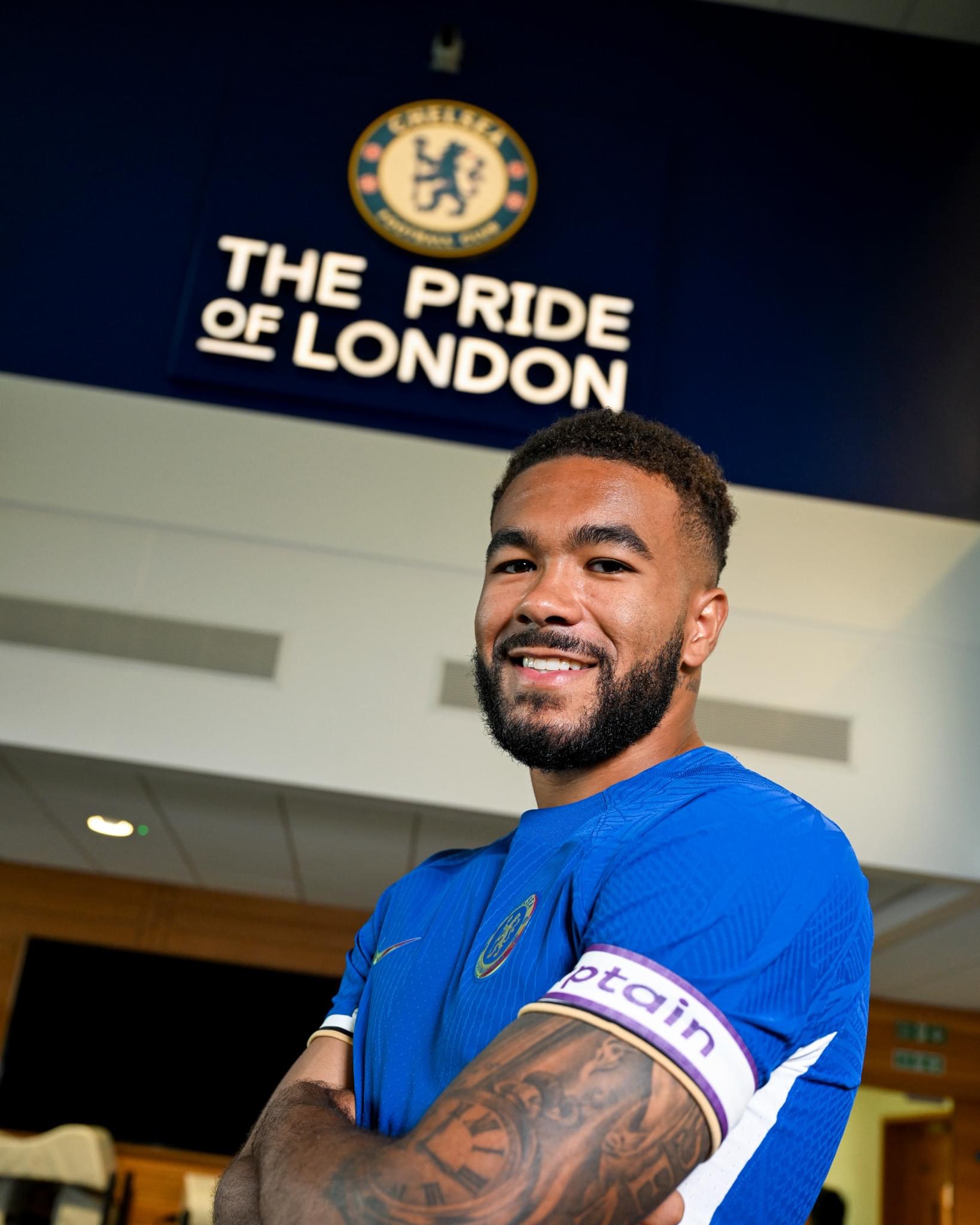
Captain Reece James
Picture: Chelsea FC
Responsibility will fall inevitably on Chelsea’s newly appointed captain, Reece James. Like Mount, Gallagher and indeed Colwill, James is a club product, having joined the club as a six-year-old. But whereas Mount’s head was turned – quite noticeably, it has to be said - by the possibility of football elsewhere, James has shown relatively unwavering commitment to the club that also has his sister Lauren on the books. The right wingback has long looked like captaincy material but with a caveat: when fit. Most fans will be pleased to see the likeable 23-year-old take on the mantle, but his injury will raise questions about consistency. 

Ben Chilwell, James’ left-sided counterpart has been appointed vice-captain, another sensible move for one of the most under-rated grown-ups in the Chelsea squad. He, too, has had a troubled history with injuries, so Pochettino must hope that his captain and his deputy won’t need another backup option. 

Leadership wasn’t always in evidence last season, with some games descending into farce as players started making things up for themselves on the pitch. “He’s a player that is a leader,” Pochettino said of his new skipper during Friday’s press conference. “He’s the present and he’s going to be the future of the club. He’s a perfect player for me and the club to be a captain.”

Viewed from one angle, Chelsea still look somewhat dysfunctional, both on the pitch and behind the scenes (for their opening game tomorrow against Liverpool they still don’t have a primary shirtfront sponsor). That said, the seismic upheavals that characterised 2022 for the club are still reverberating. 19 years of mostly relentless success under the Abramovich regime left fans with an inflated sense of expectation that the Boehly-Clearlake takeover would ensure continuity. It didn’t, although if the new owners would admit it, they didn’t get everything right themselves.

For his part, Pochettino’s job will be to not only rebuild the squad, tactically and spiritually, but rebuild some of the damaged goodwill towards the fans, who turned up at Stamford Bridge, or travelled to away fixtures, irrespective of how poor the games turned out to be. “We are building something special, I think,” he told journalists in America during the pre-season tour.

He qualified that statement by saying: “It’s a process and we need time. But in football, you cannot ask for time and you need to deliver from now. We know that we are in Chelsea and even if we have young players that will be involved against Liverpool [in the opening fixture], the mentality is to win. We are preparing ourselves to know the first game will be tough and then the next game also but we need to arrive with a good mentality.”

Chelsea, as a club, has liked to talk about “projects” for a while. The Boehly-Clearlake takeover has been one. When Tuchel, Potter and then Lampard used the phrase last season it sounded somewhat hollow, a PR phrase drummed up to excuse a work-in-progress. The fact is, every football season is a work in progress. Every team selection an experiment. A 4-3-3 formation at the start of a match can very easily change shape several times in the course of proceedings. It is, as Danny Baker once shrewdly observed, “chaos”. Thus, too much store is placed on the speculative summer weeks, which is why I tuned out in the first place. Tomorrow is the start of the period in which matters really count.