Showing posts with label Thomas Tuchel. Show all posts

Saturday, 12 August 2023

Once more into the breach…


How has your summer been? Time to relax and switch off? Read a book or two on the beach? I hope so. For me, it’s been about trying to mute anything and everything about Chelsea Football Club. Until now, at least. 

Last season, as some may have noticed, was a bin fire from kick-off to final whistle. Three managers (four if you include a one-match caretaker), a £600 million trolley dash to bring in new players in the the aftermath of a protracted and complicated takeover, all resulting in a 12th place Premier League finish, the club’s lowest season end in 29 years.

As politicians say when forced to resign for foul and unpleasant affairs of the bedroom kind, this summer has been a time for quiet reflection for all concerned with the football club. For me, it’s meant avoiding the self-appointed ‘experts’ on social media claiming to have the inside track on everything going on at Chelsea. Because for the most part, much of what I have seen has been speculative at best, utter bollocks at most. Only occasionally has some kernel of reality come through. 

Take the example of Moisés Caicedo, the Equadorian midfielder Chelsea have been pursuing all summer from Brighton & Hove Albion. At the time of writing this, it’s not entirely sure where he will be playing his football this season. Yesterday Chelsea appeared to have been gazumped at the 11th hour by Liverpool (conveniently, Chelsea’s opening day opponents tomorrow) with a bid Brighton accepted of £111 million. However, the player himself has expressed a preference of playing in London. Chelsea’s pursuit of Caicedo has, apparently, taken much of the last two months, with co-sporting directors Paul Winstanley and Laurence Stewart managing a process that saw three or four bids of up to £80 million knocked back by Brighton insisting that the player is worth £100 million. As it now stands, Chelsea chairman Todd Boehly and co-controlling owner Behdad Eghbali have taken personal charge of the discussions - not a good look for either Winstanley or Stewart - in the hope of rescuing a deal for the one player Chelsea really want this summer. A new bid of £115 million might be on the table by the time you read this.  

It is, though, quite possible that Chelsea were never going to land Caicedo, given the south coast club’s insistence of his valuation. Plus the two clubs have enjoyed a weird relationship of late, with Chelsea having taken Graham Potter and his entire coaching staff off their hands last season, after the Londoners had been rinsed for the signature of Marc Cucurella for an inexplicable initial fee of £55 million. This season, in parallel to the Caicedo deal, Brighton appeared to make it very clear that they wanted to retain Chelsea loanee defender Levi Colwill, possibly as a makeweight in a deal for the midfielder. Colwill has now signed a lucrative six-year contract with Chelsea, with whom he’s been on the books since childhood. Oh, and by the way, Chelsea have taken second-choice goalkeeper Robert Sánchez off Brighton in recent weeks. What was that about all’s fair in love and war?

While other names will no doubt continue to be bandied about by the aforementioned experts in the remaining days of the summer transfer window, given the importance of tomorrow’s season opener, it’s probably time to focus energies on other matters. As one fan commented on Twitter (or X or whatever the hell Space Karen calls it now), “it seems people are more bothered about who we sign than how we play”.

Picture: Chelsea FC

So what are Chelsea’s prospects for Season 23-24? Fresh beginnings, for a start, including a new head coach, Mauricio Pochettino. The former Spurs manager officially arrived on 1 July, having been under consideration by Chelsea since at least Thomas Tuchel’s departure, and with Frank Lampard appointed only temporarily as Graham Potter’s replacement (who, in turn, replaced Tuchel, who’d also replaced Lampard – hope you’re keeping up), the Argentinian has had plenty of time to run the rule over what the job would entail.

Before even a whiteboard had been scribbled on with team tactics, Pochettino’s first job has been to oversee the transformation of a bloated squad that, last season, grew so large there weren’t enough places in the training ground changing room for everyone. Since the end of May, 13 senior players have left in the current transfer window, including Mason Mount (to Manchester United), Kai Havertz (to Arsenal) and Mateo Kovacic (to Manchester City) – three key individuals to direct league rivals – along with captain César Azpilicueta, Christian Pulisic, N'Golo Kante and Kalidou Koulibay. Exit solutions are still to be found for at least Romelu Lukaku and Hakim Zyech, if not others. 

Most fans had grown comfortable with these departures, even that of Mount, who’d been at the club since he was eight and was largely thought of as a future captain. However, over the course of last season he’d looked increasingly disinterested, while it was well known that his contract was running down. Most fans were resigned to losing him on the basis that no player is bigger than the club. Kai Havertz was a slightly different case: though capable of scoring important goals (his Champions League winner against City in Porto being the most prominent), he seemed to struggle in his own shadow.

Picture: Chelsea FC
While dramatic, this summer’s player exits have all been justified, even if seeing players move to rivals has been tough to comprehend. By contrast, the appointment of Pochettino took some time to bed in with a section of the fan base. 

There was predictable knuckle dragging over his history as Spurs’ manager when he was first announced, but thankfully most right-minded individuals saw the opportunity Poch represents – a coach with a history of bringing on young players. Admittedly, a lack of silverware at Spurs might have dimmed some people’s view of him, but that may have simply had more to do with the limitations of that club. With, possibly, disingenuity, Pochettino described Chelsea as “a different club, different period, different process, different project”, when he arrived, adding: “For me, football is about to win”. Make of that what you will.

Not unlike Spurs, or indeed anywhere else, expectations are high and timescales are short. “It’s a parallel line,” he told The Athletic’s Liam Twomey, saying that he has to simultaneously think short-, medium- and long-term. “Our plan first of all is one year and then we go and cut into six months, three months, one month, one week and then day by day. But that doesn’t mean we aren’t thinking to win. My idea and message to the players, the fans and everyone is that we are Chelsea and we need to win. Today, yesterday, not tomorrow. At the same time we need to be working hard and being clever in how we are going to prepare next month, next six months and the year.”

Whatever the timeline, Pochettino has been somewhat forced to start his tenure at Chelsea by getting established with the smaller squad he prefers. For those players who haven’t left, he will have had to pick up an inevitably demoralised group following last season’s travails. In his first week in charge, Pochettino hosted a barbecue for players and staff as a welcome gesture. Reports from the pre-season tour of the United States have suggested a well-motivated and happy group, despite being put through Pochettino’s notoriously gruelling fitness regime (particularly needed given how sluggish Chelsea looked last season, although that may also have been due to disinterest).

Any manager will tell you that pre-season is never long enough to prepare for the exhaustive rigours of elite club football – especially in England with two domestic cups to play for on top of the league and, if qualified, Europe. Endurance not withstanding, Pochettino’s new charges will also need to adapt to his tactical thinking, favouring an asymmetrical 4-2-3-1 formation. How that works out may well depend on how balanced a squad the club finally provide him with - one of the key drawbacks for last season’s managers when the new owners’ spending spree delivered players for various parts of the pitch (and not always where they were needed, either).

The Chelsea squad jets off for pre-season in the USA
Picture: Chelsea FC

In terms of ambition, Chelsea start this season from a low base. After last season’s moribundity, even Champions League qualification seems like a hill to climb, especially with a strong Manchester City, a rejuvenated Arsenal and a revamped Manchester United in the way, not to mention Liverpool getting its mojo back, and even Aston Villa and Newcastle competing for top places. A cup is always possible, too, but perhaps Chelsea fans will have to accept a fallow season as Pochettino establishes his leaner, younger squad and builds back up for the future. He’s only been given a two-year contract, with a one-year extension, so he knows that time is not unlimited. As last season’s revolving managerial door demonstrated, the schismatic approach to managerial job security, established over decades but made more ruthless under, first, Ken Bates, then Roman Abramovich and latterly the Boehly-Clearlake consortium, means that Pochettino will still have to chalk up victories quite quickly.

Goals would be a start. The early part of Graham Potter’s spell in charge gave Chelsea some headroom when their league position started tumbling towards Christmas and continued afterwards. Without those results it’s conceivable that a club that had spent close to £600 million on new players could have been relegated. 

For the average fan – and I count myself as one – it was the lack of goals last season that proved the most disappointing. Blame what you want – lack of a striker, disinterested forwards, VAR, Anthony Taylor, changing managers, global warming – we go to football matches to watch our teams score more times than the opponent does. It’s that simple. And, yet, despite the eye-watering amount of money represented by those on the pitch (yes, you Raheem Sterling), even that seemed beyond their grasp.

Christopher Nkunku 
Picture: Chelsea FC
In Christopher Nkunku, signed in-principle from RB Leipzig in January but not released until the end of last season, we thought we’d acquired a recognisable centre forward. In pre-season, that looked very much the case, until an Ed Sheeran concert messed up Chicago’s Soldier Field ahead of Chelsea playing Borussia Dortmund in a friendly, and the Frenchman was relieved of a functioning knee until December. Back, then, to the drawing board. 

The £31 million acquisition of Senegal national Nicolas Jackson could offset Nkunku’s loss, looking very useful indeed during pre-season, scoring two goals in two games and contributing four assists. As any Chelsea fan will tell you, however, we’ve all been let down before by the prospect of an out-and-out striker who has failed to live up to expectations. The Number 9 shirt is widely considered to be a curse. 

Chelsea’s transfer business this summer has been one of both practical need and fiscal provenance. After last season’s ridiculous outlay, acquisitions have been more considered, with a view to getting the wage bill down and complying with Financial Fair Play (even with, now, a Premier League investigation hanging over the club as a result of allegedly murky deals during the Abramovich era).

“What we cannot have is a massive squad - players not be involved and then it’s going to create a mess in the squad,” Pochettino told journalists in Atlanta during the US tour. “Maybe less is more and more is less. It is not mathematic. That is why I need to make clear we don’t need a big squad. We need 22, 23, 24 players, with some younger and that’s it. I am so sorry because maybe the decision will be tough but we need to build a good and a balanced team who want to compete for things.”

As it stands, that balance is still not there. Missing out on Caicedo still leaves a hole in midfield. Buying Enzo Fernandez last season for a then-record £107 million for a midfielder (and therefore setting a precedent for the likes of Caicedo and Declan Rice) was an investment in the future, but he can’t be expected to cover every midfield need. With longtime target Rice going to Arsenal, Fernandez needs a dynamic midfield partner. Caicedo or Southampton’s Roméo Lavia could fulfil that role. Conor Gallagher, who by default has now become one of the squad’s senior players, should also look the part – and ticks another box for fans as a homegrown player - but still needs some convincing to do. Much expectation will fall on the shoulders of Mykhailo Mudryk, the Ukrainian wunderkind bought from under Arsenal’s noses for £62 million but yet to demonstrate fully what all the excitement about. There will also be increased pressure on Sterling – himself acquired in last year’s summer madness and currently the club’s top wage earner, without so far showing anything to justify that largesse.

Supporters will, for this season at least, have to be consigned to hope over reality. Pre-season has been fascinating, if only to see what Pochettino can achieve with youngsters – his stock-in-trade. Young Brazilian signing Andrey Santos has been one, as has 21-year-old Ian Maatsen, another product of Chelsea’s legendary academy. Both were noted for having outperformed more senior, more seasoned, and more expensive members of the squad during the US tour. Securing Colwill, too, will give the player an opportunity to demonstrate why Brighton was so keen to keep him, especially given Wesley Fofana’s latest injury setback, and the fact that Thiago Silva – bless him – can’t, at 39, be expected to anchor the defence with his mastery week in week out. With Fofana out for an unspecified period for the start of a second season running, Chelsea have brought in Axel Disasi from Monaco for £38 million. We can only hope that he doesn’t turn out to be another disaster like Kalidou Koulibaly last time out.
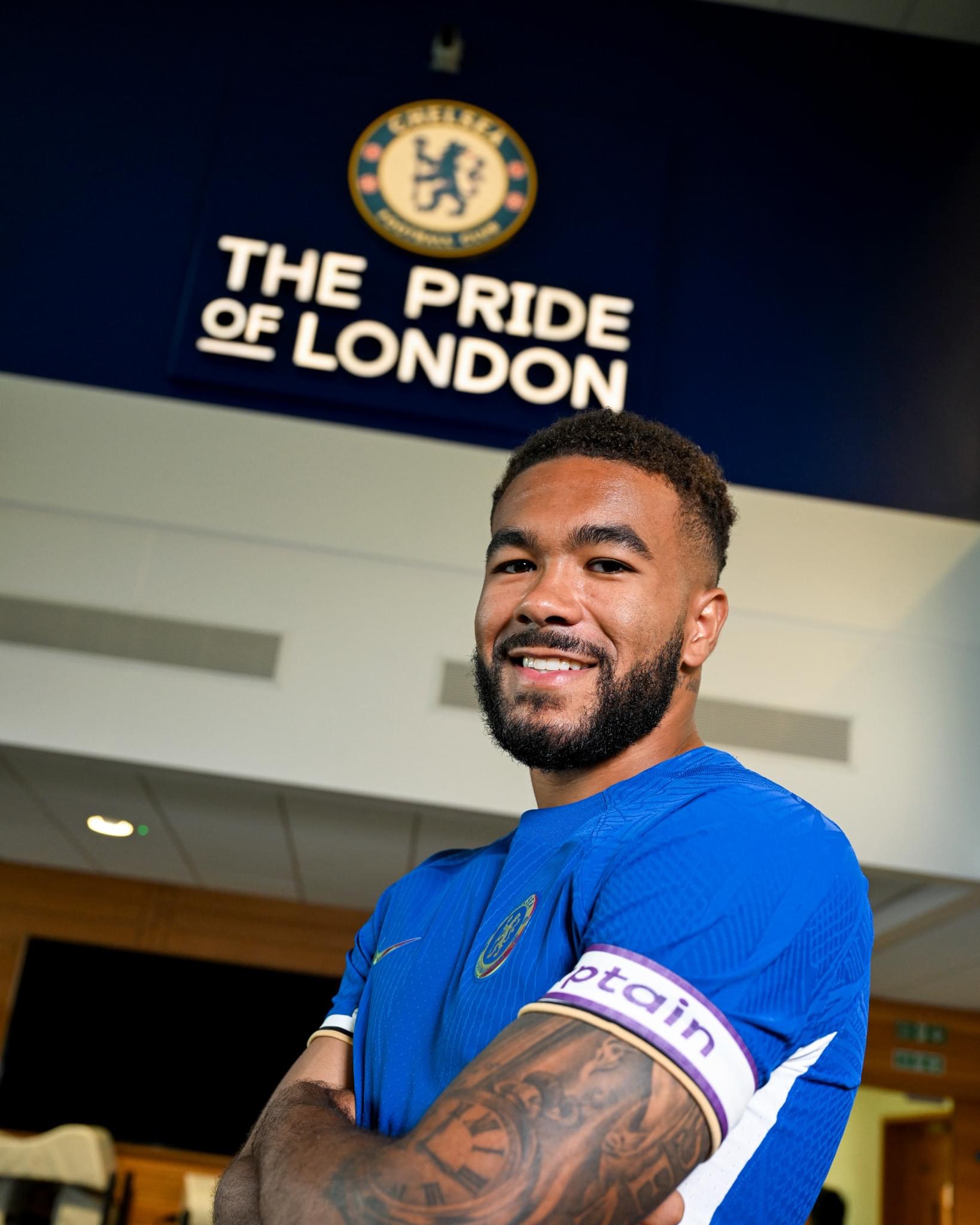
Captain Reece James
Picture: Chelsea FC
Responsibility will fall inevitably on Chelsea’s newly appointed captain, Reece James. Like Mount, Gallagher and indeed Colwill, James is a club product, having joined the club as a six-year-old. But whereas Mount’s head was turned – quite noticeably, it has to be said - by the possibility of football elsewhere, James has shown relatively unwavering commitment to the club that also has his sister Lauren on the books. The right wingback has long looked like captaincy material but with a caveat: when fit. Most fans will be pleased to see the likeable 23-year-old take on the mantle, but his injury will raise questions about consistency. 

Ben Chilwell, James’ left-sided counterpart has been appointed vice-captain, another sensible move for one of the most under-rated grown-ups in the Chelsea squad. He, too, has had a troubled history with injuries, so Pochettino must hope that his captain and his deputy won’t need another backup option. 

Leadership wasn’t always in evidence last season, with some games descending into farce as players started making things up for themselves on the pitch. “He’s a player that is a leader,” Pochettino said of his new skipper during Friday’s press conference. “He’s the present and he’s going to be the future of the club. He’s a perfect player for me and the club to be a captain.”

Viewed from one angle, Chelsea still look somewhat dysfunctional, both on the pitch and behind the scenes (for their opening game tomorrow against Liverpool they still don’t have a primary shirtfront sponsor). That said, the seismic upheavals that characterised 2022 for the club are still reverberating. 19 years of mostly relentless success under the Abramovich regime left fans with an inflated sense of expectation that the Boehly-Clearlake takeover would ensure continuity. It didn’t, although if the new owners would admit it, they didn’t get everything right themselves.

For his part, Pochettino’s job will be to not only rebuild the squad, tactically and spiritually, but rebuild some of the damaged goodwill towards the fans, who turned up at Stamford Bridge, or travelled to away fixtures, irrespective of how poor the games turned out to be. “We are building something special, I think,” he told journalists in America during the pre-season tour.

He qualified that statement by saying: “It’s a process and we need time. But in football, you cannot ask for time and you need to deliver from now. We know that we are in Chelsea and even if we have young players that will be involved against Liverpool [in the opening fixture], the mentality is to win. We are preparing ourselves to know the first game will be tough and then the next game also but we need to arrive with a good mentality.”

Chelsea, as a club, has liked to talk about “projects” for a while. The Boehly-Clearlake takeover has been one. When Tuchel, Potter and then Lampard used the phrase last season it sounded somewhat hollow, a PR phrase drummed up to excuse a work-in-progress. The fact is, every football season is a work in progress. Every team selection an experiment. A 4-3-3 formation at the start of a match can very easily change shape several times in the course of proceedings. It is, as Danny Baker once shrewdly observed, “chaos”. Thus, too much store is placed on the speculative summer weeks, which is why I tuned out in the first place. Tomorrow is the start of the period in which matters really count.

Monday, 29 May 2023

A tale of two Chelseas

If ever you wanted a weekend of footballing contrasts, these last two days provided it amply, and from one single club, too. On Saturday, Emma Hayes’ relentless pursuit of success saw Chelsea secure a fourth straight Women’s Super League title. 24 hours later Chelsea’s senior men’s team brought the curtain down on a miserable season that couldn’t have ended soon enough. One Chelsea delivered a league and cup double, the other, a Premier League bottom-half finish - 12th place, their lowest position since 1994 and their worst points tally for 30 years. That’s the kind of form that would have otherwise led to relegation were it not for the even more anaemic performances of the eight teams below them. 

Now, before anyone throws the gender debate back at me, the essential comparison being made here is that one Chelsea is managed by a tactically astute head coach who, over the past 11 years, has built, maintained and enriched the team with a profound working relationship with her players, backed by investment in the best available talent. The other has, over the course of this last season, had four different managers, each charged with integrating an embarrassment of riches acquired by a £600 million supermarket trolley dash.

And there, again, is that word: “embarrassment”. It was infamously invoked by co-owner Todd Boehly after a particularly egregious home defeat to Brighton in April. While he wasn’t wrong - chewing out the team in the changing room - many Chelsea fans felt that Boehly should have undertaken some self-reflection before making such a comment, even though in a literal sense, the players he was laying into, bought for inflated fees and in some cases, paid inflated wages, have been embarrassing. All. Season. Long.

Was it their fault though? To be blunt, yes. Six-figure weekly remuneration should be enough to incentivise anyone to deliver. But that, though, takes an extremely simplistic view of the problem. The harsh reality is that there is a collective responsibility at Chelsea for the way this season has gone - from the highest echelon on down. I don’t wish to sound churlish about the Boehly-Clearlake Capital consortium who effectively saved the club, after Roman Abramovich was forced to sell up. But the way they went about running their new toy in the wake of their £2.5 billion takeover has fuelled a level of negativity towards them that took rival club owners like Manchester United’s Glazer family and Liverpool’s Fenway Sports Group years, not months, to establish.

It shouldn’t be forgotten, though, that the ensuing dysfunction only spread to the men’s half of Chelsea. After the Women’s FA Cup Final, Hayes herself reflected on how things had gone elsewhere in her organisation: “It will bug me if I don’t say this - I’m a football fan and I’ve watched how much my club has suffered this year. We’ve had ownership changes, the men’s team hasn’t been brilliant.” And she added: “Chelsea fans - this [FA Cup title] is for you. I hope we had a little bit of joy tonight. I hope we gave you something where you can smile about it this year. The whole club, owners included.”

According to media reports, Boehly is now believed to be taking a step back from day-to-day control. Since the takeover, and the splurge on players that he personally oversaw, the management structure has supposedly been strengthened, with the appointment of co-sporting directors Paul Winstanley and Laurence Stewart, amongst other senior figures. But according to some players there have been critical exits elsewhere, particularly in medical staff and members of the ‘pit crew’ that keep the highly tuned Formula 1 car that is a Premier League football team on the road. Frank Lampard (manager #4), installed as interim manager following manager #2 Graham Potter’s sacking in April has hinted at this: “Chelsea has been a big success for 20 years but at the moment we aren’t in that position,” he said early in his tenure. “In the time I’ve been here, it’s pretty evident and clear to see - behind the scenes, on the training ground - the reasons why.” Ever the PR man, his comments were far from cryptic.

It is, though, possible that problems at Chelsea have been even deeper seated. Dysfunction, in one form or another, has long been the stream flowing though the club. BT Sport took fans of a certain vintage back to the era of chairman Ken Bates earlier this year with the excellent documentary Pound Land: Battle Of The Bridge. It sourced the origin of Chelsea’s modern day state to the hubris that followed a brief flirtation with the big time in the early 1970s, which brought a couple of trophies and Raquel Welch to Stamford Bridge. The spiralling cost of building the stand I sit in to this day amid the ’70s economy almost bankrupted the club, which was then sold to Bates for a nominal pound, only for him to be forced into an existential battle with property developers threatening to flatten the ground completely and put Chelsea out of business.

With the developers soundly beaten, Bates then took on the arrival of Matthew Harding as a director and investor, creating another power struggle. Harding, though, paved the way for new investment, and with it Glenn Hoddle, followed by European elite players like Ruud Gullit, Gianluca Vialli and Gianfranco Zola (admittedly, nearing the end of their careers). A new Chelsea emerged, enjoying less profligate times in the then-new Premier League. A remarkable goal on the final day of the 2002-2003 season from Jesper Grönkjaer propelled Chelsea into the Champions League at Liverpool’s expense, and along came Abramovich with his bottomless cheque book, followed by 20 trophies in 19 years. And 13 managers.

Low levels of job security were always priced in to any managerial appointment in the Abramovich era. The Boehly-Clearlake takeover heralded talk of long-term projects and stability. Tell that to Thomas Tuchel (manager #1): having replaced Lampard in January 2021 - with the club on much the same trajectory as it has this season - Tuchel took the team to a Champions League final within four months and won it. He then masterminded a victory in the World Club Cup the following year…only to be fired just a month into the season now ending. So much for a new regime.

Before tackling the What Happened Next? chapter of this story, it is worth framing managerial turnover in the context of player arrivals and departures. Player power has led to the undermining of many of Chelsea’s managers in the modern era. They know that if their form goes or they fall out of favour, the worst that can happen is that their agent lands them a cushy berth somewhere else. Such players are hardly likely to respond to a vulnerable coach when results go against them. Which brings me to Graham Potter.

From the outset he was handed an impossible task. Despite a reputation for creating the perfect developmental culture at Brighton on a relatively modest budget, at Chelsea he was effectively the driver of a family hatchback suddenly handed the keys to a lurid, bonkers Lamborghini. Actually, 32 of them. At first, Potter’s appointment seemed like a sharp move: a young manager who’d developed an attractive manner of play on the South Coast. But, by the time of the World Cup, and the extended international break, Potter was expressing his relief at having some time to figure out what was going wrong.

Boehly’s spending, seemingly adding people the club didn’t know it needed but bought anyway without strengthening in the departments where the need was most acute, loaded the dice for Potter. As his international players returned from Qatar, and the January window opened with Chelsea doing even more business, Potter’s fate was sealed. Despite having several weeks to figure it out, results continued to be dismal, and yet Potter now had even more new players to work with. Disquiet in the Stamford Bridge stands became more audible. As January gave way to February, the #potterout movement proliferated and, by the time he was eventually fired in April, hostility had become substantial.

Following the brief one-match tenure of Potter’s assistant, Bruno Saltor (manager #3 - effectively, the Liz Truss appointment of the season), the club decided that it would take time to consider its next permanent appointment, bringing back Lampard for the final few weeks.

Let’s be very clear, this was no more than a PR sop towards fan toxicity, but as an exercise in appeasement, it didn’t work. For all. Of the eleven games Lampard was in charge of, eight were defeats.Although most Chelsea fans still revere Lampard the player, these few weeks have damaged his managerial brand, possibly irreparably. “If you ask me what I have learned in this short period,” he reflected ruefully after the abject 4-1 defeat to Manchester United at Old Trafford, “In terms of coaching, not so much. I’ve been in in this situation as a player when you have an interim after a change of manager. A lot of the plus-points you gain are about what the team is fighting for. Can you find that extra bit? And we haven’t found that as a collective. The results say so.”

With yesterday’s final whistle at Stamford Bridge, Lampard’s second spell as Chelsea manager came to a dismal end, albeit with a smidgen of pride restored by a 1-1 draw with Newcastle at Stamford Bridge. But it also heralded a new cycle of change. Financial Fair Play rules means the club will have to trim its senior squad. Step forward, then, Mauricio Pochettino, announced today as Chelsea’s new head coach, on a two-year contract.

The 51-year-old Argentinian’s appointment has been in the works for a long time. He was even considered by Abramovich when Lampard left in 2021, and again by the new owners when Tuchel was fired last September. So, has Chelsea finally got their man? No one knows. History has shown that it doesn’t matter whether a club makes a considered appointment or a knee-jerk, instinctive hire, nothing lasts forever, no matter how smiley the obligatory contract-signing/shirt-holding photo session.

Chelsea promised a “thorough” process to identify and appoint a permanent new manager following Potter’s sacking, but whatever technical requirements were on the shopping list in early April, the weeks since will have amped up the need to restore pride and cohesion to a team that has become a laughing stock amongst rival fans. That same tribalism informed some initial misgivings about Pochettino’s Tottenham connection (before that particular quadrant of the Twittersphere was rightly shut down by reminders of where Hoddle had played for 13 years before launching Chelsea’s supposedly continuing era of elite competition). 

The task Pochettino is facing is huge. First, he has to prune an enormous 32-player squad (so big there aren’t enough spaces in the Cobham changing room for everyone). There are plenty of candidates, and while the process won’t be pain-free, those who’ve looked increasingly ineffective, disinterested or unmotivated will be easier to live without.

Hopefully, what will be left from this exercise will be a smaller, younger and more ambitious squad, something Pochettino is historically well suited to developing. He’ll have a lot to work with. It’s been hard to gauge what Lampard’s selection strategy has been over the last few weeks and what clues that might provide as to what his successor will do, given that as Pochettino has conducted his own contract negotiations he is also believed to have informed the Chelsea hierarchy who he’d like to work with from the existing squad. 

Given his reputation for developing youth, that bodes well for young homegrown left back Lewis Hall. Still only 18, and clearly with a lot to learn, he has taken his opportunity well with Ben Chilwell and Marc Cucurella both out of action, with gutsy performances since Lampard played him in his final games in charge. Similarly Noni Madueke, the 21-year-old Englishman signed in January from PSV Eindhoven who has already shown himself to be far more interested in playing up the right wing than Hakim Zyech or Christian Pulisic have ever done. More puzzling is the development prospects for Carney Chukwuemeka, the 19-year-old midfielder signed from Aston Villa with great expectation, but whom Lampard appeared to keep at arms length. At the centre of midfield sits the Argentinian Enzo Fernández, bought in January for a staggering £106.8 million but, at 22 and a long-term contract, the kind of player Pochettino might build around.

He is also thought to be a fan of using homegrown talent, something Lampard, during his first spell in charge, made good use of, with Chelsea Academy graduates like Reece James, Tammy Abraham (now at Roma) and Fikayo Tamori (now at Milan). Unless sold in the domestic departures, Pochettino would do well to retain Conor Gallagher, another youth product. He will also want to call upon 20-year-old Levi Colwill, the central defender who joined Chelsea as a schoolboy and who has been getting regular football on loan at Brighton. Given that 39-year-old Thiago Silva can’t possibly go on forever, the thinking is that Colwill could be integrated into Chelsea’s backline (ideally, with Silva retained as a defensive coach to maximise his exhaustive experience).

Pochettino’s biggest headache, though, will be Mason Mount. At 24, and a Chelsea player since he was 8, he is the ideal figure the club needs and Pochettino wants. Personable, mature, and therefore a PR asset (making him captaincy material, with Azpiliqueta nearing the door), he is also about to enter the final year of his contract, with nothing yet agreed on a renewal despite months of speculation. For such an asset, Mount and Chelsea have been engaged in a weird, socially-distanced dance in recent weeks, with negotiations either progressing slowly or not at all. Pochettino might make a last-ditch attempt to persuade him to stay at his boyhood club, but with Manchester United and Liverpool circling, and interest from Arsenal, too, the prospect of cashing in on a player valued at around £55 million could be too tempting for the club to resist. After the Newcastle game yesterday, Mount was part of the team lap-of-honour at Stamford Bridge. To most watching on, it felt like farewell.

As it did when Ruben Loftus-Cheek, another youth product, was subsituted, giving an emotional wave to Stamford Bridge that appeared to confirm speculation that he’ll be off, possibly to AC Milan. Selling Mount, along with Loftus-Cheek, Trevoh Chalobah, Callum Hudson-Odoi and even Gallagher would not only make money, but as homegrown players balance out Financial Fair Play regulations. Other disposals will just save money, such as Pierre-Emerick Aubameyang and Kalidou Koulibaly, two of last summer’s inexplicable, and expensively reumunerated purchases. Whoever goes, it is understood that Chelsea will need to do their selling business before the end of June, when the transactions can be recorded in the club’s accounts for the season. That won’t rule out new players coming in (Leipzig’s Golden Boot-winning French striker Christopher Nkunku is believed to have already agreed a move to Chelsea this summer). 

Pochettino will need - and want - to work with a much smaller squad, comprising players with a shared hunger and a sense of team spirit that has, this season, been glaringly absent. If some rumours are to be believed, a lack of commitment from some players has combined to disastrous effect with a lack of confidence in other. A fundamental rebuild will, then, be essential. Not just in personnel, but in what motivates them. In that, there is a lot to learn from the season now ended. 

All seasons can seem overly long by May, but for us Chelsea fans, 2022-23 has felt endless. A touchline mini-fracas between Thomas Tuchel and Antonio Conte, when Spurs manager, now seems distant. As does the World Cup, with all of the culture war brouhaha it engendered. Another new era at Chelsea awaits, but fans used to trophies will have to wait longer before seeing another open-top bus parade on the Fulham Road. But it’s not a lost cause: Erik ten Hag effectively rebuilt Manchester United in a season, following a similar period of managerial turmoil. Mikel Arteta took Arsenal to almost the Premier League title this term, despite a particularly rocky start to his time as their manager. As long as Pochettino is allowed to get on with his work, and expectations are managed accordingly, who knows where Chelsea could end up?

While he is, though, something of a compromise, his appointment at the third time of asking is more of a marriage of convenience. “Everything at Chelsea fits,” wrote Spanish football expert Guillem Balague when Pochettino emerged as the most likely candidate for the job. “It is a young squad, a thriving academy coupled with a desire from the owners to bring youth through, a philosophy that is aggressive and dynamic with high pressure and loads of energy.”

Pochettino has also been out of a job for almost a year, since parting company with Paris Saint-Germain, evidently taking his time to find the right project. “He has taken a good look at himself and what he did wrong at the French club, what he could have done better and how he can avoid making similar mistakes at Chelsea,” Balague added. “He needs to have the energy to be able to mould players, know that the players are listening to him and have the authority to ensure that this is happening.”

He will need a degree of autonomy rarely granted Chelsea managers in the modern era. Fixing Chelsea will not be an overnight job. Patience - the sport’s most precious commodity - has never been abundant at this football club. There’s no suggestion that the cycle is about to be broken by Pochettino’s appointment, but with no European football next season and a gentler fixture list, he will have a bit more time and space to craft the squad in the way that he wants to. How long he gets to restore incoming traffic to the Stamford Bridge trophy room remains to be seen.

At the end of the day, no one knows. Day One of a new coach’s tenure always brims with hope, expectation and optimism. Until it goes wrong. That’s been the case with Chelsea forever (with, perhaps, the one exception of Rafa Benitez, who trolled everyone by winning the Europa League as interim head coach, despite being regarded as an inflammatory appointment). Pochettino does have a record of playing good football, at Espanyol, Southampton, Tottenham and PSG, and while he is certainly not held in the same regard as, say, a Guardiola, he has at least managed well with what he’s had at his disposal. Even Chelsea’s most jaded fans should remember that he came close to winning the Premier League twice - in 2016 and 2017 - with Spurs. Which makes you wonder what he would be capable of in SW6, assuming he can sort out the mess he’s inheriting. He is, to cite Balague, a “hungry manager” after a year away from day-to-day management. Let’s hope that hunger pays off.

Friday, 7 April 2023

Just when you think you've figured football out...

“Football,” Danny Baker first observed back in the 1990s, “is chaos”. It's a theme he regularly returns to in his frequent rants on Twitter, usually of an evening while a so-called ‘elite’ fixture is taking place on television. The thinking is that the vast array of punditry deployed by the media suggests that there is something ‘scientific’ about the beautiful game, other worldly and therefore self-considered to be beyond the comprehension of mere mortals. This, Baker contests, is bogus.

I raise this largely as a result of the chaos at Chelsea this season. Graham Potter, who replaced the fired Thomas Tuchel, who replaced the fired Frank Lampard, has just been replaced on an interim basis by...Frank Lampard. “It is totally in keeping with the current chaos [that word again] at Chelsea under co-controlling owners Todd Boehly and Behdad Eghbali and the Clearlake group,” the BBC’s chief football writer Phil McNulty wrote on the corporation’s website, highlighting how, since the takeover last summer, the new owners had pumped in £600 million to buy new players, sacked Tuchel and then Potter after just 31 games in charge. “But the return of Lampard might just be the most eyebrow-raising development of the lot,” he added.

We like to think there’s logic going on at our football clubs. We expect it to be an exact science because coaching and training is governed by xG statistics and computer modelling. Clubs employ technical directors and sporting directors (I still don’t quite know the difference) on top of ‘head coaches’ (never, these days, simply “manager”) amongst the phalanx of specialists keeping the complex Formula 1 car that is a top football team on the track. Everything is therefore planned, programmed and finely tuned to the nth degree. It’s not. Because then you send your team out, and Kai Havertz is selected to lead the line.

On Tuesday night, Chelsea’s first interim coach of the week, Bruno Saltor (who’d never before picked a team at this level) put out more or less the same side that had lost so egregiously to Aston Villa three evenings previously, leading to Potter’s dismissal. Against Liverpool, it was largely painting by numbers to the untrained eye, and probably to more informed observers, too. It was also an abject reminder of just how both Chelsea and their opponents on the night have fallen this season. “Mid-table mediocrity,” one match report concluded. “Two bald men fighting over a comb,” was my erudite contribution.

Unbeknownst to most of us at Stamford Bridge until newspapers ran the picture you see at the top of this post, Lampard was observing from an executive box, the guest of Laurence Stewart and Paul Winstanley, Chelsea’s two sporting directors. This quickly turned into the suggestion that the 44-year-old could be on his way back, though in what capacity wasn’t known. At the same time, the former Spain coach Luis Enrique was said to have flown in to London for talks with the club about the vacant manager’s position, while the newly available former Bayern Munich boss Julian Nagelsmann was also under consideration, along with a fairly predictable list of runners and riders drawn from the European leagues.

At some point on Wednesday it emerged that Lampard was being considered as an interim solution, a stopgap to the end of the season, enabling the club to take until then to consider candidates for the full-time job with, perhaps, more care than that they applied after Tuchel’s abrupt exit. With a two-leg Champions League quarter-final against Real Madrid (under Lampard’s old boss Carlo Ancelotti) to play, starting next week, and some pride to be restored in the Premier League, putting Chelsea’s record goalscorer back in charge would at least be good PR. By Wednesday evening, the Lampard banner, unfurled in the Matthew Harding Lower section before kickoffs during his previous spell, was being retrieved from the back of whichever cupboard it had been stashed away in when its subject was fired - apparently with deep regret - by Roman Abramovich in January 2021.

“It’s a pretty easy decision for me,” said Lampard 26 months later, at a press conference yesterday. “This is my club. I have a lot of emotions and feelings. I’ve come with a belief I can come and help the cause until the end of the season. I’ll give my utmost to give the fans what they want until the end of the season. There’s a lot of talent in the squad. I’m excited to work with that talent and to help them.”

We shall see. The unavoidable elephant in the room here is that Lampard was sacked by Ambramovich on the back of Chelsea taking a southerly trajectory in the Premier League, followed by his dismissal two years later from Everton, with the Merseysiders in even greater peril, recording nine defeats in 12 league games to leave them in relegation territory. In both situations, there were mitigations. But even for this lifelong Chelsea fan, all romanticism aside, you hope this latest temporary arrangement doesn’t end in tears, for a second time.

Appointing club legends as managers is fraught with peril. It’s why I hope that Gianfranco Zola never comes back to Chelsea as head coach. He is rightly held in such high regard, you’d hate that to be jeopardised. Lampard’s first spell in charge carried the same risk, which eventually came to fruition. You can only hope that, in this limited new arrangement, he knows what he’s taking on.

“Of course, it was a surprise in terms of you never know a decision the club will make,” he said yesterday when asked about coming back. “There’s been lots of change in the Premier League this year. I’ve been particularly enjoying my period at home - it’s one of those where you can really throw yourself into your family, your wife and children, things you tend to put to one side when you’re working.” He stressed that Winstanley and Stewart put forward a specific proposition: “It wasn’t simple, because you have to take a lot into account in your heart and your heart,” Lampard explained, adding, knowingly, ”but this is Chelsea”.

So what is the task at hand? After taking Chelsea to Molineux on Saturday for a Premier League fixture with Wolves, they fly to the Spanish capital for that first leg with Real Madrid, a team which ruthlessly buried Barcelona 4-1 in their Copa del Rey ‘El Clásico’ on Wednesday evening. In any other season, an encounter with Madrid would be what the modern era Chelsea does well. But in this season, Lampard’s task - getting a bloated, lop-sided squad of over-priced players to gel in a way they haven’t hitherto - seems impossible.

There is, though, some precedent. In March 2012 Roberto Di Matteo replaced the failed experiment that was André Villas-Boas, immediately improving form to deliver credible wins in the Premier League and, more significantly, progress in the Champions League, beating Barcelona in a semi-final to take on - and beat - Bayern Munich in the final. “Roberto did an incredible job to stay on,” Lampard ruminated yesterday, but in typically diffident footballer style, measured that by adding “but that’s a different time in the club’s history. What is important to me is to park it to one side and get on the job.”

Lampard has always stood out as an intelligent, personable bloke. As a player, he was always regarded as a studious one, not least because his West Ham coach father Frank Sr drilled footballing discipline into him with hothousing vigour. The same concerns Chelsea fans had when he was originally appointed as manager of the club he spent 13 years at as a player will creep back this time, but if nothing else, this unexpected coda to his two-and-a-half-spell as head coach is a masterstroke of fanbase appeasement.

Picture: Chelsea FC

“We are delighted to welcome Frank back to Stamford Bridge,” said co-controlling owners Todd Boehly and Behdad Eghbali in a statement. “Frank is a Premier League Hall of Famer and a legend at this club,” it continued by way of explaining the thinking behind the appointment. “As we continue our thorough and exhaustive process for a permanent head coach, we want to provide the club and our fans with a clear and stable plan for the remainder of the season. We want to give ourselves every chance of success and Frank has all of the characteristics and qualities we need to drive us to the finish line.”

Perhaps, then, it is another experiment. Lampard won’t necessarily provide continuity, but may at least ease the sulphurous atmosphere that engulfed Stamford Bridge as Graham Potter’s hapless reign faltered ever further. In his press conference he made clear his deep and undeniable knowledge of the club, the staff at the Cobham training ground and, most importantly, many of the current players. For those acquired since his departure, they will be fully aware of Lampard’s high esteem at the club they’ve joined as well as his standing within the game at large. That alone might pay dividends, given that Chelsea’s expensively assembled squad has at times recently looked like a group of talented individuals without any semblance of unity.

Stamford Bridge, specifically, has long been trolled by visiting fans for a perceived lack of energy amongst the support. “Is this a library?” they bate us with. That has certainly been the case of late. On social media alone, Lampard’s return has certainly put smiles back on faces but if he doesn’t get a grip on team cohesion and confidence, and instil tactical thinking that seemed to desert him at Everton, those smiles might soon disappear. Chelsea’s season has already been written off, barring unlikely progression in the Champions League, but as the latest of Chelsea’s many interim managers - Di Matteo, Hiddink, Benitez et al - Lampard has history to live up to. No pressure, then.

Monday, 3 April 2023

End of the line

If ever there was an afternoon at Stamford Bridge when I needed a pick-me-up, it was Saturday. The day before I was made redundant, and with football - to evoke Karl Marx - one of my go-to opiates, I was hoping that Chelsea would deliver. I was clearly to be disappointed. 24 hours later, Chelsea head coach Graham Potter joined me amongst the unemployed (although, it should be noted, with considerably better compensation).

Credit where it’s due, Aston Villa were just more organised, more committed and better drilled. Not for the first time this season with visitors to the Bridge, they were an opponent who didn’t create many chances, but when they did, took them well, with excellent goals from Ollie Watkins and John McGinn. Potter, in his post-match comments, would bemoan Chelsea’s better possession stats, but stats don’t win games. Goals do. 

On Saturday, as it has been for countless Saturdays this season, not to mention some Sundays, the occasional Wednesday and one obscure Friday, it was hard to see where Chelsea’s goals would come from. With Reece James, arguably Europe’s best right wingback, consigned to central defence, and Ruben Loftus-Cheek - a pedestrian midfielder at best - unable to create any width, Chelsea’s notoriously anaemic attack had little supply. On the left, Ben Chilwell, James’ opposite number and just as impactful, was forced into spending more time defending that attacking. It all pointed to the same thing: Chelsea hadn’t been set up right.

Graham Potter never felt right as a Chelsea manager, but fans were prepared to give him a chance, stoically supporting the rare opportunity of an Englishman in the dugout. But before our eyes, the fanbase began to erode, and the #potterout tweets proliferated. On Saturday, the 50% of supporters yet to turn on him, did. The atmosphere at full time, with large swathes of empty seats visible, was notably sulphurous. Last night’s club statement was inevitable. 

Unlike many, however, I held back from the Graham Potter pile-on that built up in the wake of his appointment after Thomas Tuchel was abruptly dismissed in September. Todd Boehly and his co-owners had signalled that their £4.25 billion takeover would herald a period of stability, a commodity missing during the turbulent Roman Abramovich era, when managers came and went like trains at Clapham Junction. Potter had never achieved anything at a so-called ‘elite’ club, but he’d built Brighton & Hove Albion into a decent side and on relatively meagre means, too. From one angle, however, he looked like the good soldier, a nice bloke who would drive the new owners’ long-term “project”, whatever that was. 

The conclusion now is that long-term thinking is fairly pointless in the Premier League, when judgement is meted out on day-to-day results. Even if Boehly and co-controlling owner Behdad Eghbali were prepared to stick with the Englishman, the noise around him wouldn’t go away.  In the end, sporting directors Paul Winstanley and Lawrence Stewart pushed for an immediate change and got it.

In fairness, the decision put Potter out of his misery. In February he spoke about the unforgivable abuse his family had received in the wake of Chelsea’s poor performances - many of which weren’t his fault as injuries began to rack up just as a new squad, which hadn’t had the benefit of a proper pre-season, toiled. In further mitigation, the spending spree of close to £600 million that the Boehly-Clearlake Capital went on in two transfer windows, bloated the squad with more expensive players than even José Mourinho would have known what to do with, adding unbelievable pressure to Potter who found himself charting new and decidedly richer professional waters.

“You have to accept that when the results are what they are, you accept criticism and it should come,” Potter reflected in February. “But that isn’t to say it’s easy at all. Your family life suffers, your mental heath suffers, and your personality suffers. It’s hard.” That may have won him some deserved sympathy, but the results continued to be poor. “Clearly it is a process of how to get our message across better. How can we structure things in a way to help the players? Because that is what we are here for. When results aren’t good, you have to accept that we haven’t done it well enough.”

In every post-match interview and pre-match press conference, Potter would pursue the same passive defence: “I feel the support of the players, I feel the support of everyone here,” he said after being beaten 2-0 by a managerless Tottenham (Antonio Conte being absent due to gallbladder surgery). “I understand the frustrations externally but among the players it is a desire for us all to do better and that is the pleasing thing. The results haven’t been good but we are still there fighting for each other.”

If I was writing his lines, as a PR pro, I’d probably be having him say the same thing. The reality, however, on the pitch was a whole lot different. Even if the intent was there, the execution wasn’t. Potter’s 31 games in charge - which included 11 defeats, 12 wins and eight draws - resulted in Chelsea’s worst managerial record in the Premier League era, which began with a nominal revival in the early 1990s as the late Matthew Harding’s investments brought a touch of glamour to the club, including a new stand, and players like Ruud Gullit, Gianluca Vialli and Gianfranco Zola.

But nothing is ever simple at Chelsea. BT Sport’s brilliant recent documentary Pound Land - The Battle Of The Bridge recounted the fractious rivalry between Harding and chairman Ken Bates who, himself, had led a valiant effort to save Stamford Bridge from being turned into flats. Bates had bought the club at the end of an equally turbulent period, when the club faced bankruptcy as a result of over-extending itself by building the Bridge’s East Stand (where I’ve sat for the last 20-plus years) on the back of the club’s successes in the early 1970s. The late ’70s and much of the ’80s were marked by relegations, financial ruin and the scourge of hooliganism. 

The arrival of ‘name’ players in the 1990s commenced a period of increasing success that ultimately led to Roman Abramovich buying the club in 2003, and leading to 20 titles over the course of his 19 years’ ownership. We had literally never had it so good. But if the near-bankruptcy of the ’70s, and the fight to keep Chelsea at Stamford Bridge were existential threats, Russia’s invasion of Ukraine last year genuinely took the club to the abyss. The Government’s sanctioning of Abramovich forced the sale that brought the Boehly-Clearlake consortium to the rescue. 

The last ten months since the takeover must be put into some context. That Potter leaves Chelsea with such a disappointing record is unfortunate, but let’s face it - at least he had a Chelsea to be fired from. 

That notwithstanding, however, questions should quite rightly be asked about the club strategy since the takeover, particularly of the £600 million in player acquisitions that seemed more scattergun than purposeful, and whether Potter was ever the right manager to take charge of them. 

“We have the highest degree of respect for Graham as a coach and as a person,” Boehly and Eghbali said in a statement last night. ”He has always conducted himself with professionalism and integrity and we are all disappointed in this outcome.“ As they should be.

Of course, no one will ever know whether Thomas Tuchel, whose firing remains shrouded in suggestions of backroom disagreements (he wasn’t exactly a compliant employee at Paris Saint-Germain…) would have fared better, but given what he delivered since replacing Frank Lampard in January 2021, taking the team on to win the Champions League itself, makes one wonder whether his departure was really for the best. And if it was, why was Potter, a manager seen as the driver of a decent Ford Focus, given the keys to a Bugatti Veyron Super Sport like Chelsea? Potter will have his reasons for his team selections, but for the paying fans, they’ve often been hard to fathom. And if they’re hard for the crowd to comprehend, it’s likely that they’d be difficult for the players too. 

Chelsea’s next manager will have his work cut out. He’ll be inheriting a lop-sided squad that should be challenging for titles but, barring an incomprehensible miracle in Europe, will next season be focused solely on domestic silverware. A much-needed clear-out this summer, partly to balance the books for Financial Fair Play, might allow that new head coach to start from scratch, with a proper pre-season and a blueprint of how to go about things. In some respects, that clear-out began last night, with Graham Potter’s departure. The onus is on Boehly and Eghbali to choose his successor with a little more understanding of the task he’ll have to deliver on.

Wednesday, 7 September 2022

So, I was saying...

Picture: Chelsea FC
I wasn’t intending to blog again about Chelsea for a while, but this morning’s shock announcement that the club had “parted company” with Thomas Tuchel took almost everyone by surprise. 

Even with this club’s history, especially in the Abramovich era, of capricious managerial sackings (such as Carlo Ancelotti - arguably one of the greatest club coaches of the modern era - for simply leading Chelsea to second place in the Premier League at the end of his sophomore season, having done the league and cup double in his first...), the abrupt way with which the Todd Boehly-led regime dispensed with Tuchel was utterly shocking.

Viewed through a narrow prism, it might have been coming - at some point in the near future. Even if the new Premier League season record looks patchy - three wins, two defeats and a draw - it was last night’s defeat away to Dynamo Zagreb that brought the curtain down on the German’s 20-month tenure. The 1-0 loss might have been accommodated, but not the way Chelsea lost, with Boehly and his co-owner Behdad Eghbali looking on, and immediately determining that they’d seen enough.

Reports have since emerged that all had not been well in the Chelsea camp for some time. No surprise given the sometimes toothless performances of late, but most had faith in Tuchel to turn things around, especially after he’d picked up a browbeaten team from Frank Lampard in January 2021 and promptly went on to win the Champions League, the European Super Cup and the Club World Cup in the space of a few months. When Russia invaded Ukraine, and Roman Abramovich became sanctioned, putting the club itself at existential risk, Tuchel became Chelsea’s public face. This at the same time as he was going through a divorce. As spring gave way to summer, and the club’s ownership was eventually resolved at the 11th hour, Boehly took a hands-on role in rebuilding, eventually spending £273 million on acquiring Pierre-Emerick Aubameyang, Raheem Stirling, Kalidou Koulibaly, Wes Fofana, Marc Cucurella and others to plug gaps. 

Even the most ambitious proprietor would understand that, following a shorter pre-season and only a few games of the new season itself, it would take time for the new players to bed in and the squad to gel. Perhaps, though, that’s an overly generous assessment. In my last post on Chelsea I quoted Tuchel’s rantings about the team lacking the right mentality: “It’s a lack of hunger, intensity, a lack of determination to win duels, to actually do things on the highest level.” Goals were too easily shipped in moments of lax concentration, while at the other end, attacks looked positively anaemic. There are, too, reports of Tuchel’s relationship with the squad taking an unexpected turn for the worse. From, clearly, being a good man manager - you don’t achieve what he did on his arrival if you’re not - to seeing even Mason Mount off the pace makes you question how the hitherto underlying spirit dropped off. Hakim Zyech has looked as disinterested as a lethargic teenager visiting an elderly relative, while Christian Pulisic - who has never fully lived up to expectations - has stumbled about with nothing to show for it. And, yet, Tuchel continued to play them.

Conor Gallagher, who Crystal Palace were desperate to keep after his aclaimed loan period, was bawled out by Tuchel at every opportunity during his debut home start at the Bridge; Billy Gilmour, another youth prospect and serial loanee, was eventually sold to Brighton for a cut-price £9 million. That was, obviously, a club decision, but Tuchel was more involved in this summer’s business than any Chelsea manager for the previous 18 seasons. There are suggestions, too, that Tuchel simply hadn’t yet developed the same working relationship with the new owners that he’d enjoyed with Marina Granovskaia and Petr Čech, previously Abramovich’s representatives on Earth. I don’t know about that, but for a manager to be terminated so quickly suggests a ruthlessness that no one was expecting from Boehly, an owner who has been more visible in three months than Abramovich was in 18 years.

There was, though, something pleasantly round about Tuchel’s sacking, after his 100th game in charge. Yesterday marked 100 days since the new owners took over. The word is, however, that the Zagreb result wouldn’t have made any difference, and change was already in the offing. Perhaps Tuchel was indeed the architect of his own downfall. Communication with his squad had become minimal (as had his confidence in their abilities), and he had reportedly become less engaging with the club hierarchy, too. Tuchel was also racking up the bookings for his touchline behaviour, including that infamous red card and hefty fine following the stormy Tottenham encounter at Stamford Bridge. It was starting to become obvious that his public demeanour wasn’t quite right. Even his normally frenzied windmilling from the touchline, like a tracksuited Basil Fawlty, had given away a greater restlessness than his normal frenetic appearance. It’s entirely reasonable to suggest that this was only a window on what he was like behind the closed gates of Cobham. With a win ratio of 44%, and Chelsea heading towards mid-table of the Premier League - even only after six games and 10 points out of a maximum 18 - something wasn’t right.

“The new owners believe it is the right time to make this transition,” the club said in a statement, conflating the 100 days of Boehly/Clearlake ownership with Tuchel’s final match in charge. To this they aded the customary platitude of “placing on record” the club’s “gratitude” to Tuchel and his staff. The bottom line is, however, that regardless of who is in charge, Chelsea are manageress yet again. 

The end of the Abramovich era was meant to herald a period of stability, of allowing the manager to build in much the same way as Jurgen Klopp had been allowed to at Liverpool, not to be felled by a knee-jerk reaction at the first sign of failure. But, as we are constantly reminded, this is a results business, and the results simply haven’t been good enough. And even though players should always bear the burden of poor performances, the coach is paid to motivate them. Tuchel probably knew that had been missing after the Zagreb game when he declared himself to be “angry at myself and the team”, adding that “everything was missing”. Sadly, his job was to ensure that it wasn’t.

So what happens now? With Brighton’s Graham Potter hotly tipped to succeed Tuchel - in what would be a major gamble on someone unused to managing a collection of high-octane egos competing in Europe - the Chelsea roundabout spins again. The new owners have made their point in shedding Tuchel so soon in their reign, but at the same time, they’ve set themselves up for failure in the future, if the managerial door revolves every time results take a dive. From a fan’s point of view, we only want the club to succeed, and if that means drastic action, then so be it. Just as long as it doesn’t mean that Rafa Benitez gets another shot, we’ll support the shirt, come what may.

Friday, 2 September 2022

Window of opportunity: time for Chelsea to put a turbulent August behind them

Picture: Chelsea FC
“It’s soft, soft, soft defending. What stops that? Pure mentality. You stop it with pure mentality, defending mentality so there is no superiority for the opponent. Just toughen up as a team.” So said Thomas Tuchel in the aftermath of Chelsea’s defeat on Tuesday night at Southampton, their second loss of this already five games-old Premier League season, which has left the club languishing mid-table. And, to be honest, he was right.

On Match Of The Day, Tuchel was equally forthright: “We lose concentration, we lose our plan and lose consistency, it is too easy to beat us. We need to have answers, we need to step up and play a level higher if needed. We struggled to do this.” Crucially, he added: “It is too easy to put us off balance, to beat us, to confuse us. It is too easy. It happened against Leeds. We need to understand why and find solutions.”

Well, solutions may have arrived. Last night’s closure of the summer transfer window ended a £255 million spree, the second highest spend ever by a European football club. Into the ranks have come Pierre-Emerick Aubameyang, Raheem Sterling, Kalidou Koulibaly, Marc Cucurella and Wesley Fofana, along with teenagers Carney Chukwuemeka and Cesare Casadei being added to academy director Neil Bath's next-generation vision.

When the Todd Boehly/Clearlake consortium took over Chelsea it promised a sizeable fund to plug gaps, especially in defensive capabilities following the departures of Antonio Rüdiger and Andreas Christensen. It would, of course, be ridiculously naive to expect the new blood to already be producing the goods, but - the Southampton performance notwithstanding - Koulibaly and Cucurella have looked lively (but clearly still gelling with their teammates) and Sterling's brace against Leicester and Chelsea’s only goal against Southampton hinted at the goal scoring prowess of which the 27-year-old is reknown. 

However, one swallow doesn't make a summer. Until yesterday’s signing of Aubameyang, the lack of a qualified No.9 finisher and indifferent performances from Chelsea's massed ranks of attacking midfielders meant that goals were in short supply from others, including the toiling Kai Havertz - played as a sort of 9 - or the patently frustrated Christian Pulisic. The 33-year-old Aubameyang will still have to demonstrate his worth in a position that has been checkered for Chelsea over the years (and is unlikely to play straight away for his new club after he was attacked with a hammer by a burglar at his Barcelona home earlier this week).

Critics will always round on the sums of money paid by a supposed championship contender to bolster their ranks, and in Chelsea’s case, it has always been so. Ever since Roman Abramovich commenced his extravagant outlay to turn the perennial under-achievers into London’s own Galacticos, the wisdom of football’s tribality has had it that the club has simply bought the five Premier League titles, five FA Cups, the Champions League (twice) and several more trophies, at a cost of 15 different managers in the 19-year Abramovich era. But at what cost? As a season ticket holder of many years standing, I’ve benefitted from all the glory, but can’t help feeling that Chelsea have also fuelled the inflationary player market. As we’ve seen again this summer, when Chelsea come knocking, a player’s value seems to go up by at least another £10 million. How else does the relatively untried 21-year-old Fofana move to Chelsea from Leicester for an eye-watering £70 million-plus add-ons?

Todd Boehly and Wes Fofana
Picture: Chelsea FC

Time will tell as to whether this summer’s intake will make a difference. The brief, at the end of last season, was that Chelsea need to close the 20-point gap on Liverpool and Manchester City. Five games in, that looks extremely unlikely. In mitigation, this has been a somewhat fraught summer for the club. 2021-22 ended with the existential threat of the club disappearing altogether, following the UK government sanctions on Abramovich forcing him to sell up. The Boehly-Clearlake takeover took an uneasily long time to close, which meant a frantic few weeks to reorganise everything from the club website to Stamford Bridge stadium staff, as well as start their summer transfer business. A short summer, with the new season starting even earlier due to UEFA’s ludicrous World Cup in Qatar, has added to the pressures on Tuchel to hit the ground running, with both new players and a squad featuring several players looking for a move away.

There is certainly substance to Tuchel’s comments about mentality. But while there have been myriad conditions mitigating the club this summer, none of the players at the club already or newly joined are under-rewarded. That, of course, is assuming that a modern Premier League player’s psychology is purely underpinned by their wage packets and what colour Lamborghini they want to buy next. Clearly, though, there have been some fragile egos at play. For example, it will be interesting to see how Hakim Zyech performs, now that he hasn’t returned to Ajax, or that Pulisic hasn’t found somewhere else to ply his alleged wingcraft. Marcus Alonso has, thankfully, finally been off-loaded to Barcelona as a makeweight in the Aubameyang deal, which will hopefully be one less disinterested influence in the dressing room.

Picturre: Chelsea FC
Hopefully, then, the “distractions” (Tuchel’s word) of the transfer window are now behind Chelsea and they can knuckle down to the business of closing that gap with City and Liverpool. Much expectation will fall on the shoulders of Aubameyang, but given that he’s following in the footsteps of Romelu Lukaku, Fernando Torres, Gonzalo Higuain, Alvaro Morata, Radamel Falcao and even Andrei Schevchenko - with the exception of Didier Drogba, the centre forward role at Chelsea may well be cursed. In truth, though, while that position might attract all the attention, it’s elswhere that Tuchel must apply himself. 

When he took over from Frank Lampard, Tuchel rebuilt from the back, addressing defensive frailty. The job now is to find the right formation, figuring out how best to use a good pool of defenders, including newcomers Koulibaly, Cucurella, the established old heads of Thiago Silva and Cesar Azpiliqueta, and wingbacks Reece James and Ben Chillwell. Midfield still presents a challenge. On paper, N’Golo Kante, Jorginho and Mateo Kovacic should be ipregnable holding players, but injuries have blighted the position. The arrival of Juve’s Denis Zakaria on loan might make the role more dynamic. Moving upfield, Chelsea’s attack has looked anaemic in the opening games of the season. Sterling aside, others, like Havertz, Zyech, Pulisic and even the saintly Mason Mount have simply not been delivering.

Tuchel is right in saying that Chelsea’s problems have been mental rather than physical, but in itself, the mental challenge now is for the head coach himself to impose his will on team psychology. They need to play less predictably and with greater resilience. And that starts tomorrow with the visit to Stamford Bridge from West Ham.

Monday, 22 August 2022

The Monday Moan: the season begins

Picture: Chelsea FC

Oh dear. I shouldn’t be complaining, three games into the new Premier League season, but Chelsea’s 3-0 away defeat yesterday, on the back of the previous Sunday's contentious 2-2 draw with Spurs, suggests that Thomas Tuchel has a lot of work to do in shaping his post-Abramovich team. Tens of millions spent so far this summer on new players doesn’t yet look like a worthwhile investment, either. No wonder there's talk of another £150 million to come before the transfer window shuts.

But hold on there, Bald Eagle. We are only three games in. Chelsea may have started doing their business late this summer, following the sale of the club to the Todd Boehly-Clearlake conglomerate, but with key targets still to be acquired, it would be churlish to write them off after just one defeat, even if the manner of it was abject.

However Tuchel frames yesterday’s miserable performance at Elland Road, and whatever explanations he applies (“Everything that can go wrong, did go wrong,” he told BBC Sport, blaming logistical difficulties getting to Yorkshire, injuries, refereeing - again - whatevs) expectations need to be managed. What about mentality, asked the press, post-match? “Not the big ‘mentality’ as a headline, please,” snapped Tuchel. His counterpart, Jesse ‘Ted Lasso’ Marsch had sent his side out to monster Chelsea, especially in midfield, where Jorginho and Conor Gallagher - so keen to prove a point about the future at his boyhood club - toiled amid a torrid onslaught. “I think you, all of you [in the media], make the mistake - and I feel it - that [Leeds] run 11km more and we lose 3-0.” No, he insisted, it was all down to individual errors.

This is football, and it happens sometimes. No matter who you are or how gilded an existence you indulge, the difference on the day between good and bad, success and failure, can simply be down to the individual. And that, Tuchel must accept, is also a facet of mentality.

Like it or not, Chelsea are still coming to terms with life post-Abramovich. The Boehly-led management has already put a smile back on the faces of those who work at the club, but the creeping uncertainties that pervaded life amongst the players as the club's future fell under threat during the spring and early summer, might linger on. The season, don’t forget, started early to accommodate the sportswashing that will be the Qatar World Cup in December. That means that there is virtually the whole of August in which the transfer window machinations grind away in the background, with some players not knowing whether they’ll be still wearing the club colours they started the month with. 

Chelsea may have gone on a new spending spree, but there are still plenty of players with uncertainty as to their short-, medium- and long-term futures at the club. Even if some, like Marcus Alonso or even Christian Pulisic should have gone by now, Tuchel has his work cut out ensuring that resentment or indifference - call it what you will - from players (some with a long-standing sense of entitlement) don’t leak low-level toxicity into the rest of the team. Hopefully, the 3-0 defeat to Leeds will have knocked some sense into them. It was only their third competitive game of the season and their first defeat, and away to a club with a point to prove, not just to today’s supporters, but to the relics still hankering after the bruising ding-dongs of Leeds-Chelsea fixtures past.

The resources Tuchel still has at his disposal are still expected to net new talent: Leicester’s Wesley Fofana remains the key defensive option still open, while Barcelona’s Pierre Emerick Aubameyang is top choice to fill the gaping hole that is the No.9 slot (that Chelsea perennial issue). But let’s not forget that the existing reinforcements need time: Kalidou Koulibaly was magnificent in defence against Tottenham, and Marc Cucurella showed a deft touch at left wingback, with Koulibaly inside. Strengthening the defence was Chelsea’s number one priority this summer: the loss of Antonio Ruddier and Andrea Christensen required immediate attention. With Trevoh Chalobah still proving his potential, Thiago Silva approaching - incredibly - his 38th birthday, and even captain César Azpilicueta considering a move back to his native Spain after ten years in West London (in the end, he didn’t), building up from the back was going to be Tuchel’s most pressing concern. 

As good as Koulibaly and Cucurella are, more reinforcements are clearly needed, as exposed by Leeds’ intensity at Elland Road. “We could have closed the game down in first 20 minutes,” Tuchel rued. I think he meant to say “We should have closed the game down…”. In the end, Chelsea’s defence was calamitous, with goalkeeper Edouard Mendy also not doing himself any favours by gifting Leeds one of their goals. miscalculating his first touch as he dealt with a backless, only to allow Leeds’ Brenden Aaronson to stroll the ball home.

The blame shouldn’t lie solely with the defence. Gallagher and Jorginho were visibly struggling to cope with Leeds’ intensity, and even their substitution by Hakim Ziyech and Christian Pulisic did little to stir more of a response. Perhaps the missing N’Golo Kante and Mateo Kovacic might have done more, but there are questions over whether Chelsea were simply bullied off the park from front to back. Tuchel was dismissive that his side needs even more midfield options, despite speculation that Barcelona may part company with a reluctant-to-leave Frenkie de Jong (with Alonso going the other way as a makeweight). “Another midfielder? We have Jorginho, N’Golo Kante, Ruben Loftus-Cheek, Conor Gallagher, Mateo Kovacic.”

The hard fact is that, with just two weeks left of the transfer window, Tuchel needs to get settled with his ideal squad, and get them gelling. “We can win with this team in Leeds, everything was going well and we had goalscoring opportunities.,” he said during the post-match presser, before less than graciously adding: “It went the other way and I think it was more our fault than anyone else’s credit.”

Yesterday was only “Game Day 3”, to use the ridiculous NFL lingo creeping into Premier League parlance. There are 35 more to come, plus the new Champions League season and the domestic cups. On yesterday’s evidence, Chelsea are unlikely to make up the 20 points or so that Manchester City and Liverpool beat them by last term, even with more additions to join the squad. A centre forward would be nice, but surely Tuchel has at his disposal a squad that should be able to compete at the very top. Whether that’s Top Two, remains to be seen.

Monday, 3 January 2022

New year, new problems, old story

Picture; Facebook/Chelsea FC
The moment when, four minutes before the end of the first half of Chelsea’s encounter with Liverpool yesterday at Stamford Bridge, the two young lads sat immediately in front of us had had enough and slouched off to the East Stand bar to watch the remainder of the period, said it all about the home side’s performance at that point in proceedings. 

Chelsea had been as insipid as I’d seen them in recent weeks, despite this being Liverpool. I utter the Merseysiders’ name with a degree of vituperative disdain. Because we have form. History. Go back to the 1970s, when Liverpool had a regal air about them, such was their domination of English and European football. Chelsea were in the doldrums, especially as the 1980s came close, partly the result of dire finances and partly the result of just not being very good. 

To the pre-teen me, fixtures between Chelsea and Liverpool was Subbutteo made real: Blues and Reds. Liverpool were, as Manchester United were to become in the ’90s, lauded without question. To this end, the residual rivalry between Chelsea and Liverpool - or, at least, their fans - should have fizzled out years ago. But it keeps appearing, like niggling bouts of gout. I’ll spare the lengthy list of flashpoints, but it would include Chelsea beating Liverpool in May 2003 and pipping them to a Champions League (which also swung Roman Abramovich’s towards the West London club), and then the pyschodrama between José Mourinho and Rafa Benitez when in the blue and red corners respectively (skirmishing that took a perverse turn when Benitez became Chelsea’s interim manager and then went and won them the Europa League). If you dig back into my blog post archive you’ll find a longer essay about the Chelsea-Liverpool back-and-forth. 

Brought back up to date, Liverpool arrived in SW6 yesterday with its manager buried away, self-isolating with Covid, and Chelsea dealing with Romelu Lukaku giving an unauthorised interview to Sky Sports Italia, in which he appeared to question manager Thomas Tuchel as well as his own future to the club that paid Inter Milan £97.5 million in the summer to take him off their financially-troubled hands. And so, there was an air of unsettledness about Tuchel’s team as the game kicked off, Lukaku not even on the bench, and they found themselves 2-0 down by the 26th minute. There were plenty around Stamford Bridge carrying an ominous sense of foreboding as Liverpool threatened to run riot. 

It wasn’t just a case of it looking unlikely that Chelsea would get back into the game - a two-goal deficit at this level, and Chelsea’s form going into the game not inspiring much confidence - but the mood around the club had been progressively souring in recent weeks. A familiar story, too: I’ve lost count of how many times Chelsea have gone into the Christmas period looking suddenly shaky, followed by the arrival of a new manager by March. In fact the pattern this season has been almost identical to that 12 months ago when the wheels came off (or were forced off) Frank Lampard’s tenure, prompting Tuchel’s appointment and a near-miraculous revival that saw the Blues win the Champions League by May.

In the first third of this season Chelsea were being mentioned - or at least muttered - as being genuine title contenders, with an imperious defence anchored by the age-defying Thiago Silva, a goalkeeper in Edouard Mendy who seemed to stop everything, and a dynamic attack that saw wingbacks Reece James and Ben Chilwell vie with the recognised forwards for goal-scoring. Tuchel had steadied the ship at the back in his first few months, but the Chelsea backline had become increasingly vulnerable in recent weeks. Throw in a giant hole in midfield left by the mercurial N’Golo Kate, out with injury, and Mateo Kovacic, out with Covid, the spotlight soon shone on both a leaky defence and an ineffective attack, itself bereft of Lukaku due to injury and then a bout of Covid himself.

So, when squad numbers in the 60s and 70s start appearing on the bench, drawn from the Under-23s, things started to look worrying around one of the most lavishly-equipped teams in European football. You had to, though, afford Tuchel some sympathy, as you do any Chelsea head coach. A Chelsea manager is expected to deliver a trophy a season, but it’s hard to see where one will come from this term, given that Manchester City are running away with the Premier League, retaining the European Cup looks even more unlikely than it did a year ago, and the Carabao and FA cups, which continue this week, progress at a time with Chelsea both depleted and seemingly demoralised.

But hold on. While the lads from seats 109-111 in Row 19 of the East Stand Upper were supping their half-time beers a few minutes early yesterday, Chelsea defied the odds and clawed back two goals. Two good goals, too, especially Christian Pulisic’s 46th-minute equaliser. Come the second half and we were treated to one of the most entertaining 49 minutes of football I’ve seen this season. No more goals, sadly, but that didn’t matter. And it wasn’t just Chelsea, either - we had a proper ding-dong. A brilliant end to ridiculous Christmas football scheduling, which has seen clubs play every two or three days just to satisfy home TV audiences gorging themselves on Quality Street and turkey sandwiches.

Picture: Facebook/Chelsea FC
The question is, what happens next? Wednesday’s Carabao Cup tie with Tottenham will prove another test for Tuchel’s team, though it’s more than likely that next Saturday’s FA Cup Third Round tie at Stamford Bridge against Chesterfield will provide a runout for the fringe players and Under-23s rather than any of the first team regulars. Because with them, Tuchel has other challenges to address, and they’re the kind of challenges Lampard encountered at this same point a year ago - players that should be delivering that weren’t. Admittedly this time the German has more injuries to contend with, but this is where he will have to dig deep, as he did when he first came on board at Chelsea. He will not just draw on available resources but have to organise and inspire. Where they deliver is another matter entirely, given where Chelsea sit in the grand scheme of things. But like it or not, the job falls to Tuchel, who has demonstrated more than adequately that he is someone Chelsea would be mad to jettison at the first sight of trouble, as they do so often when it seems that the silverware cabinet is looking unlikely to welcome any additions this season.

Football is fickle. Go back just six weeks and Chelsea were six points clear at the top of the Premier League. They’d also just put Juventus to the sword in ruthless fashion, and in a spell of games when, at various times, they’d been without the likes of Kante, Havertz, Werner, Mount, Kovacic and Lukaku - players any side would kill to have on their books. But it was during that Juventus game that Ben Chilwell ruptured his ACL. The left-sided wingback had been key to Chelsea’s progress from simply being a good defensive side to one that could prise open opposition defences. 

Now, only an act of God or a spectacular collapse will give any of the chasing pack hope of catching up with City. But that shouldn’t mean Chelsea can’t finish the season with something to show for their quality in the run-up to the December collapse. Their Carabao Cup tie with Spurs is a semi-final, putting them only 360 minutes away from a trophy, even if it’s not the one they’d most like. They’re still in the Champions League, and without gilding the lilly, they’ve defied the odds - even against the Bayerns of this world - before. They probably shouldn’t even be defending champions based on last season’s form if we were to be honest. And if we’re counting competitive opportunities, next month Chelsea take part in the Club World Cup. 

Mindset will be the fuel that drives them. Tuchel doesn’t just have to organise Chelsea and select the right combinations and formations of available players but also instil in them the verve that sometimes makes all the difference. It’s a confidence that, yesterday, was lacking in Christian Pulisic’s atrocious miss early in the game while odds-on to score, but was there in spades when he volleyed the ball up into the top right corner of the Liverpool goal. Tuchel was handed something of a poisoned chalice when he took over at Chelsea on 26 January last year. He wasn’t just replacing another doomed head coach, but the club’s record goal scorer, Lampard. To some fans Tuchel had risen without trace; Google filled in the blanks but his recent history at Paris St. Germain suggested another European technocrat and a troublemaker too. A year on there is a strengthening relationship with the fanbase which also reflects what he is contending with. 

Twitter and radio phone-ins, the great modern sounding boards of public opinion, have appeared to back his decision yesterday to drop Lukaku from the matchday squad, not just drop him from the starting line-up, and you could conclude from the way the team responded to going two down to Liverpool that the punishment of a recalcitrant teammate didn’t have any detrimental effect on team spirit. 

Picture: Chelsea FC
The Lukaku saga isn’t over, however. ‘Clear the air talks’ might straighten things out, but the last thing Tuchel needs right now is an agitating player. Most fans, though, appeared to support Lukaku’s exclusion from the Liverpool game, concluding that maintaining leadership and discipline trumped appeasing a star ego. Amongst pundits there was a mixed view. Darren Bent tweeted: “I understand Lukaku has done wrong and should be punished appropriately but leaving him out of the squad today for one of the biggest games of the season, when your [sic] still trying to stay in the title race and his form in the last 2 games seems extreme. What's people's thoughts?”. Michael Owen coyly wrote: “If reports are accurate, it’s a huge decision from Tuchel to leave Lukaku out of today’s squad. But in the long term interests of the club, it’s a good one. No player is more important than the club and while being employed by someone, you can’t speak out like he has.” 

Graeme Souness was characteristically uncompromising, branding Lukaku’s comments in the Sky interview as “ridiculous”, “disrespectful” and “enormously“ damaging to Chelsea, adding that it was the behaviour of an impetuous 19-year-old rather than a senior player at 29. “I can't tell you a worse thing that a player can do at this moment in the season,” Souness added. “To come out and say basically, ‘I don't want to be here, I don't want to play with [these] players’ and how that damages Chelsea going forward, it has to.”

So, what happens next? Today, Tuchel and Lukaku were meant to have “talks”. In his post-match comments yesterday Tuchel attempted to play down the issue. “It’s not Chelsea-like [for Lukaku to say what he said in the interview] but it’s also not the worst thing in the world.” “[It is] not the first time an interview out there causes some noise nobody needs. But we can handle it. I don’t feel [it was a] personal attack. On Saturday, new statements [came out] and it got too big, too much noise, and we lost totally the focus of the match.” 

That last statement is the salient point. Lukaku has provided an unwelcome distraction just as his team was having to deal with injuries and Covid absences. Given the way their energy and concentration was noticeably exploited by Liverpool’s first two goals, you could easily say that the Lukaku distraction had an immediate effect. But, then, the way in which Chelsea fought their way back into the game, equalised and then went on to match Liverpool in what would end up being a satisfyingly enjoyable draw (even if it did allow Manchester City to open up an even bigger lead), suggests that no player is greater than the club he plays for.

Picture: Chelsea FC

We’re not yet at the stage of Lukaku leaving Chelsea. He’s ceainly not going to leave in the January window. There’s no guarantee, either, that he will move on in the summer. Inter can’t afford to buy him back, anyway, which is why they sold him in the first place. But the player must also remember that Chelsea managed to win the Champions League without him, on the back of a nervous few months that had seen another manager ejected. But we shouldn’t be naive. Player power (yes, you, Marcos Alonso and Antonio Rüdiger...) played its ugly part, as it had with José Mourinho, André Villas Boas and even Antonio Conte, all victims of uppity strikers. One hopes that cool heads prevail within the Chelsea hierarchy now. There’s no denying that a slump has occurred over the last six weeks, and while injury and Covid have played their part, the squad hasn’t been decimated so wholesale. Each week Tuchel has managed to send out players with first team credentials, albeit augmented by untried youngsters on the bench, just in case. Pundits might be tempted to revive talk of Tuchel’s tempestuous demise at Paris, and who knows if he is a changed manager now. But after some misgivings at first, largely the result of the how Lampard was displaced rather than anything about the incoming head coach, Tuchel has mostly proven to be an inspiring manager. Easily one of the best in the world. Chelsea would be mad to dispense with his services now, but you wouldn’t put it past Roman Abramovich and his capricious management philosophy. To boot, we’ve long grown used to Chelsea’s fire-and-hire cycle, largely because it seems to have worked. 

Judging by the way Stamford Bridge sang Tuchel’s name in the opening and closing minutes of yesterday’s encounter with Liverpool, the first time I can recall this season at home, he has certainly won over the faithful. We have, though, been here before…