Showing posts with label Star Wars. Show all posts

Thursday, 24 November 2022

The Force-free grimness of Andor is the Star Wars story I’ve been looking for

Picture: Disney Plus

Screen 1, the Granada Kingston, Christmas 1977. The ten-year-old me is taken to see a film known simply as Star Wars. A bombastic John Williams fanfare gets things underway, followed by the now-familiar ‘opening crawl’ revealing the film’s context: “A long time ago in a galaxy far, far away…” civil war is being waged by an alliance of rebels challenging the “tyranny and oppression of the awesome Galactic Empire”, which is in the process of constructing “a sinister new battle station”, powerful enough to destroy an entire planet, noting that its completion “spells certain doom for the champions of freedom”. The scene set, the camera pans across space to a small craft being pursued by an enormous Imperial destroyer firing on it, before it is captured. We are then introduced to a princess and a masked, dark-suited baddie. A 45-year legacy is commenced.

Despite the obvious sci-fi setting, that first Star Wars film was, essentially, an amalgam of children’s fairy tale, Flash Gordon, The Virginian and The Dambusters. Little did anyone expect that within six years there would be two sequels and the establishment of a canon that would extend both further forward and further back in the so-called ‘Skywalker Saga’. But it will also broaden out beyond that core, expanding into a complex universe with Biblical degrees of history.

Today, Star Wars is a “franchise”, owned by the Disney corporation, and merchandised through a plethora of films, TV series, novels, comic books, video games, Lego sets (and, indeed, Lego films), clothing, theme park rides and just about anything you can sell with a character embossed on it. It’s easy to be cynical about the commercial monster that George Lucas’s original story has become, especially as some of the original filmed sequels and spinoffs have been patchy. Heartfelt and earnest, but sometimes lacking. Fan lore dictates that of the nine-film Skywalker story, the prequel and sequel trilogies weren’t a patch on that first film (subsequently renamed “Episode IV: A New Hope”) and its follow-ups, The Empire Strikes Back and Return Of The Jedi (or Episodes V and VI if you’re keeping up). But that’s fans for you, and they’re very, very finicky about this whole enterprise.

I’m less critical: remove some of the obvious canonical duplication of the sequels and the awful dialogue of the prequels and there’s actually a story of political intrigue and profound moral choices running through it all. Core to this is the character of Sheev Palpatine, who starts out as a charismatic but ambitious and, eventually, manipulative politician, with a dark secret - he is a member of the shadowy, resurgent Sith, an ancient cult that leverages the Dark Side of The Force for its own supremacy. Over time, he engineers a civil war and all but wipes out the Jedi, another quasi-religious order, representing the ‘Light Side’ of The Force, before eventually becoming the supreme leader of the Galactic Empire, transforming the once liberal republic of planets into a malignant, all-powerful jurisdiction with quite overtly fascist tendencies. 

In 1977, the Empire was easily comparable with Nazi Germany of three decades before. In that first film British actors hammed it up as obedient generals working for Emperor Palpatine to subjugate myriad planets and species throughout the galaxy, who enforced that subjugation with legions of white body armour-clad Stormtroopers, another nod to mid-20th Century history. Over time, the Empire has become comparable with dictatorships at large. It is also strongly believed that Lucas was also making a statement about America’s overwhelming use of force against the Viet Cong. In 2022, however, parallels are even more uncomfortably drawn with modern Russia, not the very least, the ascension of a former KGB agent to become the unopposed supreme leader of a pariah state, now seeking the ideological erasure of an entire nation in order to connect with a shared cultural past.

This brings me to Andor, the latest entry in the Star Wars universe. Set in the timeline five years before the period depicted in A New Hope, Andor is more spy thriller than space fantasy. No surprise, given that the show has been created by Tony Gilroy, who wrote the screenplays for the first three Matt Damon-starring Jason Bourne films. It centres on Cassian Andor (Diego Luna), a petty thief who becomes integral to the burgeoning rebellion. Fans will have seen him in the prequel film Rogue One: A Star Wars Story, which reveals how the rebels acquire the Death Star schematics immediately before the 1977 story (enabling the space station to be - spoiler alert - blown up by Luke Skywalker at the end). Andor establishes how the rebellion builds momentum, both through the actions of its titular hero, but also politicians like Mon Mothma (Genevieve O'Reilly), who would remain a key figure in the alliance all the way to Return Of The Jedi

The Disney+ show, which reached the end of its first season yesterday, has been notable for its lack of Star Wars set pieces. There are no light sabre duels, no dogfights between X-Wings and TIE fighters, and no mention at all of The Force or its Dark Side, or Jedi Knights and the metaphysical mysticism of it all. Unusually, too, for Disney’s other Star Wars television entries, Andor has been remarkably good. Gilroy set the standard with Rogue One which, despite teeing up the Skywalker storyline and its inherent swashbuckling, was nothing like it.

Picture: Disney Plus

Indeed, Andor bears more stylistic DNA with Gilroy’s work on the Bourne films. While it doesn’t depart completely from the fantasy, it portrays deeper layers to the rebellion’s origins. It employs a bleaker palette, with cold, wet and windswept Cumbrian landscapes and a disused Buckinghamshire quarry used for locations instead of the more exotic CGI backgrounds familiar to the film series. Like much else in the Star Wars canon, the UK plays a significant part in production, with Pinewood Studios remaining - as it has since that first film - the primary centre of operations, but with that comes a further array of British thespians populating the snarling ranks of Imperial officers. 

Sci-fi shows aren’t meant to do well critically, and the disquiet over Star Wars spinoffs like The Book Of Boba Fett, Obi-Wan Kenobi and even The Mandalorian, put hardcore fans on a footing before Andor made its debut. But at the end of the first 12-episode run, any misgivings have been well and truly forgotten. Critics have bracketed the show amongst the best of streaming TV, alongside recent high watermarks like Better Call Saul. Most have branded Andor the outstanding best Star Wars TV spinoff to date. Viewing figures, however, have not been so ebullient.

Critics have all highlighted Andor’s intentional greyness and its depiction of a rebellion built by ordinary citizens, with heroism and sacrifice on a broad, unrecognised scale inherent to the cause. Some of it resembles very real opposition to despotic regimes, more than anything else in the entire canon, but with neat touches that allude to the core Star Wars story. 

While the Skywalker films concentrated on those at the apex of the conflict - Luke, Leia, Darth Vader, Han Solo, Obi-Wan Kenobi, Yoda and the demonic Palpatine - Andor focuses on its middle-management. In the timeline the series is set in, Luke is still a Tatooine farmboy, unaware of both his real father and the existence of a twin sister, while Leia herself is the adopted daughter of an Alderaan nobleman. Below their dynastic psychodramas, however, a whole stata of society - like Cassian Andor - are putting their lives on the line to challenge the ruling order, raiding Imperial bank vaults and staging town square riots armed only with the space equivalent of pitch forks.

Midway through Series 1, Andor is imprisoned in a harsh Imperial penal colony, forced into manufacturing industrial components under brutal conditions (with Andy Serkis putting in a brilliant shift as shop steward). Eventually, the prisoners riot (in scenes not dissimilar to those coming out of Apple’s iPhone factory in China…). In a coda after the closing titles of the Series 1 finale, we see Imperial droids piecing together the components Andor and his fellow inmates have helped construct, with the camera panning out to reveal them to be part of the Death Star that, ultimately, he will die for in getting the station’s blueprints to the rebels at the end of Rogue One.

Picture: Disney Plus

Disney+ has promised that Andor will be limited to just the two seasons, with the second - currently in production - taking the story up to the events of Rogue One. Series 2 is expected to concentrate further on the zeal with which Imperial Security Bureau officer Dedra Meero (Denise Gough) - a cypher for Gestapo levels of menace - pursues Andor in the belief that he is part of the glue holding together the rebel alliance throughout the galaxy. And there is more to come from Luthen Rael (Stellan SkarsgĂ„rd), the scholarly agent provocateur masquerading as a respectable antiques dealer who provides a link between Andor’s field endeavours and Mothma’s efforts to fund the rebellion in the background.

Criticism of other entries in the Disney-era Star Wars canon has aimed its fire on the writing, rather than than the lavish production values. It’s the niggle that continually impacts regard for the prequel film trilogy, too, which had George Lucas’s personal involvement. With Andor, Gilroy and his fellow writers have made the science fiction of Star Wars only a minor part, and the show has been more rewarding as a result. All sci-fi is requires suspension of disbelief, and the idea of Star Wars being set in a distant galaxy where humanity has flourished and jazz bands play in cantinas patronised by a multitude of sentient species, has invariably required the audience to blithely accept that life as we know it here has propagated on the other side of the cosmos in parallel. But stripped back to its basic premise, the universe Lucas created drives, in all its chapters, the duality of good-v-evil. 

It was never meant to be thought provoking, which is why it appealed to the ten-year-old me as much as the 55-year-old version now. The difference with Andor is that it appeals more to the adult than the child. And like an excitable child, I can’t wait for the concluding 12 episodes, even knowing what lies at their very end.

Friday, 27 May 2022

Force of nature

It’s an accepted fact amongst the fanbase that the three Star Wars films Ewan McGregor made (confusingly, the story-establishing trilogy which came after the canon-establishing trilogy...) were not the best. Not that McGregor was directly at fault: blame, ultimately, resides with the saga’s creator, George Lucas, who wrote them. I’m not going to list all the faults here, but my principle gripe was that the scripts were awful and the quality control was somewhat off.

Since then, all things Star Wars have fallen into the hands of another galactic empire, Disney, which since buying the franchise from Lucas in 2012 has been Marvelising it with a 'universe' of sequels, prequels and other offshoots from the original Skywalker storyline. These have included films like Rogue One and Solo and numerous TV projects including the ‘space Western’ The Mandalorian and the interconnected Book Of Boba Fett. At a Star Wars convention this week it was announced that a much-anticipated third series of The Mandalorian will come to the Disney+ streaming platform next February, and another new TV spinoff, Andor - a prequel to the events of the cinematic release Rogue One: A Star Wars Story - will launch on the channel in August. 

However, before any of that, today we can add another entry to the entire canon: Obi-Wan Kenobi, a supposedly standalone series in which McGregor reprises his cinematic role as the Jedi master who tutored the young apprentice Anakin Skywalker in the ways of The Force before he succumbed to the Dark Side and became Darth Vader in Episode III: Revenge Of The Sith

Set ten years after that storyline - and before the old, reclusive ‘Ben Kenobi’ encounters Luke Skywalker in the original Star Wars film (now known canonically as Episode IV: A New Hope) - Obi-Wan Kenobi finds the Jedi exiled and living in a cave on Tatooine where he keeps a distant eye on the young Luke (whom we all now know is one of Vader’s twin children, the other being the future Princess Leia).

As with all of the Star Wars properties, Obi-Wan Kenobi will frame the classic good-versus-evil struggle, promising plenty of the fairy tale magic that first enamoured a generation of cinema-goers in 1977 and snared another with the prequels and sequels. The series starts from the premise of the Jedi Master coming to terms with the ‘loss’ of Anakin and his emergence as as the Galactic Empire’s ultimate enforcer, Vader.

© 2022 Lucasfilm Ltd. & ™ All Rights Reserved

“We find Obi-Wan at the beginning of our story rather broken, and faithless,“ McGregor explained earlier this year, “and beaten - somewhat given up.” But, he added, the series is not without hope.Along the way in the six-part series we will meet the ‘Inquisitors’, a ruthless band of lightsabre-wielding hunters, tasked by Vader to track down his former Jedi mentor. That means, too, a reprise for Hayden Christensen, who played Anakin/Vader in the second two prequels, Attack Of The Clones and Revenge Of The Sith, which saw the Jedi largely wiped out. Presumably, with Obi-Wan the only known Jedi in existence (along with Yoda, of course), the series will bridge the gap with A New Hope, though it’s not clear yet how. Disney+ is committing six episodes now in a “limited series”, although both McGregor and Christensen have said they’d be open to a second series. ”It was definitely conceived as a limited series,” director Deborah Chow said recently. “It is one big story with a beginning, middle, and end. So that's the way we've always approached it. The approach has always been that it is one full story.” 

Given that the series only covers a period ten years after Sith, and a full nine years before A New Hope, Disney certainly has plenty of scope to fill in the period of Luke’s adolescence (though best not worth getting into the technicalities of McGregor’s Obi-Wan ageing in nine years to become Alec Guinness’s Obi-Wan). “It was made as a one-off limited series,” McGregor told Entertainment Weekly, following the company line. “And in a way, it does do what I wanted it to do in terms of bridging a story between [Episodes] III and IV and bringing me closer to Alec Guinness’ Obi-Wan in A New Hope.” To which he added: “Would I like to make another one? “Yeah, I would like to make another one.”

Time, though, will tell how the fanbase reacts to this latest offshoot. The Mandalorian had a slow start in its first season, but warmed up in its second. The Book Of Boba Fett left many cold for the first half of its run last year, but it warmed up as The Mandalorian character was introduced as a crossover. Another neat segway to the original cinematic canon in The Mandalorian was a significant cameo by a digitally de-aged Mark Hamill as Luke Skywalker. ”It's nice to know that by all of our efforts in making this Obi-Wan Kenobi series, the fans are going to be stoked,” McGregor said. ”I think they're not going to be disappointed by it. Maybe some will, but you can't please all the people all the time. But knowing that people are going to be happy because of our work is a nice feeling.”

Picture: StillMoving.net for Disney

McGregor was not surprisingly tight-lipped as to how Obi-Wan Kenobi would develop, but gave some insight in his interview with Entertainment Weekly. “At the beginning of our story, we know that it’s ten years after Episode III. So we know that the Jedi Order have been all but destroyed, and everyone who wasn't killed in Order 66 has fled and is in hiding. Yoda and some of the other Jedi who Obi-Wan would’ve known and loved are unable to communicate with each other.”

“So [my character is] much closer to the Obi-Wan Alec Guinness played in that he’s on Tatooine and he’s a solitary man. He’s living as normal a life as he can so as not to draw attention to himself, because the Jedi are being hunted down to be destroyed and he will know that. And his last responsibility to his old life is to look over Luke Skywalker, who is with [Uncle] Owen and Aunt Beru [his guardians at the start of A New Hope], and he's doing that from a distance so as not to draw attention to their family in the moisture farm there.”

McGregor sheds a little light on the premise of the initial series: “I think Owen wants Luke Skywalker to have a normal childhood, to grow up in an ordinary way and not to be bothered by that. And also, there's the risk that, knowing that the Jedi are being hunted down, if Obi-Wan is found out and discovered, then [Owen] doesn’t want him anywhere near Luke Skywalker because they would also take Luke.” This suggests a plot line similar to The Mandalorian’s protection of Grogu (AKA ‘Baby Yoda’), which fits into the canon immediately after the defeat of the Empire in Episode VI: Return Of The Jedi.

Picture: Gareth Cattermole/Getty Images for Disney

Time will tell how Obi-Wan Kenobi will play out, there’s no doubting the commitment of both McGregor and Christensen to the project, chastened perhaps by the criticism that befell their chapters in the film series. McGregor rewatched the entire Skywalker saga while Christensen went even deeper, watching all of the films as well as the animated series, The Clone Wars and Rebels, which introduced a number of key character and story developments to the overall canon, which have been touched on in the various Disney-era productions.  

Now older and wiser, McGregor and Christensen appear to have taken a healthy approach to the criticism of the prequel films as they reprised their roles for TV. “For the young stars, there was nowhere to hide. "I found it quite hard," McGregor, now 50, admits of the reaction to the prequels. “For [them] to come out and get knocked so hard was personally quite difficult to deal with,” said McGregor in his interview. “And also, it was quite early in my career. I didn't really know how to deal with that. I’d been involved with things that just didn't make much of a ripple, but that's different from making something that makes a negative ripple.” For Christensen, who was barely out of his teens when he was cast as Anakin Skywalker, he had even more to confiner: “When the films came out and the critics were very critical, of course that was a difficult thing,” he said recently. “Because you care so much about this thing that you've invested so much of yourself into. So, for sure, that's challenging.”

© 2022 Lucasfilm Ltd. & ™All Rights Reserved

McGregor takes the view that the audience who watched his Star Wars films will have now grown up, just as my age group watched the original trilogy and grew up. With that, he hopes, has brought a realisation that the new series has an opportunity to make a new contribution to the saga that spans more than 45 Earth years. It is, he says, one of hope as Obi-Wan heals the pain of losing Anakin, although it remains to be seen, knowing what comes in A New Hope, how much peace he will find. 

“When we last saw Obi-Wan in the prequels, he’s very emotional,” says the TV show’s writer Joby Harold. “There’s a passion to him. And when we get to see him again in A New Hope, he is the Zen master. That was the story that I wanted to understand - what had happened to Obi-Wan between the guy that Ewan had brought to life and the guy that Sir Alec Guinness brought to life.”. Over the next six weeks we will find out.

Wednesday, 23 December 2020

Seen anything good on TV lately?

Picture: Disney/Lucasfilm

If there’s one thing we need now more than ever it’s escapism, though it's a matter of opinion as to whether we need the distractive interpretation of that phrase, or simply actual escape. But over the last few weeks, unexpected relief - for me, at least - has been available in the form of The Mandalorian on Disney+. This, for the uninitiated, is a live action Star Wars spinoff series, part of Disney’s ever-expanding universe of properties based on George Lucas’s original cinematic story arc. Now, I’m no sci-fi fanboy, and Bond aside, am fairly immune to Hollywood franchises. Star Wars might, though, be the exception, seeing as my history with the Skywalker saga goes back to that very first film when it opened at Christmas 1977, when I was ten. Even now, I can vividly remember my first experience of ‘surround sound’, as the Imperial cruiser contrived to appear from behind me at the Kingston Granada, its rumbling engines sounding long before the apparently vast model moved into sight. 

When The Mandalorian commenced on Disney’s streaming service last year, I was curious but not in any immediate rush to see it. Since Disney’s acquisition of the Star Wars brand, they’ve been busy commercialising it with spinoff films like Rogue One and Solo, to varying degrees of appeal. Not being a big fan of animation, either, I’d passed by the earlier animated series, like The Clone Wars, largely because I wasn’t all that interested in the Lucas ‘universe’. The Mandalorian, I was told, was different, so I dipped in. It’s premise was that of a ‘space Western’, built around the central character of a Mandalorian bounty hunter (occasionally referred to by his name Din Djarin, or, simply, ‘Mando’, and played by Pedro Pascal), an enigmatic loner somewhat styled after Clint Eastwood in The Man With No Name. In Season 1, he is hired by the mysterious ‘Client’ (wonderfully portrayed by German auteur Werner Herzog) to retrieve a ‘package’ on behalf of an unrevealed third party. This package turns out to be ‘The Child’, a tiny, impossibly cute infant-like creature that resembles Yoda from the main Star Wars canon. As Mando successfully collects the child, and sets out on bringing him to The Client, they begin to form something of a father-son bond, while battling numerous challenges - and with the little creature revealing a nascent affinity for mystical powers. At this stage, it was very much cowboys and Indians in space, but the second season, which concluded last Friday, has evolved with far greater connectivity to the mythology that Lucas first mapped out in the early 1970s.

Picture: Disney/Lucasfilm

I dipped in and out of the first season of The Mandalorian, not because it was bad (and certainly not because it was as tedious as the Star Trek: Picard spinoff on Amazon Prime), but because it was just a tad slow-burning. Mind you, you could say that about the first series of Breaking Bad, and look at how that ended up. But with The Mandalorian’s second season dropping in November, I gave it another go and became hooked. Showrunners Jon Favreau and uber-knowledgeable Star Wars nerd sidekick Dave Filoni have created the perfect form of escape, indeed producing a modern Western that, yes, sits in the Star Wars universe with all the sci-fi mystique that comes with the territory, but not resorting to the impenetrable psuedo-science that so many sci-fi shows can be guilty of. 

The added intrigue - and therefore the core attraction - is how they’ve moved The Mandalorian closer to the cinematic canon. That original film (now referred to as Episode IV: A New Hope) was, itself, a kind of homage to the Saturday morning movies Lucas enjoyed as a child, with its sword fights, princesses, Battle of Britain dogfights and even parallels to The Wizard of Oz. The Mandalorian has proven to be so much more than laser battles and a cast of odd-looking aliens (apparently co-existing in a fictional galaxy that just happens to share many similarities to our very real one, including humans…) with Season 2 knowingly peppered with characters and even physical settings familiar to anyone who has watched the parent films over the last four decades. Some references you’d miss without an encyclopaedic photographic knowledge of the canon, but some have been genuinely huge, and immensely entertaining as a result. 

Picture: Disney/Lucasfilm

Which brings me to the Season 2 finale - and prepare yourself for a MASSIVE spoiler alert if you haven’t seen it. Over the course of the previous seven episodes, the show had flirted with the canonic plot lines: for a start, The Client’s client was revealed to be Moff Gideon (Giancarlo Esposito - you’ll know him as Breaking Bad/Better Call Saul’s principle baddie Gus Fring), who is obviously a no-gooder as he’s called “Moff” (some sort of title of badness from the old evil Empire), dresses a bit like Darth Vader, has access to his own Imperial space ships and a rather snazzy light sabre, and makes plenty of proto-panto villain statements. It also transpires that the reason he wants The Child - now revealed to be called ‘Grogu’ - is that he possesses a nursery talent for The Force, which Gideon sets out to tap into in order to draw out the Dark Side and kick things off all over again, a not too subtle reminder that Nazi-ism didn’t die in that Berlin bunker in 1945. 

For context, the events of The Mandalorian are set five years after Return Of The Jedi, with Gideon a remnant of the old evil Empire that was supposedly destroyed in the final chapter of the original trilogy (and, as we know from the final three, returns a couple of space decades later…). The next cryptic reference was the re-introduction of the bounty hunter Boba Fett, a pivotal figure (and, plotwise, divisive) from the original films who supposedly met a grisly end in Jedi. At the end of the Season 2 finale it was revealed that Fett would return in something called The Book Of Boba Fett, which has subsequently been revealed to be one of 11 new Star Wars spinoff projects being prepared for Disney+.

But the gobsmack of all gobsmacks came in the form of a hooded figure arriving in the nick of time to save Mando and his chums from a platoon of ultra-ruthless droid Stormtroopers, wielding a green light sabre in, apparently, an enigmatically leather gloved hand. No, not Alvin Stardust (though his would be an excellent Star Wars character name) but Luke Skywalker. Luke bloody Skywalker!!!  Though a digital replication of Mark Hamill’s character from The Return Of The Jedi (which was made 37 years ago), such is the technology now that it was indistinguishable from the real thing. Hamill - who cutely reacted to his cameo by tweeting with a deadpan "Seen anything good on TV lately?" - provided the voice.

Picture: Twitter/@HamillHimself


Skywalker’s appearance in the finale was as satisfying as it was arc-completing. We see him rescue Grogu from Gideon’s intentions, and take him off to a place of safety (though aficionados have suggested that 'Baby Yoda' has a grim future, as we discover in The Last Jedi when Kylo Ren goes mad and wipes out any remaining Jedi he can find. I hope you’re keeping up). There is a moment of genuine emotional heft as Mando reluctantly hands over the infant (who is around my current age in human years) to the Jedi, in a brilliantly played out scene between Pascal and the cute little green Christmas-sales-bonanza-for-Disney puppet. But it sealed the point that, cynical and snearing as people can be towards sci-fi and the fans who obsess over every detail, a show could be every bit as entertaining and engaging as anything regarded by culture snobs as more worthy.

For that, Favreau must be given huge credit, as well as Filoni and the impressive array of directors, including Bryce Dallas Howard, Ron Howard’s daughter. As The Galleries accompanying series of behind-the-scenes documentaries reveals, Favreau and his team have had a vast array of creative and technical resources at their disposal to make The Mandalorian as sumptuous a series of short shows every bit as elaborate as the cinematic Star Wars productions. George Lucas’s original film was pre-dated by his creation of Industrial Light & Magic, the special effects shop that still serves the Star Wars factory (and many other film and TV productions) with state-of-the-art techniques that, frankly, boggle the mind when seen in application. But unlike some of the newer Star Wars films, Favreau explains that the special effects are only part of the blend with live action, actors and real sets, a palette that adds to the enjoyment of The Mandalorian, and elevates it above being just another yarn. Given these assets now at Disney’s disposal, too, the benchmark has been set high for the aforementioned slew of spin-offs, including the Fett series, to be executive produced by Jon Favreau, Dave Filoni and acclaimed cult director Robert Rodriguez, and released next December. The others from Lucasfilm will include Ahsoka, featuring Katee Sackhoff’s Mandalorian Jedi character of the same name; Rangers Of The New Republic, another Mandalorian spin-off; the Rogue One offshoot Andor; and Obi-Wan Kenobi, a standalone series in which Ewan McGregor will reprise his role from the Star Wars prequel trilogy.

Picture: Disney/Lucasfilm

Taking the bigger picture, there’s every reason to fear a corporation like Disney taking over a franchise like Star Wars in this way. The arch fans will settle for nothing less than extreme quality control, while parents will simply fear their bank accounts being drained by all the merchandising. Being a streaming service with, clearly, enormous resources, Disney+ can probably do anything they want to, but if the new series are anything like The Mandalorian, and the attention to detail, story development, scripting and its place in the Star Wars universe that Favreau & Co have applied, even the most neutral viewer will find something to capture their interest, as Lucas’s original film did for me 43 years ago.

Tuesday, 8 December 2020

Just when we thought we were out...they pull us back in

Cinematic trilogies. There, you probably weren’t expecting that proposition on a Tuesday, but bear with me, as a trilogy - in fact, a trilogy of trilogies - have been somewhat on my mind of late. The trigger was sinking into The Mandalorian, Jon Favreau’s brilliant Disney+ Star Wars series, which fits into the original nine-film George Lucas canon by portraying events in the galaxy far, far away in the period five years after the events of Return Of The Jedi (sorry, Episode VI: Return Of The Jedi).

The Star Wars series is a perfect example of trilogies created by storytellers with a narrative vision to fulfil. In the case of Peter Jackson’s exhaustive adaptation of Tolkien’s three Lord Of The Rings books, it was the ambition of realising them into 11 buttock-numbing hours of celluloid (the third and final part, The Return Of The King, came in at 4.1 hours, and my gluteus maximus still hasn’t recovered). Other examples appear to be a mixture of directorial hubris and studio cash-ins, and you can take your pick of those featuring Indiana Jones, Mad Max, Spider-Man, Jason Bourne, Hannibal Lector and Austin Powers, George Romero’s zombie collection and the similar ‘Mariachi’ trio from Robert Rodriguez, Christopher Nolan’s Batman, Back To The Future, the Toy Storys, Terminators 1-3, X-Men and The Naked Gun. And then, of course, there are the franchises that have gone on beyond their third instalments, such as Die Hard and the Alien series. 

There are many, many more. Some are good, a few are very good, while others suffer from the law of diminishing returns. And while some trilogies serve a purpose of character evolution (as opposed to just creating box office queues), there is one instalment of a noted trilogy for which the jury is still out. Or at least was: The Godfather Part III. Francis Ford Coppola’s 1990 epic was released 16 years after The Godfather Part II and, two years before that, the original Godfather set the standard for modern film-making. They also established Coppola at the fulcrum of that club of Italian-American auteurs that also included Martin Scorcese and Brian De Palma. But between his second and third Clan Corleone films, Coppola had been somewhat eclipsed by these peers: Scorcese’s Goodfellas, released three months before Part III, had somewhat redefined the mob drama (using many of the actors Coppola had brought to the screen himself), while De Palma’s The Untouchables, which appeared in 1987, was even more uncompromising in its excoriating view of the Capone-era that pre-dated the rise of the fictional Corleones.

So, when The Godfather Part III came about, the question was raised: did we need a closing chapter to the Skywalker-esque arc of Al Pacino’s Michael Corleone, who’d made his own journey from innocent college boy at the start of The Godfather to the dark side of becoming ‘Don’ at the end of Part II? Coppola’s first two chapters were faithful interpretations of Mario Puzo’s novel, manifesting themselves as engrossing depictions of the American Dream mixed with Shakespearian and Greek tragedies. Part III, co-scripted by Puzo, was an attempt to bring some closure to the Corleone story, though many at the time felt there was something disjointed about suddenly presenting Michael, now in his 60s, as seeking redemption, freeing his family from crime, and finding a suitable successor to his business empire. 

Why this is important now is that Part III has been recut and, today, re-released on Blu-ray Disc and streaming platforms as The Godfather, Coda: The Death of Michael Corleone. It is, says, Coppola, an opportunity to return Part III to the original vision of the film, though he doesn’t fully reveal why this wasn’t applied to begin with. It is, though, “an acknowledgement of Mario’s [Puzo] and my preferred title, and our original intentions for what became The Godfather: Part III,” he adds. “For this version of the finale, I created a new beginning and ending, and rearranged some scenes, shots, and music cues.” With these changes, he says, along with restored footage and sound, it is a more appropriate conclusion to Corleone saga.

Look through any online film forum and it’s easy to see how Part III has been long maligned. It even became a running joke in The Sopranos, with cheeky references every now and again. Coppola’s daughter, Sofia - cast as Michael and Kay Corleone’s daughter Mary - became something of a lightning rod for criticism, owing to what critics felt was an underwhelming performance (especially in her on-screen romance with Andy Garcia’s Vincent Mancini, the illegitimate son of Michael’s dead brother Sonny). It shouldn’t be forgotten that she was 19 when she made Part III, and largely new to the profession  (though she’d made her debut in The Godfather, playing her infant brother Michael). 30 years on, her performance is probably not as bad as you remember, not that she would care, having gone on to become a justifiably celebrated director (fun fact: when I lived in Paris, my French tutor had coached her during the making of Marie Antoinette). 

Part III has continued to be something of the unloved child of Francis Ford Coppola's film career. Thus, the new version feels like, in Mob parlance, ‘unfinished business’. The idea came from Paramount Pictures: with the 50th anniversary of The Godfather coming up in 2022 the studio approached Coppola with the idea of cleaning up the original print, frame-by-frame, with modern technology. He responded by saying that it was Part III that needed the work. Painstaking restoration from the film's original negative began, a process that included sifting through original takes to replace sequences with better imagery, often cleaning up flaws that 1990 technology had been able to deal with. At the same time, the film was given a 5.1 audio mix. But, perhaps, the real magic in the new version comes with the chopping back of some scenes and new dialogue being recorded, rendering Part III - according to those who’ve seen it - as tighter and with greater emotional impact than the original had. This gives something of a clue to the original purpose. “In musical terms, a coda is sort of like an epilogue, a summing up, and that’s what we intended the movie to be,” Coppola has said, reflecting on the fact that, critics-be-damned, Part III was never meant to be a third and equal to the first two. “You’ll [now] see a film which has a different beginning and ending; many scenes throughout have been repositioned, and the picture has been given, I think, a new life.” 

Despite the new title, it’s certainly not a new film. The technical and editorial changes will be subtle, but they are effective. We still find Al Pacino, doing Pacino-doing-Rob Brydon-doing-Pacino, as Michael Corleone, wrestling with legitimising the family business at the end of the 1970s amid new, more nefarious threats from rivals (most notably Joey Zasa, played by Joe Mantegna), while addressing his faith, his failed marriage to Kay (Diane Keaton continuing in the role she first played in The Godfather) and succession. Perhaps, if Part III didn’t sit well with you the first time around, it still might not. But weirdly, it was something of an anachronism in 1990. The first two parts, sequenced into post-war America felt like period pieces in 1972 and 1974, but Part III seemed more contemporary when it came out, set just over ten years after the period in which it was set. It still might seem like an afterthought, but it was a sumptuous one. 

If you haven’t ever seen Part III - either because you were disinclined at the time it came out, have been deferred by the snark, or are simply too young, you may find the recut version’s title the ultimate spoiler. But that, I’d wager, is a bit like revealing, in 2020, that Darth Vader is Luke Skywalker’s father. Get over it. My recollection of Part III first time around is of a thrilling film which, while unable to scale the critical heights of its unassailable predecessors (and the debate over Part II being better than The Godfather will go on forever), it is still a classic. 

There was even talk, at one point, of a fourth instalment, but it never surfaced. I’m glad. Michael Corleone’s death at the end, slumped in a chair in the garden of Don Tommasino's Sicilian villa, is the closure the arc needed. Any more - even with Garcia continuing as Vincent - would have been exploitation. Part III really wasn’t that bad. It was nominated for seven Academy Awards, including Best Picture and Best Director, which don’t get handed out by default. I suspect this new version will warrant serious revision of some of the haters' views. As Michael Corleone says himself in the film: “Never hate your enemies. It affects your judgment. “ 

Monday, 30 November 2020

One will make up one’s own mind, thank you

Picture: Netflix

You would have thought - given the global pandemic - that Her Majesty's Government would have a little less time on their hands to get involved in things that really don't, frankly, need their involvement. But that hasn’t stopped Oliver Dowden, the squeaky-voiced Secretary of State for Digital, Culture, Media and Sport, who is also a Cabinet minister, from calling on The Crown to carry a ‘health warning’ to make clear that the series is a fictionalised account of life within the House of Windsor.

No sooner had I posted here on Saturday about how The Crown is just a glorious dramatisation of supposed real events and, in essence, is largely a posh version of Dallas or Dynasty, than Dowden told the Mail On Sunday (who else?): “I fear a generation of viewers who did not live through these events may mistake fiction for fact”, adding that while the show was a “beautifully produced work of fiction”, it “should be very clear at the beginning it is just that”. He is planning to write to Neflix to express his concerns further. Environment secretary George Eustice - this morning’s government stooge on the breakfast shows - even added to Dowden’s remarks when asked about them by Sky’s Kay Burley: “It is a very good drama, but it is a drama,” he said, adding that while the show was “clearly based on true events in our recent history” it was clear that it contained “colourful depictions” based on fact. While not the most explicit endorsement of his colleague’s comments, it was starting to sound like a government line. That in itself is a worry. Why should any minister have a view about something so obviously entertainment, while elsewhere there's a deadly virus on the loose and an economic meltdown and rising unemployment resulting from it? It wouldn't have anything to do with a backbench revolt over the tiering system, would it?

Picture: Netflix

If, though, The Crown is, now, a matter of highest importance for HMG, I strongly suggest that Dowden drops the BBC a note asking them to make clear that EastEnders isn’t a fly-on-the-wall series about a Cockerney community in working class London. And while he's at it, a missive should be on its way to ITV asking it to make clear that Emmerdale isn’t about real farming folk. Perhaps, too, an e-mail to Disney to have them clarify that The Mandalorian is, in fact, a drama about a bounty hunter in a galaxy far, far away, and not a hard-hitting documentary about life five years after the end of the facist Galactic Empire in Return Of The Jedi. Which also wasn’t real.

Inevitably, Twitter has piled on. “The Culture Secretary’s ‘intervention’ over The Crown is the funniest thing I've heard in ages,” said one tweet. “Netflix already tells people that The Crown is fiction. It’s billed as a drama. Those people in it are actors. I know! Blows your mind,” said another. One tweet ranted: “I just don’t know where to start with Oliver Dowden using his full powers of headed notepaper to demand Netflix proclaim The Crown is fiction, but maybe a trip round the back of the flat screen to check there aren’t little people living there.”

Understandably, those involved in The Crown have been defending the latest season which, unlike the first three, seems to be closer to contemporary sensitivities because it focuses on a period of history played out in the media unlike any before it. That aside, Series 4 is no different to Series 1-3. Showrunner Peter Morgan has happily described its fictionalised account of real-life events as a "constant push-pull" between research and drama. Josh O'Connor, who plays Prince Charles in the latest run, told the BBC: "Sometimes people will want to believe this is what happened. It's always worth checking in and remembering that we're actors, we're not real and it's not a real story.” 

This hasn’t stopped former royal correspondents from piling in: Dickie Arbiter, the onetime Independent Radio News royal correspondent who became the Buckingham Palace press secretary, has branded the show’s fourth series a “hatchet job” on both Charles and Diana, whose ill-fated marriage forms the series' core theme, along with the Thatcher premiership. Its depiction of C&D's travails stretched “dramatic licence to the extreme”, Arbiter has said. Even ex-BBC royal correspondent Jennie Bond has said she feared some viewers might treat the show "as a documentary".

The real worry, for me, is who the likes of Dowden (right) are trying to address with these comments. There’s an implied suggestion that some Netflix viewers are stupid, because they’ve also watched Selling Sunset and The Tiger King (as have I, and never once mistook them for fiction). Worse was that Dowden enraged the Mail On Sunday which, together with its rival the Daily Express, maintains a scary, mad-person-wearing-head-to-toe-Union-Jack obsession with the royals and, even 23 years after her death, Diana. “Viewers of this series,” it thundered yesterday, in total agreement with Dowden, “should never be in any doubt that what they are seeing is dramatic invention by Left-wing persons who do not in fact much like the institution or the family they pretend to portray.” 

Er, right. Let me refer the right-honourable gentleman to my remarks earlier in this post about EastEnders, Emmerdale and the Star Wars universe. They’re not all that deferential to the institutions they portray, either, but no-one’s going to think that there’s a London borough called Walford, and Phil Mitchell has been able to last 30 years as its resident alcoholic thug.  

Saturday, 20 January 2018

Unexpected person in the bagging area

Picture: LG

Amongst the supersized TV screens and Internet of Things-enabled toothbrushes unveiled in Las Vegas at this year's Consumer Electronics Show, the South Korean firm LG showcased the future. Yes, the future. And I know that’s what they all say (and, in my own CES history, I probably have, too..), but what LG revealed should make the blood run cold amongst any of the paranoid theorists who believe that we humans are to be replaced by robots.

LG revealed a conceptual family of robots designed to do menial tasks at airports, hotels and in supermarkets, such as carrying suitcases or giving directions. LG's 'CLOi' (pronounced "klo-hee") family all have faces - all bright eyes and a friendly, smiley appearance, just what might appeal to patrons of aforesaid airports, hotels and supermarkets. The added bonus is that they won't require salaries, health plans, paid holidays and sick leave. Unfortunately for LG, the CES demo of its first 'GLOi' machine - a cute-looking, voice activated kitchen assistant - didn’t go so well as the little fella refused to respond to instructions from the very human LG marketing man, David van der Waal. It won't be the first time a demo at CES has fallen over, but for tech companies like LG banking on artificial intelligence as the next big thing, it's a little embarrassing, to say the least.


Artificial intelligence has been a holy grail in the technology world for decades. It has also been a mainstay of science fiction for even longer, where robots have been a source of both whimsy and menace, be it Star Wars' R2D2 for cuteness or Gort in The Day The World Stood Still for fear (a post-Hiroshima metaphor for 1950s Cold War paranoia). But while droids in a galaxy far, far away, might be useful for fixing vaporators on Tatooine or keeping X-wing fighters in the battle, back here on Earth (i.e. the real world), robotic artificial intelligence has a long way to go, as LG's CES demo seems to suggest.

There is, though, no denying that it is coming. The question is, how quickly? And what will be the true cost to society when workers are replaced by a variety of gizmos? The service economy alone represents almost a billion employees worldwide, including the likes of airport, hotel and supermarket workers, such as those LG's CLOi robots could usurp. The Institute for Public Policy Research think tank in the UK argues that automation could help business productivity, but it also warns that that benefits could be concentrated among a narrow group of people such as investors and highly-skilled workers, at the cost of everyone else. Indeed, an IPPR report last year estimated that jobs generating wages of £290 billion annually - a third of all earned wages in the UK economy - have the potential to be automated.


And it has already begun. Remember that 1980s Fiat Strada advert showing the first industrial robots building cars? And remember the Not The Nine O'Clock News spoof, with the British Leyland 'Ambassador' being "built by Roberts" ("Bob - have you got Bob's tool wrench?"). That, though, was in the realms of the third, so-called industrial revolution, the evolution from mass production assembly lines to human-assisted automation. Today, however, the buzzword is 'Industry 4.0' - the fourth industrial revolution. Here, robots would transform from relatively dumb instruments in factories performing recurring tasks, to the use automation and data exchange, Internet of Things technology, cloud computing and, eventually, 5G - the next mobile broadband platform - to a point where data processing becomes cognitive. So-called "cyber-physical systems" will learn, making decisions for themselves about physical industrial processes. So the theory goes, computers can make decisions about how an airliner flies or a car travels, far faster than any human brain, so why not robotic factory production?

Machine learning is also already here. The American scientist Claude Shannon (who worked for my own company's Bell Labs, conducting encryption research during World War 2) developed early 'learning' electrical circuits in the 1930s, leading to research on natural language processing, work whose traces can be found in many devices today in daily usage as well as, critically, the search algorithms that are the basis of 'virtual assistants' such as Amazon's Alexa and Apple's Siri. Similarly, the somewhat creepy face recognition algorithms Facebook uses (and which are in common use for security applications) is also an example of the machine-based learning that is a core part of the move towards full artificial intelligence and, yes, intelligent, cognitive robots.

Businesses and industries already using artificial intelligence and robotics will avoid the elephant in the room, the replacement of human workers, by claiming that automation frees up employees and makes them more efficient. But business is business. It operates for profit - and maximising that profit, in particular - so if a machine can do the job of a human, it will.


The most obvious example of this are the self-service tills now prevalent in supermarkets. Clearly designed to replace paid-for till workers (despite being positioned as customer conveniences...), they still require a shop employee to keep watch on shoppers and - frequently, in my experience - come and sort out a terminal when it refuses to work.

Actually, self-service tills are an example of flawed logic in automation: just before Christmas it was revealed that British shoppers steal £3.2 billion via self-service tills every year, with nearly a quarter admitting to taking at least one item without paying for it, with toiletries, fruit and vegetables the most popular products for pilferage. In fact, over the past four years theft via self-scan tills has more than doubled. The research, carried out by VoucherCodesPro.co.uk, found that shoppers were awarding themselves discounts - pricing up one type apple by selecting a different, cheaper variety, for example - or simply finding ways of sneaking items into their shopping bag without being scanned. Another common scam is shoppers 'forgetting' to add the 5p charge for a carrier bag. Almost two-thirds of those surveyed, though, said that taking an item was due to a technical difficulty with the machine. Easy to say that, of course, but not impossible. Self-service tills are an odd compromise between cost-saving and a trusting nature. Clearly, too trusting.

They are, though, the thin end of the wedge. We're already reading about drones taking care of pizza and Amazon deliveries, and active thought is being given to drones delivering medical supplies, particularly in hard to reach parts of the developing world. Driverless vehicles are now being tested out and 5G connectivity will bring them even closer to reality, meaning taxis, buses and freight trucks without humans at the wheel could happen.

The online grocery company Ocado announced last week that it will introduce humanoid robots in its warehouses in 2025, supporting human workers with tasks like ladder moving and using a combination of artificial intelligence and speech recognition. Ocado already employs robots at its depot in Andover to move groceries around the site, but insists that it doesn't see the use of robots is a step towards getting rid of human employees: "The idea of [the SecondHands concept] is not to replace people," as spokesperson said, "it is to take away an element of a technician's job that is physically demanding, boring or unpleasant. We are removing the physical labour but you will still need the human. The idea is they work together and are more productive as a pair."

I suppose that if you apply this notion to science fiction, R2D2 and C3PO weren't acquired to replace Luke Skywalker, but to assist him on his uncle, Owen Lars' moisture farm. The other extreme is The Terminator, and Cyberdine Systems' Skynet artificial intelligence defence network becoming self-aware and causing nuclear holocaust. In the real world, somewhere between the two will be the likely scenario. The question is, at what cost to human employment? Could you be replaced by a robot...?

Thursday, 19 January 2017

The feeling of helplessness as the Trump card gets played


It might be wrong to reduce the great office of President of the United States by comparing it to a science fiction film, but when the incoming 45th President is little more than a petulant child himself, treading such ground is not without its merits. Because, I can't help comparing Donald Trump's inauguration tomorrow - speeding towards us like one of those pink stretch limousines used for hen nights in Essex (a lot of noise, crass behaviour and fake tans) - with Star Wars Episode III: Revenge Of The Sith

This third of the thoroughly underwhelming Star Wars prequels found the scheming Supreme Chancellor Palpatine (who is really the Sith Lord Darth Sidious) engineering the transformation of the Galactic Republic into the Galactic Empire, with him as Emperor, thus propelling the galaxy into decades of oppression, bolstered by the Dark Side of The Force. Got all that? 

The point I'm clumsily trying to make is that since Trump's unexpected victory on November 8, his transition from President-elect to Commander-in-Chief has been unfolding with us looking on, helpless, as he has, mostly, outlined his thoughts in a random stream-of-semi-consciousness via the medium of Twitter. He'd barely won the election before tweeting, in the early hours of November 11, "Just had a very open and successful presidential election. Now professional protesters, incited by the media, are protesting. Very unfair!".


Perhaps we shouldn't have been surprised: ever since he started using Twitter in 2009, Trump - then just a billionaire businessman with a history of exotic wives and a side career as America's version of Alan Sugar on The Apprentice - had used the platform for his wonky, archly dumbed-down observations, such as claiming President Obama's birth certificate was "a fraud", along with more inciteful suggestions that have mirrored the inflammatory nature of his presidential campaign. 

Since the election on November 8, Trump has, in 140 characters, declared Nigel Farage his preference for UK ambassador to Washington (breaking any number of diplomatic protocols in the process); waged personal war on Meryl Streep, branding her "overrated" and a "Hillary Flunky", just for her thinly-veiled comments about him at the Golden Globes (and this after he once included her in a glowing tweet about Hollywood's greatest talents); derided the cast of the hit Broadway show Hamilton for making a speech to Vice President-Elect Mike Pence, and had a go at Alec Baldwin for his note-perfect Trump impersonation on Saturday Night Live; and he's taken on everything and everyone from CNN and the "unfair" media to the US's own intelligence agencies.

Despite more sensible views to the contrary, Trump refuses to drop his Twitter account, declaring in typically bombastic style that it "has become so powerful that I can actually make my enemies tell the truth.". Methinks some self-inflated opinion of his own authority here. Earlier this week, in Michael Gove's less than objective interview for The Times, the incoming president gave the following, typically rambling statement on keeping his @realDonaldTrump Twitter handle, as opposed to taking over the official Presidential account:

"So I've got 46 million people right now - that's a lot, that's really a lot - but 46 million - including Facebook, Twitter and, ya know, Instagram, so when you think that you're 46 million there, I'd rather just let that build up and just keep it @realDonaldTrump. It's working - and the tweeting, I thought I'd do less of it, but I'm covered so dishonestly by the press - so dishonestly - that I can put out Twitter - and it's not 140, it's now 280 - I can go bing bing bing...and they put it on and as soon as I tweet it out - this morning on television, Fox - 'Donald Trump, we have breaking news'." Twitter, itself, must be beside itself at the publicity. 

It's amazing that with such a lack of self-editing Trump is able to tweet at all. But there, in that last line, is the crux of the matter: Trump tweets, Fox News runs it as breaking news. The White House press team will be feeling particularly redundant at this moment. Not to mention the strategy teams and all the other political advisors that would normally populate the White House staff.


Trump's supporters and a few commentators will cutely say that this break in protocol is all part of Trump's populist appeal, that he won't stand on ceremony and will tweet exactly what he wants, when he wants to tweet it, and without any consideration for who might be uncomfortable about it. Some will say that without the confines of tweets being filtered through officials and advisers, as any other form of official communication, Trump is doing what he said all along would be central to his philosophy, that "making America great again" means connecting with America, not hiding behind the Washington Beltway.The trouble is, his tweeting is beyond folksy engagement with the supposed disenfranchised of Middle America. Most of it is thin-skinned reaction. Are petulant responses to actors' joshing really what we should be seeing from the US Commander-in-Chief when there are more pressing matters to attend to, like Syria, Russia, China and the global economy? 

It brings me back to another comparison I've made - just after the election result itself - when I noted that America had elected Homer Simpson as its president, a boorish, bar hog with oddly coloured skin who'll drunkenly say anything outrageous to make him look popular. That may have been a persona to get him elected, but so far it doesn't seem to have come to an end. And nor can we expect it to for the next four years at least.


Saturday, 16 January 2016

And the winner is...Black Tie, White Noise

Picture: JMEnternational

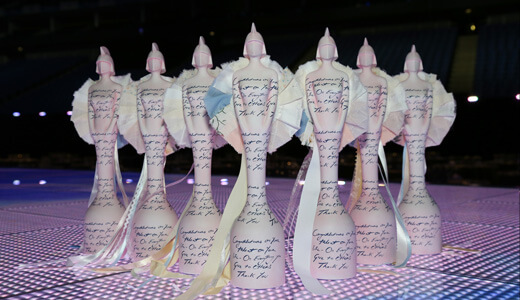
After a week of truly gloomy news in the entertainment industry, which has seen the deaths of David Bowie and Alan Rickman and, this morning, an announcement that Dame Barbara Windsor will leave EastEnders - for good!!! (I realise that this does sit at one end of the scale...) - it's time to allow regular sniping of the business of show to recommence.

Pop culture is, we must acknowledge without question, what it is. Almost by definition, there is little room for the eclectic and the obscure, and in an ideal world, elitist interests too. The Brit Awards, for example, began as a patriotic nod to HRH The Queen in her silver jubilee year with the appropriately stuffy British sobriquet, the 'British Phonographic Institute Awards', a celebration of the nation's music industry.

Over time, and via disastrous Mick Fleetwood/Sam Fox presenting combos, Chumbawumba tipping ice buckets over ministers of the crown and Jarvis Cocker goofing up Michael Jackson's grandiosity, it has evolved into a giant, paid ticket-only beanfeast at the 02 Arena.

No harm in that: in the 1960s, the annual NME Poll Winner's Party was the must-attend celebration of pop. And, as with all good awards ceremonies, the Brits always feature plenty to get annoyed about. No-one has a monopoly of opinion on what makes good and what makes bad, and taste is 90% subjectivity an probably less than 10% objectivity. But there are times when these awards dos - and I'll come to the Oscars and BAFTAs in a moment - and the nominations therein are just plain baffling.

For many years, the Brits were, as a celebration of the British music industry, less about artistic endeavour and more about recognising the number of "units" shifted. Personally I loathe those industry awards evenings where a load of predominantly male salesmen in hired Moss Bros dinner suits quaff wine, smoke cigars and behave boorishly, and then get the chance to stand on the stage of a London hotel ballroom to receive a trophy from some regional BBC news presenter. That, though, is the sort of environment where record company accountants would best enjoy acknowledgement.

The Brits, though, should be the Oscars of British music, where creative excellence is rewarded, where artistic daring is lauded and, more importantly, rock, pop and all the other genres get to be celebrated for giving those of us who love our music a damn good time. So, what about this year's Brits, nominations for which were announced this week? What sign is there of it being a superb festival of the last 12 month's grooviest choons?

Let's start with one of the perennial clangers, Best British Female. For years, this would feature almost exclusively Kate Bush, Annie Lennox, Yazz, Sade and, possibly, Clodagh Rodgers, even when they hadn't been near a recording studio in centuries. This year's BFF includes a nomination for the definitely dead Amy Winehouse, purely, it would seem, for having appeared on the soundtrack of an admittedly breathtaking film about her ill-fated life.

Inevitably Adele features prominently this year, the living embodiment of both irresistible force and unstoppable object. Depressingly, I don't see there to be any other winner, and although it's good to see the likes of Florence Welch, Jess Glynne and Laura Marling, where are Ellie Goulding and Lianne La Havas?

The nods for British Male Solo Artist - ​Aphex Twin, Calvin Harris, James Bay, Jamie xx and Mark Ronson - just depress on account of the fact Britain is currently lacking any bloke making anything truly interesting. And this in the week that we lost one of its greatest exponents.

Blur lead the odds for Best British Group, ​but with the exception of Foals, the appearance of Coldplay and One Direction, for God's sake, are all too predictable. Would it have killed the Brits committee to have included Noel Gallagher and his High Flying Birds in one of these two categories? Johnny Marr? They are quite good, if you weren't aware...

The Best International Group category has traditionally been a platform for either U2 or Foo Fighters, or Foo Fighters and U2. I may be wrong, but in truly lean years I'm sure U2 have also appeared in the Best British Group category on account of Adam Clayton being born in Oxfordshire. This year the list includes Eagles of Death Metal. As noble as this entry is for representing rock'n'roll defiance (and I'm not going to tread on the sensitivities of those - including two friends - who were caught up in the bloodbath in Paris), surely EoDM could have received a special award? Are they really one of the international groups of the year? Good, though, that the category also includes Alabama Shakes and Tame Impala.

I'm not going to go through every category, otherwise I will end up very angry indeed at the inclusion of Adele's suicidally dreary Hello as single of the year and, worse, Sam Smith's truly abject Bond theme Writing's On The Wall (yeah, I'll say...) for British Artist Video of the Year.

I know that, at 48, I have ascended to that life stage where I can legitimately be a curmudgeonly old fart, but the Brits just seem to lack a certain excitement, true pioneers. They were always meant to be a corporate event, but since getting the Smash Hits treatment, The Brits should at least amp it up and celebrate the actually good things about the British music industry.

I'm not going to re-engage the argument that music was better in the 70s, because it was and it wasn't, and there is no shortage of adventurous, exciting, music coming through now, as there has always been and always will. But for a trade association representing a national music industry that, arguably, has had more impact around the world than any others (face facts America), it should reflect the still-burning furnace of British musical invention with a bit more than Coldplay in any category that will have them.


However, there are greater crimes being committed in this, the season of black tie showbiz piss-ups. This week we've seen the 2016 nominations for the Oscars and their slightly lesser (in the mind of the rest of the world...) British cousin, the BAFTAs.

Whereas the Brits seem too populist and predictable, the film awards have, to some degree, been less so. I'm not so naive that I don't realise how film business politics plays a big part in nominations for the Oscars in particular, but there is something cringingly dismal that, yet again, diversity gets such a poor showing this year.

It should, of course, never be about tokenism, but were this last year's films so bereft of strong performances from black actors and women that the main categories this year shouldn't have a more diverse profile? Creed, Straight Outta Compton anyone...? No. This year's Academy Awards will be the whitest, straightest Oscars in living memory.

But it's not just ethnic or cultural diversity that have been badly served by the Oscars and, indeed, the BAFTAs. What about populism? Sure, The Martian is a big, balls-out bucket o'popcorn blockbuster, and it's actually quite refreshing to see a film like Mad Max: Fury Road get a look-in on gongs (though surely someone's having a laugh putting a post-apocalyptic Mad Max film up for an Oscar in the Make-up & Hair Styling category...).

But where are two of the year's biggest films - SPECTRE and Star Wars: The Force Awakens? It's possible that the latter failed to appear in time for consideration but, still, the lack of properly good, properly popular films - action, sci-fi or broad comedy - in these awards is a frustration as annually predictable as waking up on Christmas morning and not finding the keys to a Porsche under the tree.

Even with its flaws SPECTRE was exceptionally entertaining, and the Bond franchise is continuing to show every other action series how to do it. Likewise The Force Awakens, a staggeringly good romp and one that will appeal to sci-fi obsessives and regular film-goers with equal measure - damn good fun for a couple of hours on a Saturday night, with plenty of humour and pathos.

OK, neither might have, like, 'heavy, themes; neither might have the heft of human emotion stretched to its limits by survival in bear-infested forests or transgender acceptance, but does that make them any less worthy?

For the BAFTAs not to recognise either SPECTRE or The Force Awakens is even more shocking. As an awards ceremony that bigs up its Britishness (and you don't get more cut-him-open-and-he-bleeds-pure-tweed than Stephen Fry as co-host), and yet doesn't recognise two of the biggest commercial hits of the year, which were made on British soil, mostly, and which represent the very best of British acting and production talent, is just embarrassing.

Did I mention daylight snobbery? Of course I didn't. That would be terribly naughty of me...