Showing posts with label Brit Awards. Show all posts

Thursday, 23 February 2017

Bowie has the last word


Perhaps it's a generational thing. In November, David Bowie's Blackstar bafflingly missed out being nominated for inclusion in the 2016 BBC Music Awards, even though it - and his death - had been one of the pivotal cultural moments of the entire year, almost from its origin. And then, when the somewhat more prestigious Grammy Awards nominations came out in December, the final album from one of the most influential rock and pop artists of the previous five decades - an album which enigmatically came out two days before his death - failed to feature at all.

Sage-like pieces in the quality press have sought to examine whether there was something to this. After all, Bowie turned 69 on the day Blackstar came out, competing with albums from artists a mere fraction of his vintage. But the point, hopelessly lost by both the BBC and the Grammys, is that Bowie was - at the time of his death - one of the few remaining artists from the 1960s still producing compelling work (albeit only his second studio album since being forced into retirement in 2004) in the second decade of the 21st century. Blackstar was a strange, confounding, beautiful record, laden with clues - we later discovered - to Bowie's failing health. Listening to it more recently, I've heard nuances that never even occurred to me at the time. This is a particular Bowie trait, I've discovered. Not even his most immediate, commercial records (a Let's Dance, for example) are completely devoid of neat, wonderful time capsules that open up of their own accord, as years and even decades pass on.

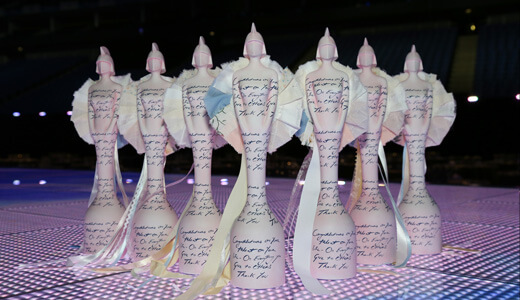
So, while I successfully avoided last night's Brit Awards (well, you would, wouldn't you), it was extremely satisfying to see Bowie rewarded with both the Best British Male award, and the gong for Best Album, for Blackstar. Some might argue that the Brits - run by the UK music industry trade body (it was once known simply as the British Phonographic Industry Awards, a stuffy, black tie affair) - aren't in touch with popular sentiment. But, despite the event becoming just a regular showbiz gongfest, the Smash Hits Poll Winner's Party it is not.

Bowie's wins last night were extremely valid recognition of what he did for the British music industry, of his actual lifetime's achievement of blazing a trail - perhaps unequalled - of artistic brilliance, of rich creativity and experimentation of both style and substance, continuing a progressiveness that began with The Beatles long into a career that could so easily have fallen into a degree of self-parody, like many of his peers. But not even Paul McCartney or Neil Young - contemporaries of arguably equal merit - could be so fĂȘted.

To make a statement of the bleeding obvious, Bowie won't appear at The Brits again, unless in some future mawkish tribute. With the recognition he deserved for a career comprising brilliance with audacity - traits rarely found together these days - and winning two of the most prestigious prizes of the night - Bowie he can finally leave the stage with a signal to any of those who follow: this is what you need to aim for. And, as his filmmaker son, Duncan Jones, said in a touching acceptance speech on behalf of his dad for the Blackstar album: "This award is for all the kooks, and all the people who make the kooks". To have been 69, and still a kook, is all the justification ever needed for Bowie.

Thursday, 16 February 2017

Down the tube - the history of rock and pop on TV

It's now just over 61 years since rock and roll - and therefore the beginnings of pop music - made its visual debut. Indeed, rock was still in its infancy when Elvis Presley exploded onto American TV, performing Heartbreak Hotel on CBS's Stage Show in January 1956. Of course, radio had already been established by then, and while video hardly killed the radio star as a result, Presley's hip-swinging, breakthrough appearance set in train a worldwide culture. Television gave a face and a body to the performers who would otherwise only be heard on radio, or pictured in the press or on record covers and, for those lucky enough, made accessible via the stage.

Bill Haley and The Comets predated Presley by performing Rock Around The Clock on The Ed Sullivan Show the previous summer, and some still say that was pop's Big Bang moment. But in the conventional, simplified sequence of musical history, it was Presley's arrival that begat The Beatles, and The Beatles who sparked the rock and pop explosion, which, running the course of the next 40-odd years, brings us to the present day.

One constant through most of this has been the evolution of television. In fact, you could argue that television has had as much of a symbiotic relationship with pop and rock as radio or any other outlet. That certainly is the impression one gets from Rock & Pop On British TV, the tremendous new book by Jeff Evans, which charts the history of music TV in the UK by going right back to the era of stuffy 'light entertainment', when music was anodyne, presenters wore dinner suits and ballgowns, and the teenager was robustly encouraged to be seen but not heard.

Published today - the 60th anniversary of the BBC's seminal Six-Five Special being broadcast for the first time - Rock & Pop On TV delivers a definitive appreciation of how music on British TV grew and has since receded, as well as providing a backdrop to social and cultural changes via shows like Ready Steady Go!, Top Of The Pops, The Old Grey Whistle Test, The TubeThe Word, The White Room and, latterly, the lone survivor - Jools Holland's Later....

While talking about the book at a recent Word In Your Ear Podcast recording, Evans raised the notion that anyone, of any musical generation, will have their 'moment' of music television - be it David Bowie's performance of Starman on TOTP (straining then-contemporary views on sexuality with his arm draped around Mick Ronson) or hoary old Dutch prog rockers Focus yodelling Hocus Pocus on Whistle Test, Frankie Goes To Hollywood's Relax being banned by the BBC in January 1984 and then performed on the TOTP Christmas edition of the same year, right up to more recent times, and Seasick Steve's breakthrough, as a novelty item on the 2006 Hootenanny. We shouldn't forget, either, the moments of notoriety: Bob Geldof's expletive-laden rant during Live Aid, the painful live broadcast of The Brits in 1989 when it just didn't go right for Mick Fleetwood and Sam Fox, and the ludicrous poking-with-a-stick of The Sex Pistols by Bill Grundy on Thames Television's Today show in 1976.

My own memories of music television are as vivid today as anything in my 49 years - be it Alvin Stardust and his somewhat creepy performances, leather jumpsuit-clad with a ring on top of a leather-gloved hand, or actually being a part of the TOTP studio audience as a teenager in the show's relentless, ra-ra skirted, balloon-fest sixth-form disco 1980s era.

Not surprisingly, Evans himself has his own poignant memories: "I do remember very clearly the moment when the UK was introduced to Meat Loaf, via the video shown on the Old Grey Whistle Test. That was what dominated conversation at school the next day. I should also point out that seeing Wizzard perform See My Baby Jive on Lift Off With Ayshea [ITV show which ran from 1969 to 1974] was the moment when I decided to start buying records. I was blown away by the fullness of the sound and the colour of the performance (Roy Wood in all his Technicolor glory and the rest of this huge band larking about behind). That said, some of my very earliest memories are of TV pop shows, because I had an older brother and sister. I don't remember any detail but I recall seeing programmes such as Thank Your Lucky Stars and Discs A Gogo at a very early age."

Without doubt, one show that spans the generations, still, is Top Of The Pops. Running from New Year's Day 1964 until July 2006, and recording weekly audiences in the tens of millions at its peak, it became a national institution which, says Evans, actually made it difficult to kill off. "It was struggling from the 1980s onwards," he says, "and not least because the music video, which had once seemed like a godsend for Top Of The Pops, because it was so handy for covering the absence of artists in the studio, was now available to every other television show. This meant that TOTP was no longer the only programme to cover the latest hits."

When TOTP began in 1964, from a cold, converted church in Manchester, pop was still an unknown beast. By the time it ended, the Internet had arrived, and pop, to some extent, had been and gone as televisual entertainment. "[TOTP] kept going until it really was no longer viable in the age when anyone could access music via the Internet at the press of a button," says Evans. "This longevity was probably due to the efforts of the various producers who were brought in to gee it up and keep it alive. The show was constantly being refreshed and changing its look so these were perhaps little kisses of life but eventually there was no way back. It might have lasted longer, given more goodwill by the BBC hierarchy and better scheduling, but probably not much longer."

Evans does argue, however, that perhaps we place too much significance on the role of shows like TOTP, despite it's perceived cultural importance, and that has some bearing on the absence, today, of the competition of music shows that existed in the '60s, '70s and '80s. "In truth, music shows have never generated huge audiences. TOTP was the one exception, with its viewing figures of around 20 million in the 1970s. This alone is disincentive enough for commercial channels but it also has a bearing at the BBC. It is not so hamstrung by audience figures but it still needs to get justifiable numbers for its programmes."

The arrival, in 1981, of MTV brought about another shift, though not immediately in the UK. Jeff says that this indirectly encouraged record companies to commission more videos which could then be shown across a broad range of entertainment shows. "Music shows then suffered as a result because they lost their USP. Increasingly, you saw broadcasters commissioning live performance shows as a contrast, or recordings of gigs and festivals, but even these have disappeared now."

Indeed, today television has lost its monopoly. "The general dearth of TV music programmes is also no doubt related to the fact that television is just one medium through which you can get your visual music fix these days," says Evans. The novelty of seeing a band 'in the flesh' has worn off in an era when poor quality smartphone footage of a gig is uploaded to YouTube within a matter of minutes of the house lights coming up. Or, worse, being streamed on Periscope.

"It's not just the easy access and the extent of availability, it's also the immediacy," Evans says. "If Rihanna has a new video out, fans are not going to wait a few days to see it on a regular weekly show. They will watch it straight away. In the same way, if there are still chart followers out there, they want the latest information there and then and not have to wait until later in the week for a run down."

Picture: Maidstone Studios

The one beacon in the dark is Holland's Later..., now in its 25th year and as a result, the second-longest music show on British TV after TOTP. "I think it [has lasted] because it is fairly timeless. Unlike Oh Boy!, Ready Steady Go!, The Tube and TFI Friday that flared brightly then burned themselves out, it has never been tied to one musical fad or era. With its broad cross-section of talent, it protects itself from the changing mood of the music buying public. Similarly, there are no gimmicks, which equally date a show. An intelligent editorial approach is also part of the success."

In mentioning Oh Boy!, Evans also raises memories of some of the more obscure pop shows that have come and gone. Who remembers All Systems Freeman!, a single-series 1968 platform for Alan 'Fluff' Freeman?  Or A Whole Scene GoingRock Goes To CollegePoparound (presented by Gary Crowley), Supersonic, and the legendary Cool For Cats, presented by future ITV wrestling commentator Kent Walton? One of the many joys of Evans' book is appreciating just how, for a good 40 years, music was everywhere on British TV - during kids' TV, Saturday mornings, Saturday evenings, weekday lunchtimes and weekday evenings. And it was spread across the channels, especially - and here's one for the teenagers - when television was exclusively terrestrial and, until 1982, comprised of just BBC1, BBC2, and ITV.

Even then, says Evans, there was an editorial difference between the BBC and ITV. "The BBC was still very Reithian [In the 1950s] in its approach to programming, including music programming," he says. "It wasn't just entertainment, it had to educate and inform at the same time, which was why Six-Five Special was no match for Oh Boy! once Jack Good had gone over to ABC. ABC allowed Jack to do his own thing and just go for pure fun."

As '60s beat pop gave way to more 'serious' music, as The Beatles concentrated on the studio and singles gave way to albums, the BBC tried to progress televised pop music with groovy shows like A Whole Scene Going, How It Is and Colour Me Pop. Says Jeff: "Thereafter, ITV always struggled to put together any sort of challenge to Top Of The Pops and Whistle Test, largely because it had problems networking shows. A lot of the music offerings were either designed for children - Granada shows like Lift Off and Get It Together, and therefore not available to the working adult, or they were made regionally and rarely made it beyond their own region, because they couldn't get into that important peak-hour networked period that was dominated by sitcoms, soaps, game shows and variety."

One significant entry in this canon, and which had a peculiar regional bent, was The Tube. Launched in Channel 4's first week, Malcolm Gerrie and his production team challenged the notion that major bands only appeared on TV shows in London, and successfully provided a breakthrough platform for a whole load of acts between 1982 and 1987 from Studio 5 at Tyne Tees Television in Newcastle.

As a fledgling journalist I was lucky enough to visit The Tube a couple of times - the first to interview Jools Holland on his return from suspension (after dropping the F-bomb in a live teatime promo...), and where I was also in a pindrop-silent control room for the world's first playout of U2’s With Or Without You video, heralding The Joshua Tree and the onset of the band as a global rock phenomenon. Gerrie invited me back six weeks later for the show's finale, after Channel 4 pulled the plug on the show after five series and 121 editions due to declining audiences (although the Holland incident didn't help). It was, nonetheless, a brilliant, brave show, providing a robust challenge to the light entertainment pop of Top Of The Pops, the earnest music journalism of Whistle Test and the emerging pervasiveness of the MTV format.

Today, though, apart from the ghoulish spectacles of the talent shows and somewhat incongruous live performances on The Andrew Marr Show or The One Show, fans of live music on TV must rely on Later...  and the annual Glastonbury visit for their fix. Notably, both are on the BBC, the result of the strong music editorial department run by Mark Cooper.

"I think there have been times when music programmes have been important to broadcasters," reflects Evans. "A good example is during the Beatle-inspired beat boom in the early '60s when pop was suddenly infiltrating all kinds of programmes from documentaries to soaps to kids' shows. Generally, because of the audience numbers, I don't think they have always been so important, however, although - of course - broadcasters have (in the past at least) needed to find a broad mix of programming, so music shows helped with that."

That repeats on BBC Four of vintage Top Of The Pops episodes generate huge - and often ironic - traffic on Twitter is a reflection of the unique shared TV experience of at least a two or three generations. "I'm sure TOTP has been missed," says Evans, "but probably only by some of its former audience, and in a nostalgic sense. I can't imagine today's teenagers, never having seen it except at Christmas, would consider it a huge miss, when they have so many options for accessing music. TOTP also belonged to an era when people watched television together. We had only three or four channels and there was no Internet. That collective experience – shared at a given time every week – has also gone."

A shame, perhaps, but for those who love music, and love seeing music, you could argue that the alternatives - the video streaming services in particular - do still do the job. But as Rock & Pop On British TV consistently reminds, there can never again be a first time for seeing The Beatles, or Bowie strumming his 12-string to Queen Bitch on Whistle Test, or Oasis making its snarling debut on The Word, and such events being the talk of the classroom the next day. Perhaps it doesn't matter, but for this music head, recalling the childhood joys of Sweet or Suzi Quatro or Slade, or finally 'getting' Britpop thanks to TFI Friday and Chris Evans' infectious zeitgeist consumption, there still is a place for an iconic 'appointment' music show on British TV today.

Saturday, 16 January 2016

And the winner is...Black Tie, White Noise

Picture: JMEnternational

After a week of truly gloomy news in the entertainment industry, which has seen the deaths of David Bowie and Alan Rickman and, this morning, an announcement that Dame Barbara Windsor will leave EastEnders - for good!!! (I realise that this does sit at one end of the scale...) - it's time to allow regular sniping of the business of show to recommence.

Pop culture is, we must acknowledge without question, what it is. Almost by definition, there is little room for the eclectic and the obscure, and in an ideal world, elitist interests too. The Brit Awards, for example, began as a patriotic nod to HRH The Queen in her silver jubilee year with the appropriately stuffy British sobriquet, the 'British Phonographic Institute Awards', a celebration of the nation's music industry.

Over time, and via disastrous Mick Fleetwood/Sam Fox presenting combos, Chumbawumba tipping ice buckets over ministers of the crown and Jarvis Cocker goofing up Michael Jackson's grandiosity, it has evolved into a giant, paid ticket-only beanfeast at the 02 Arena.

No harm in that: in the 1960s, the annual NME Poll Winner's Party was the must-attend celebration of pop. And, as with all good awards ceremonies, the Brits always feature plenty to get annoyed about. No-one has a monopoly of opinion on what makes good and what makes bad, and taste is 90% subjectivity an probably less than 10% objectivity. But there are times when these awards dos - and I'll come to the Oscars and BAFTAs in a moment - and the nominations therein are just plain baffling.

For many years, the Brits were, as a celebration of the British music industry, less about artistic endeavour and more about recognising the number of "units" shifted. Personally I loathe those industry awards evenings where a load of predominantly male salesmen in hired Moss Bros dinner suits quaff wine, smoke cigars and behave boorishly, and then get the chance to stand on the stage of a London hotel ballroom to receive a trophy from some regional BBC news presenter. That, though, is the sort of environment where record company accountants would best enjoy acknowledgement.

The Brits, though, should be the Oscars of British music, where creative excellence is rewarded, where artistic daring is lauded and, more importantly, rock, pop and all the other genres get to be celebrated for giving those of us who love our music a damn good time. So, what about this year's Brits, nominations for which were announced this week? What sign is there of it being a superb festival of the last 12 month's grooviest choons?

Let's start with one of the perennial clangers, Best British Female. For years, this would feature almost exclusively Kate Bush, Annie Lennox, Yazz, Sade and, possibly, Clodagh Rodgers, even when they hadn't been near a recording studio in centuries. This year's BFF includes a nomination for the definitely dead Amy Winehouse, purely, it would seem, for having appeared on the soundtrack of an admittedly breathtaking film about her ill-fated life.

Inevitably Adele features prominently this year, the living embodiment of both irresistible force and unstoppable object. Depressingly, I don't see there to be any other winner, and although it's good to see the likes of Florence Welch, Jess Glynne and Laura Marling, where are Ellie Goulding and Lianne La Havas?

The nods for British Male Solo Artist - ​Aphex Twin, Calvin Harris, James Bay, Jamie xx and Mark Ronson - just depress on account of the fact Britain is currently lacking any bloke making anything truly interesting. And this in the week that we lost one of its greatest exponents.

Blur lead the odds for Best British Group, ​but with the exception of Foals, the appearance of Coldplay and One Direction, for God's sake, are all too predictable. Would it have killed the Brits committee to have included Noel Gallagher and his High Flying Birds in one of these two categories? Johnny Marr? They are quite good, if you weren't aware...

The Best International Group category has traditionally been a platform for either U2 or Foo Fighters, or Foo Fighters and U2. I may be wrong, but in truly lean years I'm sure U2 have also appeared in the Best British Group category on account of Adam Clayton being born in Oxfordshire. This year the list includes Eagles of Death Metal. As noble as this entry is for representing rock'n'roll defiance (and I'm not going to tread on the sensitivities of those - including two friends - who were caught up in the bloodbath in Paris), surely EoDM could have received a special award? Are they really one of the international groups of the year? Good, though, that the category also includes Alabama Shakes and Tame Impala.

I'm not going to go through every category, otherwise I will end up very angry indeed at the inclusion of Adele's suicidally dreary Hello as single of the year and, worse, Sam Smith's truly abject Bond theme Writing's On The Wall (yeah, I'll say...) for British Artist Video of the Year.

I know that, at 48, I have ascended to that life stage where I can legitimately be a curmudgeonly old fart, but the Brits just seem to lack a certain excitement, true pioneers. They were always meant to be a corporate event, but since getting the Smash Hits treatment, The Brits should at least amp it up and celebrate the actually good things about the British music industry.

I'm not going to re-engage the argument that music was better in the 70s, because it was and it wasn't, and there is no shortage of adventurous, exciting, music coming through now, as there has always been and always will. But for a trade association representing a national music industry that, arguably, has had more impact around the world than any others (face facts America), it should reflect the still-burning furnace of British musical invention with a bit more than Coldplay in any category that will have them.


However, there are greater crimes being committed in this, the season of black tie showbiz piss-ups. This week we've seen the 2016 nominations for the Oscars and their slightly lesser (in the mind of the rest of the world...) British cousin, the BAFTAs.

Whereas the Brits seem too populist and predictable, the film awards have, to some degree, been less so. I'm not so naive that I don't realise how film business politics plays a big part in nominations for the Oscars in particular, but there is something cringingly dismal that, yet again, diversity gets such a poor showing this year.

It should, of course, never be about tokenism, but were this last year's films so bereft of strong performances from black actors and women that the main categories this year shouldn't have a more diverse profile? Creed, Straight Outta Compton anyone...? No. This year's Academy Awards will be the whitest, straightest Oscars in living memory.

But it's not just ethnic or cultural diversity that have been badly served by the Oscars and, indeed, the BAFTAs. What about populism? Sure, The Martian is a big, balls-out bucket o'popcorn blockbuster, and it's actually quite refreshing to see a film like Mad Max: Fury Road get a look-in on gongs (though surely someone's having a laugh putting a post-apocalyptic Mad Max film up for an Oscar in the Make-up & Hair Styling category...).

But where are two of the year's biggest films - SPECTRE and Star Wars: The Force Awakens? It's possible that the latter failed to appear in time for consideration but, still, the lack of properly good, properly popular films - action, sci-fi or broad comedy - in these awards is a frustration as annually predictable as waking up on Christmas morning and not finding the keys to a Porsche under the tree.

Even with its flaws SPECTRE was exceptionally entertaining, and the Bond franchise is continuing to show every other action series how to do it. Likewise The Force Awakens, a staggeringly good romp and one that will appeal to sci-fi obsessives and regular film-goers with equal measure - damn good fun for a couple of hours on a Saturday night, with plenty of humour and pathos.

OK, neither might have, like, 'heavy, themes; neither might have the heft of human emotion stretched to its limits by survival in bear-infested forests or transgender acceptance, but does that make them any less worthy?

For the BAFTAs not to recognise either SPECTRE or The Force Awakens is even more shocking. As an awards ceremony that bigs up its Britishness (and you don't get more cut-him-open-and-he-bleeds-pure-tweed than Stephen Fry as co-host), and yet doesn't recognise two of the biggest commercial hits of the year, which were made on British soil, mostly, and which represent the very best of British acting and production talent, is just embarrassing.

Did I mention daylight snobbery? Of course I didn't. That would be terribly naughty of me...