 |
| © Simon Poulter 2021 |
So, apart from our four days in Edinburgh in August, that’s been it for two years. No Air Miles Andy me - until this week, when I spent a few hours in Amsterdam to sort out some personal finance admin put on hold by COVID-19 travel restrictions. You see, while we’ve all been raving about WFH enabled by technology, some things still require face-to-face contact. In my case, a Dutch bank account requiring in-person attention because, even in the age of fintech, it couldn’t be sorted out over the phone. After 18 months, then, of being unable to do anything about it, I grabbed the opportunity of the current, potentially brief window in travel and burned off some of the Avios points accrued during my insane year of travel and popped over to the Dutch capital. As you do.
Now, I know what you’re thinking: not very green flying to Amsterdam for just two appointments and then fly straight back again. Well, no it wasn’t, but it was also unavoidable. And, I like to think, unlike the hapless Manchester United squad who recently flew to an away fixture with Leicester City, a journey of 100 miles that could have just as easily been taken by train or coach (except, apparently, they wanted to avoid traffic on the motorway). I, too, could have driven to Amsterdam, or even taken the Eurostar, now the city has been added to its services from St. Pancras. But even with a relatively reasonable journey time of just under four hours each way, the logistics wouldn’t have worked without requiring an overnight stay, with more expense and unnecessary absence.
During that year of near-constant business travel I made frequent day trips to places like Paris, Munich, Madrid and Zurich, invariably taking advantage of London City Airport being only a short DLR ride away from Greenwich, where I was living at the time. The airport was built in the 1980s as part of London’s Docklands regeneration, transforming one of the old Royal Docks wharfs into a gateway for City bankers to jet off to Europe’s financial centres and return within the day. Like all airports, London City has been impacted by the dramatic turndown in air travel over the last year, but this week there was no shortage of young, thrusting types who have barely started shaving, wearing polished shoes and sharp suits, furiously tapping away at laptops as they prepared to fly off to meetings at the big accounting houses like E&Y and PWC. That said, you could hardly say that the airport was bustling at seven in the morning as it once would have been. Travel has understandably taken a back seat, and even though it is gradually being allowed to return - this latest half-term holiday has been the first opportunity for many families to take advantage of the relative easing of restrictions - it is still far from ‘frictionless’.

Before the pandemic, my day trip to Amsterdam would have been almost as easy as catching a bus to go shopping at Westfield. But even just to visit the city for a few hours I had to go through a lot of rigmarole: first, a ‘fit to fly’ COVID test (£39 - ker-ching!) and pre-book a ‘Day 2’ PCR test for my return (£69 - ker-ching again!), upload my NHS COVID vaccination certification to the British Airways website, along with the fit-to-fly result, plus a completed health declaration form for the Dutch government and a Passenger Locator Form for the UK government. All of this so that someone could check that I’d completed the protocols. So far, no one has been in touch, £110 worth of testing later…
I must admit, once I’d gone through the stress of securing all these tests and paperwork, the actual business of getting on the plane was quite easy. After satisfying BA that I complied with all requirements, my boarding pass was sent to my phone, allowing me to breeze through the electronic gates at the airport, and then on through the now considerably lighter-touch security screening than it used to be, thanks to the installation of advanced scanners that no longer require you to remove laptops, shoes and belts. Arrival at Amsterdam’s Schiphol Airport was just as easy, save for the fact that we Brits can no longer wave an EU passport through the ‘e-gates’, now we’re outside the Schengen Zone (a bit like the Twilight Zone only less fun). Once passport control was happy with my reasons for visiting, I was on my way for the 15-minute train ride to Centraal Station in the heart of the city. The return journey was a little more arduous as BA’s app and self-service check-in kiosks refused to give me my boarding pass. Evidently not all the paperwork uploaded for the outbound flight had been replicated for the home journey, requiring a torturous wait for the check-in desk to open. I suppose this is the price to pay for any kind of foreign travel at the moment and, possibly, for the foreseeable future.
Perhaps, though, we in the UK have been lulled into a false sense of security by the relative lack of health enforcement compared to elsewhere. The travel experience notwithstanding, my brief trip afforded an opportunity to see life outside the UK for the first time since the pandemic took over the world. Although the British media has kept pace with COVID-19 developments around the world, for most of us the intensity has been in our own back yard. Seeing another city, another country, another people and how they took to, for example, mask wearing, was fascinating, almost from the minute I exited the aircraft walking through the airport and then travelling on the transport system it was notably reassuring to see that masks were de rigueur. There was similar obedience in Edinburgh, come to think of it. Just not on London’s public transport network, where COVidiocy remains stubbornly high. That said, the Dutch haven’t been immune to the virus. In a country of just 17 million people there have been 2.12 million cases to date and an estimated 18,000 deaths, though many believe that number could be higher. While I was in Amsterdam news emerged that the Dutch government is considering reintroducing local restrictions amid some of the fastest rising infection rates in Europe, an increase that was “faster and sooner than expected,” according to the country’s health minister, Hugo De Jonge.
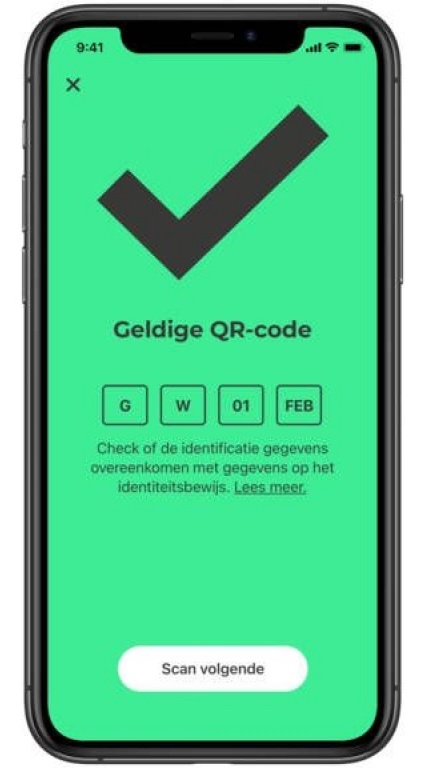
“After some early consternation, the majority of pragmatic Dutch accepted the [COVID app] pass as a means of resurrecting their social lives while shrugging off social distancing,” wrote the BBC’s Netherlands correspondent Anna Holligan this week on the BBC News website, in a feature in which the corporation’s journalists in Europe reported on the local approach to curbing the spread of the coronavirus. “When I've asked waiters or box-office workers if they want to see the QR code proving my vaccination the answers vary from ‘no, it’s okay, we trust you’ [which was my experience] to ‘we don't actually have the technology’,” Holligan added, pointing out that a recent study had found that around a third of Dutch cafes and restaurants are not scanning the local corona pass at all.
My experience was mixed: one cafe made the pass voluntary, another asked to see mine, which I didn’t have, but did have both the NHS Travel Pass and another ‘health passport’ resulting from my expensive pre-flight test. Although not officially recognised abroad (though, since Friday, they should be now), the waitress who greeted me at one cafe in Leidseplein decided that she’d seen enough and had better things to do.
In France, the passe sanitaire has become part of daily life, and is essential to do anything, from entering a bar or cinema to getting on a train. COVidiocy, however, also varies across the continent. The BBC’s Hugh Schofield says that traditional French libertarianism has reared up in response to virus measures: “Of course there are people in France who object on principle to having to prove their credentials at every turn.” he wrote. “Every Saturday there are demonstrations in Paris and other cities, bringing together anti-vaxxers with libertarians and protesters against ’health discrimination’. Contrary to what some expected, though, these have not turned into a mass movement, and are dwindling in strength.” Schofield explained that implementation of the passe sanitaire has seen a rapid uptake of vaccinations, regarding it as the key to returning to some form of French social normality. More than 50 million French people have been totally vaccinated, including a large majority of those over the age of 12. Jabs have been incentivised further by an ending of free tests for the virus, meaning that for the passe sanitaire to allow entry to the bars and cafes that are central to French living, people have to show either proof of vaccination or a recent negative (and paid-for) test.
Compare all this with the United States, for many years my go-to choice for holidays. Next week the US opens up again to foreign visitors, but the Land of the Free won’t be quite as open as it once was. In New York, for example, proof of vaccination is required to get into hospitality settings, theatres, museums and other attractions. Masks aren’t required, but it is strongly advised by the city’s mayor. Chicago is different, with masks mandatory in all indoor spaces. In Los Angeles, proof of vaccination is required to enter bars and restaurants, and masks are even required for anyone over the age of two “in all indoor public settings, venues, gatherings, public and private businesses”, according to the local public health authority with rules covering all outdoor events and public transit. Masks are mandatory in Washington DC, and several states including Nevada, Hawaii and Oregon. Ultra-conservative Florida, perhaps not surprisingly, has gone in the opposite direction, with the state’s governor Ron DeSantis even threatening to fine businesses demanding proof of vaccination from customers. All thus in a country where only 57% of the national population has been vaccinated, although the rate of infection in the US is just 225 cases per million of population. Compare that to the UK’s 621 per million, in a country with 67% vaccination.
 |
| © Simon Poulter 2021 |
Back to my trip this week: perhaps the reality of life during COVID elsewhere were at their most stark at Schiphol Airport. In the 30-plus years that I’ve been travelling through it, it has always been a bustling hub, reflecting the historic internationalist Dutch outlook on trade and, therefore, world travel, but also the fact that it has always been a superior shopping experience. I used to joke that Schiphol was essentially a shopping mall with a runway, but last week, as I returned to its airside walkways in the late afternoon, I was shocked by how many shops were already closed for the day. Even some of the airport’s coffee bars - coffee being the lifeblood of Dutch existence - were closed. It was here that I saw for myself just how the pandemic has impacted travel. Like many other places, the Netherlands has suffered a sharp fall in tourists, with the national tourist board revealing that only seven million foreigners took up hotel accommodation in 2020, a drop of 13 million compared with 2019. Inbound tourism from traditional points of origin like the US and Asia decreased by 83%, but even numbers of tourists entering via the country’s open EU borders fell, with visitors from its southern neighbour Belgium dropping by 58%.
The statement-of-the-bleedin’-obvious conclusion from all this is that the pandemic has affected so many aspects of daily life that we used to take for granted. I won’t deny that the amount of business travel I used to endure was something of a privilege, but if one good thing comes out of this global crisis, it’s that digital communications really is a substitute for the expense and environmental impact of air travel in particular. But we can’t not travel at all. As the world debates climate change in Glasgow this week, aviation in particular will come under scrutiny again, especially given the fact that world leaders have all flown to Prestwick to talk about it.
The world would be a worse place if we couldn’t move around it. Travel really does broaden the mind. We’ve missed having a week or two on a beach somewhere for the last two summers, the simplest of pleasures to provide escape from the mundanities of everyday life. Yes, there are plenty of beautiful places to explore here at home, but taking a plane somewhere should, also, be possible. For me, this week felt like a start.


