Showing posts with label travel. Show all posts

Thursday, 6 October 2022

Opening up the window on the world

Picture: Channel 5/ITN Productions/Jaimie Gramston

Let me share a personal secret with you. Some years ago, while living in Paris, I visited a therapist every other Saturday morning for a while. It was no biggie. There was no personal crisis that led me to those hour-long chats. There were, though, two triggers for seeking a friendly ear: I’d only recently moved to France from the Netherlands, separating from my-then girlfriend in the process. I was in a new and somewhat pressured job, while getting my head around a new town and a new language. I wasn’t struggling - living in Paris had been a long-held aspiration (blame a lot of Inspector Clouseau and Alain Delon films) and I revelled in it, but with a lot to process, and no local friends to unload on (and I wasn’t going to burden my new colleagues with any of this), I needed an outlet. On top of all that, The Sopranos had shown that it was OK to talk about ’stuff’, not that I was trying to equate myself with Tony Soprano, or that I harboured any latent desire for my therapist.

So the point of bearing my soul here is that one of the themes that came up regularly in my hour-long Saturday morning chats in the 20th Arrondissement was ‘escape’. To be clear, I wasn’t looking to escape the very city I’d dreamed of living in, but whenever I looked up and saw a plane above Paris it triggered a form of FOMO. I wanted to be on that plane, going somewhere – anywhere. We never did get to the bottom of this wanderlust, and to be honest, newly single I didn’t do badly for travel. 

Whether business trips to New York and Miami, or private weekends in Milan, Hamburg or back home in London, the Air Miles added up. But when I look back on all of that travel, nothing could be classed as adventurous. Even though a week spent driving Route 66, from Chicago to Los Angeles, was a marathon that took me through states and cities I wouldn’t have otherwise found time for, it was America. Familiarity. Chain hotels and drive-throughs, classic rock on the radio.

I never did find out which branch of pyschotherapy my therapist subscribed to (Freudians and Jungists don’t tend to telegraph their associations) but I’m sure she would have readily concluded that I’m a creature of both habit and familiarity. When it comes to travel, I probably still am. Language, culture and now, thanks to a health condition, food seem to present too many barriers. Which, I know, are all ridiculous reasons not to go somewhere in the modern age, and after centuries of human exploration. 

I genuinely wish I could be more dauntless. Television doesn’t help: I’ll watch Simon Reeve nosing around a Brazilian favela and wonder ‘why couldn’t I do that’? The answer is that, probably, I couldn’t. Television makes it look easy. Even if Reeve has the look of a backpacking student, he’ll be accompanied by a film crew, and probably hired security, interpreters, and that sort of thing. But television, to quote Lord Reith, really does provide a window on the world. The trouble is that, in the midst of all the endless celebrity travelogues, few really do open it. 

The exception is surely Michael Palin. For a comic actor many of us still associate with Monty Python, his travel series - ever since his own version of Around The World In 80 Days in 1989, have been compelling, engaging and truly educational without being preachy. And unlike many comedian-driven travelogues, free of over-wry ‘look at that thing!’ wackiness. From travelling between the North and South poles or encircling the planet’s middle, to the Sahara, the Himalayas, Eastern Europe, Brazil and North Korea, Palin has conducted the journeys most of us would or could never do, either because we don’t have the means, or the inclination.

Picture: ITN Productions/Jaimie Gramston

His latest, Michael Palin: Into Iraq, has done it again. Beneath an undoubted affability, Palin found humanity thriving in a country which has a claim to being the cradle of civilisation, and yet has been scarred by frequent bouts of humankind’s destructiveness. The narrative of Iraq for at least the 30 years since the first Gulf War is that it has been one of the world’s great basket cases, much like Afghanistan. But despite the seemingly perpetual turmoil – war with neighbouring Iran, then the first Gulf War and its sequel, followed by the post-Saddam collapse into tribalism and the rise of ISIS - humanity has prevailed. As Palin showed, Iraq is not a bombed out desert land. Travelling the length of the Tigris, from just over the border in Turkey to Basra, one of those names we now only know for its place in conflict, Palin found Iraq’s beauty, its stunning architecture, the culture that made it the centre of the civilised world at one point in history, and most importantly, its people.

The experience had a profound effect on him: “By the end of March we were back from battle-hardened Iraq having travelled for almost three weeks and seen things, people and places the like of which I’d never seen before in all my travels,” he wrote in a blog post. “The scenes weren’t always happy. Many of them reflected the violence of the past few decades when Iraq was disfigured by war and the threat of war. But we met some souls who’d been through it all and whose resilience was an inspiration.”

Indeed, amongst the still-chaotic administration, and latent dangers that prevail in areas where the Western military is still present, Palin found reassuring normality. The flamboyant tailor in Erbil running up a smart suit, the cafĂ© society that draws both men and (surprisingly) women out for tea in the evenings, and the children on a bombed out street in Mosul that reduced the normally genial presenter to blurt out “Fuck me!” at their stoicism. In a classroom, eloquent school kids spoke in perfect English of their desire for Iraq to be treated as a ‘normal’ country, like those in Europe. It was a truly levelling moment.

This, though, is still the contemporary narrative, and here’s what drew me in. Palin admits to having been fascinated by Iraq since childhood, when he was given a copy of Arabian Nights. It’s this connection to history – real history – that should spur us into visiting places that might be unfashionable, that don’t have McDonald’s drive-throughs and familiarities, but which may have contributed more to the world than, to quote Harold Shand in The Long Good Friday, “an ’ot dog.”

Palin’s “relentless optimism” in the Iraq series wasn’t meant to airbrush out the turmoil, and it certainly wasn’t a glorified advert for the country’s tourist authority. In one scene he visits the site of the Camp Speicher massacre in 2014, in which 1,500 Iraqi cadets were killed by ISIS. The undoubted gloom of Iraq’s recent past can’t be undone, but Palin showed that, actually, there should be plenty for tourists to come and see for themselves, if they’re willing and able. 

The people, first. Simplistic to say, I know, but they’re not all Kalashnikov-wielding monsters. They are young, aspirational, ambitious, thriving, even. There is wealth and prosperity amid the prevailing dysfunction. I can’t help feeling that it would be nice to contribute to it, as a Western tourist. Perhaps, for now, we have to accept that modest adventures are our limit, and let television be our gateway to more exotic or harder to reach places. One day, though. One day.

Tuesday, 30 August 2022

Travel won’t broaden your bank balance but it will broaden your mind

© Simon Poulter 2022

The man standing opposite me on the 7.55 to Waterloo is demonstrating why we need holidays. In fact, he is demonstrating it every 10 seconds, obsessively checking his phone’s lock screen to see if anything has been added to it. Despite it being August, the train is nose-to-nose packed, so it is impossible for me not to see his phone, but it’s clear that despite his feverish thumbing of the device, nothing new is appearing. If ever there was someone in need of a digital detox, this man is it.

I, on the other hand, am remarkably sanguine. It’s hot already, on a day likely to exceed 30 degrees, but my wife and I have just returned from 12 glorious nights abroad for our honeymoon. Since you asked, we travelled to Vancouver for a city break, before taking the incredible Rocky Mountaineer train to Banff, and then flying to Southern California for the final few days to do absolutely nothing beside a pool. And, not to sound even more smug than I do already, it was glorious.

Like everyone else, not having had a foreign holiday for three years, we’d given thought to our honeymoon probably long before thinking about our wedding. Vancouver appealed to both of us, especially as somewhere neither of us had been to before. When we then discovered that the Rocky Mountaineer departed from Vancouver, and took a leisurely two days to get up and amongst some of the most incredible scenery on Earth, we were sold. Being a little greedy, we also fancied a more traditional ‘beach’ component. The trouble is that getting from Banff to anywhere in the upper parallels of North America with a “proper” beach - for example, New England or the New York Hamptons - would require a day’s worth of travel. That’s when we discovered that Southern California could be reached in three hours by plane from Calgary, meaning that we could be at least poolside by mid-afternoon.

© Simon Poulter 2022

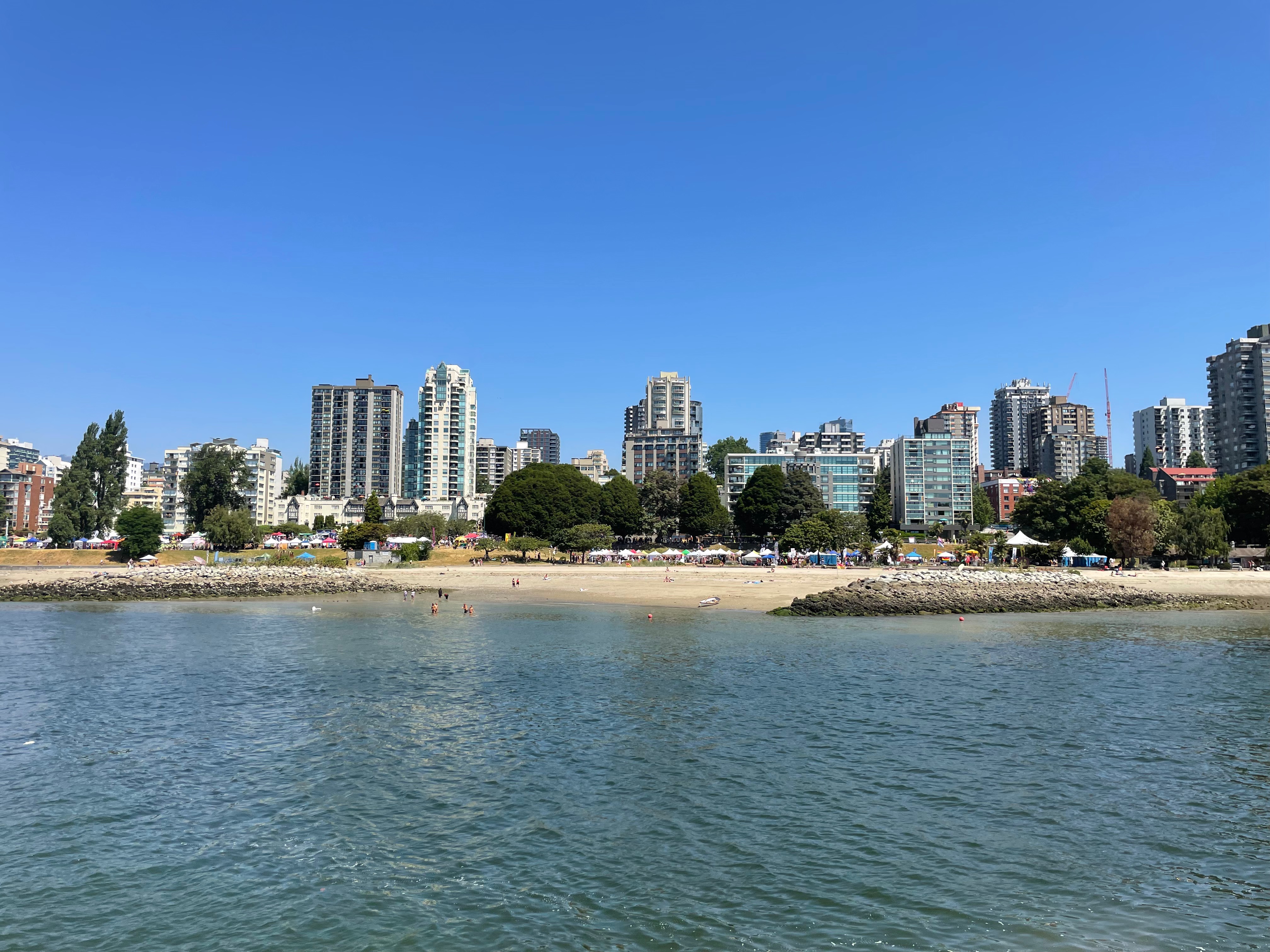
Vancouver’s appeal was that it came across as a very agreeable city, and so it proved. For a town only incorporated in the mid-19th century, flourishing as a key seaport and endpoint of the Canadian Pacific Railroad, it retains a newness, largely the result of urban regeneration that means that the most visible part of the city is dominated by the glass and steel of modern tower blocks lining miles of waterside pathways that curl in and out of apparently upmarket residential districts that appear to house much of the city’s 662,000-strong population. 10 million tourists visit Vancouver every year, and it continues to be the fastest-growing metropolis in Canada.

It’s not hard to see why: Vancouver projects itself as open and notably diverse, culturally, ethnically and socially, presenting a relatively young and progressive city. Its neighbourhoods bustle with the aspirational and the contented, roller-blading, scooting and cycling the city’s seemingly endless bike lane that hugs the waterside edge of this architecturally sharp port city. 

Vancouver was named the world’s second-best city in the Daily Telegraph’s Travel Awards a couple of years ago, only losing out to Cape Town. Colonial, New World conurbations clearly do well. But it’s not just tourists who like Vancouver: it regularly comes out high in lists of the most ‘liveable’ cities, with things like personal safety, healthcare, education, infrastructure and the environment being taken into account. Not that local endorsement is universal. Like so many North American coastal cities, Vancouver also has a homeless problem which, while nowhere near as bad as San Francisco’s, is deep in the consciousness of many residents. Locals also complain bitterly about the Vancouver’s traffic, but we found it to be free flowing (they clearly have never been to London’s car and delivery van-choked streets...).

© Simon Poulter 2022

Perhaps that’s why, with so many of Vancouver’s attractions adjacent to water, a network of water taxis is a convenient and highly relaxing method of getting about. From our hotel - the delightfully funky Opus in hip Yaletown - we were able to paddle up and down False Creek, with its spectacular view of the gleaming apartment buildings that line the waterways, framed by the looming mountains to the north of the city. The False Creek boats service destinations such as the huge BC Place sports and entertainment arena, and Granville Island, with its funky indoor market selling everything from artisan cheese to freshly caught fish. 

Travel further by ‘aquabus’ and you can explore the trendy neighbourhood of Kitsilano, with its upscale homes and a lively downtown shopping area, or to Stanley Park with its collection of First Nation totem poles the vast University of British Columbia campus, with its associate student-friendly neighbourhoods.What amounts to ‘downtown’ Vancouver, on the other hand, is harder to define. West of the city’s waterfront is Gastown, a district stretching alongside one of Vancouver’s transcontinental railway lines, and similar in vibe to New York’s SoHo, with its independent clothing shops, designer chains, restaurants, pubs and a vast vinyl record shop that I wholeheartedly approve of. Despite its apparent age, Gastown isn’t all that meets the historic eye: it’s main attraction, a steam clock that whistles the chimes of Big Ben every quarter hour, was installed as long ago as…er…1977.

Depending on your budget, there are some bigger ticket tourist attractions to eat up the credit card. A huge fleet of seaplanes take off every few minutes from the waterfront, carrying tourists out over the city and even further afield, depending on how long you want to be up in the air and how much you’re prepared to pay for it. 

For us, though, the possibility of seeing whales out in the Georgia Strait, that runs between Vancouver and Vancouver Island, looked like an excellent way to spend half a day. And so it was - five relaxing hours out on the water, catching sight of seals, a pack of sea lions ligging about on a navigation buoy, and even a bald eagle perched atop a tree. Whale sightings were “90% guaranteed”, so we were starting to get a little disappointed when, during Hour 4, we’d not seen so much as a ripple on the water. But, then, sudden excitement. A black dorsal fin, followed by the distinctive spinal arching of a humpback. And then again, and again, sometimes with longer intervals between appearances as she dove deeper after taking in great lungfuls of breath. 

Picture: @princeofwhaleswhalewatching

Finally we were rewarded with a full breach, as her barnacled head emerged from the sea like a submarine surfacing. Her name was Divot (marine biologists have identified them all by their unique tail fin markings) and she’d travelled up from Hawaii to give birth in the Pacific North-West. We learned that she was part of a remarkable re-population of Pacific humpbacks generating a ring binder’s-worth of tail fin pictures of hundreds of the animals, including one called Big Mama, whose annual returns to the area to give birth to the one calf a year they carry had played a huge part in the revival of an entire species that had been hunted almost to extinction.

How do you beat that? You don’t, really, but as experiences go, the Rocky Mountaineer comes pretty close. The luxury train service snakes its way up to breathtaking at-altitude destinations in the Canadian Rockies such as Banff, Jasper and Lake Louise, taking its time (its average speed is just 30mph) to let you take it all in. There’s a choice of packages, with two levels of service and the possibility to travel up to Jasper. Our preference was a two-day journey to Banff, the winter sport resort that, each June, plays host to the international television industry. That fact alone made it seem a good choice - if it’s good enough for expense account-funded TV executives, its going to be good enough for Mrs. P and myself. 

© Simon Poulter 2022

To get there we chose the ‘Gold Leaf’ package, which gave us very comfortable seats in a carriage with giant windows and a semi-transparent moon roof out of which to gawp at God’s work as we progressed at a glacial pace north-east. The idea is that you sit still and just watch the ever-changing countryside, occasionally being interrupted by a drink and a snack served at your seat, a visit to the open viewing platform in each carriage to get a little closer to nature or, a couple of times a day, downstairs to the dining car (it’s the lower half of the double-deck Gold Leaf carriages) for gourmet food. 

Mobile reception for most of the journey is either non-existent or viciously expensive if you’re roaming, so it’s easy to switch off and admire the alpine pastures that become high desert, the vast forest-clad mountains and the seven dramatic rivers that course alongside the majority of the line’s route. If you’re lucky you might catch sight of the wildlife teaming in this part of Canada. Some passengers have seen bears, but the most we saw was another bald eagle in a tree and a confused group of caribou wandering the streets on the outskirts of Banff. Camera buffs will end up with more pictures than they’ll ever need, as the awe-inspiring sights sail past. At some point, the train passes the Continental Divide, marked only by the sudden realisation that the seventh and final river is flowing in the opposite direction to the other six.

It is an overwhelmingly relaxing experience, but also supremely well organised. Your luggage is collected in Vancouver and transported by road to your final destination, briefly reuniting with you in Kamloops, the somewhat nondescript town where you make an overnight stop on the first day. Your hotel room key is handed to you while still sitting in your seat on the train, and your bags are waiting for you in the hotel room. The bus transporting you to the hotel is parked up in front of the steps to your carriage - Bus 13 for Carriage 13. It’s a well-oiled machine. If there was one anxiety, it was being forced to talk to strangers at meal times on the train, though much like an extended speed dating encounter, the conversations are convivial and reveal the same reasons why everyone else is taking the same journey. Over two days, and four meals, we only had to sit with three other couples, fate intervening and giving us a pass on the final lunch in the dining car (there are also plenty of drinks and snacks served at your seat).

© Simon Poulter 2022
The gentle pace of a vast train comprising 41 carriages, pulled by two or even three locomotives, plus the lack of Internet coverage forces you to appreciate the view. At times, the journey grinds to a complete stop, as the Mountaineer waits for mile-long freight trains to pass in the opposite direction (one, my wife counted, contained 140 units). But whereas such a 45-minute delay on that 7.55 to Waterloo would result in a Twitter meltdown, it’s just part and parcel of this experience. as you ride to ever-higher elevations. 

At one point the vast train performs a remarkable change of direction through a right-angled tunnel that seemingly corkscrews up and through a mountain, with the front of the train emerging as the last carriage is still entering. A remarkable piece of human engineering - one of many which built the Canadian Pacific Railway from east to west between 1881 and 1885, with hundreds of European and Chinese immigrant navvies earning just a dollar a day...and often paying with their lives (an estimated 800 Chinese labourers died constructing the line).

Reaching Banff, and travelling across and out of British Columbia and into the province of Alberta, we encountered a lively town teaming with summer tourists. Out of the ski season, its main tourist attraction is the gondola that ascends the near-8,000ft Sulphur Mountain. At the top a four-storey visitor centre offers more views of the breathtaking local peaks and valleys, as well as a couple of restaurants, one of which provides an all-you-can-eat buffet for just C$34 each and all the Rocky Mountain views you can handle. For hardier types, there is even a bar on the open top floor, from which you can grab a beer and shiver under a blanket, looking out over the incredible scenery thousands of feet below.

Vancouver and the Rockies are definitely bucket list-ticking destinations, but that won’t stop us going back. Over the course of a week it felt like a rich and glorious tasting menu for what Canada has to offer. Given that the country itself covers a greater land mass than its southern neighbour, I would certainly look forward to seeing more of it (a Channel 4 travel series presented by Griff Rhys Jones is currently whetting the appetite for a nation and its people that deserves more attention). I’ve never been on a honeymoon before, but as holidays go, this was superbly relaxing, due in part to where we went and the experiences. 

That even extended to our departure for California: though we had to have a brutal, Rude O’Clock 4.30am pickup from our Banff hotel to get to Calgary Airport to check-in for a 9.50am flight to Los Angeles, the airport experience was just as relaxed as the previous few days had been. The check-in area was deserted, security screening a breeze, and then the best part - clearing US immigration while still in Calgary, thus sparing us the often nightmare queues at LAX when large flights from Asia and Europe land at the same time and overwhelm the system.

The three-hour flight to LA, and then the 40-minute drive down the 405 freeway to Huntington Beach in Orange County meant that our brilliant planning worked out perfectly, and we were sitting in the sun, eating lunch with a view of the ocean by early afternoon.

We spent the final four nights of our honeymoon in the lap of luxury. I won’t lie, it came at a price: such is the dismal exchange rate between the pound and the US dollar that every meal and even poolside softdrinks that, a few years before would have cost half the price, required an eye-watering use of the flexible friend, especially once you added 8% sales tax and a 20% tip (even branches of that corporate behemoth Starbucks had a tip jar, not that employees working from 4am for, presumably, minimum wage don’t deserve customer gratuities).

© Simon Poulter 2022

But what cost the memories - the glorious sunsets, the poster paint-blue skies, the palm trees and all the things about SoCal that I’ve been enjoying over almost 30 years of visiting there. There’s so much of the state that I’ve experienced over those three decades that it never fails to draw a grin. 

Cruising up PCH to Malibu for coffee on our final morning is something else I’ve done plenty of times. And it never gets old. For a culture nerd like me, growing up on California-filmed TV shows, driving on roads that have appeared in episodes of Columbo or CHiPs, or popping into the branch of Ralphs where very real Hollywood stars get papped while out doing their weekly shopping never fails to amuse. That the reality cheesiest that is Selling Sunset has now spawned an Orange County spinoff means we can gawp at the actual prices of the incredible beachfront properties we saw up close in places like Laguna Beach. It all adds up to being immersed in your own virtual reality experience - except the sights and sounds of California are all very real.

Spending a few days in this gilded paradise was just the finale to our honeymoon we wanted. Forget the expense and just soak it all up. Those sunsets aren’t just the selling point of ridiculous estate agents. They’re a potent symbol of the dreams and aspirations associated with reaching the ‘left coast’, even if you know that soon you’ll have to get on board that big ol’ jetliner and leave dreamland behind to return to reality.

This, then, wasn’t just our honeymoon. It was the trip we needed. The previous time we’d gone anywhere for fun was a weekend in Palma in the autumn of 2019. So much has happened since then, not least a global pandemic. When we walked into a Guildford travel agency last December we were still in the process of planning our April wedding. A honeymoon at the end of July seemed even further off, but from the moment we dropped cash on the deposit, it was the desirable end of a long road that only included the wedding itself. Canada excelled itself - we will be back! - and no doubt California too. As lifelong memories go, these 12 days and its three distinct components - city break, train ride through breathtaking scenery, poolside decompression - will remain with us forever.


Sunday, 31 October 2021

It’s very nice to go trav'ling

© Simon Poulter 2021
The last time I set foot in another country - unless Scotland counts as one - was almost two years ago to the week: a cheeky trip to Palma for a dose of autumnal Majorcan sun. The trip also provided welcome respite from a mad 12 months in which I flew 52 times for a job that I ultimately walked away from. I hate to think what my carbon footprint was for the return on that time and professional investment. 

So, apart from our four days in Edinburgh in August, that’s been it for two years. No Air Miles Andy me - until this week, when I spent a few hours in Amsterdam to sort out some personal finance admin put on hold by COVID-19 travel restrictions. You see, while we’ve all been raving about WFH enabled by technology, some things still require face-to-face contact. In my case, a Dutch bank account requiring in-person attention because, even in the age of fintech, it couldn’t be sorted out over the phone. After 18 months, then, of being unable to do anything about it, I grabbed the opportunity of the current, potentially brief window in travel and burned off some of the Avios points accrued during my insane year of travel and popped over to the Dutch capital. As you do. 

Now, I know what you’re thinking: not very green flying to Amsterdam for just two appointments and then fly straight back again. Well, no it wasn’t, but it was also unavoidable. And, I like to think, unlike the hapless Manchester United squad who recently flew to an away fixture with Leicester City, a journey of 100 miles that could have just as easily been taken by train or coach (except, apparently, they wanted to avoid traffic on the motorway). I, too, could have driven to Amsterdam, or even taken the Eurostar, now the city has been added to its services from St. Pancras. But even with a relatively reasonable journey time of just under four hours each way, the logistics wouldn’t have worked without requiring an overnight stay, with more expense and unnecessary absence.

During that year of near-constant business travel I made frequent day trips to places like Paris, Munich, Madrid and Zurich, invariably taking advantage of London City Airport being only a short DLR ride away from Greenwich, where I was living at the time. The airport was built in the 1980s as part of London’s Docklands regeneration, transforming one of the old Royal Docks wharfs into a gateway for City bankers to jet off to Europe’s financial centres and return within the day. Like all airports, London City has been impacted by the dramatic turndown in air travel over the last year, but this week there was no shortage of young, thrusting types who have barely started shaving, wearing polished shoes and sharp suits, furiously tapping away at laptops as they prepared to fly off to meetings at the big accounting houses like E&Y and PWC. That said, you could hardly say that the airport was bustling at seven in the morning as it once would have been. Travel has understandably taken a back seat, and even though it is gradually being allowed to return - this latest half-term holiday has been the first opportunity for many families to take advantage of the relative easing of restrictions - it is still far from ‘frictionless’. 

Before the pandemic, my day trip to Amsterdam would have been almost as easy as catching a bus to go shopping at Westfield. But even just to visit the city for a few hours I had to go through a lot of rigmarole: first, a ‘fit to fly’ COVID test (£39 - ker-ching!) and pre-book a ‘Day 2’ PCR test for my return (£69 - ker-ching again!), upload my NHS COVID vaccination certification to the British Airways website, along with the fit-to-fly result, plus a completed health declaration form for the Dutch government and a Passenger Locator Form for the UK government. All of this so that someone could check that I’d completed the protocols. So far, no one has been in touch, £110 worth of testing later… 

I must admit, once I’d gone through the stress of securing all these tests and paperwork, the actual business of getting on the plane was quite easy. After satisfying BA that I complied with all requirements, my boarding pass was sent to my phone, allowing me to breeze through the electronic gates at the airport, and then on through the now considerably lighter-touch security screening than it used to be, thanks to the installation of advanced scanners that no longer require you to remove laptops, shoes and belts. Arrival at Amsterdam’s Schiphol Airport was just as easy, save for the fact that we Brits can no longer wave an EU passport through the ‘e-gates’, now we’re outside the Schengen Zone (a bit like the Twilight Zone only less fun). Once passport control was happy with my reasons for visiting, I was on my way for the 15-minute train ride to Centraal Station in the heart of the city. The return journey was a little more arduous as BA’s app and self-service check-in kiosks refused to give me my boarding pass. Evidently not all the paperwork uploaded for the outbound flight had been replicated for the home journey, requiring a torturous wait for the check-in desk to open. I suppose this is the price to pay for any kind of foreign travel at the moment and, possibly, for the foreseeable future.

Perhaps, though, we in the UK have been lulled into a false sense of security by the relative lack of health enforcement compared to elsewhere. The travel experience notwithstanding, my brief trip afforded an opportunity to see life outside the UK for the first time since the pandemic took over the world. Although the British media has kept pace with COVID-19 developments around the world, for most of us the intensity has been in our own back yard. Seeing another city, another country, another people and how they took to, for example, mask wearing, was fascinating, almost from the minute I exited the aircraft walking through the airport and then travelling on the transport system it was notably reassuring to see that masks were de rigueur. There was similar obedience in Edinburgh, come to think of it. Just not on London’s public transport network, where COVidiocy remains stubbornly high. That said, the Dutch haven’t been immune to the virus. In a country of just 17 million people there have been 2.12 million cases to date and an estimated 18,000 deaths, though many believe that number could be higher. While I was in Amsterdam news emerged that the Dutch government is considering reintroducing local restrictions amid some of the fastest rising infection rates in Europe, an increase that was “faster and sooner than expected,” according to the country’s health minister, Hugo De Jonge. 

The Netherlands declared its own ‘freedom day’ at the end of September, ending all restrictions with the introduction of a smartphone app-based pass system, requiring proof of vaccination and a negative test to be shown before entering bars, restaurants, cinemas and other public venues. A month on, there wasn’t any noticeable skittishness in Amsterdam, and in restaurants and cafes customers of all ages and demographics dutifully showed their digital passes to gain entry. It was actually quite reassuring to see such apparent civil compliance. 

“After some early consternation, the majority of pragmatic Dutch accepted the [COVID app] pass as a means of resurrecting their social lives while shrugging off social distancing,” wrote the BBC’s Netherlands correspondent Anna Holligan this week on the BBC News website, in a feature in which the corporation’s journalists in Europe reported on the local approach to curbing the spread of the coronavirus. “When I've asked waiters or box-office workers if they want to see the QR code proving my vaccination the answers vary from ‘no, it’s okay, we trust you’ [which was my experience] to ‘we don't actually have the technology’,” Holligan added, pointing out that a recent study had found that around a third of Dutch cafes and restaurants are not scanning the local corona pass at all. 

My experience was mixed: one cafe made the pass voluntary, another asked to see mine, which I didn’t have, but did have both the NHS Travel Pass and another ‘health passport’ resulting from my expensive pre-flight test. Although not officially recognised abroad (though, since Friday, they should be now), the waitress who greeted me at one cafe in Leidseplein decided that she’d seen enough and had better things to do.

In France, the passe sanitaire has become part of daily life, and is essential to do anything, from entering a bar or cinema to getting on a train. COVidiocy, however, also varies across the continent. The BBC’s Hugh Schofield says that traditional French libertarianism has reared up in response to virus measures: “Of course there are people in France who object on principle to having to prove their credentials at every turn.” he wrote. “Every Saturday there are demonstrations in Paris and other cities, bringing together anti-vaxxers with libertarians and protesters against ’health discrimination’. Contrary to what some expected, though, these have not turned into a mass movement, and are dwindling in strength.” Schofield explained that implementation of the passe sanitaire has seen a rapid uptake of vaccinations, regarding it as the key to returning to some form of French social normality. More than 50 million French people have been totally vaccinated, including a large majority of those over the age of 12. Jabs have been incentivised further by an ending of free tests for the virus, meaning that for the passe sanitaire to allow entry to the bars and cafes that are central to French living, people have to show either proof of vaccination or a recent negative (and paid-for) test.

Compare all this with the United States, for many years my go-to choice for holidays. Next week the US opens up again to foreign visitors, but the Land of the Free won’t be quite as open as it once was. In New York, for example, proof of vaccination is required to get into hospitality settings, theatres, museums and other attractions. Masks aren’t required, but it is strongly advised by the city’s mayor. Chicago is different, with masks mandatory in all indoor spaces. In Los Angeles, proof of vaccination is required to enter bars and restaurants, and masks are even required for anyone over the age of two “in all indoor public settings, venues, gatherings, public and private businesses”, according to the local public health authority with rules covering all outdoor events and public transit. Masks are mandatory in Washington DC, and several states including Nevada, Hawaii and Oregon. Ultra-conservative Florida, perhaps not surprisingly, has gone in the opposite direction, with the state’s governor Ron DeSantis even threatening to fine businesses demanding proof of vaccination from customers. All thus in a country where only 57% of the national population has been vaccinated, although the rate of infection in the US is just 225 cases per million of population. Compare that to the UK’s 621 per million, in a country with 67% vaccination.

© Simon Poulter 2021

Back to my trip this week: perhaps the reality of life during COVID elsewhere were at their most stark at Schiphol Airport. In the 30-plus years that I’ve been travelling through it, it has always been a bustling hub, reflecting the historic internationalist Dutch outlook on trade and, therefore, world travel, but also the fact that it has always been a superior shopping experience. I used to joke that Schiphol was essentially a shopping mall with a runway, but last week, as I returned to its airside walkways in the late afternoon, I was shocked by how many shops were already closed for the day. Even some of the airport’s coffee bars - coffee being the lifeblood of Dutch existence - were closed. It was here that I saw for myself just how the pandemic has impacted travel. Like many other places, the Netherlands has suffered a sharp fall in tourists, with the national tourist board revealing that only seven million foreigners took up hotel accommodation in 2020, a drop of 13 million compared with 2019. Inbound tourism from traditional points of origin like the US and Asia decreased by 83%, but even numbers of tourists entering via the country’s open EU borders fell, with visitors from its southern neighbour Belgium dropping by 58%.

The statement-of-the-bleedin’-obvious conclusion from all this is that the pandemic has affected so many aspects of daily life that we used to take for granted. I won’t deny that the amount of business travel I used to endure was something of a privilege, but if one good thing comes out of this global crisis, it’s that digital communications really is a substitute for the expense and environmental impact of air travel in particular. But we can’t not travel at all. As the world debates climate change in Glasgow this week, aviation in particular will come under scrutiny again, especially given the fact that world leaders have all flown to Prestwick to talk about it. 

The world would be a worse place if we couldn’t move around it. Travel really does broaden the mind. We’ve missed having a week or two on a beach somewhere for the last two summers, the simplest of pleasures to provide escape from the mundanities of everyday life. Yes, there are plenty of beautiful places to explore here at home, but taking a plane somewhere should, also, be possible. For me, this week felt like a start.

Friday, 24 May 2019

It’s very nice to go travellin’…sometimes

Picture: British Airways
There are plenty of pithy quotes about travel, and I could be somewhat pretentious here by referencing the Taoist saying that "the journey is the reward”, but I’d prefer the kernel of Robert Louis Stephenson's oft-truncated "for to travel hopefully is a better thing than to arrive", which says much the same thing. Because it just isn’t. Fact.

In the last three months I’ve spent a lot of time in the air. In fact, I’m writing this on my way back from Dubai on a trip that comes only a week after returning from a visit to Los Angeles. Ooh, get him! And, yes, I am aware of my extending carbon footprint... And there's even more to come. Over the course of March and the beginning of April I traversed some 7,000 miles of continental Europe on a tour of cities where my company was staging a series of customer events. All but 300 of those miles were conducted by plane, which meant that many - if not most - journeys required dealing with those [mostly] alpha male road warriors who spend much of their working lives plying these routes, hogging the overhead luggage bins and generally acting like utter cocks. Many are quite senior in their companies, spending their days in dull business review meetings, looking at pie charts and spreadsheets and barking out instructions and percentages. In other words, they are used to getting their own way in general, which leads to a sense of entitlement when they board a plane while flashing their high-tier frequent flier status (the coveted ‘gold’ level that opens up the perfumed gardens of first class lounges and the ‘priority’ boarding group - the one that gets them to their seat before the rest of us plebs, taking a provocative age to fold their raincoat neatly into the overhead bin while belligerently blocking the aisle to prevent the remaining 30 rows to fill up). At this point I have to confess that I, too, have tasted this nirvana. I’ll confess to the occasional upgrade that has propelled me to the front of the boarding queue. However, this is a double-edged sword: on the one hand you’re seated smugly with your carry-on wheelie case stowed and a hot towel with which to freshen up, but on the other hand, your remaining passengers troop past with barely concealed contempt, casting you the skunk-eye as they go.

If your only experience of air travel is an annual excursion to a beach somewhere then you’ve actually been spared the worst of it. I don’t mean that to sound elitist, but even enduring passengers who’ve been downing pints of Stella since 4.30 in the morning at the Gatwick bar are a mild irritation compared with the passive-aggression of some regular business travellers. That’s right, the armrest-hogging, stow-my-bag-sideways-in-the-locker, hover in front of the boarding aisle as if that makes actual boarding happen sooner, types who demonstrate my long-held belief that travel really does bring out the worst in people. As I am often reminded, it doesn’t really matter which class you fly in (“we’ll all get there at the same time”). Well, in principle, yes, though that doesn’t stop the pushy types who rush from the back on landing and bundle past those trying to exit their rows like cars filtering into traffic. I know that some of these serial bargers might be desperate to make a connecting flight, but the experience of many of my recent journeys has been somewhat different. “Gits,” we shall call them.

© Simon Poulter 2019
Two of the journeys in my burst of travel in March were by train, and I have to say, they restored my faith in the old locomotive. In the early days of living in Paris I used the Eurostar to get back to London for the weekend. But the prevalence of delays caused by everything from trackside fires outside Gare du Nord to illegal immigrants in the Channel Tunnel rendered the Eurostar anything less than the romantic notion of Jason Bourne-style city-to-city travel. However, recent trips from Zurich to Milan, and Milan to Lausanne reminded me that it's not at all a bad way to travel. Being the Swiss railway, the trains were punctual and comfortable, even in second class. And what better way to travel than watching lakes, snow-capped mountains and quaint chalets passing by the window? And not a single scrap for overhead locker space. Notable, too, was the absence of turbulence, or Storm Gareth which contrived to bugger up my journey into and out of Amsterdam.

So, if you haven’t taken this on board so far, travel isn’t all it's cracked up to be. It’s a refrain I’ve found myself repeating a lot in recent months, as friends have commented on what seems like near-daily Facebook posts of “Simon Poulter is travelling from Airport X to Airport Y”. And there is now some scientific evidence to prove this point. Researchers at the University of Surrey and at Sweden’s Linnaeus University recently published a report into the “darker side of hypermobility”, that group of people - which I suppose must, now, include me - who travel a lot, mainly for work and end up inducing both envy and disdain from their social circles for the never-ending updates which, perhaps, suggest a veneer of ‘jet set’ (in old money) glamour. Underlying this, however, is anything but glamour.

The study found that frequent travel bears three types of risk: physiological, psychological and emotional, and social. The physiological is, essentially, jet lag but unbeknownst to most who succumb to it with their travels is the fact that spending extended hours crossing oceans, continents and timezones speeds up the ageing process and raises the risk of a heart attack or stroke. And that’s on top of deep-vein thrombosis, absorbing strangers’ germs (and not necessarily from airplane toilet seats - your tray table is a proper little germ farm), and exposure to levels of radiation for some frequent flyers that goes well beyond regulatory limits on the ground. Add to that, a lack of exercise and poor diet, and you’ve got a cocktail of lethality.

The view from seat 68K
© Simon Poulter 2019
The Surrey/Linnsaeus study then found that business travel takes its toll psychologically and emotionally, especially when you combine the isolation of often travelling alone and separated from loved ones with work stress (especially managing e-mail and incoming demands while on the move). A study of World Bank employees found that there was a three times-higher likelihood of frequent business travellers making insurance claims about psychological mistreatment. Finally, the study also identified a social impact, in particular, the creation of ‘war brides’. Most business travellers are male (the French hotel group Accor found in a 2011 survey that 74% of Asian business travellers were men), adding pressure on partners who remain at home, especially with children. There was even evidence that friendships suffer, as frequent business travellers prioritise immediate family when they are back on home soil.

Even factoring in that those who travel abroad for work the most tend to be in the upper echelons of the corporate ladder, and are therefore more likely to be compensated for it, being part of the “mobile elite” is not all champagne flutes at 39,000ft. Well, it might be for some, but for the vast majority of us, compressed into an economy class seat by corporate travel policies, and racing to catch connecting flights because the company travel agency found the only routing that was ‘in policy’, spare a thought for the mounting expenses backlog and the utter dirge of truly awful airline food. And take pity on us - well, me in particular - who’ve succumbed to the reality of air travel, which, perhaps more than any other form of organised movement, seems to generate a sense of entitlement, regarding professional and social achievement as that nirvana of over-inflated privilege, the airline lounge, and who regularly put up with the vagaries, the ageing plane fleets and the penny-pinching contempt of pledging unstinting loyalty to one airline over another to get in there. Have pity.

Friday, 15 March 2019

To sleep, perchance to dream

Picture: Royal Philips

If there was one commodity, one seemingly luxury item, I could guarantee myself every single day of the week it would be a good night's sleep. But, as I progress through the novice slopes of my 50s, a night where I'm out at 11 and awake again next morning, unbroken, appears as elusive as a sane resolution to Brexit.

I can, so my girlfriend attests, go to sleep quite quickly after head hits pillow, but it is rarely the last movement before waking again at the preferred hour. Not wishing to take things too far into unpleasantness, there is usually at least one trip to the smallest room in the house, before returning to, apparently, slumber. Travel isn’t helping. By the end of this month I will have travelled to Barcelona, Madrid, Stockholm, Amsterdam, Rome, Zurich, Milan and Lausanne (having dodged brief visits - and long flights - to Tel Aviv and Dubai), with individual overnight hotel stays in each city. Sounds luxurious (and in the case of Barcelona, possibly the best hotel bed I’ve ever had the pleasure to snuggle up in), but, alas, not a solid night's sleep in any. No matter how Egyptian the cotton, or how high the thread count, I just can’t relax. Travel weariness might catch up with me, conking me out for an hour or two at a time, but I’m too easily awake, briefly, searching for the optimum sleeping position (a choice of: 1. on my right flank; 2. my back; or 3. my left flank). It's not insomnia per se, just a lack of proper, deep, uninterrupted, out-for-the-count, lost-in-the-depths-of-Bedfordshire, giving it the full Z, sleep. Over-the-counter sleep aids bought easily in American supermarkets don’t seem to help, either, even contributing to the frustration of sleeplessness by being ineffective. You just lie there thinking about the pills you’ve taken, rather than being blissfully asleep.

So, in this month of almost perpetual takeoffs and landings, check-ins and check-outs, and a generally disturbed pattern to my nocturnal doings, it’s somewhat ironic that today should be World Sleep Day. Yep, there's one of them, too (though I have to confess that I’m a little more excited about Record Store Day next month). To mark this day-of-days, my former employer, Philips - which is less about consumer electronics, these days, than healthcare - has published the findings of a global study into sleeping habits, and not of the usual "he hogs the duvet/she takes up too much of the bed” kind.

Surveying adults in 12 countries to see how they feel about sleep, the results come worryingly close to my own sleep issues, showing that people are increasingly concerned about the impact on their health caused by poor sleep, but also their frustrations at the pursuit of a quality night's kip. Though not giving an immediate explanation for the finding, Philips reports that 44% of adults say their sleep has worsened in the last five years. The obvious culprit may well be the use of smartphones and tablets close to lights-out, a point of blame recently cited as the reason for sleep issues amongst teenagers, due to the blue light such devices emit which strongly inhibits the production of the sleep hormone melatonin. Addiction to such devices isn't, however, limited to teenagers.

Getting off to sleep is one thing, but the quality - and therefore, restorative effects of good sleep is another thing. Eight out of ten adults would like to improve their sleep, according to the Philips study, with 77% recognising that sleep has an enormous impact on general health, including a growing awareness of chronic sleep problems and sleep deprivation and a high correlation to medical conditions such as depression, obesity, diabetes, heart disease, stroke, neurocognitive disease and even cancer. More than three-quarters of those surveyed said that at least one recognisable condition impacted their sleep, be it insomnia (37%) or snoring (29%).

So, as my month of almost perpetual motion continues, I'll try and apply these top tips from New York-based sleep therapist Dr. Ross Levin: 
  • Limit alcohol consumption.
  • Give yourself at least an hour to wind down before going to bed.
  • Disconnect from electronics and keep them out of the bedroom.
  • Keep regular sleep/rise times within an hour day to day.
  • Never cancel social/work obligations in anticipation of staying up late.
  • Keep a sleep diary.
  • Get morning sunlight.
  • What you think about during the day affects how you sleep at night.
  • Try not to obsess about your sleep – people who don’t sleep well think about sleep all day long. People without sleep problems just go to sleep.
  • Talk to your doctor if you’re concerned about a sleep disorder.
Night-night.

Wednesday, 13 December 2017

Snowmageddon out of here!

It was supposed to be a romantic weekend for two. My girlfriend and I visiting Amsterdam, a city I lived in and around for nine and a half years, and just before Christmas. A little sightseeing, some festive shopping, a couple of cosy dinners and then home to start another working week. And even though the weather forecast had talked of snow, being the out-in-the-Midday-sun Brits that we are, we didn’t see this as a reason to worry.

Even on the Sunday morning, as we trudged to breakfast pancakes through blizzard conditions like Captain Scott just popping out for a bit, we were confident that all would be fine later. No, really, this was just a dusting of snow, and that by the time we were meant to leave that afternoon, our modern plane, with its weather radar and automated flight systems, would soar up through the clouds.

It didn’t. As we were getting into the taxi to Schiphol Airport, a text message from British Airways said our flight had been cancelled. No suggestion of how we were now meant to travel, mind, just that it was off, and have a nice day. Tra-la-la. The missive provided a couple of numbers to call: the first didn’t work at all (BA’s Amsterdam call centre) and the second just offered details of a third number, in Newcastle, which of course everyone else was ringing, so you couldn’t get through. For the next 45 minutes I listened to a loop of soothing string music and suggestions of how I could get the best out of my weekend away. Marvellous.

At Schiphol we joined a queue that possibly led to a British Airways person to see whether we could get a new plane, or a hotel room, or a pot of gold or, frankly, anything. I decided to be bold and secured accommodation for the night at the Schiphol Sheraton (no point being inconvenienced for a night and uncomfortable). Eventually, a clearly already-weary BA employee rebooked us onto a new flight departing the next day, and that was all we could do about it. No other options, not even the train.

It was at this point that I begun to wonder where we actually were. This was Amsterdam, a city founded by intrepid international traders and now inhabited by one of the most vibrant, affluent, technology-savvy urban populations on Earth. And yet it was starting to feel like we were struck in the back of beyond in the midst of a crippling natural disaster. Little did we realise just what a crippling natural ”“disaster” we were stuck in for real.

That morning’s photogenic frosting had reduced the seven-runway Schiphol to just one and, worse, London City (where we were supposed to fly back to), Heathrow and other airports in the UK had been closed. Europe - or at least those parts of Europe unable to cope with snow - was grinding to a complete halt. Flights into and out of Schiphol, and again to and from the UK, were being progressively cancelled, leaving planes, crews and passengers in the wrong places at the wrong times. BA alone was said to have 50,000 passengers stranded around the world, which meant more than 300 aircraft were not moving.


The following morning we stoically camped in the Sheraton’s executive lounge, with the Schiphol and BA websites continuing to say our flight was on time, even when most others were being cancelled for a second day running. Ominously, it started snowing again, whiting out the planes we’d been reassuringly watching taxiing for most of the morning. But, thinking we still had a flight to catch we boldly left the comfort of free refreshment and went off to drop our bags at the terminal.

It was almost inevitable that our hubris would be shattered. In the 15-minute walk from bag drop, through an empty security inspection, to the lounge, our rebooked flight had been cancelled. And this time, no 24-hour delay. It would be a full two more days before BA would be able to get us out of Amsterdam. This was no longer a mere inconvenience: our two nights in Amsterdam had extended to five. Yes, there’d be compensation, hotel costs covered and a somewhat miserly £25 a day to keep us fed and watered. But we would now be delayed 72 hours to get home from a city only 230 miles away as the crow flies (were it able to get clearance to take off...).

Now, I know what you’re thinking: why, at this point, didn’t we drive or take the train? Well the first option was nixed by an absence of driving licences (plus the conditions would have been treacherous) and the second by train seats costing hundreds of Euros each disappearing before our very eyes.
By this stage we'd been reduced to the ‘you couldn’t make it up’ state of mental paralysis. We weren’t yet ready to cry and, oddly, not yet ready to lose it, either. Northern Europe had been caught by the weather, and Sunday afternoon’s chaos had snowballed - if I can use that word - with knock-on effects. BA's rebooking algorithms had made a huge assumption that it would be OK for us to turn a basic weekend into a five-day holiday, and that our employers and (in my girlfriend’s case) children wouldn’t have a problem with us being away for three nights longer than planned. But, of course, throughout there was no one to actually speak to, even if we wanted to complain as - guess what? - you couldn’t get through to anyone if you tried.

Luckily, got yet another hotel booked - our third of the trip (and, as it turned out, a rather nice one) - and headed off to the lengthy taxi queue where, as if trying to make a point, the weather conditions seemed to worsen further as we snaked slowly towards a ride back into Amsterdam.

So how does this story end? It is now Wednesday and we’re in the British Airways business lounge at Schiphol, checked in for a flight back to London this afternoon. The snow is clearing and it is drizzling, but the temperature has gone up and Schiphol has declared itself fully operational again. Life returns to normal.

Frankly, I’m amazed that both of us have remained sane throughout this experience. We've repeatedly reminded each other - and our Facebook friends - that there really is not a lot we can do other than sit it out. Our respective employers have also said the same, which has been wonderful of them (lucky that we have jobs with such flexibility). But, really.

Travel, as I'm prone to observe, seems to bring out the worst in people. But sometimes it brings out the worst in travel. Situations like ours are where people go mad and start lashing out. Twitter provides a somewhat healthy outlet for venting, as a search of the word “Schiphol” revealed. Inevitably, though, the poor employees staffing airport desks have taken the brunt of frustrations. To be honest, you can’t blame some complainants, as missed business meetings, college lectures, family gatherings and everyday normality is turned upside down by a transport infrastructure, that we normally use without blinking an eye, comes to a halt.

Those of us of a more rational composure will accept that snow is simply Mother Nature at work, even if mankind has done much to make severe weather “events” more severe. And we will accept that for all those hundreds of days in the year when planes take off and land like clockwork, once in a while it will all go Pete Tong, and there’s absolutely nothing you can do.

If there is one observation to offer, however, it is to British Airways: the blame for Sunday’s 'Snowmageddon' could hardly be placed at the airline’s feet (no - that must surely be shared between whoever didn’t order enough snowploughs and the weather forecasters who didn’t see such a huge dumping coming...), but there’s plenty BA must improve upon when these situations occur. It was only a few months before that an IT outtage left 75,000 of its passengers stranded throughout the world, and the once proud British flag-carrier’s reputation has taken a pounding ever since, by everything from shrinking seats and charging for food on short-haul flights, to its ageing aircraft fleet and making passengers with the cheapest tickets board those planes last.

BA’s low-cost rivals have their faults (Ryanair’s pilot shortage catastrophe might even make this week’s difficulties pale), but the absence of true customer service since Sunday seems to point to a threadbare organisation more concerned with short-term profit margins rather than long-term sustainability built on a quality product and the customer loyalty that deserves. And while BA’s chief executive Alex Cruz has promised a multi-billion pound investment in much needed new aircraft, as well as facilities like an improved business class and in-flight WiFi to help it catch up with its biggest competitors, this will do very little to repair the company’s reputation today. Because issues like paying for a sandwich are trivial when you can’t even get through to a helpline to get on a plane to begin with.

I’ve worked in corporate PR for many years and know that the first rule of crisis communication is to engage your stakeholders properly. If that means calling in every single employee on a Sunday to man the phones or hand out coffee and snacks at the airport, that’s what you’ve got to do. You can’t rely on automated text messages and bots rebooking people onto flights three days after they were due to depart as customer engagement if that customer isn’t being informed of the whys, hows, and whens. In a crisis you communicate and communicate often. Because if you don’t, an information vacuum  develops leading to frustration and, in the case of travel - rarely the most placid of human conditions - palpable anger.

Lessons should have been learned from the May IT meltdown, when passengers complained about the lack of information as to what was going on, either collectively or in individual situations. A cursory text message may be a modern way of saying getting out information quickly, but if the follow-up process falls down, the engagement is pointless. Just as airports should have been better prepared for the snow, airlines should have been better prepared by putting staff on standby. Just two people on BA’s information desk at Schiphol on Sunday wasn’t enough (a problem replicated throughout the airport with other airlines), and although Schiphol employees were handing out bottled water and bars of chocolate on Monday, there was no such comfort on the day it all went wrong. 

Perhaps, though, the worst lapse was in something that shouldn’t have cost a penny: an airline acknowledging that lives had been disrupted, that people wouldn’t be returning home to families or that business appointments would be ruined, that what should have been the simplest of excursions had been turned on its head.

Monday, 12 December 2016

Just because you can, doesn't mean you should


"When Qantas created the 'Kangaroo Route' [from Australia] to London in 1947, it took four days and nine stops. Now it will take just 17 hours from Perth non-stop." So declared, yesterday, the chief executive of Australian airline Qantas while announcing plans to launch the first regular passenger flight directly between Australia and Europe.

Just think about it: 17 hours, probably sat in economy class. Not even in my most slovenly moments of box-set binge-watching could I imagine being able to remain mostly inert, squeezed into an airline seat for the equivalent of how much I'm normally awake during an average day. With four toilets between 232 passangers. Even an upgrade to business class wouldn't make much difference.

Despite my phobia that Australia contains most things that can kill you, it remains a country I would love to visit. But with my occasional flights out to the US West Coast at the very edge of long-haul tolerance (my longest-ever journey - San Francisco to Taipei - was partially aided by an accidental over-prescription of sleeping pills), the only way I could ever manage going Down Under would be by stopping halfway in Dubai or Los Angeles. I know a direct flight would keep the overall trip relatively brief, but I just don't think the risk of DVT, air rage (mine or others') or being sat next to someone with personal hygeine issues for 17 hours is worth shaving half a day off the flying time.

Even the prospect of flying on a Boeing Dreamliner - a plane that actually lives up to its manufacturer's hype and is both more comfortable for the passenger and more economic for the airline - doesn't make the ordeal any easier to contemplate. You'd still feel housebound at 38,000ft, and there are still only so many episodes of Curb Your Enthusiasm and Friends you can take.