Showing posts with label NASA. Show all posts

Tuesday, 23 February 2021

A mighty wind

Picture: NASA/JPL-Caltech

For months now we’ve been looking for escape, a release from the relentless psychodrama that has been the pandemic. And yesterday, we caught a glimpse of freedom. No, not Boris Johnson’s “roadmap” out of lockdown, but a ten-second audio recording of a few puffs of celestial wind. Actual pops of noise created by a force of nature on another planet: Mars. Mind actually blown. 

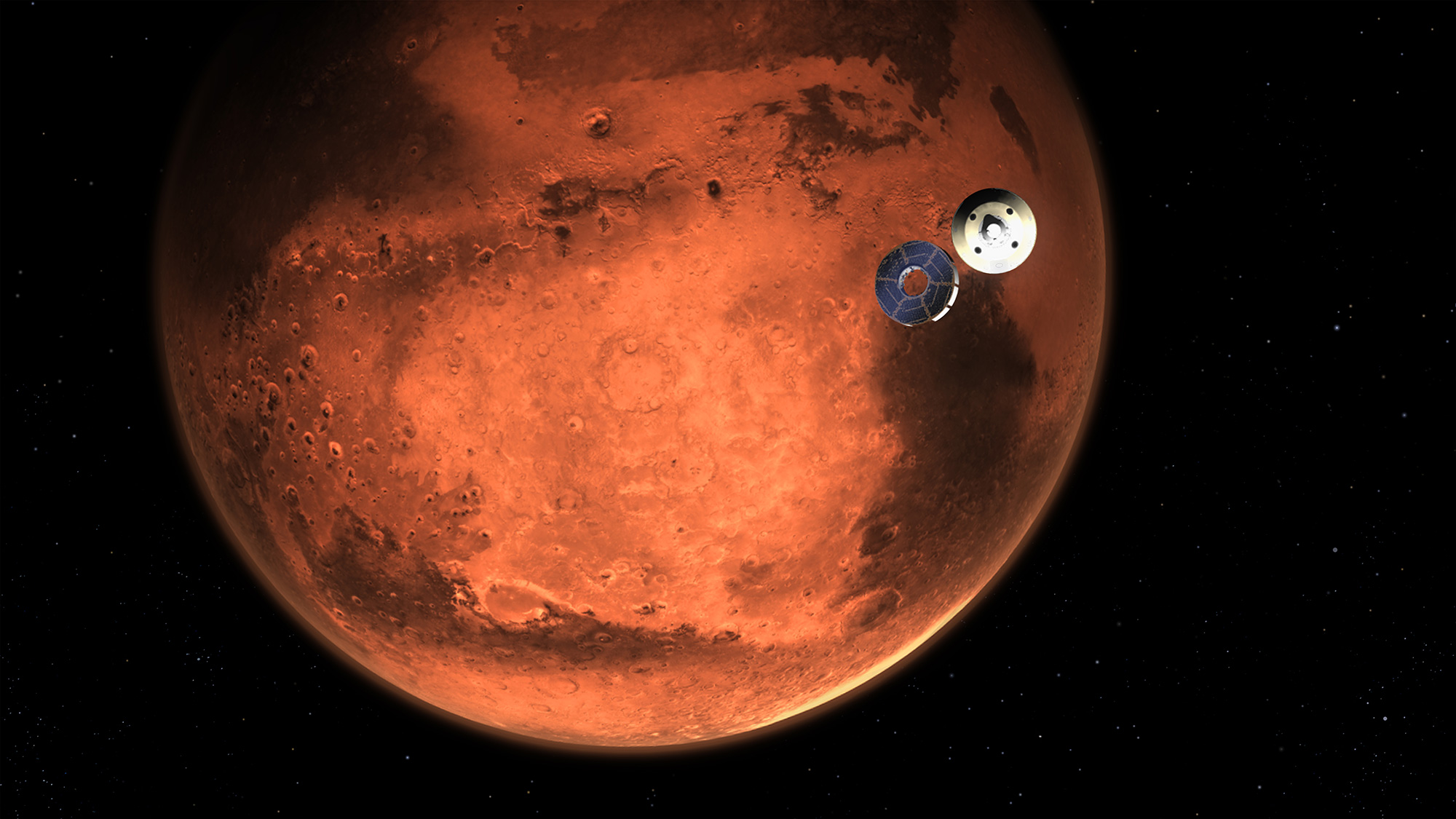
The timing of NASA’s Perseverance mission to the red planet has been uncanny: when it was first conceived, no one could have imagined where the world would be in February 2021 - and will be for a few months to come. Since its rover landed on the Martian surface the other day, Perseverance has given the world something to properly marvel at, a true 'moment' in the expansion of human knowledge. 

We’ve understandably long held fascination for our planetary neighbours, ever since the ancient Egyptians and Chinese first plotted the sky at night. But Mars, that tiny but distinctive red dot amongst the brighter white lights, has been of particular interest, generating its own rich mythology. This was long before scientists theorised that this relative near-neighbour ('just' 253 million miles from Earth, give or take the waning of its solar orbit) might potentially be a cousin, a product of the same event, 3.8 billion years ago, that sent our worlds spinning into orbits they occupy today. 
Picture: NASA/JPL-Caltech

Mars has been an obsession for our kind for centuries. The Sumerians and ancient Greeks were the first to track its movements, then appearing to the naked eye as a little different to the others. But it wasn’t until Galileo Galilei conducted the first telescopic viewing of Mars in 1610 that interest really kicked into gear. Before long, astronomers were noting the planet’s features and by the Victorian era, it had become the subject of fanciful notions of harbouring life - and, possibly, hostile life. Quite what foundation authors like H.G. Wells had for assuming that little green men were looking back this way with nefarious intent is not really known, but as astronomer Carl Sagan wrote: “Mars has become a kind of mythic arena onto which we have projected our Earthly hopes and fears”. The planet’s depiction as the Roman God of War was even interpreted by composer Gustav Holst in the foreboding Mars The Bringer Of War, the opening movement of The Planets suite. 

Theories about Mars as a planetary body have been equally as intoxicating: through the telescope’s optics, fascination has grown exponentially deeper, as its surface revealed topography and geology so tantalisingly similar to the deserts of our own world, its volcanoes (including Olympus Mons, the largest known in the solar system) and ice-covered polar regions. Several years ago, scientists found minerals in Australia that were a likely close match to the geochemistry first explorations of Mars had discovered. Even its seasons draw vague parallels to our own. The idea that we might share geological DNA is mind-bogglingly incredible.

Picture: NASA/JPL-Caltech

Perseverance may not be the first time something from here has landed up there (or down there, or over there, or wherever Mars is, geographically speaking), but in these COVID-impacted times, NASA has brilliantly distracted us with vivid, colourful sight of another world, albeit one without many striking features so far, but at least we haven’t yet seen anyone wearing a face mask, scurrying about at two metres distance from anyone else.

Picture: NASA/JPL-Caltech
There are seven billion people on this world, but to the best of anyone’s knowledge, no one on Mars. As one scientist on Sky News this morning said, the idea that we might find someone up there is a notion now long gone. Not that I really care: we’ve been exposed to preposterous depictions of alien life via science fiction for decades - centuries even (Ezekiel's Wheel, anyone?). That Perserverence is, in drilling into the Jezero crater on Mars, looking for evidence of past microbial life, is no less awe-inspiring. Think about it: something made on Earth is currently on Mars, controlled remotely from Mission Control in Pasadena, digging into another planet to see if, once, organisms may have existed in much the same way as primitive life emerged here. As The Fast Show's 'Brilliant Kid' would say, "Aren't planetary probes amazing?!".

I’m no expert, and wouldn’t pretend to be, but having spent plenty of time exploring the rocky, arid landscape of California’s Mojave Desert, the high-resolution video images of the Martian surface coming from the Perserverence rover’s onboard cameras have only made the $2.7 billion NASA mission more impressive. Yes, there’s plenty money like that could be spent on, here on Earth, but the idea that human endeavour has landed a vehicle on Mars, with technical and aeronautical understanding that I’ll never begin to understand allowing a precision drop in that manic, seven-minute descent through the thin Martian atmosphere, is worth every penny in the pursuit of greater understanding of our own origins.

The Space Race in the 1960s eventually led to us becoming somewhat blasé about things beyond Earth’s atmosphere. Once Armstrong and Aldrin set foot on the Moon, and subsequent Apollo missions appeared, briefly, to be routine, appeared to have been reached. In the 1980s, we grew used to the Space Shuttle missions - even in spite of the Challenger disaster - as the idea of a crewed reusable vehicle popping out to little more than Earth's front drive came across as the limit of endeavour. And then the excitement seemed to fade. Even astronauts squeezing onto to the International Space Station has become something of a mundanity. I would beg to differ: anything we do beyond Earth's gravity is a feat of staggering science, mathematics and engineering, both sending it up and bringing it back down again. I would still place the Apollo 11 mission, and the landing of men on the moon, as one of the greatest things mankind has ever done, along with developing language, inventing the wheel, medicine and air travel. 

Perseverance is not far off any of these. “I feel like we took a big leap of humanity,” Thomas Zurbuchen, Nasa’s associate administrator for science, concluded about the mission. Last night’s video and - crucially - audio, added a fantastic new dimension. “All of us here on Earth [now] know what it’s like to see and hear on Mars and explore other worlds. This is as close as we can get to landing on Mars without putting on a pressure suit.”

In remarkable, clear pictures, we found ourselves looking on an alien world, as vivid as any terrestrial travel documentary. “It really is the surface of an alien world,” one of the Perseverance team said. They were not, of course, the first images of Mars we’d ever seen, but they were certainly the most staggering. Past missions had sent back pictures that, indeed, could so easily have been taken with a Polaroid camera out in the deserts beyond the Los Angeles city limits.

At some point we learned that Mars once featured vast liquid oceans, running water flowing across its geography in much the same way as it does here. The very juice of life. This has made Mars - perhaps more than any other body in the solar system - utterly compelling. And that’s what makes Zurbuchen’s statement so true and not hyperbole at all. 

Hearing Martian wind for the first time, caught by a microphone on the landing vehicle, compounded the marvel. Coupled with the rover’s myriad cameras, relaying back to us the rocky testures and actual colour of the ‘red planet’, we have been given access to the most unique tourist’s Instagram account ever. No wonder everyone at NASA’s Jet Propulsion Laboratory in Pasadena was “overjoyed, giddy” and “like kids in a candy store,” according to one project manager when Perserverence made its textbook landing the other night. They have a right to be. The team at Mission Control, plus thousands more working from home during lockdown, have pulled off another giant leap for mankind.

Thursday, 10 October 2019

All we need is music, sweet music


In a previous job I had the great privilege to arrive at a crossroads in my personal interests when the legendary Bell Labs, now owned by Nokia, staged a unique event that brought me into contact with Beatie Wolfe. Once named by Wired magazine as “one of 22 people changing the world”, Wolfe is the Los Angeles-based, Anglo-American singer-songwriter who, when she’s not composing beguiling acoustic guitar music, has taken a keen interest in science, technology and innovation, a legacy, she reveals in a new documentary about her, stemming from the discovery that her grandfather worked for NASA’s Jet Propulsion Laboratory.

The “JPL”, for the uninitiated, is NASA’s R&D department, responsible for everything from the Mars Rover to deep space exploration. Clearly the curiosity gene has been passed down to Wolfe. Like pop’s original spaceman, the artist who gives this blog its name, David Bowie, Brian Eno or another hero of mine, Peter Gabriel (whose dilettante nature has taken him off into a multitude of directions, also, perhaps, a result of his inventor father), Wolfe’s work has come out of an innate curiosity with the world. As a child she would look at her parents’ records, not just listening to them but examining how they were packaged and presented. Her debut album 8ight was released as a palm-sized ‘3D theatre’, literally a box that opened up and played audio and visual content associated with the songs. 

As if that wasn’t left-field enough, her second album, Montagu Square was released as a piece of clothing. Conceived at 34 Montagu Square - the former home and studio, at various times, of Jimi Hendrix, Ringo Starr, Paul McCartney, John Lennon and Yoko Ono (and where the notorious Two Virgins cover photograph was shot) - the album continued Wolfe’s interest in making music “tangible”, as well as stretching notions of what a recording artist should be about. The album was literally woven into a jacket made for her by the tailor (not weatherman) Michael Fish, who has dressed the likes of Bowie and Jagger. Using NFC wireless technology, songs could be played back on a mobile phone simply by tapping the jacket. The same NFC technology was used to enable the album to be heard via a pack of cards, with each card containing the album’s tracks individually, as well as multimedia content including the lyrics.

Perhaps this apparent eccentricity is what drew me to Wolfe’s work when, in 2017 she released her third album Raw Space from the quietest room on the planet, the Anechoic Chamber at Bell Labs’ sprawling campus in New Providence, New Jersey. It’s a room where literally all ambient sound is sucked out, rendering visitors at risk of nausea and disorientation. Raw Space was something of a reaction to the streaming age and, again, another attempt to find new forms of tangibility, as well as the narratives that the greatest records have presented in the album age, the story arcs of Sgt. Pepper or Dark Side Of The Moon. Working with Bell Labs and designer Theo Watson, Raw Space was released as a true multimedia stream, combining 360-degree video and artificial reality visuals with the music being played, apparently, off a turntable inside the anechoic room in New Providence, streaming it continuously for seven days in a row. There was more to come when Raw Space was beamed out of the so-called Horn Antenna, the giant listening device in Holmdel - close to New Jersey’s Springsteen country - where Bell Labs scientists first discovered confirming cosmic evidence of The Big Bang. The album became the first piece of music to escape Earth’s atmosphere. It is estimated to have travelled more than 12 trillion miles since.

Earlier this week I was at a Q&A session with the DJ Gary Crowley, during which a member of the audience somewhat showed his age by questioning the interest in music consumption of kids in the streaming age, and the playlist mentality that is supposed to have been adopted in place of listening to albums with a beginning, middle and an end; in my last post I reviewed Sheryl Crow’s new album Threads as, possibly, her last, her interest in recording complete albums diminished by the pic’n’mix streaming culture. To Beatie Wolfe, I suspect, this might smack of Ludditism, which is probably why she is the subject of a brilliant new documentary, Orange Juice For The Ears: From Space Beams To Anti-Streams. Director Ross Harris’s fascinating profile follows Wolfe around her adopted Los Angeles, as she looks for new technologies with which to release music. Poignantly, for me, at least, following the death of my own father from Alzheimer’s Disease in August, Harris accompanies her to a care home in the UK where she performs for dementia patients, part of an initiative she co-founded, The Power of Music And Dementia, to demonstrate how music can have a profoundly positive effect on people living with these cruel conditions. It’s a highly moving segment of the film, but a powerful demonstration, as you see the dementia patients responding to Wolfe’s performance, of just how music is capable of moving anyone. Frankly, it’s why I still care about it.

Listened to without the context of her technology interests, Wolfe’s music is acoustic and simple, matching bittersweet indie lyrics with the kind of folkie guitar you might hear in a West Village coffee shop. That, by the way, isn’t a bad thing. Her solo performance of the utterly beguiling Little Moth, after a preview screening of Orange Juice For The Ears at London’s Barbican Centre on Tuesday, was a pin-drop moment of uncomplicated musical beauty. It was also a reminder of how, there can be so much more to music than just notes, chords and lyrics. If you get a chance to see this remarkable film, you’ll experience for yourself just why.

Saturday, 20 July 2019

One giant leap

Picture: NASA

The timing was perfect. Tuesday night’s partial lunar eclipse on the 50th anniversary of the Apollo 11 mission blasting off from the Kennedy Space Centre couldn’t have coincided better. It was as if our closest extra-terrestrial neighbour was doing its best to remind us why humans went to the Moon in the first place, given mankind’s lengthy - some might say unhealthy - obsession with it. There is, perhaps, more than a coincidence that Luna, the Roman goddess of the Moon, shares her name with the modern word “lunacy”. Theories have existed for centuries linking the full moon with everything from psychiatric episodes and suicides, to murders and even traffic accidents, along with other tropes about vampires, werewolves and full moons as the cause of eccentricity.

When, on July 20, 1969, the Lunar Module Eagle landed on the Moon’s surface, four days after Neil Armstrong, Buzz Aldrin and Michael Collins had left the launchpad, strapped to the 363 feet, 2,800-tonne Saturn V rocket, they weren’t about to simply satisfy ancient curiosity about the Earth’s only natural satellite. The astonishing feat of engineering that the Apollo missions represented were, ultimately, about Cold War brinksmanship, a demonstration of virility in the rivalry between the United States and the Soviet Union. It had begun with the Russians launching Sputnik, continued with the Americans sending up Telstar (enabling, amongst many other more important things, football matches to be beamed across the Atlantic), went further with the Russians launching an unmanned lunar lander, and both countries launching manned missions into Earth’s orbit as precursors to the manned missions to the Moon.

Some will suggest that there was a military objective, that putting boots on the Moon was a demonstration that, with the right capability, the successful nation could land anything, anywhere - humans on the Moon, a nuclear warhead on the other’s capital city. Some even surmised, wildly, that the Apollo landings were a precursor to establishing a lunar military base from which to launch pre-emptive strikes on the rival. And, of course, even with Neil Armstrong and Buzz Aldrin actually walking on the Moon a few hours after landing there, conspiracists have continued to chomp at the bit, arguing that it was all a hoax, filmed in a Hollywood studio, either to save money or simply fulfil some CIA plot to fool the Soviets that the United States had successfully beaten them to it.

While some of these theories sit somewhere between science fiction and further lunar lunacy, history shows that US-Soviet rivalry and paranoia was rampant during the decade in which President Kennedy declared “we choose to go to the Moon”.  By September 1962, when he made that famous speech at Houston’s Rice University, the two superpowers were already on a course towards nuclear conflict. Under Kennedy, South-East Asia was becoming the site of a proxy war; in April 1961 he suffered the political and military ignominy of the Bay of Pigs debacle, the attempt to overthrow the Cuban government of Fidel Castro. More global tension was to come a few months later with the discovery of Soviet nuclear missiles being deployed to Cuba.

Political and social change was afoot in Kennedy’s America, too, and with a growing belief that the country was also falling behind the Russians in terms of technical superiority in outer space, the Rice speech delivered more than just rah-rah: “We set sail on this new sea because there is new knowledge to be gained, and new rights to be won, and they must be won and used for the progress of all people,” he thundered. “For space science, like nuclear science and all technology, has no conscience of its own. Whether it will become a force for good or ill depends on man, and only if the United States occupies a position of pre-eminence can we help decide whether this new ocean will be a sea of peace or a new terrifying theatre of war. I do not say that we should or will go unprotected against the hostile misuse of space any more than we go unprotected against the hostile use of land or sea, but I do say that space can be explored and mastered without feeding the fires of war, without repeating the mistakes that man has made in extending his writ around this globe of ours.”

Like the current White House tenant, Kennedy knew full well what what he was doing. In invoking the debate about space presenting an opportunity for mankind, he was lighting the fires of what would become the largest national ego trip in history. “We choose to go to the Moon in this decade and do the other things, not because they are easy, but because they are hard," he intoned. "Because that goal will serve to organise and measure the best of our energies and skills, because that challenge is one that we are willing to accept, one we are unwilling to postpone, and one we intend to win, and the others, too.” A year and two months later, Kennedy was dead. Assassinated in Dallas, so we’re still led to believe, by Lee Harvey Oswald. Or forces unknown controlling him. But the blue touch paper had been lit on what is, still, one of mankind’s most dazzling technical achievements.

It is, today, something of a cliche to compare modern technologies with those that put man on the Moon. Digital computing, in modern parlance, was still in its infancy, but the computers used to get Apollo 11 up to the Moon and back were absolutely state of the art for their day. The comparison with the power of the smartphone in your pocket isn't particularly valid. That said, the Moon landings didn’t add anything technologically or scientifically, according to James Burke, the legendary science presenter and journalist (and one of my broadcasting heroes), who was a part of the BBC’s commentary team on the night Eagle landed on the Moon’s surface.

Picture: NASA
“The rocket was made of stuff that already existed, the computer already existed,” Burke told the BBC this week, pointing out that the Saturn V rocket itself was largely the work of Wernher von Braun, the German ‘father of rocket science’ who’d created the V2 missiles that rained down on Britain towards the end of the war. What made it unique was the 400,000 people at 2,500 companies producing five and a half million components for it: “Each one [of those components] had to be absolutely flawless and perfect and wouldn’t break down.” Burke said. “That kind of management is something that NASA invented and I think has changed the world more than anything else.”

The Saturn V was - and remains to this day - the largest and most powerful rocket ever made. It had enough thrust to send 43 tonnes to the Moon - the equivalent of almost four London buses - delivering a payload comprising the command, service and lunar lander modules, along with the astronauts. Sending it all into orbit, however, was only the start of the challenge, however.

Putting anything on the Moon wasn’t a simple task of pointing a rocket at it: as anyone who has seen the wonderful film Hidden Figures will know, leaving the Earth and returning safely requires highly complex mathematics. This task, then, fell to a group of women NASA had employed as ‘human computers’, one of whom being Katherine Johnson, who was the basis of Hidden Figures. Johnson - who initially had to deal with many of the inequalities and prejudices suffered by black women in America at the time - had worked as a NASA technologist since 1958 (and would retire in 1986 having been involved in every mission up to and including the Space Shuttle). In 1961 she’d calculated the trajectory for the flight that made Alan Shepard the first American in space. When John Glenn went into orbit, aided by early mainframe computers, Johnson was again asked to verify the numbers, a condition the astronaut made before he’d step into the capsule. Her story alone is one of the most remarkable associated with the space race. As any rudimentary knowledge of space travel will inform, the easy bit is getting up there. Coming back down, safely and without burning up in the Earth’s atmosphere is the hard part. The work of Johnson and her team was essential in calculating the angle at which the module containing Armstrong, Aldrin and Collins should make re-entry. There were, however, other hazards that risked the astronauts coming back at all. The trajectory calculations also included complex formulas for fuel burn. As it was, when Armstrong the Eagle landed on the Moon’s Sea Of Tranquility there were just 19 seconds of fuel left. “Now that is what you call nerves of steel. It still makes me get goosebumps,” says James Burke.

Over this weekend of anniversary much will be made of the statement made by Neil Armstrong as he stepped down from the landing module: “That’s one small step for [a] man…one giant leap for mankind.” Few humans in all of history will have uttered a phrase so memorable. No human being before, arguably, had been watched by 650 million people live on television making such a giant step forward for humanity. The superlatives were, however, thoroughly justified. There would, by 1972, be six further Apollo missions to the moon - five of them successful (Apollo 13, the third attempt, infamously aborted). And then nothing. Buzz Aldrin has recently ranted about how, while this weekend's 50th anniversary of the first manned mission to the Moon should be celebrated, it is 47 years since the last mission and, apart from NASA Space Shuttle programmes, the International Space Station and assorted probes to Mars and beyond, what has been done to build on the Apollo programme?

Picture: NASA

NASA has launched the Artemis space exploration programme that will include a manned mission to the Moon in 2024, but not everyone has been excited about it, not least of whom being Donald Trump who, in customary fashion, publicly questioned NASA’s priorities, writing in a tweet: “For all of the money we are spending, NASA should NOT be talking about going to the Moon. We did that 50 years ago”. Seamus Tuohy, the lead of space exploration programmes at the Draper institute of MIT, one of NASA’s partners in the Artemis programme, says: “If we were just going to repeat what we did 50 years ago I would agree. But unlike the geopolitical drivers behind the Apollo missions, the new project comes with big commercial goals, including the beginnings of space tourism.” Tuohy adds that space exploration offers more to humanity than the bragging rights that drove the Apollo missions. “At some point the Earth becomes a finite resource,” he explains. “There are things to be done in space that may not be kind to the Earth – natural-resource extraction, refining, cracking – things that we require to maintain our what we do and what we would like to do in the future.”  Scientists believe that any major missions further into space, particularly any involving humans, will need to use the Moon as a base camp. Ice known to exist at both lunar poles contains hydrogen and oxygen, both of which would be used in fuelling a longer distance mission, to Mars, specifically.

Nor has space travel stagnated. Mankind may not have travelled further than the Moon since the last Apollo mission in 1972, but space travel has grown closer to mankind, with Richard Branson's Virgin Galactic, Jeff Bezos' Blue Origin and Elon Musk's SpaceX commercial ventures taking manned spaceflight beyond a small elite with 'the right stuff'. Travel to the Moon could, too, one day be “no more than a commute”, says Draper's Tuohy, “not the main event, but a routine, safe procedure” for mining it to further technology on Earth. That said, a visit to the Moon, in terms of space exploration, is little more than the equivalent of nipping to the corner shop for a pint of milk: bigger objectives abound, not the least of which being a manned mission to Mars, the next closest full planet and one which has, largely due to its proximity, generated an equal amount of fascination. So, unless new Moon landings become part of the preparations for taking humans further into outer space, the value of a new mission remains questionable.

Picture: NASA
James Burke believes there is little political appetite to return to the Moon. “I don’t have any feelings about going back to the Moon or not. [But] I think going back to the Moon is a waste of money,” he says. Mars, however, might be a different proposition: “Where there is [an appetite], or rather where public opinion doesn’t matter, and where there’s loads of money, is China,” he says. “My bet will be we’ll see a Chinese landing on Mars within the next 10 years.”

Whatever Apollo 11 did or, ultimately, didn't achieve, its technological and engineering achievement should not be underestimated. Indeed, you’d place it up there with the invention of the wheel, the mechanisation that launched the Industrial Revolution and, perhaps, the discovery of flight. Scientists will question what the giant leap for mankind actually achieved in terms of scientific progress. Space travel, then, was still in its infancy, and even though in the intervening decades unmanned probes have reached the very edge of our solar system, providing incredible data about the planets immediately around us, the Apollo missions must still be viewed as high watermarks of  advancement. “Many homes still didn’t have an inside toilet or a bathroom in 1969,” James Burke said this week. “Most families didn’t have a car. Yet here we were going to the Moon. The astronauts, with all their gleaming technology, were like people from a different planet. Watching them was like leaping into the future for a few hours.” To roll out an other hackneyed expression, science fiction had become science fact.

Picture: NASA